When HOA president Victoria Langford tore a judge’s order in half and dropped it into the red mud beside my ranch road, she thought an $11.4 million project had too much momentum to stop. I watched the deputy’s body-camera light blink—and remembered the map coordinate someone had moved 1,312 feet on paper.
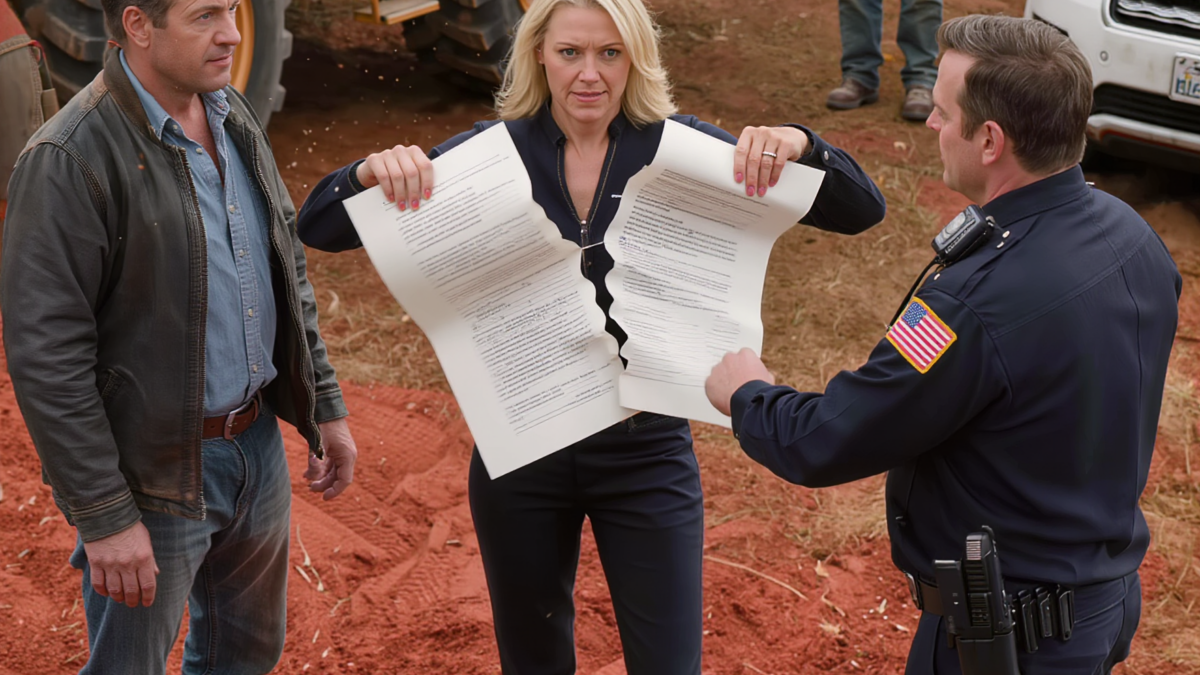
“This order doesn’t stop a thing, Mr. Mercer. That road is going through your ranch whether you like it or not.”
Victoria Langford held the court order between two manicured fingers while Deputy Aaron Mills stood several feet away, watching her read every line.
Behind us, graders and dump trucks had gone silent across my pasture. Their diesel engines ticked as they cooled beneath the late-afternoon heat. Fresh asphalt gave off a sharp, oily smell that caught in the back of my throat.
Dale Patterson, the site foreman, had already shut down his crew.
Nobody was talking.
Victoria finished reading the judge’s signature and looked at me.
“You really think one piece of paper can stop an $11.4 million project?”
Deputy Mills kept his voice even.
“Ma’am, you’ve been served. Construction stops immediately.”
Her smile tightened.
“Silver Creek has county approval. We have engineers, attorneys, investors, contractors, and hundreds of homeowners depending on this road.”
Mills glanced at the order in her hand.
“That doesn’t change what the court just ordered.”
Victoria stared at him for half a second.
Then she folded the paper once.
The rip was surprisingly quiet.
She tore the order straight down the middle.
Every person on that site heard it.
She folded the two pieces again and tore them into smaller squares before dropping them into the reddish mud beside her spotless boots.
“Tell your judge he can call me.”
Nobody moved.
Somewhere behind a grader, a cooling engine clicked three times.
I looked at Victoria.
Then I looked at the tiny red light blinking on Deputy Mills’s body camera.
She had just been recorded reading a court order, acknowledging what it required, destroying her copy, and announcing in front of witnesses that she had no intention of following it.
I could have told her what that meant.
I could have explained that ripping paper did not erase a judge’s signature any more than drawing a line on a map changed a recorded property boundary.
Instead, I stayed quiet.
By then, I had learned something important about Victoria Langford.
Every time she believed she was winning, she created another piece of evidence against herself.
She turned toward Dale.
“Start the machines.”
Dale remained beside the grader.
His orange safety vest barely moved in the hot breeze.
“Ma’am, I need authorization from my office.”
Victoria took one step closer.
“You have authorization from me.”
Dale did not move.
That was when I knew Victoria still had not understood what had changed.
Six days earlier, she had an entire project behind her.
Contractors.
Engineers.
Attorneys.
A major developer.
Hundreds of planned homes waiting for faster highway access.
Millions of dollars already committed.
And a professional set of drawings that reduced my family’s ranch to an empty strip of land between two development sites.
Six days earlier, I had been standing in this same pasture at 5:41 in the morning, staring at a broken cedar fence while heavy equipment moved across land my family had owned for three generations.
Back then, I had no court order.
I had no attorney standing beside me.
I did not even know how far they had already gone.
All I knew was that the water glass beside my bed had started rattling before sunrise.
The vibration woke me before the noise did.
The glass trembled against the nightstand, stopped for a moment, then trembled again.
Beside me, Rachel opened her eyes.
“Storm?”
I listened.
“No.”
A few seconds later came the electronic beep of heavy equipment reversing.
“Storms don’t do that.”
I checked the clock.
5:41 a.m.
By the time I pulled on jeans, boots, and a work jacket, the sound had multiplied—diesel engines, hydraulic whine, metal tracks grinding across hard ground.
I stepped onto the back porch.
The eastern horizon was only beginning to turn gray.
The ranch should have been almost silent.
For as long as I could remember, the loudest sound before sunrise was usually a gate hinge, cattle moving near a trough, or a mockingbird starting earlier than anything had a right to.
That morning, orange work lights moved across my eastern pasture.
I smelled exhaust before I saw the machines.
I climbed into my pickup and drove toward the fence line.
Less than half a mile from the house, I found two excavators, three dump trucks, a grader, and a compactor working across my land.
Sections of cedar fence had been pulled out of the ground.
Posts lay in the grass with fresh soil clinging to the concrete around their bases.
Blue and orange survey paint marked a route across the pasture.
A corridor had already been scraped wide enough to become a major road.
I parked sideways near the equipment and walked toward a man in a reflective vest holding a clipboard.
He looked tired rather than surprised.
“You the property owner?”
“Caleb Mercer.”
I pointed toward the excavators.
“Why are your machines on my ranch?”
He glanced at his clipboard and then toward a temporary project sign near the access lane.
SILVER CREEK COMMUNITY CONNECTOR.
Below the name was the projected cost.
$11.4 million.
The man introduced himself as Dale Patterson.
He told me his company had been given right-of-way authorization, county clearance, and a construction schedule approved weeks earlier.
“Approved by who?”
He flipped through his packet and handed me the top sheet.
Engineering stamps.
Contractor information.
A county permit number.
Then a signature.
Victoria Langford.
President, Silver Creek Estates Homeowners Association.
I read the name twice.
Then I looked beyond Dale at the path his crews had cleared.
It ran directly toward the northeast corner of our ranch, where our oldest irrigation line crossed beneath the pasture.
“This is private land.”
Dale rubbed his jaw.
“I’m building what’s on the plans.”
That was when a white Range Rover appeared beyond the equipment.
It rolled toward us over the temporary gravel base and stopped about twenty feet away.
Victoria stepped out wearing cream slacks, spotless boots, and the calm expression of someone arriving at a meeting she believed had already been decided.
“Mr. Mercer,” she said. “I was wondering when you’d come down.”
I held up the authorization.
“You signed this.”
“Of course I did.”
She looked past me at the machinery.
“The county approved the connector months ago.”
I pointed toward the sections of my fence lying in the grass.
“Where is the recorded easement?”
Her smile stayed in place for about a second.
Then something behind it shifted.
She recovered quickly.
People who spend years running committees and meetings often become very good at recovering quickly.
“The recorded easement is part of the county project file.”
She said it as though the words themselves created the document.
I handed the authorization back to Dale.
“Don’t lose that.”
Then I studied the ground.
The broken fence.
The paint marks.
The scraped earth extending across grass my family had worked for nearly eighty years.
And I realized Victoria had made one assumption that might matter more than all of her lawyers and contractors.
She thought I was only a rancher.
My name is Caleb Mercer.
I was forty-seven that spring.
Mercer Ranch had been in my family since my grandfather bought the first two hundred acres after returning home from the Pacific.
My father expanded it slowly, parcel by parcel, until the property covered a little more than six hundred acres of pasture, cedar breaks, seasonal creek bed, and hard limestone ground.
I grew up repairing gates, clearing drainage channels, checking cattle, setting fence posts, and learning a simple lesson.
Land does not care how important you think you are.
Water still runs downhill.
Property lines remain where the survey says they remain.
And mistakes hidden beneath concrete have a way of returning.
After college, I spent more than twenty years as a civil construction superintendent.
I worked on highways, subdivision roads, bridge approaches, storm drainage systems, and utility corridors.
Some projects were large enough to have their own temporary traffic plans, full-time inspectors, and legal teams.
I knew what compacted base looked like.
I knew how contractors received right-of-way information.
I knew what a legitimate access package usually contained.
And I knew how many people normally signed off before a contractor legally moved a single fence post.
My father had a phrase for construction shortcuts.
“Concrete remembers every shortcut.”
He meant a mistake could disappear beneath asphalt for years.
Then one day something cracked, settled, flooded, or failed, and the shortcut returned to the surface.
I had not thought about that sentence in a long time.
Standing beside Victoria’s Range Rover, I heard it again.
Rachel found me near the barn about twenty minutes later carrying two cups of coffee.
Her hair was pulled back, and worry showed before she said anything.
She had married into the ranch fifteen years earlier, but by then she cared about the property as deeply as I did.
I showed her the damaged fence.
Then I showed her three things Victoria probably did not know existed.
The first was a steel survey monument set near our northeast boundary, driven deep enough that a bulldozer blade could cover it but not change its coordinates.
The second was our irrigation main beneath the pasture, shown on a hand-drawn utility map my father kept in a weathered red binder in the ranch office.
The third was an old limestone culvert beneath a cattle trail.
It mattered because it followed the drainage alignment shown on the earliest property plats.
None of those things looked impressive.
A steel cap in the dirt.
A faded drawing.
A stone opening half hidden by grass.
But construction disputes are often decided by the detail everybody else assumed did not matter.
I looked back toward Victoria.
She stood beside her spotless vehicle speaking confidently on her phone while the equipment idled behind her.
She had engineers, lawyers, permits, contractors, and millions of dollars already moving.
I had two cups of coffee, an old binder, and three pieces of ground that had not moved in generations.
For the first time that morning, I felt calm.
By 8:30, the edge of my pasture looked like an outdoor conference room.
A black SUV arrived.
Then a silver engineering pickup.
Then two men in pressed shirts carrying rolled drawings.
Nobody looked very long at the broken fence.
They looked at Victoria.
She introduced project engineer Paul Benson, development attorney Martin Hail, and a representative from Ridgepoint Communities, the company building hundreds of new homes behind Silver Creek.
That was when the real purpose of the connector became clear.
This was not primarily about making life easier for existing residents.
The road was the missing link between Ridgepoint’s development and a state highway interchange roughly three miles east.
Without the connector, future residents would use a narrower county route with stop signs and a railroad crossing.
With the connector, the development could advertise direct highway access.
Victoria spread a large site map across the hood of her Range Rover.
Thick red lines crossed the drawing.
Parcels were shaded in different colors.
My ranch sat in the center like an inconvenience someone had solved with a marker.
“The corridor has been approved through the county transportation plan,” Victoria said. “Silver Creek worked with Ridgepoint to secure access months ago.”
The map looked professional.
Survey notes.
Engineering seals.
Drainage callouts.
Station numbers.
If somebody had handed it to me on one of my former job sites, I might have assumed the property work was complete.
That was exactly what bothered me.
Good paperwork can make a bad assumption look permanent.
“Show me the recorded instrument.”
Martin Hail gave me a practiced smile.
“Mr. Mercer, all necessary property rights were reviewed before mobilization.”
“That isn’t what I asked.”
His smile weakened.
Victoria stepped in.
“You’re focusing on a technicality.”
I looked toward my broken fence.
“Property ownership is a technicality now?”
She exhaled.
“This project benefits more than six hundred households. It improves emergency access, reduces congestion, and supports regional growth. Sometimes individual property owners have to accept that communities change.”
That was when I understood her position.
She did not see herself as taking something.
She believed the size of the project gave her permission.
Paul unrolled another plan and pointed toward a proposed drainage structure near our seasonal creek.
I recognized the design.
Box culvert.
Headwalls.
Storm line.
The project had been designed in detail as though my consent already existed.
Materials had been ordered.
Crews scheduled.
Asphalt subcontractors booked.
Every piece of equipment sitting idle behind us cost somebody money.
Victoria knew that.
She wanted the weight of that momentum to settle on me.
Hundreds of homes.
Millions of dollars.
Lawyers.
Engineers.
Contractors.
Investors.
She closed her folder.
“Caleb, this road is happening. The sensible thing is to cooperate.”
I looked at the site map again.
Near the northeast corner of our ranch, one property line bent at an angle I had never seen before.
I did not challenge it.
I did not point it out.
I took out my phone and photographed the map.
Victoria watched me.
For the first time, her confidence looked slightly less permanent.
That afternoon, I drove into town with the photograph on my phone and my father’s red binder on the passenger seat.
The county records office smelled like paper, dust, old carpet, and fluorescent lights.
I had spent enough years around permit counters to know the routine.
Be polite.
Ask for certified copies.
Never assume the first document somebody hands you is the only version that exists.
The clerk pulled the recorded plats, transportation exhibits, easement filings, and amendments connected to Silver Creek and Ridgepoint.
For the first hour, everything looked clean.
The stamps were there.
The engineering references matched.
The signatures looked legitimate.
I even found an easement recorded years earlier along the eastern boundary of the ranch.
For about ten minutes, I felt something heavy settle into my chest.
Maybe my father had signed something without ever discussing it with me.
Maybe I had missed a file.
Maybe Victoria was right about one thing.
Maybe the paperwork had existed all along.
I called Rachel.
“Don’t panic yet.”
“You’re telling me not to panic in the voice you use when you’re panicking.”
I looked down at the documents.
“I’m calling Frank.”
Frank Delaney was seventy-one and mostly retired.
He had surveyed Mercer Ranch more times than I could count.
He still carried a field notebook and sharpened pencils by hand.
He also trusted coordinates more than people.
Frank met me at the ranch before sunset with an old tripod, a modern receiver, and a thermos of coffee that smelled burned enough to strip paint.
We started at the steel monument near the northeast corner.
He checked the number stamped into the cap.
Compared it with the original notes.
Then followed the line toward the seasonal creek.
He stopped.
Measured again.
Walked back.
Measured a third time.
Then he looked at the map.
“This doesn’t close.”
I knew what he meant.
A proper legal description should return to its beginning.
This one missed by more than thirteen hundred feet.
We put the certified county documents beside the contractor exhibit.
The recorded easement was real.
But it stopped at the ranch boundary exactly where my father had always said it did.
The exhibit Victoria’s project was using carried the same document number while extending the corridor across our property.
Same reference.
Different geometry.
Frank placed the maps side by side on the hood of my truck.
On the recorded copy, the line ended at the steel monument.
On the contractor version, it bent sharply and continued toward the highway.
One coordinate had been shifted 1,312 feet east.
That single change transformed my private pasture into a transportation corridor on paper.
Then Frank leaned closer.
“Look at this.”
He pointed to the signature block.
The notary date on the replacement exhibit appeared three days before the engineering revision date printed in the lower corner.
“That’s impossible in that sequence,” he said.
I checked the certified recorder’s copy again.
The replacement exhibit was not part of it.
The crews were constructing from a version that did not match the official record.
At that moment, the dispute changed.
This was no longer a question about where an old easement ended.
Somewhere between the public record and the contractor’s plan set, a different exhibit had appeared.
And that exhibit told companies they possessed access rights that the recorded documents did not give them.
I drove back toward the construction corridor after dark.
Portable lights illuminated the machines.
Dust drifted through the beams.
Gravel trucks continued moving across the pasture.
From a distance, everything looked organized.
Professional.
Expensive.
Legitimate.
But now I knew what sat beneath the appearance.
A bad coordinate.
A substituted exhibit.
Dates that did not line up.
Victoria had confidence built on paper.
For the first time, I had paper of my own.
The next morning, I allowed the work to continue.
Rachel thought I had lost my mind until I explained why.
Parking my truck across the access lane would create exactly the image Victoria needed—an angry property owner physically obstructing a large public-facing project.
I had spent too long around construction claims to hand her that argument.
Instead, we built a record.
Rachel unfolded a table inside the ranch office.
By noon it was covered with maps, certified copies, photographs, delivery tickets, and handwritten notes.
Every truck entering our land received a timestamp.
Every newly disturbed area was photographed from consistent positions.
Frank returned with survey equipment and marked the original boundary with bright flags.
He prepared a signed field report.
I hired a licensed drone operator to photograph the corridor from above.
The images showed where construction crossed the recorded easement line and exactly how far it extended across private property.
Victoria emailed me three times.
Her first message called the project fully authorized.
The second told me not to interfere with contractors.
The third warned that delays caused by my objections could expose me to financial liability.
I printed every message.
Then I called Nathan Cole.
Nathan was an Austin property attorney who had spent three decades handling access disputes, condemnation cases, and development conflicts.
He arrived wearing dusty boots and carrying a legal pad.
That immediately made me like him.
He spent almost two hours comparing the certified county documents with the contractor exhibit.
He rarely spoke.
Every few minutes, he circled something in blue ink.
Finally, he leaned back.
“Do not block them.”
Rachel stared at him.
Nathan continued.
“Do not touch their equipment. Do not move a single marker they installed.”
He tapped the documents.
“Every foot they build after receiving formal notice creates another documented decision. Let the records do the work.”
Formal notice went out by certified mail, electronic delivery, and process service to Silver Creek Estates, Ridgepoint Communities, the general contractor, and the project engineer.
The notice identified the recorded boundary, the missing access rights, the conflicting exhibit, and the coordinates Frank had verified.
After that, nobody could say they did not know a dispute existed.
The next two days felt like a countdown.
More gravel arrived.
Concrete forms appeared near the drainage crossing.
Crews compacted base across ground they had now been formally told was disputed.
I stayed fifty yards away with coffee in one hand and my phone in the other.
Construction creates its own paper trail.
Purchase orders.
Daily reports.
Supervisor logs.
Fuel tickets.
Crew assignments.
Change orders.
Machines leave tracks in dirt.
Companies leave tracks in files.
By Friday afternoon, Nathan had enough.
He filed an emergency petition for an immediate injunction.
Attached were the certified plat, Frank’s survey report, aerial photographs, Victoria’s emails, and timestamped photographs showing continuing work.
The hearing was scheduled for Monday morning.
Victoria learned about it before sunset.
For the first time, she called instead of emailing.
Her voice was colder.
“You’re making a very expensive mistake, Caleb.”
I looked through the office window at the new road stretching farther across the pasture.
“No,” I said. “I’m measuring yours.”
Monday morning smelled like rain, courthouse stone, and burnt coffee.
Rachel stood beside me outside the county building while Nathan carried the certified plat, Frank’s report, aerial photographs, emails, and competing exhibits into the hearing.
Victoria arrived with Martin Hail and two representatives connected to the road project.
She looked irritated.
Not worried.
That changed when the judge asked one question.
“Can anyone show me a recorded instrument granting access across the Mercer property?”
Papers moved around the table.
Martin asked for additional time.
Nathan placed the certified county record in front of the judge and pointed to the boundary where the easement ended.
Less than an hour later, the judge signed a temporary injunction ordering all construction on my land stopped immediately.
That afternoon, Deputy Aaron Mills accompanied the process server to the ranch.
Nathan and I followed separately.
When we arrived, graders and dump trucks were still working.
Dale saw the deputy.
He raised one hand.
Engines shut down one at a time.
The pasture slowly became quiet until only wind and the ticking metal of cooling equipment remained.
Victoria arrived twelve minutes later.
She walked straight toward us with her phone in one hand.
Deputy Mills gave her the order.
She read it.
Then she looked at me.
“You really think one piece of paper can stop an $11.4 million project?”
“Ma’am,” Mills said, “you’ve been served. Construction stops immediately.”
Victoria’s smile tightened.
She talked about county approval.
Engineers.
Investors.
Homeowners.
Mills repeated that the court order controlled what happened next.
Victoria folded the paper.
Tore it.
Dropped the pieces in the mud.
“Tell your judge he can call me.”
I looked at Mills’s body camera.
The red indicator light continued blinking.
Victoria turned to Dale.
“Start the machines.”
He hesitated.
“Ma’am, I need authorization from my office.”
“You have authorization from me.”
He remained still.
Victoria walked away and made a call.
About ten minutes later, Dale’s phone rang.
He listened for nearly a minute.
His expression changed.
Then he climbed into the grader and moved it forward slowly.
Another crew resumed work near the drainage crossing.
Nathan immediately started taking photographs.
Mills documented the time.
The grader passed Frank’s bright boundary flags and pushed loose base across the steel survey monument until the cap disappeared beneath gravel.
Then Rachel called me from the barn.
“Caleb, we’ve lost pressure on the east field.”
I turned toward the trenching crew.
The irrigation line had been damaged.
Water hissed beneath the disturbed soil.
Nathan looked from the wet ground to the machinery.
There was no satisfaction on his face.
Only focus.
Victoria had been given a clean opportunity to stop.
She could have preserved every legal argument she believed she had and waited for the court to review the records.
Instead, she had acknowledged the order, torn her copy in front of witnesses, ordered the work restarted, and created an entirely new record in less than twenty minutes.
Six days earlier, she had seemed untouchable.
Now every decision she made was being documented by somebody who did not work for her.
By Tuesday morning, the road itself was quiet.
The paperwork was moving faster than the machinery ever had.
Nathan filed an emergency compliance motion before breakfast.
He attached Deputy Mills’s body-camera footage, photographs of the torn order, Frank’s boundary markers, and timestamped images showing construction continuing after service.
The hearing was set for Wednesday.
This time, the courtroom felt different before anyone spoke.
Victoria arrived with Martin.
Ridgepoint also sent an attorney.
But their attorney sat two seats away from Victoria instead of beside her.
I noticed the distance immediately.
Companies built on contracts understand physical distance when liability begins becoming expensive.
Nathan started with the body-camera recording.
Nobody needed to interpret it.
The judge watched Victoria receive the order.
Read it.
Tear it.
Drop it.
Tell Dale to restart the machines.
The room stayed quiet through the recording.
Then Frank testified.
He put the certified plat beside the contractor exhibit and walked through the coordinates.
The recorded easement stopped at our northeast boundary.
The construction version extended 1,312 feet across my land.
He showed the location of the steel monument.
The original drainage alignment.
The old limestone culvert that matched the historic survey record.
Then Dale testified.
I almost felt sorry for him.
He explained that his crew had received the plans through the normal project-management chain.
Then he confirmed that Victoria personally instructed him to continue after the court order had been served.
Nathan introduced the daily work reports.
3:22 p.m.: grader operating beyond marked boundary.
3:46 p.m.: trenching resumed near Mercer irrigation line.
4:11 p.m.: reported pressure loss.
Small entries.
Plain language.
Placed in sequence, they said everything.
Then Ridgepoint’s attorney asked to address the court.
He stated that Ridgepoint had relied on representations from Silver Creek and had never authorized work in violation of a court order.
That was the first visible wall to fall.
By lunchtime, Ridgepoint suspended its agreement with the homeowners association pending investigation.
The general contractor issued its own written stop-work notice.
Later that afternoon, Nathan received a request from the association’s insurer for every document connected to the road.
Then two Silver Creek board members contacted him separately.
Both said they had never seen the altered exhibit before approving project funds.
Victoria’s paper structure began separating one sheet at a time.
The next morning, the county engineering office froze further permit activity connected to the disputed corridor until the records could be reconciled.
Martin Hail withdrew from representing Victoria personally, citing a conflict between her interests and the association’s.
By Friday, she was no longer speaking for a united board.
She was answering questions from one.
I stood in the ranch office while Nathan spread the files across our table.
Body-camera transcript.
Contractor logs.
Certified plat.
Insurance correspondence.
Board emails.
The two competing maps.
Rachel placed my father’s worn red binder beside them.
Its faded cardboard looked almost ridiculous among the polished legal documents.
But inside was the utility drawing showing exactly where our irrigation line had existed before the trenching crew reached it.
Another old detail that had refused to disappear.
Nathan leaned back.
“They built this case for us one decision at a time.”
Through the office window, I could see silent equipment sitting along the unfinished corridor.
Victoria had begun with engineers, lawyers, a developer, contractors, and an HOA board behind her.
Now Ridgepoint had stepped away.
The contractor had stopped.
The insurer was asking questions.
The county had frozen permit activity.
Her own board wanted explanations.
Victoria had believed power meant having the largest number of people standing beside you.
What she had missed was how quickly borrowed authority disappears when those people finally read the same documents.
Three weeks later, heavy equipment returned to Mercer Ranch.
This time the machines were pointed the other direction.
I heard the first excavator before sunrise and carried my coffee onto the porch.
The noise was almost identical to the sound that had woken me weeks earlier.
But it did not feel the same.
There was no surprise.
No helplessness.
The contractor had returned under a court-approved restoration plan.
The unauthorized pavement would be removed.
The damaged drainage repaired.
The irrigation line replaced.
The cedar fence rebuilt along the recorded boundary.
Rachel came outside and stood beside me.
The excavator lifted the first section of asphalt from the ground in a heavy black slab.
Under it sat the pale limestone base I had watched crews spread across our land.
And beneath that was the same soil my family had worked for generations.
The final hearing had taken place two days earlier.
By then, the Silver Creek board had removed Victoria as president pending its internal review.
Ridgepoint had terminated the access agreement.
The insurer agreed to fund restoration and a negotiated settlement covering damage to the irrigation system, survey expenses, legal fees, and loss of ranch use.
The county corrected its project file and rejected the substituted exhibit.
Nobody in the courtroom described the outcome dramatically.
That was what struck me about real consequences.
They often arrive quietly.
Signatures.
Revised filings.
Invoices.
People changing seats.
Victoria sat at the far end of the table without the board gathered around her, without Ridgepoint beside her, and without Martin representing her personally.
When the judge confirmed the permanent injunction, she looked down at the polished wood.
I expected to feel victorious.
Mostly, I felt tired.
Then the judge said something I remembered.
“A project doesn’t acquire property rights simply because it becomes expensive.”
Back at the ranch, Frank supervised the survey crew while they exposed the northeast monument.
One worker brushed away loose gravel and called me over.
The steel cap appeared beneath the compacted base.
Scratched.
Dirty.
Exactly where it had always been.
I crouched and wiped it with my glove.
The stamped number was still readable.
A 1,312-foot alteration.
Engineering drawings.
Meetings.
Lawyers.
Confident assurances.
Millions of dollars.
None of them had moved that piece of steel an inch.
Farther downhill, another crew uncovered the old limestone culvert.
It had survived too.
Rachel laughed when she saw it.
It was the first easy laugh I had heard from her since the morning the machines arrived.
By late afternoon, new cedar posts followed the original fence line.
The repaired irrigation system returned to pressure.
Water moved through the field valves the way it had before.
I found my father’s red binder on the passenger seat of my truck.
I ran my thumb along one worn corner.
Concrete remembers every shortcut.
He had been right.
So does dirt.
So do surveys.
So do emails.
So do cameras.
Before sunset, I walked to the edge of the restored pasture.
The temporary Silver Creek project sign was gone.
The remaining road ended where the recorded easement ended.
At the boundary where it should have stopped from the beginning.
Victoria had believed money created permanence.
She had believed momentum created authority.
She had believed tearing a piece of paper could somehow diminish what the paper meant.
But asphalt can be removed.
Fences can be rebuilt.
Even an $11.4 million mistake can be dug back out of the ground.
Records are harder to erase.
Justice did not arrive with shouting.
It arrived one document at a time.
And it waited patiently until Victoria tore up the wrong piece of paper.