Wade Parker laughed at the thirty-two hogs tearing through our Georgia pecan orchard and told my father, “You’re letting your little girl ruin your life’s work.” I held my yellow field pad against my chest and said, “Give it until spring.” He never asked what six weeks of numbers already showed.
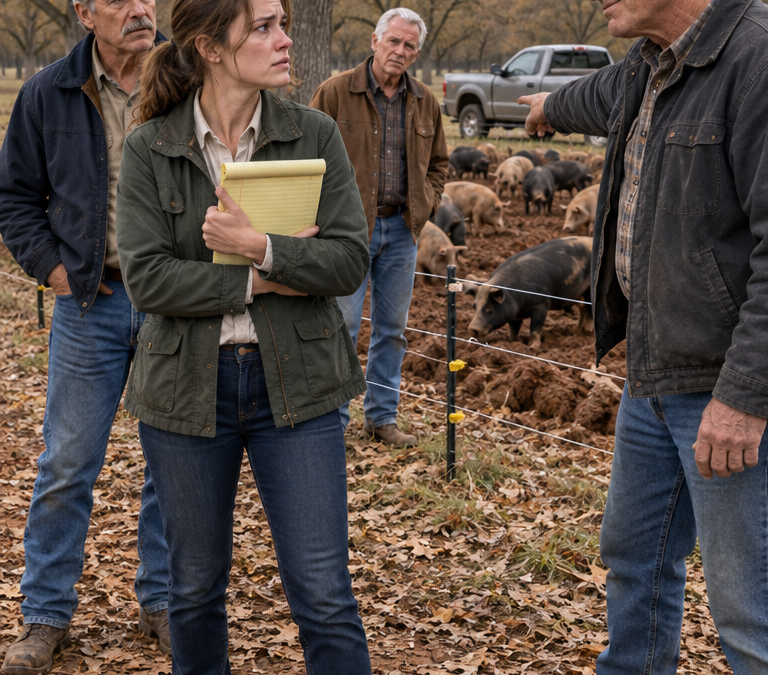
Thirty-two hogs were tearing through a pecan orchard on a cold November morning when Wade Parker pulled his truck onto the shoulder of the county road.
He killed the engine, stepped out, and stared through the fence.
The ground beneath the oldest trees looked as though someone had taken a machine to it. Fallen leaves had been pushed into dark piles. Red Georgia clay showed through long furrows where broad snouts had turned the surface. Temporary electric fencing divided the southern block into sections that looked improvised to anyone who did not know why they were there.
Wade knew farms.
At least that was how people in the county saw him.
He had sold seed, fencing, fertilizer, tools, replacement parts, and nearly everything else working farmers needed for more than twenty years. He knew which families were carrying debt, which growers had expanded too quickly, and which operations could survive one bad season but not two. He had seen expensive ideas arrive with impressive language and disappear when the soil refused to cooperate.
So when he saw the hogs beneath the pecan trees, he decided he understood exactly what was happening.
Thomas Bennett stood near the South Ridge gate with his daughter, Clare.
Wade pointed toward the torn-up ground.
“You’re letting your little girl run your life’s work into the ground.”
The remark carried easily across the fence line.
Someone nearby laughed.
Clare said nothing at first. She shifted the yellow legal pad under her arm and looked toward the hogs.
Wade shook his head.
“Pigs don’t fix orchards. Bulldozers do.”
Clare finally looked at him.
“Give it until spring.”
That earned another laugh.
Wade drove away convinced that he had just watched a young woman make the sort of mistake people remembered for years.
What he had not asked about was the yellow pad.
Its pages contained six weeks of soil-moisture readings, rooting-depth measurements, pest counts, tree-condition notes, irrigation checks, and rotation records.
Clare had been writing down everything.
That habit had started long before the hogs arrived.
Bennett Orchard had belonged to Clare’s family for two generations. Her grandfather planted the first pecan rows on red clay that neighboring growers had once considered too stubborn to be worth much effort.
He did not transform the land overnight.
He learned it.
He watched where water collected after heavy rain. He noticed which trees reacted poorly to certain treatments. He wrote observations in notebooks and adjusted his decisions season by season.
Thomas inherited both the orchard and that habit.
Over nearly four decades, he added acreage, improved irrigation, replaced equipment, and built the property into more than three hundred acres of mature pecan canopy.
By the time Clare was old enough to remember harvest clearly, the Bennett name carried weight in the county.
Autumn was usually the season when that reputation looked most visible.
The rows would turn gold. Branches bent under mature crops. Trucks came and went from the property. Crews moved steadily through blocks that had been producing for years.
It was easy to look at a successful orchard and believe success was permanent.
Clare learned otherwise.
She left home for college and studied agronomy and soil science. After graduation, she spent several years consulting for an agricultural firm that sent her across the Southeast.
The work changed the way she looked at land.
She saw fields that appeared healthy from the highway while yields declined quietly. She saw growers blame age, weather, or bad luck when the actual problem was accumulating beneath the surface. She learned that visible symptoms often arrived long after the conditions causing them.
By the time she returned to Georgia, she had stopped asking only what a field looked like.
She wanted to know what it had been doing for years.
That was why South Ridge bothered her.
The block covered roughly five acres near the southern edge of the Bennett property. Seventeen mature pecan trees grew there, several of them among the oldest on the farm.
They had once been dependable producers.
Three years before Clare came home, their output began slipping.
The decline was not dramatic enough to force immediate action.
That was part of the problem.
One year looked a little worse than the last. The trees still produced. Other blocks continued performing well enough that South Ridge became a concern rather than an emergency.
Thomas attributed most of it to age.
The explanation made sense.
Old trees changed. Some became less productive. Every grower knew that.
Clare still wanted data.
During her first two weeks back, she walked the orchard with a collection kit. She took soil cores, pulled leaf samples, checked moisture, examined the ground beneath the canopy, and compared South Ridge with healthier blocks elsewhere on the property.
What she found did not look like exhausted soil.
The problem was lying on top of it.
Years of fallen pecans, damaged fruit, shells, husks, leaves, and other organic material had accumulated beneath the trees. Some of it had decomposed into thick mats.
Mixed inside were insect casings, fungal growth, and the remains of repeated pest cycles.
The same ground layer that looked harmless from above was providing shelter through winter.
Each spring, when the trees began another growth cycle, the same pressure returned with them.
Clare brought samples into the farmhouse kitchen one evening and lined them across the table.
Thomas sat opposite her.
He opened the bags, read her notes, and studied the moisture charts.
“What are you thinking?” he asked.
Clare explained that she did not believe the trees were simply failing from age.
She believed the system beneath them had been allowing the same pests to rebuild year after year.
Thomas listened.
Then she told him her proposed solution.
“Hogs.”
He looked up.
Clare explained before he could answer.
Not a permanent herd. Not animals roaming loose across the orchard. She wanted to divide South Ridge into temporary paddocks using electric fencing and move a small group through the block under controlled conditions.
Pigs rooted naturally.
They searched aggressively through surface material for food. In the process, they could break apart the decomposing layer without requiring deep mechanical tillage.
They would consume damaged pecans and exposed larvae. Their movement could disrupt protected overwintering habitat.
Thomas’s concern came immediately.
“The roots.”
“I know.”
One reason pecan orchards could be vulnerable to that kind of experiment was the lateral root system beneath mature trees.
Unmanaged rooting at the wrong time, especially when soil was wet, could expose or damage roots quickly.
Thomas had spent decades protecting those trees.
He was not going to sacrifice them for an interesting theory.
Clare did not ask him to.
She had already written limits into the plan.
Every paddock would have a strict rotation window.
She would take moisture readings before moving animals.
Soil above the safe threshold would be closed.
She would inspect for root exposure every day.
Any visible root damage would trigger an immediate stop.
Irrigation lines would be mapped and checked.
The herd would remain small.
Five acres.
Thirty-two hogs.
One season.
Thomas studied the written protocol.
“You call it if it goes wrong,” he said. “I don’t want to be the one telling you when enough is enough.”
Clare nodded.
“If the roots are at risk, I stop it.”
He agreed.
The following week, South Ridge became one of the strangest-looking blocks in the county.
The location made privacy impossible.
The county road ran close enough to the southern property line that drivers could see directly into the experimental paddocks.
Clare had designed the layout around drainage, wind, root spread, water access, and rotation efficiency.
She had not designed it around public opinion.
Within days, people began slowing down.
A few pulled over.
The hogs worked through leaves and old fruit with impressive determination. Their snouts cut grooves into the ground. Areas that had looked undisturbed for years became rough within hours.
From the road, nothing about the scene looked controlled.
The fencing appeared temporary because it was.
The ground appeared damaged because the surface was being intentionally disturbed.
The animals looked out of place because almost nobody in the county had seen livestock managed beneath mature pecan trees that way.
Wade Parker gave the sight a story people could repeat.
Thomas Bennett’s daughter had returned from college and was letting hogs destroy a productive orchard.
The phrase changed slightly depending on who told it, but the point stayed the same.
Education had made Clare arrogant.
Tradition was being ignored.
A young woman with a degree had decided she knew more than farmers who had spent their lives on the land.
The story worked because the visual evidence seemed to support it.
Then someone recorded a video from the road.
It lasted less than a minute.
The camera captured hogs rooting, disturbed soil, fencing, and old pecan trees standing above the mess.
It did not capture a moisture reading.
It did not show the control block.
It did not show Clare checking root exposure.
It did not show the spreadsheet on her laptop.
None of that mattered online.
The clip reached a local farming group and spread.
By the end of the week, strangers were making jokes about Bennett Orchard.
Wade repeated his opinion at the feed store, during extension meetings, and over breakfast at the diner where older growers met on Thursday mornings.
Thomas tried not to react.
Clare could tell he heard everything.
One evening he found her near the South Ridge entrance.
The sun had dropped low enough to put the western rows in shadow. Clare’s pickup was parked near the gate with mud drying along the wheel wells.
Thomas stood beside her for a while before speaking.
“People are asking me whether you know what you’re doing.”
Clare looked at him.
He did not tell her to stop.
He did not need to.
The pressure was already there.
She opened her laptop on the truck’s tailgate.
“Look.”
She showed him the daily soil-moisture readings first.
Then the rooting-depth measurements taken every three days.
Then the pest counts from treated sections compared with the untouched control area.
She showed him her root-inspection records.
Clean.
The irrigation checks.
Clean.
The hog weights.
Normal.
The cost comparison against manual removal of the same accumulated ground material.
Thomas leaned closer to the screen.
Clare moved through the records one page at a time.
Finally she closed the file.
“I need until spring.”
Thomas remained quiet.
Then he nodded.
“I trust the logs more than the laughter.”
He returned to the house.
Clare stayed at the fence until the light disappeared.
The hog rotation continued through late November.
When the natural window ended, Clare removed the animals and took down the temporary fencing.
South Ridge looked terrible.
The leaf mat was gone.
The surface was broken and uneven.
Areas where the animals had concentrated their rooting looked almost like unfinished construction.
People who drove past during those final days did not need to say much.
Some slowed long enough to look.
Clare could imagine the conclusion.
See?
We told you.
She completed the final seasonal records anyway.
Then winter closed over the orchard.
For three months, almost nothing happened.
The hogs went to market.
South Ridge sat beneath a gray sky.
The trees dropped fully dormant.
Rain settled the disturbed soil.
Cold weather hardened the surface.
Clare continued checking the block, but winter gave her no dramatic answer.
That uncertainty became harder than the public criticism.
If the experiment failed, Wade would not be wrong simply because he had been rude.
Her education would not protect the trees.
Her charts would not restore damaged production.
The orchard would answer in its own time.
The first sign came in early March.
Clare nearly walked past it.
She had been checking soil temperatures at six established points across South Ridge and comparing them with control trees.
The pecans were beginning to come out of winter.
At first, nothing looked unusual.
Then Clare noticed bud development on one South Ridge tree was farther along than expected.
She checked the next.
Then the next.
She opened her previous measurements.
The pattern repeated.
The seventeen treated trees were moving earlier than the control group.
Not by hours.
By days.
Nearly a week.
Clare refused to celebrate.
She remeasured.
Then she repeated the measurements the following morning.
And again the next day.
The numbers held.
By mid-March, the difference could be seen without instruments.
South Ridge had leafed out ahead of schedule.
The new growth came in dense and even, not scattered and tentative the way stressed trees often emerged.
The color was deeper than Thomas remembered seeing from that block in years.
When flowering began, Clare photographed every major branch.
Catkins appeared longer and more uniform.
Pistillate flowers developed in concentrations that looked unlike the previous three seasons.
Thomas came outside one afternoon without being asked.
He walked South Ridge slowly.
His hands stayed in the pockets of his jacket as he moved from tree to tree.
Near the center of the block, he stopped under one of the trees he had privately stopped expecting much from.
He reached up and pulled a low branch closer.
Young nut formations clustered along it.
Thomas held the branch for several seconds.
Then he looked toward Clare.
“What did you put in this ground?”
She almost smiled.
“Nothing that isn’t already in the logs.”
Two weeks later, the pest results confirmed what the trees were showing them.
Overwintering insect pressure in South Ridge was measurably lower than in comparable blocks.
The ugly surface Wade had mocked was no longer merely something Clare hoped would help.
It had played a measurable role.
The hogs had physically disrupted the layer where pests had been sheltering through winter.
The old trees had not been losing simply because they were old.
They had been beginning each spring under recurring pressure created by conditions that accumulated beneath them.
The entire meaning of the November photographs changed.
What had looked like destruction had been controlled disruption.
What had looked irresponsible had been monitored carefully enough to stop before roots were harmed.
What had looked like a young woman ignoring experience had actually depended on her respecting the farm enough to measure what the land was telling her.
Spring became summer.
Other farms in the region dealt with the usual mix of insect and fungal pressure.
South Ridge held.
Its canopy stayed full.
Fruit set remained strong through thinning.
Clare tracked production all summer and watched the treated block slowly separate from its own historical trend.
Thomas avoided making predictions.
He had lived through too many seasons to count a crop before it was harvested.
But in late July he walked into South Ridge and stood beneath branches heavy enough to bow.
He looked for a long time.
That evening he found Clare inside.
“Next fall,” he said, “I want twenty acres.”
She looked up from her work.
“Twenty?”
“If the harvest confirms what we’re seeing.”
It did.
South Ridge finished well above its own three-year average.
Thomas entered the production totals into a spreadsheet himself.
He checked the formulas.
Then he checked them again.
The cost per pound had fallen.
Part of the improvement came from fewer spray applications.
The hogs also created a secondary return when they went to market.
Measured from beginning to end, the experimental rotation cost less per acre than the standard cleanup practices the farm had been using.
The story in the county changed.
Not all at once.
Farmers rarely abandoned skepticism because of a single season, and Clare did not want them to.
But people began asking questions instead of making jokes.
How wet had the soil been?
How long were the animals left in each section?
What happened around young trees?
What happened if rooting went too deep?
Clare answered carefully.
She had never believed the lesson was simply to add hogs.
The following fall, Bennett Orchard expanded the program to twenty acres.
The year after that, sixty-five acres of older established blocks entered carefully planned rotations.
With each expansion, Clare changed the protocol.
She evaluated drainage.
She mapped root density.
She considered canopy age, tree establishment, pest load, soil condition, and seasonal moisture before deciding whether a block was suitable.
Some parts of Bennett Orchard never received hogs at all.
The method did not fit them.
That fact mattered to Clare as much as the successful acreage.
Two years after the first strong South Ridge harvest, she received an invitation to speak at a regional agricultural conference.
By then she had multiple seasons of usable data.
Nearly three hundred people attended.
Clare recognized extension agents, neighboring growers, orchard managers, suppliers, and several people who had once shared the roadside video.
Wade Parker sat near the back.
Thomas did too.
Clare did not begin with photographs of beautiful trees.
She began with mistakes.
A flooded paddock.
A loose irrigation coupling.
Two hogs that pushed through a weak fencing point.
A rotation that ran too close to unsafe moisture.
She placed the failure log on the screen and walked through each entry.
The room listened.
Those mistakes were not embarrassing footnotes.
They were the reason later rotations worked.
Clare showed the audience how each problem forced a change in the protocol.
Then she showed five acres.
Twenty acres.
Sixty-five acres.
Pest-pressure comparisons.
Yield changes.
Cost differences.
Hog returns.
Reduced treatment requirements where conditions supported the system.
When the final slide disappeared, people stood.
The applause surprised her.
Thomas remained near the back.
He was not the loudest person in the room.
Clare found him anyway.
The look on his face was more complicated than pride.
Years earlier, he had allowed his daughter to try something that could have harmed trees his own father planted.
He had accepted the risk because she had done the work.
Now he was watching a room full of professionals recognize what careful observation had built.
Clare thought the hard part was over.
The calls began the following week.
Neighboring growers asked her to inspect blocks.
Extension agents requested copies of the rotation protocol.
Orchard managers from other counties wanted to know whether South Ridge could be repeated.
Clare answered those calls by asking questions.
How old were the trees?
How did the soil drain?
What happened after a wet fall?
Where were the irrigation lines?
What was the root density?
How much pest pressure existed in the ground layer?
Several conversations ended with Clare recommending that the caller not use hogs at all.
Those were easy calls.
Then Gordon Hale contacted her.
Hale owned one of the larger pecan operations in the region—roughly nine hundred acres spread across two neighboring properties about thirty miles northwest of Bennett Orchard.
He had attended Clare’s conference presentation.
On Monday morning, he called.
“I’m ready to move forward.”
Clare asked what his site assessment showed.
There was a pause.
“I haven’t done one yet.”
“Then don’t move forward yet.”
“I already ordered the hogs.”
Clare sat straighter.
“How many?”
“Just under a hundred.”
“For what acreage?”
“Eighty to start.”
Clare closed her eyes for a second.
“Gordon, wait. We need to walk the property first.”
He told her he understood.
She explained that soil conditions would determine paddock size and rotation intervals. She warned him that wet red clay could make unmanaged rooting dangerous quickly.
He thanked her.
Then he never called back.
Six weeks later, people were talking about his orchard.
Hale had released nearly one hundred animals into a large block without the paddock system Clare used.
He had not established moisture thresholds.
He had not followed controlled rotation intervals.
He had started during a wet fall.
The animals worked through saturated clay.
Root exposure appeared.
Several younger trees began showing visible stress.
By December, Hale was telling people he had followed Clare’s method exactly.
The accusation spread fast.
This was different from Wade Parker’s laughter.
Wade had believed Clare was wrong.
Gordon Hale claimed she had been right enough to create a method but careless enough to spread something other people could not use safely.
Being mocked required patience.
Being blamed required something else.
Clare reviewed her notes from their phone call.
She knew what she had told him.
But she also understood why the story had power.
People remembered the pigs.
They remembered before-and-after photographs.
They remembered South Ridge.
They did not remember moisture thresholds.
They did not remember failed paddocks.
They did not remember the hours of measurements that determined when not to use the animals.
That was when a large agricultural-input company contacted her.
The representatives had identified what they called the Bennett method as a product opportunity.
Their proposal looked polished.
Branded fencing infrastructure.
Preferred livestock suppliers.
Standardized feed recommendations.
Implementation manuals.
Consulting packages.
Clare’s name attached to the system.
The money offered was larger than any single figure anyone had ever placed in front of her.
She read the contract once.
Then again.
On the third pass, she stopped reading the compensation pages and began marking questions.
During the next meeting she started with moisture.
“What happens at sites outside the safe range?”
The representative said the implementation guide would cover most scenarios.
“What about younger trees?”
Limitations would be noted.
“What if a client follows the standard guide and experiences root damage because the conditions on that specific site aren’t captured by the guide?”
The representative smiled.
“We’ll build appropriate language into the program.”
“That isn’t what I asked.”
The smile stayed.
The answer did not improve.
Clare finally understood what the company wanted.
Not the knowledge.
The image.
Hogs beneath pecan trees.
A ruined-looking block transformed into productive acreage.
An unconventional young agronomist proved right.
It was simple enough to advertise.
The actual method was not simple.
The actual method was a series of judgments.
The company wanted the photograph.
Clare wanted the conditions surrounding the photograph.
She left the contract on her desk.
Outside, harvest was entering its final weeks.
South Ridge looked nothing like the block Wade Parker had mocked years earlier.
The canopy was healthy.
The trees were productive.
The orchard floor was managed cleanly.
Clare walked to the base of one of the oldest trees and checked the moisture gauge.
The reading was high.
She checked another.
Then another.
That fall had been wetter than the previous two.
Water remained in the soil longer.
The oldest portions of South Ridge also carried dense root systems that Clare was no longer willing to risk.
Thomas found her there before dinner.
“What are you thinking about the rotation?”
Clare stared toward the rows.
The timing could not have been worse.
If she ran hogs through South Ridge successfully again, she would answer Gordon Hale.
She would reinforce confidence in the system.
She might even protect the company deal.
If she refused, critics could say she no longer trusted her own idea.
Clare looked down at the moisture reading.
“South Ridge is out this year.”
Thomas did not argue.
“Too wet?”
“Too wet. And the trees are doing too well to justify the risk.”
She had spent three years restoring them.
She was not going to endanger that work simply to prove something publicly.
Thomas nodded once.
Then he walked back toward the house.
The next morning Clare reread the commercialization contract.
She thought about Hale’s eighty acres.
She imagined dozens of growers buying a standardized package because it appeared easier than years of observation.
She imagined her name printed across instructions that could never contain every decision behind South Ridge.
Then she declined the offer.
The regional conference invited her back the following spring.
Clare accepted.
This time, she did not prepare a defense.
She prepared a warning.
The conference room was nearly identical to the previous year, but the audience felt different.
Last time, people had leaned toward her with curiosity.
Now some sat with arms crossed.
They had heard about Gordon Hale.
He was seated near the aisle in the third row.
Wade Parker occupied a seat toward the back.
Thomas sat several rows away.
Clare stepped to the front.
Her first slide contained four words.
PIGS WERE NEVER THE SYSTEM.
She let people read it.
Then she began.
She talked about Gordon Hale directly.
What happened on his property, she said, had been predictable.
Not because he was foolish.
Not because pigs were inherently destructive.
Because nearly every condition that made his application dangerous had already appeared in Clare’s own early mistakes.
Wet soil.
Excessive rooting.
Weak fencing.
Poor rotation timing.
Infrastructure risk.
She had encountered smaller versions of those problems while working South Ridge.
Each one had forced her to change the protocol.
That was the difference.
Hale copied the visible tool.
He did not copy the decision process surrounding it.
Clare returned to the failure log she had shown the previous year.
This time, a second column appeared beside every entry.
The flooded paddock led to formal moisture thresholds.
The loose irrigation connection led to mapping requirements.
The fencing breach led to buffer standards around younger trees.
Every mistake had generated a rule.
The method people wanted to package was not the original idea.
It was what remained after the idea collided repeatedly with reality.
Then Clare changed slides.
A color-coded map of Bennett Orchard appeared.
Green marked blocks where rotations had worked successfully.
Yellow marked places where the approach required modification.
Red marked sections where Clare did not use hogs at all.
The red zones covered roughly forty percent of the property.
People shifted in their seats.
Clare pointed toward the map.
“These aren’t failures.”
She moved the pointer through the red sections.
“This is the system working.”
Assessment did not always lead to action.
Sometimes the correct outcome of careful analysis was to leave the ground alone.
Then she highlighted South Ridge.
The original five acres were red.
Several people looked toward each other.
Clare explained the wet fall.
The soil saturation.
The root density.
The improved productivity of trees that were now valuable enough to change the risk calculation.
She had not run a single hog through South Ridge that season.
The method had restored those trees.
The same method—properly understood—now told her not to repeat the very action that made the story famous.
The room became quiet.
Not doubtful.
Not impressed.
Recalibrating.
Then Thomas stood.
He was wearing the same plain jacket he wore to nearly every agricultural meeting.
In his hands was an old soft-covered notebook.
Clare recognized it immediately.
It had belonged to her grandfather.
She had found the notebook years earlier in the farmhouse office.
Its pages were uneven at the edges.
The handwriting changed in darkness depending on the pencil or pen used.
There was no grand theory inside.
No secret system.
No formula waiting to be rediscovered.
There were observations.
Rain after dry periods.
Unusual pest pressure.
A block that reacted poorly to one treatment.
A tree that produced differently after a particular winter.
Notes on soil conditions decades before Clare owned digital moisture sensors.
Her grandfather had not spent his life defending one answer.
He had spent it watching.
Thomas walked toward the front.
Clare moved away from the lectern.
He faced the audience.
“I’ve run Bennett Orchard for almost forty years,” he said.
He looked down at the notebook.
“My father ran it for more than twenty before that.”
Nobody interrupted.
“The people who last in this work aren’t the people who find one answer and hold on to it forever.”
He looked toward Clare.
“They’re the ones who keep asking whether the answer they have is still right.”
Thomas explained that he had watched his daughter build something in South Ridge.
Then he had watched her refuse to use it when the conditions changed.
The first decision had impressed him.
The second had convinced him.
He held the notebook toward her.
“Starting next season, Clare makes the operational decisions for Bennett Orchard.”
Clare did not move immediately.
Thomas continued.
“Not advising me. Not proposing something and waiting for approval. Deciding.”
She took the notebook.
Its cover felt soft beneath her fingers.
For a second, the conference room disappeared from her attention.
Her grandfather had held it.
Her father had learned from it.
Now it was in her hands.
The connection had nothing to do with hogs.
It was attention passed from one generation to the next.
Gordon Hale stood after a few moments.
Not dramatically.
He simply rose.
Wade Parker stood too.
Then other people began leaving their chairs.
Outside, South Ridge rested beneath a late-November sky.
The branches were bare.
The soil beneath them was wet.
No hogs moved through the block.
No temporary paddocks divided the ground.
No visible sign remained of the experiment that had once drawn trucks to the roadside.
Only the trees remained.
They were taller, denser, and productive again.
Several months later, a university agriculture student visited Bennett Orchard to interview Clare.
They walked part of the property together.
The student asked about the original experiment, the conference, the expansion, and the controversy that followed.
Near the end, they stopped where the South Ridge rows stretched into the distance.
The student asked the question Clare had heard in dozens of forms.
“So was the secret really the pigs?”
Clare looked across the orchard.
More than sixty years of Bennett decisions were standing around them.
Her grandfather had watched the soil with a pencil and notebook.
Her father had watched it through decades of harvests.
Clare watched it with sensors, spreadsheets, sampling tools, and data.
The technology had changed.
The obligation had not.
She shook her head.
“The secret was paying attention.”
The student waited.
Clare looked down at the ground.
“You keep looking at what’s actually in front of you, even after you think you know the answer.”
She thought about Wade’s laughter.
Gordon Hale’s wet acreage.
The contract she had refused.
The South Ridge moisture gauge telling her not to repeat her own success.
“Especially then,” she added.
The most dangerous moment was not always when an idea failed.
Sometimes it was when an idea succeeded so completely that people stopped questioning it.
Once Clare needed the method to be right more than she needed to know whether it was still right, the orchard would stop teaching her.
And Bennett Orchard had survived too many years by listening to the ground to start arguing with it now.