Vincent Moretti offered Clare Bennett $10,000 for seat G12 in a nearly empty neighborhood theater, then stood in front of her as the opening credits rolled. Clare refused and lifted her popcorn. But when Vincent looked at the screen, his confidence disappeared—and the manager suddenly wanted them outside.
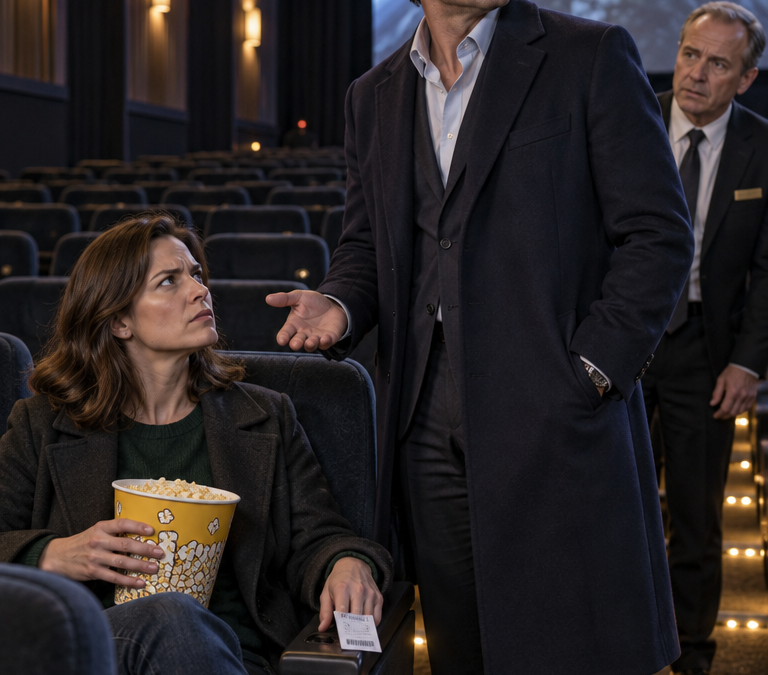
“Ten thousand dollars.”
Clare Bennett lowered her popcorn.
For a moment, she assumed she had misheard him. The neighborhood theater was nearly empty, the previews had just ended, and the tall man standing in the aisle beside her looked far too serious for the sentence he had just spoken.
She glanced around at the rows of vacant seats.
“For what?”
“Your seat.”
Clare looked at the small brass plate fixed to the armrest.
G12.
Then she looked back at the stranger.
“You have terrible taste in investments.”
Vincent Moretti did not smile.
The theater manager had hurried down the aisle behind him and now hovered with the strained expression of a man who had spent years handling broken projectors, spilled drinks, marriage proposals, and one memorable argument involving an emotional-support parrot, but had never been trained for a wealthy customer trying to purchase another customer’s chair.
“Ms. Bennett,” the manager said quietly, “Mr. Moretti is offering you a very generous arrangement.”
Clare settled the popcorn bucket against her lap.
“I bought a movie ticket. I’m not negotiating a merger.”
Vincent checked his watch.
“Name your price.”
“I already paid mine.”
Something about that answer seemed to irritate and fascinate him at the same time.
“Do you know who I am?”
Clare looked past him toward the glowing screen.
“At the moment? The man blocking the movie.”
The opening credits had begun.
Vincent turned toward the screen.
That was when Clare first noticed something stranger than the money.
He looked nervous.
Until then, everything about him had suggested control. His dark coat fit too well to be accidental. His posture belonged to someone accustomed to conference rooms where people waited for him to speak. Even the way he had offered ten thousand dollars sounded less like an outrageous proposal than an administrative solution.
But the instant the credits started, something in his face tightened.
The manager saw it too.
“Mr. Moretti,” he said, lowering his voice, “perhaps we could discuss this outside.”
Vincent kept his eyes on the screen.
“Not now.”
Clare leaned back in G12.
“Excellent. We agree on something.”
The manager tried again.
“Ms. Bennett, we can refund your ticket.”
“No, thank you.”
“We could offer another screening.”
“I chose this one.”
“Complimentary concessions?”
Clare lifted her popcorn.
“I am equipped.”
“A year of free movies?”
That made her pause.
Vincent noticed.
Clare considered it for exactly three seconds before shaking her head.
“Tempting. Still no.”
Vincent finally faced her again.
“Why?”
“Because I bought the seat.”
“That cannot possibly be the entire reason.”
“It’s enough of one.”
For a few seconds he simply studied her, as though waiting for the negotiating position behind the answer.
There wasn’t one.
Clare wasn’t trying to embarrass him. She wasn’t holding out for more money. She had not recognized him when he walked over, and even now his name meant little to her beyond the manager’s obvious anxiety.
She had bought G12.
She wanted to sit in G12.
That was all.
The manager lowered his voice.
“Sir, I could cancel her ticket.”
Vincent’s eyes dropped to the paper resting on Clare’s armrest.
She had arrived on time.
She had broken no rule.
He could certainly make the evening unpleasant if he wanted to. Clare could see that possibility pass through his expression.
Then he said, “No.”
The manager blinked.
“No?”
“She stays.”
Clare nodded approvingly.
“Wonderful. The tall gentleman has discovered ticketing policy.”
Vincent looked across the theater.
There were dozens of empty seats.
He could have moved almost anywhere. He could have gone home. A man who offered strangers five figures for upholstered furniture probably had access to private screening rooms and luxury sound systems.
Instead, he stepped into the row and sat in G13.
Clare turned slowly toward him.
“You just offered me ten thousand dollars so you wouldn’t have to sit beside me.”
“Don’t make this worse.”
“I haven’t even opened the candy.”
He stared straight ahead.
“Please don’t.”
She opened it.
The wrapper crackled through the quiet theater like a collapsing shed.
Vincent shut his eyes.
Clare smiled and settled in.
For the next several minutes, he appeared to be losing a private argument with the entire concept of public entertainment.
He disliked the sticky floor.
He disliked the previews.
He disliked the bright phone two rows ahead.
He especially disliked the man behind them who whispered explanations of jokes approximately three seconds before each joke happened.
Clare noticed him checking his watch.
“Have you never been to a movie theater?”
“Not like this.”
“With civilians?”
Vincent looked at her.
“I was going to say popcorn.”
She tilted the bucket toward him.
He shook his head.
Ten minutes later, his hand entered the popcorn.
Clare caught him immediately.
“That’s five dollars.”
He withdrew his hand.
“You rejected ten thousand.”
“Popcorn is different.”
Vincent reached into his jacket for his wallet.
Clare pushed the bucket toward him.
“Relax. First handful is promotional.”
He took some.
She turned back toward the screen.
A second later, the corner of his mouth moved.
Not quite a smile.
Close enough.
The movie itself was an old-fashioned comedy about a father trying to repair a damaged relationship with his adult son through increasingly elaborate gestures.
The father rented a sailboat.
Neither man knew how to sail.
He organized a family dinner and accidentally invited the wrong family.
He bought his son a car.
The son wanted an apology.
Clare laughed when the father managed to lock himself inside the vehicle he had purchased as a peace offering.
Vincent did not.
A few scenes later, the son finally confronted him.
Paying attention, he said, was not the same as paying for things.
Vincent went completely still.
Clare noticed.
She didn’t comment.
Until that moment, his behavior had been entertaining. Bizarre, but entertaining.
Now the strange urgency surrounding G12 began to feel different.
Halfway through the movie, the father arrived at his son’s apartment carrying another expensive gift.
The son did not open it.
“Did you ever think,” the character asked, “that I might have wanted you to come without bringing anything?”
Vincent lowered his popcorn.
Clare glanced at him.
The irritation had disappeared from his face.
So had the impatience.
What remained looked quieter.
Older, somehow.
She turned back to the film.
Some reactions deserved privacy, even in public.
When the credits finally rolled, Clare remained in her seat.
Vincent did too.
The other moviegoers gathered their coats and drifted toward the exits. The theater manager reappeared near the aisle, perhaps checking whether the building had survived whatever complicated personal event he had accidentally hosted.
Clare looked at Vincent.
“You’ve seen this before.”
“Yes.”
“You didn’t laugh once.”
“I laughed.”
“When?”
“Quietly.”
“You don’t strike me as a quiet laugher.”
“That is an unusual accusation.”
“It’s an observation.”
Vincent’s gaze returned to the screen.
Then a name appeared in the credits.
Clare read it once.
Then again.
Written and directed by Luca Moretti.
She turned toward him.
“Moretti?”
Vincent remained silent.
“Relative?”
“My younger brother.”
The last audience member walked through the doors.
Clare looked around the empty rows.
“Does he know you came?”
“No.”
“Does he know you liked it?”
Vincent stood.
“I haven’t decided whether I did.”
Clare picked up her coat.
“Then maybe watch it again before offering anyone money.”
He looked at her.
She smiled.
“Preferably from a seat you actually bought.”
For the first time that night, Vincent laughed.
It was brief.
But it was real.
A month later, Clare returned to the neighborhood cinema carrying a paper bag of candy.
Someone was sitting in G13.
She stopped in the aisle.
“No.”
Vincent Moretti looked up from a program.
“I have a ticket.”
“There are two hundred seats.”
“I’ve heard.”
She narrowed her eyes.
“How much do you want for that one?”
“Ten thousand dollars.”
“Ridiculous.”
“I learned from an expert.”
Clare sat in G12.
“What are you doing here?”
“Watching a film.”
“You own a private screening room.”
Vincent lowered the program.
“You looked me up.”
“You offered me ten thousand dollars for upholstered furniture. I had questions.”
The movie that evening was a mystery.
Vincent guessed the murderer eleven minutes in.
“Stop,” Clare whispered.
“I’m not speaking.”
“You’re looking smug.”
“That isn’t against theater policy.”
“Give it time.”
He turned out to be wrong.
Clare waited until the credits ended before saying anything.
“Would you like to revise your official statement?”
“I was deliberately misled by the plot.”
“That is generally how mysteries work.”
Outside, Vincent offered to buy her coffee.
Clare checked the time.
“One cup. I have an early meeting.”
He nodded with such solemnity that she almost laughed.
At the café, he asked what she had thought of Luca’s movie.
Clare stirred her coffee.
“Are you asking as his brother?”
“As someone who saw it.”
“Then I liked it. Some of the jokes were uneven. The father was difficult to forgive. But the son felt real.”
Vincent looked down at his cup.
“What made him real?”
“He wanted his father to listen. And he wanted him to stop trying so hard to prove he was useful.”
“That sounds contradictory.”
“People are.”
Vincent considered that.
“Did the ending work?”
“I wanted another scene.”
“What kind?”
“The father showing up again.”
“With another apology?”
“No. Without a gift. Without a speech. Just showing up.”
Vincent looked through the café window.
Clare let the silence stay where it was.
They exchanged numbers before leaving.
His first message arrived two days later.
Movie Friday?
Clare replied:
Not this week. Children’s Theater Workshop.
Vincent answered:
Understood.
No persuasion followed.
That surprised her.
The next Friday, she invited him to a screening of a terrible science-fiction movie.
He arrived with expensive chocolate.
Clare pulled gas-station candy from her bag.
“Mine has more personality.”
“Mine contains actual cocoa.”
“Yours looks afraid of having fun.”
They shared both.
Vincent still could not whisper.
Halfway through the movie, he leaned toward Clare.
“That robot is clearly the villain.”
Three people turned around.
Clare covered her face.
“You whisper like you’re announcing an execution.”
“I am speaking quietly.”
“The back row knows the ending now.”
Over the next several weeks, Vincent learned Clare’s schedule.
She coordinated programs at a neighborhood arts center housed inside an old brick building that had been renovated just enough to remain useful without losing its mismatched charm.
Mondays brought senior film afternoons.
Wednesdays meant short-play rehearsals with teenagers.
Some weekends, Clare hosted film discussions for people who loved movies but rarely had anyone to discuss them with.
She liked coffee alone.
Bookstores alone.
Walking home alone.
Vincent noticed that she never described solitude as something she needed another person to fix.
One Saturday she invited him to the arts center.
“Wear something you can spill paint on.”
“I don’t own that.”
“Then prepare for personal growth.”
When he arrived, she introduced him to volunteers without mentioning his money, his company, or whatever status usually caused people to straighten when he entered a room.
A boy handed Vincent a cardboard sword.
“You’re the dragon.”
Vincent examined it.
“Do I have lines?”
“Only if you die.”
“Comforting.”
Twenty minutes later, Vincent Moretti was lying on a classroom floor while six children celebrated his defeat.
Clare watched from the doorway.
“You’re surprisingly convincing.”
“I have range.”
“You have glitter in your hair.”
“That was not in the contract.”
After the workshop, she showed him a locked auditorium.
Dust covered the stage.
An old projector sat beneath a sheet.
“We used to screen films here,” she said. “Then the equipment failed. Repairs cost more than our annual program budget.”
“Have you considered sponsorship?”
“We’re considering several options.”
“How much would—”
“No.”
Vincent stopped.
“I was asking about the projector.”
“With you, those questions have suspiciously similar endings.”
He smiled.
Clare opened a cabinet filled with audience surveys, volunteer schedules, cost estimates and proposed partnerships.
“I want affordable screenings here again,” she said. “Older people who can’t travel across town. Families who can’t justify premium ticket prices. Teenagers who need somewhere to be.”
Vincent looked through the folders.
“You’ve done the work.”
“We’ve started it.”
For once, he did not reach for his phone.
On their way out, Clare mentioned an upcoming event.
“We’re hosting a conversation with local filmmakers next month.”
Vincent nodded.
“Luca Moretti is on the invitation list.”
He stopped walking.
“Did he accept?”
“Not yet.”
She studied him.
“You haven’t spoken to him?”
“Not properly.”
“For how long?”
“Three years.”
“That’s a long time.”
“Yes.”
“What happened?”
Vincent looked toward the street.
“He told me he wanted to make films.”
“And?”
“I told him it wasn’t a serious future.”
Clare winced.
“Ouch.”
“I offered to finance a business instead.”
“Double ouch.”
Vincent looked almost offended by the accuracy.
“He stopped asking my opinion.”
“Maybe he wasn’t asking for your opinion.”
Vincent met her eyes.
Then he gave a small nod.
“No. I don’t think he was.”
That evening, Clare received an email from Luca’s publicist.
He had accepted.
The arts center’s auditorium still wasn’t functional, so the discussion would take place at the neighborhood cinema.
Clare forwarded the announcement to Vincent.
A minute passed.
Then another.
Finally his reply appeared.
Will you be there?
Clare smiled.
I’m organizing it.
A second message came.
Right. Obvious question.
Then a third.
Is there a seat available?
Clare pulled up the seating chart.
G13 was open.
She typed:
You’ll have to buy your own ticket.
Vincent purchased G13 three days before the event.
Then, apparently unable to trust the ordinary machinery of ticketing, he called the theater.
“Is the ticket valid?”
“Yes, sir.”
“Will the seat be available?”
“It is assigned to you.”
“Good.”
The manager paused.
“Mr. Moretti, are you planning to buy the theater again?”
“No.”
“Excellent. We’ve already printed the posters.”
On Saturday evening, Clare found Vincent outside the cinema wearing a dark coat and the expression of a man waiting outside a courtroom.
“You came.”
“I bought a ticket.”
“A promising start.”
She handed him a paper program.
“Does Luca know you’re here?”
“No.”
“Did you tell him we know each other?”
“No. That’s your conversation.”
Vincent exhaled.
Clare pointed toward the lobby.
“I have seventy guests, two microphones, and a volunteer who thinks the projector is haunted. I cannot manage your brother too.”
“I didn’t ask you to.”
“Good. Because I’d charge more than ten thousand.”
The screening began on time.
Clare introduced Luca as a filmmaker whose work explored the awkward distance between love and understanding.
She did not mention Vincent.
From G13, he watched his younger brother walk onto the stage.
Luca looked older than he remembered.
His hair was shorter.
He was comfortable holding a microphone.
Vincent had missed enough years for those details to feel like accusations.
The film began.
This time Vincent knew the story.
He knew where the father ruined dinner.
He knew where the son stopped answering calls.
But he noticed something he had missed before.
In the final scene, the father stood outside his son’s apartment without a gift.
He almost knocked.
Then he walked away.
The screen faded to black.
The first time Vincent watched it, he had called the ending unfinished.
Now he wondered whether the father had simply been afraid of hearing no.
Beside him, Clare offered the popcorn.
He took a handful.
“Five dollars,” she whispered.
“Invoice me.”
During the discussion afterward, audience members asked Luca about casting, funding, editing and the stubborn father.
A woman near the front raised her hand.
“Why didn’t you let them reconcile?”
Luca considered the question.
“Because an apology doesn’t guarantee access to someone’s life.”
Vincent looked down.
Luca continued.
“The son might answer the door next week, next year, or never. The father still has to become someone who can knock without demanding to be let in.”
Clare glanced toward G13.
Vincent was listening.
Not preparing a defense.
Not planning an argument.
Listening.
Near the end, Luca’s gaze moved across the audience.
It stopped.
Vincent felt the instant his brother recognized him.
Luca looked away and finished answering a question about the soundtrack.
After the applause, Clare began gathering her notes.
Vincent stayed seated.
“You can leave if you need to,” she said.
“I know.”
“You can stay too.”
He looked at the stage.
“I know that now.”
Luca approached before Vincent stood.
For a moment, neither brother spoke.
Then Luca looked at the ticket in Vincent’s hand.
“You paid to see it?”
“Twelve dollars. Financially devastating.”
Luca almost smiled.
“Why are you here?”
Vincent glanced toward Clare.
She was already walking into the lobby, answering a volunteer’s question.
He faced his brother.
“I wanted to see what you made.”
“You saw it last month.”
Vincent blinked.
“The manager told me.”
“He did?”
“You offered someone ten thousand dollars for a seat. People talk.”
“That part was unnecessary.”
“Which part?”
“The ten thousand.”
Luca folded his arms.
“That’s a first.”
Vincent resisted the urge to explain himself.
“I was wrong when you told me you wanted to make films.”
Luca’s expression closed.
“Vincent—”
“I called it a hobby. I offered you a business you never asked for. I thought being practical made me right.”
“You told me I’d come crawling back when the money ran out.”
“I remember.”
“That’s the part I believed you meant.”
“I did mean it. I was angry that you didn’t want the future I understood.”
Luca looked toward the lobby.
“I’m not ready to make this easy.”
“I’m not asking you to.”
“Then what are you asking?”
Vincent held up the program.
“Could you tell me why you cut the scene with the second dinner?”
Luca stared at him.
“You noticed?”
“It’s in the trailer. Not the film.”
For the first time, Luca looked interested instead of guarded.
“Because the father was still performing.”
Vincent nodded.
“I thought so.”
They spoke for eight minutes.
Not three years’ worth.
Eight minutes about editing, a difficult actor, and the ending.
When Luca’s publicist called him away, he hesitated.
“There’s another screening next Thursday.”
Vincent nodded.
“I know you don’t have to invite me.”
“I understand.”
Luca took one step backward.
“Don’t buy the whole room.”
Vincent smiled.
“I’m learning.”
Clare found him beside the poster display.
“How did it go?”
“He didn’t forgive me.”
“I didn’t ask whether he did.”
Vincent looked at her.
“He told me about a scene he cut.”
“That sounds like a conversation.”
“It was.”
Her phone buzzed.
The arts center board had approved a small trial program using borrowed projection equipment.
Clare read the message twice.
“We have six community movie nights.”
“Six?”
“Six chances to prove people will come.”
Vincent started to ask about the budget.
Then stopped.
“What film are you showing first?”
Clare grinned.
“Something with a villain you can guess incorrectly.”
Outside, the evening air was cool.
Vincent walked her to the corner.
“May I take you to dinner?”
“You already bought a ticket.”
“That was for the movie.”
“Good distinction.”
She slipped her hand into his.
“Dinner sounds nice.”
Vincent looked back toward the cinema.
For once, he had entered a room he could not control and left with more than he had brought.
Not forgiveness.
Not certainty.
A conversation.
And a woman beside him who had chosen to stay.
He took Clare to a small Italian restaurant.
She inspected it suspiciously.
“Your family?”
“No.”
“Business partner?”
“No.”
“Someone you once offered ten thousand dollars for a table?”
“Not yet.”
She laughed.
For once, Vincent did not ask for the quietest room.
They sat by the window, surrounded by ordinary conversation, clinking glasses and servers carrying plates between crowded tables.
Their dates continued around Clare’s six community screenings.
Vincent attended two.
He missed one because of work and apologized without offering to replace the projector.
At another, a child spilled juice on his coat.
Vincent stared at the stain.
The child stared at Vincent.
Clare handed them both napkins.
“Neither of you is under arrest.”
The child fled.
Vincent looked at his sleeve.
“Was that a possibility?”
“With your face? Briefly.”
The first screening drew thirty people.
The second brought forty-six.
By the fourth, Clare had volunteers managing tickets, folding chairs and donated snacks.
She was proud.
She was also exhausted.
One evening, Vincent found her stacking chairs after everyone else had left.
“Can I help?”
“Yes. Those six.”
He stacked them.
“Now those four.”
“Are you billing me by the chair?”
“I was considering it.”
“Five dollars for access?”
“Your pricing remains irrational.”
Luca attended the fifth screening.
He came without a publicist and stayed afterward to answer questions from teenagers who wanted to make short films.
Vincent arrived halfway through.
Clare watched the brothers notice each other across the room.
Neither approached.
Afterward, Luca found Clare near the ticket table.
“Did Vincent ask you to invite me?”
“No.”
“Did he know I’d be here?”
“I told him the program was public.”
Luca studied her.
“He’s very good at arranging things.”
“So am I. It’s my job.”
“That’s not what I meant.”
“I know.”
Clare set down the ticket box.
“I’m not arranging a reconciliation. I’m running a film program. You’re welcome because you’re a filmmaker. He’s welcome because he bought a ticket.”
Luca looked embarrassed.
“Sorry.”
“Accepted. Now help me carry these chairs.”
Vincent saw Luca carrying chairs and approached.
“Need another pair of hands?”
Luca glanced at Clare.
“Ask her. She’s in charge.”
Vincent did.
Clare pointed toward the back wall.
The brothers worked silently for several minutes.
Then Luca frowned at Vincent’s stack.
“You’re doing it wrong.”
“They’re chairs.”
“And yet you found a way.”
Vincent adjusted the pile.
“I saw your interview last week.”
Luca paused.
“The radio one?”
“Yes.”
“You listened?”
“All of it.”
Luca nodded.
It wasn’t forgiveness.
But he stayed until the chairs were finished.
Outside, Clare found Vincent examining a tiny paper star stuck to his coat.
“Another injury?”
“Glitter.”
“Again. You’re developing a signature look.”
He held up the star.
“Did you plan this?”
“Obviously. It’s part of my long campaign to make you less intimidating.”
“Is it working?”
“Your chair stacking needs improvement.”
Vincent stepped closer.
“Clare.”
“Yes?”
“May I kiss you?”
She considered him.
“Depends.”
“On?”
“Are you going to offer ten thousand dollars if I say no?”
“No.”
“Good answer.”
She kissed him first.
A week later, the arts center hosted its final trial screening.
Every chair was occupied.
Clare stood in the back while a teenager introduced a short film she had made during the workshop.
It was about a girl trying to repair an old bicycle with her grandfather.
The sound was uneven.
The camera shook.
The ending made half the room cry.
When the lights came up, the teenager searched the audience.
“Did you like it?”
Her grandfather stood.
“I loved it.”
Clare looked toward Vincent.
He was applauding.
Luca stood beside him, applauding too.
For a moment they were simply two brothers watching someone else be proud of a film.
Then Clare’s supervisor called her aside.
A representative from a wealthy foundation wanted to speak with her.
He had seen Vincent and Luca together.
“You’ve done something remarkable,” he told Clare.
“What?”
“Getting those two into the same room.”
Clare waited.
“If you could arrange a proper family appearance at our fundraiser, the publicity would be invaluable.”
“My program isn’t a family-reunion service.”
He laughed.
“I only mean you clearly have influence.”
“I have a screening schedule and a volunteer roster. Those are the things I can promise.”
His smile thinned.
“Donors appreciate flexibility.”
“Then they’ll appreciate how many different films we can show.”
Vincent found her afterward.
“You’re smiling like someone committed an offense.”
“Just a donor who thinks I’m your family’s event coordinator.”
His expression changed.
“Who?”
“Not important.”
“Clare.”
She looked at him.
“I handled it.”
Vincent stopped himself.
That mattered.
“Do you want me to do anything?”
“No.”
“Would you like me to listen?”
“Yes.”
So she told him.
And he listened.
When she finished, he said, “You shouldn’t have been put in that position.”
“No. But I’m glad you didn’t try to fix it for me.”
“I considered several dramatic options.”
“I’m sure you did.”
“All terrible.”
“Progress.”
Later, Luca approached.
“The teenager with the bicycle film,” he said to Clare. “Would she want feedback on her next script?”
“I can ask.”
“Please do.”
Then he looked at Vincent.
“There’s a rough cut of my next project.”
Vincent waited.
“If you want to see it, I can send a link.”
“I’d like that.”
“Don’t send notes.”
“I won’t.”
“Especially financial notes.”
Vincent smiled.
“Understood.”
After Luca left, Clare touched Vincent’s hand.
“That sounded like an invitation.”
“A limited one.”
“Those count.”
Vincent looked at the empty screen.
For years he had tried to arrange the perfect moment in which Luca would finally understand him.
Now his brother had offered something smaller.
A film.
A chance to watch.
And no permission to direct it.
The following Monday, Clare received approval for a permanent community film program.
There was one problem.
The arts center could afford the room.
It could not afford the projector.
By lunchtime, Clare had three spreadsheets open and a headache.
Her supervisor stopped beside her desk.
“The foundation is interested.”
“The same foundation?”
“The one that wanted the Moretti brothers at its fundraiser.”
Clare closed one spreadsheet.
“What do they want now?”
“A naming opportunity for the screening room.”
“That sounds negotiable.”
Her supervisor hesitated.
“They also want approval over the films.”
“No.”
“Clare—”
“We can discuss sponsorship. We cannot let a donor decide what the neighborhood is allowed to watch.”
“I agree.”
“But?”
“We still need equipment.”
That was the worst part.
Clare knew exactly what the money could accomplish.
That evening she met Vincent at the neighborhood theater.
G12 and G13.
Neither had chosen the movie carefully.
On screen, a woman was being chased through a museum by a man dressed as a medieval knight.
Clare ate popcorn with unusual determination.
“Bad day?” Vincent whispered.
“Spectacularly.”
“Would you like to talk about it?”
“After the knight stops running.”
The knight fell into a fountain.
Clare nodded.
“Now.”
At the café afterward, she explained the foundation’s conditions.
Vincent listened without interrupting.
Then he said, “I know three equipment suppliers.”
Clare looked at him.
“I assumed you knew seven.”
“Eight. One is unpleasant.”
“Of course he is.”
“I can give you their names. You can request quotes.”
Clare watched him carefully.
“No surprise delivery?”
“No.”
“No anonymous donation?”
“No.”
“No projector appearing at my apartment with a ribbon?”
“That was never the plan.”
“You hesitated.”
“It would have been an excellent ribbon.”
She laughed.
Vincent wrote down the suppliers.
Later that night, Luca sent him the rough cut.
No notes.
Vincent watched alone.
The movie followed a young woman trying to reopen her father’s abandoned bakery.
It was funny.
Uneven.
And halfway through, Vincent sat forward.
The father had left his daughter a notebook.
Not money.
Recipes.
In the final scene, she opened the bakery without using a single one.
Vincent understood what Luca was saying.
He also knew exactly how the ending could be made more commercially appealing.
He reached for his phone.
Stopped.
Put it down.
Then sent one message.
I watched it. Thank you for trusting me.
Luca replied the next morning.
Did you like it?
Vincent stared at the question.
Then typed:
Yes. Especially the ending.
Three dots appeared.
Disappeared.
Appeared again.
I thought you’d hate that part.
Vincent answered:
I would have three years ago.
Clare spent the next week meeting suppliers.
One offered refurbished equipment.
Another proposed a rental plan.
A local cinema technician volunteered to inspect the arts center’s wiring.
The numbers were difficult.
But they were becoming possible.
Then the foundation representative called again.
“We can cover everything.”
“That’s generous.”
“Provided we can announce the Moretti family as honorary patrons.”
Clare looked at the budget on her desk.
“Have you discussed that with them?”
“We assumed you could.”
“No.”
“Ms. Bennett, this is a substantial offer.”
“I understand the amount.”
“Then I don’t see the difficulty.”
“The program is for the audience. Vincent and Luca are not attractions I can include in a sponsorship package.”
The man sighed.
“Think about what you’re turning down.”
“I am.”
Clare ended the call.
Her hands shook afterward.
She was proud of the answer.
She was also frightened of what it might cost the program.
That evening, she told Vincent.
He was quiet.
“I can make a call.”
“To whom?”
“The foundation.”
“No.”
“I could explain that my family isn’t available for purchase.”
“Tempting speech.”
“I have rehearsed several versions.”
“Of course you have.”
She took his hand.
“But I don’t want this program to survive because someone is afraid of upsetting you.”
Vincent looked at their joined hands.
“What do you need?”
“A little time.”
“Done.”
“And maybe someone to help me test a secondhand projector on Saturday.”
“I have no qualifications.”
“Perfect. Neither do I.”
On Saturday, the projector displayed everything upside down.
Clare stared at the screen.
Vincent stared at the manual.
“I believe this is intentional.”
“Why?”
“For dramatic tension.”
She laughed so hard she had to sit down.
Twenty minutes later, they fixed it.
The image was slightly dim.
The sound worked.
Clare watched the test clip fill the wall.
“It isn’t perfect.”
Vincent stood beside her.
“No.”
He smiled.
“I’ve heard that can be a good thing.”
On Monday, the arts center board approved a modest plan.
The refurbished projector would be funded through a small community grant, individual donations and six months of ticket revenue.
No single donor would control the program.
Clare called Vincent from the empty auditorium.
“We did it.”
“You did.”
“You carried the projector.”
“I nearly dropped it.”
“That’s why I’m including you in the story.”
He laughed.
Then his voice changed.
“Clare?”
“Yes?”
“Luca invited me to dinner.”
She sat down.
“Just you?”
“Just me.”
“Are you going?”
“I think so.”
“Good.”
“I’m nervous.”
“I know.”
Dinner took place at Luca’s apartment.
Vincent brought nothing.
No wine.
No expensive gift.
No business proposal.
Luca opened the door and looked at his empty hands.
“Did you forget something?”
“I was told to come without bringing anything.”
“Who told you that?”
Vincent smiled.
“Someone who charges five dollars for popcorn.”
Luca stepped aside.
“Come in.”
And this time, Vincent did.
Weeks later, Vincent arrived at the arts center carrying two paper cups of coffee.
Clare stood in the auditorium doorway checking the seating plan.
“You’re early.”
“I was told the first permanent screening was important.”
“It is.”
He handed her a cup.
“No projector in the car?”
“No.”
“No backup sound system?”
“No.”
“No secret purchase of the building?”
“I brought coffee.”
Clare examined the lid.
“Suspiciously reasonable.”
“I’ve been practicing.”
The refurbished projector hung above the last row.
The walls had fresh paint.
The chairs still did not match.
Clare loved every inch of the room.
Six months earlier, she had shown Vincent a locked auditorium and a stack of plans.
Now volunteers were hanging signs.
Families collected tickets.
An elderly couple argued cheerfully about the best row.
A teenager tested the microphone.
It squealed.
Vincent winced.
Clare grinned.
“Luxury cinema.”
Luca arrived twenty minutes before the screening carrying a paper bag.
Vincent looked at it.
“What’s that?”
“Cookies.”
“You baked?”
“I bought them.”
“Good. I was concerned.”
Luca handed the bag to Clare.
“For the volunteers.”
“Thank you.”
Then he looked at Vincent.
“Dinner next week.”
Vincent tried not to react too quickly.
“If you’re free.”
“I just asked you.”
“Right.”
Clare turned away to hide her smile.
The first dinner had not repaired everything.
They had eaten pasta.
They had argued about a football game.
Vincent had admitted he still worried about Luca’s finances.
Luca had told him he was allowed to worry quietly.
They had both laughed.
Before Vincent left, Luca asked if he wanted to see the next cut of the bakery film.
Vincent said yes.
He did not offer a single note.
The next morning, Luca sent him a photograph from their childhood.
Two boys sat on the floor in front of a television holding a cardboard camera they had built together.
Underneath Luca had written:
You were my first camera operator.
Vincent kept the photograph.
He didn’t show Clare.
Some things were better allowed to grow without an audience.
At seven that evening, Clare walked to the front of the auditorium.
The room quieted.
“Thank you for coming. This program began with borrowed equipment, volunteers, and a lot of people who believed a movie night could be more than a movie night.”
She looked across the rows.
“There are people here who haven’t been to a cinema in years. Children seeing their first film on a big screen. Filmmakers who started with nothing more than a phone and an idea.”
Luca stood near the back.
The teenager who had made the bicycle film waved at him.
He waved back.
Clare smiled.
“This room belongs to all of you. Please silence your phones.”
Her eyes found Vincent.
“And try not to announce the villain before the ending.”
Laughter spread through the room.
Vincent lowered his head.
Luca looked delighted.
The film began.
It was a comedy about a woman who inherited a failing seaside hotel and slowly realized every guest had lied about why they were there.
Vincent leaned toward Clare.
She raised one finger without looking at him.
“Don’t.”
“I didn’t say anything.”
“You inhaled like a man preparing a speech.”
He settled back.
Ten minutes later, the twist proved him wrong.
Clare patted his hand.
“Another difficult evening for your detective career.”
“Please respect my privacy.”
After the screening, people stayed.
They discussed the ending.
They exchanged recommendations.
An elderly man asked when the next film would be shown.
Clare told him.
He carefully wrote the date on the back of his ticket.
Across the room, Luca helped the teenager set up a camera for an upcoming workshop.
Vincent watched them.
Then he joined Clare at the ticket desk.
“You were right.”
“About what?”
“The program. People needed this.”
“They did.”
“And you knew before anyone gave you a budget.”
“I had evidence.”
“You had faith too.”
Clare looked around the crowded room.
“A little.”
After the final guest left, Vincent helped fold chairs.
Luca worked from the other side of the room.
For several minutes, the three of them said nothing.
Then Luca pointed at Vincent’s stack.
“Wrong again.”
Vincent examined it.
“I followed the diagram.”
“There is no diagram.”
“Then this institution has serious management problems.”
Clare laughed.
Luca laughed too.
Vincent looked between them.
He could have spent a fortune arranging a night like this.
Instead, he had bought a ticket.
Carried chairs.
Stayed until the work was finished.
It was better than anything he would have planned.
Outside, Luca pulled on his coat.
“Thursday?”
Vincent nodded.
“Thursday.”
“And don’t bring a business proposal.”
“I’ll bring nothing.”
“Cookies are acceptable.”
“I’ll make a note.”
Luca smiled at Clare.
“Good night.”
She watched him walk away.
“Your brother seems happy.”
“He does.”
“So do you.”
Vincent considered denying it.
Then he took her hand.
“I am.”
The following Friday, Clare arrived at the neighborhood cinema.
She had G12.
Vincent waited beside G13 holding two tickets.
She looked at them.
“You bought my seat.”
“I bought mine.”
“Then why two tickets?”
He handed her one.
“Luca asked if we wanted to see his film again.”
Clare looked down the row.
Luca was already sitting in G11, opening a bag of cookies.
“Don’t worry,” he said. “I’m not sitting between you.”
Clare laughed and settled into G12.
Vincent took G13.
The lights dimmed.
On screen, the father approached his son’s apartment.
He stopped outside the door.
Raised his hand.
This time Clare heard Vincent whisper:
“Knock.”
From G11, Luca whispered back:
“Watch the movie.”
Clare covered her smile with the popcorn.
When the credits finished, Luca left to speak with a friend in the lobby.
Clare and Vincent remained in their seats.
“Do you remember the first night?” she asked.
“I offered you ten thousand dollars.”
“You were very annoying.”
“I’ve improved moderately.”
He turned toward her.
“I thought if I could clear the room, I could watch Luca’s film without anyone seeing what it did to me.”
Clare’s expression softened.
“And now?”
Vincent looked at the people still filing out through the aisle.
“Now I’d rather be here with an audience.”
He looked at her.
“With you.”
Clare said nothing.
Vincent took her hand.
“I love you.”
She held his gaze for a long moment.
Then she smiled.
“I love you too.”
Vincent leaned closer.
“May I kiss you?”
“You’ve already asked me that.”
“I thought I’d check.”
“Good answer.”
She kissed him.
Months earlier, Vincent Moretti had offered ten thousand dollars for G12.
Clare Bennett refused because it was her seat.
Tonight, Vincent had paid twelve dollars for G13.
G12 was still hers.
And when the lights went down again, she reached across the armrest and took his hand.
From G11, Luca leaned toward them.
“Are you two finished?”
Clare glanced past Vincent.
“You’re still blocking the screen.”
Vincent laughed.
And nobody tried to buy another seat.