Twelve families arrived at my locked farm gate believing they had bought permanent access across my land, and Harbor Ridge’s sales director told me I was blocking a recorded easement. Then her own project manager unfolded a plan labeled “Proposed,” and the first buyer opened a contract promising something nobody could prove existed.
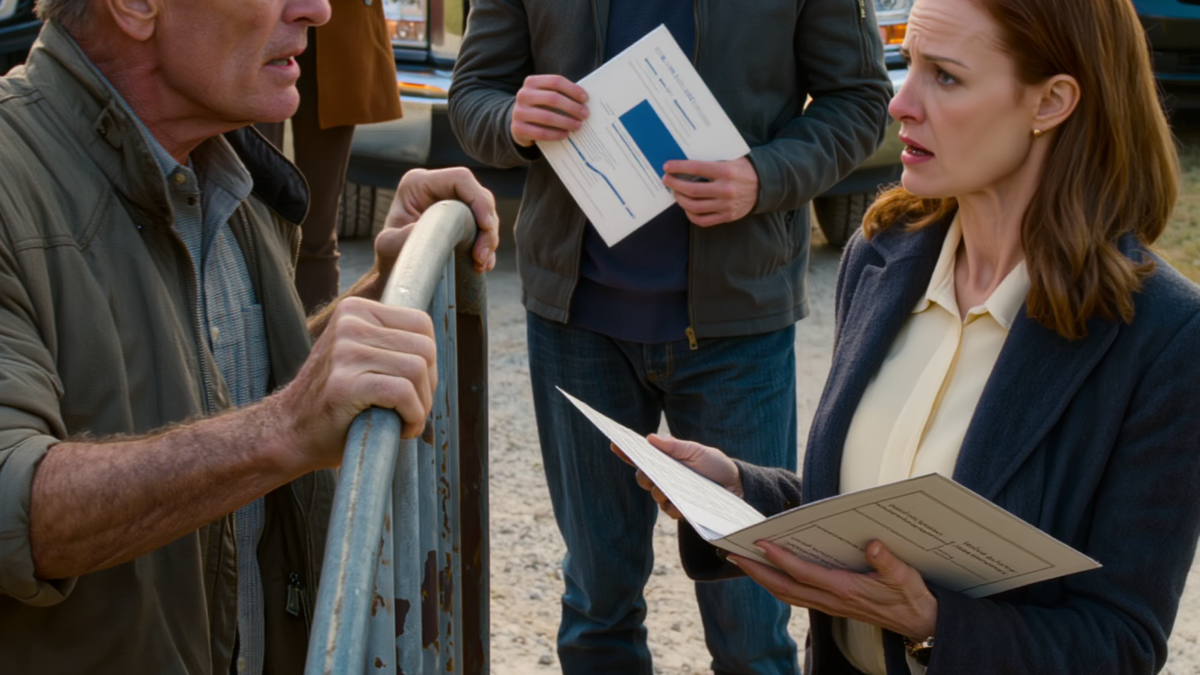
“You can’t lock this gate anymore. Twelve families were promised this road.”
The man saying it stood on my property with a Harbor Ridge brochure in one hand while a moving truck idled behind him on the gravel lane. Three SUVs waited beyond it. Farther back sat a silver pickup with a magnetic Harbor Ridge Development sign on the door.
I looked at the vehicles, then at him.
“My name is Daniel Foster,” I said. “And this is Foster Farm.”
He frowned as though that changed nothing.
“I’m closing on Lot 14 today.”
“Congratulations.”
His expression tightened. “The developer says this is our permanent western access.”
That got my attention.
My family had owned those sixty-two acres for forty-one years. Foster Lane ran from County Road 6 across our land to the barn, following the same gravel path my father had maintained long before Harbor Ridge existed.
Harbor Ridge was a twenty-eight-home subdivision along my eastern pasture. Its approved entrance connected to Willow Creek Drive almost a mile away.
There had never been a subdivision entrance through my farm.
A woman stepped out of the silver pickup and walked toward us with the quick, polished stride of someone accustomed to settling problems before customers started asking too many questions.
She introduced herself as Melissa Grant, Harbor Ridge’s sales director.
“Mr. Foster, we’re trying to avoid delaying several closings.”
“Then get these vehicles off my lane.”
Her smile remained in place.
“The development has access rights here.”
“Show me.”
She opened a glossy folder and removed a color site plan.
A blue line crossed my pasture and followed Foster Lane.
Beside it were the words Western Access — Permanent Resident Entry.
I studied the page carefully.
No recording number.
No easement reference.
No survey notation.
Just a blue line on a marketing map.
“That’s a sales plan,” I said.
“It’s part of the buyer package.”
“That doesn’t make it an easement.”
The buyer beside her glanced between us.
“Wait,” he said. “You’re saying we can’t use this road?”
“I’m saying nobody has ever shown me a recorded right allowing Harbor Ridge residents across my property.”
Melissa’s smile disappeared.
“Your father agreed to access years ago.”
“My father died six years ago.”
“He discussed it with the original developer.”
“Discussing something isn’t granting an easement.”
Another vehicle pulled up before she could answer.
A couple climbed out holding a closing folder. The woman pointed toward my gate.
“Our agent said this entrance was included.”
Melissa moved toward them quickly.
“Everything is being handled.”
Something about that phrase stayed with me.
I had heard versions of it all my life from people trying to keep a problem quiet until someone else accepted the consequences.
I walked to my gate and closed it.
The latch settled into place with a metallic click.
Melissa stared at me.
“You cannot obstruct a recorded access.”
“Give me the recording number.”
She didn’t.
Instead, she pulled out her phone.
Within minutes, another Harbor Ridge vehicle arrived.
The project manager introduced himself as Eric Dalton. He carried a rolled construction plan, which he spread across the hood of his truck.
A dashed corridor crossed my land.
I leaned closer.
The label said Proposed Secondary Access.
I tapped the first word.
“Proposed.”
Eric looked at Melissa.
Melissa looked toward the buyers.
Nobody spoke.
Then the first man opened his closing packet.
“My name’s Ryan Mercer,” he said. “Look at this.”
He handed me a property disclosure.
It promised buyers permanent secondary vehicular access to County Road 6 via Foster Lane.
My name did not appear anywhere.
Neither did my parcel number.
But the timing mattered.
Ryan’s closing was scheduled for two that afternoon.
Eleven more closings were scheduled over the next three days.
Those families had paid for lots advertised with two entrances.
The second entrance apparently crossed my farm.
Melissa lowered her voice.
“Daniel, opening the gate today would prevent a major problem for you and everyone else.”
I looked past her at the moving truck.
Then at Ryan.
He wasn’t standing there trying to take something from me because he had invented a right to it.
He had been sold one.
That changed the question.
Who had sold it to him?
I called Nathan Cole, the surveyor who had worked on Foster Farm more than once.
Then I called the county recorder’s office.
Before I finished the second call, Melissa said, “The easement should have been recorded with the development documents.”
I turned toward her.
“Should have?”
She stopped.
Her phone rang almost immediately.
She answered.
For thirty seconds she barely spoke.
Then the color in her expression shifted.
“What do you mean the title company can’t find it?”
Ryan slowly closed his folder.
His appointment was less than three hours away, and somewhere between Harbor Ridge’s sales material and the county’s official records, a road promised to twelve families had disappeared.
Melissa stepped away, turning her back as she lowered her voice.
“No, I’m standing at the gate now.”
A pause.
“Then check the older file.”
Another pause.
“What about the Foster agreement?”
Ryan reopened his brochure.
“This is why we chose Lot 14.”
He pointed at the community map.
One entrance connected to Willow Creek Drive.
The second crossed Foster Farm.
Western Resident Access.
“My wife works at the hospital,” he said. “This route cuts almost fifteen minutes off her commute.”
Melissa ended the call.
“The title company is reviewing archive documents.”
“That isn’t what you said five minutes ago.”
Eric rolled up his plan.
“There may be an older access agreement that wasn’t indexed properly.”
“Who signed it?”
“My understanding is your father.”
“My father was Robert Foster. Show me his signature.”
Nobody could.
Nathan arrived less than twenty minutes later.
He had surveyed Foster Farm after my father died and again when Harbor Ridge began construction.
He stopped his truck, looked at the moving vans, brochures and blue access line, and asked the obvious question.
“What happened?”
“They sold my road.”
Melissa objected immediately.
“Nobody sold your road.”
Ryan lifted his brochure.
“You sold us access to it.”
That silenced her.
Nathan opened his tablet and pulled up the recorded boundary survey.
Harbor Ridge ended at the eastern fence.
Foster Lane remained entirely inside my parcel.
“There’s no dedicated public road here,” he said.
Eric pointed toward the fence.
“There was supposed to be an access corridor.”
Nathan barely looked up.
“Supposed to be isn’t recorded.”
Melissa’s phone rang again.
This time she put it on speaker.
A woman introduced herself as Rebecca Sloan from Pioneer Title.
“We located a 2016 document involving Robert Foster and the original Harbor Ridge developer.”
Melissa exhaled.
“That’s it.”
Rebecca continued.
“It is labeled Temporary Construction Access License.”
Nobody moved.
I remembered that document.
My father had allowed construction crews to cross part of the farm while Harbor Ridge’s main entrance was unfinished.
Rebecca read the dates.
“Effective March 2016. Expires December 31, 2017, or upon completion of Willow Creek Drive, whichever occurs first.”
Ryan stared at Melissa.
“That isn’t permanent resident access.”
“No,” Rebecca said.
Melissa interrupted.
“Was there an amendment?”
“We haven’t located one.”
I remembered my father complaining about dump trucks during that period. He had tolerated them because heavy equipment couldn’t easily reach the subdivision from its unfinished entrance.
Once Willow Creek Drive opened, he chained Foster Lane again.
Nathan asked Rebecca to email the recorded exhibit attached to the license.
She did.
We opened it beside the gate.
The temporary route didn’t even follow the path shown in Harbor Ridge’s brochure.
It crossed the southern edge of my pasture, then turned toward an old staging area.
The current Harbor Ridge map had moved the blue line almost two hundred feet north and placed it directly on Foster Lane.
Eric held the two images side by side.
“That isn’t the exhibit we’ve been using.”
“Where did your map come from?”
He enlarged the title block.
Harbor Ridge Sales Access Plan — Revision 4.
It had been prepared eighteen months earlier.
Not by a surveyor.
By Harbor Ridge’s own sales department.
Another buyer arrived.
Then another.
By noon, six families stood near my gate.
A few were still frustrated with me.
One man demanded I open the road because his purchase contract guaranteed two-access convenience.
I kept my voice level.
“I didn’t sign your purchase contract.”
That redirected the question immediately.
Ryan turned toward Melissa.
“Did your company verify this before advertising it?”
She didn’t answer.
Rebecca called again.
Her voice sounded different.
“We found correspondence from the original developer.”
Melissa immediately asked, “Does it include the permanent easement?”
“No.”
“What does it include?”
Rebecca paused.
“A request to purchase one.”
My stomach tightened.
“From my father?”
“Yes.”
Another pause.
“Robert Foster rejected it.”
Melissa went completely still.
Rebecca continued.
“There’s a handwritten note on the developer’s copy.”
She read it aloud.
“Owner will allow temporary construction crossing only. No permanent subdivision access.”
Ryan slowly turned toward Melissa.
The developer had not lost a permanent easement.
At least according to everything uncovered so far, one had never existed.
“There has to be another document,” Melissa said.
Ryan shook his head.
“You advertised an entrance you can’t prove exists.”
“We advertised based on development records.”
“Then show us those records.”
Melissa told the buyers to continue to the sales office.
Nobody moved.
At 12:35, Pioneer Title suspended Ryan’s closing.
Two minutes later another buyer got the same call.
Then another.
The lots still existed.
Willow Creek Drive still provided legal access.
But the closing documents promised an additional benefit Pioneer Title could not verify.
That was enough to stop the transactions.
Eric’s phone began ringing.
First Harbor Ridge’s attorney.
Then the construction office.
Then Harbor Ridge owner Charles Whitman.
Nathan stood beside me as the calls continued.
“There’s something else bothering me.”
“What?”
“That Revision 4 map.”
He enlarged it.
The blue line crossed my gate, followed Foster Lane and entered Harbor Ridge through an opening in the subdivision fence.
Except no opening existed.
Not yet.
We drove along the fence.
Roughly four hundred yards north, we found orange stakes and fresh white paint marking a twenty-four-foot section between fence posts.
A wooden stake read:
Future West Access.
I called Eric over.
“Who marked this?”
He looked genuinely surprised.
“I didn’t.”
Nathan crouched beside the stake.
“This isn’t survey control.”
Then an engine sounded from inside Harbor Ridge.
A compact excavator came down an unfinished interior street.
A fencing contractor followed.
I raised my hand.
The operator stopped.
“We’re opening the west connection,” he said.
“Under whose authorization?”
He handed me a work order.
Remove existing fence section. Install temporary vehicle apron.
Authorized by Melissa Grant.
Melissa reached us seconds later.
“That order was issued before today.”
“Before you confirmed you had access?”
“We believed access had already been established.”
Nathan pointed toward the fence.
“Your subdivision survey shows this fence on Daniel’s property.”
The contractor read the paperwork again.
“I’m not touching it.”
He backed the excavator away.
Ryan had followed us.
“So you were about to open this before we closed?”
Melissa looked exhausted.
“It was scheduled to make the western access available.”
“For something you didn’t own,” I said.
“It was supposed to be resolved.”
That phrase again.
Supposed to.
Then Eric received an email from Harbor Ridge’s attorney.
He read it silently.
“What?”
He turned his screen toward me.
A 2017 negotiation file had been located.
After my father refused the first permanent easement request, Harbor Ridge had made a second offer.
Seventy-two thousand dollars for a thirty-foot easement.
My father rejected that too.
Then came the final letter.
Harbor Ridge will proceed with Willow Creek Drive as its sole permanent vehicular connection. Temporary Foster access shall terminate upon completion.
Willow Creek Drive opened in November 2017.
The construction license ended with it.
Melissa admitted she had never seen the letter.
“Then who created Revision 4?” I asked.
Eric checked the digital file history.
Revision 1 showed no western entrance.
Revision 2 showed the temporary construction route in gray.
Revision 3 labeled it Former Temporary Construction Access — Closed.
Then, eighteen months earlier, Revision 4 appeared.
The gray line disappeared.
A blue line moved north onto Foster Lane.
The words former and closed disappeared.
They were replaced with Permanent Resident Entry.
Created by Harbor Ridge Development Sales Department.
Approved by Charles Whitman.
Eric stared at the screen.
“That’s the owner.”
A black SUV entered the subdivision before anyone could say more.
Charles Whitman stepped out.
He looked at the buyers, contractor, my fence and finally me.
“I think we can solve this without ruining twelve closings.”
I crossed my arms.
“How?”
He glanced toward Foster Lane.
“We make the easement real today.”
That was when I understood why he had come.
Not with the missing document.
With a new one.
Charles opened the rear of his SUV and removed a leather folder.
“I’m prepared to compensate you.”
He handed me a document.
Permanent Access Easement Agreement.
My name had already been typed beneath the signature line.
I found the amount.
Twenty-five thousand dollars.
“You offered my father seventy-two.”
“That was years ago.”
“And he still said no.”
“The circumstances are different now.”
Six buyers were listening behind us.
Charles lowered his voice.
“Daniel, nobody benefits from turning this into a spectacle.”
Ryan stepped closer.
“It became a spectacle when my closing got suspended.”
Charles ignored him.
“This preserves access everybody believed was already available.”
“No,” I said. “It creates access you already promised them.”
Melissa looked away.
Charles took the agreement back.
“You’re entitled to negotiate.”
“I’m not negotiating.”
His expression hardened.
“Then you’re potentially affecting twelve families.”
I looked toward Ryan.
“No. Whoever promised them my land did that.”
Nathan asked to read the proposal.
Charles hesitated, then handed it over.
Nathan made it through two pages before stopping.
“Daniel.”
“What?”
“This isn’t just road access.”
The proposed easement was forty feet wide.
It granted rights for widening, drainage, utility installation, lighting, signs, gates, landscaping, maintenance equipment and future Harbor Ridge phases.
I looked at Charles.
“You’re asking for more than the original developer asked my father for.”
“It’s standard infrastructure language.”
“Across my farm.”
Ryan pointed to the line about future phases.
“What future phases?”
Charles did not answer.
Eric opened an internal concept plan.
Harbor Ridge currently contained twenty-eight lots.
The concept showed nineteen more homes east of the existing subdivision.
Phase 2 — Preliminary.
Its secondary traffic route ran straight across Foster Lane.
Ryan looked at Charles.
“So this isn’t just about our commute.”
“That plan isn’t approved.”
“Neither was my road,” I said.
An older pickup stopped nearby.
Walter Briggs climbed out.
He had farmed the neighboring property for decades and knew my father well.
Ryan explained the situation.
Walter gave one short laugh, with no humor in it.
“Robert would never have given them that road.”
Charles looked irritated.
“This concerns recorded property rights.”
Walter nodded.
“Good. I brought something recorded.”
He had been clearing old files after selling part of his farm and had found a copy of a 2017 county planning meeting packet.
Both Walter and my father had attended.
The minutes included a Harbor Ridge western connection discussion.
Developer requested permanent secondary access across Foster property. Foster owner declined.
Then came the planning commission condition:
No western vehicular connection without separately recorded private easement.
Nathan read it twice.
“That condition should be on the final plat.”
I called the planning office.
Twenty minutes later, planner Susan Parker emailed the certified final plat.
Note 17 said exactly that.
No western connection unless a separate easement was obtained and recorded.
Susan searched the recorder index.
Nothing.
No Foster easement.
No amendment.
No dedication.
No transfer.
Charles stopped suggesting the document had simply been misplaced.
Then Susan found a compliance letter issued when Harbor Ridge’s first phase was completed.
Western temporary construction access closed. Permanent resident access shall remain via Willow Creek Drive unless future easement rights are acquired.
Charles read it on my phone.
Ryan asked quietly, “When did your company receive that?”
Susan answered before Charles could.
“The developer acknowledged receipt electronically.”
“What date?”
She gave it.
Eighteen months earlier.
Nathan looked at Revision 4.
Same month.
The same month Harbor Ridge formally acknowledged no permanent western access existed, its sales department created a map calling Foster Lane a permanent resident entrance.
“Charles?” Melissa whispered.
He didn’t answer.
Ryan’s wife opened her purchase agreement.
Near the back was a charge of $12,500.
Dual Access Location Benefit.
She held it up.
“You charged us extra for this.”
For the first time all day, nobody looked at my locked gate.
They looked at Charles.
Ryan asked, “How many buyers paid that?”
Melissa answered quickly.
“Not every lot had the same pricing structure.”
“That wasn’t my question.”
Eric opened the sales spreadsheet.
Charles stepped toward him.
“That file is internal.”
Eric paused.
Ryan’s wife raised her phone.
“My closing attorney is asking the same question.”
Eric continued.
Nine lots contained a West Access Premium.
Three others were sold as preferred dual-entry lots.
Additional charges ranged from eight thousand dollars to fourteen thousand five hundred.
Another buyer, Thomas Reed, stared at Charles.
“You collected money for access across Daniel’s property.”
“The premiums reflected general location advantages.”
Ryan tapped his own contract.
“It literally says dual access.”
Melissa’s phone rang.
Pioneer Title again.
Rebecca had expanded her search.
Harbor Ridge had ordered a title examination eighteen months earlier.
Same month as the county compliance letter.
Same month as Revision 4.
Nathan opened the report.
The first page identified Foster Farm’s owner.
Daniel Foster.
Then came the easement section.
Temporary construction license — expired.
Permanent Harbor Ridge access easement — none found.
A note from the title examiner had been highlighted.
Do not represent Foster Lane as subdivision access without new recorded agreement from current owner.
Ryan stared directly at Charles.
“Who received this?”
Rebecca answered through speakerphone.
“Harbor Ridge Development.”
“Who specifically?”
“I’m checking.”
Charles finally spoke.
“A title report isn’t a final legal determination.”
“No,” I said. “But it told you to ask me.”
Walter pointed toward Melissa.
“She told us Daniel’s father agreed.”
Melissa looked uncomfortable.
“That’s what I was told.”
“By who?”
She hesitated.
“Charles.”
Everything went still.
Charles turned toward her.
“Be careful.”
Her expression changed.
Not frightened.
Angry.
“I asked about the missing easement when we started advertising the western entrance.”
She pulled out her phone.
“I still have the email.”
It was dated seventeen months earlier.
Melissa had written:
Title report shows no permanent Foster access. Should sales material remove west entrance?
Charles had replied:
Keep West access on current materials. Acquisition will be resolved before final closings.
Ryan read it twice.
“You knew before we signed.”
Charles answered quickly.
“We expected to complete negotiations.”
“With me?” I asked.
He didn’t answer.
There had been no negotiation.
No call.
No letter.
No offer.
Nothing until that morning.
Then Eric found another internal file.
A project schedule.
Western Access Acquisition.
Original deadline: nine months earlier.
Status: Open.
Beside it was a note.
Defer owner contact until sales velocity established.
Nathan looked at Charles.
“You deliberately waited.”
“It’s a planning note.”
Rebecca called back.
“I found the recipient information.”
The title report had been emailed directly to Charles Whitman.
He opened it fourteen minutes after delivery.
Now the sequence was complete.
The county had told Harbor Ridge no permanent easement existed.
The title examiner had told Charles no easement existed.
Melissa had asked whether the west entrance should be removed.
Charles told her to keep advertising it.
Nobody contacted me.
Not until closing day.
Ryan’s attorney arrived shortly before two.
Two other buyers’ attorneys followed.
They did not care about my gate.
They wanted Harbor Ridge’s disclosures, advertising and title representations.
Charles tried one last time.
“Daniel, if you sign today, most of this problem disappears.”
I looked at the eleven-page easement in his hand.
“No.”
His jaw tightened.
“Then these closings may fail.”
Ryan stepped between us.
“Stop blaming him.”
That was the moment the buyers finally understood.
My gate had not created the missing easement.
It had exposed it.
At 2:07, Pioneer Title postponed all twelve closings.
Charles called the situation a late access clarification.
Ryan’s attorney corrected him.
“This isn’t late. Your company had the title report seventeen months ago.”
A county vehicle arrived.
Susan Parker was not alone.
County development inspector Mark Ellis stepped out carrying the approved Harbor Ridge site plan.
The planning department had contacted him after hearing that a contractor had been sent to open the western fence.
He walked directly to the orange stakes.
“Who ordered this connection?”
Melissa looked toward Charles.
Charles answered.
“It was preparatory work for an anticipated approved access.”
Mark opened the final plat.
“There is no approved entrance here.”
He pointed to Note 17.
No western vehicular connection without a separately recorded private easement.
Nathan handed him my survey.
Mark compared the documents.
Then he photographed the stakes and work order.
“Did anyone remove fencing?”
“No. The contractor stopped.”
“Good.”
He placed a red county notice on Harbor Ridge’s side.
NO WORK — UNAPPROVED ACCESS CONNECTION.
Charles objected.
“You can’t shut down an entire development over this.”
“I’m not.”
Mark pointed toward Willow Creek Drive.
“Your approved entrance remains open. I’m stopping work here.”
Then another vehicle arrived.
A paving truck.
The driver said Harbor Ridge had ordered twelve tons of gravel for a temporary apron at the western connection.
Eric checked the dispatch.
Authorized three days earlier.
By Charles.
Mark sent the truck away.
Charles glared at him.
“You’re making this unnecessarily dramatic.”
Mark looked at the marked fence.
“You scheduled road construction toward private property without an approved connection.”
There was nothing left to argue about.
Then Susan called me.
She had found another document in Harbor Ridge’s original approval archive.
Not an easement.
A completion bond.
Harbor Ridge had guaranteed the infrastructure required to complete the subdivision.
The listed permanent access was singular.
Willow Creek Drive.
Foster Lane appeared only under temporary construction facilities.
Expired.
Mark read the scan.
“This development was certified complete without western access.”
Ryan’s attorney asked the obvious question.
“Then how did western access return to the sales materials?”
Everyone looked at Charles.
Before he answered, a sheriff’s cruiser arrived.
Deputy Karen Holt stepped out.
The fencing contractor had contacted the sheriff’s office after realizing he had been ordered to remove part of a fence belonging to someone outside Harbor Ridge.
Karen made one thing clear immediately.
“I’m not here to decide your easement or contract dispute. I’m documenting the attempted property entry and the work authorization.”
She photographed my gate, the orange stakes, white paint and contractor order.
Then she asked Charles, “Did Mr. Foster authorize work here?”
“No.”
“Did Harbor Ridge have a recorded easement?”
Charles hesitated.
“We believed one existed.”
Ryan’s attorney handed Karen the title report.
“Read the highlighted part.”
Charles glared at him.
Karen read it.
Melissa then gave her the email where Charles had told sales to keep Western Access in the marketing material.
Karen looked at Charles.
“You received a report stating no easement was found.”
“That report was part of an unresolved acquisition process.”
“Did Mr. Foster know there was an acquisition process?”
“No,” I said.
Karen wrote it down.
Eric’s phone buzzed.
An automatic project archive notification had appeared.
Someone had attempted to delete the Western Access acquisition folder from Harbor Ridge’s shared server.
The attempt failed because the backup system retained deleted files.
Eric opened the activity log.
2:18 p.m.
Roughly twenty minutes after the closings were suspended.
Charles stared at the screen.
“It was housekeeping.”
Ryan laughed once.
“You picked today to clean seventeen months of files?”
Karen asked Eric not to alter anything else.
Mark requested copies for the county review.
Pioneer Title requested the same records.
Then the backup restored a document none of us had seen.
A draft letter from Charles to me.
Nine months old.
Subject:
Proposed Purchase of Foster Lane Access.
It had never been sent.
At the bottom, Charles had left an internal note.
Do not contact owner yet. Closing leverage may improve terms.
I read it twice.
He had not forgotten to secure the easement.
He had planned to wait.
Wait until buyers committed money.
Wait until closings approached.
Wait until moving trucks were loaded.
Wait until twelve families had something to lose.
Then use that pressure to improve Harbor Ridge’s terms with me.
Charles read his own words and tried to explain.
“Closing leverage means commercial timing.”
Ryan’s attorney stared at him.
“It means you expected twelve buyers to pressure Daniel for you.”
“That’s your interpretation.”
“It’s your sentence.”
Karen photographed the screen.
Mark asked for the full project archive.
Charles stepped forward.
“You’ll need a formal request.”
Mark nodded.
“Then you’ll receive one.”
By four o’clock Harbor Ridge’s corporate attorney, Michael Reeves, had arrived.
He asked Charles, Melissa and Eric not to discuss the access issue until he reviewed the files.
That lasted eleven minutes.
Melissa handed him her phone.
“You need to see this.”
A sales meeting message from six months earlier showed an agent asking:
Should buyers be told West Access is still pending?
Charles replied:
No. Present both entrances as part of final community configuration.
Michael read it twice.
“Were buyers told an easement still needed to be acquired?”
Melissa shook her head.
“No.”
Ryan’s wife opened her disclosure packet.
“Ours says permanent access.”
Another buyer held up a brochure.
“Mine says guaranteed secondary entrance.”
A third showed an email from a sales agent promising Foster Lane would be open before move-in.
This was no longer one inaccurate map.
The promise appeared throughout Harbor Ridge’s sales materials.
Nathan found another file in the restored project archive.
Access Status Summary.
Prepared ten months earlier by Harbor Ridge’s outside land consultant.
The conclusion was simple.
Foster Lane — private property. Temporary license expired. No current vehicular rights for Harbor Ridge. Owner consent required before any future access representation.
The report had been addressed to Charles and Melissa.
Melissa stared at it.
“I never received this.”
Eric checked the delivery log.
Her address had been included.
The message had been recalled six minutes after delivery.
By Charles.
Melissa turned toward him.
“You recalled it?”
“It contained preliminary information.”
“You kept me selling lots.”
Michael raised a hand.
“That’s enough.”
County planning called Mark.
A formal compliance review was being opened into Harbor Ridge’s western access representations and attempted construction.
Harbor Ridge remained usable through Willow Creek Drive.
But it could no longer advertise Foster Lane as approved subdivision infrastructure.
The county ordered every active sales sign and map showing the western entrance removed or corrected.
Charles started to object.
Michael stopped him.
“We’re complying.”
It was the first time anybody from Harbor Ridge had said those words without arguing.
Karen walked with me back toward the fence.
The contractor had sent her photographs taken two days earlier.
They showed workers installing orange stakes.
Charles was visible in one of them.
Standing beside the planned opening.
Melissa wasn’t there.
Eric wasn’t there.
Charles was.
The contractor’s supervisor had also preserved a text message.
Open west fence before Friday closings. Access must appear operational.
Karen read it aloud.
Ryan’s expression changed.
“You wanted us to see an open road.”
Charles said nothing.
“You knew there wasn’t an easement,” Ryan continued. “So you were going to make it look like there was one.”
Michael closed his folder.
“Charles, do not answer.”
Then Pioneer Title called with the completed historical search.
Rebecca had traced Foster Farm back fifty-three years.
No Harbor Ridge easement.
No road dedication.
No permanent access grant.
No forgotten transfer.
Nothing.
The only recorded development-related right was my father’s expired temporary construction license.
Nathan compared the title certification with my survey.
Mark compared it with the approved plat.
Michael compared it with Charles’s acquisition notes.
All of them matched.
The missing easement was not misplaced.
It had never been created.
Michael asked me one question.
“Daniel, before today, did Charles Whitman ever ask you to grant Harbor Ridge permanent access?”
“No.”
Charles looked down.
Everyone finally understood why closing day mattered.
He had never expected the title company to discover a forgotten easement.
He expected twelve families waiting to close to help him create a new one.
Michael asked everyone to move to the Harbor Ridge sales office.
This time Charles did not lead the meeting.
Michael did.
He placed three documents on the conference table.
The certified title search.
Nathan’s survey.
The county-approved final plat.
Then he faced the buyers.
“Harbor Ridge has no permanent access rights across Foster Farm.”
Nobody interrupted.
“The western entrance should not have been represented as existing permanent access.”
Ryan leaned forward.
“Should not have been?”
Michael nodded.
“It was inaccurate.”
Charles shifted in his chair.
“We intended to acquire it.”
Michael looked at him.
“Intent does not create an easement.”
That ended the argument.
Pioneer Title joined by speakerphone.
Rebecca explained that the homes themselves could still close because Willow Creek Drive gave every lot lawful access.
But any packet referring to Foster Lane had to be corrected.
Revised disclosures would be issued.
No buyer would be required to close under the original representations.
Ryan asked about the extra access premiums.
Michael looked at Charles.
Charles said nothing.
“That will be addressed,” Michael said.
Melissa opened the sales records.
Nine buyers had paid explicit western-access premiums.
Three more had received written representations promising two permanent entrances.
Total additional premiums exceeded one hundred thousand dollars.
The room changed again.
This was no longer about whether I would unlock a gate.
It was about what Harbor Ridge had charged its customers for.
Mark entered with a written county directive.
All marketing maps showing Foster Lane as approved subdivision access had to be removed immediately.
The western connection would be marked:
NOT APPROVED — PRIVATE PROPERTY.
Charles accepted the notice without arguing.
Then Michael opened another internal file.
Harbor Ridge’s original acquisition budget for Foster Access had been $95,000.
Ryan looked at the figure.
“You budgeted ninety-five thousand to buy the easement?”
“Yes,” Michael said.
I thought about the agreement Charles had placed in my hands that morning.
Twenty-five thousand dollars.
Nathan noticed too.
“So where did the other seventy thousand go?”
Eric checked the budget revision.
The amount had been reduced after Charles inserted the note:
Closing leverage may improve terms.
Nobody needed an explanation.
Charles had expected pressure to lower the price.
Instead, the pressure had reversed.
Michael announced that Charles was being removed from Harbor Ridge sales and land-acquisition decisions pending an internal investigation.
Melissa suspended all western access advertising.
The fence work was canceled.
The gravel order was canceled.
The access construction order was canceled.
Then Michael turned to me.
“Daniel, Harbor Ridge formally withdraws today’s easement proposal.”
“Good.”
“If the company wishes to discuss access in the future, it will contact you before representing anything to buyers.”
I nodded.
“That’s how it should have started.”
Ryan’s attorney asked whether buyers could cancel.
Michael confirmed Harbor Ridge would offer rescission options or revised terms depending on each contract.
Several buyers requested reimbursement of their access premiums.
Ryan did not decide immediately.
He looked at me.
“You really never promised any of this?”
“Never.”
He nodded slowly.
“I believe you.”
I had not realized until then how much that would matter.
By sunset, workers were removing the large Western Resident Access sign from Harbor Ridge’s sales center.
I watched from my side of the fence.
Charles stood beside his SUV for several minutes.
Eventually he walked toward me without a folder or contract.
“You could still make a lot of money from that road.”
“I know.”
“Then why refuse?”
I looked down Foster Lane toward the barn my father had built.
“Because my father already answered that question.”
Charles glanced toward the buyers.
“Things change.”
“Ownership didn’t.”
He had nothing else to say.
That morning, twelve families arrived believing my locked gate blocked an entrance they had purchased.
By evening, the county, title company, survey and Harbor Ridge’s own internal records had established the opposite.
My gate was not blocking their easement.
It stood exactly where the missing easement should have been.
Six weeks later, Harbor Ridge looked mostly the same.
The houses were still there.
Willow Creek Drive still carried residents to the county road.
My gate still stood across Foster Lane.
What had disappeared was the blue line.
Harbor Ridge replaced every sales map.
The western arrow vanished.
The revised map showed the property boundary clearly.
Foster Farm — Private Property — No Subdivision Access.
Ryan and his wife eventually closed on Lot 14, but not under their original agreement.
The Western Access premium was refunded.
Their purchase price was adjusted.
Before they signed, Ryan drove to my gate.
“Still private?”
“Still private.”
He smiled.
“Good. I finally know what I’m buying.”
Seven other families closed under revised terms.
Two selected different lots.
Three canceled and eventually received their deposits back through negotiations with Harbor Ridge.
Nobody blamed me anymore.
That may have been the biggest change.
Melissa personally delivered a written correction to everyone who had received the old marketing materials.
She gave me a copy.
It stated plainly that Harbor Ridge possessed no legal vehicular rights across Foster Farm and that any future access would require a separately negotiated, executed and recorded easement.
No vague language.
No anticipated connection.
No final configuration.
Just the truth.
The county closed its immediate compliance review after Harbor Ridge removed the western access representations and canceled construction near my property line.
Mark had the orange stakes removed.
Rain and traffic slowly erased the white paint.
The fence Charles wanted opened remained untouched.
Pioneer Title also changed its Harbor Ridge closing checklist.
Any advertised off-site access would require a recording reference before appearing in a title-related closing package.
Harbor Ridge’s ownership group completed its internal review.
Charles lost authority over sales disclosures and land acquisition.
About a month later, he left the company.
Melissa stayed.
The first time I saw her afterward, she stopped outside my gate.
“I should have verified it myself,” she said.
“Yes.”
She nodded.
“I believed what I was told.”
“So did the buyers.”
That had been the real damage.
Not the orange stakes.
Not the excavator.
Not even the unsigned easement Charles pushed toward me on closing day.
Families had planned commutes, paid premiums, signed contracts and loaded moving trucks around a road Harbor Ridge had no right to promise.
Nathan returned after the county requested a final boundary verification.
He reset two markers near the eastern fence and handed me the updated survey.
I looked at it.
“Nothing changed.”
“On paper, no.”
“Feels like everything changed.”
He smiled.
“On paper, nothing did.”
He was right.
My boundary had never moved.
My father’s construction license expired exactly when it was supposed to.
No permanent easement appeared afterward.
Harbor Ridge had simply drawn one into existence on a sales map and hoped reality would catch up before closing day.
It didn’t.
That fall, Ryan stopped by while I was repairing the gate.
He brought coffee.
We stood beside Foster Lane while vehicles moved through Harbor Ridge in the distance.
“You know,” he said, “I was angry at you that first morning.”
“I noticed.”
“I thought you were some stubborn landowner blocking our neighborhood.”
“And now?”
He looked down the gravel road.
“Now I know you were the only person there who hadn’t promised something that wasn’t his.”
A truck approached from County Road 6.
One of mine.
I opened the gate.
The truck passed.
Then I closed it again.
No confrontation.
No developer.
No buyers waiting to cross.
Just my road running across my land exactly as it had for decades.
Charles believed closing day would give him leverage.
Twelve families would be waiting.
Money would already be committed.
Moving trucks would be loaded.
Surely that pressure would make one landowner sign.
Instead, closing day forced everyone to check the records.
And once they did, the entire promise collapsed.
The easement was not misplaced.
It was not filed under the wrong name.
It was not buried in a forgotten county archive.
It was missing for the simplest possible reason.
My father had never granted it.