The wounded man everyone in the city feared slammed his hand onto my diner counter and ordered me around while his guard reached inside his coat. I kept the coffee pot steady and refused to move. What stopped Leonardo Costas wasn’t my courage. It was the fact that, for once, someone wasn’t afraid of him.
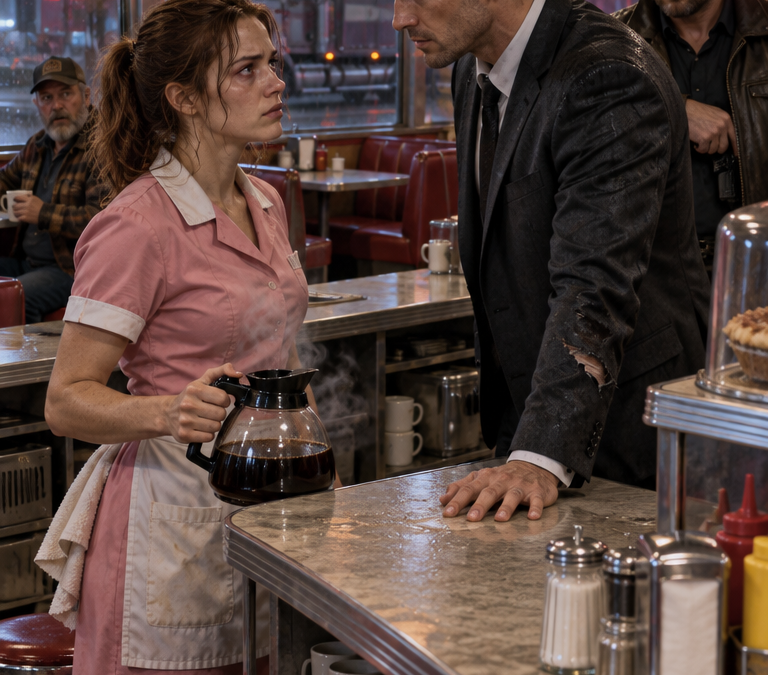
Most people would have stepped backward when Leonardo Costas entered Rusty’s that night.
Dora Mitchell had nowhere left to step.
She had been on her feet since noon, working the second half of another double shift beneath fluorescent lights that buzzed loudly enough to make headaches feel permanent. Her pink polyester uniform had faded around the collar. One shoelace was tied twice because the plastic tip had broken off months ago. Her back hurt, her wrists hurt, and the cheap non-slip shoes she had bought from a discount store had stopped pretending to provide support sometime before midnight.
Outside, November rain beat against the windows of the twenty-four-hour diner and dragged the red glow from Rusty’s neon sign across the parking lot.
Dora was wiping booth six for the third time because there was nothing else to do.
Two truckers sat at the counter. One elderly man had been asleep over a piece of apple pie for nearly twenty minutes. The cook had gone out behind the dumpster for a cigarette.
Dora’s mind was on numbers.
Rent.
Electricity.
Gas.
The notice folded inside her purse.
She had been calculating how many more shifts she could take before exhaustion became more expensive than poverty when the front door flew open hard enough to slam against the stopper.
The brass bell above it gave one frantic ring.
Cold air entered first.
Then three men.
The two truckers looked up.
One of them immediately placed cash beside his mug.
The other followed.
Neither waited for change.
They left through the side entrance.
Dora watched them go.
That was her first clue.
The second was the man in the middle.
Leonardo Costas was the sort of person ordinary people claimed not to recognize. His face had appeared in newspapers without charges ever seeming to stay attached to it. Businesses changed hands around him. Men who argued with him stopped appearing at familiar places. His name belonged to rumors, whispered warnings, and conversations that ended when strangers entered the room.
Tonight, however, Leonardo looked less like a legend and more like a man struggling to stay upright.
Rain had soaked the shoulders of his charcoal suit. His hair was wet and pushed back from his forehead. He held his left arm close to his body, the sleeve damaged and darkened around an injury.
Two guards followed him.
The taller one scanned the diner before the door had even finished swinging shut.
Leonardo walked to the counter and lowered himself onto a stool.
The vinyl creaked.
“Coffee,” he said.
Dora remained where she was.
His pale hazel eyes moved toward her.
“Black. And get the first-aid kit.”
Dora glanced toward the damaged sleeve.
“We don’t have a trauma kit.”
Leonardo said nothing.
“This is a diner,” she continued. “We have bandages, burn cream and a first-aid box nobody has opened since Clinton was president.”
His good hand struck the Formica.
The sugar dispensers jumped.
“I didn’t ask for an inventory.”
The larger guard stepped forward.
Dora stared at Leonardo.
Something inside her should have recognized fear.
Instead, exhaustion arrived first.
Seven years of late shifts. Seven years of being called sweetheart by men who never bothered learning her name. Seven years of landlords, overdraft fees, broken heaters, managers who changed schedules without warning and customers who treated kindness like a debt service workers owed them.
Dora turned toward the coffee burner.
She lifted the glass pot.
Then she walked back.
She did not pour.
“Stop shouting at me.”
Leonardo’s expression barely changed.
The guard’s hand moved inside his coat.
Dora saw it.
Her pulse accelerated, but her body did not.
She kept her eyes on Leonardo.
“You’ll get your coffee,” she said, “when you remember you’re not the only tired person in this room.”
The guard looked to Leonardo.
Leonardo did not look back.
He studied Dora instead.
His gaze moved across the worn collar of her uniform, the dark circles beneath her eyes, the coffee pot in her steady hand.
A strange sound escaped him.
A laugh.
It was brief and rough, as if even he had not expected it.
“Put it away, Dante.”
The larger man frowned.
“Boss—”
“Put it away.”
Dante’s hand came away from his coat.
Dora finally lowered the coffee pot.
Leonardo leaned against the napkin dispenser.
“You’ve got nerve, waitress.”
“My name is Dora.”
“Dora.”
“And this isn’t nerve. I’m tired.”
For the first time, one corner of his mouth shifted.
Dora turned away.
She found the old first-aid box in the supply closet along with clean bar towels, gauze and a roll of silver duct tape.
When she returned, Leonardo was holding the counter with white knuckles.
“Jacket off.”
His eyebrows lifted.
“You heard me.”
Dante helped him remove the rain-soaked coat carefully.
Dora saw enough of the injury to understand that it needed professional attention.
“You need a doctor.”
Leonardo picked up the coffee she had finally poured.
“I’ve had worse.”
“That isn’t the same thing as being fine.”
Dora cleaned and wrapped the injury as well as she could, keeping the process practical and quick.
When she was finished, the bandage looked crude.
The duct tape made it worse.
But it held.
“You need proper medical care,” she said.
Leonardo inspected the improvised wrap.
“Is that duct tape?”
“Yes.”
“You always use industrial supplies on customers?”
“Only the ones who scare off everyone else.”
Dante looked offended.
Leonardo almost smiled again.
He asked her why she had not run when they entered.
Dora washed her hands in the sink.
“I have two hours left on my shift.”
“That’s your reason?”
“If I close early, my manager docks me. If my manager docks me, my landlord doesn’t care that I had an exciting night.”
Leonardo went quiet.
He reached inside his jacket with his good hand, pulled out a money clip and removed several bills.
He slid them across the counter.
“For the floor.”
Dora looked down.
“I didn’t ask for that.”
“You didn’t ask for me either.”
He stood.
Dante placed the damaged coat over his uninjured shoulder.
They headed toward the entrance.
Leonardo stopped with one hand on the door.
“Make sure the coffee is fresh tomorrow.”
The bell rang once as he left.
Dora stared after him.
Then she returned to the counter.
Five hundred dollars sat beneath his mug.
She stood there for nearly a minute.
Then she sighed, picked up her rag and started cleaning.
She did not sleep that day.
Her studio apartment was three floors above a laundromat, and the radiator produced more noise than heat. A television played loudly through the wall. Pipes knocked. Someone’s dog barked down the hall.
The five hundred dollars remained on her nightstand.
Dora tried to convince herself she would not use it.
Then she noticed the final notice from the gas company.
By evening, the money was in her wallet.
When she returned to Rusty’s that night, every pair of headlights entering the parking lot made her shoulders tighten.
At two in the morning, she began watching the clock.
At 2:15, the bell rang.
Leonardo walked in.
No guards.
No damaged suit.
He wore a dark overcoat and moved stiffly on his injured side, but otherwise he looked exactly like the man people feared again.
He sat on the same stool.
Dora approached.
“You came back.”
“You sound disappointed.”
“I haven’t decided.”
“I told you to make fresh coffee.”
She poured him a cup.
He tasted it.
“Still terrible.”
“That’s free feedback. The coffee costs two dollars.”
Leonardo set the mug down.
“Dante wanted to come back earlier.”
Dora stopped wiping the counter.
“And?”
“He was offended.”
“I noticed.”
“He wanted to make the point that nobody talks to us that way.”
Dora rested both hands on the damp rag.
“Is that why you’re here?”
“No.”
“Why, then?”
Leonardo studied the steam rising from his cup.
“Because you didn’t flinch.”
Dora leaned against the pie case.
“You keep saying that like it means something.”
“In my world, everyone flinches eventually.”
“That sounds exhausting.”
“It is.”
There was no joke in his answer.
Leonardo asked whether he could use a quiet corner of the diner each night for about an hour.
He wanted somewhere his rivals would not expect him.
Somewhere ordinary.
Dora glanced around Rusty’s.
The cracked vinyl seats.
The humming refrigerator.
The broken letter on the neon sign outside.
“You chose well.”
“I’ll pay.”
“Coffee is two dollars.”
“Five hundred.”
Dora looked at him.
“A night?”
“Yes.”
“For sitting?”
“For being left alone.”
“That sounds suspiciously like renting a stool.”
“Then I’m renting a stool.”
Every practical instinct Dora possessed told her to refuse.
Five hundred dollars a night was also more than she earned in a week.
Rent was due.
The heater in her apartment barely worked.
Winter had arrived.
She folded her arms.
“You follow my rules in here.”
Leonardo raised an eyebrow.
“No shouting.”
He nodded.
“No frightening customers.”
Another nod.
“No treating me like staff you own.”
A faint smile.
“And if you make a mess, you pay for it.”
“I already learned that.”
That was how it started.
Night after night, Leonardo returned.
Sometimes he sat at the counter.
Sometimes booth six.
If he brought paperwork, he spread it across the table in neat stacks and worked in silence.
Dora never asked what the pages contained.
She did notice that he always sat where he could see the entrance.
She noticed the way he stiffened when unfamiliar cars remained too long in the parking lot.
She noticed that his phone could change his entire expression before he even answered it.
Most nights, he did not answer.
He would stare at the caller ID and let the vibration stop.
Then he drank his coffee.
At first, Dora hid his five hundred dollars in an old coffee can beneath her kitchen sink.
Then her landlord threatened to begin eviction proceedings.
She used one night’s payment for rent.
Another paid overdue utilities.
Another bought proper winter boots.
Poverty had always been loud.
Leonardo’s money made it quiet.
That frightened Dora almost as much as the man himself.
Three weeks into their arrangement, a drunk regular named Hayes stayed long after everyone else had left.
At four in the morning, Dora gave him his check.
He pushed it onto the floor.
“I want more coffee.”
“Machine’s being cleaned.”
“Turn it back on.”
“Go home, Hayes.”
When Dora bent to retrieve the check, Hayes caught her wrist.
His grip was too tight.
“Don’t get an attitude,” he said.
Dora immediately pulled against him.
Then a shadow covered the booth.
Leonardo stood beside them.
Dora had not heard him rise.
He looked at Hayes.
“Let her go.”
Hayes released her.
Immediately.
Leonardo did not raise his voice.
He did not need to.
Hayes stumbled out of the diner moments later.
Dora rubbed her wrist.
“You didn’t have to do that.”
Leonardo looked at the reddened skin.
“I know.”
“I had it handled.”
“I know that too.”
“Then why interfere?”
His eyes lifted to hers.
“Because you shouldn’t always have to.”
He returned to his stool.
Dora remained beside the booth.
Something changed that night.
She hated admitting it.
By January, Leonardo knew how she took her tea.
He discovered she hated Rusty’s house blend and appeared one evening with a box of Earl Grey.
Another night, a compact space heater appeared behind the register.
Dora plugged it in.
The cold draft that had bothered her for years vanished.
She did not thank him.
He did not mention it.
Leonardo also changed at the diner.
Outside Rusty’s, he was still surrounded by men who stood when he entered rooms.
Inside, Dora told him when his coffee had been sitting too long.
She complained about the broken jukebox.
She made fun of his refusal to eat apple pie.
He listened.
Sometimes he laughed.
Sometimes he simply looked tired.
Dora began anticipating the 2:15 bell.
She knew that was dangerous.
Then one Tuesday, Leonardo did not arrive.
Snow covered the streets.
At 2:30, Dora checked the clock.
At 2:50, she checked again.
At 3:10, headlights swept across the windows.
A battered SUV stopped outside.
Two men entered.
Dora knew immediately they were not customers.
“We’re closed.”
One man glanced toward the twenty-four-hour sign.
“No, you aren’t.”
“Kitchen is.”
“We’re not hungry.”
The second man walked toward the counter.
“We’re looking for Leonardo Costas.”
Dora’s stomach tightened.
Her expression did not.
“Never heard of him.”
The taller man smiled.
“Sure.”
He moved behind the counter line.
Dora stepped backward.
“Leave.”
Instead, he caught the front of her uniform and pulled her a few inches toward him.
“Maybe we wait.”
Dora’s hand moved beneath the counter toward the heavy ice mallet.
Then the front door flew open.
Leonardo entered with Dante behind him.
Dora had seen Leonardo angry before.
This was different.
Everything that followed happened too quickly for her brain to arrange neatly.
Leonardo crossed the diner.
The stranger holding Dora released her.
Furniture shifted.
Glass broke.
Dante rushed toward the second man.
The confrontation became loud and chaotic, forcing Dora backward toward the kitchen door.
She watched Leonardo move with a cold efficiency she had never seen during their quiet conversations at the counter.
For three months, Dora had managed to separate the man who drank her coffee from everything people said about him.
That illusion ended in less than a minute.
When the confrontation was over and the intruders had been removed, Rusty’s looked wrecked.
The front entrance was damaged.
The pie display was broken.
Food, glass and overturned furniture covered sections of the floor.
Dora stood behind the counter.
Her hands shook.
She found the broom.
Cleaning made sense.
Cleaning was normal.
She began sweeping.
“Dora.”
She ignored Leonardo.
The broom scraped against the floor.
“Dora, stop.”
“I have to clean this before the morning manager gets here.”
“I’ll pay for it.”
“That isn’t the point.”
“Put the broom down.”
“The pie case alone costs more than I make in—”
Leonardo reached gently toward the broom handle.
Dora flinched.
It was almost nothing.
A small backward movement.
A quick intake of breath.
Leonardo released the broom as if it had burned him.
He stepped away.
His hands opened at his sides.
“I’m sorry.”
Dora looked up.
The man who frightened entire rooms looked devastated by the possibility that she was frightened of him.
“I promised they wouldn’t get near you.”
“You didn’t send them.”
“They came because of me.”
“That isn’t the same thing.”
“To me it is.”
He removed a thick stack of cash and placed it beside the register.
“This pays for everything.”
Dora stared at it.
“There’s enough there for you to leave.”
“Leave what?”
“This job. This neighborhood. All of it.”
He looked toward the broken entrance.
“I will deal with the people who found this place. After tonight, you won’t see me again.”
Dora should have agreed.
She should have taken the exit he was offering.
Instead, Leonardo turned toward the door and something inside her rebelled.
“Leonardo.”
He stopped.
“Did you think I was stupid?”
He looked over his shoulder.
“I knew who you were the first night.”
“Knowing my name isn’t understanding my world.”
“I understood enough.”
“No, you didn’t.”
“I understood enough to say yes every time you came back.”
He turned fully.
Dora let the broom fall against the counter.
“You don’t get to decide I’m helpless because you feel guilty.”
“They came here because of me.”
“And I chose to let you sit here.”
“They threatened you.”
“And you stopped them.”
“I was late.”
“But you weren’t too late.”
The cold wind pushed through the damaged entrance.
Leonardo looked exhausted.
“This place was the only normal thing I had.”
Dora’s anger softened.
“And now?”
“Now it isn’t normal anymore.”
Sirens sounded several streets away.
Leonardo looked toward the windows.
His expression changed immediately.
“We need to go.”
Dora looked around Rusty’s.
“I can’t leave.”
“If you stay, you answer questions.”
“So?”
“Then your name becomes part of this.”
Dora understood.
The danger had reached the diner because of Leonardo.
Public attention would make that connection permanent.
Dante appeared at the entrance.
“We need to move.”
Dora grabbed her coat.
She hesitated.
Then she picked up Leonardo’s five hundred dollars from beneath his mug and shoved it into her pocket.
“Okay.”
They stepped into the snow.
A dark sedan waited at the curb.
Dante drove.
Leonardo sat beside Dora in the back.
The city passed outside in blurred orange light.
Dora still held the stained cleaning rag she had used at work.
Leonardo looked down at it.
Gently, he pulled it from her hand.
“You’re scared.”
“I left my job in the middle of the night with men everyone in the city is afraid of.”
“That wasn’t an answer.”
“Yes,” Dora said. “I’m scared.”
Leonardo nodded.
He took her hand.
The gesture was surprisingly ordinary.
“The shipyard office is secure,” he said. “You’ll stay there until this is finished.”
“Finished how?”
His expression closed again.
Dora decided she did not want details.
Twenty minutes later, they entered an industrial district lined with corrugated warehouses and stacked shipping containers.
The office Leonardo used looked more like an aging logistics company than the command center Dora had imagined.
Fluorescent lights.
Cheap desks.
File cabinets.
Coffee that smelled worse than Rusty’s.
Leonardo led her into a private room in the back.
A wall of security monitors displayed different properties around the city.
“Stay here.”
“You’re leaving?”
“I have to.”
Dora stepped closer.
“Don’t do anything stupid.”
That almost made him smile.
“I’ll bring the coffee tomorrow.”
Then he left.
Dora locked the door.
For the first hour, she paced.
During the second, she tried to drink the office coffee and immediately regretted it.
During the third, she sat in front of the wall of monitors.
The digital clock read 6:45 a.m. when the burner phone on the desk vibrated.
Dora stared at it.
Leonardo had left it behind.
She answered.
“Hello?”
Static.
Wind.
Then Dante.
“Dora?”
Her stomach tightened.
“You’re supposed to be outside.”
A pause.
“Listen to me.”
“Where is Leonardo?”
Another pause.
Dora stood.
“Dante.”
“We’re at the Southside warehouse.”
She looked toward the monitors.
“What happened?”
“They knew we were coming.”
“Where’s Leonardo?”
“He’s hurt.”
Dora’s hand tightened around the phone.
“How badly?”
“He can move, but not fast enough.”
“What do you need?”
Dante hesitated.
“You have the security feeds?”
Dora turned toward the wall.
Most screens showed the shipyard.
Several were labeled with locations she did not recognize.
One cluster read SOUTH DISTRICT TRANSIT.
“Yes.”
“Find the warehouse feeds.”
Dora moved to the desk and grabbed the mouse.
She expanded one camera.
Then another.
Rain covered the lenses.
Dark vehicles blocked several exits around a concrete warehouse.
People moved through the yard.
“I see it.”
“Bay four.”
Dora changed cameras.
A loading dock appeared.
“Got it.”
For the next several minutes, Dora did the only thing she knew how to do.
She observed.
She had spent seven years surviving dinner rushes by predicting where problems would appear before they actually did.
Which table needed coffee.
Which customer was about to leave.
Which order would bottleneck the kitchen.
Which cook was losing track.
The stakes were different now.
The skill was not.
Dora traced movement across the screens.
She identified an open route along one side of the property.
She relayed what she could see.
Dante made decisions on the ground.
Other men from the shipyard were dispatched to help them withdraw.
At one point, the warehouse lights went dark.
The screens changed exposure.
Figures moved quickly through the rain.
Dora found Leonardo among them because of his injured stride.
She watched him cross toward the extraction vehicles.
Several minutes later, Dante’s voice returned.
“We have him.”
Dora sank into the desk chair.
Her hands began shaking only after she knew they were moving away from the warehouse.
The danger ended before sunrise.
Not cleanly.
Not without consequences.
But Leonardo survived.
Dora spent the next three days inside a private hospital wing that smelled of antiseptic, linen and expensive flowers.
She slept in a chair more than once.
Dante appeared periodically with food, coffee and information.
The conflict that had followed Leonardo for months was finally over.
Dora did not ask for operational details.
She had learned enough already.
On the third morning, a nurse allowed her into Leonardo’s room.
He looked strange in a hospital bed.
Smaller somehow.
Human.
His shoulder was secured in a sling. One leg was immobilized. His face looked pale from medication and exhaustion.
His eyes, however, were clear.
Dora walked to the small kitchenette.
The hospital offered an impressive selection of tea.
She ignored it.
Instead, she carried over a plain ceramic mug of coffee.
Leonardo smelled it.
“That’s terrible.”
“I bribed someone in the cafeteria.”
“How much?”
“Twenty dollars.”
“You overpaid.”
“I know.”
She placed the mug beside him.
Leonardo reached for her hand instead.
Dora let him take it.
“Dante told me what you did.”
“I watched cameras.”
“You helped them find a way out.”
“I watched cameras.”
“You coordinated people who had been doing this longer than you.”
“Your employees apparently require better management.”
Leonardo laughed once, then immediately regretted it because of his injuries.
Dora pulled a chair closer.
His fingers remained around hers.
After a quiet minute, Leonardo said, “The diner is gone.”
Dora blinked.
“What?”
“I bought the building.”
She stared at him.
“You what?”
“And the empty lot beside it.”
“Leonardo.”
“The building was dangerous.”
“You bought my workplace?”
“Yes.”
“While you were in the hospital?”
“Technically Dante handled the paperwork.”
She pulled her hand away.
“You cannot buy everything that causes you stress.”
“I didn’t.”
“You bought Rusty’s.”
“That place had exposed wiring.”
“It had character.”
“It had mold.”
“You don’t know that.”
“I had it inspected.”
“When?”
“Yesterday.”
Dora stood.
“So what exactly am I supposed to do now?”
Leonardo watched her.
“Build a restaurant.”
She stopped.
“What?”
“A real one.”
“I’m a waitress.”
“You’ve run Rusty’s graveyard shift for years while the owner barely showed up.”
“That doesn’t make me a restaurant owner.”
“The deed does.”
Dora stared at him.
Leonardo continued.
“You choose the layout. You choose the equipment. You hire the staff. You decide the wages.”
“Whose name is on the company?”
“Yours.”
“No.”
His brow furrowed.
“No?”
“No hidden partners.”
“Fine.”
“No cash appearing in boxes.”
“Fine.”
“No meetings in the back room with people who frighten my customers.”
“Agreed.”
“No pretending it belongs to me while you actually control it.”
Leonardo’s expression changed.
“It belongs to you.”
Dora studied him.
“What do you get?”
“Coffee.”
She almost laughed.
“That’s it?”
“And possibly cherry pie.”
“You’re impossible.”
“I’ve been told.”
Dora sat again.
For seven years, she had worked inside businesses where she had no control over her schedule, wages or future.
Leonardo, of all people, understood that the thing she wanted most was not luxury.
It was agency.
He was not offering to hide her from the world.
He was offering her something of her own.
Dora looked down at his hand resting on the white hospital sheet.
“What happens when you need coffee at three in the morning?”
Leonardo’s mouth curved.
“I suppose I’ll have to know the owner.”
Dora leaned closer.
“You yell at my employees once and you’re banned.”
“Understood.”
“You frighten customers, you’re banned.”
“Understood.”
“You leave five hundred dollars beneath every mug, accounting is going to think we’re laundering something.”
That earned another small laugh.
Dora touched his jaw carefully.
The first time Leonardo Costas had entered her life, he had been soaked in rain and expecting obedience.
Dora had given him diner coffee and an argument.
Everything afterward had been built from that contradiction.
He had discovered a place where his name carried no privileges.
She had discovered someone who saw her exhaustion without mistaking it for weakness.
Neither of them had come through the winter unchanged.
The diner where they met would eventually be rebuilt into something brighter, warmer and entirely different from Rusty’s.
Dora insisted on durable floors.
Good coffee.
Reasonable hours.
Health insurance for full-time staff.
And wages high enough that nobody working there had to choose between heat and groceries.
She also kept one old ceramic mug from Rusty’s.
Leonardo recognized it the first night he visited the finished restaurant.
He sat at the counter after closing.
Dora poured black coffee into it.
He tasted it.
His eyebrows lifted.
“This is actually good.”
“Don’t sound so surprised.”
“I spent months drinking coffee that tasted like radiator water because you made it.”
“You came voluntarily.”
Leonardo looked around the restaurant.
Warm pendant lights reflected across the hardwood.
The staff had gone home.
Snow drifted past the windows.
“No,” he said quietly. “I came because it was the only place where nobody wanted anything from me.”
Dora leaned against the counter.
“That isn’t true.”
He looked at her.
“I wanted two dollars for the coffee.”
Leonardo smiled.
This time, nothing about the expression looked dangerous.
Dora set the pot down.
Outside, the city remained complicated, cold and unforgiving.
Inside, the old mug rested between them.
Dora had not become fearless.
She had simply spent too much of her life letting fear make decisions for her.
Leonardo had not become harmless.
He had finally learned that protecting someone did not mean deciding everything on their behalf.
Their lives would never be simple.
But the restaurant was hers.
The choice had been hers.
And when Leonardo Costas walked through the door late at night, he waited like every other customer until Dora decided his coffee was ready.