Six years after leaving home, Grant Whitaker returned to his late father’s 68-acre property and found a steel gate across the road his family had owned for 43 years. Lorraine Beckett stood behind three guards and told him, “You need my permission.” Then Grant noticed the HOA map said his father had surrendered the road in 2019.
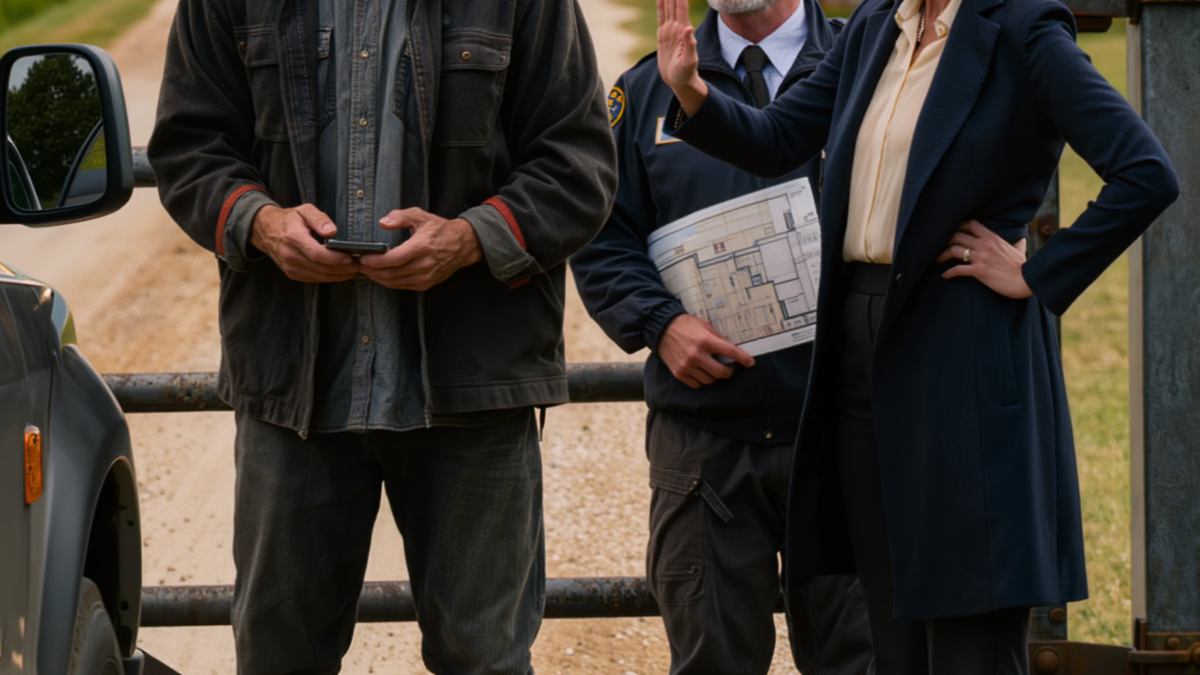
When Grant Whitaker turned off the county road and headed toward his father’s property for the first time in six years, he expected the place to feel smaller than he remembered.
That happened sometimes with childhood landmarks. Barns shrank. Fields narrowed. Roads that once seemed endless became ordinary stretches of gravel measured in minutes rather than summers.
What Grant did not expect was for the road itself to be gone.
He slowed his pickup.
Where the Whitaker family entrance had opened onto the county road for more than four decades, a wide steel gate now stood between two concrete posts. Security cameras watched from above. Electrical conduit disappeared beneath recently patched ground. Beside the gate, a professionally printed sign read RIDGEREST ESTATES — HOA CONTROLLED ACCESS — AUTHORIZED VEHICLES ONLY.
Grant stopped.
For several seconds he simply stared through the windshield.
Beyond the gate, he could see the same gravel road curving between the oaks.
Farther in, through a break in the trees, he could make out the faded tin roof of his father’s barn.
Nothing beyond the gate looked unfamiliar.
The gate itself looked impossible.
His father, Russell Whitaker, had bought the sixty-eight-acre parcel in 1983. Grant had learned to ride a bicycle on that road. He had driven an old pickup down it before he had a legal license. He had watched his father repair washouts after summer storms and spread fresh gravel before every winter.
Russell had died only a few months earlier after a brief illness.
The family had been given just enough warning to say goodbye, though Grant still carried the uneasy feeling that no amount of warning would ever have been enough.
Probate had been straightforward. There were no competing heirs, no disputed wills and no confusion about the property. Grant had returned expecting a few quiet weeks of practical work—sorting tools, checking fences, clearing the workshop and deciding whether the land should be kept or eventually sold.
Instead, he was staring at a gate he had never authorized.
Three men in dark security uniforms emerged from a small structure just inside the entrance.
The man in front raised one hand.
Grant rolled down his window.
“Good afternoon,” the man said. “Resident badge?”
Grant looked at him.
“I’m not a resident of Ridgerest.”
“Visitor authorization?”
“No.”
The guard glanced toward the gate.
“Then I’ll need written approval from the HOA president.”
Grant opened the truck door.
The other two men shifted slightly but did not approach.
“I’m Grant Whitaker.”
The name produced no visible recognition.
“This road leads to the Whitaker property.”
The guard nodded once.
“My name is Vernon Cole. I supervise security here.”
“Good. Then you can open the gate.”
Vernon did not move.
“I can’t do that without authorization.”
Grant pointed past him.
“You see that barn?”
Vernon followed the gesture.
“That’s my father’s barn. I grew up in the house behind it. This road is part of his property.”
Vernon’s expression remained professionally neutral.
“Mr. Whitaker no longer controls this road.”
Grant felt the first real shift inside him.
Not anger yet.
Confusion.
“What does that mean?”
Vernon walked back toward the security station and returned with a laminated map.
Grant took one step closer.
Ridgerest Estates had been built on land east of Russell’s property. Grant remembered bulldozers appearing there when he was younger, followed by curving streets, stone entrance pillars and houses with similar mailboxes.
The subdivision had never included Whitaker Road.
On Vernon’s map, however, the road had been shaded in the same color as Ridgerest’s common property.
Grant traced the line with one finger.
“Who authorized this?”
“Mrs. Beckett.”
“Who is Mrs. Beckett?”
“Lorraine Beckett. HOA president.”
Grant looked at the map again.
In the lower corner, beside the old parcel number, was a notation.
WHITAKER PARCEL ANNEXED 2019.
Grant read it twice.
His father had never told him anything about annexing the property into Ridgerest.
More importantly, Russell Whitaker had spent most of Grant’s adult life expressing his opinion of HOAs in blunt, consistent language.
Grant handed the map back.
“Does Mrs. Beckett have a deed showing she owns this road?”
Vernon hesitated.
“She has the paperwork she needs.”
That answer sounded memorized rather than known.
Grant could have argued.
Instead, he took out his phone.
He photographed the gate.
The concrete footings.
The cameras.
The electrical housing.
The sign.
The parcel notation on Vernon’s map.
Then he recorded a short video showing exactly where the gate stood in relation to the public road and the old family entrance.
Vernon watched him.
“You’re not authorized to record HOA facilities.”
“I’m standing on the public right-of-way.”
Grant saved the video.
Then he called the sheriff’s office.
Deputy Graham Tate arrived less than twenty minutes later.
A black SUV pulled in almost simultaneously.
A woman stepped out before the vehicle had fully settled.
She was in her mid-fifties, polished and composed, wearing a tailored navy coat that seemed too formal for a gravel roadside.
She walked directly toward Grant.
“Mr. Whitaker?”
“Yes.”
“I’m Lorraine Beckett.”
She stopped between him and the gate.
“You need my permission to pass through.”
Grant looked at her, then at Deputy Tate.
“Permission to enter my own property?”
Lorraine gave him a restrained smile.
“Your parcel no longer has independent access rights through this entrance. The road is managed by Ridgerest Estates.”
“That’s not what I asked.”
Her smile tightened.
“I’m explaining the current arrangement.”
Grant pointed toward the gravel beyond the gate.
“Show me the document that gives your association ownership of that road.”
“Our attorney can provide the appropriate records.”
“When?”
“In due course.”
Deputy Tate listened to both sides.
After several minutes, he explained that he could document the disagreement but could not determine property ownership on the roadside. If competing land records existed, the dispute belonged in civil court.
Lorraine seemed to treat those words as confirmation.
She turned to Vernon.
“Do not open this gate under any circumstance while I’m gone.”
Grant said nothing else.
He returned to his truck and drove away.
Before leaving, however, he enlarged the photograph he had taken of Vernon’s map and saved a close-up of the parcel notation.
Whitaker parcel annexed 2019.
That evening, Grant sat at the kitchen table of the small motel room where he was staying and studied the image again.
If the notation was legitimate, Russell had done something completely unlike him.
If it was false, somebody had gone to considerable effort to make it look routine.
The next morning, Grant drove to the Ridgerest management office.
Lorraine appeared unsurprised to see him.
She led him into a conference room and placed a thick folder on the table before he had fully sat down.
“You wanted documentation.”
Grant opened it.
Near the top was a document titled Consent to Annexation and Road Maintenance Covenant.
The date was 2019.
The signature at the bottom appeared to read Russell Whitaker.
According to the document, Russell had agreed to bring Whitaker Road under association jurisdiction, allow controlled access, permit the construction of security infrastructure and bind future owners to the same arrangement.
The language was formal.
The formatting looked professional.
For a moment, Grant understood why the guards had treated the situation as settled.
Then he reached the signature page.
Russell Edward Whitaker.
Grant looked up.
Lorraine was watching him.
“What?”
“My father’s middle name wasn’t Edward.”
She blinked.
“Excuse me?”
“Everett. Russell Everett Whitaker.”
“That could be a clerical error.”
Grant looked back at the document.
Maybe.
But his father’s full legal name appeared on every deed, tax record, bank document and insurance policy Grant remembered.
Then Grant noticed the property description.
Instead of the metes-and-bounds wording used in the Whitaker deed, the covenant referred to Ridgerest’s internal lot numbers.
A third detail followed.
The document repeatedly called the road West Ridge Access Road.
Grant had never heard Russell use that name.
To Russell, it had always been Whitaker Road.
Grant closed the folder.
“I want a copy.”
Lorraine immediately pulled it toward herself.
“Requests for association records must go through counsel.”
“You just showed it to me.”
“And you’ve seen what you requested.”
She slid a different form across the table.
“If your immediate concern is access, there is a temporary process.”
Grant read it.
He would have to register his license plate, provide twenty-four hours’ notice before each visit and acknowledge the HOA’s management authority over the road.
He placed the form back on the table.
“No.”
Lorraine folded her hands.
“Then you may have to wait until the ownership issue is resolved.”
Grant stood.
“That’s exactly what I intend to do.”
That afternoon, he met attorney Elise Marlo.
Elise practiced real-estate and property law and had spent years dealing with boundary disputes, title defects and access conflicts.
She listened without interrupting.
When Grant finished, she asked, “Do you know whether your father owned the road itself or whether he held an easement over somebody else’s property?”
“He owned it.”
“Let’s prove that before we assume anything.”
At the county recorder’s office, they began with the original deed.
The 1983 instrument described a sixty-eight-acre parcel and a forty-foot-wide strip extending from the public road to the farmhouse.
Elise traced the description on an old plat.
“This isn’t an access easement.”
“I know.”
“No. I mean legally. This strip is part of the parcel. Your father didn’t merely possess the right to travel over this road. He owned the ground.”
That changed the dispute.
If the original boundary remained valid, Ridgerest had installed a gate on land belonging to Russell.
But the records contained another problem.
The 2019 covenant Lorraine had shown Grant had actually been recorded.
Elise found the instrument number and requested the public copy.
Grant felt his confidence dip.
“So they really filed it.”
“Yes.”
“Does that make it valid?”
“It makes it dangerous.”
She turned several pages.
“Recorded does not mean unquestionable. But until we understand where this came from, we treat it seriously.”
They kept searching.
In 2022, Ridgerest had filed an “access improvement declaration” referencing the same road and expanding the association’s claimed authority over it.
Grant stared at the date.
Three years after the supposed consent.
Year by year, the paperwork had made the association’s claim look more established.
Elise closed the file.
“We need a certified survey.”
Grant nodded.
“And I need to know what my father knew.”
He found another route onto the land later that week.
The farmhouse was quiet.
A thin layer of dust lay on the kitchen counters. Russell’s old coffee mug remained upside down beside the sink where someone had washed it after the funeral.
Grant stood there longer than he intended.
Then he walked to the workshop.
His father had believed in records.
“Never trust a copy if you still have the original,” Russell used to say.
Grant opened filing cabinets.
Tax receipts.
Insurance renewals.
Equipment invoices.
Farm records.
Nothing about joining an HOA.
He searched for nearly an hour.
Then he remembered the storage locker.
It stood against the rear wall, gray steel with scratched paint and shallow drawers full of drill bits, bolts and old tools.
When Grant was a teenager, Russell had once shown him a narrow compartment hidden behind those drawers.
Grant had forgotten it existed.
He pulled the bottom drawer free.
The false panel was still there.
Behind it sat a metal document tube.
Grant carried it to the workbench.
Inside were old surveys, photographs, deeds and nearly twenty years of correspondence.
One envelope stopped him.
Across the front, written in Russell’s block handwriting:
KEEP FOREVER.
Grant opened it carefully.
The letter was addressed to the Ridgerest Estates Homeowners Association.
More than a decade before the supposed 2019 consent, the development had asked Russell for access across Whitaker Road.
Russell’s answer was unmistakable.
No.
He refused permission to gate the road.
He refused association control.
He refused any claim that the route could become common property.
Another certified letter from 2011 repeated the refusal.
There were receipts proving delivery.
Photographs of boundary markers.
Copies of tax payments.
Maintenance invoices.
The original deed.
Grant called Elise.
She arrived that evening.
For nearly two hours, they arranged the documents chronologically across the workbench.
“This is very good,” she said.
“It proves Dad never wanted their arrangement.”
“It proves he objected repeatedly. That matters. But the HOA will say he changed his mind in 2019.”
Grant looked at the disputed consent form.
“So everything still comes back to that signature.”
“Exactly.”
The following week, licensed surveyor Mason Greer met them at the entrance.
Lorraine was not there when he began.
Mason located one old marker beneath brush near the public road.
Then another.
He checked their relationship to the 1983 deed, measured the angles and repeated his measurements.
Grant waited.
Mason finally stood and looked toward the gate.
“That gate isn’t close to the property line.”
“How far?”
“About seventeen feet inside it.”
Grant followed his gaze.
Mason continued working.
Both camera posts were also inside the Whitaker boundary.
So was the gate-control housing.
Part of the fence.
And more than a hundred feet of buried electrical conduit.
The association had not merely closed access to Grant’s property.
According to the survey, it had constructed part of its security system directly on his land.
Mason began placing survey stakes.
Vernon arrived with several guards.
“You’ll need to stop.”
Mason handed him his credentials.
“I’m working for the landowner.”
“This is HOA property.”
“Then you should probably call whoever told you that.”
Lorraine arrived minutes later.
She walked toward the fresh line of stakes and stopped.
For the first time since Grant had met her, she did not immediately speak.
Then she pointed toward the markers.
“Remove those.”
Vernon looked at her.
“All of them.”
Grant stepped forward.
“Don’t touch the survey markers.”
Lorraine turned toward him.
“This is Ridgerest property regardless of what your contractor says.”
Grant gestured toward Mason.
“He’s a licensed surveyor.”
“He works for you.”
“Then prove him wrong.”
Lorraine took out her phone and called the sheriff’s department.
Sheriff Calvin Rhodes came personally, accompanied by Deputy Tate.
Calvin reviewed the deed.
He reviewed Mason’s credentials.
Then he studied the new boundary map.
Lorraine stood with her arms folded.
“Well?”
Calvin handed the papers back.
“I don’t see any legal basis to remove Mr. Whitaker or Mr. Greer from this location.”
Lorraine’s posture stiffened.
“They’re trespassing.”
“That assumes this is your property.”
“It is.”
“You haven’t established that.”
Lorraine went to her SUV and returned with a copy of the 2019 consent form.
She handed it to Calvin.
“This establishes it.”
Elise stepped beside him.
“Sheriff, would you note in your report that Mrs. Beckett presented that document as the basis for Ridgerest’s ownership and access claim?”
Lorraine looked almost relieved.
“Absolutely,” she said.
Grant glanced at Elise.
Later, after the sheriff left, he asked why she had done that.
“Because now there’s an official record identifying exactly which document they’re relying on.”
“You think that matters?”
“If that document has problems, it matters a lot.”
Mason completed his survey.
His final finding was clear.
One hundred percent of the primary gate foundation was inside the Whitaker parcel.
Elise filed for emergency court relief and demanded that the HOA preserve every document, email and record connected to the road.
Ridgerest resisted.
Eventually, it produced hundreds of pages.
Buried among them was a scanned version of the 2019 consent form.
Elise enlarged the notary block.
She noticed the commission number.
Then she checked it against the state database.
She called Grant.
“Where are you?”
“At the farm.”
“Sit down.”
Grant sat on the edge of his father’s workbench.
“What did you find?”
“The notary commission listed on the consent form expired fourteen months before the date the document says your father signed.”
Grant said nothing.
Elise continued.
“That does not automatically establish that the signature is false.”
“But?”
“But this document now needs a much deeper examination.”
Grant provided samples of Russell’s verified signature from tax filings, bank records and the original deed.
A forensic document examiner began comparing them.
Meanwhile, Elise traced how the consent form had reached the recorder’s office.
Russell had not filed it.
Neither had his attorney.
The filer of record was a representative of Ridgerest’s own management company.
“That’s unusual,” Elise said.
“Unusual enough?”
“Not by itself.”
They kept going.
Ridgerest board minutes from 2019 contained a vague closed-session entry:
WESTERN ACCESS ACQUISITION — EXECUTIVE SESSION.
There was no public explanation.
Three months later, the Whitaker consent appeared in the county records.
Six months after that, Ridgerest finalized a $310,000 agreement with a developer for western access rights.
The developer planned eleven additional home lots.
Marketing materials advertised private secured western access.
That access was Whitaker Road.
Residents also paid maintenance and gate fees connected to the route.
Grant drove to the public end of the road one afternoon and watched vehicles pass through the gate using a connector lane from Ridgerest.
Every few minutes another resident crossed ground Grant’s family still appeared to own.
Vernon approached.
“You can’t record HOA facilities.”
Grant kept his phone pointed down.
“Have you personally seen a deed showing the HOA owns this road?”
Vernon did not answer.
Grant looked at him.
“That wasn’t a difficult question.”
Vernon glanced toward the gatehouse.
“I follow the documentation I’m given.”
It was the first time he sounded less certain than Lorraine.
The association responded by increasing pressure.
Grant received a notice accusing him of violating community access rules and interfering with security personnel.
The fine was $2,500.
Elise stared at the page.
“You’re not a member of this association.”
A later notice raised the total to $6,750 and demanded that Grant sign a new access agreement within seventy-two hours.
He refused.
Then the construction records arrived.
Grant and Elise reviewed them in her office.
One set of drawings concerned the gate.
Elise checked the title block.
She pulled the 2019 consent form beside it.
Then she looked at Grant.
“The gate plans are older.”
“How much older?”
“Enough.”
Grant leaned closer.
The architectural drawings had been ordered before the date Russell supposedly gave Ridgerest permission to control the road.
The association had been planning the security structure before its central authorization document said authorization existed.
Lorraine maintained that Russell had verbally agreed.
She produced no witness.
The claim fit poorly with the certified letters in which he repeatedly objected.
It fit even more poorly with an $8,000 road-maintenance invoice Russell personally paid in 2021.
“If they controlled and maintained the road,” Grant said, “why was Dad still paying to repair it?”
Elise added the invoice to the file.
The court scheduled an expedited hearing.
Ridgerest’s attorney relied heavily on the 2019 covenant.
Elise presented the 1983 deed.
The certified survey.
Russell’s 2007 and 2011 refusals.
Tax records.
Maintenance invoices.
The expired notary commission.
The judge did not decide the entire case that day.
But he issued an immediate order preventing Ridgerest from obstructing Grant’s access, imposing additional fines or altering physical evidence.
Grant could pass through the gate.
Immediately.
Lorraine learned of the order before it was formally served.
Instead of waiting, she doubled the security presence.
Additional concrete barriers appeared.
A sign near the entrance now read:
GRANT WHITAKER — ENTRY PROHIBITED BY HOA ORDER.
Grant photographed it.
He and Elise later confronted Lorraine from the public side of the gate.
“Are you aware,” Grant asked while recording, “that the certified survey places this gate inside my property line?”
“I am aware of your survey.”
“And you increased the blockade after receiving notice of the dispute?”
“Yes.”
“Why?”
“Because your survey does not change the HOA’s authority.”
Elise said nothing until they were back in the car.
Then she looked at Grant.
“Save that recording in three places.”
The following morning, Grant returned.
Elise drove behind him.
Two sheriff’s patrol cars followed.
Lorraine was already at the gate with six guards.
Sheriff Rhodes stepped out carrying a certified copy of the court order.
Vernon approached him.
Calvin handed him the paper.
“This is a lawful order. Read it.”
Lorraine stepped closer.
“We intend to appeal.”
Elise answered.
“You do not have a stay.”
Lorraine looked toward Vernon.
“Keep the gate closed.”
Vernon read the order again.
Then he looked at her.
“You told us this land belonged to Ridgerest outright.”
“It does.”
“The order says ownership is disputed and Mr. Whitaker cannot be obstructed.”
Lorraine’s voice sharpened.
“I pay your salary.”
Vernon folded the document once.
“You don’t pay me enough to defy a court.”
He turned toward the gate technician.
“Open it.”
Lorraine moved toward the control panel.
Sheriff Rhodes calmly stepped between her and the equipment.
“Mrs. Beckett, don’t turn a civil dispute into something more serious.”
The gate rose.
Grant sat behind the wheel of his truck and watched the opening widen.
For the first time since returning home, nothing stood between him and his father’s road.
He drove forward.
No badge.
No form.
No permission.
The gravel crackled beneath his tires exactly as he remembered.
But the most consequential development happened after he passed through.
Vernon asked to speak privately with Sheriff Rhodes and Elise.
He carried a small external drive.
For weeks, he explained, he had been saving copies of certain instructions sent to the security team.
At first he had considered it ordinary recordkeeping.
Then some of Lorraine’s orders had become increasingly difficult to justify.
One archived email had been sent before the disputed consent form surfaced.
The sender was Lorraine.
Grant read the crucial line twice.
Whitaker never signed the original access proposal.
The rest of the message discussed securing the western road before the developer’s transaction closed.
Another message told staff not to provide the Whitaker family copies of road documents without legal review.
Then Vernon produced file-history information.
The digital record showed that the consent document had been created on a computer inside Ridgerest’s management office.
It had not arrived from Russell.
It had not originated with a Whitaker attorney.
Its creation history began inside the organization now claiming Russell had voluntarily given it authority.
Lorraine stood several yards away while Vernon handed the drive to Calvin.
For the first time, the problem was no longer simply Grant’s word against hers.
A member of her own security operation had preserved evidence from inside the system.
Investigators began reviewing the paper trail.
Russell had repeatedly refused access.
The developer needed a western entrance for expansion.
Ridgerest needed control of Whitaker Road to sell that access.
A consent form appeared when it became commercially valuable.
The developer paid $310,000.
The gate went up.
Fees followed.
A senior HOA board member, concerned about personal liability, eventually provided minutes from the 2019 executive session.
In those minutes, Russell was described as the “remaining obstacle” to western access.
There was no mention that he had agreed to anything.
Financial records showed the developer payment had helped fund the gate, cameras, connector road, consulting expenses and other association projects.
The implications spread far beyond a driveway dispute.
If Ridgerest never possessed legitimate access rights, it had accepted a substantial payment for something it did not own.
Lorraine tried shifting responsibility toward the outside management company.
But the emails carrying the most damaging statements came from her account.
Then Grant found another document in Russell’s tube.
It was dated 2020.
Another certified letter.
Russell demanded that Ridgerest stop encroaching on his property.
The delivery receipt bore a signature from someone working in Lorraine’s office.
At the next hearing, the judge reviewed the letter.
He looked toward the HOA attorney.
“Was Mrs. Beckett aware of this correspondence?”
The attorney requested time to speak privately with his client.
Grant sat across the courtroom and watched Lorraine.
He remembered the first morning at the gate.
You need my permission.
The court upheld Grant’s unrestricted right of access for the duration of the case and barred Ridgerest from collecting any additional fees tied to Whitaker Road.
The developer was notified that the western access rights it had purchased were under active litigation.
Ridgerest’s board convened an emergency meeting.
Lorraine was suspended from her position while an internal investigation proceeded alongside the examination of the 2019 document.
Grant still did not consider the matter finished.
A temporary order could expire.
A future board could attempt a different theory.
He wanted the property record itself settled.
Elise filed for quiet title, a permanent injunction and damages related to the unauthorized construction and obstruction.
The final hearing reduced years of confusion to a timeline.
Russell Whitaker purchased the sixty-eight-acre parcel, including the forty-foot road strip.
He formally rejected the association’s request to use the road.
He rejected another proposal.
Ridgerest needed western access for an expansion project.
A disputed consent document appeared in the county record.
Russell sent a certified letter demanding that the association stop encroaching.
He continued paying for road maintenance himself.
In later years, Ridgerest expanded the gate system and collected access-related fees.
Then a new certified survey established that the gate and supporting infrastructure sat inside the Whitaker property line.
Mason Greer testified about his measurements.
The true boundary ran outside the entire gate foundation.
Elise introduced the original deed.
Then Russell’s refusal letters.
Then the HOA’s internal records.
Then the email in which Lorraine herself had written that Whitaker had never signed the original access proposal.
Ridgerest’s attorney argued that years of continuous use might have created an implied right to the road.
Elise answered that the use had never been unopposed.
Russell’s letters documented objection after objection.
The judge issued the ruling.
The 2019 covenant had not created a valid claim over the Whitaker parcel.
Title to Whitaker Road belonged to Grant through an unbroken chain of ownership tracing back to the 1983 deed.
Ridgerest Estates HOA had no authority to require badges, permission forms or association compliance from the Whitaker property.
It could not rebuild a gate there.
It could not sell future access rights to developers.
It could not describe Whitaker Road as association common property.
The permanent injunction removed the ambiguity that had allowed the dispute to grow.
Ridgerest was also ordered to pay for removal of the physical infrastructure it had placed on Grant’s land.
The gate.
Cameras.
Electrical lines.
Associated structures.
Restoration of the road entrance would be completed at association expense.
Other financial claims would continue through the legal process, but one statement in the judgment mattered most to Grant.
The Whitaker parcel was not, and had never legally been, a member of Ridgerest Estates HOA.
Outside the courthouse, Lorraine walked toward the parking area.
Grant stood near the steps.
She tried to pass him.
He did not celebrate.
He did not mock her.
He said only, “My father told you no in 2007.”
Lorraine stopped.
Grant continued.
“You assumed nobody would be left who remembered.”
She looked at him for a moment.
Then she walked away.
About a month later, Grant stood beside Whitaker Road as a construction crew dismantled the gate.
The cameras came down first.
Workers opened the ground and removed electrical conduit.
Steel posts were separated from their concrete foundations.
The barriers Lorraine had ordered installed were loaded onto a flatbed truck.
By late afternoon, the entrance looked strangely wide.
Vernon came by during the work.
He no longer worked for Lorraine.
He shook Grant’s hand.
“I’m sorry about the first day.”
Grant looked toward the space where the gate had stood.
“You followed the documents you were given.”
“That doesn’t make it feel much better.”
“No,” Grant said. “But the problem started with whoever made those documents look trustworthy.”
Ridgerest’s new board later approached Grant about paying for continued use of Whitaker Road.
The association still wanted the convenient western connection.
Grant declined.
Not because he wanted to punish residents.
Not because he wanted a dramatic victory.
The answer had been given years before.
Russell had said no.
Grant intended to honor it.
Ridgerest residents returned to the development’s legitimate eastern route.
A few complained that the change added minutes to their commute.
When questions reached Grant, he showed them the boundary map.
“The association sold access to something it did not own,” he told them. “That isn’t a promise I can continue for them.”
Over time, the complaints faded.
Grant restored the entrance.
He did not install a towering electronic gate.
There was no guard station.
No camera system operated by Ridgerest.
Near the roadside, he placed one modest metal sign.
WHITAKER ROAD
PRIVATE PROPERTY
NO HOA AUTHORITY
Then he returned to the workshop.
The metal document tube lay open on the workbench.
Grant placed Russell’s letters back inside.
He added the updated certified survey.
The permanent injunction.
The quiet-title judgment.
He sealed the tube.
For years, Grant had teased his father about keeping everything.
Receipts.
Letters.
Old maps.
Certified-mail slips.
Documents other people would have thrown away after a few seasons.
Standing in the workshop after everything that had happened, Grant finally understood the habit differently.
Russell had not kept the papers because he expected a battle every day.
He kept them because memory weakens.
People move away.
Officials change.
Boards turn over.
Maps are redrawn.
A confident person can repeat an incorrect story often enough that newcomers begin treating it as history.
Paper, preserved carefully, does something else.
It waits.
Grant returned the tube to the hidden compartment.
Then he closed the steel locker.
Later that evening, he drove back toward the public road.
Where the gate once stood, only two faint patches of concrete remained.
He turned around.
Ahead of him stretched the old gravel road toward his father’s farmhouse.
No guard stepped out.
No one asked for identification.
No one called Lorraine Beckett.
No one told him that the road his family had owned since 1983 required somebody else’s permission.
Grant eased the truck forward.
For six years, he had been away.
During that absence, Ridgerest had redrawn a boundary on its internal maps.
It had built security infrastructure.
It had sold western access to a developer.
It had collected money from residents using a route that looked, after enough time, as though it naturally belonged to the subdivision.
The arrangement had lasted long enough to acquire the appearance of permanence.
Then Grant came home.
And buried beneath old workshop drawers was the history everyone else had assumed no one could still prove.
He drove past the faint concrete marks.
Gravel snapped beneath the tires.
The barn roof appeared through the trees.
For the first time since returning to his father’s land, the road ahead was exactly what Russell had always insisted it was.
Whitaker Road.