Six days after my husband died and three days after our daughter was born, my father set my packed bags on the hospital sidewalk and said, “Take the baby and leave.” I reached for my phone—then saw Ethan’s blue folder on his truck dashboard, already out of my hands.
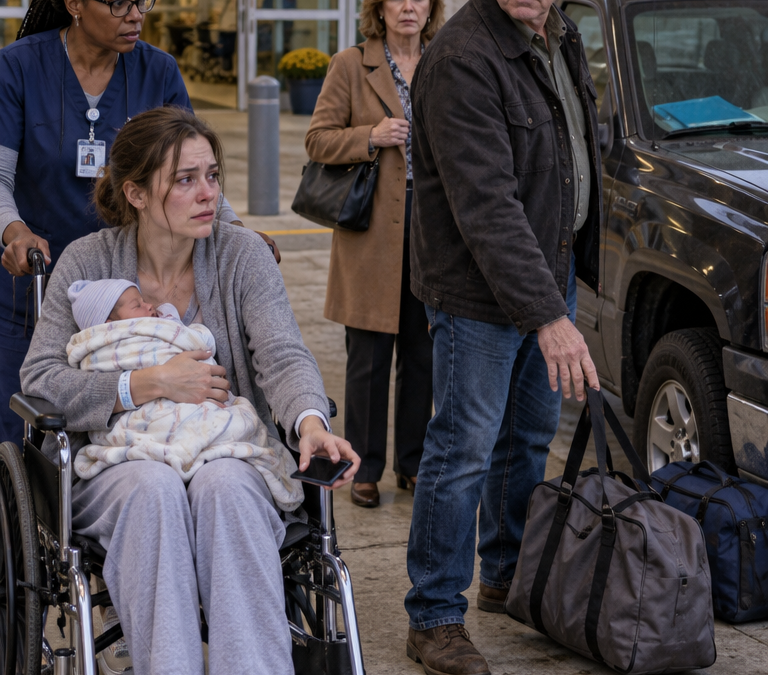
Six days after my husband died and three days after I gave birth to his daughter, my father met me at the main entrance of Blanchfield Army Community Hospital with my bags already packed.
He didn’t put them in his truck.
He set them on the concrete beside my wheelchair, one after the other, with the detached care of a man finishing a delivery.
“Take the baby and leave,” he said. “You’re not coming home.”
I was a widow of six days and a mother of three.
Ellie was tucked against my chest in a hospital blanket, warm and impossibly small. Moving still hurt from the surgery that had brought her into the world Friday night, and my car was twenty-five minutes away in my parents’ garage in Hopkinsville.
My mother stood one step behind my father with her purse already on her shoulder.
“A widow and her child aren’t our problem,” she said.
I didn’t answer.
I shifted Ellie carefully into my other arm, pulled the strap of the nearer duffel against the wheelchair footrest, and reached for my phone.
There was a contact in my favorites that Ethan had entered himself three weeks earlier while sitting on the nursery floor.
REYES — CALL FIRST.
Twenty minutes after I made that call, my father’s expression changed.
It wasn’t because two military police soldiers had walked into the hospital behind Captain Daniel Reyes.
It was because Reyes already knew about the blue folder lying on the dashboard of Dad’s truck.
He knew about the phone call my father had made on Saturday.
He knew what Dad had asked in our living room on Thursday.
And for the first time in my father’s life, he was beginning to understand that people he had treated like furniture had been listening.
To explain why I didn’t argue on that sidewalk, I have to go back to Wednesday morning.
I was thirty-eight weeks pregnant and sleeping on my parents’ couch because climbing the stairs had become uncomfortable. Ethan had been away on a field exercise at Fort Campbell, and I had been telling myself that two weeks wasn’t long.
At 7:40 that morning, I heard two car doors close outside.
Then footsteps.
Not hurried footsteps. That was what I remember.
My father reached the front door first.
Over his shoulder, I saw two men in dress uniform.
One was a captain I didn’t know.
The other was a chaplain.
The instant I saw the small cross on the chaplain’s collar, I knew.
Anyone who has loved a soldier learns that picture without wanting to.
You tell yourself for years that you will never be the person looking through a doorway at those uniforms.
Then one morning there they are on your father’s porch with dew still shining on the railing.
Dad turned and raised one hand toward me.
“Sit down, Karen. Let me handle this.”
He tried to step outside and pull the door partly shut behind him.
The captain didn’t follow.
“Mrs. Karen Brandt?”
He looked past my father directly at me.
Then he came inside.
He gave me Ethan’s full name and rank. He spoke plainly, the way people are trained to speak when the words themselves are already unbearable.
There had been a vehicle rollover during a night movement on the training area Tuesday.
Ethan had died.
My mother made a quiet sound behind me.
Then, almost under her breath, she said, “I told her.”
I don’t think she realized she’d spoken aloud.
The first words I heard myself say were, “Thank you for coming.”
I’ve thought about that many times.
My husband had just died, and somehow manners were what came out of my mouth.
The captain told me a casualty assistance officer would contact me within a day. Someone would help me through the paperwork, the memorial, the return of Ethan’s belongings, and everything I couldn’t yet imagine.
The chaplain asked whether he could pray with me.
I said yes.
I remember none of the prayer.
When they finished, I asked the only useful question my mind could find.
“Who do I call?”
The captain told me someone would call me.
I looked down.
My phone was already in my hand, and the screen had come on.
There, above Ethan’s name and Jenna’s, was the contact he had created.
REYES — CALL FIRST.
I turned the screen off.
I couldn’t make the call.
Not yet.
Calling would mean I had accepted that something had happened.
As long as I didn’t call, some tiny irrational part of me could keep pretending I had misunderstood the uniforms at the door.
My father walked the officers outside.
He stood on the porch with them for another minute.
When he returned, he closed the door, leaned his back against it, and said, “We’ll handle everything. You don’t worry about a thing.”
At the time, I heard comfort.
Later, I learned to listen differently.
Thursday afternoon, a gray government sedan pulled into the driveway behind my father’s truck.
Captain Daniel Reyes came inside with Staff Sergeant Dana Whitlock.
Reyes had been Ethan’s company commander.
I’d met him twice before, once at a company picnic and once at Ethan’s promotion ceremony. Both times he’d remembered my name before I reminded him.
Whitlock carried a folder.
She didn’t open it immediately.
Reyes sat near me with his cap in his hands.
He didn’t tell me how Ethan died.
Instead, he told me about a storm in March.
The generator at company headquarters had failed, and Ethan had spent two hours in rain gear with a flashlight between his teeth trying to get it running again.
He succeeded.
Forty people got a hot meal that night.
“Every company has one guy who fixes the generator,” Reyes said. “Mrs. Brandt, he was ours.”
That was when I cried.
Not when the men arrived at the door.
Not when I heard the words vehicle rollover.
A generator did it.
Whitlock waited until I could breathe normally again.
Then she explained her job.
She would help me with paperwork, Ethan’s personal effects, the memorial process and anything else that had to happen.
“Everything goes through you, Mrs. Brandt,” she said.
She looked directly at me.
“Nobody else.”
She placed her card on the coffee table.
My father had been standing behind an armchair the entire time.
He nodded through the story about the generator.
Then, when Whitlock finished explaining the process, he asked, “So what does the Army pay out for something like this?”
Nobody answered immediately.
Reyes looked at him.
Then he looked down at his hands.
Whitlock closed the folder she had barely opened.
“Those conversations are with Mrs. Brandt.”
“He’s just practical,” my mother said from the kitchen doorway.
She had a dish towel over her shoulder.
“Somebody in this house has to be.”
Dad shrugged.
“I’m only saying somebody’s going to have to be the adult about it.”
Whitlock asked whether Ethan had ever told me what he would want for his memorial.
Before I could answer, Dad said he’d already spoken to the pastor at the Baptist church in Hopkinsville.
The fellowship hall was available.
Whitlock didn’t write that down.
“We’ll talk about it when you’re ready, Mrs. Brandt.”
I looked at Reyes and did something I had been doing for my father since childhood.
I apologized with my face.
I’d done it in restaurants.
At school conferences.
In stores.
Any time Dad said something that made the room change, I became the person who silently told everyone else he didn’t mean it that way.
I hated myself for doing it then.
My husband was dead somewhere on that post, and I was still managing my father’s effect on strangers.
At the door, Reyes paused where my parents couldn’t hear.
“You have my number.”
“He put it in himself,” I said.
Reyes nodded once.
“Then use it.”
I watched their sedan back out.
Dad came to the window beside me.
“Officers,” he said. “They talk nice.”
That night my back began hurting in waves.
At three Friday morning, my water broke on my parents’ couch.
Dad drove me to Fort Campbell.
My mother sat in the back seat holding the hospital bag I’d packed two weeks earlier.
In a side pocket was Ethan’s blue folder.
At the gate, a soldier asked for identification.
Between contractions, I signed my parents onto a visitor pass.
The form called me their sponsor.
I labored for fourteen hours.
Late Friday afternoon, Ellie’s heart rate changed enough that the doctor told me we needed to go to the operating room.
One support person could come.
My mother stood.
She looked toward the double doors.
Then she sat down again.
“I can’t handle blood,” she said. “You know that about me.”
A nurse named Tasha came with me instead.
She was around forty, with reading glasses pushed into her braids and a voice that never hurried.
When I asked her to say my husband’s name, she did.
“Ethan.”
Then again.
“Ethan.”
She kept saying it quietly until I didn’t need her to anymore.
Eleanor Ruth Brandt was born at 7:52 Friday night.
Ruth was for Ethan’s grandmother, the woman who had raised him.
In recovery, Ellie lay on my chest while I whispered her name.
Under the chair by the bed sat my hospital bag.
The blue folder was still inside.
Exactly where Ethan had told me to keep it.
My father’s interest in money wasn’t new.
He had a rule when I was growing up.
He called it fairness.
When I was nineteen and started earning a real paycheck answering phones at a dental office, Dad sat me at the kitchen table and told me every adult living under his roof contributed to the household.
My contribution would be $400 a month.
He wrote the bank information on a sticky note.
I set up an automatic transfer.
For the next five years, I entered that account information into enough banking systems that I memorized the final four digits.
The house account.
My younger brother Cody paid nothing.
There was always a reason.
He was finding his direction.
Then he worked for Dad.
Then his situation was different.
Whenever I noticed the difference, my mother had the same response.
“Karen, why do you always have to count?”
Because no one else was counting for me.
Still, I want to be fair about my parents.
They fed me.
Clothed me.
Drove me to swim practice.
There are homes where $400 a month would have been nothing compared with what a child owed.
What stayed with me wasn’t the amount.
It was being the child who paid and still being called ungrateful for noticing that my brother didn’t.
When I was twenty-two, I decided to file my own taxes for the first time.
I was taking classes in medical billing at the community college and trying to become more independent.
My return was rejected.
Someone had already claimed me as a dependent.
I put the printout in front of Dad while he ate dinner.
“It’s all one pot,” he said.
He never looked away from his plate.
“I’ve never lost a dollar of this family’s money, and I’m not starting because you got a certificate.”
“I pay rent here, Dad. You can’t claim someone who’s paying you rent.”
Mom put her hand over my wrist.
“Your father does the taxes. That’s how it works in this house.”
I didn’t win that argument.
Instead, I did something quieter.
I finished my medical-billing program.
Then I got a job coding insurance claims for a pediatric clinic in Clarksville.
It was work where one wrong number could cost a family real money.
I became very good at reading forms.
And I made myself a rule.
I would never again sign anything without keeping a copy.
I still paid Dad another two years.
Because if I stopped, I would become the difficult one.
I’d learned young how expensive that role could feel.
Ethan was the first person who ever asked me why I kept doing it.
My parents never forgave him for that.
Our rehearsal dinner was held in the back room of a steakhouse in Hopkinsville.
Ethan wore his only civilian suit.
His grandmother Ruth had come down from Ohio in a wheelchair wearing a purple blouse she’d bought for the occasion.
Before the salads arrived, my mother stood with her wine glass.
She thanked everyone for coming.
Then she smiled.
“I’ll just say what every mother of a soldier’s bride is thinking. Soldiers make widows. I hope I’m wrong.”
The whole table went quiet.
Ethan smiled.
He had a talent for taking an insult as if someone had commented on the weather.
“Then I’ll work on not dying, ma’am.”
My uncle Ray laughed too loudly.
Conversation resumed.
But Ethan got quiet.
After dessert, Dad took him onto the patio.
Through the window, I watched my father talk with both hands while Ethan listened with his hands in his pockets.
Later, Ethan told me the questions.
How much did a sergeant make?
What was his housing allowance?
Who handled the money in our marriage?
“Karen does,” Ethan had answered. “She’s better at it than I am.”
Dad had looked at him for a moment.
“We’ll see.”
Back at the table, Ruth reached across and covered my hand with hers.
Her rings had become loose on her fingers.
“Well, I’m a soldier’s widow,” she said loudly enough for my mother to hear. “And I raised a good one.”
Mom smiled politely.
In the parking lot later, Ethan and I sat in the car with the engine off.
“Your parents look at you like an account,” he said.
“They’re old-fashioned.”
“Okay.”
He didn’t argue.
That was one of the things he did best.
He waited.
Then he said, “Stop paying them.”
I told him it wasn’t that simple.
“I know.”
A month after the wedding, I canceled the automatic transfer.
Mom didn’t speak to me for five weeks.
When she finally called, her first question was whether the Army was making me behave differently.
That became the shape of our relationship for the next three years.
Which was why, when I reached thirty-four weeks pregnant and my mother called saying, “Come home. We’ll take care of you,” I wanted to believe her.
Ethan had a two-week field exercise coming.
By the time he left, I’d be thirty-six weeks pregnant.
“You can’t be alone out there,” Mom said.
Out there was our duplex on post, twenty-five minutes from her house.
“Come home. Cody will clear out his room. We’ll take care of you.”
I repeated those words to Ethan that evening like they were evidence of a miracle.
We’ll take care of you.
He was on the nursery floor assembling the crib.
He didn’t respond immediately.
“Two weeks is a long time to owe them,” he finally said.
“They’re trying, Ethan. Let them.”
He looked at me.
Then at the crib pieces.
“All right. One thing.”
He stood and went to the kitchen drawer.
He returned with the blue folder.
“This goes in your bag. Your bag, not their house. It stays with you.”
“Fine.”
I didn’t ask why.
Part of me already knew.
Our life on Fort Campbell had taught Ethan more about my family than I liked admitting.
We lived in an older duplex with two bedrooms, a carport, and a kitchen window that faced the Alvarez family’s window across the shared driveway.
Jenna Alvarez became my friend almost immediately.
Her husband Marcus was Ethan’s squad leader.
Jenna had two young boys, an enormous laugh and nine years of experience with military life.
Within weeks, she had taught me which commissary lines to avoid on payday and which rumors were worth ignoring.
I worked from our second bedroom.
Ethan would come home smelling faintly of diesel, sit on the floor while I finished coding claims, and say almost nothing.
He didn’t fill rooms.
He steadied them.
During our second year of marriage, Ruth died in Ohio.
She had been Ethan’s last close relative, the woman who raised him after his mother could no longer do it.
Eleven people came to the graveside.
Four were soldiers from Ethan’s unit who had taken leave and driven seven hours without being asked.
My parents mailed a card.
After that, many holidays were spent with the Alvarezes.
My parents’ Thanksgiving invitations had a habit of becoming “just family this year.”
My parents visited our duplex exactly once.
Dad stood in the living room, listened to a neighbor’s television through the wall and asked Ethan when he planned to “get out and do something real.”
“I am doing something real,” Ethan said.
Dad laughed.
Ethan didn’t.
Then I became pregnant.
Ethan bought a crib in a flat box and spent three weekends fighting with the instructions.
When it was finished, he used his pocketknife to carve two letters into the inside of the headboard, low enough that no one would see them unless they were lying on the floor looking upward.
E and K.
During my seventh month, he came home with a stack of paperwork.
He laid it across the kitchen table between the salt and pepper.
“This one tells them who to call if something happens,” he said.
He tapped another page.
“This is the life insurance.”
My name was listed on both.
“You’re the only name. Nobody changes that except me, in person, in front of someone authorized to change it. Not your dad. Nobody.”
“I don’t want to talk about this.”
“I know. That’s why we’re doing it.”
I was angry with him.
Not because he was wrong.
Because he was calmly explaining how I would survive if he didn’t.
Finally, I asked the only question that made the subject feel manageable.
“Where are my copies?”
He laughed.
Then he pulled the blue folder from beside his chair.
“Already made them.”
Inside was a casualty-assistance business card and copies of everything.
“Keep this somewhere you’d find it half asleep,” he told me. “And Karen—if somebody ever tells you they’ll handle the paperwork for you, that’s the day you get this folder out.”
I put it in a drawer.
I didn’t open it again until the night before he left for the field.
That Sunday, after the crib was finished, Ethan lay on his back on the nursery floor and inspected the underside.
“Quality control.”
I sat in the glider with my feet against his shin.
He held up one hand for my phone.
I gave it to him.
He typed something.
When he handed it back, a new favorite contact appeared.
REYES — CALL FIRST.
“If anything happens, call him first,” Ethan said. “Before your dad. Before anybody.”
“Nothing happens at Fort Campbell.”
That was what everyone said about training.
Ethan went to the kitchen and came back carrying the folder.
He also had a sealed white envelope with my name written across it in his square block lettering.
He slid it behind the copies.
“Don’t open it unless—”
“I hate this folder.”
“Good. Hate it in your bag.”
We stayed in the nursery.
He asked again whether we were set on the baby’s name.
“Eleanor if it’s a girl.”
“Ruth in the middle.”
“I decided that a month ago.”
He laughed from the floor with his hands behind his head.
When I get to choose the image of him I remember, that’s the one.
The next morning, he drove me to Hopkinsville.
He carried my bag into my parents’ house himself.
Dad met him near the door.
“We’ve got her,” he said.
Mom hugged me and promised to make sure I ate.
She was warm that morning.
I need to say that because it was true.
My mother could be warm.
The problem was that the warmth usually lasted only until it cost her something.
Ethan kissed my forehead in the driveway.
“Two weeks.”
I watched his truck turn at the end of the street.
That was the last time I saw him.
He left Monday.
On the last night of the field exercise, the vehicle rolled in the dark.
The next Wednesday, two uniforms appeared on my father’s porch.
And on Saturday morning, my father opened the bag Ethan had personally carried into that house.
I was still on strong medication after Ellie’s birth.
My parents arrived around ten with coffee for themselves.
Dad went through my bag looking for a phone charger.
He pulled out the blue folder instead.
He stopped.
He read the writing across the front.
“I’ll keep this safe.”
“The copies—”
“You’re on medication. You don’t need to be responsible for paperwork.”
I let him take it.
The same way I had let the tax return go.
The same way I’d kept paying rent after I knew the system wasn’t fair.
Dad sat closer.
His voice changed into the one he used when closing a sale.
“Here’s what’s going to happen. You’re coming home with us. I’ll deal with the Army people. Money like this brings out scammers. You’re in no shape to handle any of it.”
Mom said Cody was moving into the basement.
His room would be mine.
I cried.
I wish I could say I didn’t.
But after twenty-seven years of wanting my parents to take care of me, the words coming home broke through every defense I had.
A nurse brought discharge-planning forms and Ellie’s birth-certificate worksheet.
I wrote Ethan’s name on the line for her father.
Then I asked for copies.
“Of course,” the nurse said.
Dad laughed.
“See? She’s not thinking straight. She wants copies of everything.”
The nurse looked at him.
Then at me.
She returned with my copies and placed them directly in my hand.
Later, Dad stepped into the hallway and made a phone call.
I assumed it was Uncle Ray.
The next morning, Sergeant Whitlock arrived alone.
She didn’t sit down.
“Before we start, there’s something you need to know.”
My stomach tightened.
“Your father called yesterday. He said you’d asked him to handle things while you recovered.”
She paused.
“He gave me an account number for the first payment.”
“What did you say?”
“I told him I only take that information from the beneficiary.”
“What number?”
Whitlock read it.
I knew it immediately.
The house account.
“Is that your account?”
“No.”
“Do you have access?”
“No.”
“Whose is it?”
“My parents’.”
She asked for the account Ethan and I had opened after our wedding.
I gave it to her.
She read the numbers back.
I confirmed them.
Then I signed.
Whitlock handed me a copy without being asked.
I held onto it.
“Did he ask anything else?”
She chose her words carefully.
“He asked whether the life insurance could be redirected to family if the beneficiary wasn’t in a condition to manage it.”
She gave no opinion.
She didn’t need to.
Then she explained that the housing office would let me remain in the duplex while I decided what came next.
The memorial would happen on my timeline.
Ethan’s belongings would be inventoried and released to me.
“Only to you,” she said.
She repeated it.
At the door she stopped.
“Captain Reyes asked me to make sure that anything requiring a signature gets signed by you.”
Then she said something I’ve never forgotten.
“You don’t have to decide anything today. But you should know who’s asking questions.”
After she left, I stared at the place where my blue folder had been.
Then I rearranged my father’s sentences.
We’ll handle everything.
I’ll deal with the Army people.
She’s not thinking straight.
Put them in that order, and coming home changed shape.
It no longer looked like fresh sheets and a bedroom waiting for me.
It looked like a bank account.
I didn’t become angry.
I became clear.
Nobody was going to sign for Ellie except me.
Nobody was going to move Ethan’s money except me.
I texted Jenna.
Are you around tomorrow? Might need a ride. Might not.
She replied almost immediately.
I’m around. I’m always around.
When my parents returned that evening, they brought a casserole dish and a manila envelope.
Dad spread papers across the tray holding my dinner.
The first was a generic power-of-attorney form.
The second was from my bank.
I recognized it instantly.
A form for adding another person to an account.
“Whitlock tells me you gave her your own account number,” he said. “That’s fine. That’s your right. But you’re going to add me here.”
He placed a pen on top.
“Can we talk about this when I’m home?”
I heard the old version of myself in my voice.
“We talk about it now,” Dad said.
Mom sat on the edge of my bed.
“Your father has never lost a dollar. Ethan’s gone, honey. Who’s going to look out for you now?”
She dismissed Jenna as “some sergeant’s wife across the driveway.”
Dad moved to the memorial.
He had already spoken to the pastor again.
Saturday after next.
Fellowship hall.
Family handling the food.
“The Army can send whoever it wants.”
“Ethan wanted—”
I stopped.
I didn’t know exactly what Ethan wanted yet.
Dad leaned forward.
“Ethan isn’t here. That’s the whole point of this conversation.”
Then he softened.
He told me if I signed, he would put the first payment into a certificate of deposit for Ellie.
Locked away for college.
He said I wouldn’t have to worry about bills.
I could recover.
I could be a mother.
He sounded loving.
That was what made it dangerous.
My hand actually moved toward the pen.
There is a version of me who signs those forms.
She isn’t stupid.
She’s a woman who has spent her entire life waiting for her father to say, “I’ll take care of it,” and finally mean it.
My hand stopped.
“I’ll think about it.”
Dad watched me.
Then he stood.
“We’re leaving at ten tomorrow. Decide by then.”
They left the paperwork behind.
At ten that night, my brother texted.
Dad’s been talking about the money since Wednesday.
He told Uncle Ray it could clear the shop loan.
Mom said if you don’t sign you can figure it out yourself.
Don’t tell them I told you.
My father’s heating-and-air business had been slowing down for a year.
I’d noticed without asking questions.
Now the whole thing made sense.
The money wasn’t abstract to him.
He had already assigned it a job.
It would rescue his business.
And if I refused, my parents intended to leave me at the hospital.
I took a screenshot.
Then I opened my favorites and stared at Reyes’s name.
I still didn’t call.
I wanted to give my parents one last chance.
If they came in the morning, loaded my bags into the truck and took me home without another demand, I could tell myself Cody had misunderstood.
I could preserve some version of them.
Around 10:30, I typed:
Okay. I’ll sign.
I stared at the message.
I didn’t send it.
The reasons to send it were real.
I couldn’t drive for two weeks.
I had a newborn.
The duplex was full of Ethan.
His boots were still by the door.
Every feeding, every fever, every three-in-the-morning cry would be mine alone.
My mother had asked the question that frightened me most.
Who’s going to look out for you now?
Tasha came on for the night shift.
She found me holding my phone while the unsigned forms sat on the tray.
She didn’t ask what they were.
Instead, she picked up the baby carrier I’d been struggling with and showed me how to work the buckle one-handed.
I tried.
Failed.
Tried again.
The second time I got it.
“You’ve got the hands for it,” she said.
Such a small sentence.
But at midnight, three days after becoming a mother and six days after becoming a widow, a stranger telling me I was capable mattered more than I can explain.
Tasha glanced at the paperwork without touching it.
“I’ve been on this floor eleven years,” she said. “I’ve seen a lot of people get wheeled through that door. You learn who shows up for the hard part.”
Then she dimmed the lights and left.
I deleted the text to Dad.
Not courage.
Arithmetic.
If I signed that document, I would spend the rest of my life paying rent to my father in one form or another.
Only this time, the money would be Ethan’s.
And Ellie would grow up watching me teach her that daughters existed to surrender what was theirs.
I called Jenna.
It was nearly eleven.
She answered on the first ring.
I told her everything in the wrong order.
The paperwork.
The deadline.
Cody’s text.
The folder.
She listened.
Then she said, “Marcus put the car-seat base in my van Friday morning.”
“What?”
“Before we knew whether you’d had a girl or boy. He said you’d need it and wouldn’t ask.”
“I might not need it.”
“Then I’ll sit in the parking lot for nothing. I’ve done worse for less.”
I laughed.
It surprised me.
Then she asked, “Karen, what do you actually need from your parents’ house?”
I thought about it.
“My car.”
“Anything else?”
Ellie’s things could be replaced.
Nothing else there belonged to me.
I had lived in that house for twenty-four years and couldn’t think of one thing I would return for.
After we hung up, I messaged Sergeant Whitlock.
I asked a procedural question.
If I withdrew my parents’ visitor sponsorship, what would happen?
They would no longer have authorization to remain on post.
Security could escort them to the gate.
Do you want me to do something?
Not yet.
I might not need it.
Whitlock replied that Reyes would be at battalion headquarters all morning.
If it came to that, he would want the call directly from me.
I lay awake putting things in order.
Reyes first.
Jenna second.
And I needed the folder back before Dad’s truck left the parking lot.
I moved every document I’d signed into the inner pocket of my bag.
Then I put that bag on the far side of the bed where anyone reaching for it would have to reach across me.
It wasn’t much.
It was the first thing I had deliberately hidden from my parents.
I slept two hours.
At five, Ellie woke to eat.
While I held her, I practiced one sentence into the top of her head.
Again.
Again.
Until it sounded like mine.
At 9:30, Mom entered carrying two duffel bags.
Dad followed empty-handed.
The bags contained my clothes, laptop, toiletries and charger.
The tiny sleepers Mom had bought were missing.
So were the diapers.
She noticed me looking.
“Those stay at the house. For when you visit.”
Visit.
That one word told me the plan.
Tasha came in with the discharge checklist.
Before she finished, Dad announced, “She’s coming home with us. I’ll be managing her affairs from here on.”
Tasha finished writing.
Then she looked at me.
“Ma’am, where would you like to go?”
“I’ll let you know at the door.”
Dad waited until she stepped out.
“So you’ll sign?”
“No.”
My voice was smaller than I wanted.
He didn’t raise his.
He became calm.
“Then I guess we’re just here for the ride.”
Mom picked up her purse.
She did not pick up Ellie.
An orderly brought the wheelchair.
Tasha tucked the discharge papers beside me.
We went down in the elevator together.
Mom stared at the doors.
“You’ll come to your senses before we hit the highway. You always do.”
I held Ellie closer.
Through the lobby glass, I saw Dad’s truck.
On its dashboard sat a square blue object.
My folder.
The automatic doors opened onto cool October air.
Dad walked past the passenger door.
He didn’t open it.
He placed one duffel on the concrete.
Then the second.
“Take the baby and leave,” he said. “You’re not coming home.”
Mom stood behind him.
“A widow and her child aren’t our problem.”
Three years earlier, she had used widow like a warning at my rehearsal dinner.
Now she used it as a reason.
And something strange happened.
It didn’t hurt as much as I had expected.
It hurt.
But I’d already lived the scene in my head.
They were the ones arriving late.
I shifted Ellie.
Pulled my bag closer.
Opened my phone.
Reyes answered on the second ring.
“Captain Reyes, this is Karen Brandt. I’m at the Blanchfield main entrance. My parents are on post under my sponsorship. I’m withdrawing it.”
A pause.
“My father has Ethan’s folder on the dashboard of his truck.”
I heard movement on his end.
A door.
Footsteps.
“Stay inside the lobby. Twenty minutes. Don’t get in the truck.”
“I won’t.”
I ended the call.
Dad watched me.
“Who was that?”
“Ethan’s captain.”
He gave a short laugh.
“Good. Let him drive you.”
I asked Tasha to take me inside.
She did.
My parents followed.
Dad bought coffee from the kiosk and sat across from me.
Mom stood at the windows with her arms crossed.
“You’re embarrassing us in front of the whole hospital.”
I fed Ellie under a blanket and watched the clock.
Ten minutes.
Fifteen.
Dad sipped his coffee.
At seventeen minutes he said, “Ten more and we’re gone. And don’t call us after that. Not for money. Not for a ride. Nothing.”
Mom turned from the window.
“Gary, tell her about the truck.”
Dad put down his cup.
“There’s a folder on my dashboard that says who to call and what you get. You come home, we open it together like a family. You don’t, it goes in the shop safe with the rest of the paperwork.”
There it was.
Spoken plainly.
I said nothing.
For twenty-seven years, silence had belonged to my father.
Now it belonged to me.
At eighteen minutes, he stood and took his keys from his pocket.
Behind me, the automatic doors opened.
His expression changed before I turned around.
Captain Reyes walked in wearing his duty uniform.
Two military police soldiers came behind him.
Sergeant Whitlock followed carrying a clipboard.
Reyes came directly to me.
He crouched so we were eye level.
He looked at Ellie first.
“Mrs. Brandt, you asked for me.”
“I did.”
He stood.
“Mr. Hollis.”
My father’s keys remained in his hand.
“Mrs. Brandt has withdrawn your visitor sponsorship. You and Mrs. Hollis are now on the installation without a sponsor. These soldiers will escort you to the gate.”
“She can’t do that.”
Dad’s voice came out too loudly.
He lowered it.
“She can,” Reyes said. “She did.”
The MP sergeant moved one step sideways, making the route to the door obvious.
Then Reyes continued.
“Mrs. Brandt also tells me you’re holding a folder that belongs to her. It’s on your dashboard.”
Dad stopped moving.
Reyes added, “Sergeant Whitlock told me about your phone call Saturday. And I was in the room Thursday.”
I watched my father process the timeline.
Thursday.
Saturday.
The truck.
He had asked about money in front of Reyes.
He had given my parents’ account number to Whitlock.
He had put the folder on his dashboard in full view.
He had assumed every person in uniform would stay in the room where he left them.
My mother turned toward me.
“What did you tell them?”
Whitlock raised her clipboard slightly.
“She gave me her account number, ma’am. That’s all she needed to tell me.”
Dad changed strategies.
“Captain, with respect, my daughter isn’t competent to make decisions right now. She had surgery three days ago. She’s medicated. She’s grieving. I’m her father. I’m her next of kin.”
Reyes didn’t move.
“Her husband was her next of kin, Mr. Hollis. He named her on his paperwork. He signed those forms himself.”
He glanced toward Whitlock.
“She signed her own paperwork yesterday. None of it names you.”
The generic power of attorney upstairs suddenly seemed exactly what it was.
A printout with a blank signature line.
Dad shifted his weight.
“I raised her.”
“I understand.”
“Twenty-four years under my roof. I know what’s best for her.”
“I understand she’s the one who called me.”
Mom stepped forward.
“We’re her parents. We have rights.”
“Not on this installation, ma’am. Not today.”
Dad looked at me.
“Karen.”
I knew that tone.
Tell everyone you’ve overreacted.
Tell everyone Dad is still in charge.
“Tell them this is a misunderstanding.”
I said the sentence I’d practiced at five that morning.
“Give them the folder, Dad.”
Quietly.
The MP sergeant looked toward the doors.
“Sir. Your vehicle.”
Mom started.
“After everything we’ve done for you—”
Then she stopped.
She looked down at the duffel bags.
The ones she had packed.
The ones she had carried into the hospital that morning.
Dad tried one final argument with Reyes.
“I was protecting her from exactly this. People in uniform circling a check.”
Reyes answered without changing expression.
“Then you’ll be glad it’s in her name.”
Something shifted.
Tasha walked around Dad as though he were simply an obstacle in the hall.
She bent toward me.
“Ma’am, where would you like your bags?”
“Right here. My ride is coming.”
The younger soldier picked up both duffels.
He placed them beside my wheelchair.
For once, Dad stood in a room where another person’s answer mattered more than his.
The MP sergeant accompanied him outside.
I asked Tasha to take me behind them.
Dad opened the driver’s door.
He reached across the seat.
He picked up the blue folder.
Then he handed it to the sergeant.
The sergeant carried it directly to me.
I checked the contents.
The copies Ethan had made were there.
Whitlock’s card was still tucked into the pocket.
And behind them was Ethan’s white envelope.
My name was written across it.
But it wasn’t sealed anymore.
The top had been torn open.
I looked at Dad.
“You opened it?”
He had run out of useful explanations.
“I needed to know what he told you to do.”
I put the envelope back.
I wasn’t going to read my husband’s last words in a hospital loading zone while my father watched.
Mom was already sitting in the passenger seat.
She lowered the window.
“Don’t come crying to us when the money runs out.”
I didn’t answer.
The window went up.
The MP vehicle followed their truck toward the gate.
I watched until the taillights disappeared.
Then I looked down.
My hands were shaking against the folder.
They had probably been shaking for several minutes.
No one had noticed.
For the first time, I was the person who decided when anyone got to see.
Jenna’s van arrived before Dad’s truck was entirely out of sight.
She had been waiting exactly as promised.
For nothing.
Marcus had already installed the car-seat base.
Jenna secured Ellie before I had finished thanking her, talking to my daughter as if they had known each other for years.
The soldier carried my bags over.
Reyes waited.
Then he came to the open van door.
“Ethan came to see me before the field,” he said.
I looked at him.
“He said if something ever happened, you’d try to carry everything yourself. And your father would try to carry you.”
Reyes paused.
“He asked me not to show up unless you called.”
“Why?”
“He was pretty sure you wouldn’t.”
“I called.”
“You did.”
That was all.
Whitlock handed me a handwritten schedule for the week.
“You’ll have people, Mrs. Brandt. Real ones. You won’t have to ask twice.”
Tasha checked the straps on Ellie’s seat.
Then she rested a hand on the top of my head for one second.
“You did good, mama.”
She went back to work.
Jenna drove me to the duplex.
The radio stayed off.
When we arrived, Ethan’s crib stood exactly where he’d left it.
I lowered myself carefully onto the nursery floor.
I reached beneath the headboard.
My fingertip found the letters.
E.
K.
Jenna slept on our couch that night with her shoes still on.
Marcus arrived around nine with groceries.
He stayed near the doorway.
“Ethan owed me twenty bucks from a Titans bet,” he said. “I’ll let the estate slide on it.”
It was the first laugh in the house since Ethan had left.
After Jenna went to sleep, I sat at the kitchen table.
I took out the envelope Dad had opened.
I’m not going to repeat everything Ethan wrote.
Some of it belongs only to me.
But he had predicted one thing accurately.
He wrote that I would probably want to give my parents another chance.
He said that was part of who I was, and he loved me for it.
He wasn’t asking me to stop.
He gave me one condition.
Give it once with your eyes open.
Then he explained Reyes.
He had asked his commander to wait.
Not to interfere automatically.
Not to make decisions for me.
Wait for Karen to call.
Because, Ethan wrote, you have to be the one who calls, Care. It’s got to be you or it doesn’t count.
I read that twice.
Then I put the letter away.
And for the first time since Wednesday morning, I cried only for Ethan.
A week later, Reyes told me the garrison commander had signed a letter barring my parents from Fort Campbell because of their conduct on the installation and their attempt to control paperwork that wasn’t theirs.
He said it without satisfaction.
I heard it the same way.
It meant my parents couldn’t attend Ethan’s memorial at the post chapel.
I sponsored one member of my family.
Cody.
He arrived wearing a suit borrowed from Uncle Ray.
He sat in the last row.
He didn’t ask for anything.
Marcus read Ethan’s name.
The chaplain handed me a folded flag.
Jenna held Ellie.
Reyes stood in the back.
The MP sergeant from the hospital came on his own time.
Ethan’s personal effects had already been returned to me in two inventoried boxes.
His boots.
His watch.
The rain poncho from the generator story, washed and folded by someone in his company who knew I would understand without a note.
After the service, Cody stood in the parking lot with his hands buried in his pockets.
“I should’ve said something Wednesday.”
“You said something Sunday.”
He looked at me.
“That counted.”
Cody went back to Hopkinsville.
He still worked for Dad.
Still lived at home.
One text message didn’t transform his whole life.
I stopped expecting it to.
Five weeks after the hospital, Mom called.
“Come for Thanksgiving.”
No hello.
“Bring the baby. Your father’s willing to move past it.”
I stood at my kitchen window with Ellie on my shoulder.
Across the driveway, the light was on in Jenna’s kitchen.
Then Mom added, “He still thinks somebody should sit down with you and go over those accounts. Just so no one takes advantage.”
I wanted to go.
That’s important.
I wanted Ellie’s first Thanksgiving to include her grandmother’s dishes.
I wanted the normal table.
I wanted the fantasy badly enough that the word yes almost left my mouth.
Give it once with your eyes open.
“Not Thanksgiving,” I said.
Mom went quiet.
“Saturday. Riverside Park in Clarksville. One hour. Jenna comes with me. Nobody mentions money. Not the insurance. Not the accounts. Not Dad’s shop. If money comes up, we leave.”
“You’re making rules for your own parents?”
“Yes.”
I heard Dad’s voice in the background.
Mom covered the phone.
Then returned.
“Your father says fine.”
That Saturday was cold and bright.
Jenna parked nearby and sat on a bench about sixty feet away with a book she never really read.
My parents were waiting near the playground.
Mom had brought cinnamon bread from the bakery in Hopkinsville.
For fifteen minutes, everything was good.
She held Ellie.
She cried.
“She has Ethan’s chin.”
She does.
Dad sat with his hands on his knees.
He commented on the trees.
Asked whether I was sleeping.
Mom told me about a woman from church whose daughter had also lost her husband and eventually remarried.
I let it pass.
The cinnamon bread smelled exactly like childhood.
For ten minutes, I allowed myself to believe they had learned something.
At around twenty minutes, Dad spoke.
His voice was completely reasonable.
“Now, I’m not asking to be on anything. I just want to see the statements. One look. So I know nobody’s taking advantage of you.”
I stood.
I held out my arms.
Mom gave Ellie back.
“You had one hour with her,” I said. “And you spent it on my bank account. We’re leaving.”
“You’re punishing us,” Mom said.
“I’m leaving. That’s different.”
Dad stood.
“This is that captain talking.”
“No. It’s me.”
I buckled Ellie into the stroller.
My hands didn’t shake.
“Same terms next time if you want one. Call Jenna’s number until then. Not mine.”
Then I walked toward my friend.
I could hear Mom crying behind me.
It was real.
I cried in the van too.
Jenna drove.
She didn’t turn around.
Neither did I.
That happened in November.
It’s May now.
My parents haven’t called Jenna.
I’ve stopped checking whether they will.
That isn’t the same thing as not caring.
I’ve learned to live with the difference.
Ellie is seven months old.
She has two teeth.
She still has Ethan’s chin.
I’m back at the clinic part-time, coding claims from the kitchen table with my laptop beside the bottle warmer.
The housing office has given me time to figure out what comes next.
Jenna keeps a list of duplexes in Clarksville on her refrigerator.
Three are circled.
All are close to the clinic.
She pretends the list is for someone else.
The blue folder is back in the drawer where it started.
It’s fuller now.
Ellie’s birth certificate is inside.
So is the memorial program.
Ethan’s letter is there too.
I taped the envelope closed again, not because it could become unopened, but because that’s how he left it.
On the inside cover I added a page.
I wrote it in the same block letters Ethan used.
IF ANYTHING HAPPENS, CALL FIRST.
Underneath are three names.
Jenna.
Sergeant Whitlock.
Captain Reyes.
This morning, I’m packing Ellie’s diaper bag.
Wipes.
Two changes of clothes.
Her good blanket.
The giraffe she likes to chew.
We’re meeting Jenna and the boys at Riverside Park.
The same park.
I chose it deliberately.
I wanted it to become a place where we meet people who actually show up.
My car is back in the carport.
Cody drove it to the gate in December.
Jenna drove him home.
Neither of them made a ceremony of it.
Sometimes Cody stays for dinner on Sundays when Dad’s shop doesn’t need him.
We don’t talk much about our parents.
We don’t have to.
I close Ellie’s bag.
I look toward the drawer containing the blue folder.
Then I leave it there.
It doesn’t need to travel with me anymore.
I know who to call.
Ellie is asleep in the crib Ethan built, the one with our initials carved into the hidden side of the headboard.
In another minute, I’ll wake her.
She’ll be furious about it until she sees the car seat.
Then I’ll lock the door behind us.
I’ll carry the bag to my own car.
And I’ll put it in myself.