Seven years after my wife vanished without a letter or goodbye, an anonymous note led me to a quiet village. I found Eleanor beside a stone cottage—and a little boy with my black hair and gray eyes. She pulled him closer and said, “You lost the right to ask.”
Autumn always carried Eleanor Vale backward.
It was the smell that did it. Wet leaves, damp stone, woodsmoke curling from chimneys before the air had truly turned cold. Seven years had passed, yet one breath of an October morning could still return her to the library at Blackthornne Hall more effectively than any memory she consciously summoned.
She disliked autumn for that reason.
This morning, however, she stood outside the small stone cottage in Ashmir and let the past come.
Only briefly.
Her son was chasing a yellow leaf across the garden.
Thomas had been trying to catch it for nearly a minute, laughing whenever the breeze lifted it just beyond his fingers. At six, he had not yet learned that some things became more difficult the harder one chased them.
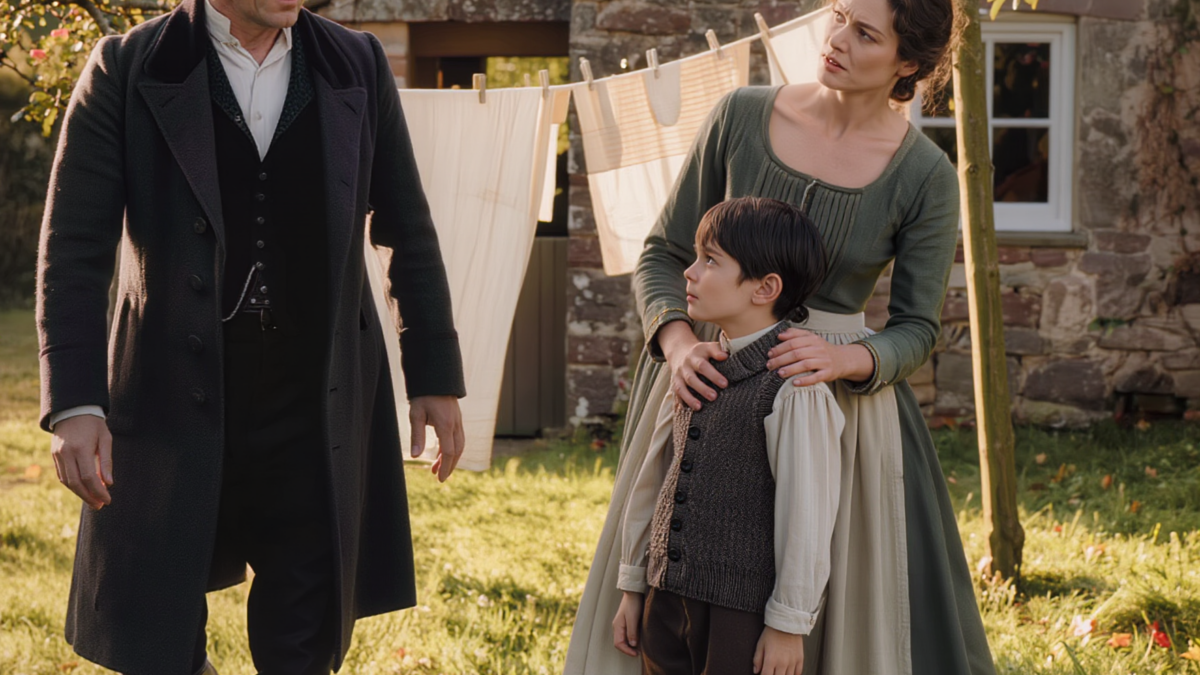
Eleanor leaned against the wooden post beside the clothesline and watched him.
He had Adrien’s hair.
That had frightened her from the day he was born.
Near-black, thick, impossible to mistake once she had seen it against the pale linen of his cradle.
The eyes had come later.
Gray.
Sharp.
Observant.
By the time Thomas was old enough to study people rather than merely look at them, Eleanor sometimes had to turn away when he frowned because the resemblance became too precise.
She had told herself she had made peace with it.
Most days she almost believed that.
Seven years earlier, Eleanor Vale had believed herself to be one of the happiest women in England.
Not because she had married a duke.
Certainly not because London society had finally decided that a quiet woman from a modest country family was interesting now that she possessed a title.
She had been happy because of Adrien Blackthornne.
Everyone had warned her that he was difficult.
He was too reserved, acquaintances said.
Too serious.
Too accustomed to being obeyed.
His judgment could make seasoned men reconsider themselves, and his composure was famous enough that people spoke of it as though it were another inherited Blackthornne property.
Eleanor had never feared those things.
She had seen another Adrien.
Years before their marriage, at a summer gathering in the country, she had startled a flock of geese while trying to retrieve a ribbon from the grass.
The geese had erupted across the lawn in complete disorder.
Eleanor had nearly fallen backward.
Adrien had laughed.
Not the polite sound he used at dinners.
Not the controlled smile offered to satisfy people expecting charm from a duke.
He laughed until he had to sit on a stone bench.
His sister later told Eleanor she had never heard him laugh like that.
“You found the person underneath all that dignity,” she had said.
Eleanor remembered thinking nothing could be more precious.
They married within the year.
For nearly four years, she remained certain she had been right.
Adrien was never demonstrative in public. He did not become suddenly warm because he had married. He still disliked unnecessary conversation and possessed an extraordinary ability to make a crowded room feel foolish without raising his voice.
But with Eleanor, he softened.
He left books beside her tea because he thought she would like them.
He remembered tiny details from conversations held months earlier.
On nights when social obligations had exhausted her, he would invent reasons for them to leave first.
He listened when she spoke.
At least, she believed he did.
Then something changed.
It began so gradually that Eleanor could not identify the exact day.
Adrien stayed later in his study.
Dinners were postponed.
Then canceled.
Letters arrived bearing seals Eleanor did not recognize.
Sometimes Adrien read them once and placed them directly into the fire.
When she asked whether anything was wrong, he told her there were estate concerns.
Later he said the matter involved people in London.
Another time he kissed her forehead and told her not to worry.
That should have comforted her.
Instead, it became the first thing that frightened her.
Eleanor tried to be reasonable.
Blackthornne lands stretched across several counties. Adrien managed property, tenants, investments, family obligations, and political relationships that had existed before either of them was born.
A duke’s life contained responsibilities most people never saw.
She told herself she was being insecure.
She told herself this because the alternative required imagining that the man she trusted most had begun constructing a portion of his life from which she had been deliberately excluded.
Months passed.
One evening, Adrien canceled dinner for the third time that week.
Eleanor went upstairs alone.
She sat at her dressing table for nearly twenty minutes before noticing a small card Adrien had once written to her tucked beneath the edge of the mirror.
It contained only two sentences.
He had written it during the first year of their marriage after a ridiculous disagreement over whether a dog belonged inside the breakfast room.
The memory made her smile.
On impulse, she found stationery.
She wrote him a short letter.
Nothing dramatic.
Only a memory of the garden where he had first laughed with her, followed by a sentence telling him that whatever burden he carried, he did not need to carry it alone.
She folded the page.
She decided to leave it on his desk.
The corridor outside Adrien’s private library was quiet when Eleanor approached.
The door was not fully closed.
A narrow stripe of firelight crossed the hallway carpet.
Eleanor heard a woman’s voice.
She stopped.
For one foolish second, she wondered whether Adrien’s sister had arrived unexpectedly.
Then she recognized the voice.
Lady Victoria Ashkam.
Eleanor pushed the door wider.
Victoria stood beside the fireplace.
Adrien was holding her.
The letter slipped in Eleanor’s fingers.
Nothing about the embrace looked casual from the doorway.
Victoria’s face was turned toward Adrien’s shoulder.
His arms were around her.
It was late.
They were alone.
The private library was the one room in Blackthornne Hall where visitors never entered without invitation.
Adrien looked up.
Their eyes met.
“Eleanor.”
He spoke her name quietly.
To Eleanor, it sounded like guilt.
Lady Victoria immediately stepped away.
She straightened her skirt and avoided Eleanor’s eyes.
Adrien moved toward the door.
“It is not what you think.”
Eleanor looked at him.
Despite everything happening inside her, her voice remained surprisingly steady.
“That is what everyone says when it is exactly what someone thinks.”
She turned.
Adrien followed her into the corridor.
“Eleanor, wait.”
She continued walking.
He caught up near the staircase.
His hand lifted toward her arm, then stopped before touching her.
“How long?” she asked.
Adrien frowned.
“What?”
“How long have you been seeing her?”
“I have not been seeing anyone.”
Eleanor looked back toward the library.
“Then why was she there?”
The answer should have been simple.
Years later, Adrien would understand that almost every disaster that followed grew from what he did next.
He hesitated.
Not because he had been unfaithful.
Because the truth was dangerous.
For months, Adrien had been quietly investigating a network of blackmail, forged property documents, financial coercion, and manufactured scandals tied to men with influence over several old estates.
Blackthornne holdings were among the targets.
Lady Victoria’s late husband had moved within the same circles.
After his death, she found correspondence that convinced her some of those men were coordinating their efforts.
She had approached Adrien privately.
They shared information.
They kept no predictable schedule.
They avoided letters whenever possible.
Most importantly, no one close to Adrien was supposed to know what they were doing.
That included Eleanor.
Adrien had convinced himself this was necessary.
If the people involved realized Eleanor knew anything, she could become leverage.
That evening Victoria had come to Blackthornne Hall because she believed the investigation had been discovered.
She thought she had been followed.
For one frightened moment beside the library fire, she had lost the composure London admired in her.
She embraced Adrien.
Eleanor opened the door during that exact moment.
Adrien could have explained enough.
He could have told his wife Victoria had brought urgent information.
He could have told her the meeting concerned a threat to the family.
He could have told her that what she witnessed was fear, not affection.
Instead, seeing danger everywhere, he decided silence was safer.
“There are things I cannot tell you,” he said.
Eleanor stared at him.
“Things involving her?”
“Things involving people who could create serious problems for this family.”
“Then tell me what I am supposed to believe.”
Adrien’s jaw tightened.
He was thinking of names.
Documents.
People watching Victoria.
The possibility that Eleanor could repeat one harmless fact to the wrong servant or acquaintance.
“You should trust me.”
The sentence remained between them.
Eleanor’s expression changed.
The anger left first.
What replaced it was worse.
Resignation.
“I did,” she said.
Two words.
Past tense.
Adrien heard it.
He would hear it for the next seven years.
Eleanor walked away.
Adrien allowed her to go because he told himself morning would be different.
He would decide what could safely be explained.
He would find words that protected the investigation without destroying his marriage.
He would make her understand.
By morning, Eleanor’s bedroom was empty.
Most of her clothes were gone.
Personal letters had disappeared from the desk.
A few pieces of jewelry remained.
Her wedding ring sat alone on the dressing table.
No letter.
No explanation.
No forwarding direction.
Nothing.
Adrien stood in the center of the room and stared at the ring for so long that his valet eventually asked whether he needed a physician.
Within two hours, Adrien had begun searching.
Servants were questioned.
Carriage drivers were questioned.
Stable hands were questioned twice.
He sent men to relatives, former school friends, old neighbors, and estates Eleanor had visited before their marriage.
He rode personally to the country home where they had first met.
Nothing.
Eleanor seemed to have stepped out of England.
The disappearance became gossip within days.
At first London society treated it as scandal.
Then tragedy.
Then entertainment.
People invented explanations.
Perhaps the duchess had always been unstable.
Perhaps Adrien had been impossible to live with.
Perhaps Eleanor had discovered another woman.
Perhaps she had simply grown tired of aristocratic life.
Theories multiplied because facts did not.
Adrien corrected people at first.
Eventually he stopped.
The investigation surrounding Lady Victoria continued.
Months later, enough documentation was gathered to dismantle much of the network quietly.
Certain men withdrew from public life.
Others settled financial disputes without explanation.
A few estates avoided losses that might otherwise have destroyed them.
The danger passed.
Adrien should have felt relieved.
Instead, the moment it became safe enough to tell Eleanor everything, he had no idea where she was.
He searched harder.
Private investigators traveled across counties.
Letters went to distant cousins.
Innkeepers were paid to remember women traveling alone.
Descriptions were circulated discreetly.
Nothing.
By the third year, most people assumed Adrien had accepted reality.
By the fifth, no one mentioned Eleanor unless someone new to London asked why the Duke of Blackthornne had never remarried.
Adrien developed an answer.
He claimed marriage had never interested him particularly.
His title and estate were sufficient responsibilities.
Love, he suggested, was an unnecessary complication.
People considered the answer dignified.
It was also entirely false.
He never stopped searching.
He simply learned to do it quietly.
In Ashmir, Eleanor built a life that could not have looked more different.
She had first traveled north to an aunt’s cottage.
Only after reaching it did she realize she was pregnant.
That knowledge changed everything.
Whatever uncertainty Eleanor had felt about leaving disappeared.
She believed Adrien had chosen Victoria.
She believed the secretive world surrounding Blackthornne Hall contained dangers she did not understand.
Most of all, she believed she was responsible for protecting the child she carried.
She told almost no one where she had gone.
Months later, after Thomas was born, she moved again.
Ashmir was small enough that strangers attracted attention but kind enough that questions eventually stopped being asked.
Eleanor used her maiden name.
She rented the stone cottage.
At first she survived largely on money she had taken from her personal account before leaving London.
Later, she learned to manage without much of it.
She sewed.
She kept household accounts for two village families.
She helped the local schoolmaster with correspondence.
She grew vegetables badly the first year and much better the second.
Her hands changed.
Her expectations changed.
Thomas grew.
When he was old enough to ask about his father, Eleanor was unprepared.
She could not tell a child that his father had chosen someone else.
She could not explain adultery, secrecy, or the strange machinery of London society.
So she gave him the cleanest answer she could bear.
His father had died before he was born.
The lie hurt every time Thomas repeated it.
But Eleanor told herself it was kinder than the truth she believed.
Years passed.
Then, on an October afternoon at Blackthornne Hall, Adrien’s steward placed an unremarkable envelope on his desk.
“No seal, Your Grace.”
Adrien almost ignored it.
The handwriting was unfamiliar.
No return address appeared on the envelope.
He broke the seal.
Inside was one line.
Your Grace, I believe you should know that Eleanor Vale is living in the village of Ashmir.
Adrien read it once.
Then again.
He stood so quickly his chair struck the wall.
Within minutes he was outside.
He forgot his coat.
He gave the driver instructions twice because the first time his voice did not sound like his own.
The journey to Ashmir blurred.
Seven years of imagined reunions crowded together.
He would apologize.
He would explain Victoria.
He would show Eleanor the documents if necessary.
He would tell her how long he had searched.
Then another possibility intruded.
Perhaps Eleanor had built a new family.
Perhaps she had remarried.
Perhaps she had children with another man.
Perhaps the reason no message ever reached him was because she did not want to be found.
That possibility remained with him when the carriage entered Ashmir.
Villagers looked toward the Blackthornne crest painted on the door.
Adrien barely saw them.
He asked the driver to stop near the end of the lane.
He walked.
Then he saw her.
Eleanor stood between two apple trees hanging linen.
Seven years had changed her.
They had changed him too, though Adrien could not see himself.
Her hair was simpler.
Her dress plain.
Her hands looked like the hands of someone accustomed to work.
But her eyes were unchanged.
Adrien opened his mouth.
A boy ran from the cottage.
He was chasing a leaf.
Adrien watched without understanding at first.
Then the child turned.
Near-black hair.
Sharp gray eyes.
A familiar tilt of the head.
Adrien forgot every sentence he had prepared.
The boy ran toward Eleanor.
She lifted him instinctively.
When she looked beyond the child and saw Adrien, all color left her face.
“Adrien.”
Hearing his name in her voice after seven years nearly broke what remained of his composure.
His eyes returned to the boy.
“Is he mine?”
Eleanor held Thomas tighter.
“You have no right to ask me that.”
“I have every right.”
“You lost that right seven years ago.”
Thomas looked up.
“Who is he, Mama?”
Adrien lowered his voice.
“I never betrayed you.”
Eleanor’s eyes hardened.
“I saw you.”
“You saw Victoria.”
“In your arms. In the middle of the night.”
“She was frightened.”
Eleanor stared at him.
Adrien forced himself to continue.
He told her about the documents.
The network.
The pressure placed on estates.
Victoria’s late husband.
The information she had gathered.
The danger.
He explained that Victoria believed she had been followed the night Eleanor saw them.
“She thought people close to me could be used against me,” Adrien said. “Against us.”
Eleanor’s expression shifted.
“She came to warn you?”
“Yes.”
“And the embrace?”
“Fear.”
Eleanor looked down.
Thomas had begun playing with a button on her dress, too young to understand what seven lost years sounded like when spoken aloud.
“Why didn’t you tell me?”
Adrien answered truthfully.
“Because I was afraid.”
She looked up sharply.
“I thought if you knew nothing, no one could force anything from you. I believed silence would protect you.”
Eleanor laughed once, without amusement.
“You protected me so thoroughly that I had no idea who my husband was.”
Adrien flinched.
“I know.”
“No, I don’t think you do.”
Her voice trembled now.
“I stood in that corridor asking whether another woman was in my marriage, and you answered by telling me to trust you.”
“I was wrong.”
“You decided what I was allowed to know.”
“Yes.”
“You decided what danger I could understand.”
“Yes.”
“You decided silence was kinder than truth.”
Adrien lowered his head.
“Yes.”
For the first time, Eleanor did not have to fight him for acknowledgment.
That mattered more than she wanted it to.
Adrien looked toward Thomas.
“What is his name?”
“Thomas.”
He repeated it.
“Thomas.”
The boy watched him.
Adrien stepped closer.
Eleanor immediately tightened her arm.
He stopped.
That reflex told him how much ground he did not possess.
He crouched instead.
Thomas studied him with open curiosity.
“Why are you kneeling?”
Adrien almost smiled.
“So I can talk to you properly.”
Thomas considered this reasonable.
Adrien held out his hand.
“I have been searching for your mother for a very long time.”
Thomas looked toward Eleanor.
She hesitated.
Then nodded once.
Thomas placed his hand in Adrien’s.
Adrien stared at their joined fingers.
His son.
There was no longer room for doubt.
He looked up at Eleanor.
“He is mine.”
She said nothing.
Her silence answered.
Adrien swallowed.
“I lost six years with him.”
“You did.”
“I cannot recover them.”
“No.”
“I can be here for what comes next.”
Eleanor’s eyes narrowed.
“If I allow it.”
Adrien nodded.
“If you allow it.”
That surprised her.
The Adrien she remembered would have treated fatherhood as a fact granting him immediate rights.
This man remained kneeling in the garden asking permission.
Thomas squeezed Adrien’s fingers.
“Do you have horses?”
The question escaped with such seriousness that Eleanor almost laughed.
Adrien looked at him.
“Yes.”
“How many?”
“A great many.”
Thomas’s eyes widened.
Eleanor finally smiled despite herself.
Only briefly.
But Adrien saw it.
The sight hurt.
Not because the smile was small.
Because he remembered when he had once been able to produce it easily.
The three remained in the garden until the afternoon light began to turn gold.
Eventually Eleanor invited Adrien inside.
Not because she had forgiven him.
Because Thomas was cold.
The cottage contained no marble floors, uniformed servants, or ancestral portraits.
It smelled of bread and woodsmoke.
Books were stacked beside a small chair near the fire.
A wooden horse sat on a shelf.
Adrien noticed everything.
He imagined Thomas playing there.
Eleanor reading near the window.
Winter evenings.
Birthdays.
Ordinary mornings.
A life existed in that cottage into which Adrien had never entered.
Thomas climbed onto a chair.
“Are you staying for supper?”
Adrien looked at Eleanor.
The question was not his to answer.
“If your mother permits it.”
Eleanor noticed the deliberate restraint.
“You may stay.”
The meal was simple stew and bread.
Thomas asked enough questions to occupy three adults.
Did Adrien ride every day?
Had he ever fallen from a horse?
Was Blackthornne Hall larger than the church?
Did he know how to climb trees?
Adrien answered every question seriously.
Eleanor watched him.
The cold Duke of Blackthornne, who could silence a dining room by lifting an eyebrow, was explaining to a six-year-old that he had once fallen into a hedge after attempting to jump a ditch on a horse he had been specifically told not to ride.
Thomas laughed until he hiccuped.
Adrien laughed too.
Eleanor looked down at her bowl.
That sound.
The same unguarded laugh she had heard beside the geese years ago.
After supper, Thomas became sleepy.
Eleanor took him upstairs.
Adrien remained near the fire.
He expected her to ask him to leave when she returned.
Instead she sat opposite him.
Several feet remained between their chairs.
Neither commented on it.
“There is something else you should know,” Eleanor said.
Adrien waited.
“When I left London, I wasn’t only leaving because I believed you had chosen Victoria.”
“What else?”
“I was afraid of what I had become in that house.”
Adrien frowned.
“I no longer knew which instincts to trust. Every time I noticed you hiding something, I convinced myself I was imagining it. Every time you dismissed a question, I told myself a good wife should understand that your responsibilities were complicated.”
Eleanor folded her hands.
“By the night I found you with Victoria, I had spent months teaching myself not to trust what I saw.”
Adrien said nothing.
“So when I finally saw something impossible to ignore, I left.”
She paused.
“I found out about Thomas afterward.”
Adrien stared at her.
“You didn’t know?”
“Not when I walked out of Blackthornne Hall.”
The revelation changed something in him.
For seven years, a small part of Adrien had wondered whether Eleanor had known she carried his child and chosen deliberately to keep that knowledge from him from the beginning.
Now he understood the sequence.
She had run believing she was a betrayed wife.
Only afterward had she learned she would become a mother.
“When you discovered the pregnancy…”
“I was at my aunt’s cottage.”
“You could have written.”
“I could have.”
Eleanor’s voice remained quiet.
“But I believed the danger around you was real even if I misunderstood Victoria. And I believed you had chosen another woman. I could not bring a child back into a house where I no longer understood what was true.”
Adrien absorbed that.
“I told Thomas I was dead.”
Eleanor looked toward the staircase.
“I told him his father died before he was born.”
The words hurt.
But Adrien understood why.
“I wish you hadn’t.”
“So do I.”
That answer surprised him.
Eleanor looked toward the fire.
“I have wished many things differently.”
The next morning, Adrien returned.
He did not arrive with servants.
He did not arrive with legal papers or declarations about heirs.
He arrived carrying a small wooden horse he had purchased in the nearest market town.
Thomas examined it critically.
“The legs are too short.”
Adrien looked at the toy.
“You may be right.”
Thomas showed him exactly why.
Adrien listened.
He came again the following day.
Then again.
Eventually, he rented a small house near Ashmir instead of returning permanently to Blackthornne Hall.
London found this baffling.
Adrien did not care.
He refused to move Eleanor before she was ready.
He refused to take Thomas somewhere simply because his title allowed him to provide more.
He began learning his son one ordinary day at a time.
Thomas loved horses but initially feared riding them.
He disliked turnips.
He could read well for his age but became impatient with handwriting.
He collected smooth stones from the stream.
He asked questions without mercy.
He inherited Eleanor’s patience when assembling things and Adrien’s irritation when those things did not cooperate.
One morning Adrien spent nearly an hour helping him repair a wooden cart.
Thomas finally looked at him and said, “You’re not very good at this.”
Adrien nodded.
“That appears to be true.”
Eleanor laughed from the doorway.
There were harder days.
Some conversations ended with Eleanor leaving the room.
Once, after Adrien mentioned Blackthornne Hall too casually, she accused him of assuming she would eventually return.
He realized she was right.
Another evening Eleanor admitted that whenever Adrien became quiet for too long, some part of her still wondered what he was hiding.
He did not defend himself.
Instead, he began telling her more.
Not dramatically.
Ordinary things.
A difficult letter from the estate manager.
A financial decision.
A disagreement with his sister.
Plans for Thomas.
Information he once would have withheld because he considered it his responsibility to solve first.
Slowly, Eleanor began trusting the silences between them again.
Months passed.
Adrien returned occasionally to Blackthornne Hall for unavoidable responsibilities.
He always came back to Ashmir.
Thomas began calling him Father without ceremony.
The first time it happened, Adrien was fastening the saddle on the boy’s pony.
“Father, this strap is twisted.”
Adrien stopped moving.
Thomas noticed.
“What?”
“Nothing.”
The strap required far more concentration than it should have because Adrien’s vision blurred for several seconds.
A year after he first arrived in Ashmir, Eleanor stood again in the cottage garden beneath the apple trees.
The season had turned.
Adrien approached carrying two letters.
“One is for you.”
She accepted it.
“What is it?”
“Nothing urgent.”
Eleanor gave him a look.
He smiled slightly.
“I have learned that saying that without explaining is usually a mistake. It is from my sister. She wants to know whether you would permit her to visit.”
Eleanor opened the letter.
Inside was no demand that the Duchess of Blackthornne return to her proper place.
No discussion of society.
Only a short note.
I have missed you. I would like to meet Thomas whenever you decide we have earned the privilege.
Eleanor read the sentence twice.
“She has changed.”
“We all have.”
Eleanor folded the page.
Later that evening, after Thomas went inside, she remained beneath the apple trees with Adrien.
“I think I am ready.”
Adrien’s heart accelerated.
He did not assume.
“For what?”
“To see Blackthornne Hall again.”
They returned several weeks later.
Eleanor expected the house to feel haunted.
Instead, it felt strangely smaller.
The corridor where she had confronted Adrien was simply a corridor.
The library was simply a room.
The dressing table where she had left her wedding ring remained upstairs.
Adrien had never moved the ring.
It sat inside a small box in his desk.
He showed it to her.
“I kept it.”
Eleanor touched the box but did not immediately take the ring.
Adrien made no request.
That mattered.
Thomas ran through the gardens.
He met relatives.
He discovered the stables and immediately forgot every solemn warning Eleanor had given him about behaving properly.
The staff who remembered Eleanor welcomed her carefully, as though afraid too much warmth might frighten her away again.
Nothing returned to normal.
That was precisely why it worked.
Normal belonged to the life they had lost.
What they built afterward had to be different.
Eleanor eventually chose to return to Blackthornne Hall, but not because anyone told her it was her duty.
She kept the cottage in Ashmir.
Thomas continued spending part of every year there.
Adrien supported the decision without argument.
The village had given Eleanor safety when his world had not.
He would never ask her to erase that.
Their marriage repaired itself in increments.
Trust returned even more slowly.
Neither pretended seven years had vanished.
They spoke about them.
Sometimes painfully.
Adrien learned that apology was not a single event.
Eleanor learned that forgiveness did not require pretending she had never been hurt.
Thomas grew between the two worlds.
At Blackthornne Hall, he learned the expectations attached to his family name.
In Ashmir, he learned how little a title mattered when a fence needed repairing or rain had ruined the road.
Adrien discovered that fatherhood required skills no estate had prepared him for.
Patience.
Humility.
Listening before deciding.
Eleanor sometimes watched the two of them together and felt grief for the years they had lost.
But grief no longer occupied the entire space.
There were new memories now.
Thomas falling from his pony into soft grass and immediately blaming the saddle.
Adrien attempting to bake something for Eleanor’s birthday with disastrous results.
Winter evenings when Thomas read aloud beside the fire.
Spring mornings in Ashmir.
Summer afternoons at Blackthornne.
Years later, people who had once known Adrien only as the distant Duke of Blackthornne noticed he had changed.
He laughed more easily.
He left dinners early when Thomas expected him home.
He stopped treating vulnerability as a flaw requiring correction.
Eleanor changed too.
The young duchess who had once believed love alone guaranteed understanding no longer existed.
She had built a life alone.
Raised a son.
Survived uncertainty.
Returned by choice.
That distinction mattered to both of them.
One evening, long after Thomas had fallen asleep, Eleanor and Adrien sat outside the Ashmir cottage.
The apple trees were older.
So were they.
Adrien looked toward the garden where he had first seen his son.
“I used to think protection meant preventing the people I loved from carrying difficult knowledge.”
Eleanor smiled faintly.
“I remember.”
“I was spectacularly wrong.”
“Yes.”
He glanced at her.
“You could occasionally pretend I learned that lesson with less difficulty.”
“That would require lying.”
Adrien laughed.
Eleanor rested her hand over his.
Seven years earlier, silence had separated them.
Now silence meant something different.
It no longer concealed.
It no longer demanded trust without offering truth.
It was simply the quiet shared by two people who had finally learned that love could survive mistakes only when honesty was allowed to survive with it.
Adrien turned his hand beneath hers and intertwined their fingers.
Neither needed to say anything else.