On Thanksgiving morning, my parents set my suitcases on a freezing Chicago porch after charging me $3,000 a month for five years. My sister smiled and said, “Good luck starting over.” I walked away gripping Grandpa’s brass key. The next morning, a bank manager locked his office door.
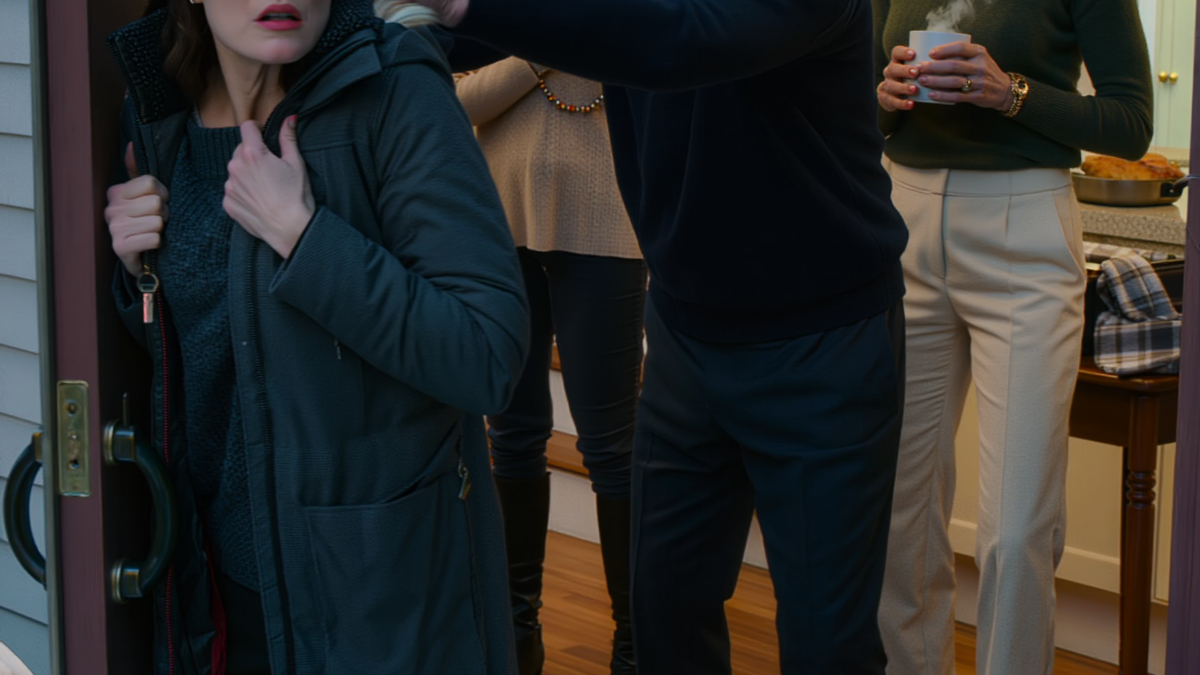
I am Riley Harrison, thirty-two years old, and until one Thanksgiving morning, I believed the most humiliating thing my family had ever done to me was charge me $3,000 a month to live in their basement.
I was wrong.
The turkey had been in the oven for less than an hour when I heard something heavy hit the hardwood floor in the hallway.
Then another thud followed.
I wiped my hands on a kitchen towel and stepped out of the kitchen.
My father, Thomas, stood near the front door. My mother, Brenda, hovered a few feet behind him with her arms folded. Two large suitcases sat beside the entrance.
My suitcases.
I stared at them.
“What’s going on?”
Dad drew a breath and straightened his shoulders in the way he always did when he wanted an ordinary statement to sound like a boardroom decision.
“Riley, you need to leave.”
For a moment, I thought he meant for the afternoon.
Maybe the basement had flooded. Maybe something had happened while I was cooking.
Then I saw my older sister Ashley leaning against the staircase with a mug of coffee.
Her husband, Terrence, stood beside her.
Neither looked surprised.
Dad continued.
“Ashley and Terrence need the basement. They need space to rebuild, and Terrence needs somewhere to operate his business.”
I looked at the bags again.
Someone had gone downstairs, entered my room, opened my drawers and closet, and packed my belongings while I was preparing Thanksgiving dinner for them.
“You packed my things?”
Mom finally spoke.
“Don’t make this harder than it needs to be.”
Outside, a bitter Chicago wind pushed against the windows. The temperature had fallen well below freezing overnight.
I had paid my rent three weeks earlier.
The full $3,000.
“You’re putting me out on Thanksgiving morning?”
“You have a good job,” Dad said. “You can afford a hotel.”
Mom gave me the expression she usually reserved for moments when she wanted cruelty to sound charitable.
“Family helps family, Riley. Ashley needs us right now. You’re single. You’re independent. You’ll be fine.”
There it was.
The logic that had governed our family for as long as I could remember.
Ashley needed something, so I was expected to surrender it.
When we were children, she was the gifted one, the social one, the daughter my parents introduced first at parties.
She received a premium credit card at sixteen.
I got an after-school job because Dad said work would teach me discipline.
Ashley’s mistakes were experiments.
Mine were character flaws.
I had stopped arguing about the difference years earlier.
I studied, earned my degree, and built a career in supply chain analysis because numbers made sense in a way my family never had.
Five years before that Thanksgiving, I moved home to save for a down payment.
My parents offered me the finished basement.
Then they demanded $3,000 a month.
It was more than I could have paid for several good apartments, but Dad called it a contribution to the family.
I believed him.
I worked long weeks, transferred the rent on the first of every month, kept the basement immaculate and rarely asked my parents for anything.
Then Ashley married Terrence.
He was charismatic, polished and endlessly confident.
Every new business he launched came with a presentation deck, expensive dinners and promises that investors were “about to close.”
The businesses rarely lasted.
My parents adored him anyway.
They helped lease his luxury SUV.
They praised his entrepreneurial courage.
When I received a promotion at work, Dad congratulated me and then spent dinner asking Terrence about his next startup.
The latest startup collapsed a month before Thanksgiving.
Ashley and Terrence lost their downtown loft.
My parents invited them home.
I assumed they would take the guest suite.
Apparently, they had chosen my basement instead.
Ashley lifted her coffee.
“Good luck starting over.”
Her tone was almost cheerful.
Then she nodded toward the kitchen.
“Don’t worry about the turkey. I’ll make sure it gets basted.”
Something inside me became very still.
I could have shouted.
I could have demanded my money back.
I could have reminded them that tenants normally received notice before being displaced.
But every face in that hallway told me the decision had been made long before I walked out of the kitchen.
So I picked up my winter coat.
Then I took my suitcases.
“Keep the turkey,” I said.
Dad opened the door.
I stepped into the cold.
The deadbolt slid shut before I had reached the bottom porch step.
I stood there with the wind cutting through my coat and stared at the house I had grown up in.
For five years I had paid thousands of dollars for the privilege of being reminded that it was not mine.
My fingers moved into my coat pocket.
They touched cold brass.
Grandpa Harrison’s key.
He had given it to me before he died the previous year.
Grandpa was the only member of my family who had never treated practicality as a defect.
He had built his businesses from almost nothing, and he respected quiet competence more than presentation.
Shortly before he died, he pressed the small engraved key into my palm.
“Don’t ask your parents about this,” he told me.
I remember frowning.
“What does it open?”
“You’ll know when you need it.”
“That’s not an answer.”
A tired smile touched his face.
“Then remember one thing. Open it only when you truly need a way out.”
I had kept the key without understanding why.
Standing outside on Thanksgiving morning with my life packed into two suitcases, I finally understood what he meant by need.
The bank was closed for the holiday.
I drove to a roadside motel near the interstate.
The room had a sagging mattress, a rattling heater and curtains that did not quite meet in the middle.
I ate a protein bar from the vending machine for Thanksgiving dinner.
At some point that evening, I checked social media.
Ashley had posted a photograph from my parents’ dining room.
The turkey I had prepared sat in the center of the table.
The caption thanked everyone for “new beginnings.”
There was no mention of me.
I put the phone facedown.
The brass key stayed in my palm most of the night.
At 7:50 the next morning, I stood outside First National Bank waiting for the doors to open.
A security guard unlocked them at eight.
I went straight to the counter.
The teller greeted me with the practiced brightness of someone returning from a holiday.
I placed my driver’s license and the brass key on the marble surface.
Her smile disappeared.
She picked up the key and turned it over.
“Would you excuse me for a moment?”
She vanished through a secured door.
Two minutes later, a man in a tailored gray suit approached.
“Ms. Harrison?”
“Yes.”
“I’m Daniel Caldwell, senior branch manager. Would you come with me?”
He took me to a private office overlooking the street.
I expected a safe-deposit box number.
Instead, he examined the key, verified my identification and opened a secure banking record.
He typed for several seconds.
Then stopped.
He leaned closer to the monitor.
He refreshed the screen.
The expression on his face changed enough that I noticed.
“What is it?”
Mr. Caldwell did not answer immediately.
He stood, walked to the office door, turned the lock and closed the blinds covering the glass wall.
My heartbeat accelerated.
“Is there a problem with the box?”
He returned to the desk.
“Ms. Harrison, your grandfather was one of this bank’s longstanding private clients. He left very specific instructions concerning this key and your identity.”
He turned the monitor toward me.
At the top of a digital document were the words:
HARRISON FAMILY TRUST.
“I don’t understand.”
“Your grandfather did not merely leave you a safe-deposit box.”
He scrolled.
“He placed a residential property into an irrevocable trust.”
I saw the address.
My parents’ house.
My house, although I did not know it yet.
Mr. Caldwell pointed to the beneficiary section.
My name was there.
Only my name.
He explained that Thomas and Brenda had been designated temporary custodians responsible for taxes, maintenance and basic administration.
Their authority had an expiration condition.
My thirtieth birthday.
“When you turned thirty,” Caldwell said, “the custodianship terminated automatically. Full title vested in you.”
I stared at him.
“I’m thirty-two.”
“I know.”
I looked at the address again.
“My parents have the deed.”
“No. They had custodial control of trust documents. That is not ownership.”
“They charge me rent.”
That sentence changed the room.
Caldwell’s brows pulled together.
“How much?”
“Three thousand dollars every month.”
“How long?”
“Five years.”
He sat back slowly.
Then he reopened the trust provisions.
Even before I turned thirty, Grandpa had expressly granted me a right to occupy the property without rent.
An adjacent investment account covered property taxes and approved upkeep.
My parents had never needed my money to maintain the house.
I took out my phone and opened my bank history.
Five years of transfers.
$3,000 each.
The arithmetic was immediate.
$180,000.
“I paid them one hundred eighty thousand dollars to live in a house I was entitled to live in for free.”
Caldwell did not soften the answer.
“Yes.”
My first reaction was not anger.
It was confusion.
I thought of every lecture from my father about responsibility.
Every time my mother told me I should be grateful.
Every frozen dinner I ate downstairs because I was trying to save.
Every weekend I declined invitations because I wanted to build a down payment faster.
Then another thought arrived.
“Did they know?”
Caldwell retrieved the custodial acknowledgment.
Thomas Harrison.
Brenda Harrison.
Their signatures appeared beneath language explaining my rights.
“They knew.”
The final excuse disappeared.
Caldwell then used the key authorization to access the financial component of the trust.
That was when the story stopped being about rent.
The ledger showed my monthly transfers entering a custodial account.
Within forty-eight hours of many deposits, money moved out again.
Some withdrawals were ordinary enough to ignore.
Others were not.
A luxury boutique.
An Aspen resort.
First-class airfare.
Five-star restaurants.
One December transfer immediately preceded the purchase of a limited-edition handbag Ashley had shown off at Christmas.
I remembered her laughing while Terrence accepted compliments for buying it.
I had bought it.
Then Caldwell turned to a second page.
The transactions there were larger.
$50,000.
Another $50,000.
Another.
All transferred to an LLC.
I recognized the company name.
Terrence’s startup.
The business my parents had praised while dismissing my ordinary corporate job.
The business that had supposedly attracted investors.
There had been no investors.
At least not the kind Terrence claimed.
My family had been feeding the company money connected to Grandpa’s estate.
The same family that charged me rent while telling me I needed to learn independence.
Caldwell gave me copies of the trust and transaction history.
He also recommended I speak with a trust-litigation attorney immediately.
Her name was Michelle Crawford.
I called from the bank.
Twenty minutes later, I was sitting across from her in a downtown office.
Michelle was not theatrical.
She read.
That was the first thing I noticed.
She read every page before saying anything.
When she finished, she placed both palms on the table.
“Your grandfather designed this trust carefully.”
“What does that mean?”
“It means the custodians had narrow powers. It also means that if they misused trust assets, the beneficiary could revoke access and demand a complete accounting.”
I looked at the ledger.
“What about the house?”
“You own it.”
“And my parents?”
“They are occupying it without a lease from the owner.”
The sentence felt almost absurd.
Twenty-four hours earlier, they had thrown me onto the porch as if I were a guest who had overstayed.
Michelle continued.
“We can address possession of the property. We can also preserve the financial records. But I need you to do something difficult.”
“What?”
“Nothing.”
I thought I had misheard her.
“No angry calls. No social-media posts. No warning that you know what the trust says. Let the documentation speak before anyone has time to rewrite the story.”
That part I could do.
Silence had always been my family role.
For once, it would work for me.
I rented the motel room for another week.
During the day, I went to work.
At night, I watched Ashley turn my house into content.
She posted videos of new furniture arriving.
Terrence recorded motivational clips in the living room.
He called the property their new headquarters.
My parents commented beneath the posts as though they were witnessing the beginning of a dynasty.
I saved everything.
Then they announced a large holiday housewarming gathering.
The guest list included business acquaintances, country-club friends and other people whose approval my parents valued.
Ashley went live during the party.
From my motel desk, I watched guests move through the house I had just learned belonged to me.
At around eleven, my personal phone rang.
Mom.
I almost let it go.
Then I remembered Michelle telling me to preserve communications.
I started a recording device for my own documentation and answered.
“Hello, Mom.”
Music and conversation filled the background.
“Are you finished with this little attitude yet?” she asked.
I said nothing.
She told me the party was magnificent.
She told me everyone important was there.
She told me the house looked better now that my things were gone.
Still I said nothing.
My silence irritated her.
It always had.
Finally, she revealed why she was calling.
My parents were prepared to let me return.
Not to the basement.
That belonged to Ashley and Terrence now.
Mom said I could sleep in the detached garage.
The price would be $1,500 a month.
Plus chores.
And an apology to Ashley.
I made her repeat the terms.
She did.
Clearly.
Then I ended the call.
Michelle received the audio that night.
By morning, formal property and accounting notices were ready.
A professional process server delivered them during the same social gathering my family had been using to celebrate my disappearance.
I watched part of the delivery through one of Ashley’s live videos.
The server approached Dad near the fireplace.
“Thomas Harrison?”
Dad turned with the mildly annoyed expression of a man accustomed to assuming everyone wanted something from him.
“Yes.”
The envelope was placed directly into his hand.
“You have been formally served.”
Conversations nearby stopped.
Mom appeared.
The server explained that the documents concerned the Harrison trust, a demand for financial accounting and notice regarding their continued occupancy.
Ashley’s live feed ended abruptly.
My phone started ringing minutes later.
Dad.
Mom.
Ashley.
Again.
Again.
Again.
I did not answer that night.
The next morning, I called Dad with my recording device running.
He answered almost instantly.
His opening argument was not that the trust documents were false.
It was that I had humiliated them.
He threatened lawsuits.
Mom came onto the speaker and claimed Grandpa had not understood what he was signing when the trust was created.
That accusation lasted less than a minute.
Grandpa had undergone independent cognitive evaluations surrounding the trust execution.
The documentation already existed.
Then Dad shifted to another defense.
They had broad discretion over the accounts.
I asked whether “broad discretion” included transferring money to Terrence’s company.
Silence.
Mom tried a softer approach.
“We can resolve this privately.”
She offered a repayment plan.
That was the first time either parent acknowledged there was money to repay.
I told them all future communication could go through counsel.
Then I returned to work.
I expected the next few days to revolve around the trust.
Instead, Michelle called.
Her voice was sharper than usual.
“Come back to my office.”
When I arrived, a new stack of documents sat on the conference table.
Different bank.
Same property.
Michelle slid the first page toward me.
It was a home-equity line of credit.
$200,000.
Opened fourteen months earlier.
The collateral was my house.
“That isn’t possible.”
“I agree.”
“I owned the property then.”
“Yes.”
“No lender could put a credit line against it without me.”
Michelle turned to the signature page.
My name appeared in blue ink.
Riley Harrison.
I knew instantly that I had not written it.
My real signature leaned farther right.
My capital R never looked like that.
The signature on the page looked studied.
Copied.
Beside it were Thomas and Brenda’s names.
A notary stamp stated that I had appeared in person.
I had never been there.
Michelle explained that the trust review had exposed the loan in the property history.
The proceeds had gone into another account outside the normal trust structure.
My parents had not merely collected money from me.
Someone had used my identity to place debt against my home.
That discovery triggered a much wider financial review.
Federal financial investigators became involved because the lending records and transfers crossed multiple institutions.
I returned to my motel with one thought repeating in my head.
They had not just been living off me.
They had been borrowing against a future they knew legally belonged to me.
Monday morning, I went to work as usual.
I parked on the third level of my company garage.
Before I could close my car door, an SUV pulled across the aisle and stopped near my space.
Ashley climbed out.
Terrence came from the driver’s side.
Ashley looked exhausted.
Her polished Thanksgiving appearance was gone.
“Riley, please.”
I stayed beside my car.
She told me Terrence’s accounts were inaccessible.
She said the eviction process had to stop.
She called everything a misunderstanding.
Then she claimed she was pregnant and insisted the stress would be dangerous.
I did not argue about whether she was telling the truth.
I simply said, “If you need housing, start looking now.”
Terrence’s restraint disappeared.
He stepped closer.
Too close.
He told me to call off the attorney.
He told me to release the accounts.
His voice dropped as he warned that he could make trouble for me at work if I refused.
I kept my thumb on the panic button of my key fob.
When he raised his hand in a threatening gesture, I pressed it.
The car alarm exploded through the concrete structure.
Terrence stepped backward.
I called corporate security.
Within minutes, company security arrived and separated us.
An incident report was created.
Ashley and Terrence were ordered to leave the property.
As their SUV disappeared down the ramp, I realized something important.
My family had spent years relying on one assumption.
That I would rather absorb humiliation than create a record.
That assumption was gone.
Two weeks later, the property hearing began.
My parents arrived with counsel and presented their version first.
They described themselves as longtime caretakers of a generational family home.
They described me as an angry daughter trying to displace aging parents over a private disagreement.
For a few minutes, it sounded almost reasonable.
That was the frightening thing about my family.
They rarely began with a lie so wild that nobody could believe it.
They began with a version containing just enough truth.
Yes, they had lived there for decades.
Yes, they had maintained the home.
Yes, I was their daughter.
Then Michelle introduced the trust.
The judge read the termination clause.
My parents’ custodial authority had ended on my thirtieth birthday.
The property belonged to me.
Then came the banking records.
My $3,000 monthly transfers.
The luxury spending.
The payments toward Terrence’s company.
The tone of the room changed without anyone announcing it.
The judge stopped looking primarily at me.
He started looking at my parents.
Dad was asked whether he had charged me rent while knowing I had beneficiary rights in the house.
He called it a lesson in responsibility.
Then the ledger was placed in front of him.
The explanation became harder to sustain.
The court granted possession of the property to me and imposed a short deadline for my parents to leave, while the disputed financial matters continued through separate proceedings.
The financial accounts connected to the disputed transactions remained restricted while investigators reviewed them.
As we left the courthouse, I received a message from Mike, a contractor who had remodeled the kitchen two years earlier.
He told me Dad had called asking about heavy demolition tools and fast-setting concrete.
Mike had heard Ashley in the background talking about damaging countertops and plumbing before they left.
I sent the message to Michelle.
This time, nobody waited to see whether my family was bluffing.
A court order was sought limiting destructive activity at the property.
A licensed private security team was stationed outside while my parents packed.
I watched from a distance as Dad and Terrence arrived with a rented truck containing construction materials.
Security stopped the vehicle before anything crossed the threshold.
Terrence backed away first.
He had always liked risk when someone else absorbed the consequences.
Ashley protested from the porch.
Dad argued.
None of it changed the order.
For the remainder of their occupancy, packing occurred under supervision.
When the final deadline arrived, county personnel came to enforce the possession order.
There was no dramatic confrontation.
Just a cold morning, official paperwork and the final consequence of months of choices.
Dad carried bags outside.
Mom followed.
Ashley came behind them.
Terrence was gone.
Several neighbors watched from their lawns.
My parents had spent years managing appearances in that neighborhood.
Now there was no story they could tell that changed who legally possessed the house.
When they were gone, I stepped through the front door.
The first thing I noticed was the silence.
Not victory.
Silence.
For five years, I had moved through those rooms as though I needed permission.
Now there was no one upstairs deciding whether I was grateful enough.
I changed the locks that day.
I upgraded the security system.
Then I started cleaning.
The master bedroom was the worst.
My parents had packed quickly.
Closet doors stood open.
Hangers covered the floor.
Cosmetics and papers had been abandoned around the room.
I filled trash bags for hours.
While dragging one bag across the floor, my boot caught the edge of a heavy rug.
The rug folded back.
Underneath was a square seam in the hardwood.
I stopped.
The cut was too precise to be ordinary flooring.
I lifted the panel.
A small steel safe had been installed below.
Grandpa had hated hidden compartments.
This had not been his.
I searched the remaining clutter.
Inside one of Dad’s old planners, I found a laminated card containing six digits.
I entered them.
The lock released.
Inside the safe was a waterproof envelope.
The papers inside had nothing to do with my rent.
Nothing to do with Terrence’s company.
Nothing to do with the $200,000 home-equity credit line.
They concerned Grandpa.
Specifically, an $8 million corporate life-insurance policy intended for a charitable foundation supporting underserved young people.
Attached to the policy were beneficiary-change forms.
The charity’s name had been removed.
A newly created holding company had been substituted.
The company was connected to my mother’s maiden name.
The forms were dated three weeks before Grandpa died.
There were also medical documents supporting the purported change.
Some of the names and licensing information did not match records I already knew from Grandpa’s real physicians.
I photographed every page exactly where I found it.
Then I called Michelle.
“I found something in the house.”
“How serious?”
“Eight million dollars serious.”
That discovery widened the investigation again.
Specialists compared signatures, medical documentation, corporate records and financial transfers.
The same pattern kept appearing.
Documents said one thing.
Independent records said another.
The policy change had not been completed before questions were raised, but the attempt itself became relevant to the existing inquiry into the loan and trust transactions.
Within days, federal investigators executed warrants connected to the financial case.
My parents were taken into custody for questioning and later charged with offenses tied to fraudulent lending documents, misuse of financial accounts and attempted insurance-related fraud.
I did not watch the operation in person.
I learned about it through Michelle and later through public court proceedings.
Ashley was not prepared for the financial floor beneath her life to disappear.
Neither was Terrence.
Their marriage lasted only long enough for Terrence to understand that the money was no longer coming.
According to documents filed soon afterward, he sought divorce.
Ashley came to my property forty-eight hours later during a freezing rainstorm.
My security system alerted me to movement at the front gate.
When I opened the camera feed, I barely recognized her.
Her hair was soaked.
Water ran down her face.
She pressed the intercom repeatedly.
I put on my coat and stepped onto the covered porch.
“Riley!”
Her voice carried across the lawn.
“Please open the gate.”
I stayed under the overhang.
She told me Terrence had left.
She told me Mom and Dad were dealing with the federal case.
She said she had nowhere to stay.
Then she used the phrase I had heard from my mother countless times.
“We’re family.”
For a second, I saw both Thanksgivings at once.
Ashley on the staircase holding hot coffee.
Ashley at the gate in freezing rain.
I did not enjoy the comparison.
That surprised me.
I had imagined this moment during the worst nights at the motel.
I thought it would feel like vindication.
Instead, it felt tired.
“I’m sorry,” she said.
“For what?”
“For everything.”
“That’s not specific.”
She looked down.
“I should never have taken the basement. I should never have let Mom and Dad treat you that way.”
“You didn’t just let them.”
She said nothing.
“You knew they were throwing me out on Thanksgiving.”
“I know.”
“You smiled.”
Rain rattled against the iron gate.
She started crying.
“I was horrible.”
I believed that she regretted where her choices had brought her.
I did not yet believe she understood what those choices had done to me.
“I can’t let you move back in.”
Her hands tightened around the bars.
“Riley—”
“No.”
“Where am I supposed to go?”
I remembered the coffee mug.
The staircase.
The deadbolt turning behind me.
I did not raise my voice.
“Good luck starting over.”
Then I returned inside.
Months passed.
The criminal case became a matter of documents rather than family arguments.
Forensic accountants traced disputed transfers.
Signature specialists reviewed the lending paperwork.
The insurance records were examined.
Emails and account instructions tied my parents to decisions they had previously described as misunderstandings.
At trial, the government’s presentation was methodical.
No one needed dramatic speeches.
Dates were enough.
Signatures were enough.
Transfers were enough.
The $200,000 credit line had been opened against property they did not own.
My name appeared on documents I had never signed.
Trust money had been redirected.
Insurance-beneficiary paperwork had been altered in ways prosecutors argued were intended to divert a major payout.
My mother’s recorded garage-rent conversation also contradicted the claim that they had never viewed me as a source of money.
The jury convicted them on major financial-fraud counts.
Dad received a custodial federal sentence.
Mom received a combination of probation, supervision and extensive community-service requirements, along with financial penalties.
Restitution proceedings addressed money connected to the trust.
Assets were liquidated where legally permitted.
Some of what had been taken from me was recovered.
The country-club invitations stopped.
Old acquaintances disappeared.
The public image my parents had spent decades constructing did not survive the court record.
I expected that to matter more to me than it did.
By then, I was focused on the house.
I renovated slowly.
Not to erase the past, but to stop living inside someone else’s taste.
The dark drapes came down.
The heavy furniture left.
Natural light returned to rooms that had always felt too formal.
I rebuilt the kitchen.
I turned Ashley’s former bedroom into a gym.
The basement changed most.
For years it had represented what my family thought my place was.
I transformed it into a home theater and lounge.
No rent.
No lectures.
No permission required.
My career changed too.
During the months when everything at home was unstable, work had been the one place where my decisions were measured against results.
I leaned into that.
I presented a restructuring plan I had been building for months, showing how several supply-chain bottlenecks could be corrected across the company’s network.
The plan was approved.
So was my promotion.
Eventually, I became senior director of global supply-chain operations.
The title mattered less than the feeling I had the first evening I sat alone in my new office and realized nobody in my family had given it to me.
I had built it.
A year after the Thanksgiving eviction, I hosted dinner at the house.
Not a country-club gala.
Not a performance.
Just people I trusted.
Friends from work.
A former college roommate.
Two neighbors who had quietly checked on the property during the legal dispute.
Michelle stopped by briefly and brought a bottle of wine.
The kitchen filled with ordinary noise.
Someone burned the first batch of rolls.
Someone else laughed too loudly.
Nobody cared which glassware matched.
At one point, I stepped outside onto the porch.
The air was cold enough to see my breath.
I looked at the place where my suitcases had landed the year before.
For a long time, I had believed the worst thing my parents did was throw me out.
It was not.
The worst thing was convincing me for years that I should be grateful for what they were taking from me.
Grandpa’s brass key still sits in a small wooden box in my desk.
I no longer need it to open anything.
But I keep it anyway.
Because one freezing Thanksgiving morning, when the people I trusted closed a door behind me, that little piece of brass led me back to something far more important than a house.
It led me to the truth.