On our fifth wedding anniversary, my husband made dinner for the first time in years and kept checking the clock. On the balcony, my hearing aid caught him whispering, “Everything is going exactly to plan.” Then he handed me one of two identical cocktails—and watched my glass instead of my face.
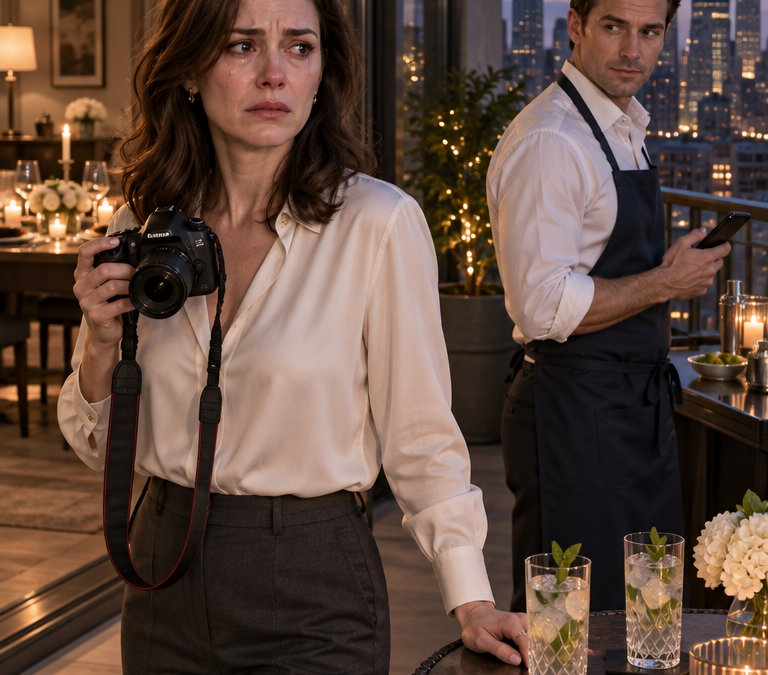
Today was our fifth wedding anniversary.
For most couples, that sentence would have belonged beside flowers, champagne, and some sentimental photograph posted before midnight. For me, it became the dividing line between the life I thought I had and the one that had apparently been unfolding behind my back.
Julian Vance was cooking dinner.
That alone should have warned me.
In five years of marriage, I had seen my husband cook exactly three things without assistance: scrambled eggs, grilled cheese, and microwave popcorn. Even those usually ended with a smoke alarm, a dirty pan abandoned in the sink, and Julian announcing that cooking was “an inefficient use of time.”
Yet there he was in our Chicago apartment, wearing the navy apron I had once bought him as a joke and moving around the kitchen as though he had been hosting dinner parties his entire life.
“You’re staring,” he said.
“I’m documenting a historical event.”
He grinned without turning around.
The late-afternoon sun came through the western windows and stretched gold across the hardwood floor. Candles were already waiting on the dining table. A small vase held white roses. Soft jazz played from the speakers.
The whole apartment looked almost suspiciously perfect.
Julian had promised me a surprise.
He had certainly delivered one.
I set my bag near the sofa and watched him plate dinner.
My job had trained me to observe people even when I did not want to. I had spent more than a decade as an investigative reporter learning that what people said mattered less than what they did while saying it.
Julian was affectionate.
He was attentive.
He was also distracted.
Every few minutes, he checked the wall clock.
The first time, I ignored it.
The second time, I noticed.
By the fourth, I had filed it away.
“Expecting somebody?” I asked lightly.
He looked at me.
“No.”
“Then what’s with the clock?”
“Trying not to ruin dinner.”
He kissed my forehead and returned to the stove.
It was a reasonable explanation.
That was the problem with the most effective lies.
They usually were.
We ate at the dining table while the city slowly darkened beyond the windows.
Julian talked about our first year together. He remembered the terrible apartment I had rented when we met, the tiny elevator that stalled whenever it rained, and the coffee shop near my office where he had once waited ninety minutes because I was late leaving an interview.
“You were impossible,” he said.
“You still married me.”
“I was young.”
“You were thirty-four.”
“Tragically young.”
I laughed.
For a while, I almost forgot the clock.
Almost.
Then Julian stood.
“Stay there.”
“That sounds threatening.”
“I’m making you something.”
“That sounds more threatening.”
He laughed and went to the liquor cabinet.
From it, he pulled white rum, club soda, mint and several other cocktail ingredients.
I stared at him.
“Who are you?”
“Your husband.”
“My husband thinks balsamic vinegar is cooking wine.”
“That was one time.”
“It was two.”
He carried everything through the sliding door to the balcony.
I reached for my DSLR on the side table.
I had brought it home from work because I was testing a new lens.
“Hold still,” I called.
Julian looked back.
“No.”
“I need proof.”
“Of what?”
“That you made a drink voluntarily.”
“You’re very funny.”
I followed him outside.
The balcony was cold enough that I regretted not bringing a sweater. Chicago wind moved between the buildings and lifted the ends of my hair.
Julian began mixing the drinks.
His movements were much smoother than I expected.
I lifted the camera.
“That actually looks rehearsed.”
“Maybe I contain multitudes.”
“Maybe you watched twelve tutorials while I was at work.”
He smiled.
Then his phone vibrated.
It was lying beside the cocktail shaker.
Julian glanced at the screen.
Something in his expression changed.
Not much.
A tightening around the eyes.
He picked up the phone and angled himself slightly away from me.
“I need this.”
“Go ahead.”
I pretended to adjust the camera settings.
The jazz inside the apartment was loud enough that Julian probably assumed the call would disappear beneath it.
What he did not account for was the hearing device in my right ear.
I had begun wearing it during certain interviews after years of working in crowded rooms where people lowered their voices when they thought reporters could no longer hear them.
The device amplified exactly the sort of quiet conversation Julian was attempting to hide.
A woman spoke.
Her voice was young.
And anxious.
“Has it started?”
Julian lowered his voice.
“Relax.”
There was a pause.
“Everything is going exactly to plan.”
My finger stopped over the shutter button.
The woman said something else.
I could not catch every word.
But I heard enough.
Tonight.
Insurance.
Money.
A dangerous substance.
And one sentence from Julian that made the entire balcony seem to tilt beneath my feet.
“Tomorrow, this is over.”
I looked through the viewfinder because it gave me somewhere to put my eyes.
Julian’s profile filled the frame.
A man I had slept beside for five years.
A man whose mother had stood beside us at our wedding.
A man who had cried when my father died.
A man whose hand I had held when his first company failed.
My husband.
Talking to another woman as though my life were a problem scheduled to be solved before morning.
I had covered fraud.
Corporate corruption.
Families shattered by money.
I had interviewed people who lied while evidence sat on the table between us.
None of that prepared me for recognizing the same rhythm in my own marriage.
I did not scream.
I did not confront him.
I lowered the camera as though the cold had become uncomfortable.
My hand moved toward the fountain pen clipped inside my jacket pocket.
It contained a small audio recorder I sometimes carried for interviews.
I activated it.
That was all.
No dramatic gesture.
No accusation.
Just one professional reflex taking over when the rest of me wanted to collapse.
Julian ended the call.
When he turned around, the affectionate husband had returned.
“Ready?”
He carried two cocktails toward me.
They looked identical.
Clear liquid.
Ice.
Mint.
Condensation on the glass.
He handed one to me.
His own remained in his left hand.
I noticed where he was looking.
At my drink.
Not me.
“Happy anniversary,” he said.
I forced myself to smile.
“Happy anniversary.”
For several seconds neither of us drank.
Julian’s smile remained in place.
Then he touched his forehead.
“Napkins. I forgot napkins.”
“There are some inside.”
“I’ll grab them.”
He set his own glass on the small patio table and disappeared through the sliding door.
I stood alone.
Two glasses.
Two identical garnishes.
Two lives that apparently no longer meant the same thing.
I had no way of knowing precisely what Julian had done.
I knew only that I would not drink from the glass he had deliberately placed in my hand.
I moved it away from myself.
The two glasses changed positions on the small table while I tried to put distance between myself and the drink he had been watching.
Julian returned carrying napkins.
His gaze flicked downward.
Once.
To the glasses.
His smile tightened.
That reaction confirmed what the phone call had already told me.
Something about one of those drinks mattered.
I kept my own glass near my hand without tasting it.
Julian lifted the other.
“To another five years.”
There are moments that replay later with strange clarity.
The sound of ice.
The traffic far below.
The white edge of a napkin moving in the wind.
Julian’s wedding ring catching the light.
I remember all of it.
He drank.
I did not.
We went back inside.
For the next half hour, Julian performed the role of a loving husband with almost painful perfection.
He talked about the first time we met.
He remembered our trip to Boston.
He teased me about the stack of unread books beside our bed.
He discussed a vacation.
He asked whether we should finally replace the living-room sofa.
And every few minutes, he looked at the clock.
I barely heard his stories anymore.
I was watching him watch time.
Eventually, he became quieter.
He rubbed his forearm.
Then his chest.
“You okay?” I asked.
“Fine.”
“You don’t look fine.”
“Long week.”
His breathing changed.
I stood.
“Julian.”
He tried to wave me off.
Then he gripped the edge of the table.
The confidence disappeared from his face.
For the first time that night, genuine fear appeared.
He looked at me.
Then at the glass.
Then back at me.
The realization arrived between us without either of us saying it.
I called emergency services immediately.
“My husband collapsed,” I told the dispatcher. “He’s conscious, but something is seriously wrong.”
The next minutes moved too quickly.
I unlocked the apartment door.
I cleared space around him.
I followed instructions from the dispatcher until paramedics arrived.
The EMTs came through the door carrying equipment and turned our anniversary dinner into a medical scene.
One of them asked what Julian had eaten.
“The same dinner I did.”
“Anything else?”
“He made cocktails.”
The paramedic looked at the two glasses.
“Did you drink yours?”
“Barely.”
“Did he?”
“Yes.”
They loaded Julian onto a stretcher.
As they moved him toward the hallway, his eyes found mine.
He looked terrified.
But beneath the fear was something else.
Recognition.
He knew I knew.
I grabbed my coat.
Then I remembered the words from the balcony.
Insurance money.
Before leaving, I opened the small fireproof safe in our bedroom where we stored financial documents.
Several life-insurance policies were inside.
My name appeared as the insured.
Julian’s appeared as beneficiary.
The total coverage was $2 million.
I photographed the documents and sent copies to secure storage.
Then I followed the ambulance to the hospital.
The emergency department smelled like disinfectant and overheated air.
I sat beneath fluorescent lights while doctors worked behind double doors.
For the first time since the balcony, I had nothing to do.
My hands began shaking.
I pressed them between my knees.
A nurse brought water.
I held the cup without drinking.
About an hour later, a doctor came out.
“Mrs. Vance?”
I stood too quickly.
“How is he?”
“Stable for the moment.”
I closed my eyes.
The relief surprised me.
Not because I wanted my marriage back.
Because despite everything I had heard, I did not want a death sitting at the center of what came next.
The doctor continued.
“We don’t think this was a typical cardiac event.”
“What does that mean?”
“His laboratory results suggest exposure to a concentrated medical compound. We’re treating him, but because of what we found, we have to notify law enforcement.”
I stared at him.
“Something he drank?”
“Possibly.”
The cocktail.
The doctor asked whether Julian worked around medical supplies.
“No.”
“Do you?”
“No.”
“Anyone in the household?”
“No.”
Then I remembered the woman’s voice.
Young.
Female.
Afraid.
I did not know her name yet.
But for the first time, I knew the phone call had involved more than money.
Chicago police arrived later that night.
Detective Aaron Miller introduced himself in a quiet consultation room.
He was in his fifties, broad-shouldered, with the patient expression of someone who had learned that nervous people filled silence if you let them.
A younger detective sat beside him.
Miller opened a notebook.
“Start with dinner.”
I did.
I told them Julian had cooked.
I described the drinks.
I told them about the phone call.
That changed the room.
Miller’s pen stopped.
“You heard what he said?”
“Enough to know I was frightened.”
“What exactly did you hear?”
I gave him the recording.
The detectives listened without interrupting.
When it ended, Miller looked at me differently.
Not as a confused spouse.
As a witness.
“Do you know the woman?”
“No.”
“Do you recognize her voice?”
“No.”
“Did your husband know about the recording?”
“No.”
Miller asked whether there were financial pressures.
I told him Julian’s logistics company had been struggling.
I had known about debt.
I had not known how severe it was.
Then I showed him the insurance documents.
The younger detective reread the total payout.
Miller closed the file.
“We’re going to search the apartment.”
I nodded.
The next afternoon, they returned to the hospital.
By then Julian was awake.
He had been moved into a private room.
Before I saw him, Miller stopped me in the corridor.
“We found something.”
He showed me a photograph.
A small medical container recovered from our kitchen trash.
“Forensics found residue consistent with what the hospital identified.”
My throat tightened.
“There’s more.”
He turned the page.
“One usable fingerprint.”
“Whose?”
“Your husband’s.”
I sat down on the hallway bench.
The evidence did not answer everything.
It made everything worse.
Julian had handled the container.
Julian had prepared the drinks.
Julian had discussed insurance money with a woman moments before handing me one.
Those facts did not need dramatic interpretation.
Together, they spoke clearly enough.
I entered his room alone.
Julian looked smaller than he had the night before.
His skin was washed out beneath the hospital lighting.
A monitor pulsed beside him.
He stared at me.
“You moved them.”
I closed the door.
“Moved what?”
“The glasses.”
His voice was rough.
I pulled a chair toward the bed.
“Why would that matter?”
He looked away.
I let the silence sit.
Journalists learn that silence is often more productive than interrogation.
Julian finally whispered, “You heard the call.”
I did not answer.
His eyes moved back to me.
“How much?”
“Enough.”
He closed them.
I asked the only question that mattered next.
“Who was she?”
He resisted for almost a minute.
Then he said a name.
“Chloe.”
“Last name.”
“Sterling.”
“Who is she?”
He swallowed.
“A nurse.”
“Where?”
“A clinic in the South Loop.”
“How long have you known her?”
Silence.
“Julian.”
“Six months.”
There it was.
The second betrayal beneath the first.
I had spent those six months helping him stabilize his company.
Canceling dinners because he said creditors were calling.
Moving money from our shared savings when he said payroll was tight.
Defending him when friends wondered why he was always unavailable.
He had not been unavailable.
He had been elsewhere.
“With her?”
His eyes remained on the blanket.
“Yes.”
I stood and walked to the window.
Traffic moved far below.
For one weak second, I wished the entire story were simpler.
An affair I could understand.
An affair belonged to ordinary human weakness.
The anniversary dinner did not.
“Did Chloe give you the medical compound?”
Julian’s silence answered before he did.
“She got access to it.”
I turned.
“Why?”
He started crying.
Not dramatically.
Just tears moving sideways toward his ears as he stared at the ceiling.
“My company was finished.”
“So you insured me.”
“We already had policies.”
“You increased them.”
He did not deny it.
“And Chloe?”
“She said we could start over.”
“With my insurance money.”
He covered his face.
Something inside me went quiet.
I had imagined many explanations while sitting outside the ICU.
None made me feel as empty as the truth.
Detective Miller did not yet know everything Julian had told me.
I gave him the facts I could substantiate.
The name.
The clinic.
The affair.
The financial pressure.
The police did the rest.
Within a day, they confirmed Chloe Sterling worked at a private medical clinic.
Financial investigators found purchases Julian had hidden.
Rent payments.
Luxury gifts.
Trips.
Money leaving accounts I thought were supporting his company.
The accepted version of my marriage continued collapsing one document at a time.
Then investigators found messages between Julian and Chloe.
Those messages turned suspicion into a timeline.
Their relationship had begun months earlier.
Money problems intensified.
The insurance policies were discussed.
My work schedule appeared repeatedly.
So did the anniversary.
Chloe stopped cooperating with Julian soon after police confronted her with the records.
She turned over her phone.
The messages showed that the dinner had not been an impulsive decision.
It had been planned.
Not perfectly.
Not intelligently.
But deliberately.
Detective Miller sat across from me in a hospital conference room with printed excerpts arranged on the table.
“I’m sorry,” he said.
It was the first personal thing he had said to me.
I stared at one message.
Julian had written that after everything was over, they could finally “live without looking over our shoulders.”
I almost laughed.
They had built their future around making me disappear, and somehow they had imagined themselves as the trapped ones.
Miller gathered the pages.
“We’ll handle the evidence from here.”
I nodded.
That was what should have happened.
I wish I could say I simply went home.
I did not.
I went to the parking garage and sat inside my car for almost forty minutes.
Then I cried.
I cried for the wedding.
For the anniversary photographs.
For every time I had defended Julian.
For the six months during which I had believed his distance came from business stress.
Most of all, I cried because I had been professionally trained to recognize deception and had still wanted to believe love made me exempt from it.
It did not.
Nobody is exempt.
Martha Vance arrived from Ohio the following afternoon.
Julian’s mother had disliked me since the beginning.
She believed journalism was an occupation for unmarried people and that my deadlines explained every problem in Julian’s life.
She entered the hospital room already furious.
“This is what happens when a man has no peace at home.”
“Martha,” I said quietly.
She pointed at me.
“Don’t.”
Julian shifted in bed.
“Mom, stop.”
She looked at him.
“You nearly died.”
“It wasn’t Elena.”
Martha stared at him.
Something about his tone registered.
Her anger changed direction.
“What does that mean?”
Julian said nothing.
Martha looked between us.
“What aren’t you telling me?”
I left them alone.
I did not have the strength to spend another hour defending myself to a woman who had decided years earlier that her son’s choices were always someone else’s fault.
That evening, Detective Miller called.
Chloe had formally agreed to cooperate.
Her phone contained months of messages.
Julian’s financial motive was now documented.
His involvement with the medical substance was supported by physical evidence.
The case was no longer built on my interpretation of an overheard call.
It was built on independent records.
For the first time, I felt safe enough to exhale.
Then Miller added something else.
“We may need to speak with Martha.”
“Why?”
“She has been contacting Julian frequently.”
“She’s his mother.”
“I know.”
His tone told me that was not the entire reason.
Later that night, I returned to the hospital.
Martha was still there.
I paused outside the partially closed door when I heard my name.
“You insured Elena?” Martha asked.
Julian answered too quietly for me to hear.
Then Martha said, louder, “Two million dollars?”
I stopped.
Julian murmured something.
Martha responded.
“Did you do something to her?”
Silence.
Then Julian began talking.
I could not hear every sentence, but I heard enough to understand that he was no longer denying the insurance policy.
Martha’s chair scraped.
“You idiot.”
I expected outrage.
I expected a mother horrified by what her son had considered.
Instead, her next words chilled me.
“Why would you try handling something like this yourself?”
Julian said her name sharply.
“Martha.”
“You should have told me.”
I stepped back from the door.
There are sentences that open an entirely new room inside a story.
That was one.
The investigation widened.
Detectives interviewed Martha.
Initially, she insisted she had spoken emotionally and had meant nothing criminal.
She claimed she had simply been angry at Julian’s stupidity.
But a deeper review of family communications revealed that she had known far more about Julian’s financial situation than she first admitted.
She had also known about the insurance.
That did not prove she had participated in the anniversary plan.
It did prove that her knowledge was not as limited as she claimed.
Meanwhile, Julian changed strategy.
At first he blamed Chloe.
Then, when Chloe’s messages made that impossible, he blamed me.
His attorney suggested that I had manipulated the scene.
According to Julian, I had discovered the affair, become furious, and constructed an elaborate story to destroy him.
For the first time since the hospital, I understood how dangerous my profession could appear when stripped of context.
I knew how to preserve evidence.
I knew how to record interviews.
I knew how to build timelines.
I remained calm under pressure.
The same skills that had kept me alive were repackaged as proof that I was calculating.
Within days, online accounts began repeating Julian’s version.
Some called me a ruthless journalist who had engineered the entire scandal.
Others treated the case as entertainment.
Photographs from my career were posted beside pictures of Julian in a hospital bed.
People who had never met either of us confidently explained our marriage.
My editor, Marcus Reed, called me into his office.
The Chicago Chronicle newsroom was nearly empty when I arrived.
He closed the door.
“We’re getting hammered.”
“I know.”
“The publisher wants distance until this is resolved.”
I nodded.
Marcus rubbed his forehead.
“I don’t believe Julian.”
“Thank you.”
“But belief isn’t evidence.”
“I know that too.”
“What do you have?”
I opened my bag.
“The balcony recording.”
He leaned back.
“The original?”
“Yes.”
“The insurance documents?”
“Yes.”
“The message timeline?”
“The police have most of it.”
“What else?”
I hesitated.
Then I told him about Martha’s hospital conversation.
Marcus stopped moving.
“Elena.”
“I know.”
“You cannot investigate your own criminal case like it’s a feature story.”
“I’m not.”
He gave me a look that said neither of us believed that sentence.
I placed my hands flat on the table.
“I’m preserving what reaches me. That’s all.”
He leaned forward.
“Then preserve it properly and give it to your attorney.”
That was the first advice anyone gave me that week that sounded like it came from someone who cared about me rather than the story.
I followed it.
My attorney coordinated with investigators.
The original files were authenticated.
The balcony recording established Julian’s intent before the drinks were served.
The insurance policies supported motive.
The clinic records connected Chloe to the controlled substance.
Messages established planning.
Financial records showed Julian had been draining marital money while telling me his company needed help.
And Chloe’s cooperation supplied the missing explanation.
The pieces no longer depended on me.
That mattered.
Public opinion changed after court filings made portions of the evidence available.
The people who had called me calculating found a new target.
I did not enjoy that reversal.
Watching strangers celebrate Julian’s destruction felt almost as ugly as watching them celebrate mine.
I stopped reading comments.
I stopped searching my name.
I went to work only when necessary.
One morning, Detective Miller called.
“We’re making arrests.”
Julian was formally charged while still receiving medical treatment.
Chloe faced charges connected to her role in supplying the medical substance and participating in the plan.
Martha’s position was more complicated.
Investigators did not initially claim she had participated in the anniversary dinner.
But statements and communications uncovered during the investigation created a separate conspiracy issue.
The case moved slowly after that.
Real cases do.
Television compresses months into commercial breaks.
Courts do not.
There were motions.
Hearings.
Continuances.
Arguments over admissibility.
Arguments over recordings.
Arguments over whether Julian had been properly advised before certain statements.
Arguments over whether Chloe’s cooperation was reliable because she hoped for leniency.
For almost a year, my life became a calendar organized around other people’s legal decisions.
During that period, I filed for divorce.
I also sold the apartment.
I could not sleep there.
The first night I tried, I woke at 2:14 a.m. and walked into the kitchen before remembering why two empty cocktail glasses on the drying rack made my hands shake.
I called a realtor the next morning.
The apartment was listed within a week.
I rented a smaller place under a different name through a corporate housing arrangement.
Marcus offered me a leave of absence.
I accepted.
For the first month, I barely knew what to do without work.
Journalism had been my identity long before Julian.
Without the newsroom, I had too much quiet.
Therapy helped.
So did walking along the lake.
So did learning that healing was less dramatic than survival.
Survival had an emergency room.
A recording.
A detective.
Healing had groceries.
Sleep.
Changing the locks.
Ignoring unknown numbers.
Learning to cook for one.
The criminal case eventually reached court.
Chloe agreed to testify.
Her cooperation reduced her exposure, but it did not erase what she had done.
On the stand, she described her affair with Julian.
She described his financial panic.
She admitted obtaining a controlled substance from her workplace without authorization.
She admitted knowing that it was intended for me.
She cried through much of her testimony.
I did not hate her.
That surprised me.
What I felt was distance.
Chloe had helped Julian treat my life as an obstacle.
But by the time she sat on that witness stand, she looked less like a glamorous rival and more like a frightened young woman discovering how cheaply Julian had valued everyone around him.
The prosecution played the balcony recording.
The courtroom became completely still.
Julian’s voice filled the room.
“Everything is going exactly to plan.”
Hearing it through speakers was different from hearing it through my device that night.
In the recording, he sounded ordinary.
That was what disturbed me most.
No theatrical menace.
No rage.
Just a husband discussing the future.
The insurance documents followed.
Then the financial records.
Then the clinic evidence.
Then the messages.
Julian’s attorney attacked my credibility.
He argued that as an investigative reporter I knew how narratives were built.
He was right about that.
He suggested I had manipulated events.
That part the evidence did not support.
Detective Miller testified about the physical findings.
Forensic specialists explained the chain of custody.
Doctors described Julian’s condition without sensationalism.
Digital analysts authenticated the messages.
The case became less about personalities and more about chronology.
Date.
Time.
Transaction.
Call.
Message.
Document.
By the end, Julian’s version had nowhere left to stand.
Martha’s case was different.
Her attorneys insisted that the statements attributed to her had been angry talk, not participation.
Prosecutors introduced other communications indicating she had discussed Julian’s financial crisis and my insurance coverage before the anniversary.
The jury had to decide whether that crossed the legal line.
I sat through every day.
Not because I wanted revenge.
Because for months other people had argued over what had happened to me.
I wanted to hear the final version spoken where evidence mattered.
The verdicts came on a gray Chicago morning.
Julian was convicted on the major charges tied to the plot against me and the related financial conduct.
Chloe was convicted on a lesser set of charges after her cooperation was considered.
Martha was convicted for her role in the broader conspiracy.
The specific sentences differed from what prosecutors originally requested, but all three faced serious consequences.
I listened without celebrating.
When the judge finished, Julian looked toward me.
For the first time in months, we made direct eye contact.
He looked older.
So did I.
There was no final speech between us.
No perfect line.
No cinematic victory.
The court officer moved him away, and that was the last time I saw my husband in person.
The divorce became final afterward.
The financial settlement returned assets Julian had improperly diverted.
His struggling company remained his responsibility.
The apartment had already been sold.
I closed every remaining joint account.
I changed my legal documents.
I changed emergency contacts.
I removed his name from places I had forgotten contained it.
Streaming subscriptions.
Insurance forms.
Airline profiles.
The small administrative archaeology of ending a marriage.
Chloe contacted me once through her attorney.
She wanted to apologize.
I declined the conversation.
I wished no harm on her.
I also did not owe her comfort.
Martha never contacted me.
That suited me.
Marcus called every few weeks.
Eventually he offered me a senior editorial role.
I surprised both of us by saying no.
“You sure?”
“Yes.”
“You love this work.”
“I did.”
“You still do.”
I looked around the temporary apartment.
Stacks of books occupied half the living room.
“For a long time, I thought noticing darkness made me good at my job.”
Marcus waited.
“I don’t want to spend the next twenty years proving that.”
“What are you going to do?”
“I have no idea.”
He laughed softly.
“That might be healthy for you.”
Maybe it was.
I resigned from the Chronicle.
Two months later, I packed two suitcases and flew west.
Monterey, California, was supposed to be temporary.
I had rented a small house for six months.
It overlooked a slice of the Pacific and collected fog against the windows most mornings.
On the third day, I walked into an independent bookstore because it was raining.
The owner mentioned she was selling.
Six weeks later, I bought it.
It was the least strategic decision I had made in my adult life.
I loved it.
I spent mornings unpacking shipments.
Afternoons recommending novels.
Evenings drinking coffee near the water.
I took painting classes.
I learned badly, then slightly less badly.
A surf instructor named Ben convinced me to try a beginner lesson.
I spent most of it falling into cold water.
For once, failure had no consequences.
Nobody was harmed.
Nobody lied.
Nobody went to court.
I simply climbed back onto the board.
The strangest part of Monterey was anonymity.
To people there, I was not the investigative reporter whose marriage had become national news.
I was Elena from the bookstore.
The woman who always ordered too much history.
The woman who knew which mystery novels tourists finished before their vacations ended.
The woman who kept dog treats behind the counter despite not owning a dog.
A year after the trial, Marcus called.
“Sit down.”
“I’m shelving books.”
“Then lean against something.”
“What happened?”
“The anniversary investigation piece won.”
I closed my eyes.
“Won what?”
“The National Magazine Award.”
I laughed because I assumed he was joking.
He was not.
The article had been assembled from verified evidence after the case concluded.
I had agreed to one final piece on the condition that it focus on documentation rather than spectacle.
The editors titled it The Reporter’s Survival.
I hated the title.
Everyone else loved it.
“You’re coming to New York,” Marcus said.
“I don’t own anything appropriate.”
“You own a bookstore. I’m confident there’s a black dress somewhere in California.”
There was.
I flew east.
Standing on a ballroom stage under bright lights felt stranger than any courtroom.
I held the award in both hands.
The prepared speech in front of me suddenly seemed dishonest.
So I ignored it.
“A year ago,” I said, “I thought surviving something meant getting through the worst night.”
The room was quiet.
“I was wrong. The difficult part was learning that survival isn’t a personality. It isn’t a career. It isn’t a story you have to keep retelling forever.”
I looked toward Marcus.
He smiled.
“For a long time, I made a living investigating what people hid. I’m grateful for that work. It saved me. But this is the last story I want my life to revolve around.”
I lifted the award slightly.
“Thank you for honoring the reporting. I’m going home to my bookstore.”
People laughed.
Then applauded.
And for the first time, applause connected to that chapter of my life did not make me feel trapped inside it.
The next morning, I sat at JFK waiting for my flight to California.
My coffee had already gone cold.
Planes moved beyond the window.
My phone buzzed.
A message from my Chicago attorney.
One last update, it began.
Chloe had recently given birth.
During a routine legal and family-services process, questions about paternity had arisen.
Testing had been completed.
Julian was not the father.
I stared at the screen.
For several seconds, all I could think about was the absurdity of it.
Julian had dismantled a marriage.
Risked my life.
Destroyed his freedom.
Dragged his mother into an investigation.
Trusted Chloe with a future built on my absence.
And the final secret had belonged to Chloe.
According to the attorney, the child’s father was another man connected to her former workplace.
I laughed.
Not cruelly.
Not triumphantly.
Just because sometimes reality was more ridiculous than anything an editor would allow into fiction.
Then I deleted the message.
I removed the attorney’s thread from my favorites.
I put my phone away.
When my flight boarded, I chose the window seat.
Hours later, the plane descended over California.
The Pacific appeared beneath the clouds.
For years, I had believed my strongest skill was recognizing when somebody’s version of events did not add up.
Maybe it was.
But that was no longer the skill I valued most.
The one I valued was simpler.
Knowing when a story was finished.
I watched sunlight move across the water until Monterey came into view.
Then I closed my eyes and let the rest of my life begin.