On Christmas Day, my six-year-old handed my mother a flower-covered mason jar she had spent two months making. My mother dropped it into the trash and said, “Don’t call me Grandma.” Garrett pulled it back out—then asked my father whether he should tell everyone who had been paying their bills.
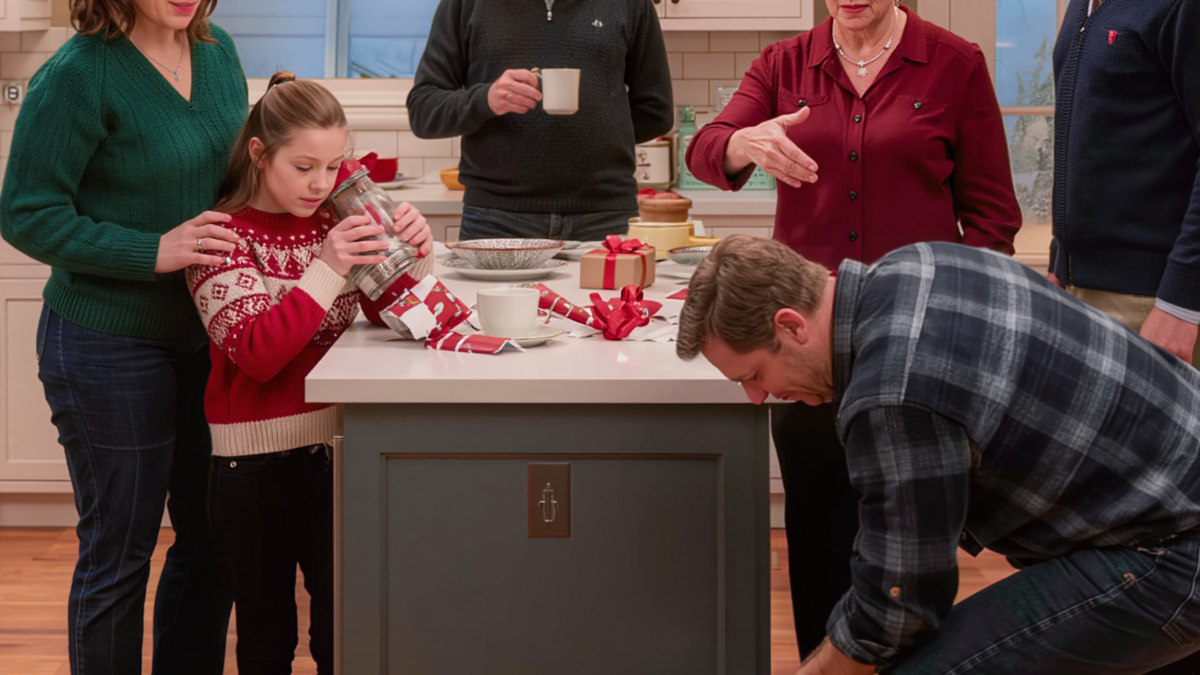
In my mother’s kitchen on Christmas Day, nine people watched my six-year-old daughter hold out a mason jar she had spent two months making.
Cleo still had scraps of wrapping paper in her hands when my mother turned the jar once, looked at it for perhaps a second, and dropped it into the trash can beside the sink.
“You’re just a farmer’s child,” she said. “Don’t call me Grandma.”
My father laughed.
It was not a full laugh. More of a short sound through his nose, the same little social noise I had heard him make at the end of uncomfortable conversations for most of my life.
Cleo looked up at me.
“What did she say?”
For a second, I could not answer.
Then she began crying quietly into my sleeve.
My husband, Garrett, moved.
He reached past the paper plates and Christmas trash, pulled the jar back out, wiped it with the dish towel from the oven handle, and set it carefully on the counter.
The glass had not broken.
He straightened.
Garrett is not a loud man, and he did not become one then.
“You can look down on me,” he told my mother. “Not my child.”
Then he turned toward my father.
“Should I tell everyone who’s been paying your bills?”
Nobody answered.
My brother Everett looked at our mother.
His wife, Colleen, looked down.
My mother placed one hand flat on the counter.
“That’s between adults,” she said.
My father stopped laughing.
That was the detail I carried home with me.
Not the jar.
Not even my mother’s sentence.
My father’s face.
For the rest of that afternoon, he barely looked at anyone.
At the time, I thought Christmas had exposed the worst thing in our family.
I was wrong.
The worst part had already been sitting in cardboard boxes in my basement for years.
I simply had not opened the right envelopes yet.
My name is Edna Bergos. I was thirty-six that Christmas, married to Garrett Ostrander, and living on a farm south of Kalamazoo, Michigan, with our daughter, Cleo.
I grew up in Grosse Pointe in a house where nobody raised their voice.
People sometimes hear that and imagine peace.
It was not peace.
In our house, disagreement was simply pushed underground until it returned later in a quieter, colder form.
My mother, Bernadette, had one sentence she used whenever she wanted a conversation to end.
“We don’t discuss that at the table.”
She could say it about money, disappointment, family, a bad decision, or something somebody had said that hurt.
Once she used those words, continuing to talk meant that you were the difficult one.
Nobody continued.
I learned young that the skill my family rewarded was not being fine.
It was appearing fine while something inside you went somewhere private.
That was why, at thirty-six, I stood in my mother’s kitchen while she threw away my daughter’s handmade gift and did not shout.
The quiet in our family had always been a system.
Someone was always paying for it.
It was simply never the person controlling the conversation.
My brother Everett is four years older than I am.
He was not a stereotypically spoiled child. My parents did not buy him everything or excuse every mistake.
He simply walked the path they understood.
Business degree.
Pharmaceutical sales.
A country-club wedding to Colleen in Bloomfield Hills in 2011.
My mother talked about the flowers at their wedding for years.
A large framed photograph from that day hung in my parents’ living room.
My own wedding had been in 2016.
That photograph never made the wall.
I did not hate Everett for any of it.
That would have made everything simpler.
He called our mother every Sunday. He loved his children. He worked hard. He assumed our parents were basically the people they claimed to be.
And he never asked where the money in their house came from.
Those facts became important later.
My father, Stanley, worked as an internal auditor for an auto-parts supplier in Sterling Heights for thirty-one years.
He retired in 2019.
The thing I admired most about him was his precision.
Since the early 1980s, he had written expenses in green spiral notebooks he kept in his desk.
Groceries.
Gas.
Repairs.
My childhood allowance.
Everything appeared in small square handwriting.
When I was about fourteen, I asked him why he bothered if he never seemed to use the notebooks for anything.
“Numbers don’t argue with you, Edna,” he said. “That’s the whole appeal.”
He was the quietest man in almost every room he entered, and the most meticulous record keeper I have ever known.
For years, I assumed those were unrelated qualities.
My mother was harder to understand.
Bernadette grew up in Warren, in a modest two-bedroom house off Ryan Road. Her father worked in manufacturing. She left home young, built a career in hospital human resources, and spent decades turning herself into the polished suburban woman she wanted the world to see.
By the time she retired as a department head in 2018, almost nothing in her appearance, speech, or house suggested where she had come from.
Her mother died in 2011.
After the funeral, standing in a parking lot, my mother once told me that her mother had grown lilacs along the back fence.
“The lilacs are the only thing I miss about that house,” she said.
It was one of the few unguarded things I ever heard her say.
Years later, when Cleo was four, I told her that story.
I wanted to give my daughter one warm fact about the grandmother who rarely offered her any.
At the time, I thought that was kindness.
Eventually, it would become part of the reason Christmas hurt so much.
I had always been the person in our family who handled paperwork.
Insurance statements.
Incorrect bills.
Appointments.
Taxes.
When something needed organizing, my parents said, “Edna’s good with that kind of thing.”
It was one of the only forms of praise I received easily.
Thirty years later, that habit placed every important piece of paper in my hands.
Neither of my parents ever considered that I might someday read them differently.
I met Garrett in May 2015 at a farmers market near Kalamazoo.
He was standing behind a folding table of tomato seedlings, explaining to an older woman that the plant she wanted would die where she planned to put it.
He talked himself out of a sale because he would rather lose eleven dollars than sell somebody a plant he knew would fail.
I bought four seedlings.
I killed all four.
Garrett’s family farmed roughly three hundred acres south of Kalamazoo. They grew sod for landscaping contractors and municipal courses, plus nursery stock for garden centers.
When I told my parents about him, my mother paused.
“And what does he plan to do after the farm?”
For a moment, I thought she had misunderstood.
There was no “after.”
The farm was his work.
His life.
His future.
When I explained that, my father laughed.
Garrett and I married in September 2016 on the farm, outside between the equipment shed and nursery rows.
About a hundred people came.
Garrett’s mother, Lorraine, baked the pies herself because she refused to pay four dollars a slice for something she could make better.
My mother arrived late.
She blamed traffic on I-94.
She stayed through the ceremony, ate very little, and left before the toasts.
On her way out, she hugged me and said, “We’ll make it up to you at the real reception.”
There was no other reception.
There was never supposed to be.
That was how my mother refused things.
She postponed them.
By the time you realized postponement was the refusal, enough time had passed that mentioning it made you seem bitter.
Garrett never criticized her.
Not then.
Not later.
I knew why.
If he said it aloud, I would have to defend my parents or agree with him.
Both would cost me something.
So he said nothing.
That was the kind of man he was, and it mattered when my mother eventually called him for money.
Before Cleo was born, Garrett and I went through two painful pregnancy losses.
The first time, my mother said she was sorry, then immediately told me about somebody else who had gone through the same thing and later had healthy children.
The second time, I left her a message.
She called back more than a week later about something unrelated and never mentioned what had happened.
Lorraine came to our house the next day.
She made soup.
Washed clothes.
Sat in our kitchen.
On the fourth morning, she asked whether I wanted her to go.
“Not yet,” I said.
She stayed another night.
After that, I stopped telling my mother things that truly mattered.
I still called her every Sunday.
Both facts were true for years.
I think I kept calling because I was not really calling the woman she was.
I was calling the woman I still believed she might become.
Cleo was born on August 2, 2019.
My mother drove 145 miles to the hospital.
She held Cleo for two hours.
“She has your hands,” she said.
I took a photograph of the three of us.
For years afterward, it stayed on our refrigerator.
My mother never displayed a photograph of Cleo in her own home.
There were photographs of Piper and Grady, Everett’s children, in hallways and on shelves.
I noticed.
Then I told myself noticing was the problem.
A woman who drove across Michigan to hold her granddaughter had changed, I decided.
She had not.
Four months later, my mother called Garrett directly.
Not me.
She told him my father’s supplemental insurance situation after early retirement had left them with unexpected expenses.
She said money was tight.
Then she added the sentence that made the request work.
“I’d rather Edna didn’t carry this. She’s got enough.”
Garrett agreed during the call.
He had grown up with a simple understanding of family obligation. If your parents needed help and you could provide it, you helped.
My mother understood that about him very quickly.
He told me three weeks later.
I remember feeling touched.
That memory embarrasses me now, but it is true.
The first transfer left our farm account on January 10, 2020.
Two thousand dollars.
Automatic.
Every month.
There was no contract.
No repayment schedule.
No interest.
No one used the word loan.
My mother called it “help.”
I once suggested that we put something in writing so everyone understood the arrangement.
Garrett looked at me as though I had suggested invoicing his mother for Christmas dinner.
“They’re your parents,” he said. “You don’t invoice your parents.”
The transfers continued.
In 2021, my father had cataract surgery. He stopped wanting to deal with paperwork afterward.
My mother never handled paperwork.
That had always been Stanley’s domain.
So I started helping with their taxes.
Every spring, I drove to Grosse Pointe, collected the documents, organized them, and took what was necessary to their tax preparer.
In April 2021, my mother handed me a banker’s box.
“Could you keep last year’s stuff at your place? We’re tripping over things.”
I stored it in our basement.
The arrangement repeated the next year.
And the next.
Every spring, another box came home with me.
I opened them when I needed tax documents.
I ignored everything else.
In May 2021, the roof on my parents’ house needed work.
Garrett paid the contractor $9,200.
My mother mailed him a handwritten thank-you note.
That September, I texted her about Cleo.
Garrett and I had been talking about college.
Money was not loose for us. The farm had equipment debt, and we were raising a child.
But I thought if grandparents and parents contributed small amounts over time, it could grow.
I asked whether she and Dad might want to start something for Cleo.
She answered within an hour.
“Honey, we’re not in a position to be setting anything up right now. I wish we were.”
I immediately felt guilty.
I apologized.
I told her I knew things were tight and asked her to forget I had mentioned it.
She accepted my apology.
At the time, it felt like an ordinary Tuesday.
Eventually, that text would become the cleanest piece of evidence in the entire story.
The monthly transfer rose to $2,800 in 2022.
Then to $3,400 in 2024.
There were additional expenses.
Dental work.
A transmission.
Other things that seemed temporary.
On our side, the costs became harder to see because Garrett hid them inside delays.
We owned an old irrigation reel that began failing.
Replacing it would cost around $22,000.
Every season, Garrett repaired it under a work light and said the same thing.
“We can get one more year.”
We stayed on a high-deductible health plan.
During open enrollment, he told me a better plan did not fit the numbers.
I believed him.
The better plan could have fit.
It simply did not fit after more than forty thousand dollars a year left the farm account for my parents.
When I finally understood that, I wanted to be angry at Garrett.
I could not.
He had been buying me distance from a decision.
If he had told me exactly what helping my parents cost us, I would have been forced to choose.
He had spent years trying to make sure I did not have to.
There were clues on my parents’ side too.
In 2022, they leased a new Buick Enclave.
I noticed.
I asked my mother about it carefully.
She gave me a perfectly reasonable explanation involving the end of their old lease and savings.
It was the kind of answer built so well that questioning it would have made me feel rude.
So I stopped questioning.
By then I had enough pieces.
Parents who said money was tight.
A new vehicle.
My husband postponing equipment replacement.
My mother declining to help her granddaughter.
I simply refused to assemble the picture.
Because assembling it would have required action.
And action was not what I had been trained for.
Cleo, meanwhile, became a child who collected and organized things.
Lorraine taught her to press flowers using an old Kalamazoo County phone directory from the equipment shed.
They placed blossoms between the pages, stacked weight on top, and wrote dates in pencil beside each one.
Some of Cleo’s numbers were backward.
She loved it.
One day when she was four, she asked whether her other grandmother liked flowers.
I said yes.
It was not exactly a lie.
I had the lilac story.
That became enough.
Two years later, she decided to make Bernadette a Christmas present.
The nursery had a row of lilacs that bloomed every May.
Cleo picked one.
She pressed it.
Over several weekends, she and Garrett decorated a quart mason jar with pressed flowers arranged in the order she had collected them.
The lilac came first.
Inside, she placed a drawing.
Our little family.
And a taller woman with gray hair.
Garrett helped her make a masking-tape label.
Grandma’s Jar of Our Farm.
The night before Christmas, she took it to Lorraine’s house.
Lorraine held it under a lamp and turned it carefully.
“The lilac is the best one,” she told her.
Then Cleo practiced saying, “Merry Christmas, Grandma.”
Three times.
Slowly.
She wanted to get it right.
Christmas morning, she held that jar on her lap for almost the entire 145-mile drive.
Garrett offered to put it safely on the seat.
She refused.
Somewhere past Jackson, he glanced toward me.
“If it gets bad, we leave.”
“We leave,” I agreed.
We had versions of that conversation before most visits.
My parents’ house was full when we arrived.
Everett and Colleen were there with Piper and Grady.
My father’s older brother Dennis had come too.
After lunch, everyone drifted into the kitchen with coffee.
Christmas presents followed their familiar hierarchy.
Piper received thoughtful gifts.
Grady received thoughtful gifts.
Cleo received an envelope containing ten dollars.
“We didn’t know what she’d like,” my mother said to the room.
Cleo barely cared.
She was waiting to give her gift.
When the boxes had been moved aside, she carried the jar around the island in both hands.
“Merry Christmas, Grandma.”
She said it slowly, exactly as she had practiced.
My mother removed the wrapping.
She turned the jar once.
Then dropped it into the trash.
“You’re just a farmer’s child. Don’t call me Grandma.”
The wrapping paper stayed in Cleo’s hands.
She looked at me.
“What did she say?”
My father made his little laugh.
“Oh, Bernie.”
Cleo began crying.
Garrett took the jar out of the trash.
“You can look down on me. Not my child.”
Then he asked my father whether he should tell everyone who had been paying their bills.
My father stopped laughing.
We left.
Garrett wrapped the jar in the dish towel and carried it to the truck.
Cleo barely spoke on the drive home.
That night I believed the story was simple.
My mother was cruel.
Garrett had helped my parents financially.
Those two facts were painful enough.
The next morning, my father called at nine.
He did not mention Christmas.
He asked whether I would still do their taxes.
I said yes.
I did not fully understand why.
On January 5, I asked Garrett to stop the automatic payment.
“Are you sure?”
“Yes.”
“Do you want me to call them?”
“No. Don’t explain anything.”
The January payment did not arrive.
A few days later, my mother texted.
She suggested there must be a banking problem.
She mentioned my father’s prescriptions.
She did not mention Cleo.
Another message followed when I did not answer.
“I’d appreciate a response, Edna.”
At home, the damage from Christmas appeared in smaller ways.
Cleo stopped pressing flowers.
I found the old phone book on top of her wardrobe with a rubber band around it.
“I just don’t want to do it anymore,” she said.
Then she added the phrase I had used my entire life.
“It’s fine.”
I left the book where she had put it.
On January 17, I went into the basement for a tax form.
I opened the 2024 box.
Among the papers were two envelopes from the Michigan Education Savings Program.
The owner was Bernadette A. Bergos.
Beneficiary: Piper Bergos.
The second statement was the same.
Beneficiary: Grady Bergos.
I stared at them.
Then I pulled down the 2023 box.
Two more statements.
Then 2022.
Then 2021.
Eight statements.
Two accounts.
No Cleo.
I checked the establishment date.
January 14, 2020.
Garrett’s first payment to my parents had gone out January 10.
Four days.
At the kitchen table, I created a spreadsheet.
Payment from our account.
Deposit into education accounts.
Dates.
Amounts.
Patterns.
Then I added up what I knew about my parents’ finances.
Their pensions.
Their retirement accounts.
Their paid-off house.
The absence of credit-card balances.
They were not wealthy.
But they were not broke.
“Garrett,” I said when he came into the kitchen. “They were never broke.”
He stood in the doorway holding coffee.
After a long silence, he asked the best question anybody could have asked.
“What do the statements prove?”
I made myself answer carefully.
They proved my parents received money from us.
They proved my mother was funding college accounts for Piper and Grady.
They showed an extremely close timing pattern.
They did not prove that the dollars leaving our farm account were literally the dollars entering those accounts.
Money does not carry fingerprints.
If my mother said she funded the accounts from her pension, I could not produce a document proving otherwise.
The case felt smaller.
Then I remembered September 2021.
I searched my phone until I found the message.
“Honey, we’re not in a position to be setting anything up right now. I wish we were.”
September 14.
I opened the 2021 statement.
September 18.
Four days later.
Deposit to Piper’s education account:
$4,000.
That ended the argument.
Not about whose money she used.
About what she had told me.
My mother had said she could not contribute toward Cleo.
Ninety-six hours later, she contributed four thousand dollars toward Piper.
That was not a misunderstanding about finances.
It was a decision about grandchildren.
The next morning, Cleo came into the kitchen while the statements were still spread across the table.
“What are those?”
“Savings accounts for when kids get older.”
She looked at the names.
“Do I have one like Grady?”
She had almost no understanding of what an education account meant.
What she understood was simpler.
There was a list.
She wanted to know whether her name was on it.
“Not yet,” I said.
She nodded and went to find her shoes.
In early February, I drove to Grosse Pointe alone.
Snow followed me most of the way down I-94.
Garrett stayed with Cleo.
I did not call ahead.
My mother opened the door looking genuinely pleased to see me.
She took my coat.
She made coffee.
She asked about the farm.
I could hear the television in the den.
My father never came out.
“I have one question,” I said.
My mother sat across from me at the kitchen table.
“Why isn’t there an account for Cleo?”
I expected denial.
Confusion.
A promise to fix it.
She gave me none of those.
“Your brother’s children have a path in front of them,” she said.
“What does that mean?”
“I put it where it would matter.”
She spoke gently.
That made it worse.
“Piper is going somewhere. Grady too. They’re on a track. I’m not going to pretend I don’t see the difference.”
“She’s six.”
“And she’ll be raised on a farm.”
“That sounds like an insult.”
“It isn’t. It’s a fact.”
I asked whether she knew Cleo had spent two months making the jar.
My mother set down her cup.
“That,” she said, “is exactly the problem.”
Neither of us raised our voice.
If someone had stood outside the kitchen, they might have thought we were having an ordinary conversation.
I put on my coat.
At the door, she reminded me that the money Garrett had given them came with no conditions.
She said she hoped I would not make everything about money.
I told her I would think about that.
Three days later, an invitation arrived.
Heavy cream cardstock.
My parents’ forty-fifth anniversary.
March 14.
Their original wedding date had fallen on a Saturday again, and they were hosting an open house.
About thirty people.
Family.
Church friends.
Everett and Colleen.
I stood in our driveway holding the envelope and laughed once.
My mother had invited me because not inviting her own daughter would require explanation.
She had chosen the room.
She simply did not understand yet what that room could do to a story.
Everett called in February.
I knew within seconds that he had already heard our mother’s version.
“She said you brought up money at Christmas.”
Not: What happened to Cleo?
Not: What did Mom say?
Money.
I asked what else he had heard.
That Mom was hurt.
That she had barely slept.
That she did not understand what she had done wrong.
Everett was not deliberately lying.
He simply received one version first from a woman who had never treated him the way she treated me.
He had no reason to imagine there was another.
I almost sent him the statements.
I stopped myself.
A private accusation from a sister can be turned into jealousy.
A document read in a room full of witnesses is harder to reshape.
“I’ll see you on the fourteenth,” I told him.
Near the end of February, my mother called.
She had an offer.
She understood that I was hurt, she said.
If things returned to normal, perhaps there would be room to do something for Cleo too.
“Making room for her,” she called it.
I said no.
After I hung up, I stood in our mudroom with one arm still inside my coat.
For six years, Garrett had sent them thousands every month.
Now my mother had finally named the price of belonging.
If the money resumed, perhaps my daughter could be included.
A week later, a package arrived.
An expensive doll.
The card said it was from Grandma.
Cleo watched me hold the box.
I gave it to her.
I could not bring myself to throw away a child’s gift after seeing how that looked from the other side.
Cleo turned the box over in her hands.
“Does Grandma like me now?”
I told her that her grandmother had sent her a present.
“And presents and liking somebody aren’t always the same thing.”
It was a terrible answer.
It was also the truest answer I had.
That same week, Cleo brought home a classroom family-tree worksheet.
She filled in names around the branches.
Then she erased my mother’s.
“Do you get a bad grade if you leave one blank?”
“No.”
She stared at the empty box.
“Can you draw a different tree?”
Six years old.
She reached a place in one afternoon that had taken me three decades to reach.
That night, I told Garrett I intended to attend the anniversary party.
He said he did not want to go.
It was the busiest stretch of nursery shipping.
But we both knew the farm was not why.
“I understand,” I said. “I’m going anyway.”
“Why?”
“She spent forty years building that room. I’m going to use it.”
Garrett left the kitchen.
Ten minutes later, he came back.
“What time do we need to leave?”
There were about thirty people in my parents’ house on March 14.
My mother met us at the door glowing with hospitality.
Two women from church stood nearby.
“There she is,” my mother said when she saw Cleo.
She hugged my daughter in the entryway.
Cleo let her.
Watching it, I finally understood something physically that I had understood intellectually for years.
My mother was capable of warmth.
Warmth was not absent from her.
She rationed it.
She decided when it was useful, who deserved it, and which audience should see it.
Dennis stood near the drinks table.
Everett and Colleen were there.
Piper and Grady too.
Garrett shook hands and answered questions about the farm.
Around three o’clock, my father raised a glass.
His toast lasted less than a minute.
Forty-five years.
Ups and downs.
Not everyone gets that many.
There was no story about my mother.
No private memory.
No detail that belonged specifically to them.
Only arithmetic.
Forty-five years.
A Saturday again.
People clapped.
Then my mother stood.
She thanked everyone for coming.
She talked about the house and the family.
Then she lifted two envelopes from the sideboard.
She handed one to Everett.
One to Colleen.
She said she and Stanley had spent years thinking about what forty-five years was for.
“This isn’t a fortune,” she said, “but it’s what we’ve been able to put aside for the grandchildren.”
The room applauded.
My mother continued.
The accounts had been opened in January 2020.
Together, they were worth about $138,000.
She said the number aloud because numbers make generosity visible.
Cleo stood three feet away holding a plastic cup of ginger ale.
Colleen looked down at the envelope.
Then at Cleo.
Then away.
When the applause faded, Uncle Dennis asked the first question.
He did it in the mild voice of a retired mail carrier asking where to set a chair.
“Doesn’t Cleo get one?”
Nobody answered.
Something moved briefly across my mother’s face.
Dennis put down his drink and sat in a chair along the wall.
I crossed the room.
I placed my hand on Cleo’s shoulder.
“Colleen, could you take her outside for a few minutes?”
Colleen was reaching for her coat before I finished the sentence.
I did not want my daughter standing there for what came next.
Once the back door closed, I looked at my mother.
“Which grandchildren, Mom?”
“There are practical considerations, Edna.”
She said it with complete composure.
The same words had worked in private.
Why would she expect a different result in public?
I removed a folded sheet of paper from my bag and put it on the dining-room table beside the anniversary cake.
I did not give a speech.
I read dates.
January 10, 2020.
Money leaving our farm account.
January 14.
Deposits.
Again.
Again.
Year after year.
The tenth.
The fourteenth.
Six years.
My mother waited until I stopped.
Then she answered carefully.
“That money was a gift. Nobody asked us to account for it. Nobody put conditions on it.”
She was right.
Legally, procedurally, she was right.
Garrett had given the money freely.
We had never created a repayment agreement.
She could use her own funds however she wanted.
I had known she would say that.
So I reached into my bag again.
I took out a printed photograph of my phone screen.
“September 14, 2021,” I said. “I asked whether you and Dad wanted to help start something for Cleo.”
I read her message.
“Honey, we’re not in a position to be setting anything up right now. I wish we were.”
Then I placed the 2021 statement beside it.
“September 18. Four thousand dollars into Piper’s account.”
My mother stared at the pages.
“I’m not saying you stole anything,” I told her. “I’m saying you lied to me. Four days later, you wrote a check for somebody else.”
She turned toward my father.
Stanley stood beside the china cabinet holding a glass.
For once, he did not laugh.
Everett moved to the end of the table.
He still held the unopened envelope.
“How much, Garrett?”
Garrett had barely spoken all afternoon.
Everett repeated himself.
“Total.”
Garrett answered.
“Two hundred eighteen thousand eight hundred.”
The room changed.
Everett turned toward our father.
Not our mother.
The auditor.
“Dad. Is that right?”
Stanley looked at the tablecloth.
“The fourteenth is right.”
Four words.
That was all.
But numbers were the language he had spent his life refusing to manipulate.
Nobody in our family had ever questioned him about a date in a ledger.
My mother said my name.
“Edna.”
She said it in the old tone.
The tone that once meant the conversation was finished.
It did not work.
Dennis had already asked the first question.
My father had confirmed the date.
And thirty people had heard my mother say “the grandchildren” in the plural only minutes earlier while one grandchild stood without an envelope.
I told her what I had actually come to say.
“I’m not asking for the money back. It was a gift. Garrett gave it. It’s gone. Those accounts are yours.”
She began to speak.
I continued.
“The transfers are finished.”
She stopped.
“And you don’t see Cleo.”
“Edna—”
“You don’t get to decide what my daughter is worth, and you don’t get to practice on her again.”
Garrett stood beside me without saying a word.
That silence was deliberate.
He had spent six years quietly protecting me from choosing between my parents and our household.
Now he let the choice belong entirely to me.
We found Cleo outside with Colleen.
Colleen hugged me before we left.
She did not speak.
About forty minutes into the drive home, somewhere past Belleville, Cleo looked through the passenger-side window.
“She didn’t want my jar because she didn’t want me.”
She was not crying.
She sounded like a child who had already thought about the sentence for a long time.
I turned in my seat.
I did not tell her she was wrong.
I could not promise her somebody loved her when their own behavior had said otherwise.
The weeks afterward were not triumphant.
My mother’s version spread quickly.
Edna brought financial papers to her parents’ anniversary.
Edna caused a scene.
Edna made money an issue.
That version was easier to believe for people who had known my mother socially for thirty years and met me only a handful of times.
Dennis called me.
His call lasted less than a minute.
“I was there,” he said. “That’s not what I saw.”
I did not spend much time correcting anyone else.
I had not needed all thirty people in that room.
I only needed enough witnesses that the truth could no longer be rewritten completely.
In April, Colleen drove down from Grand Rapids.
She brought the anniversary envelope.
It was still sealed.
She placed it on our kitchen counter.
“I’m not apologizing for your mother,” she said. “I’m apologizing for me.”
I waited.
“I noticed there were never pictures of Cleo in that house. I noticed years ago. I didn’t say anything.”
Before leaving, she told me Everett would call.
“He’ll get it wrong the first time.”
She knew her husband.
Everett called.
He spent most of the conversation describing how impossible his position felt.
I listened.
When he finished, I told him I could not help him feel better about it.
We hung up.
A few weeks later, he called again.
This time he had researched the education accounts himself.
He had asked our mother why she had never added Cleo.
Bernadette told him changing beneficiaries would be too expensive.
Everett checked.
It would not have cost anything meaningful.
No penalty.
No complicated tax consequence.
She simply did not want to do it.
My brother had spent most of his life accepting the first version of every family story.
It took him ten minutes with a search engine to knock down the last explanation.
After that, he stopped bringing Piper and Grady to Grosse Pointe.
My mother kept the accounts.
Every dollar.
She lost access to all three grandchildren.
No court ordered it.
No one confiscated anything.
She chose.
At the end of April, a thick envelope arrived at our farm.
Inside were twelve photocopied pages from one of my father’s green spiral notebooks.
Every transfer.
Every date.
Every amount.
January 2020 through December 2025.
Small square handwriting.
At the top was a card addressed to Cleo.
Not to me.
Cleo,
I laughed. I want you to know that I know I did.
Grandpa Stan.
That was all.
No excuse.
No request for forgiveness.
No demand to see her.
I put the card in a drawer.
Someday, when Cleo is old enough, I will give it to her.
What she does with it will belong to her.
My mother’s letter arrived about a week later.
Two pages.
She was sorry that things had been said.
She hoped we could move forward.
She wrote that she and Stanley would consider doing something financially for Cleo if we could put the past behind us.
Two letters sat on the same counter.
My father’s asked for nothing.
My mother’s offered money if silence came with it.
She called that healing.
I said no.
In May, Everett sent Garrett a check for twelve thousand dollars.
It was not $218,800.
It was what he could afford.
Garrett ordered the irrigation reel we had postponed for years.
During open enrollment, we changed health plans.
Three years late.
I opened an education account for Cleo.
When the form asked for the first deposit, I typed $4,000.
I did not consciously choose the number.
Then I saw it.
Four thousand dollars.
The same amount my mother had deposited into Piper’s account ninety-six hours after telling me she could do nothing for Cleo.
I left the number.
A few weeks later, I came home from the library and found the old phone book on the kitchen table.
It was open.
A new flower lay pressed between the pages.
Beside it, Cleo had written the date in pencil.
One number backward.
Nobody had told her to start again.
I did not make a big moment out of it.
That evening, I returned the book to her shelf at a height she could reach.
On Memorial Day weekend, we ate outside.
Lorraine cooked.
Dennis drove down and stayed in our spare room.
Everett and Colleen came with Piper and Grady.
Things were not magically repaired between my brother and me.
They may never return to what they were.
But he drove to our farm.
He stood in our yard.
That counted.
Nobody mentioned Grosse Pointe.
At one point, Cleo ran into the nursery rows where the lilacs were blooming and yelled that Uncle Everett was standing in her way.
He stepped aside.
Later, Garrett carried a spade into the nursery.
He dug up one lilac from the sale stock.
The three of us carried it to the corner of our yard beside the kitchen steps.
We planted it there.
“When are you selling this one?” Cleo asked.
Garrett packed soil around the roots.
“This one doesn’t go on the truck.”
“This one stays?”
“This one stays.”
She asked how long lilacs live.
Garrett told her they can outlive the people who plant them.
I looked at the small bush in the ground.
Lilacs were the one thing my mother had once admitted missing from her childhood.
Now one was growing beside our kitchen for the granddaughter she had dismissed because she lived on a farm.
The jar remained on the windowsill above our sink.
Garrett had carried it home on Christmas night wrapped in my mother’s dish towel.
The lilac blossom was still first in the band around the glass.
Months later, Cleo stood on a stool at the sink and asked me why her grandmother had not wanted it.
I had spent most of my life searching for softer explanations for my mother.
I did not do that anymore.
“People get to decide they don’t want you,” I told her. “That has never once been information about you.”
Cleo thought about it.
Then she picked up a dish towel.
“Can I dry the forks?”
Outside the kitchen window, headlights came up the drive.
Garrett was coming in from the field.
And beside the steps, the lilac was still growing.