My mother stood in her sewing room holding six inches of my $4,800 Vera Wang train while my sister modeled the rest. “She’s getting married first now,” Mom said. I was furious—until that one word, now, made me realize they knew something about my future I had never told them.
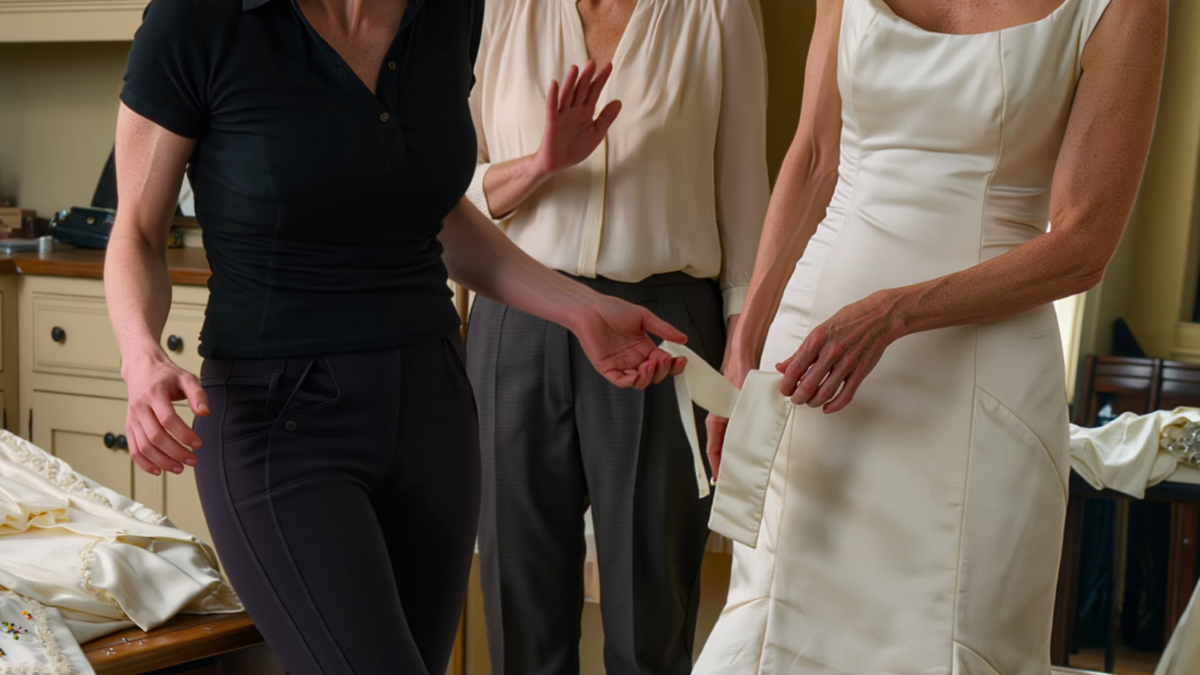
“Your wedding dress. I altered it for your sister.”
My mother said this while holding six inches of ivory silk in one hand.
Not metaphorical inches.
Six actual inches of the train from my Vera Wang wedding gown were stretched across her palm like evidence from an extremely expensive crime scene.
It was 3:17 on a Thursday afternoon in May, and I was standing in the sewing room at my parents’ house outside Lexington, Kentucky, still dressed for work.
I had come straight from the barn. There was dried mud on my left knee, horsehair clung to my black polo, and I could still smell saddle soap on my hands.
Across the room, hanging half-open from the closet door, was the garment bag I had trusted my mother to keep safe.
And standing in front of the mirror was my younger sister Madison.
Wearing my dress.
I knew it instantly, even though it no longer looked like the dress I had bought.
The neckline had been cut lower.
The waist had been taken in.
The long sleeves I loved were gone.
And the train—the entire reason I had stopped in front of that bridal-shop window three years earlier—had been shortened so drastically that the silhouette looked completely different.
Madison turned sideways in front of the mirror.
She lifted the skirt slightly.
“I actually think it’s more modern now.”
I stared at her.
Then at my mother.
Then at the six-inch strip of silk in Mom’s hand.
“Olivia,” Mom said, already using the careful voice she used whenever she believed I was about to become unreasonable. “Please don’t make this ugly.”
I looked at what remained of the train.
“I’m not sure I’m the one who made it ugly.”
Madison rolled her eyes.
“You’re not even engaged.”
That was technically true.
For another eleven days.
Madison didn’t know that.
Neither did my parents.
My boyfriend Daniel had already bought a ring. I knew because Daniel was an excellent architectural photographer and a terrible spy.
We had been together four years. We had talked seriously about marriage for two. He believed he had concealed his plan for our upcoming trip to Paris.
Unfortunately, he had once left his laptop open on our dining table with a browser tab titled something close to How to Get an Engagement Ring Through Airport Security Without Girlfriend Seeing It.
There are men who can conceal international conspiracies.
Daniel could not conceal a baguette.
I had pretended I never saw the tab.
He had pretended I remained completely unaware of the oddly guarded backpack, the phone calls taken on the balcony, and the restaurant reservation in Paris that he insisted was “just dinner.”
It had become a private performance.
I loved him enough not to ruin it.
Then Madison got engaged.
That happened six weeks before I found her wearing my dress.
She had been dating Trevor for five months. Trevor sold luxury cars, had extremely white teeth, and called nearly every man he met “boss.”
He was pleasant enough.
At Christmas dinner, Daniel had casually mentioned that he and I were looking at apartments together.
Eleven days later, Trevor proposed to Madison at a steakhouse.
From what I learned later, Trevor had originally intended to wait until summer.
Madison helped him understand that there was apparently no reason to delay.
Her wedding was scheduled for October.
Then she learned Daniel and I were going to Paris in May.
October immediately became unacceptable.
The date moved to June.
At the time, I told myself that Madison was simply excited.
I should have known better.
Competition had been the background noise of our relationship since childhood.
Not constant war.
Nothing that dramatic.
Just a thousand small moments that taught me the same rule.
If I accomplished something quietly, Madison usually ignored it.
If someone praised me for it, she needed the same thing, preferably bigger, preferably sooner.
When I was eleven, I won a county science fair with a project on water quality.
Madison was eight.
The following year, she entered three projects.
One involved magnets.
One involved bean plants.
The third involved a potato connected to a calculator in a way no one in our family ever fully understood.
She didn’t win.
She cried in the parking lot because Dad had taken a picture of me holding my ribbon.
When I was sixteen, I spent months mucking stalls and helping at weekend lessons until I had enough money for a used Honda Civic.
It was beige, had 142,000 miles, and possessed an air conditioner with only two settings: Arctic winter and elderly-hamster breath.
I loved it.
Three months later, thirteen-year-old Madison announced that she needed a car.
My parents pointed out that she could not legally drive.
She told them that wasn’t the point.
At my college graduation, she arrived forty minutes late because she had gotten her hair done.
During lunch, while my diploma was still under my chair, she announced that she had been accepted into a semester-abroad program in Florence.
Mom cried.
Dad ordered champagne.
None of that destroyed our relationship.
It simply established its physics.
Madison needed to feel first, prettier, more impressive, more injured, or more interesting.
Sometimes I challenged her.
Most of the time, I found it exhausting and stepped aside.
Horses were the exception.
Horses did not care who was prettier.
They did not care who had better photographs, a newer car, or more attention at dinner.
This offended Madison on a spiritual level.
I had been teaching riding for twelve years by the time of the dress incident, mostly hunter-jumper lessons for children, teenagers, and adults who had watched enough television to believe a horse was basically a large motorcycle with feelings.
A horse is not a motorcycle.
A motorcycle does not notice your anxiety and suddenly discover a powerful personal interest in a plastic bag forty yards away.
My job was part instruction, part animal management, part unpaid therapy, and part yelling things like, “Heels down, Emma,” while Emma attempted to negotiate with gravity.
I loved it.
The barn had eleven regular lesson horses, three competition horses, and one chestnut gelding named Moody Rudy.
Rudy technically belonged to the barn owner.
Emotionally, he belonged to no one.
He was seventeen hands, chestnut, with one white sock, a crooked blaze, and the facial expression of a man who had been waiting forty years for a waiter to bring the check.
He was safe.
That part matters.
He had never bitten anyone.
He had never kicked anyone.
He did not rear or buck.
He simply judged.
Deeply.
Personally.
With extraordinary commitment.
If Rudy liked you, he rested his chin on your shoulder.
If he disliked you, he looked at you as though you had cornered him at Thanksgiving to explain cryptocurrency.
Rudy disliked Madison.
Not humanity.
Madison.
Their feud began eight years earlier.
I had started competing locally, and Dad hung a photograph in his office of me jumping a four-foot oxer.
Madison saw the photograph.
Three days later, she bought riding boots.
Her first lesson was on Daisy, a twenty-two-year-old gray mare who had taught so many children to ride that she carried herself with the calm resignation of a public-school librarian.
Madison spent twenty minutes taking selfies.
Then she asked when she could jump.
“When you can steer,” I said.
“I can steer.”
Daisy walked directly to the center of the arena and stopped.
Madison squeezed with her legs.
Nothing.
She kicked.
Daisy slowly turned her head and looked back at her.
I had never seen an animal communicate Are you finished? so clearly.
Two months later, Madison demanded a more advanced horse.
That was how she met Rudy.
I did not put her on him for revenge.
At that time, Rudy was one of our more reliable intermediate horses.
He simply required riders to ask instead of demand.
Madison demanded.
She mounted.
Rudy turned his head.
His ears moved sideways.
Not pinned.
Just sideways.
It was the equine equivalent of opening an email and seeing the words Per my last message.
“Why is he looking at me?” Madison asked.
“He looks at everybody.”
“He looks annoyed.”
“That’s his face.”
Rudy exhaled.
Madison pointed at him.
“See?”
For forty minutes, he obeyed nearly every instruction I gave and almost none of the ones Madison thought she was giving.
“Ask for trot.”
She squeezed.
Nothing.
She kicked.
Nothing.
She clucked.
Rudy stood in the middle of the arena contemplating mortality.
“Use your leg, Mads.”
“I am.”
“You’re kicking randomly.”
“He knows what I mean.”
Rudy looked at me.
Then at Madison.
Then back at me.
I could not prove what that look meant scientifically.
But I was there.
Eventually she got him trotting.
She immediately pulled too hard.
Rudy stopped.
She kicked.
He backed up.
She pulled.
He backed faster.
Within ten seconds, my younger sister had reverse-parked a horse neatly between two jump standards.
I turned away because instructors are supposed to be encouraging.
“Olivia,” she called. “He’s doing this on purpose.”
“He’s a horse.”
“He knows.”
Rudy knew.
Again, I cannot prove that.
Over the years, Madison returned to riding whenever horses became fashionable in photographs.
Rudy’s opinion never improved.
Once she brought him an organic apple because she had read that treats promoted bonding.
Rudy accepted the apple, chewed it, then turned around and walked away while she was still talking to him.
Another time she tried to film herself leading him through a field in slow motion.
Rudy stopped behind her.
Madison kept walking.
The lead rope tightened.
She bounced backward.
He never moved one hoof.
Her friend posted the video.
It received tens of thousands of views.
Madison did not consider that funny.
I considered it quietly funny for years.
The wedding dress entered my life when I was thirty.
I was not engaged.
Madison was correct about that.
I had recently ended a six-year relationship with a man named Eric, who believed shared finances meant I should handle the electric bill while he invested in collectible sneakers.
Three weeks after we separated, I traveled to Chicago for a horse clinic.
One rainy afternoon, I passed a bridal boutique.
The dress was in the window.
Long sleeves.
Clean neckline.
Open back.
Silk that fell straight and simple instead of exploding into layers of tulle.
I went inside because it was raining.
I tried the dress because the saleswoman was persuasive.
When I stood in front of the mirror, something unexpected happened.
I didn’t imagine Eric.
I didn’t imagine any man.
I imagined myself older.
Happy.
Standing somewhere beautiful.
The dress cost $4,800.
I laughed when the saleswoman told me.
Then I left.
For six months, I thought about that ridiculous dress.
I had spent most of my twenties being practical.
Used cars.
Roommates.
Secondhand saddles.
Packed lunches.
Overtime.
I had never bought anything wildly unnecessary simply because I loved it.
So I opened a separate savings account.
One hundred dollars here.
Two hundred there.
Private lessons.
Holiday bonus money.
Competition coaching fees.
Everything extra went into that account.
Three years later, the boutique called.
The dress was being discontinued.
I had enough money.
I bought it.
Mom offered to store it at her house because my apartment closet was tiny and smelled faintly of saddle soap no matter how aggressively I cleaned it.
I said yes.
That was my mistake.
The deeper mistake was telling Madison.
She laughed when she found out.
“You bought a wedding dress without a fiancé?”
“I bought a dress.”
“That’s insane.”
“Probably.”
“What if it goes out of style?”
“Then I’ll be out of style.”
“What if you gain weight?”
“Then I’ll develop a personality.”
Madison did not laugh.
Rudy would have.
Nine months later, I met Daniel.
He photographed architecture for magazines, hotels, developers, and very wealthy homeowners who wanted documentary evidence that their kitchen islands cost more than some cars.
He was calm.
Funny.
Patient.
He liked horses from a respectful distance.
The first time I introduced him to Rudy, Daniel approached slowly and held out his hand.
“I understand you have boundaries,” he told him.
Rudy sniffed his fingers.
Then pressed his forehead against Daniel’s chest.
I nearly proposed to Daniel myself.
Madison disliked him at first for reasons she could never articulate.
Then one of his photographs landed on a magazine cover.
Suddenly she thought he was “actually kind of successful.”
That should have warned me.
Six months before the dress incident, Daniel was hired to photograph a restored hotel in Paris.
The client invited him back for the grand opening the following May.
Daniel asked if I wanted to come.
I said yes.
Not long after that, Madison began dating Trevor.
Then came the Christmas dinner, the apartment conversation, her engagement eleven days later, and the increasingly urgent wedding schedule.
But I didn’t know all the connections yet.
Standing in my mother’s sewing room, all I knew was that the dress I had spent years saving for had been altered beyond repair, without anyone asking me.
Mom continued talking.
“You weren’t using it.”
“I was saving it.”
“For three years.”
“Yes.”
“That’s not normal, Olivia.”
“It’s a wedding dress.”
“Exactly. And there was no wedding.”
Madison gave me the sympathetic smile she normally reserved for people whose dogs had died.
“You have to admit it was a little sad.”
That was the moment something in my brain changed.
Not emotionally.
Logistically.
I stopped trying to convince them.
I pulled out my phone.
Mom looked at it.
“Who are you calling?”
“Daniel.”
Madison laughed.
“Oh my God, Liv. Don’t drag him into this.”
He answered on the second ring.
“Hey, horse girl.”
“Hi.”
His voice changed immediately.
“You okay?”
I looked at Madison modeling my altered gown in the mirror.
“Do you still have our passports?”
A pause.
“Yes.”
“Move the date up.”
Another pause.
Longer.
“What date?”
“The thing you think I don’t know about.”
Silence.
Madison stopped moving.
Daniel finally said, “Oh.”
“How much do you know?” he asked.
“Ring. Paris reservations. And apparently the internet search history of a twelve-year-old jewel thief.”
He groaned.
Then laughed.
“I love you.”
“I love you too.”
I took one breath.
“Want to elope tomorrow?”
He was silent for about three seconds.
Then he said, “Air France has a 7:40.”
I smiled.
“Book it.”
“What?” Madison said.
“Olivia,” Mom said.
Daniel asked, “Seriously?”
“Completely.”
“What happened?”
I looked at the six inches of Vera Wang silk still resting in my mother’s palm.
“I’ll tell you at the airport.”
I ended the call.
Madison stared at me.
“You’re going to Paris?”
“Yes.”
“Tomorrow?”
“Yes.”
“To get married?”
“If the French government continues its historic policy of letting Americans make impulsive decisions.”
“You can’t.”
The room went still in my mind, if not in reality.
That was her first instinct.
Not congratulations.
Not surprise.
Not questions about Daniel.
“You can’t.”
And suddenly I knew the dress wasn’t the entire story.
I removed the damaged gown and placed it back in the garment bag.
Then I left.
Madison followed me onto the porch.
“You’re seriously taking it?”
I turned.
“It’s mine.”
“But it fits me now.”
That was a remarkable amount of confidence for someone standing barefoot in our mother’s driveway.
“You can’t wear it anymore,” she said.
“No.”
“So what are you going to do with it?”
“I don’t know.”
“Then why can’t I?”
There it was.
Madison’s philosophy of ownership.
If I wasn’t using something at that exact moment, she could see no compelling reason why she shouldn’t have it.
I put the garment bag in my truck.
“You’re really going to get married tomorrow because of a dress?”
“No.”
“Then why?”
I closed the tailgate.
“Because I was already going to marry him.”
That confused her.
I will admit I enjoyed that part.
Daniel arrived at my apartment around six that evening.
He had booked our flights.
He had also brought Thai food and champagne.
Then he saw the dress.
He stood silently in my living room while I opened the garment bag.
“Did it lose a fight?”
“My mother.”
“And Madison?”
“Two on one.”
He lifted the cut edge of the train.
“This was longer?”
“Yes.”
He looked at the neckline.
“And this was higher.”
“Yes.”
He nodded thoughtfully.
“I’m going to say something supportive.”
“Okay.”
“I hate them a little.”
“That was supportive.”
We ate noodles on the floor because most of my furniture had already been boxed for the apartment we planned to share after Paris.
Then Daniel reached into his backpack.
“Since apparently my entire proposal has been compromised by browser history…”
He got down on one knee.
I started laughing.
Not because the moment wasn’t romantic.
Because he was kneeling between a cardboard box marked BATHROOM and a bag of horse supplements.
“Olivia Bennett.”
“Yes.”
“I had a speech.”
“I’m sorry.”
“It was good.”
“I’m sure.”
“There was a bridge involved.”
“Very French.”
He held out the ring.
“Will you marry me tomorrow?”
I looked at him.
“Yes.”
Then I added, “But I’m not wearing that dress.”
“Thank God.”
Getting legally married in France with twenty-four hours’ notice turned out not to be how France worked.
France had paperwork.
France loved paperwork.
I suspect France has paperwork documenting its affection for paperwork.
So the next morning, Daniel and I went to the courthouse in Kentucky.
Two friends from the barn served as witnesses.
Tasha wore riding breeches because she had a lesson afterward.
Miguel smelled faintly of hoof oil.
The clerk looked at the four of us and asked whether we were sure.
Daniel said, “Very.”
I said, “Extremely.”
Tasha said, “She has to be back by noon because Rudy has the farrier.”
Romance.
That evening we flew to Paris.
Two days later, we held a small symbolic ceremony on a terrace overlooking the Seine.
I bought a simple ivory dress from a little boutique near the hotel for €240.
Short sleeves.
No train.
No history.
Daniel wore a navy suit.
A photographer he knew through work came with his wife, and they stood with us.
It rained for nine minutes.
Then the sun came out.
For several hours, I forgot Madison existed.
That may have been the most romantic part.
Three days later, Daniel posted six photographs.
He wasn’t trying to make a statement.
Neither was I.
The first photograph showed us laughing under an umbrella.
The second showed my ring.
The third showed us standing on the terrace.
The fourth showed me eating a croissant in my wedding dress.
The fifth showed Daniel pretending to marry a baguette.
The sixth showed our Kentucky courthouse certificate beside two glasses of champagne.
His caption was simple.
Turns out she knew.
My phone became unusable within eleven minutes.
Mom called first.
I didn’t answer.
Dad called.
I didn’t answer.
Madison called.
I answered because I was curious.
“Hello.”
“You got married?”
“Yes.”
“In Paris?”
“Yes.”
“Before me.”
There it was.
Not without me.
Not why didn’t you tell me?
Before me.
I looked across the hotel room at Daniel.
He was sitting on the bed eating cheese directly from the wrapper.
I put Madison on speaker.
“You did this deliberately,” she said.
Daniel stopped with the cheese halfway to his mouth.
“I deliberately got married.”
“You know what I mean.”
“I genuinely don’t.”
“My wedding is in four weeks.”
“I know.”
“You couldn’t let me have one thing.”
Daniel silently pointed at himself.
Then at me.
Then gave me a confused expression.
I looked away so I wouldn’t laugh.
“Madison, you have a fiancé, a venue, a wedding, and my sleeves. That seems like several things.”
“You embarrassed me.”
“How?”
“Everybody knows you got married first.”
I sat down.
Something about the conversation stopped being funny.
Not entirely.
Being angry about chronological marriage was still objectively strange.
But something older sat underneath it.
“Why does that matter so much?”
Silence.
“Madison?”
“You always do this.”
“Do what?”
“Act like you don’t care.”
“I don’t care who gets married first.”
“Exactly.”
I frowned.
“You never care. And somehow you still win.”
I said nothing.
“You didn’t care about being valedictorian.”
“I wasn’t valedictorian.”
“You were salutatorian.”
“So was someone else.”
“You didn’t care about riding competitions, and Dad kept that stupid jumping picture in his office for ten years.”
“I absolutely cared about competitions.”
“You bought that dress without even having someone to marry, and then you got Daniel.”
Daniel stopped eating cheese.
Madison’s voice cracked.
“And everyone acts like things just happen for you.”
That changed the sound of the entire conversation.
For the first time, I heard what was underneath the competition.
Fear.
I thought about the science fair.
The cars.
Graduation.
The riding lessons.
The engagement.
Every time someone looked toward me, Madison had rushed into the room waving both arms.
I had always assumed she wanted my attention.
Maybe she didn’t.
Maybe she wanted proof that attention was limited.
That if I had some, she had less.
Then I remembered the sewing room.
Mom’s exact wording.
“She’s getting married first now.”
Now.
“Madison,” I said, “did Mom tell you to use my dress?”
Silence.
Then she said, “You probably wouldn’t need it.”
“Why?”
Another pause.
“She thought Daniel wasn’t going to propose.”
My stomach tightened.
“Why would she think that?”
“She called him.”
Daniel sat upright.
“What?”
Madison became quiet.
“When?”
“A few months ago.”
Daniel was already shaking his head.
“She never called me.”
“She said she did.”
Daniel reached for his phone.
He scrolled.
Then stopped.
His expression changed.
“Your mom emailed me.”
He turned the screen toward me.
Four months earlier.
Subject: Olivia.
I had never seen the message.
The wording was polite.
That almost made it worse.
My mother told Daniel that I had always struggled with unrealistic expectations around marriage.
She told him about the dress.
She described it as evidence that I had built up a fantasy.
She suggested he be cautious about encouraging those expectations unless he was absolutely certain about our future.
Daniel’s response consisted of three sentences.
“Thank you for your concern. Olivia and I communicate very well. I think we’re okay.”
That was all.
Daniel had meant: I love your daughter. We’re adults. Please don’t worry.
Mom had apparently read: I am uncertain.
Then she told Madison.
Madison moved her wedding forward.
After that, she asked Mom whether I still had “that weird dress.”
The entire sewing-room scene changed meaning.
They hadn’t simply borrowed something they assumed I wasn’t using.
They had made a decision about my future.
They had concluded I wasn’t getting married.
They believed I had lost a race I had never agreed to run.
Then they redistributed the trophy.
I did not speak to either of them for the rest of Paris.
Daniel didn’t pressure me.
He knew when I needed conversation and when I needed quiet.
When we returned to Kentucky, I went back to work.
Rudy greeted me by wiping green saliva down the front of my clean shirt.
Normal life resumed.
Then, two weeks later, the barn receptionist walked into the arena holding the office phone.
“She wants to book a lesson.”
I kept adjusting a student’s stirrup.
“Who?”
“Your sister.”
From behind me, Rudy snorted.
I turned toward him.
He was tied near the rail, ears forward.
I swear he knew.
Madison arrived Saturday at ten wearing brand-new beige breeches, a fitted navy riding shirt, and a rose-gold helmet.
Rudy saw her walking down the aisle.
He stopped chewing.
Then slowly moved to the back corner of his stall.
“Don’t,” I told him.
He looked at me.
“Be professional.”
He turned his rear toward the stall door.
Madison stopped outside.
“Is he sulking?”
“No.”
“He moved away when he saw me.”
“He may remember you.”
“That was eight years ago.”
“Rudy holds space for his emotions.”
She glared at me.
I assigned her Daisy.
Madison asked for Rudy.
“No.”
“Why?”
“You haven’t ridden in three years.”
“I know how.”
“Daisy.”
“I’m getting married in two weeks. I want some riding pictures.”
There it was.
She had seen my photographs from Paris.
Now she wanted horse photographs.
A year earlier, that would have irritated me.
Instead I felt strangely peaceful.
Maybe Paris changed me.
Maybe being married for two weeks had turned me into a sage.
Maybe I simply had an instinct about how the morning was going to go.
Eventually, after some controlled warm-up and because Rudy was genuinely safe, I let her ride him.
For fifteen minutes, he behaved perfectly.
Suspiciously perfectly.
Walk.
Trot.
Circles.
Transitions.
Madison relaxed.
“This is easy.”
I said nothing.
Then she asked Tasha to film her.
Madison wanted a canter video.
“Not today.”
“I can canter.”
“Not today.”
“Liv.”
“No.”
She sighed.
Rudy sighed louder.
Tasha coughed into her fist.
“Fine,” Madison said. “Just film me trotting down the long side.”
Tasha lifted her phone.
Madison adjusted her posture.
Rudy began trotting.
Perfect rhythm.
Ears forward.
Beautiful movement.
Madison smiled toward the phone.
Then, directly in front of Tasha, Rudy stopped.
Not gradually.
Stopped.
Madison slid forward onto his neck.
She didn’t fall.
She simply ended up hugging him.
For one remarkable second, they were frozen together.
Madison wrapped around Rudy’s neck.
Rudy stared toward Tasha’s phone.
His expression was impossible to describe.
Madison eventually straightened herself.
“He did that on purpose.”
That sentence finished me.
I grabbed the arena rail.
Tasha bent over laughing.
Madison climbed down and glared at the horse.
“This horse is evil.”
Rudy immediately walked over to me.
Then he rested his chin on my shoulder.
Tasha had to leave the arena because she could no longer pretend to be useful.
Madison stared at us.
“I hate him.”
Rudy closed his eyes.
“The feeling appears to have administrative documentation.”
Madison fought it.
I saw her mouth tighten.
Then she made one short, unwilling laugh.
She covered her mouth.
I looked at her.
She looked at me.
Then at Rudy.
“He really hates me.”
“Yes.”
“Why?”
“I think he finds you exhausting.”
She laughed again.
And for maybe thirty seconds, we were just sisters.
Not competitors.
Not the first daughter and second daughter.
Not the married one and the engaged one.
Not the person Dad photographed and the person who wondered whether anyone would photograph her.
Just two women in an arena beside a horse who had been holding a grudge since the previous administration.
Then Madison looked down.
“Mom shouldn’t have cut your dress.”
“No.”
“I shouldn’t have let her.”
“No.”
She swallowed.
“I’m sorry.”
I nodded.
I didn’t tell her it was okay.
It wasn’t.
But I believed she was sorry.
Her wedding happened two weeks later.
I went.
Daniel came with me.
I wore green.
Madison wore a different gown.
A beautiful, very expensive one.
Mom had apparently offered to modify it before the wedding.
Madison, according to Dad, responded with:
“Don’t touch anything.”
Growth comes in many forms.
Trevor cried when Madison walked down the aisle.
After the ceremony, he called the officiant “boss.”
They looked happy.
Mom found me during the reception.
She said she had only been trying to help.
I told her I knew.
Then I said that understanding her intention didn’t mean I trusted her with my belongings anymore.
She cried quietly.
I didn’t.
Six months later, she apologized again.
That time, she did it without explaining herself first.
That mattered.
The Vera Wang gown stayed in its garment bag inside my closet for almost a year.
I couldn’t sell it.
I couldn’t wear it.
For a while, I didn’t even like opening the closet door.
Then one afternoon, a sixteen-year-old student named Ellie was helping me clean tack after her lesson.
Her mother had died the previous winter.
She mentioned an upcoming school formal and complained about how much dresses cost.
I thought about the garment bag.
I had the silk professionally cleaned.
Then I took it to a seamstress.
Not my mother.
I am capable of learning.
The seamstress transformed part of the skirt into a simple ivory formal dress for Ellie.
The remaining fabric became two small evening bags and a decorative ring pillow.
Daniel suggested using another strip for a stock tie I could wear at horse shows.
It was completely unnecessary.
Naturally, we did it.
There was still one piece left.
About six inches.
I kept it.
It sits folded in the top drawer of my dresser.
Not because I’m sentimental about the original dress.
Sometimes an object becomes funny after enough time passes.
Sometimes it changes meaning.
Madison still rides occasionally.
She refuses to ride Rudy.
Rudy is twenty-one now and semi-retired.
He teaches a couple of beginner lessons each week, which he tolerates because beginners bring carrots and rarely arrive with ambitions.
Last Christmas, Madison came to the barn with Trevor.
She carried a bag of peppermint horse treats.
Rudy heard her voice from inside his stall.
He looked over the door.
Saw Madison.
Then disappeared.
Not walked away.
Disappeared.
One second there was a chestnut head over the door.
The next there was nothing.
Madison stood in the aisle holding the treats.
“You have got to be kidding me.”
From the back of the stall came one enormous sigh.
Daniel looked at me.
I looked at Daniel.
Neither of us spoke.
Madison put one hand on her hip.
“Rudy, I’m married now.”
Nothing.
“I have a house.”
Nothing.
“I have a husband.”
Nothing.
She looked offended.
Then she rested one hand over her stomach.
“I’m pregnant.”
Rudy’s head appeared above the stall door.
We all froze.
Madison gasped.
“Oh my God. He understands.”
Rudy stretched his neck toward her.
Madison smiled.
For one miraculous second, I thought perhaps time had softened him.
Perhaps the old horse had finally decided to forgive.
He sniffed Madison’s hand.
Ignored the peppermint.
Reached past her shoulder.
Took the apple from Daniel’s coat pocket.
Then withdrew into his stall.
Daniel stared after him.
Madison stared after him.
I leaned against the barn door because my knees had stopped cooperating.
“He still hates me,” Madison said.
I wiped my eyes.
“Yes.”
She nodded thoughtfully.
Then placed the peppermint treats on a shelf.
“Fine.”
She started down the aisle.
Halfway to the exit, she stopped.
“Do you think the baby can take lessons?”
“Eventually.”
“How old?”
“Four or five for pony rides.”
She considered that.
“Could they ride Rudy?”
Inside the stall, Rudy kicked his feed bucket.
The clang echoed down the aisle.
Madison looked at me.
I looked at her.
We both lost it.
Rudy stuck his head over the door, ears forward, visibly offended by the noise we were making.
I walked over and scratched the white marking between his eyes.
At home, six inches of ivory silk were folded inside my dresser.
My wedding photographs hung on the wall.
My husband was stealing peppermint treats from the lesson kids.
My sister was laughing so hard she had to sit on a hay bale.
And Moody Rudy, having successfully maintained an eight-year personal vendetta against a woman who once kicked him too hard, accepted one peppermint from my hand.
Then he looked directly at Madison.
And dropped it on the floor.