My mother had just thrown a bowl of soup across my grandmother’s birthday table after my family laughed at the life I said I’d built. I was wiping the stain from my dress when Grandma pressed paper towels into my hand and said, “Now you understand why I’ve been putting certain things in writing.”
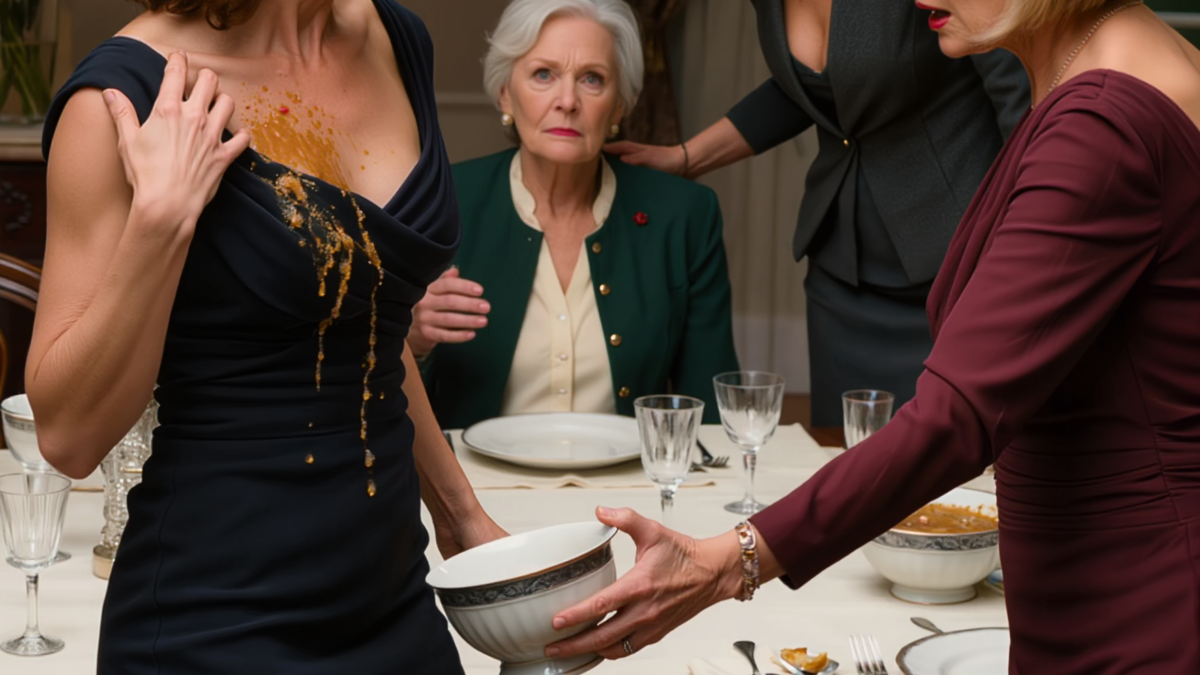
My name is Karen Peek, and I was thirty-seven the night my mother threw a bowl of soup at me across my grandmother’s birthday table.
The strange part is that the soup wasn’t what changed my life.
The question that came before it did.
We were celebrating my grandmother Dorene’s eighty-first birthday in a private dining room on Paris Mountain outside Greenville, South Carolina. The windows looked down over the Upstate, where the lights of neighborhoods and roads were beginning to show through the evening haze.
Relatives had arrived in layers. Coats went over chair backs. Phones appeared before the cake did. A server described specials nobody ordered.
My sister, Joselyn, sat near our mother.
She was twenty months older than I was and had spent most of our lives occupying the place our family had quietly decided belonged to her.
The successful one.
The polished one.
The daughter who knew what she was doing.
Joselyn had become an attorney working in trusts and estates at a Greenville firm. She spoke easily in rooms full of strangers, remembered the right names, and knew exactly how long to hold eye contact before smiling.
Our mother loved introducing her.
“This is my daughter Joselyn. She’s our legal mind.”
Then there was me.
For years, when relatives asked what I did, Mom would say I worked “around construction” or “with lumber.”
It didn’t matter how much responsibility I had taken on.
It didn’t matter how many crews I coordinated.
In our family story, Joselyn had chosen a profession.
I was still figuring things out.
Our mother had been building that story since we were children.
She kept a framed board in the hallway of the house where we grew up, filled with certificates, photographs and clippings.
Most of it belonged to Joselyn.
When I won a county shop-and-build challenge in high school by designing a better staging system for our workshop, Mom congratulated me.
Then she asked if I could move the certificate.
She needed the space for a mock-trial picture of Joselyn.
I remember standing there with four thumbtacks in my palm while she rearranged the board.
No screaming.
No dramatic insult.
That was the problem.
The ranking was ordinary.
When I was sixteen, I spent six months on a regional construction-management project. The presentation fell on the same afternoon as one of Joselyn’s scholarship events.
Mom announced everyone would go with Joselyn.
Even Grandma Dorene went.
I placed second.
When I came home that night, balloons were hanging in the kitchen for Joselyn because she was waiting to hear back about an interview.
My certificate stayed in my backpack.
Grandma found me after midnight eating leftovers.
She sat across from me without turning on another light.
“I should have been in that room,” she said.
It was the first time anyone in my family admitted that overlooking me had been a decision rather than a scheduling problem.
I asked her how many times somebody could be treated like the optional person before they stopped showing up.
Grandma looked at me for a long moment.
“Fewer times than this family seems to think.”
After that, something changed between us.
She started asking what I was building.
Not whether it was as impressive as what Joselyn was doing.
Not whether it came with a title she recognized.
She listened while I explained load paths, procurement problems and why a construction schedule that looked perfect on paper could fall apart on a wet Tuesday.
She did not suddenly become perfect.
She never turned against Joselyn.
I never asked her to.
I didn’t need Grandma to pick a favorite granddaughter.
I needed one person to stop treating love like a ranking system.
Years later, she said something I never forgot.
“Love is not a scoreboard, Karen. A mother who needs a winner will keep inventing a loser to make the math work.”
By then, I had stopped trying to correct the family story.
Joselyn followed the path everybody expected.
College.
Internships.
Law.
A clean résumé.
A Greenville firm.
Every promotion became an announcement.
Mom forwarded Joselyn’s professional posts to relatives like press releases.
Meanwhile, I went through a state program on a trade and operations scholarship and worked evenings on crew sheets for a regional rebuild contractor.
At a cousin’s rehearsal dinner, Mom described me as “good with my hands.”
Then she spent the rest of the toast talking about Joselyn’s new office.
I stopped explaining.
One Thanksgiving, Joselyn asked if I was “still hauling materials.”
“I coordinate storm-repair crews across three counties.”
She smiled.
“Well, somebody has to keep the job sites organized.”
Mom laughed.
Grandma looked across the table at me, waiting.
I said nothing.
People committed to misunderstanding you rarely change because you give them a more accurate job title.
So I separated the life I was actually living from the version my family discussed at dinner.
They knew I worked.
They knew I stayed busy.
That was about it.
At twenty-six, I was assigned to a warehouse recovery after a storm damaged a ridge road in Pickens County.
The warehouse itself wasn’t the interesting part.
The confusion was.
Three clipboards contradicted one another.
Two supervisors couldn’t be reached.
Nobody could agree which materials had stayed dry, which had sat in water, what had been removed or whose timestamp was correct.
Twenty people spent hours calling adjusters and subcontractors.
Watching it, I realized something.
Companies had elaborate systems for getting goods and buildings into the world.
They had far fewer systems for putting a damaged operation back under control.
Over the next year, I learned everything I could about rebuild sequencing, insurance documentation, temporary services, supplier tickets and deadlines.
That was where I met Grant Ives.
Grant challenged nearly every assumption I made.
At first, I thought he was annoying.
Then I realized he wasn’t trying to defeat my ideas.
He was trying to find out whether they would survive reality.
I saved $14,200 and tried to launch a rebuild coordination service.
The first version failed.
I spent too much on software before I had enough clients.
One company used my proposal internally and never hired me.
Another signed and canceled.
Within eight months, most of my savings were gone.
I went back to extra shifts to cover rent.
Some nights, my office was a folding table inside a subleased industrial bay where the heat shut off after six.
I told nobody in my family.
I already knew what Mom would say.
Joselyn had a stable desk.
Why couldn’t I be sensible?
Grant was the only person who knew how close I came to quitting.
One Friday, I showed him a spreadsheet proving I had about six weeks of cash left.
He studied it.
“Your software isn’t the product.”
I waited.
“The client is terrified of losing control of the claim. Sell them control.”
That sentence rebuilt the business.
Instead of selling a software tool, I created an end-to-end field service.
We tracked materials.
Coordinated licensed crews.
Documented removals.
Managed temporary power.
Organized drying work.
Made sure the owner had one place to call during the chaos.
The software became part of the service instead of the entire service.
Our first major break came when a household-goods distributor needed help managing a multi-county withdrawal after flooding.
For eleven days, I slept in pieces.
We finished ahead of the revised deadline.
The client sent two more jobs.
Pinnacle Rebuild Group grew slowly.
Then it grew faster.
Grant left his job and became my first full-time operations hire.
We moved out of the industrial bay.
I hired people who understood transportation, insurance language, permits and the kind of midnight call that happens when temporary protection fails during another storm.
In our third year, we nearly went under again.
A major client delayed payment for four months after we had already paid outside crews.
I stopped taking a salary.
I remember sitting in my truck after telling our employees payroll was safe.
My personal account held less than it had when I finished school.
I said nothing to my family.
By thirty-four, Pinnacle was handling storm and flood rebuilds throughout the Upstate and toward the coast.
We were not famous.
Inside the industry, our name meant something.
Eventually, a private fund bought thirty percent of the company to finance expansion.
I kept seventy.
The transaction changed my finances significantly.
I bought a two-story property in Travelers Rest.
After years of motels, job trailers and client buildings with ceilings open to the weather, I wanted a place that was mine.
I invested the rest.
I also bought a yacht that I used partly for work and partly because I could finally afford something that had once seemed ridiculous.
Grandma knew.
She came to the Travelers Rest house.
The first time she walked through it, she stood near the windows facing the mountains and laughed.
“Your mother thinks you still work off a ladder.”
“I know.”
“Why haven’t you corrected her?”
“Because I’m done applying for a rank.”
Grandma smiled.
“Good.”
She asked me about Pinnacle for almost two hours.
I showed her photographs of the folding table, the first bay and the Pickens County warehouse where the idea had begun.
She didn’t care much about the valuation.
She cared about the years between that folding table and the view outside my windows.
Meanwhile, Joselyn’s career continued rising.
She became visible at her firm.
Panels.
Client dinners.
Professional events.
Mom forwarded every photograph.
Around that time, Miles Calder became a regular part of Joselyn’s life.
Miles worked in real estate, especially view lots and lake properties.
He had a habit of looking at land and turning the conversation toward what it might bring on the market.
Grandma mentioned him once after he had walked her property line.
“Courtesy that arrives with a price sheet isn’t courtesy,” she said.
I remembered the sentence.
I did not interfere.
Grandma owned two significant parcels, including a view property and another lot with a metal building.
They were hers.
Joselyn understood trusts.
Miles understood sales.
I understood that Grandma had said no.
That should have been enough.
On Grandma’s eighty-first birthday, we gathered on Paris Mountain.
Soup arrived early in the meal.
Steam rose from wide bowls.
An uncle toasted Grandma’s health.
People made small talk.
Then Joselyn turned toward me.
She wasn’t asking where I lived because she cared.
She wanted the table to laugh with her.
“So, what dump are you living in now? Or are you still living off other people?”
I set down my fork.
“Travelers Rest.”
She waited.
“Two stories. About twenty million dollars.”
The smile stayed on her face.
“An eight-million-dollar investment portfolio. Seventy percent of Pinnacle. And a five-million-dollar yacht.”
Miles laughed first.
It was short and deliberate, an invitation.
An aunt covered her mouth.
A cousin asked if I had rehearsed the numbers.
Someone joked that the yacht was probably a pontoon boat with a good story attached.
The laughter spread because laughter was easier than revising the family mythology during the first course.
Mom’s hand tightened around her soup bowl.
“You always have to make everything about you.”
“I answered the question.”
Her hand moved.
The bowl left it.
Soup struck my shoulder and front.
Ceramic hit the table.
A spoon skittered.
For half a second, laughter continued.
Then it stopped.
Nobody in my family moved first.
A waiter offered me a napkin.
I went to the restroom.
The stain ran from my shoulder down the front of my dress.
I held fabric under cold water and watched the mark thin without disappearing.
For a moment, I considered leaving through a side exit.
Then I imagined the family version.
Karen made a scene.
Karen stormed out.
Karen was always difficult.
I wrung the towels until my hands smelled like soap and seafood.
Grandma found me in the side hallway.
She handed me fresh paper towels.
“Now you understand why I’ve been putting certain things in writing.”
“I don’t want to talk about money tonight.”
“This isn’t about money.”
She looked toward the dining room.
“This is about what happens when people believe they’re entitled to make decisions for someone else.”
Miles and Joselyn passed the end of the hall without stopping.
From inside the dining room, Mom was telling somebody the bowl had slipped.
Heat.
Nerves.
An accident.
It hadn’t been an accident.
Grandma asked me to meet her estate attorney the following week.
She was not asking me to negotiate an inheritance.
She wanted one thing made clear.
Whatever she decided about her estate would be her decision.
In writing.
Independently.
Nobody would get to rewrite her motives after she died.
“You’re acting like you’re afraid of something.”
“Caution and fear are not the same tool.”
The following week, I sat with Grandma in a downtown office that smelled faintly of paper and old coffee.
Her attorney confirmed Grandma had initiated the meeting herself.
She paid the invoices herself.
She had ordered the firm not to send documents to either granddaughter.
The attorney explained the idea of an independent fiduciary.
Grandma named her properties.
Then she mentioned Joselyn’s suggestions.
Joselyn wanted the land moved into a family trust.
Miles had his own thoughts about its potential sale value.
I had never asked Grandma for either property.
The attorney asked if I wanted to know percentages.
“No.”
Grandma looked almost amused.
On the drive home, she stayed quiet until the mountains came into view.
Then she said, “Joselyn hears no as a delay, not a decision.”
“I’m not refereeing a fight that hasn’t happened.”
“It’s already happening in conversation. That’s where these fights start.”
I dropped her at home.
She unlocked her own door.
I waited in the driveway until the kitchen light came on.
Then I drove back to Travelers Rest.
I hung the ruined birthday dress on a hook and tried not to look at it.
What I did not know was that Grandma had already begun preserving emails.
Some came from Joselyn.
Some involved Miles.
They sounded polite.
Helpful.
Professional.
That was what made them effective.
Eight months later, Grandma Dorene died on a gray morning.
She had remained sharp until near the end.
She knew the days.
She knew the names.
She disliked vague arrangements.
And she left far more documentation than the family expected.
I was devastated.
When the estate attorney said Grandma had revised her plan, I wasn’t surprised.
I was surprised by the details.
Grandma left specific gifts to cousins.
She funded assistance for apprentices in a Greenville trades program so young workers could buy boots and pay testing fees.
I received the largest remaining share and management responsibility for two parcels.
Joselyn received a fixed sum.
She received no authority over those properties.
Grandma also removed my mother as executor and appointed an independent fiduciary.
That decision lit the fuse.
Three weeks after probate opened, I was in a Pinnacle site trailer during a commercial progress meeting when a process server asked for me by full name.
He put a thick envelope on the folding table.
Joselyn had filed a petition contesting the will.
She accused me of undue influence.
Isolation.
Manipulating a vulnerable adult.
Interfering with an earlier estate plan.
Then I reached a paragraph about the signing.
It said I had personally taken Grandma to the downtown Greenville office on the afternoon the revised documents were completed.
I had not.
That afternoon I had been on a ridge toward Caesar’s Head handling drying work after a washout.
There were witnesses.
Logs.
Photos.
Gate entries.
I stopped feeling insulted and started making a list.
My attorney, Joan Sibi, told me not to call Joselyn.
Not to post anything.
Not to confuse one false date with winning the case.
“Probate fights are slow,” she said. “They run on documents, witnesses and motive. Not outrage.”
Then the fight moved outside probate.
A Pinnacle client forwarded an anonymous email containing Joselyn’s petition.
The accusations had been highlighted.
Another adjuster received the same packet.
The message was clear.
Someone did not want to wait for a ruling.
They wanted the allegations attached to my business while they were still allegations.
The board held an emergency meeting.
No one declared me guilty.
But questions came.
Would clients leave?
Would crews be disrupted?
Would the investment fund pause expansion?
I gave one instruction.
We were not leaking stories about Joselyn.
We would document.
Grandma’s attorney produced calendars showing Grandma had requested every appointment herself.
A physician had evaluated her because Grandma predicted somebody might challenge her decisions.
The notes were unexciting.
That was exactly why they mattered.
She understood her assets.
She understood her family.
She understood her choices.
Grant kept running Pinnacle.
One evening, he found me reviewing deposition binders in a trailer after everybody else had gone.
“You hired me to run operations.”
“I know.”
“No, you don’t. You’re checking every call because you’re afraid one missed inspection will somehow prove your sister right.”
I hated hearing it.
He was right.
“Your sister doesn’t get to damage this company from outside while you damage it from inside trying to prove she can’t.”
So I delegated.
Joan built our case around the records.
Then she found the video.
Grandma had recorded herself on a tablet.
The file was held by her estate attorney.
A handwritten instruction said it was to be used only if someone later claimed she had not understood her own decisions.
Joan paused Grandma’s image on the conference-room screen.
A dented recipe tin sat beside her.
“Do you want to watch it now?”
“No.”
I wanted the first time I heard Grandma defend herself to matter.
Then the email production arrived.
Grandma had forwarded messages to her attorney months before the lawsuit.
One of the earliest came from Joselyn’s professional account.
She proposed moving the view parcel and the lot with the metal building into a trust her firm could administer.
There would be an origination fee.
There would be continuing administration.
The file contained no written conflict approval for Joselyn steering a close relative toward a fee-generating structure while also standing to inherit.
Grandma had declined.
Joselyn followed up.
Then followed up again from a personal account.
Miles appeared in the same records.
He had sent Grandma a valuation sheet for the view property before she had agreed to list it.
Joan placed the dates beside one another.
Grandma’s refusal.
Joselyn’s follow-up.
Miles’s valuation.
One of Grandma’s forwarded emails contained a single line.
“This is the pressure I will not sign.”
I read it twice.
Joselyn’s lawsuit described Grandma as confused and easily influenced.
Grandma’s own records showed a woman identifying pressure, documenting it and sending it to independent counsel.
Another document changed something else.
A text Joselyn had sent Mom after Grandma rejected the trust idea.
“She’ll understand when she realizes Karen has no idea how to hold those assets.”
Joselyn’s theory said I had abruptly inserted myself into Grandma’s financial life.
But Grandma’s records contained years of ordinary operational conversations with me.
A leak in the metal building.
Insurance renewals.
Vendors.
Mowing.
Repairs.
I never touched her brokerage accounts.
Never asked to become a beneficiary.
Never requested control.
Mom’s deposition exposed another layer.
She said Grandma had become overwhelmed after learning how successful I was.
Joan asked whether Mom knew I owned the company before the birthday dinner.
“No.”
“Did you tell relatives Karen was still finding her way?”
“I may have.”
“Was she?”
“I didn’t know.”
“Then why say it?”
Mom hesitated.
Finally, she said Joselyn was doing so well and she hadn’t wanted constant competition.
For most of my life, I had believed I was losing a comparison.
Under oath, my mother admitted something different.
Once my life began contradicting the family hierarchy, she protected the hierarchy.
Joselyn’s deposition went worse.
She denied connecting professional advice to inheritance.
Joan displayed the email sent on firm letterhead.
Joselyn said she had been speaking as a granddaughter.
Joan asked whether the firm had authorized her to solicit the arrangement.
Joselyn said she hadn’t considered it solicitation.
Joan displayed the sentence about beginning transfer paperwork as soon as Grandma confirmed.
Miles called his valuation sheet “market research.”
He had not been Grandma’s broker.
Grandma had not requested a listing.
The sheet still contained numbers that would have led toward a commission path.
Then came my alibi file.
The job gate had logged my truck.
A toolbox meeting on a phone video showed me wearing a safety vest, timestamp visible.
A nearby inn confirmed the use of my key envelope that morning.
The superintendent’s daily report kept me on the ridge through the exact hour Joselyn’s filing placed me in downtown Greenville.
She had not written that I might have attended.
She had stated I did.
Discovery dragged on for eight months.
I ran Pinnacle between filings.
The investment fund paused expansion talks, but the company kept moving.
Payroll cleared.
Crews rolled.
Odden and Pike, Joselyn’s firm, eventually produced internal policies requiring disclosure and approval before an associate directed a close relative toward a firm-administered trust.
Joselyn’s personnel file contained no approval.
Joan placed that policy beside Grandma’s emails.
The lawsuit had begun with Joselyn accusing me of influence.
The documents were now asking a different question.
Who had actually refused to accept Grandma’s boundary?
The probate hearing took place in Greenville.
Relatives filled two rows.
Nobody openly counted sides.
Everybody seemed to know where each person sat.
Joselyn’s attorney spent the first two days describing my success.
The house.
The yacht.
Pinnacle.
My relationship with Grandma.
She displayed photographs of Grandma visiting Travelers Rest.
Messages congratulating me about work.
Affection was presented as motive.
Then she asked the question Joselyn’s theory depended on.
If Grandma’s changes had truly been independent, why did the largest shift seem to come after my financial success became visible?
Joan stood.
She said the evidence would show Grandma had known about Pinnacle long before the birthday dinner.
Grandma’s estate attorney testified first.
Grandma began revisiting her plan more than a year before the soup bowl ever crossed the table.
She booked appointments herself.
Paid bills herself.
Refused to copy either granddaughter on drafts.
The attorney had recommended a capacity evaluation precisely because Grandma expected a challenge.
“Did Karen Peek tell you what she should receive?”
“No.”
“Did Karen know she would be given responsibility for the parcels?”
“Not until Dorene died.”
The physician testified next.
Grandma had no condition preventing her from understanding the estate plan when she signed it.
Then I testified.
Joselyn’s attorney approached slowly.
“You want the court to believe you had no influence over your grandmother?”
“I’m saying I did not influence her estate decisions.”
“You discussed work with her.”
“Yes.”
“You discussed her properties.”
“Operational questions. Vendors. Repairs. A leak.”
“She admired your success.”
“She was my grandmother. I hope she was proud of me.”
Then came the question.
“If she trusted you so much, why didn’t she simply give you the land while she was alive?”
I looked toward the judge.
“Because it was hers.”
The room settled.
“She didn’t owe me property because she sat in my kitchen,” I continued. “She didn’t owe Joselyn control because Joselyn drafts trusts for other families. Loving somebody doesn’t transfer ownership of their decisions.”
Then the signing accusation appeared.
Joan introduced the ridge evidence.
Hotel record.
Gate log.
Truck.
Phone video.
Superintendent’s report.
The timestamps did not merely make the petition unlikely.
They made its specific claim impossible.
Joselyn was called.
She said Mom had told her I attended.
Joan read Mom’s deposition.
Mom had said she didn’t know.
“Somebody is mistaken,” Joselyn said.
Joan didn’t argue.
“Let’s stay with what you personally knew.”
She displayed the trust email.
Joselyn said she had tried to help Grandma.
Would her firm have received fees?
Potentially.
Had she disclosed that interest in writing?
Joselyn avoided the question.
Joan repeated it.
“No.”
Had her firm authorized the arrangement?
“I didn’t consider it a formal solicitation.”
Joan placed the transfer language on the screen.
Behind the attorneys, a man from the firm’s professional-responsibility department kept writing.
Then Joan asked Joselyn for one document showing that I had recommended an investment to Grandma.
There was none.
One document showing I had asked to become a beneficiary.
Nothing.
One showing I had requested control of the land.
Nothing.
Then Joan displayed Joselyn’s messages about Grandma leaving me the assets.
“Who is applying pressure in that message?”
“That was personal.”
“Personal pressure concerning land and a paid trust arrangement?”
Miles testified after her.
The valuation sheet appeared next to his license information.
A woman from his brokerage was sitting in the gallery.
When the date was read aloud, she closed her notebook.
Then Joan played Grandma’s recording.
Grandma appeared at a conference table.
The dented recipe tin sat beside her elbow.
She looked directly into the camera.
She said she was changing her estate plan because responsibility was not the same as entitlement.
She said Joselyn had continued pressing after financial recommendations were declined.
She said I had never requested the parcels.
She believed I would manage them carefully.
Then she said:
“This was my decision. If anybody says otherwise after I’m gone, they are saying I didn’t know my own mind.”
The recording ended.
Joselyn stared at the table.
Mom cried behind her.
I felt no triumph.
Grandma had known she might be accused of not understanding herself.
She had sat in a room alone and created the evidence necessary to preserve her own voice.
The judge recessed.
No ruling came that afternoon.
On the way out, the professional-responsibility representative from Joselyn’s firm was already on his phone.
Three days later, the written order arrived.
The revised will stood.
The court found that Grandma had the capacity to make the decision, had independent counsel and had clearly expressed what she wanted.
The order specifically noted that the claim placing me at the signing was contradicted by objective records.
Joselyn lost the challenge.
That was only the first consequence.
Her firm had now seen documents showing that she approached a close relative about a fee-generating trust arrangement without the written approval required by internal policy.
They placed her on leave.
Two weeks later, her employment ended.
An ethics grievance followed.
A professional panel removed her from an upcoming program.
I made none of those calls.
I never contacted her clients.
Joselyn had filed a lawsuit that required outside professionals to read her own correspondence.
Grandma’s estate plan did not require the estate to pay for an unsuccessful challenge.
Joselyn paid her own attorneys.
The fixed inheritance Grandma had left her remained, but the legal bill consumed much of the financial advantage she had hoped to increase.
Miles’s brokerage also opened a review.
His valuation sheet had become a court exhibit.
Two pending listings changed hands.
He sent me one message asking me to tell people the matter had simply been family drama.
I didn’t answer.
Mom called the evening Joselyn’s firm let her go.
“You have to fix this.”
“Fix what?”
“Call somebody.”
“Who?”
“Tell them this was family drama. Tell them she made a mistake.”
“Which part?”
Mom went quiet.
“The petition? The claim about where I was? The trust she didn’t clear?”
“She’s your sister.”
“And Grandma was your mother.”
Silence.
“You watched Joselyn say Grandma was too confused to make a decision because you didn’t like the decision. You watched those accusations reach my company. You supported it until the documents became uncomfortable.”
“I was trying to keep the family together.”
“No. You were trying to keep the family arranged the way you preferred.”
After a long pause, Mom asked whether I was taking revenge.
“No.”
I looked out the window of my Travelers Rest house.
“Revenge would require me to do something to Joselyn. I defended a record. What happened afterward came from what she wrote when she thought nobody outside this family would ever read it.”
I ended the call.
Relatives attempted to restore the old roles.
Some said Joselyn had suffered enough.
Some asked me to contact people and soften the consequences.
Others told me I should sit down with Mom because family was family.
A few suddenly became interested in Pinnacle, my house and everything else they had ignored while they believed I was ordinary.
I stopped explaining.
The independent fiduciary continued managing Grandma’s parcels.
Quarterly reports went into the file.
The apprentice fund operated exactly as Grandma intended.
Grant took the operations title that matched the work he had already been doing.
I changed the locks on Grandma’s house, forwarded her mail and blocked the numbers that only seemed to call when somebody needed me to become small again.
I skipped the next holiday gathering.
When Mom left a voicemail about place settings and who would sit where, I deleted it before she finished.
For years, I thought success might eventually purchase respect.
It didn’t.
Then I thought a court ruling might purchase understanding.
It didn’t do that either.
What changed was simpler.
I stopped allowing my family’s description of my life to serve as evidence of whether the life was real.
Joselyn had built an identity around being the daughter everybody applauded.
I had built mine around surviving being the daughter everybody skipped.
Both of us had allowed the family ranking too much power.
The cleanest thing I ever did was stop defining myself against her.
Grandma’s most valuable gift wasn’t the view parcel.
It was the example she left behind.
She wrote down what she meant while she was still able to say it herself.
When somebody later tried to replace her decision with a more convenient story, the record was still there.
I didn’t need to become the person Joselyn’s petition described.
I didn’t need to retaliate.
I only needed to refuse to surrender the truth because telling it made other people uncomfortable.
Families sometimes confuse familiarity with ownership.
A parent can become convinced she has the right to decide which child counts as successful.
A sibling can mistake professional knowledge for authority over somebody else’s choices.
Relatives can begin treating an inheritance as a reward for the role they believe they played.
None of those beliefs creates ownership.
Grandma understood that before the rest of us did.
And by the time everybody else finally had to read what she had written, she had already made one thing impossible to rewrite:
Her no meant no.