My manager was already crossing the dining room to fire me when I tipped water across a billionaire’s contract and whispered in Cajun French, “Don’t sign. They’re lying to you.” The two men across from him had promised his family home was protected. I had heard them say the opposite.
Late-November rain swept across New Orleans in silver sheets, turning the sidewalks of the French Quarter into long mirrors of streetlamps, hotel signs, and passing headlights.
Lauren Hayes slipped through the service entrance of the Magnolia Crown with the shoulders of her coat damp and her phone still glowing in one hand.
The message on the screen was from her landlord.
Rent past due.
Payday was more than a week away.
Lauren locked the phone and slid it into her bag before anyone could see. She tied on her black apron, checked the dining room schedule pinned beside the kitchen door, and touched the small photograph she carried in her pocket every shift.
Three people stood in the picture beneath hard Louisiana sunlight: Lauren at about seven, her mother beside her, and her grandmother Caroline with one hand resting on Lauren’s shoulder.
Caroline had raised her on two rules.
Never waste good broth.
And listen before speaking.
“People tell you who they are when they think no one important is listening,” Caroline used to say in the Cajun French of her childhood near St. Martinville.
“Hayes.”
Lauren turned.
Ryan Sanders, the Magnolia Crown’s floor manager, stood behind her with a clipboard against his chest. His suit was immaculate. His expression suggested she had already wasted more time than he considered acceptable.
“Are you working tonight,” he asked, “or writing a memoir?”
“Working.”
“Good. Because tonight isn’t the night to improvise.”
He gathered the front-of-house staff near the kitchen doors.
“Arthur Mercer is dining with us tonight. I want polished glasses, quiet service, no delays, and absolutely no experiments.”
The name changed the room.
Even Mason Reed, the youngest server on staff, stopped adjusting his tie.
Arthur Mercer was chairman of Mercer Atlantic, a company with interests in shipping terminals, hotels, logistics, commercial real estate, and industrial property across the Gulf Coast. Business reporters followed his decisions closely enough that even people who never read the financial pages had heard his name.
Some newspapers had called him the Gulf Wolf.
Lauren had always thought the nickname sounded ridiculous.
Ryan pointed toward Samuel Moore.
“You have Mercer’s table.”
Then he looked at everyone else.
“No one approaches unless I say so.”
Lauren understood what that meant.
Some employees served important guests.
Other employees carried plates.
Arthur Mercer arrived shortly after eight.
He was sixty-two, tall, silver-haired, and more tired-looking than Lauren expected. He entered alone without an entourage and asked for no special welcome, yet the room tightened around him anyway.
Samuel approached with the restaurant’s best wine list.
He returned several minutes later with a rigid jaw.
“What happened?” Ryan asked.
“He asked for someone else.”
Ryan’s eyes narrowed.
“What did you do?”
“Nothing.”
“You clearly did something.”
“He said he didn’t want to hear another speech about terroir.”
Ryan muttered something under his breath and pointed at Mason.
“You go.”
Mason looked as though he had been sentenced.
He lasted less time than Samuel.
“He asked what was in the sauce,” Mason whispered after returning to the service station. “I knew it this afternoon. I swear. My mind just went blank.”
While Ryan delivered a furious lecture about preparation, Lauren worked her own tables and watched Arthur from the corner of her eye.
Something did not fit the story everyone had already decided to tell about him.
He wasn’t angry about the food.
He barely touched it.
He checked his phone repeatedly, rubbed the bridge of his nose, and looked toward the restaurant entrance whenever the front door opened.
Lauren had served arrogant customers.
She knew what entitlement looked like.
This looked different.
This looked like fear wearing an expensive suit.
As she cleared glasses from a nearby table, Arthur answered his phone.
Lauren kept walking.
Then a familiar cadence reached her.
Cajun French.
Not polished classroom French.
Not the smooth accent of someone trying to impress a guest.
It was the clipped, warm phrasing Caroline had used while stirring a pot on Sunday afternoons or calling Lauren back inside before a storm.
Lauren did not stop to listen.
Later, carrying bread past Arthur’s table, she heard fragments.
“Meeting.”
“Documents.”
“Deadline.”
On another pass, she heard a woman’s name.
Evelyn.
Arthur fell silent after saying it.
Ryan appeared beside Lauren as she set a basket on a side station.
“I can’t send another server to that table.”
“Let me try.”
He gave one short laugh.
“You?”
“The others don’t want to go back.”
His amusement disappeared.
“If Arthur Mercer leaves this restaurant because of you, don’t bother coming in tomorrow.”
Lauren thought about the rent notice.
She thought about the checking account she had avoided opening all day because she already knew the number.
She needed this job.
There was no savings account waiting behind it. No wealthy relative. No convenient backup plan.
Fear pressed against her ribs.
Then she looked toward Arthur again.
Samuel had tried to impress him.
Mason had tried desperately not to make a mistake.
Neither had tried to understand what he actually wanted.
Lauren picked up a menu.
Arthur did not look up when she approached.
“If you’re going to spend five minutes explaining why every plate is an artistic journey,” he said, “save us both the trouble. Bring me something to drink and let me sit in peace.”
Lauren waited a beat.
Then she answered gently in Cajun French.
“As you wish, Mr. Mercer.”
Arthur’s hand froze above his phone.
He looked up.
The guarded expression on his face opened by the smallest degree.
“Who are you?”
“Lauren Hayes. Apparently the server no one else wanted to send.”
A faint smile appeared and vanished.
“Where did you learn to speak like that?”
“My grandmother. Caroline. She grew up near St. Martinville.”
Arthur set his phone on the table.
“She taught you?”
“She said a language was more than words. It was the sound of the road home.”
For the first time that evening, Arthur looked less like a feared executive and more like a man who had just heard a voice from a room he thought no longer existed.
Lauren opened the menu.
Arthur closed it again.
“I don’t want a performance.”
“I gathered that.”
“I want something I can actually eat.”
Lauren glanced at the untouched appetizer.
“Then maybe you don’t need this menu.”
In the kitchen, Chef Elliot Pierce stared at her as though she had proposed serving Mercer canned soup.
“You want to give Arthur Mercer staff food?”
“I want to give him something warm.”
On the back stove sat a large pot of chicken-and-sausage gumbo meant for employees working the late shift.
It had no edible flowers, no tableside presentation, and no expensive imported ingredient.
It smelled like dark roux, pepper, thyme, sausage, and patience.
Ryan entered just as Elliot reached for a bowl.
“We have redfish, tenderloin, oysters, and enough truffle in this building to ruin a small nation, and you’re sending him the kitchen meal?”
Lauren met his stare.
“Do you want to serve the man who appears in magazines or the man sitting at that table?”
Elliot turned away quickly, hiding a smile.
“If he complains,” the chef said, “I’m telling him this was entirely your idea.”
Arthur studied the gumbo when Lauren placed it in front of him.
“This is what the Magnolia Crown recommends?”
“No.”
Lauren set down the spoon.
“This is what I recommend.”
Arthur took one bite.
Then a second.
By the third, his shoulders had lowered.
“My mother made something like this on Sundays.”
Lauren said nothing.
He traced his thumb around the rim of the bowl.
“I remember the smell before I remember the taste.”
“My grandmother would say that meant it was doing its job.”
Arthur looked toward the rain-streaked window.
“My father always sat in the same chair. My mother used to say you could change jobs, suits, even cities, but you should never forget where home was.”
“And did you?”
Arthur gave a dry laugh.
“I became very talented at finding reasons not to return.”
His phone lit up.
Evelyn.
He stared at the name until the call ended.
“Your family is still in Louisiana?” Lauren asked.
His expression closed again.
“Some of them.”
“I’m sorry. That wasn’t my business.”
Arthur took another spoonful.
“Companies are easier than families, Miss Hayes.”
“Why?”
“Because a balance sheet tells you exactly what you lost.”
Before Lauren could answer, the front doors opened.
Two men entered with the confident pace of people who had not come to eat.
The first, Ethan Vaughn, wore a charcoal overcoat over a dark suit. His face was calm in the practiced way that made calmness feel strategic.
Beside him walked Grant Foster, an attorney Lauren recognized only because Ryan had mentioned his name earlier that year during a private corporate dinner.
Grant carried a dark leather case.
Arthur set down his spoon.
“So you came.”
Ethan stopped beside the table.
“You knew I would.”
They did not shake hands.
Grant opened the case and placed a thick folder on the table.
Ethan sat opposite Arthur.
“You know where things stand.”
“I know you’ve waited a long time to see me cornered.”
“You once told me I lacked patience.”
“That was twenty years ago.”
“Some lessons age well.”
Ethan pushed the folder forward.
“You have less than an hour. Sign the transition agreement and you preserve what actually matters. Refuse, and the board votes tonight. After that, nothing will be orderly.”
Grant placed a pen beside the documents.
“Certain personal assets remain protected if you execute the transition now.”
Lauren moved through the neighboring tables, careful not to stare.
She understood almost nothing about corporate restructuring.
But she understood hands.
Arthur’s fingers rested on the edge of the folder as though the paper itself might burn him.
His phone rang.
He stood.
“I need to take this.”
He walked toward the window.
The second his back turned, Ethan leaned closer to Grant.
They switched languages.
Cajun French.
Lauren was carrying bread past them when she caught two words.
Personal guarantees.
She kept walking.
On the return pass, Grant answered in the same language.
“The Lafayette Parish property is inside the annex.”
Lauren nearly missed a step.
She did not know which property they meant.
She did not know exactly what a personal guarantee would allow.
She told herself she had heard only fragments.
Fragments could mislead.
A few minutes later, while replacing water at a neighboring table, she heard Ethan again.
“Once he signs, he can’t undo it.”
Grant glanced toward Arthur.
“He doesn’t need to know tonight.”
Lauren kept moving.
Ryan intercepted her at the service station.
“Why are you circling Mercer’s table?”
“I’m working the section beside him.”
“Then work it without collecting private conversations.”
“I wasn’t—”
“One more problem and you’re done here.”
Lauren looked toward the dining room.
She thought of the degree she had abandoned when her mother became ill.
She had told herself the interruption would be temporary.
Then came medical bills.
Then funeral expenses.
Then rent.
Then work.
The semester she planned to return became the next semester, then the next year, then an imaginary future in which life would finally become easier.
She had spent years making decisions according to the next bill.
That habit told her to stay silent now.
Arthur returned to the table.
He opened the folder.
“I want a clear answer,” he said. “My family home stays outside this agreement.”
“Of course,” Ethan replied without hesitation.
Lauren stopped moving.
The pieces were no longer fragments.
Arthur picked up the pen.
Lauren had only seconds to decide what kind of person she would be after that night.
If she spoke, Ryan could fire her before Arthur left the building.
If she stayed quiet, she could tell herself she was only a waitress.
She could tell herself wealthy men had lawyers for this.
She could tell herself rent mattered more than a stranger’s family property.
Every excuse sounded reasonable.
None sounded like something Caroline would have respected.
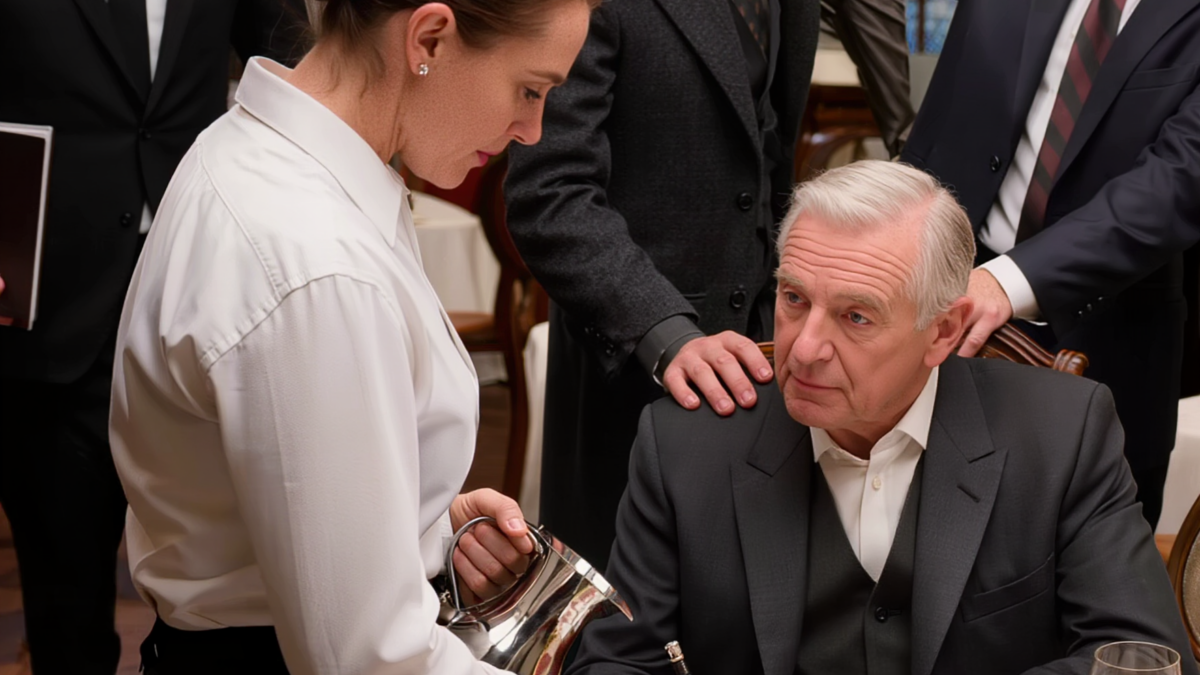
Lauren picked up a water pitcher and walked toward the table.
“Water, Mr. Mercer?”
Ethan did not look at her.
“Not now.”
Lauren tilted the pitcher anyway.
Water spilled across the edge of the folder.
Several pages darkened immediately.
Grant’s chair scraped backward.
“What are you doing?”
“I’m so sorry.”
Lauren grabbed a cloth.
Ryan was already crossing the room.
Five seconds.
Maybe less.
Lauren bent over the papers and spoke in Cajun French, barely above a whisper.
“Don’t sign. They’re lying to you.”
Arthur’s eyes locked on hers.
“Are you certain?”
He answered in the same language.
“I don’t know the law,” Lauren whispered. “I heard them mention personal guarantees and property in Lafayette Parish. They said once you signed, you couldn’t change it.”
Arthur became very still.
“Which property?”
“I think the house you asked them to protect.”
Arthur did not simply take her word for it.
He turned toward Grant.
“Show me the annex containing the personal guarantees.”
Grant hesitated.
“It’s incorporated into the broader agreement.”
“Then show it to me.”
“There’s no reason to review every page right now.”
“Show me.”
Ethan leaned forward.
“Arthur, we don’t have time for theater.”
Arthur looked from Ethan to Grant.
Something in their silence answered before either man did.
“The Lafayette Parish property is included, isn’t it?”
No one answered.
Arthur put the pen down.
“I’m not signing.”
Ethan’s face hardened.
“You’re making a mistake.”
“Maybe. But it’ll be my mistake, not one you hid in an annex.”
Ethan looked at Lauren.
“You have no idea what you’ve interfered with.”
Arthur answered before she could.
“Your mistake was assuming no one here understood you.”
Grant closed the folder.
Ethan stood.
“Refusing doesn’t stop the board.”
Arthur checked his watch.
“How long?”
“Minutes,” Grant said. “Not hours.”
They left carrying the damp agreement.
Lauren remained beside the table, cloth in her hand, heart pounding hard enough to make her fingertips pulse.
Ryan stood several yards away.
His expression promised consequences.
Arthur, however, was already thinking past the room.
“Is there a landline here?”
Lauren blinked.
“In the staff office.”
“Then we may still have time.”
Ryan moved toward the service corridor.
“Mr. Mercer, guests aren’t permitted behind the kitchen.”
Then he turned on Lauren.
“And you stay right here. We’re going to discuss what you just did.”
Arthur’s voice remained calm.
“This woman did what none of my advisers managed tonight.”
Ryan stared at him.
“She told me the truth.”
Arthur stepped past.
Lauren unlocked the narrow staff office behind the kitchen.
There was nothing luxurious about it.
Metal filing cabinets leaned against one wall. Schedules were pinned beneath magnets. A forgotten mug sat beside an old beige telephone.
Arthur dialed from memory.
No answer.
He hung up and tried again.
“Come on, Thomas.”
Still nothing.
Lauren found a notepad.
When she pulled a pen from her apron, the old photograph slipped from her pocket and landed face-up on the floor.
Arthur bent before she could reach it.
“Your mother?”
Lauren nodded.
“And Caroline. My grandmother.”
“The one who taught you French?”
“Yes.”
He handed the photograph back.
“Why do you carry it every day?”
Lauren looked at the three faces.
“Because when you lose someone, you find out how many things you shouldn’t have left for tomorrow.”
Arthur lowered his eyes.
“My father could have said that.”
He placed one hand on the desk.
“We argued when I was in my early thirties. I wanted to leave Acadiana and prove I could build something without anyone’s help.”
Lauren waited.
“He said I was beginning to measure people by money, titles, and whatever name was printed on their business card.”
A bitter smile touched Arthur’s mouth.
“I promised I’d come home when I had something worth showing him.”
His gaze went toward the silent phone.
“I didn’t make it back in time.”
Lauren did not ask what happened.
Arthur continued anyway.
“When he died, I returned for the funeral. I walked into the kitchen still wearing my coat. His chair was exactly where it had always been.”
He swallowed.
“I put my hand on the back of it, but I couldn’t sit down.”
For nearly thirty years, Arthur explained, he had paid the taxes on the house. Repaired the roof. Replaced damaged boards. Covered every bill necessary to preserve the property.
“I spent decades protecting a door I was too ashamed to walk through.”
Only then did Lauren understand why the hidden clause mattered.
The Lafayette property was not simply real estate.
It was unfinished grief with walls around it.
“You can’t talk to your father,” she said quietly. “But maybe you can still talk to the people who are here.”
Arthur immediately looked at his phone.
Evelyn.
Before he could touch the screen, the landline rang.
Arthur grabbed it.
“Thomas. Listen carefully.”
His posture changed.
“I didn’t sign. There are concealed personal guarantees in the agreement. I need you to review the annex and stop the board vote until we know exactly what they tried to include.”
The response on the other end was long.
Arthur checked his watch.
“If they vote now, it’ll be too late.”
He listened.
His fingers tightened around the receiver.
Then something shifted in his expression.
“Are you sure?”
Another pause.
“Thank you.”
He hung up slowly.
Lauren waited.
“The vote has been suspended. Counsel is reviewing the agreement before anyone proceeds.”
They had bought time.
Arthur did not celebrate.
His eyes returned to Lauren’s photograph.
“You lost your mother and still carry her with you.”
“It keeps her from feeling too far away.”
Arthur pulled out his phone.
Evelyn’s name remained in his contacts.
His thumb hovered over it.
“Do you think nearly thirty years is too long to apologize?”
Lauren considered the question.
“Too long to ask? No.”
Arthur looked at her.
“Too long to expect forgiveness? That part isn’t yours to decide.”
He stared at Evelyn’s name.
This time he did not put the phone away.
When Lauren returned to the dining room, Ryan was waiting outside his office.
“Inside.”
He closed the door behind her.
“You abandoned your tables, interrupted a private business meeting, poured water over legal documents, and brought a guest into a restricted employee area.”
Lauren said nothing.
“Do you understand what that can mean for this restaurant?”
She thought about the rent notice again.
“Yes.”
“Then give me one reason not to fire you.”
Lauren took a breath.
“I’m sorry I created trouble.”
Ryan waited.
“I’m not sorry I stopped someone from being deceived in front of me.”
His lips tightened.
“You’re not an attorney.”
“I know.”
“You’re a waitress.”
“I know.”
“Then act like one.”
Lauren held his gaze.
“Does that mean pretending I didn’t hear the truth?”
A voice came from the doorway.
“I hope not.”
Ryan turned.
Arthur stood there.
“Miss Hayes did her job tonight better than people I pay many times more to advise me.”
“Mr. Mercer,” Ryan said, “restaurants have procedures.”
“And good judgment is supposed to be one of them.”
Lauren turned toward Arthur.
“I don’t want to keep my job because you tell him to keep me.”
Arthur looked genuinely surprised.
“Why not?”
“Because tomorrow you leave and I’m still here. If I stay, I want it to be because I’m good at what I do, not because a powerful man rescued me.”
Arthur studied her.
“What would you recover if you could return to something you left unfinished?”
“My degree.”
She told him briefly about leaving college when her mother became ill.
The bills afterward.
The years of postponement.
Arthur nodded.
He made no promise.
Before leaving the Magnolia Crown, he paid his bill, thanked Elliot for the gumbo, and told Ryan only that he expected Lauren to be judged by the same standards as everyone else.
Ryan disliked the message.
But it was not an order.
Lauren finished her shift close to midnight.
The rain had weakened to a mist by the time she walked home.
The rent notice was still on her phone.
Nothing practical had been solved.
She was still behind.
Still tired.
Still uncertain whether Ryan would find another reason to remove her from the schedule.
Yet something inside her felt steadier.
She had spent years believing fear always got the final vote.
That night, for once, it had not.
Over the next several days, Lauren returned to work as usual.
Mercer Atlantic’s attorneys reviewed the agreement.
The annex confirmed what she had overheard.
Ethan’s proposed transition contained guarantees broad enough to reach the Lafayette Parish family property Arthur had expressly instructed them to protect.
The deal froze.
The board postponed its decision.
There was no dramatic public confrontation.
There were conference calls, revised documents, legal reviews, and several people suddenly becoming careful about what they claimed to have known.
Arthur had come within one signature of losing control over something no amount of money could replace.
Yet the business fight was not the hardest unfinished matter waiting for him.
One evening, alone in his office, he found Evelyn’s number again.
He pressed call.
She answered after several rings.
“Yes?”
He recognized her immediately.
“Evelyn. It’s Arthur.”
Silence.
“I know who it is.”
Arthur closed his eyes.
He had negotiated contracts worth fortunes with less fear.
“I know it’s been too long.”
“Nearly thirty years isn’t ‘too long,’ Arthur.”
He did not defend himself.
“You’re right.”
Another silence.
“I’m not asking you to forget anything. I only want to know whether I’m still allowed to come home.”
Evelyn waited before answering.
“If you actually want to talk, come to the house.”
The call ended soon afterward.
There was no forgiveness.
No reassurance.
Only a door that had not completely closed.
Two weeks after the rainy night, Arthur returned to the Magnolia Crown and requested the same table.
Lauren found him studying the menu.
“Gumbo again?”
“Not tonight.”
“That sounds serious.”
“I came to tell you something.”
A hospitality division connected to Mercer Atlantic had been negotiating a minority investment in the restaurant for several months.
The transaction was going forward under revised management conditions that included new staff-training programs and tuition assistance for employees who wanted to continue their education.
“They want to interview you for a floor-coordinator position,” Arthur said.
Lauren narrowed her eyes.
“That sounds suspiciously like a gift.”
“It’s an interview.”
“Why me?”
“Because that night, everyone else saw a uniform.”
He leaned back slightly.
“You saw a person. You listened. You noticed what didn’t fit. And you acted when acting carried a cost.”
Lauren looked down at her hands.
“That isn’t charity,” Arthur said. “That’s competence.”
The offer could not return the years she had lost.
But maybe life rarely returned years.
Sometimes it returned choices.
“I’ll take the interview.”
“I hoped you would.”
Nearby, Mason nearly dropped a tray.
Ryan turned sharply.
“Mason.”
The younger server froze.
For a second, Ryan looked ready to humiliate him in front of the room.
Then he stopped.
“Fix the placement before you reach the table.”
Mason blinked.
“Yes, sir.”
Lauren noticed.
Ryan was still Ryan.
One difficult evening had not transformed him.
But the pause had not existed before.
Arthur stood to leave and reached into his coat.
He removed an old brass key.
Lauren smiled.
“What does that open?”
“My parents’ house outside St. Martinville.”
“You’re going?”
“Tomorrow.”
He turned the key between his fingers.
“I’ve carried it for almost thirty years.”
“The lock still works?”
Arthur looked toward the door.
“The hard part was never opening the lock.”
Arthur also ordered an internal review of how Mercer Atlantic handled senior decisions.
Several managers admitted they had noticed inconsistencies in Ethan’s proposal but feared speaking openly would damage their careers.
Arthur found that harder to dismiss than he expected.
He had built a company that prized speed, certainty, and loyalty.
He had not spent much time asking whether employees felt safe disagreeing with him.
A company in which everyone admired the leader but no one warned him was not strong.
It was fragile.
He began requiring independent dissenting reviews before major transactions.
Before leaving New Orleans, he told Thomas that saving one contract would mean little if truth inside Mercer Atlantic could surface only after someone risked everything to say it.
The next morning Arthur drove west.
Low gray clouds followed the highway.
Cane fields stretched beyond the road. Cypress trees stood dark against the wet horizon. Town names he had avoided thinking about for years began appearing on signs.
When he finally stopped in front of the old house, he remained in his car longer than he intended.
He had opened hotels, warehouses, offices, and boardrooms across the country.
He had walked into rooms where one decision moved more money than his father had earned in a lifetime.
None of those doors frightened him like this one.
The brass key resisted at first.
Then it turned.
Inside, the house smelled of wood, dust, old fabric, and rooms that had spent too much time closed.
Some things had changed.
Others seemed to have been waiting.
The narrow kitchen window still stood above the sink.
One cabinet still leaned slightly to the left.
Beside the table stood his father’s chair.
Arthur placed his hand on the back.
For almost thirty years he had spent money keeping this building standing.
Only now did he understand that preserving a building was not the same as returning home.
“I thought you’d sit in the car longer.”
Arthur turned.
Evelyn stood in the kitchen doorway.
Her hair had gone gray.
Her arms were folded.
“Hello, Evelyn.”
“Hello, Arthur.”
There was no embrace.
He did not attempt one.
“I was wrong,” Arthur said. “And I took too long to admit it.”
“Yes.”
He accepted the answer.
“Dad waited for years.”
Arthur’s hand tightened on the chair.
“I know.”
“You don’t know all of it.”
“No.”
He did not search for an excuse.
“I can’t give those years back to you.”
“I didn’t ask you to.”
“Then what do you want?”
Evelyn watched him.
Arthur breathed in the familiar kitchen air.
“To stop leaving.”
She studied him for a long time.
Then she pulled out a chair.
“I don’t know if anything can be what it was.”
“It can’t.”
For the first time, some of the tension left her shoulders.
“Good. At least you understand that.”
Arthur sat.
And for once, he did not fill the silence with strategy, explanations, or defense.
He stayed.
Back in New Orleans, Lauren passed the internal interview.
She became one of the Magnolia Crown’s new floor coordinators.
She still entered through the service door.
Still tied her hair back before the dinner rush.
Still carried plates when the room became overwhelmed.
But now she had a small office, responsibility for training schedules, and enough authority to decide what kind of manager she wanted to become.
She enrolled in evening classes to resume the degree she had abandoned.
The first time the college portal displayed her schedule, she stared at it for nearly a minute.
Returning did not feel triumphant.
It felt terrifying.
She wondered whether she still remembered how to study.
Whether she could write papers after a double shift.
Whether she would sit in classrooms full of students who had never spent years measuring life from one paycheck to the next.
Her first semester back tested every insecurity she had.
One evening she spent hours trying to understand software younger students opened without thinking.
Another night she arrived home after a double shift, stared at a reading assignment, and nearly withdrew from the course.
The next day Mason brought her coffee during break.
Elliot covered a closing task.
Even Ryan moved one schedule without making Lauren plead for it.
She had spent years believing independence meant never needing anyone.
Slowly, she began to understand that accepting help was not the same as surrendering control.
She completed the semester with grades that surprised her.
The Magnolia Crown promoted her again, this time giving her responsibility for staff development.
Lauren created a mentorship program for new employees and argued that kitchen staff, cleaners, dishwashers, and service workers should have access to the same training opportunities as employees who regularly served wealthy guests.
Mason found her behind the host stand one night with a textbook.
“You’re really going back.”
“I’m really going back.”
“Are you nervous?”
“Terrified.”
He grinned.
“That makes me feel better.”
“Why?”
“You always look like you know what you’re doing.”
Lauren closed the book.
“No one always knows what they’re doing.”
That idea became part of how she trained people.
When Samuel missed an allergy note, she showed him a better system instead of humiliating him.
When Mason confused table numbers, she made him redraw the floor plan from memory.
Even Ryan changed around the edges.
He still loved rules and hierarchy.
But he began asking questions before deciding who was at fault.
One afternoon Elliot emerged from the kitchen holding a freshly printed seasonal menu.
“I have committed a professional crime.”
Lauren looked up.
“What now?”
He pointed to one item.
Caroline’s Gumbo.
Lauren stared.
“You named it after my grandmother?”
“I improved the recipe.”
“My grandmother would say that means you ruined it.”
Elliot laughed loudly enough to make two cooks turn around.
That evening Lauren removed the photograph from her apron pocket.
For years it had stayed hidden beneath her uniform.
Something she touched only when she needed courage.
Now she placed it on the desk in her office.
Her mother.
Caroline.
And the little girl who had assumed there would always be more time.
The phone rang.
Arthur.
“How’s St. Martinville?” Lauren asked.
“Colder than I remember.”
A woman’s voice sounded in the background.
“Tell that restaurant their gumbo has too much salt.”
Lauren laughed.
“That sounds promising.”
Arthur paused.
“It’s slow.”
“Slow isn’t the same as bad.”
“No.”
Another pause.
“Evelyn has many things she wants to say.”
“Then listen.”
“I’m trying.”
His voice softened.
“I wanted to thank you.”
“I only told you not to sign.”
“No. You reminded me I still had something worth returning to.”
Lauren looked at Caroline’s photograph.
“Then don’t postpone it again.”
“I won’t.”
In St. Martinville, Arthur began learning what “I won’t” actually required.
He could not repair thirty years with one visit.
Evelyn had no interest in making his return convenient.
She did not soften because he brought groceries.
She did not treat his money as evidence of sincerity.
One Saturday Arthur arrived with a toolbox and began examining rotten porch boards.
Evelyn stopped him.
“Don’t repair the porch because you feel guilty.”
“The boards are rotten.”
“They were rotten last year.”
Arthur set the toolbox down.
“Then tell me what would help.”
She looked toward the kitchen.
“Sit down and drink coffee without checking your phone.”
That proved more difficult than replacing wood.
At first, Arthur lasted only a few minutes before glancing toward the screen.
Every time he did, Evelyn stopped talking.
Eventually, he learned to leave the phone in his car.
The first afternoon he managed it, they sat for almost two hours beneath the porch roof while rain gathered beneath the eaves.
No breakthrough came.
No dramatic apology was accepted.
Evelyn told him about a neighbor’s garden, a cousin’s retirement, and a church roof damaged by a storm.
Arthur realized that family life was made mostly of details that never seemed important enough to schedule.
Missing those details for decades was part of what he had lost.
Eventually Evelyn told him about their mother’s final years.
Her own marriage.
Her divorce.
Cousins who had moved away.
Neighbors who had died.
Children who had grown into adults knowing Uncle Arthur mostly as a name from business articles.
None of that could be recovered.
Listening did not undo absence.
It simply stopped adding to it.
At Mercer Atlantic, the independent review continued.
The concealed guarantees were formally exposed.
Ethan Vaughn eventually left the company after a negotiated separation.
Grant Foster lost his role as outside counsel.
Arthur refused to treat either outcome as a victory celebration.
The incident had shown him too much about his own leadership.
He had created a culture in which employees feared questioning senior people.
The attempted maneuver had succeeded as far as it did partly because silence had been rewarded.
Arthur started changing that.
Independent review became mandatory on major deals.
Managers were expected to identify weaknesses rather than merely confirm decisions already made.
The process was slower.
Arthur decided slower was sometimes the cost of not being deceived.
At the Magnolia Crown, Lauren’s mentorship program began changing the restaurant in quieter ways.
Turnover declined.
Kitchen staff started suggesting improvements because they no longer assumed no one would listen.
A dishwasher named Nora Bell asked about language classes and later helped translate for visiting guests.
A hostess who had planned to quit applied for hospitality certification.
Mason joined the training program.
Samuel volunteered to help him study wine service.
Elliot began explaining dishes to servers without treating questions as evidence of stupidity.
Ryan resisted some of the changes.
“Not everyone wants a career ladder,” he said once.
“Then they don’t have to climb it,” Lauren replied. “But they should be allowed to see it.”
He had no answer.
One winter evening, Arthur returned to the restaurant with Evelyn.
Lauren recognized them the moment they entered.
Arthur looked almost nervous.
“This is my sister.”
Evelyn shook Lauren’s hand.
“So you’re the woman who nearly drowned a contract.”
Lauren smiled.
“I’ve refined my technique since then.”
“Good. He tells the story like you performed surgery with a water pitcher.”
Arthur frowned.
“I do not.”
“You absolutely do.”
They ordered Caroline’s gumbo.
Before the bowls arrived, Evelyn looked around the dining room and admitted Arthur had told her about the spilled water, the hidden annex, and Lauren’s photograph so many times that she suspected he had begun polishing the story.
Lauren corrected several details.
“I was shaking so badly I nearly dropped the pitcher before I reached the table.”
Arthur looked offended by the revision.
Evelyn laughed.
Lauren saw him watching his sister as though he still could not quite believe he was allowed to hear that sound again.
Evelyn tasted the gumbo.
She frowned thoughtfully.
“Still too much salt.”
Elliot, listening from a safe distance, looked personally wounded.
For Lauren, the scene felt almost impossible.
Months earlier, Arthur had sat at the same table alone, watching the entrance and ignoring Evelyn’s calls.
Now they were disagreeing over how their mother had seasoned gumbo.
Nothing about the moment was perfect.
That was what made it believable.
When the restaurant closed, Arthur handed Lauren a small envelope.
She hesitated.
“If this is money, I’m giving it back.”
“It isn’t.”
Inside was a photocopy of an old recipe card written in faded ink.
At the bottom, Arthur’s mother had written a sentence in Cajun French.
Lauren read it silently.
Then translated.
“A house stays warm when someone is willing to remain at the table.”
Arthur nodded.
“My mother wrote that years ago.”
He looked toward Evelyn.
“I think I finally understand it.”
By the following autumn, the old Mercer house no longer looked abandoned.
Arthur repaired the porch beside Evelyn instead of hiring a crew.
They argued about boards, shutters, and paint.
But their arguments no longer ended with someone leaving.
Arthur was learning that staying through disagreement could be its own form of repair.
During a short break from college, Lauren accepted Evelyn’s invitation to visit St. Martinville.
Evelyn greeted her without ceremony and immediately handed her a knife.
“Slice those green onions.”
Lauren laughed.
“Yes, ma’am.”
When the gumbo was ready, Evelyn placed a bowl in front of her.
“Taste that and tell your chef what he’s doing wrong.”
Lauren took a spoonful.
“He’s definitely using too much salt.”
Arthur groaned.
“I’ve been hearing this for months.”
The three of them laughed.
For a moment, Lauren imagined Caroline laughing too.
Later, while Evelyn cleared the table, Arthur and Lauren stood on the porch.
A breeze moved through the cypress branches.
The yard smelled of damp earth.
Arthur asked whether returning to school had been worth the exhaustion.
“Ask me after exams.”
Then Lauren grew serious.
“Yes.”
“Why?”
“Not because it gave me my old life back. That life is gone.”
Arthur waited.
“It gave me a different relationship with the years I thought I wasted.”
Arthur nodded slowly.
“I understand that better than I wish I did.”
Lauren took Caroline’s photograph from her bag.
The corners had softened after years of being carried.
Arthur looked at the seven-year-old girl in the picture.
“Caroline would probably scold us for letting the gumbo get cold.”
“She absolutely would.”
Inside, Evelyn placed three cups on the kitchen table.
Arthur’s phone vibrated on the counter.
Years earlier, he would have answered before the second vibration.
This time, he did not move.
Evelyn sat across from him.
“You were asking about Mom,” she said.
Arthur turned back toward his sister.
“I was.”
She watched him for a moment, still deciding in small ways whether his return was temporary or real.
Then she continued speaking.
Arthur listened.
He did not ask her to erase the past.
She did not pretend his absence had been harmless.
Rain began tapping softly against the roof of the house he had spent nearly thirty years maintaining from a distance.
His phone vibrated again.
Arthur left it where it was.
And this time, he stayed at the table.