My husband announced his girlfriend was pregnant while his mother rolled my blue suitcase into our kitchen and said, “This is no longer your home.” I left without fighting. The next day, $12,500 was missing from our joint account—and an old house file suggested they had been preparing for my exit long before dinner.
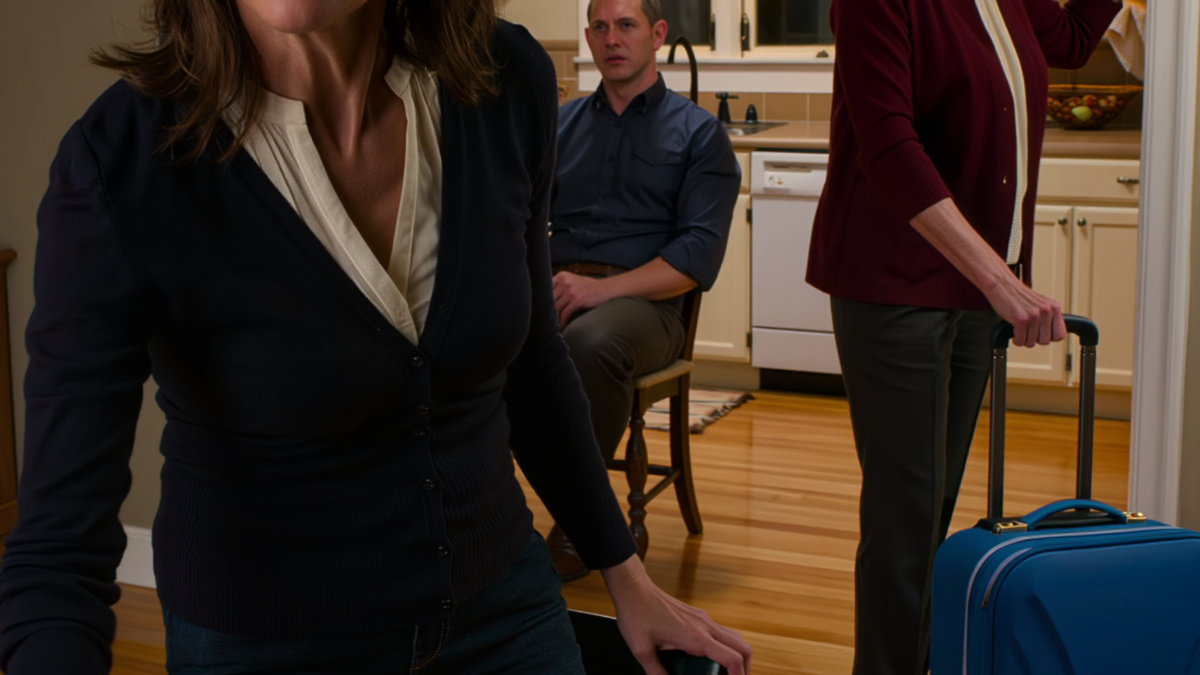
My husband told me his girlfriend was pregnant on a Thursday evening while I was still holding my dinner fork.
The dishwasher was running behind him. The clock above the kitchen doorway read 7:18. A load of towels was turning slowly in the basement dryer, and a Jewel-Osco receipt lay beside my plate because I had not yet copied the grocery total into the notebook where I tracked our household spending.
Everything looked ordinary.
That was what made the moment feel so strange.
Daniel sat across from me with both hands folded on the table.
“Aurora, there’s something you need to know.”
His mother, Patricia, sat beside him.
I looked at her first.
Patricia did not live with us. Her brick house was about fifteen minutes away, closer to downtown Naperville. She occasionally came over for Sunday dinner or stopped by on a weekend, but she did not simply appear at our kitchen table on a Thursday night without calling.
She was wearing a burgundy cardigan and had her purse tucked neatly beside her chair.
That detail bothered me before I understood why.
“What is this?” I asked.
Daniel inhaled slowly.
“Lauren is pregnant.”
For several seconds, I honestly did not understand the sentence.
I knew three Laurens. One worked at our dentist’s office. Another had been married to a former neighbor. The third was the daughter of someone Patricia knew from church.
I waited for Daniel to explain.
He looked down.
“My girlfriend.”
The dishwasher continued humming.
I stared at the cracked salt shaker between us. I had meant to replace it for weeks.
“You have a girlfriend?”
Daniel did not answer immediately.
Patricia did.
“She’s having his baby.”
I turned back to my husband.
We had been married for twenty-one years.
Twenty-one years was long enough to survive layoffs, funerals, home repairs, illnesses, family arguments, one failed business venture and enough ordinary mornings that I could tell how Daniel was feeling by the way he placed his coffee mug on the counter.
He took two sugars.
I drank mine black.
I knew which side he slept on and how he rubbed his thumb against the edge of his wedding ring when he was nervous.
Apparently, I did not know the most important thing about him.
“How long?” I asked.
Daniel rubbed his forehead.
“A while.”
“That isn’t an answer.”
He looked toward his mother.
“About a year.”
My fork was still in my hand.
I lowered it carefully onto my plate.
Patricia stood.
At first, I thought she was leaving.
Instead, she walked toward the hallway.
A few seconds later, I heard something rolling across the hardwood floor.
Wheels.
Patricia came back pulling my blue suitcase.
It was the medium-size one Daniel and I had taken on our anniversary trip to St. Louis three years earlier.
She parked it beside my chair.
“This is no longer your home.”
I stared at her.
Daniel did not object.
He did not look surprised.
That was the first moment I understood the conversation had started long before I entered it.
Someone had already gone upstairs.
Someone had opened my drawers.
Someone had decided which clothes I would need.
Someone had taken my suitcase from the closet and packed it.
I was not being consulted.
I was being informed.
“You packed my things,” I said.
Patricia folded her arms.
“You need to make this easy for everyone.”
Everyone.
That word landed harder than I expected.
Then she looked directly at me.
“You’re a woman who can’t have children.”
Daniel said nothing.
For years, our inability to have children had been something Daniel and I treated as a private sadness.
There had been appointments. Tests. Conversations that went in circles. Hope followed by disappointment, then more appointments.
Eventually we had decided—or I believed we had decided—that our marriage could not spend the rest of its life orbiting something we could not control.
We had built routines around other things.
Travel.
Work.
Our home.
Friends.
Family.
Small traditions.
Now Patricia had reduced twenty-one years to one absence.
Daniel finally spoke.
“Aurora, Lauren is going to have my child. Things are different now.”
I looked at him.
“Are they?”
He nodded.
“We need to move forward.”
For one second, I almost laughed.
Nothing about the moment was funny.
But suddenly the suitcase, Patricia’s presence, Daniel’s measured tone and their almost rehearsed calm made sense.
They had practiced this.
Maybe not every sentence.
But the outcome.
They had already decided I would leave.
I was merely the last person being told.
I could have shouted.
I could have demanded to know how Daniel had come home every night for a year and looked me in the eye while building another relationship.
I could have told Patricia exactly what I thought of her.
Instead, I looked at the kitchen clock.
7:24.
I thought about the towels in the basement.
I thought about the mortgage payment scheduled to leave our joint account the following Tuesday.
I thought about the framed wedding photograph in the hallway.
Then, absurdly, I noticed I had barely touched my chicken.
Patricia nudged the suitcase closer.
“Take what you need tonight. You can come back for the rest later.”
I looked at Daniel.
“You want me to leave?”
His throat moved when he swallowed.
“Yes.”
I nodded once.
“All right.”
Patricia seemed almost disappointed.
Perhaps she had expected tears.
Perhaps she had expected a scene that would make their version of events easier to tell later.
I stood and walked upstairs.
My hands did not start shaking until I reached our bedroom.
I opened the closet and packed pajamas, underwear, toiletries, jeans, two sweaters and the black cardigan I always wore when I felt nervous.
On the top shelf sat our wedding album.
For a moment, I reached toward it.
Then I stopped.
I had no idea why.
Maybe some part of me understood I could not carry twenty-one years out of that house in one suitcase.
I zipped the bag and went downstairs.
Daniel stood near the kitchen counter.
He did not come toward me.
Patricia opened the front door.
The November air stung my face.
I stepped onto the porch.
Behind me, Daniel said, “Please don’t make this harder than it needs to be.”
I turned.
“Harder for whom?”
Neither of them answered.
I pulled the suitcase toward my car.
After getting inside, I closed the door and sat with both hands on the steering wheel.
I could not start the engine.
Through the windshield, our porch light glowed above the steps. My flowerpots were still arranged near the railing. The curtains I had chosen hung in the living-room windows.
Everything looked unchanged.
Except I was outside.
Ten minutes later, I drove to a nearby Hampton Inn.
At 8:03, the woman at the front desk smiled professionally.
“Business or pleasure?”
For a second, I nearly laughed.
“Just one night,” I said.
Upstairs, I placed the suitcase on the luggage rack and sat on the edge of the bed.
My phone vibrated.
Daniel.
Please don’t make this harder than it needs to be.
I read the message twice.
Then I turned the phone facedown.
For the first time that evening, I stopped wondering what Daniel wanted.
I started wondering what I wanted.
I had no answer.
But one thought came clearly.
They were not going to tell the story of my marriage without me.
I barely slept.
Whenever I closed my eyes, I saw Patricia standing beside my chair with that blue suitcase.
At 5:30 the next morning, I gave up.
I showered, put on the same jeans and went downstairs to the breakfast area.
A television played quietly above the coffee station.
I poured black coffee and took a bowl of oatmeal to a table beside the window.
Outside, ordinary people crossed the parking lot.
A man in a work jacket climbed into a pickup.
A woman carried a travel mug toward an SUV.
An older couple walked side by side beneath the gray morning sky.
Everyone seemed to be living inside a normal Friday.
I felt as though I had stepped out of mine.
At 6:17, I called my sister.
Miriam answered after four rings.
“Aurora?”
Her voice was thick with sleep.
“I’m sorry. Did I wake you?”
“What’s wrong?”
I looked at the oatmeal.
“Daniel’s been having an affair.”
Silence.
“What?”
“His girlfriend is pregnant.”
Another silence.
Then her voice sharpened.
“Are you serious?”
“Yes.”
“Where are you?”
“A hotel.”
“Which one?”
I told her.
“I’m coming.”
“Miriam, you don’t have to.”
“Yes, I do.”
Traffic on Route 59 slowed her down, but she arrived about thirty-five minutes later wearing jeans, sneakers and a gray sweatshirt.
She hugged me first.
Then she saw the suitcase.
“Oh, Aurora.”
“My mother-in-law packed it.”
Miriam pulled back.
“She packed your suitcase?”
“Apparently.”
“And Daniel let her?”
I nodded.
Miriam stared at the bag for several seconds.
Then she pulled out the chair beside me.
“Come home with me.”
Miriam lived in Wheaton in a small ranch house she had bought after her divorce.
Her spare bedroom mostly contained boxes, old Christmas decorations and a treadmill she had promised herself she would use someday.
By lunch, she had cleared enough space for me.
We ordered sandwiches from Panera.
I managed two bites.
“You need to eat,” she said.
“I know.”
“You’re going to need your strength.”
I gave her a tired smile.
“That’s what people say when they don’t know what else to say.”
She smiled back.
“Fair.”
That afternoon, I contacted a divorce attorney Miriam recommended.
Ellen Harper told me one thing before our first meeting.
“Start gathering financial information.”
So I opened our joint checking account.
The first transfer I noticed was $8,500.
The second was $4,000.
Both had gone to an account I did not recognize.
I called the bank.
The representative confirmed the transfers had been authorized using Daniel’s online credentials.
I stared at the total.
$12,500.
Miriam sat across from me at her kitchen table.
“How much?”
“Twelve thousand five hundred.”
She slowly lowered her coffee.
“For what?”
“I don’t know.”
Against my better judgment, I called Daniel.
He answered after several rings.
“What?”
“Where did $12,500 go?”
A pause.
Then, “Why are you checking the account?”
I stared at the phone.
“Because it’s our account.”
“Aurora, we’re separating.”
“That doesn’t answer my question.”
He sighed.
“It was for expenses.”
“What expenses?”
“Things I needed to take care of.”
“Were they related to Lauren?”
Silence.
That silence answered enough.
“Daniel, I don’t want to fight.”
“Neither do I.”
“Then tell me where the money went.”
“I’ll account for it.”
“When?”
“I said I’ll account for it.”
He hung up.
Miriam watched me lower the phone.
“Well,” she said, “he’s developed a talent for ending conversations.”
A small laugh escaped me.
It was the first one since the dinner.
The next morning, I met Ellen Harper in her office near Ogden Avenue.
She was in her early sixties, silver beginning to show in her dark hair, with the calmest voice I had heard all week.
She listened without interrupting.
When I finished, she asked about tax returns, retirement statements, mortgage records and bank statements.
Then she looked directly at me.
“Did Daniel ever tell you he intended to divorce you?”
“No.”
“Did he ever tell you he was seeing another woman?”
“No.”
“Did he tell you his mother planned to remove you from the house?”
“No.”
Ellen leaned back.
“Then don’t assume everything they’ve told you is the whole story.”
That sentence followed me out of her office.
Because there was something I had not told anyone.
About two months before Daniel announced Lauren’s pregnancy, he had started asking odd financial questions.
How much money was in my retirement account?
Where were the original house papers?
Did I still have documents from the purchase?
At the time, I had assumed he was organizing our finances.
Now I wondered why.
That night, I searched through old storage bins at Miriam’s house.
Near the bottom of one plastic container, I found a folder marked HOME 2005.
Mortgage papers.
Closing documents.
Tax records.
Old bank statements.
I sat cross-legged on the floor and began reading.
My name was everywhere.
So was Daniel’s.
Then I found the original down-payment record.
A large portion had come from my personal savings.
Nearly $30,000.
I had almost forgotten how significant that money had been.
Daniel’s business had been struggling in 2005.
I had worked extra hours, driven an aging Honda and saved carefully.
That money helped us buy the house.
Over the years, Daniel had developed a habit of describing the property as something he had built.
The records showed a more complicated truth.
I photographed every page.
Then my phone buzzed.
Daniel.
You need to stop digging through old records.
I stared at the screen.
I had not told him what I was doing.
I looked at the folder in my lap.
For the first time since walking out of our house, I felt something other than grief.
Caution.
If Daniel was worried about old documents, then the affair might not be the only thing happening.
The next morning, I took the folder to a Starbucks in Wheaton and opened my laptop.
Ellen had told me to collect facts, not assumptions.
So I made a spreadsheet.
Date.
Amount.
Account.
Description.
I worked through months of transactions.
At 8:42, I found a recurring payment.
$2,185.
Every month.
Destination: an apartment complex in Oak Brook.
It had been happening for almost six months.
Daniel had never mentioned an apartment.
I called Ellen.
“Don’t call Daniel,” she said after I explained.
“I wasn’t planning to.”
“Good. Send me the statements.”
Later that afternoon, she showed me more.
Transfers to a credit card I did not recognize.
Restaurant charges.
Furniture purchases.
One payment to a medical office.
I knew the date immediately.
“That was Lauren’s prenatal appointment.”
Ellen looked at me.
“How do you know?”
“Daniel’s calendar used to sync with our family account. I saw the appointment months ago. He told me it was a business meeting.”
Ellen placed the paper down carefully.
“This isn’t about punishing him, Aurora. It’s about documenting marital finances and protecting your interests.”
I understood what she meant.
But part of me still wanted Daniel to feel the loneliness he had handed me.
That evening, Miriam and I ate spaghetti at her kitchen table.
I spent several minutes moving pasta around my plate.
She looked up.
“You’re doing that thing again.”
“What thing?”
“Staring at your food like it personally betrayed you.”
I laughed despite myself.
Then I said, “I keep thinking about how stupid I was.”
Miriam shook her head.
“You trusted your husband.”
“I missed everything.”
“You missed what he was hiding.”
I looked at her.
“That’s different.”
“It is.”
The next day, Ellen called.
“Daniel has been telling Lauren the house belongs entirely to him.”
I almost smiled.
“He’s always acted like that.”
“The records don’t support such a simple version.”
She asked me to locate the original statements showing my contribution.
I found them in Miriam’s basement after two hours of searching.
There it was.
My account.
My name.
$30,000.
Attached to one document was a handwritten note from Daniel.
Aurora’s savings — down payment.
I sat on the basement floor staring at those words.
For twenty-one years, I had never imagined I would need proof that my husband knew what I had contributed.
Now I did.
That night, Daniel called.
“Why are you going through old house records?”
“Because my attorney asked me to.”
“You don’t need to do this.”
“Do what?”
“Turn everything into a fight.”
I sat quietly.
“You’ve been telling Lauren the house is yours.”
Silence.
“Is that true?”
“Aurora, this is complicated.”
“No. That part is actually simple.”
He sighed.
“I’ll make sure you get what you’re entitled to.”
“That isn’t what I asked.”
His voice rose.
“Why are you doing this?”
I could have answered honestly.
Because I had spent twenty-one years believing we were a team.
Because his mother had packed my clothes as though I were a guest who had overstayed her welcome.
Because Daniel had been financing another life while I compared grocery prices and worried about our electric bill.
Instead, I said, “Because I want the truth.”
He hung up.
My hands were shaking.
Not from fear.
From anger.
That unsettled me.
I had always been the person who kept things calm.
I remembered birthdays.
I paid bills on time.
I apologized first.
I avoided confrontation.
Now I was beginning to understand that remaining calm did not require remaining passive.
The next morning, Ellen emailed me.
We need to discuss Daniel’s business records.
There may be another issue.
At her office, she placed a folder in front of me.
Daniel had accumulated business debt over several years.
Some involved equipment financing.
Some involved credit.
Several payments appeared to have been covered with money from marital accounts.
“How did I not know?” I asked.
“You weren’t involved in his business.”
“No. But I thought I knew our finances.”
Ellen nodded.
“That assumption is part of what made this possible.”
She was not blaming me.
She was explaining how Daniel had compartmentalized his life.
At home, he was my husband.
At work, he was a businessman.
With Lauren, he was apparently a man preparing for a new beginning.
I had been given only one section of the whole picture.
A few days later, Daniel began pressing for a quick settlement.
We need to settle this quickly.
There’s no reason for lawyers to make everything harder.
Then:
We are both adults.
You should accept that things change.
I finally replied.
Things changed when you decided I didn’t deserve the truth.
A week later, we met at a mediation office.
Daniel wore the blue dress shirt I had bought him for our twentieth anniversary.
That bothered me more than I expected.
He looked exactly like the man I had known for two decades.
Same haircut.
Same watch.
Same habit of rubbing his thumb where his wedding ring used to be.
The mediator discussed the house, our accounts, business obligations and the money transferred from joint funds.
Daniel barely looked at me.
Eventually, he leaned back.
“Aurora, we’re both adults. You should accept that things change.”
I met his eyes.
“Things changed when you decided I didn’t deserve the truth.”
He looked down.
I did not say anything else.
The mediation solved little.
Legal fees grew.
Documents piled up.
One evening, I sat in Miriam’s spare room with a calculator, a legal pad and three months of expenses.
For the first time in my adult life, I calculated how long my savings would last.
I was forty-eight.
I had assumed that by this point the biggest uncertainties were behind me.
Retirement.
A paid-off house.
Maybe a few trips.
A quiet life.
Instead, I was discovering how expensive it was to untangle twenty-one years.
That night I cried.
Not dramatically.
I simply sat on the edge of the bed with my face in my hands.
Miriam knocked once and entered.
She sat beside me.
After a while, she said, “Tomorrow morning, you’re coming with me to Cantigny.”
“I don’t feel like walking.”
“You don’t have to feel like it.”
The next morning, we walked through the park in the cold.
People walked dogs.
A couple pushed a stroller.
An older man read a newspaper on a bench.
For forty minutes, I was not Daniel’s wife.
I was not Patricia’s daughter-in-law.
I was not the woman someone had decided was replaceable.
I was simply Aurora.
Afterward, Miriam said, “You need something that belongs to you.”
So I began taking bookkeeping work again.
A contractor needed invoices organized.
A retired couple needed help sorting expenses.
A landscaping company needed monthly accounts reconciled.
The checks were small.
But they were mine.
Gradually, my days stopped feeling like one continuous emergency.
Then Miriam showed me a photograph someone had posted from Lauren’s baby shower.
Lauren stood beside Patricia.
Behind them was a nursery.
Pale green walls.
A crib.
A rocking chair.
And a desk.
I recognized the room.
My old office.
“She moved into my office,” I whispered.
Miriam looked at the picture.
“No. She moved into the space you left behind.”
I looked at her.
That distinction mattered.
Lauren had been given a story.
In Daniel’s story, he was free.
The marriage was ending cleanly.
The house belonged to him.
Their future was secure.
She did not know about the debt.
She did not know about the transfers.
She did not know about my contribution to the house.
And she did not know that Daniel’s paperwork was about to become a problem.
By summer, I had rented a tiny office in Wheaton and built enough bookkeeping work to fill most days.
Then Ellen called.
“Daniel wants you to sign the property agreement.”
“I haven’t agreed to it.”
“I know.”
“Then why send it?”
“Because he may be hoping you’re tired enough to sign.”
I was tired.
That was the part people rarely discussed about divorce.
Not only the heartbreak.
The repetition.
Reading the same paragraph five times because your concentration had disappeared.
Opening another bill.
Answering another email.
Wondering whether holding your ground was worth another month of stress.
That evening, Daniel called.
“You’re making this much harder than it needs to be.”
“I haven’t refused anything reasonable.”
“You know what the house is worth.”
“Yes.”
“And you know I need stability.”
I almost laughed.
“You’re asking me to give up my financial interest so you can have stability.”
Silence.
Then Daniel said, “You’re going to regret dragging this out.”
I did not answer.
The following week, Ellen asked me to come in.
She placed several pages in front of me.
“These are supposed to show that you voluntarily gave up your interest in certain marital property.”
I read the first page.
Then the second.
Then I stopped.
“I never signed this.”
Ellen nodded.
“I know.”
The signature looked like mine.
Not perfectly.
But close.
“When does he say I signed it?”
“About three years ago.”
I thought back.
Three years earlier, Daniel had been renewing business documents.
One Sunday afternoon, he came home with a thick stack of papers.
I need your signature on a few things.
I remembered sitting at the kitchen island.
I remembered signing several pages.
But nothing about surrendering my interest in our house.
“Did you read every page?” Ellen asked.
I lowered my eyes.
“No.”
“That’s important.”
“I know.”
“Don’t be embarrassed. We are not going to assume what happened. We’re going to verify what we can.”
For two days, I searched old email accounts, cloud storage and external drives.
Nothing.
Then, Friday afternoon, an email arrived.
The sender was Mark Dalton.
I recognized the name.
Mark had worked with Daniel years earlier.
Aurora,
I heard there is a dispute involving old business documents. I may have something that could help. Call me when you can.
I called immediately.
Mark sounded nervous.
“A few years ago, Daniel asked me to scan some files.”
“What kind?”
“Business paperwork. Some personal documents were mixed in.”
“Do you still have them?”
“I might have an old email.”
I heard him clicking through folders.
Then he stopped.
“Wait.”
My heart began pounding.
“I found it.”
“What does it say?”
“I’d rather not read it over the phone.”
“Why?”
“If this becomes part of a legal issue, I’d rather send it directly to your attorney.”
He forwarded the material to Ellen.
The attachment carried a file creation date that did not match the date printed on the submitted document.
That alone did not prove what had happened.
But it raised an obvious question.
Why had a document supposedly signed years earlier been created later?
Ellen requested more records.
Then another file surfaced from a shared digital account Daniel and I had used years before.
The wording differed.
The disputed signature page was absent.
The document history showed edits made after the date Daniel claimed the agreement had already existed.
Ellen spread the pages across her conference table.
“I’m not saying this alone proves exactly what happened,” she said. “But it gives us a legitimate reason to challenge his version.”
I stared at the documents.
For months, I had been afraid Daniel’s confidence would outweigh everything else.
He had more control over the records.
More certainty.
More willingness to tell people a simple story.
But confidence was not evidence.
When I returned to Miriam’s house, she was sorting coupons at the kitchen table.
“Well?”
I placed the folder beside her.
“I think we finally found something.”
She read the first page.
Then she looked at me.
“Are you scared?”
“Yes.”
“Good.”
I frowned.
She smiled.
“Being scared means you understand what’s at stake. Just don’t let it make your decisions.”
For the first time, I stopped needing Daniel to confess.
The records could speak without him.
Meanwhile, his family seemed to believe the divorce was effectively over.
Daniel had the house.
Lauren had the nursery.
Patricia had a grandchild on the way.
And I was the woman who had finally been removed.
Then, one Thursday afternoon, an invitation arrived.
Patricia was hosting a family dinner in a private room at a restaurant in Naperville.
A celebration for Lauren and the baby.
I nearly threw it away.
Instead, I photographed it and sent the image to Ellen.
She called ten minutes later.
“You do not have to go.”
“I know.”
“Then don’t.”
I looked at the invitation again.
“Will Daniel be there?”
“Probably.”
“And Patricia.”
“Almost certainly.”
I was quiet.
“I’m going.”
Ellen sighed.
“Do not discuss legal strategy. Do not threaten anyone. And do not let them provoke you.”
“I won’t.”
“Why do you want to go?”
I thought about the blue suitcase.
About Patricia standing in my kitchen as though she had the authority to erase me.
About Daniel remaining silent.
“I’m tired of being the person everyone discusses when I’m not in the room.”
The restaurant was busy when I arrived.
I parked near the entrance and sat inside my car for several minutes.
My hands were cold.
For a moment, I almost drove away.
Then I looked at myself in the rearview mirror.
I was not going inside to embarrass Lauren.
I was not going to attack Daniel.
I was going because for twenty-one years, I had allowed other people to define what my marriage meant.
That evening, I intended to speak for myself.
I entered the private dining room.
Patricia saw me first.
Her smile disappeared.
Daniel turned.
Lauren stood beside him with one hand resting against her stomach.
“Why are you here?” Patricia asked.
I held up the invitation.
“You invited me.”
“This is a family celebration.”
“I know.”
Patricia lowered her voice.
“You should have enough dignity to let go.”
I did not answer.
Dinner continued.
Or people attempted to make it continue.
Guests discussed the baby.
Someone passed photographs of the nursery.
Lauren smiled when a relative mentioned the baby’s name.
I sat quietly at the end of the table.
Eventually Patricia raised her glass.
“To new beginnings.”
Everyone lifted theirs.
I did not.
She noticed.
“You know, Aurora, some people don’t know when it’s time to move on.”
The room quieted.
I looked at her.
“I remember you saying something similar before.”
Her expression changed.
“I don’t know what you’re talking about.”
“The suitcase.”
Daniel’s shoulders tightened.
Patricia looked away.
“You were very clear that night, Aurora,” Daniel said.
I turned toward him.
“You don’t have to explain anything to me.”
Then I looked around the table.
“But some people here deserve to know what actually happened.”
I removed a folder from my bag.
Daniel stood.
“Don’t do this.”
“I haven’t done anything yet.”
I placed copies of several financial records on the table.
“These are records from our marriage.”
Daniel remained standing.
“For months,” I continued, “people have been told the house belonged entirely to Daniel.”
“That isn’t what I said,” he replied.
I looked at him.
“Then you’ll have no trouble explaining these.”
I pointed to the closing records.
“The original down payment included $30,000 from my personal savings.”
One relative looked up.
“Aurora put that much into the house?”
“Yes,” Daniel said quickly. “That was twenty-one years ago.”
“Yes,” I said.
Another relative picked up a different page.
“What are the apartment payments?”
Daniel stopped answering.
I did not need to say Lauren’s name.
The statements showed payments from our joint account to an Oak Brook apartment.
They showed purchases connected to the baby.
They showed transfers Daniel had never discussed with me.
Lauren looked at him.
“What is this?”
“It’s complicated.”
Her eyes narrowed.
“You told me the divorce was basically done.”
“I said we were separating.”
“You said the house was yours.”
Daniel said nothing.
Patricia stood.
“This is not the place for this.”
I looked at her.
“You’re right.”
For a fraction of a second, she seemed relieved.
Then I continued.
“But you made it the place when you decided to humiliate me in front of everyone.”
Nobody moved.
“You handed me a suitcase and told me it was no longer my home. You used the fact that I never became a mother as though it erased twenty-one years of my life.”
Patricia lowered her eyes.
“I didn’t argue that night,” I said. “I didn’t scream. I didn’t beg. I left.”
I looked toward Daniel.
“And while you were telling people I had nothing left, the records were still there.”
Daniel sat down.
Someone asked about the disputed property documents.
A legal assistant connected to Daniel’s side was sitting quietly near the end of the table.
The assistant immediately said, “I can’t discuss that here.”
That answer was enough.
Several people looked at Daniel.
Lauren slowly stepped away from him.
I felt no pleasure watching her do it.
Only exhaustion.
There was no triumphant confession.
No perfect moment where everyone apologized and declared me right.
Only people finally seeing pieces of a story they had never bothered to question.
Before leaving, I gathered my folder.
Then I faced Patricia.
“You thought you were giving me a suitcase because you believed I had nowhere to go.”
She stared at me.
“You were wrong.”
I walked out.
The legal process continued for another three months.
Daniel still had attorneys.
I still had bills.
Documents still had to be reviewed.
Nothing became magically simple.
But the version of events Daniel had been telling could no longer survive unchanged.
The divorce was finalized without courtroom theatrics.
There were signatures.
Paperwork.
Negotiations.
A settlement that left both of us with futures we had not expected.
I did not receive everything I wanted.
Neither did Daniel.
I received the share of marital property and funds supported by the records and the legal process.
Daniel kept the house.
That surprised me at first.
For years, I had thought of that house as the center of my life.
Then one afternoon, I drove past it.
The kitchen windows were visible from the road.
I remembered the table where Daniel told me about Lauren.
The front door where Patricia stood with my suitcase.
The office that became a nursery.
And I realized I did not want to spend twenty more years measuring every room against the person I had been when I lived there.
I moved into a small townhouse in Downers Grove.
Two bedrooms.
A narrow kitchen.
A little patio in back.
On the first night, I unpacked one box at a time.
There was no husband asking where I had put the coffee filters.
No mother-in-law telling me how things should be done.
No one expecting dinner.
The silence felt strange.
Then it began to feel peaceful.
I placed my coffee maker beside the window.
I hung photographs in the living room.
I bought a small patio table.
None of it was dramatic.
But every choice was mine.
My bookkeeping business grew steadily.
I no longer worried about finding enough work.
Twice a month, I began volunteering at a local food pantry.
Mostly I sorted canned goods and helped people carry boxes.
One Saturday, I met an older woman preparing to move into an apartment after forty years of marriage.
She looked terrified.
I knew that look.
I squeezed her hand.
“You’ll figure it out.”
She smiled weakly.
“I hope so.”
“So do I.”
Months later, Daniel emailed me.
The message was longer than I expected.
He apologized for the way everything had happened.
He said he regretted how he had handled the end of our marriage.
He hoped I could forgive him eventually.
I read the email twice.
Then I closed my laptop.
I did not answer.
A week later, Patricia sent me a handwritten letter.
That was harder.
She apologized for packing the suitcase.
She apologized for what she had said about children.
She wrote that she had been angry and had turned her disappointment toward me.
I folded the letter and placed it in a drawer.
I did not hate her.
But forgiveness was not a door I had to open merely because someone finally knocked.
For much of my adult life, I had connected my worth to being Daniel’s wife.
Then Patricia made me feel as though my worth depended on motherhood.
Neither was true.
I was forty-eight.
I had spent twenty-one years working, saving, supporting a household and showing up for people I loved.
None of that disappeared because Daniel chose another relationship.
And I did not become less of a woman because I never became a mother.
I also learned something uncomfortable about myself.
I had avoided difficult conversations for years.
Whenever Daniel withdrew, I gave him space.
Whenever something felt wrong, I told myself marriages went through difficult seasons.
Whenever Patricia crossed a boundary, I tried to keep the peace.
I had believed silence protected my family.
Sometimes silence only protected other people’s behavior.
I did not regret being kind.
I regretted confusing kindness with disappearing.
During the first terrible weeks, I had imagined revenge.
I wanted Daniel to understand what he had done.
I wanted Patricia to regret every word.
I wanted Lauren to realize the future she had been promised rested on a story with missing pages.
But none of those things became the victory that mattered.
The real victory was quieter.
I refused to disappear.
I kept the records.
I told the truth.
I allowed the legal process to do what it was supposed to do.
Then I walked away.
One Saturday morning, I sat alone in my new kitchen with coffee.
Sunlight stretched across the table.
My phone rested on the counter.
No messages.
No arguments.
No demands.
Just quiet.
I looked around the room.
For once, I was not thinking about what I had lost.
I was thinking about what remained.
My home.
My work.
My sister.
My health.
My freedom.
And the strange, peaceful knowledge that I could build a life without asking anyone’s permission.
Daniel and Patricia thought the suitcase meant they were sending me away with nothing.
They were wrong.
That suitcase held a few clothes, toiletries and the things I believed I needed to survive several days.
But when I look back now, I understand I did not leave that house empty-handed.
I took myself with me.
And, eventually, I learned that was enough.