My four-year-old daughter spent six hours riding the same elevator, pressing a roof button nobody understood. When I finally reached her, she signed five words so fast the guard missed them: Aunt up. Uncle push. Door shut. Then I realized the building had been listening to the wrong language.
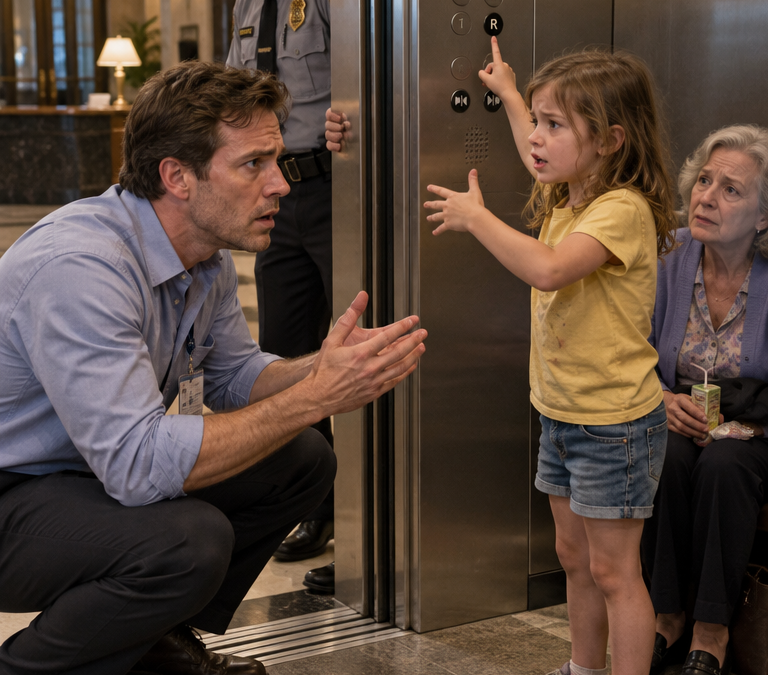
There is a sentence that English can leave unfinished in a way American Sign Language cannot.
You can say, “She was pushed,” and never identify who did it. No direction. No name. No person standing on the other side of the verb.
In ASL, movement matters.
The sign begins where the person doing the pushing is located and travels toward the person receiving it. Space becomes grammar. Direction becomes part of the sentence.
Jared Madigan had not learned that because he expected it to matter in court someday. He had learned it because his daughter was born deaf and he had decided, almost from the moment he understood what that meant, that he would never let his inability to communicate become her loneliness.
Three years later, that decision was the reason he understood what everyone else had missed.
The only person who had seen what happened near the roof of the Adcock Building was four years old.
She had never spoken a sentence aloud.
And for nearly an entire working day, she had been trying to tell adults exactly where to look.
Her name was Macy Madigan.
Her father was thirty-seven, and becoming fluent in her language had rearranged his whole life.
Before Macy was born, Jared had worked nights as an auditor at a hotel near the airport, reconciling folios between midnight and dawn and sleeping through much of the day. He liked systems that balanced. Numbers either matched or they did not.
Then a nurse placed headphones on his newborn daughter, watched a monitor, and gently explained that Macy had not responded to the tones.
The word used was profound.
Jared went home, looked at his daughter asleep in a bassinet, and treated the diagnosis the way he treated every difficult thing: as work he had to learn how to do.
He enrolled in a community-college sign-language class the week Macy came home.
He took the next level while she still slept beside his bed.
By the time she was two, he had left the airport hotel and taken a job at a residential program connected to the state school for the deaf, accepting a brutal commute because immersion was the fastest route to fluency.
He sat for a national interpreting certification examination when Macy was three.
He failed the first attempt.
He studied harder and passed the second.
By the time she was four, Jared worked as a staff interpreter for a Toledo hospital system and accepted occasional county-court assignments on the side.
He liked the precision of interpreting.
The rule was simple: render what was communicated and nothing more.
Do not improve it.
Do not soften it.
Do not add what you think the speaker meant.
Macy, meanwhile, signed the way some children talked when excited—with her entire face, shoulders and body.
She had her own sign for a neighbor’s cat.
She had one for the particular way Jared burned toast.
And she knew that the elevator button marked R went to the roof because her aunt Tamson had taken her there one Sunday to look across Toledo toward the river.
Tamson Laferty was Jared’s sister-in-law, Joelle’s older sister.
The Madigans rented apartment 7C in the Adcock Building, an old brick structure on Jefferson Avenue that had begun life as offices decades earlier and had later been converted into apartments. Much of the building had been modernized in pieces rather than all at once.
The elevators were a good example.
One worked.
The other was awaiting repairs that kept being postponed.
Tamson came to see Macy often.
Unlike Joelle, Tamson had quietly taken sign-language classes.
She had never announced it.
She had simply walked into the Madigans’ kitchen one morning when Macy was three and signed good morning.
Macy had stared at her aunt as if a door had opened in a wall she had assumed was solid.
Joelle knew the alphabet and perhaps thirty useful signs.
She always meant to learn more.
She said that often.
When Macy signed a long thought, however, Joelle usually turned toward Jared for help.
Joelle was thirty-four and worked in the leasing office of a suburban apartment community.
She and Jared had built the kind of marriage that could look ordinary from the outside—jobs, bills, a child, routines, takeout containers in the refrigerator, shoes by the door.
What Jared did not know was that his wife had been seeing Tamson’s husband, Everest Laferty, for more than a year.
Everest was forty-one.
He had run a boat dealership that failed, then a marine-financing business that failed more quietly. At the time he described himself as a consultant.
People liked him.
He remembered dogs’ names.
He borrowed money with the ease of someone borrowing a pen.
He could make attention feel like warmth.
Tamson had married him ten years earlier because, when Everest looked directly at someone, he had a talent for making that person feel chosen.
Two years before everything came apart, Tamson and Joelle’s father died.
He had farmed soybeans outside Ottawa, Ohio.
After the land was sold, each daughter received a little more than three hundred thousand dollars.
Jared believed Joelle had placed her inheritance into savings for Macy.
He had never asked to see the account.
Tamson kept hers at a bank on Jefferson Avenue.
Everest managed most of their household finances and had online access to many things.
He did not legally own Tamson’s inheritance account.
That distinction would later matter.
On the last Thursday in August, Jared left apartment 7C at around 6:40 in the morning.
He had a long hospital assignment involving a deaf patient on a secure behavioral-health unit. Every phone had to be surrendered at the door and locked in a cabinet until staff and visitors signed out.
Macy was awake when he left.
She watched him from bed with the solemn expression children use when they consider an adult’s departure unnecessary.
“Back later,” Jared signed.
“Love you.”
Macy signed love you back.
Then she made the sign she used for the roof.
She meant Aunt Tamson.
Tamson had taken her there once, and in Macy’s mind the association had stuck.
Jared answered maybe.
He kissed her and left.
He did not know that Everest’s pickup was already downstairs.
He did not know Joelle would let Everest into the apartment before Jared had cleared the block.
His phone remained locked away until 2:31 that afternoon.
When he got it back, the screen showed fourteen missed calls.
Most were from a number he did not recognize.
The last voicemail came from a young man trying hard to sound calm.
“Mr. Madigan, this is Julio downstairs at the Adcock. Sir, your daughter has been riding elevator B by herself since before nine this morning. She won’t get off. We can’t get her to get off. Please call.”
Jared called from the hospital stairwell before he had even removed his badge.
“Where’s my wife?”
The line went quiet.
“She left this morning, sir,” Julio said at last. “Around nine. With your brother-in-law. I helped him with the bags.”
“Is Macy hurt?”
“No, sir. She’s just… riding.”
“What does that mean?”
“She keeps pressing the top button. The roof button. It doesn’t work without a key.”
Another breath.
“Sir, she’s been pressing it for six hours.”
Jared was moving before Julio finished.
The drive downtown should not have been terrible at that hour, but roadwork had narrowed traffic along part of his route. Jared drove with Julio on speaker while a line of orange barrels seemed to go on forever.
Julio Barkley was in his mid-twenties and only a few weeks into his job at the Adcock.
The building had one daytime security desk and a bank of monitors showing the lobby, loading zone and elevator interiors.
Elevator A had been out of service for weeks.
Every resident used B.
Julio first noticed Macy on a monitor shortly after nine.
A small child in a yellow shirt stood at the rear of the elevator while the doors opened on one floor, closed, opened on another, then closed again.
At first he assumed a parent was nearby, perhaps sending her between floors as a game.
Later he stepped into the doorway.
Macy reacted badly.
She backed away, vocalized sharply and struck the R button with the heel of her hand again and again.
The light flashed.
Then went dark.
Julio crouched and talked to her.
“Hey. Where’s your mom?”
Macy watched his mouth.
Then she made movements with her hands.
Pointing.
Lifting.
Placing.
Repeating.
He thought she might not speak.
It did not occur to him that she could not hear.
He called the property manager.
He tried riding the elevator with her.
On the seventh floor, Macy suddenly rushed out, ran to 7C and pushed open the unlocked apartment door.
The television was still playing.
A bowl of cereal had gone soft on the table.
No adults were inside.
Macy walked into the living room, stared toward her bedroom for a moment, then returned to the elevator.
And pressed R.
Julio found the tenant sheet.
Joelle’s number went directly to voicemail.
Jared’s phone rang inside a cabinet across town.
Julio called the non-emergency line and reported a child whose parent was believed to be somewhere in the building.
Help would come when a unit was free.
Around noon, Mrs. Fluker from the sixth floor came down carrying crackers and a juice box.
She was in her seventies and had lived at the Adcock longer than some of its renovations.
She sat on the elevator floor beside Macy.
Macy ate.
Then pressed R again.
“I’ve stayed in the car with her,” Julio told Jared. “It’s the only thing that calms her. If I stand in the lobby, she cries. If I ride with her, she’s okay. I don’t know what she’s trying to tell me.”
“She’s deaf,” Jared said.
Silence.
“She’s telling you something.”
The elevator doors opened onto the lobby shortly before three.
Macy stood in the back corner.
Mrs. Fluker was beside her.
Julio held the doors open with his arm.
Macy saw her father.
She did not run to him.
She lifted her hands.
The signs came so quickly that the others saw only motion.
Jared understood every part.
Aunt.
Up.
Roof.
Uncle.
Push aunt.
Door shut.
Aunt not come down.
The sign for push traveled through space from the place where Macy had positioned her uncle to the place where she had positioned her aunt.
She had supplied actor, direction and recipient through movement.
Jared looked at Julio.
“Where’s the key for the roof?”
The key was stored in a lockbox inside the manager’s office.
Julio had been warned never to use it casually. The roof contained mechanical equipment, and the building did not want residents wandering around an area never designed for recreation.
No one had explained what he should do if a four-year-old had been pointing toward it for six hours.
Julio opened the lockbox.
He inserted the key into the elevator switch.
R illuminated and stayed illuminated.
Macy placed her palm flat over the glowing button.
The elevator climbed.
At the top was a concrete vestibule and a heavy steel door.
From inside, there was a push bar.
Outside, on the roof side, there was no usable handle.
The door had been designed for exit, not reentry.
Jared pushed through.
Late-August heat rolled in.
The roof was tar, gravel, machinery and hard afternoon light.
In a strip of shade beside the elevator structure sat Tamson.
She had been there since morning.
Her body was exhausted from hours in the heat. She had tried shouting toward the street until her voice was nearly gone. She had used a shoe to strike the door until it was useless. She had spent hour after hour watching ordinary city life continue below while nobody looked upward.
Julio stopped in the doorway.
A paramedic was called.
Jared moved toward Tamson.
She lifted her head.
The first thing she communicated was not about herself.
“Where is Macy?”
Jared told her.
Macy knew.
At the hospital, Jared refused to interpret Tamson’s statement.
For the first time in his professional life, the boundary was personal.
He was family.
Someone else needed to do it.
Tamson told her story in pieces while medical staff treated dehydration and the effects of spending most of the day on the roof.
The story had actually begun the previous evening.
Tamson logged into her bank account to pay property taxes.
The balance was wrong by $186,000.
The transfer had been made three weeks earlier to an entity called Laferty Marine Ventures LLC.
She called Everest, who claimed he was in Cincinnati at a boat show.
He sounded calm.
The transfer was temporary, he said.
A deposit on a vessel.
A good opportunity.
He would explain on Friday.
Tamson did not sleep.
Early Thursday she drove downtown so she could speak to the bank when it opened.
As she passed the Adcock Building, she saw Everest’s pickup in the loading area.
She recognized the trailer hitch she had given him for his birthday.
Tamson went upstairs to 7C.
Joelle answered the door wearing a robe.
Everest was inside the kitchen drinking coffee.
He was wearing the shirt he had supposedly taken to Cincinnati.
Two suitcases and a duffel bag sat near the entrance.
Tamson confronted them.
She later admitted that she was not calm and regretted some of what she said in front of Macy.
Everest responded the way he often responded when other people became emotional.
He made himself quieter.
He raised his hands.
“Not here. Not in front of the kid. Come upstairs. I’ll show you the paperwork.”
He told Tamson it was a legitimate boat deal.
He told her she would understand if she saw the documents.
She went with him.
A decade of marriage had built habits stronger than suspicion.
Some part of her still wanted the missing money to have an explanation.
They climbed the fire stairs.
Everest pushed open the roof door.
He held it for her.
“Look at the river,” he said.
Tamson stepped outside.
She turned toward the view.
The steel door closed.
When she spun around, the exterior face offered her nothing useful to grip.
Everest was already going downstairs.
Detective Latoya Helms listened to Tamson’s statement in the emergency department.
When Tamson finished, Helms asked whether she had ever been treated for a mental-health condition.
“No.”
Helms looked at her notes.
Then she explained why she had asked.
Everest had visited a district station on Tuesday, two days before the roof.
He had told officers he was worried about his wife.
He claimed Tamson had been talking as though she might harm herself and asked officers to make a note at her address.
He had presented himself as a frightened husband.
He had cried.
The roof was no longer a single argument that had gone too far.
Someone had been preparing a story in advance.
Later, Jared would work backward and decide that the plan had probably begun months earlier.
The boat itself was real.
It was a forty-two-foot sailing catamaran called Slack Tide, berthed in Orange Beach, Alabama.
Everest had found it in February.
He formed Laferty Marine Ventures and put down a deposit.
The final payment kept being delayed while he searched for enough money to close.
Eventually, the money began coming from the women around him.
Jared learned that Joelle’s inheritance—the money he believed she had protected for Macy—had been transferred into the same venture months earlier.
The account supposedly carrying Macy’s future contained only a few hundred dollars.
Joelle had helped finance the plan.
Tamson’s money was meant to complete it.
The preparation around Tamson had also begun long before Thursday.
In spring, Everest arranged an appointment with a psychiatrist and framed it as something related to their marriage.
Later he began telling family members that Tamson had been struggling since her father died.
He spoke softly.
Carefully.
Sadly.
By summer he had repeated concerns to neighbors.
By August, he was reporting those concerns to police.
By the morning the roof door closed, multiple people had already heard some version of the same story: Tamson was unstable.
A contractor was scheduled to inspect the roof several days later.
By then, Everest and Joelle planned to be in Alabama, completing the boat purchase.
If Tamson had eventually been found, Everest’s earlier warnings could be offered as explanation.
The plan did not account for Macy.
Joelle left her daughter inside 7C with the television on and the door unlocked.
She sent her mother, Alleta, a message implying that Mrs. Fluker had Macy until Alleta arrived.
Mrs. Fluker did not have Macy.
Alleta, sixty-six, was in a medical treatment appointment that morning and did not see the message for hours.
Joelle had used her limited signing to tell Macy something like stay, Grandma come.
She did not understand what Macy had already seen.
Macy had watched Aunt Tamson go upstairs.
She had watched Uncle Everest come back down alone.
Then the adults left.
At nine o’clock, the most important word in Macy’s world was roof.
That night, Jared stood outside Tamson’s hospital room with Macy sleeping against his shoulder.
Joelle’s phone remained off.
Everest’s did not.
Jared borrowed a hospital phone and dialed Everest.
The call rang several times.
Then Everest answered in a warm, anxious voice.
“Hello? Is this the hospital? Is she all right? Is Tamson all right?”
Jared said nothing.
Behind Everest’s voice came wind, rigging and the distant public-address system of a marina.
Jared hung up.
He knew where they were.
His mother-in-law, Alleta, was terrified Jared would drive south.
“You’re not going down there,” she said. “You’re not leaving that child again.”
Jared had no intention of leaving Macy.
His next decision came from the rules of his profession.
An interpreter should not interpret for family in a legal matter.
If Macy’s account was going to matter, Jared could not be the person converting it into English.
Her most important statement would have to pass through someone neutral.
Friday morning he called Sky Batson.
Sky was fifty-two and deaf.
She was a certified deaf interpreter, someone skilled at communicating across variations in signing style, language background and comprehension.
For a frightened four-year-old, a deaf adult communicating directly in her first language could make the difference between cooperation and confusion.
Jared had worked beside Sky before.
He explained the situation.
By nine that morning, Macy was at the county child-advocacy center.
A forensic interviewer had questioned hundreds of children but had never handled a signed interview.
She wisely allowed Sky to guide the communication process.
The session was recorded from two angles.
Jared waited down the hall with coffee he never drank.
He watched the recording afterward.
Macy sat in a small chair with her feet above the floor.
Then she rebuilt the apartment in the air.
Aunt on the left.
Uncle on the right.
Mother near the door.
She showed the argument.
She showed Everest taking Tamson’s phone from Tamson’s bag and slipping it into his own pocket.
Nobody had known that.
It explained why calls to Tamson’s phone went unanswered while the phone itself traveled south.
Macy showed Everest and Tamson going upstairs.
Then she showed Everest returning alone.
She made the sign for waiting.
A long time.
Then she showed the push again.
Sky stopped.
She asked Macy to repeat it slowly.
Macy did.
The movement traveled from the space assigned to Everest toward the space assigned to Tamson.
Then came the door.
Sky later explained the linguistic point carefully.
Macy was not describing a fall.
The handshape and movement were different.
She was not describing help.
That sign was different too.
She had located two people in space.
The verb moved from one to the other.
The grammar itself encoded who acted on whom.
A judge signed a warrant for Everest that afternoon.
Detective Helms warned that persuading another jurisdiction to act quickly on an Ohio warrant late on a Friday could take time.
Jared did not rely on speed.
He called Gaspard Bro, the broker handling Slack Tide.
Bro was around sixty and had been selling boats for decades.
Jared identified himself truthfully as a court interpreter and gave his credential information. Then he asked whether Bro knew that the prospective buyer of the catamaran had become the subject of an Ohio felony warrant.
Silence followed.
Eventually Bro said Everest had told him the money was connected to his wife.
Everest had described Tamson as psychologically unwell and suggested he was managing financial matters for her.
Bro also mentioned something else.
Everest had recently asked whether Bro knew a woman who might crew the boat for the season.
His wife, according to the version he had given the broker, would soon be unavailable.
Tamson called her bank from her hospital bed.
She reported the $186,000 transfer as unauthorized.
A bank could not instantly recover money already moved elsewhere, but it could prevent the next transfer from leaving an account under review.
The remaining balance intended for Slack Tide was scheduled to move Monday.
By Friday afternoon, it was frozen.
There was still one person who had not fully accepted what happened.
Alleta had spent months hearing her son-in-law describe Tamson as fragile.
He had done it gently enough to sound like concern.
On Saturday, Alleta stood at the foot of her daughter’s hospital bed and asked a question that broke something in the room.
Had Tamson been taking anything?
Jared did not argue.
He showed Alleta a photograph of the roof-side face of the steel door.
No handle.
No plate.
Nothing a trapped person could use to reopen it.
“Everest told you she wandered up there,” Jared said. “Tell me how you wander through that.”
Alleta studied the picture.
Eventually she sat in the visitor chair.
She placed a hand over her daughter’s ankle through the blanket.
Then she apologized.
That was the first time someone who had trusted Everest’s version stopped asking Tamson to explain herself and started asking what Everest had done.
Jared had been thinking about Everest and Joelle since the hospital phone call.
Everest had answered because he believed the hospital might be calling with news about Tamson.
That meant he was still waiting to learn how his plan had ended.
He had prepared one narrative for himself.
Another for Joelle.
What he had not prepared was a narrative for a witness.
He had seen a deaf four-year-old and assumed silence.
Jared sent Everest one short section of Macy’s recorded interview.
Her hands showed the direction of the push.
The neutral interpretation could be heard with it.
Underneath, Jared sent one sentence.
She says it was you.
He sent Joelle something different.
Public business records showing Laferty Marine Ventures had one listed member and manager.
Everest.
No Joelle.
He sent her the listing for Slack Tide.
He sent her what Bro had reported about Everest already asking about another woman who might work aboard the boat.
Jared did not add commentary.
Joelle had enough information.
Everest called repeatedly.
On the third attempt, Jared answered.
Everest began with warmth.
“Jared, come on. You know how Tam gets.”
Then reasonableness.
“Nobody is going to put a deaf four-year-old on a witness stand.”
Then pressure.
He suggested that Joelle had been the last person near the stairs and that investigators might decide she was responsible.
Jared listened.
Then he said, “I’m not sending the recording to anyone. I’ve already sent it.”
He ended the call.
Monday morning, Jared received a call from Joelle for the first time since Thursday.
He heard a hand dryer and echoing tile.
Joelle whispered that Everest was asleep and she had locked herself in a marina bathroom.
Then she told Jared what Everest had proposed.
If authorities arrived, Joelle would say she had accidentally shut the roof door during the argument.
As a mother with no previous record, Everest had told her, she might receive leniency.
He would remain outside the event entirely.
“What do I have to do?” Joelle asked.
Jared had already decided.
First, she would be at Gaspard Bro’s office at ten o’clock beside Everest.
She would not warn him.
Second, anything Everest said before then about the stairs, the roof, the door or what story they should tell would be recorded on her phone.
Third, when the immediate crisis was over, she would not fight Jared over Macy’s custody, education or medical decisions.
“You left her in an elevator,” he said. “You don’t get to come home and argue with me about her bedtime.”
Joelle cried.
Then she agreed.
Monday morning in Orange Beach was bright and still.
Everest entered the brokerage office shortly after ten carrying a folder.
Joelle sat beside him wearing sunglasses.
Her phone was in her pocket.
Bro moved through the paperwork slowly.
Every few minutes he looked at his computer and said the wire still showed as pending.
Everest checked his phone.
A message from the bank had changed something.
He suggested stepping outside to make a call.
Bro told him the notary would arrive any minute.
There was no reason to reschedule.
Everest stayed.
At 10:26, Baldwin County deputies entered the office carrying the Ohio warrant.
Everest stood.
He did not try to leave.
Instead, he used the voice that had worked for him for years.
Reasonable.
Wounded.
Helpful.
He told the deputies there had been a terrible family argument. Tamson had been emotionally unwell. She had gone upstairs. Joelle, he said, was the last person near the roof.
He turned toward her.
“Tell them, Joelle. You were the one who closed it. It was an accident.”
Joelle took out her phone.
She placed it on the desk.
Then she played the recording.
Everest’s voice filled the office.
He explained how she should say the door closed accidentally.
He explained how she should claim he had been downstairs.
He calculated what consequences she might face.
He said they would be gone before anyone understood that Macy’s hand movements carried legal meaning.
When the recording ended, nobody spoke immediately.
One deputy looked at Joelle.
“Ma’am, is that him?”
“That’s him.”
Everest was taken from the brokerage.
Bro later called Jared and described one detail he could not forget.
As Everest was escorted along the marina, he looked back.
Not at Joelle.
At Slack Tide.
The boat he no longer owned.
Jared took Bro’s call from the ninth-floor fire stairs of the Adcock Building.
He was there with the building owner, photographing the roof access.
The owner pointed out that the door complied with code.
Jared said he believed him.
Then he explained that a door could satisfy an emergency-egress requirement and still create a deadly trap from the other side.
Within thirteen days, the roof-side access had been modified.
Julio Barkley also received the roof key on a lanyard.
He had spent the days after the incident expecting to lose his job for opening the manager’s lockbox.
Instead, tenants defended him.
One letter pointed out that a guard in his third week had spent hours riding an elevator beside a child he could not communicate with because remaining with her was the only thing that kept her calm.
Julio kept the job.
That fall, without anyone asking, he enrolled in the same community-college sign-language course Jared and Tamson had taken.
Everest waived extradition and returned to Ohio.
Joelle drove north separately and stayed with Alleta.
There was a hearing the following week.
It was not yet a trial.
The central problem was Macy.
Everest’s attorney argued that the prosecution’s account of what happened near the roof rested on a preschooler who did not speak aloud and whose father was both a family member and an interpreter.
The criticism was not frivolous.
Jared knew it.
Everything he had done helped move the case forward.
None of it could replace an independent account from Macy.
When Macy communicated in court, Jared sat several rows behind her.
His hands remained still in his lap.
Sky Batson sat with Macy.
A hearing interpreter from Cleveland whom Jared had never met worked beside Sky.
The judge did not question Macy from the bench.
He came down and sat near her level.
First, he tested whether she understood truth and falsehood.
He asked what color his robe was.
Black, Macy signed.
He asked whether it would be true if he said it was red.
Macy looked at him with the unfiltered skepticism of a four-year-old.
No. Lie.
“What happens when somebody lies?”
Trouble.
Then she glanced toward Jared.
Big trouble.
Only after that did the judge ask about the day of the elevator.
Macy rebuilt the scene again.
Aunt on one side.
Uncle on the other.
Mother near the door.
Argument.
Phone taken.
Two people going upstairs.
One person returning.
Waiting.
Then the push.
The hearing interpreter rendered it plainly.
“He pushed her. The door closed.”
Macy showed the waiting.
Then her finger pressing an imaginary button.
Again.
Again.
Again.
“I pressed it. I pressed it. I pressed it. Nobody came.”
Everest’s lawyer asked whether Tamson might have fallen.
Whether the door could have closed in the wind.
Whether Macy’s sign might have meant Everest reached toward Tamson to help her.
Sky requested permission to explain the grammar.
The judge allowed it.
Sky demonstrated the sign for fall.
Then help.
Then push.
She made push in three directions.
One direction meant one person pushed another.
Reverse it and the sentence reversed.
Push directly outward from oneself and the signer became the actor.
Macy had placed Everest on her right and Tamson on her left at the beginning of the narrative.
She had never changed those positions.
Her movement traveled from him to her.
The judge found that Macy understood truth and falsehood and could communicate what she had observed.
The prosecution could proceed.
Everest never went to trial.
His attorney had heard the boat-cabin recording and watched a four-year-old construct the apartment in physical space with grammatical consistency.
He advised his client accordingly.
That November, Everest entered guilty pleas to abduction, felonious assault and theft connected to Tamson’s account.
The sentencing judge reviewed the earlier hearing and the evidence showing that Everest had spent months building a story about Tamson before leaving her trapped on the roof.
He received seven years.
Joelle pleaded guilty to child endangering.
Prosecutors considered her cooperation, including the recording from Alabama.
She received a shorter county sentence, probation and court orders governing contact with Macy.
Jared received full custody.
Joelle’s visits were supervised.
She attended several.
Then she stopped.
She told Alleta that Macy watched her as if she were a stranger and she could not bear it.
Alleta replied that being a stranger was something Joelle had chosen.
Tamson recovered most of her missing money the following spring after the bank completed its fraud process and the criminal case established what had happened.
Slack Tide was eventually sold to a couple from Georgia.
Bro sent Jared a photograph of the catamaran leaving the marina under new ownership.
In one corner he wrote a date and a short message.
The chair held.
Tamson did not return to the home she had shared with Everest.
She rented an apartment on the sixth floor of the Adcock Building, one floor below Macy and Jared and two doors from Mrs. Fluker.
She developed one habit she never tried to hide.
Before allowing a door to close behind her, she checked the other side.
On Sunday evenings, she sometimes took Macy to the roof.
Julio’s key opened the elevator control.
The light over the river softened toward evening.
Tamson stayed well away from the edge.
Jared continued working at the hospital and accepting court assignments.
He also kept one professional promise.
He would never interpret for Macy in a room where the accuracy of her words legally mattered.
When she was five, he explained why.
Macy listened with the same patient expression she had given him on the morning he left for work.
Then she signed a sentence he had never taught her.
She had assembled it herself.
Then I say it.
My hands.
A year after the roof, Jared and Macy rode elevator B down to the sixth floor to collect Tamson.
Macy reached up and pressed R.
The button stayed dark because the key was still required.
She studied it for a second.
Then she looked at her father, shrugged with her entire body, signed aunt first, and pressed six.
For hours on that Thursday, adults had assumed Macy’s silence meant an absence of information.
Everest had made the same mistake on a much larger scale.
He had built his plan around the belief that a child who did not speak aloud could not tell anyone what she had seen.
The one thing he never bothered to learn was that her language had been precise enough to name him all along.