My father pointed at the front door and told me that if I walked through the gate with David, I was choosing life without my family. I left his keys and credit cards behind. Weeks later, one folder on our leaking ranch-house table proved both men had been hiding something from me.
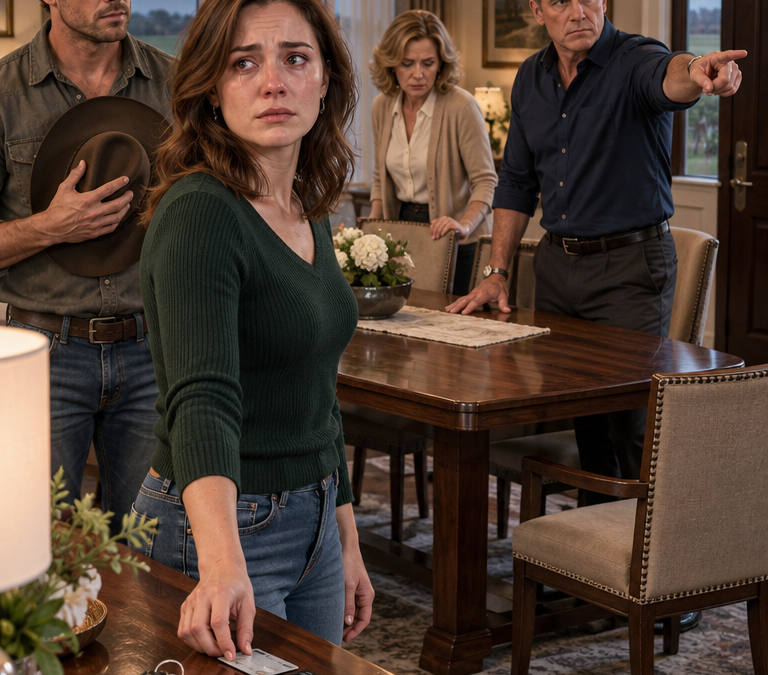
The storm had been gathering over Amarillo since early afternoon, pushing a wall of gray clouds across the Texas Panhandle and turning the windows of the Mercer house into dark mirrors. Inside, the air felt even heavier.
Owen Mercer stood behind the walnut dining table with one hand spread flat across its polished surface. His other arm was extended toward the front door.
Across from him stood his daughter, Emily.
A small suitcase rested near her feet. Beside her was David Hail, the ranch worker Owen had already decided was not worthy of a chair at his table.
“Walk through that gate with him,” Owen said, “and don’t come back when life gets hard. Don’t call when the refrigerator is empty. Don’t call when you can’t pay for heat. If you choose him over this family, then you’re choosing to live without this family.”
Teresa Mercer pushed herself halfway up from her chair.
Owen looked at her.
She stopped.
Emily watched her mother slowly lower herself back down.
All afternoon, during the drive home, Emily had imagined that Teresa would be the first person to interrupt. She had pictured her mother saying that disagreement did not have to become exile, that loving someone Owen disliked did not make Emily less their daughter.
Instead, Teresa lowered her eyes.
On the sideboard rested the things Owen had ordered Emily to return: the keys to the car he had bought after college, two credit cards, and the access card to an account he had managed for years.
Emily removed the final card from her wallet and set it beside the others.
“There,” she said. “Now we can talk without every sentence turning into a price tag.”
Owen’s mouth tightened.
“I paid for your education. I introduced you to people who could give you a future. I made sure you never had to struggle. And this is how you repay me?”
His eyes moved toward David.
“By throwing all of it away for a ranch hand.”
David held his hat against his chest. He had offered twice to leave so father and daughter could speak privately. Emily had refused twice.
She was tired of pretending David was the problem.
The real problem was that Owen Mercer believed gratitude created ownership.
“I am grateful for what you gave me,” Emily said. “But you didn’t buy the right to decide who I love.”
Owen gave a humorless laugh.
“You think love puts food on a table?”
“I think respect should have a place at that table.”
David finally spoke.
“Mr. Mercer, maybe today isn’t the day. Emily and I can leave. We can come back when everyone has had time to calm down.”
Emily shook her head.
“Tomorrow the price will be the same.”
David looked at her.
She continued.
“Leave David, and I can be your daughter again. Stay with him, and I’m a disgrace. Waiting twenty-four hours won’t change that.”
Owen said nothing.
Emily turned toward the staircase.
Her childhood bedroom looked almost untouched.
College photographs stood beside invitations from charity dinners and business events. Dresses her father had approved for fundraisers still hung neatly in the closet. Books from school remained on the shelves. The room looked less like the place where she had grown up than a preserved version of the daughter Owen preferred.
Emily opened the suitcase.
She packed only what she could carry.
At the last moment, she noticed a silver picture frame on the dresser. The photograph inside showed Emily and Teresa leaning toward each other over a birthday cake, both laughing so hard neither one was looking at the camera.
Emily removed the photograph from the frame and slipped it into the side pocket of her suitcase.
When she came downstairs, Owen was waiting at the bottom of the steps.
David reached for the suitcase.
Owen nodded toward him.
“He’ll learn what you cost.”
Emily stopped on the final stair.
“I wish you had asked whether he makes me happy.”
Owen did not answer.
That silence hurt more than the threat.
David picked up the suitcase. Emily crossed the entry hall slowly, allowing Teresa every possible second to stand, call her name, touch her arm, do anything.
Teresa’s hands trembled in her lap.
She did not move.
Outside, the wind had become sharp enough to lift dust from the long drive. Emily and David walked toward the iron gate.
Owen came as far as the porch.
“Don’t come back hungry,” he called.
Emily tightened her hand around David’s and stepped through the gate.
Behind her, the house remained silent.
Owen told Teresa not to change Emily’s room.
He was certain his daughter would return.
In his mind, pride could last only until the first difficult bill, the first broken appliance, the first month when a paycheck disappeared before the end of it. He imagined Emily discovering that love did not repair roofs, fill gas tanks or build savings.
A week passed.
The bedroom stayed empty.
That same week, rain hammered a small ranch house outside Canyon, south of Amarillo.
Water found a crack in the ceiling and began falling onto the kitchen floor.
David grabbed an old cooking pot and placed it beneath the leak.
When he turned, embarrassment had spread across his face.
“This is not how I wanted to bring you home.”
Emily started laughing.
David stared at her.
She pulled out the chair beside her.
“Sit down.”
“Emily—”
“I did not come here to inspect the roof.”
He sat.
They ate bread with butter and drank coffee while rain rattled the windows.
The kitchen furniture did not match. One cabinet door refused to stay completely closed. The overhead light flickered whenever the wind grew stronger.
Yet nobody in that room asked Emily to justify what she loved.
That mattered.
The next morning, David climbed onto the roof before breakfast while Emily held the ladder in wet grass.
She did not know what their life would become.
She only knew that uncertainty felt less frightening than a future chosen for her by someone else.
Life did not become easy simply because Emily had chosen it.
The following morning, she borrowed David’s old pickup and drove into Canyon looking for work. By late afternoon, a family-owned home-supply store hired her to manage inventory and customer accounts.
The pay was modest compared with the life she had known.
Her first paycheck still made her stop.
She stared at her own name printed on it before depositing the money.
A few days later, she bought blue fabric for curtains.
She kept the receipt in a kitchen drawer.
The curtains themselves were ordinary. The feeling behind them was not.
For years, almost everything Emily owned had entered her life through Owen’s approval. The car. The accounts. The expensive clothes. The opportunities.
The faded blue curtains were the first thing in the ranch house she could look at and think, I paid for that with a life I chose myself.
David never treated her decision as a sacrifice she owed him for.
When Emily worked late, he cooked.
On weekends, she helped him mend fence wire.
He taught her how to calm a frightened mare. She taught him to organize receipts so he would stop losing them in feed sacks.
Some nights they ate on the porch while the Texas sky faded from copper to violet.
Other nights they were too tired to say much at all.
Those quiet days should have made Emily completely peaceful.
They did not.
Grief appeared in small places.
Whenever something good happened, she reached for her phone.
Once she nearly sent Teresa a photograph of the blue curtains.
Another time she typed a message about a customer who had praised her work.
Both times she deleted the words.
She did not want every conversation with her mother to become a defense of David.
Several weeks after Emily left home, a sedan turned onto the gravel drive.
Teresa stepped out carrying a wooden sewing box.
For one bright second, Emily believed her mother had come simply because she missed her.
Emily made coffee.
She cut bread.
She asked Teresa to stay for lunch.
Teresa never removed her coat.
“Your father is willing to give everything back,” she said.
Emily sat across from her.
“The car?”
“Yes.”
“The accounts?”
“Yes.”
“Help with bills?”
“Anything you need.”
Emily waited.
“He wants to put all this behind us,” Teresa added.
“What exactly does he want me to put behind me?”
Teresa glanced toward the window.
Outside, David was repairing a gate hinge.
Emily followed her mother’s eyes.
“He thinks you still have time to correct the mistake.”
Emily looked back at her.
“Does the mistake have a name?”
Teresa said nothing.
Emily leaned against the chair.
“Every offer comes with the same condition. I can come home, but David can’t. I can be your daughter, but only if I stop being the woman I chose to become.”
“You’re making this harder than it has to be.”
“No, Mom. Dad made love into a contract. You’re asking me to sign it.”
Teresa’s face tightened.
“We’re worried about you.”
“You can worry about me here. You can visit me here. You can have coffee with me here. But don’t come to collect me like I’m lost.”
The words hurt both women.
Emily knew that.
She did not take them back.
She opened the door.
Teresa placed the sewing box on the table and left.
Hours later, David came inside and found the coffee untouched and cold.
Emily stood at the sink looking through the window.
“Do you miss the old house?” he asked.
She shook her head.
“I miss being able to tell my mother something good without first convincing her that loving you wasn’t a disaster.”
David placed his hand gently against her back.
He stayed there until she moved.
That evening, after Emily went to bed, David stepped outside with his phone.
He made one call.
The next morning, he came to the kitchen table carrying a thick folder.
Emily assumed it contained ranch bills.
She opened it.
The first page was a property deed.
Then came incorporation documents, investment statements and legal records.
David’s name appeared repeatedly.
Emily turned another page.
And another.
Her eyes stopped on a line near the top.
“Why are you listed as the owner?”
David sat across from her.
“Because I am the owner.”
“Of this ranch?”
“Yes.”
Emily looked down again.
A regional agricultural-equipment company was listed beneath his name.
So were several properties.
Investments.
Holdings.
She added the figures mentally and stopped trying.
“David, these assets are worth millions.”
He did not deny it.
Emily’s fingers tightened around the paperwork.
“So when you told me you worked on this ranch…”
“I do work here.”
“You left out the part where you own it.”
David swallowed.
“Yes.”
The leaking ceiling, the old truck and the worn boots rearranged themselves in Emily’s mind.
She had walked away from a father who measured people by money only to discover that the man she trusted had deliberately hidden the truth about his own.
For the first time since leaving Owen’s house, Emily wondered whether love by itself was enough to make a home feel safe.
David did not reach for the folder.
He let the silence remain.
“Why?” Emily finally asked.
David rubbed his palms together.
“Before I met you, people came close to me because they knew what I owned. Some wanted a position. Some wanted money. Some wanted the life they imagined came with it.”
“So you tested me.”
“I told myself I was protecting myself.”
“You let me walk away from my family without telling me the truth.”
“I know.”
“No. I don’t think you do.”
Emily stood.
“My father called you poor as if that made you less human. He told me I would crawl back when I got hungry. I defended you because I believed none of that mattered.”
Her voice tightened.
“And all that time, you knew the insult was built on a lie.”
David lowered his eyes.
“At first, I wanted to know whether you would choose me without money. Then after you left home, I became afraid that if I told you, you’d think everything between us had been staged.”
“It was staged in one important way. I was making decisions without knowing the truth.”
“I’m sorry.”
Emily placed both hands on the back of a chair.
“I didn’t need you to be wealthy. I needed to know who I was building a life with.”
David nodded slowly.
“You’re right.”
He did not defend himself again.
That mattered.
It did not repair the damage overnight.
Emily moved into the spare bedroom.
She kept her job in town.
She told David she needed time.
He never asked how much.
For the first time since they had met, Emily began asking questions she had never known she should ask.
Who managed the company?
How many employees worked there?
Why did David still repair fences himself?
Why did a man who could afford almost anything live in a house with a leaking roof?
David answered.
The agricultural-equipment business had originally belonged to his uncle, who taught him that ownership meant understanding what employees did with their hands, not merely reading reports from an office.
David had expanded the company slowly.
Instead of changing his lifestyle, he bought land and invested profits.
The ranch was not a costume.
He genuinely loved it.
The early mornings were real.
The calluses were real.
The worn boots were real.
Only the secrecy had been false.
A few days later, David introduced Emily to Hannah Price, the company’s chief financial officer, and Marcus Reed, who supervised operations.
Neither treated Emily like someone who had accidentally discovered wealth.
They answered questions.
They showed her records.
They confirmed what David had told her.
Over time, Emily began to understand the difference between privacy and deception.
David had every right to dislike being valued for money.
He did not have the right to make Emily prove herself without her consent.
One evening on the porch, she told him exactly that.
“I understand why you were afraid,” she said. “Fear doesn’t give us permission to control the truth.”
“I know that now.”
“If we stay together, I won’t live inside another man’s test.”
“You won’t.”
The promise took seconds.
Keeping it took months.
David began involving Emily in decisions that affected their shared life.
He stopped arranging things quietly for what he thought was her own good.
When she disagreed, he listened instead of trying to solve her reaction.
Emily also changed.
She stopped treating every mistake as proof that he would deceive her again.
Trust returned through ordinary behavior.
A complete answer.
A plan discussed before it was made.
A difficult conversation finished instead of avoided.
No diamond arrived to erase the argument.
No luxury vacation replaced the apology.
They rebuilt what had cracked by acting differently.
By spring, Emily moved back into their bedroom.
Months later, beneath a wide Texas sky, she and David married beside the ranch house.
The ceremony was small.
Hannah attended with her husband.
Marcus brought his teenage daughter.
Emily’s co-workers filled one row of folding chairs.
David’s ranch crew stood near the back in clean jackets that looked unfamiliar on them.
Two chairs in the front row remained empty.
Teresa had received an invitation.
So had Owen.
Neither came.
Emily did not cry during the ceremony.
She smiled when David promised never again to hide behind fear.
She promised never to confuse forgiveness with silence.
After the guests left, she carried the old photograph of herself and Teresa onto the porch.
David sat beside her.
“I thought she might come,” Emily whispered.
“I know.”
“She didn’t even call.”
David took her hand.
The ranch was quiet except for wind moving across the grass.
Emily did not regret choosing her life.
But she learned that making the right choice did not prevent grief.
Sometimes freedom and heartbreak arrived together.
Several years passed before Owen Mercer’s name appeared on Emily’s phone.
By then, the roof no longer leaked.
David had repaired the house without erasing its character. Emily had chosen every change with him.
She had eventually moved from the home-supply store into community-development work connecting small businesses with local suppliers.
She and David had learned how to disagree without turning disagreement into punishment.
Owen had not learned that lesson.
His manufacturing company in Amarillo had once supplied parts to construction firms and agricultural businesses throughout the region.
For years, Owen saw the company as proof that discipline and certainty could conquer nearly anything.
Then the market changed.
Two major customers left.
An expansion failed.
Managers warned him that cash reserves were disappearing.
Owen rejected their concerns.
By the time he called Emily, the business had unpaid invoices, overdue loans and payroll it could barely meet.
Emily stared at the phone until the ringing nearly stopped.
Then she answered.
“Hello?”
Silence.
“I need to talk to you,” Owen said.
She sat down.
“I don’t know how to fix this alone.”
Emily had imagined dozens of versions of their first real conversation after all those years.
In some, Owen apologized.
In others, he simply asked how she was.
She had never imagined surrender.
“What happened?”
Owen explained in fragments.
Clients had left.
Debt had accumulated.
The bank refused another line of credit without outside capital.
He might need to sell the family house.
“Your mother thinks it’s temporary,” he added. “I haven’t shown her everything.”
Emily closed her eyes.
Across the room stood the birthday photograph she had carried away in her suitcase years earlier.
A bitter question rose in her throat.
Why are you calling now that you need something?
She swallowed it.
“Send me the financial statements.”
“All of them?”
“All of them. I’ll look. I’m not promising I can solve anything.”
Owen exhaled.
“Thank you.”
It was the gentlest phrase Emily had heard from him in years.
That evening, she and David spread the documents across their dining table.
Hannah joined by video.
The numbers were worse than Owen had admitted.
The company was not worthless, but it was trapped beneath debt, outdated purchasing agreements and years of decisions nobody had been allowed to challenge.
David kept reading until he reached the payroll report.
“How many employees?”
Emily checked.
“Thirty-two.”
The number changed the room.
Those thirty-two workers had never stood in Owen’s dining room while he disowned his daughter.
They had never mocked David.
They had never ignored Emily’s wedding invitation.
They were mechanics, warehouse workers, machinists, drivers and clerks with families of their own.
“If the company closes,” Emily said, “they lose their jobs because of a fight they never had any part in.”
David leaned back.
“The question is whether the business can be saved, not whether Owen deserves to be rescued.”
Emily looked at him.
“I want to help. But I don’t want him to mistake help for forgetting.”
“You can offer a hand without pretending the wound never happened.”
The following week, Hannah and Marcus inspected the operation in person.
They found working machinery.
Experienced employees.
Smaller but loyal customers.
Contracts that might be recovered if production became reliable.
The central problem was not only money.
It was management.
Owen approved almost everything himself.
He rejected criticism.
He changed priorities without warning.
Marcus returned to the ranch with a blunt assessment.
“With new capital and new controls, the company has a chance. Without both, investment only delays the collapse.”
David looked at Emily.
“Would Owen accept oversight?”
“I don’t know.”
“Then he’ll have to decide whether pride matters more than thirty-two people on that payroll.”
They prepared a proposal through one of David’s holding companies.
The representative who contacted Owen never revealed David’s identity.
He simply explained that an investor was willing to hear the case personally.
Owen agreed immediately.
On the morning of the meeting, Teresa insisted on accompanying him.
During the drive into Amarillo, Owen practiced sentences about market conditions, temporary losses and the company’s history.
In the elevator, he checked his tie in the reflection of the doors.
He believed he was preparing to persuade a stranger.
When the receptionist opened the conference-room door, Owen gathered his papers and stepped inside.
“Come in, Dad.”
He stopped.
Emily stood beside the table.
At the head of it sat David.
Behind David, mounted on the wall, was the name of the investment firm Owen had spent the previous week trying to impress.
Owen remained in the doorway long enough for Teresa to bump lightly into his shoulder.
His eyes moved from Emily to David and then to the company name.
Recognition replaced confusion.
“You?”
David stood.
He wore a plain dark jacket. Nothing about him was theatrical.
Yet Hannah and Marcus waited for him to speak.
“I own the firm considering the investment,” David said. “Please sit down.”
Owen did not move.
Years earlier, he had looked at David’s work clothes and believed he understood everything important about him.
Now that same man controlled the decision that might determine whether Owen’s company survived.
Eventually Owen sat.
Hannah explained the financial findings.
Debt.
Customer losses.
Purchasing problems.
Weak oversight.
Owen tried to interrupt twice.
Both times Emily lifted her hand.
“Please let her finish.”
He did.
When Hannah closed the folder, David leaned forward.
“I have one question before we discuss money.”
Owen’s jaw tightened.
David’s voice remained calm.
“If I were still, in your mind, the penniless ranch hand you met years ago, would you have called Emily?”
Teresa looked at her husband.
Owen stared at the table.
The air conditioner hummed overhead.
Emily had waited years for her father to face what he had done.
Now that the moment had arrived, she realized revenge was not what she wanted.
She wanted the truth.
Owen rubbed his thumb along the edge of the papers.
“No.”
The word landed more heavily than an excuse.
He continued.
“I would have kept waiting for her to come back. I would have expected her life to fail so I could tell myself I had been right.”
Teresa began crying quietly.
Emily’s throat tightened.
“While you were waiting to be right,” she said, “I was waiting for my father.”
Owen looked up.
“I waited on birthdays. I waited when I got married. I waited when work went well and I wanted to call home. I waited when something hurt and I wanted my mother.”
Her voice shook.
“I kept thinking one of you would decide that missing me mattered more than winning.”
Teresa covered her mouth.
“I didn’t need you to approve every choice I made,” Emily continued. “I needed you to stop treating love like a reward I could lose.”
Owen’s shoulders lowered.
“I made my pride into a debt you had to pay,” he said. “And I kept charging interest.”
He looked at David.
“I judged you by what I thought you had. I never asked who you were.”
Then he turned to Emily.
“I was cruel because I believed fear gave me the right to control you. That does not make it better.”
He swallowed.
“I’m sorry.”
Emily had imagined those words so many times that she expected them to create immediate relief.
They did not.
An apology could open a door.
It could not erase the years behind it.
Teresa rose and walked around the table.
“I owe you something too.”
Emily watched her.
“That day at the house, you kept looking at me. I knew exactly what you were asking.”
Emily’s eyes filled.
“I could have stood beside you,” Teresa said. “I could have told your father he was going too far. I stayed quiet because I was afraid of fighting with him.”
Her hands trembled.
“My silence made you stand alone.”
Teresa reached toward Emily and stopped before touching her.
“I’m sorry.”
Emily closed the distance herself.
She accepted the embrace, but only briefly.
“We need time.”
Teresa nodded against her shoulder.
“I understand.”
David waited until everyone had returned to their chairs.
“What happens next is a business decision,” he said. “It isn’t payment for an apology.”
He laid out the conditions.
His firm would provide enough capital to stabilize operations and protect payroll.
Overdue employee wages would be paid first.
New financial controls would be introduced.
Marcus would supervise restructuring.
Hannah’s team would review expenditures regularly.
Owen could remain involved, meet customers and contribute his experience.
But he would no longer possess unquestioned authority.
Major decisions would require approval.
Years earlier, those terms would have humiliated him.
Now Owen looked at the payroll sheet.
“Will the employees keep their jobs?”
“If the recovery goes as projected,” David said, “that is the goal.”
Owen nodded.
“Then I agree.”
The first transfer was approved that afternoon.
Within days, workers who had feared another missed paycheck received what they were owed.
Marcus began meeting supervisors one by one.
Contracts were reviewed.
Wasteful orders were stopped.
Former customers were contacted with realistic production schedules instead of promises.
Owen moved into a smaller office.
On his first morning there, he stood alone beside a desk without a private conference room, panoramic windows or an assistant outside the door.
For the first time in decades, he was not the final voice in the building.
He sat down.
He opened a customer list.
He began calling.
Recovery came more slowly than Owen wanted and taught him more than he expected.
In the past, he had measured leadership by how quickly people obeyed.
Under Marcus, he had to sit through meetings where employees described problems he had dismissed for years.
Lewis Carter, a machinist, explained how rushed orders created expensive rework.
Nina Brooks, a shipping clerk, showed how constant last-minute changes increased freight costs.
Owen’s instinct was to defend every decision.
Marcus stopped him.
“You’re here to learn why the system failed, not to prove you were innocent inside it.”
Owen disliked the sentence.
Mostly because it was true.
He began visiting the production floor without announcing himself.
At first, conversations stopped when he approached.
Employees expected criticism.
Instead, Owen started asking questions.
More importantly, he began waiting for the answers.
Some customers returned.
Others did not.
The company sold unused equipment, renegotiated supplier agreements and focused on products it could deliver reliably.
Hannah’s reports remained strict.
David never softened them because Owen had reentered the family in some uncertain sense.
Emily observed from a distance.
After the first profitable month, Owen called.
She nearly ignored the phone, afraid another request was coming.
Instead he said, “I wanted to ask how your week was.”
Emily glanced toward David across the kitchen.
“My week?”
“Yes.”
They spoke for less than ten minutes.
Owen never mentioned the company until Emily asked about it.
He did not complain about Marcus.
He did not remind her that he was her father.
Before hanging up, he asked, “I hope I’m not calling at a bad time.”
That question affected Emily more deeply than the apology in the conference room.
Respect, she realized, often arrived in ordinary forms.
The calls continued.
Sometimes Owen asked about the ranch.
Sometimes Emily told him about a community project in Canyon.
Eventually she described how much it had hurt to see two empty chairs at her wedding.
Owen did not explain why he had stayed away.
He did not tell her it had happened years ago.
He simply said, “I should have been there.”
Then he allowed the silence to belong to her.
Teresa changed more slowly.
Her guilt made every conversation sound like an apology waiting to happen.
Eventually Emily stopped her.
“Mom, I don’t need you to punish yourself forever. I need you to be honest with me now.”
After that, Teresa began visiting alone.
She learned that the ranch house was not a symbol of poverty.
It was simply Emily’s home.
She helped restore an old chair.
She cooked lunch in the small kitchen without commenting on its size.
One afternoon, while sorting photographs, they found the birthday picture Emily had carried out of the Mercer house.
Teresa held it carefully.
“You took this?”
“It was the only thing from that house I couldn’t leave.”
Teresa’s eyes filled.
“I’m glad you kept one memory that wasn’t painful.”
Emily looked at the photograph.
“The memory was good. What happened later doesn’t get to rewrite everything that came before it.”
That became the shape of their reconciliation.
Nobody pretended the past had vanished.
They simply stopped allowing it to control every new moment.
At the company, all thirty-two jobs remained intact.
Months later, overdue obligations were current and two former customers signed new agreements.
Owen won back one difficult account.
When Marcus praised him, Owen surprised everyone by giving credit to Nina, whose shipping plan had made the delivery schedule possible.
One afternoon Lewis found Owen near the loading dock.
“You listen more now.”
Owen smiled tiredly.
“I used to think listening meant waiting for someone else to finish.”
Lewis laughed.
“That explains a lot.”
Owen laughed too.
The change was not dramatic enough for headlines.
It appeared in smaller things.
An employee finishing a sentence without fear.
A manager disagreeing openly.
A daughter answering her father’s call without preparing to defend herself.
Emily still kept boundaries.
She did not give Owen a key to the ranch.
She did not treat business improvement as proof that everything had been forgiven.
Once Owen said, “Maybe all of this happened for a reason.”
Emily stopped him.
“No. Some good came after it. That doesn’t make what happened good.”
Owen was quiet.
Then he nodded.
“You’re right.”
A year earlier, he would have argued.
On a cool Saturday morning, Teresa called Emily.
“Can we visit together?”
Emily looked down the long gravel drive.
“Dad too?”
“Yes.”
“What does he want?”
Teresa laughed softly.
“He wants to bring something.”
“What?”
“Bread.”
Later that morning, Owen’s truck appeared beyond the gate.
He did not honk.
He parked outside, picked up a paper bag and waited.
David saw him first.
He walked down the path.
For a moment, the two men stood on opposite sides of the gate that had once divided Emily from her family.
Then David reached for the latch.
He opened it.
Owen held the paper bag against his chest.
Teresa stood beside the truck with a thermos and a small container of jam.
“I told my daughter once that if she chose you, she should never come back to my table when she was hungry,” Owen said.
David listened.
“I’ve thought about that sentence more times than I can count.”
Owen looked toward the house.
Emily was standing on the porch.
“Today I brought breakfast,” he continued, “because this house is the one teaching me how to ask whether there’s room for me.”
David stepped forward and embraced him.
It was not a dramatic reconciliation.
Nobody declared the past erased.
Owen simply held on for a moment, then carried the bread inside.
Emily pulled chairs around the old kitchen table.
Teresa found cups.
David sliced the loaf while Owen opened the jam.
At first, everyone spoke carefully.
Weather.
Fence repairs.
The company’s newest order.
Then Teresa spilled coffee near her elbow.
David looked down at the worn tabletop.
“Don’t worry. This thing has survived worse.”
The laughter that followed loosened something in the room.
After breakfast, Owen walked outside with Emily.
The ranch looked different from the place he had imagined for years.
The barn roof had been repaired.
Cottonwood trees shaded part of the drive.
The porch was wider.
The original kitchen table remained inside because Emily had insisted on keeping it.
Owen touched one of the porch posts.
“I pictured this place differently.”
“Smaller?”
He smiled faintly.
“Colder.”
“You imagined hardship because you needed hardship to prove you were right.”
“Yes.”
“There was hardship.”
“I know.”
Emily crossed her arms.
“The hardest part wasn’t earning less or fixing a roof. It was knowing my parents were alive a short drive away and choosing not to know me.”
Owen absorbed the words without defending himself.
“I can’t give those years back.”
“No.”
“I wish I could.”
They stood together while the wind moved across the grass.
Then Owen asked a question Emily had never expected.
“Was there anything good I gave you that you still wanted to keep?”
Emily thought about school.
Books.
Long drives with him when she was young.
His habit of taking apart broken machines and explaining each piece.
The confidence he once placed in her intelligence before that confidence turned into control.
“Yes,” she said. “A lot.”
Owen looked at her.
“That’s part of why losing you hurt so much.”
His eyes reddened.
In the months that followed, the family began gathering without using crisis as an excuse.
Teresa invited Emily and David to dinner but asked what they actually liked rather than planning a formal meal designed to impress.
Owen came to the ranch for a fence repair and discovered that David still worked with his hands despite being able to hire someone for every job.
At the company’s annual employee lunch, Owen stood before the staff.
He thanked the people who had stayed through the worst year.
He named Lewis.
Nina.
Marcus.
Hannah.
Then he said something the old Owen Mercer would never have admitted publicly.
“This company nearly failed because I confused control with leadership.”
Nobody applauded immediately.
They were too surprised.
Lewis started first.
Then the room followed.
Emily stood near the back beside Teresa.
She felt proud, but not because her father had been humbled.
Humiliation had never been the point.
She was proud because he had finally learned that dignity did not become smaller when a person admitted being wrong.
Later, Owen approached David.
“I used to think money told me who had value,” he said. “Then I learned you had more money than I did, and for a while I was embarrassed because I thought that made me the fool.”
David gave him a faint smile.
“And now?”
“Now I think I was a fool because I needed money to discover that I should have respected you.”
David extended his hand.
Owen looked at it.
Then he ignored the handshake and hugged him.
That evening, Emily and Teresa sat on the ranch porch while David and Owen carried leftover food into the kitchen.
Teresa looked toward the open door.
“Do you trust us again?”
Emily considered the question carefully.
“More than I did.”
Teresa waited.
“Trust isn’t a switch,” Emily said. “It’s more like a road. You prove where it leads by walking it.”
Teresa smiled through tears.
“Then we’ll keep walking.”
Emily rested her head against her mother’s shoulder.
Inside, Owen and David were arguing cheerfully about where to store a serving tray.
Their voices drifted through the screen door.
Years earlier, Emily had believed she had to choose between the man she loved and the family she came from.
For the first time, nobody was asking her to leave someone outside in order to belong.
By the time Owen’s company was stable again, he no longer occupied the largest office.
Management offered it back after restructuring.
He declined.
“Give it to whoever needs the space.”
He preferred a smaller office near operations, where he could hear forklifts moving and conversations in the hall.
Some mornings he arrived before everyone else.
Other days he left early to have dinner with Teresa or drive to the ranch.
One autumn evening, Emily invited both families and several friends to supper.
Hannah came with her husband.
Marcus brought dessert.
Lewis and Nina stopped by after work.
The kitchen table had to be extended with two folding tables.
The mismatched chairs made Teresa laugh.
Owen looked around the crowded room.
Years earlier, he had believed the family table belonged to him because he owned the house around it.
Now he understood that a table mattered only when people felt safe sitting there.
During dinner, Lewis told a story about Owen’s disastrous first week under Marcus’s supervision.
Everyone laughed.
Owen laughed too.
Later, David carried coffee to the porch while Teresa helped clear plates.
Emily remained seated for a moment.
Across the room, Owen passed bread to David.
The gesture was so ordinary nobody else noticed.
Emily did.
After the guests left, Owen stood by the door.
“Thank you for letting us come.”
Emily smiled.
“You don’t have to ask every time anymore.”
His expression changed.
“That means more than you know.”
“I think I do know.”
He kissed her forehead and walked outside with Teresa.
Emily watched their truck disappear beyond the gate.
David came beside her.
Together they stood in the quiet kitchen where rain had once fallen into a cooking pot.
As Emily grew older, she came to understand that the deepest injuries inside families were rarely created by one sentence, even when one sentence became unforgettable.
They grew from the belief underneath it.
The belief that love could be withdrawn to force obedience.
That money created authority over another person’s heart.
That silence was harmless while someone we loved was being wounded.
Owen’s threat at the gate had lasted only seconds.
The pride underneath it cost them years.
Emily also learned that forgiveness was not the same as pretending pain had never happened.
For a long time she worried that forgiving her parents might make their choices seem acceptable.
It did not.
Forgiveness became possible only after the truth was spoken clearly.
Owen had to admit that being right had once mattered more to him than understanding his daughter.
Teresa had to admit that fear had turned her into a silent witness.
David had to admit that hiding his wealth had transformed love into a test Emily never consented to take.
Emily had to admit something too.
Independence did not mean needing nobody.
That was the lesson no one had taught her when she was young.
People often imagined strength as the ability to walk away without looking back, win every argument and protect every wound behind pride.
Growing older taught Emily something gentler and more difficult.
Strength meant knowing when to leave a table where respect had disappeared.
It also meant recognizing when it was safe to pull out a chair again.
It meant setting a boundary without turning the boundary into revenge.
It meant accepting an apology without pretending trust could return overnight.
It meant allowing changed behavior to matter while remembering why change had been necessary.
Owen’s company had nearly collapsed because he refused to listen.
His family had nearly collapsed for the same reason.
Emily often thought about the thirty-two workers whose livelihoods forced her to look beyond her own hurt.
Helping them brought her father back into her life, but not because rescuing the company erased anything.
It created a place where everyone had to decide what came next.
Owen chose accountability.
Teresa chose courage.
David chose openness.
Emily chose compassion without surrendering self-respect.
Years later, when younger people asked Emily how she knew whether someone had truly changed, she never pointed toward tears, gifts or dramatic promises.
She remembered her father listening without interrupting.
Her mother entering the ranch without trying to take her away.
David answering difficult questions even when the answers embarrassed him.
Change, she had learned, was not a speech.
It was a pattern.
And love was not proven by how tightly people could hold one another.
Sometimes love was proven by giving another person enough freedom to stay.
That night, before turning off the kitchen light, Emily touched the old photograph of herself and Teresa.
It now stood in a simple wooden frame beside a newer photograph showing the whole family gathered on the ranch porch.
The two pictures did not contradict one another.
One remembered what had been lost.
The other showed what patient truth had rebuilt.