My daughter told me, “Mom, my husband’s family eats first. You can wait,” after I’d spent six hours cooking Thanksgiving dinner. I quietly carried my roast back to the kitchen and left. The next day, one phone call revealed the missing chair wasn’t the first thing Emily had volunteered me to provide.
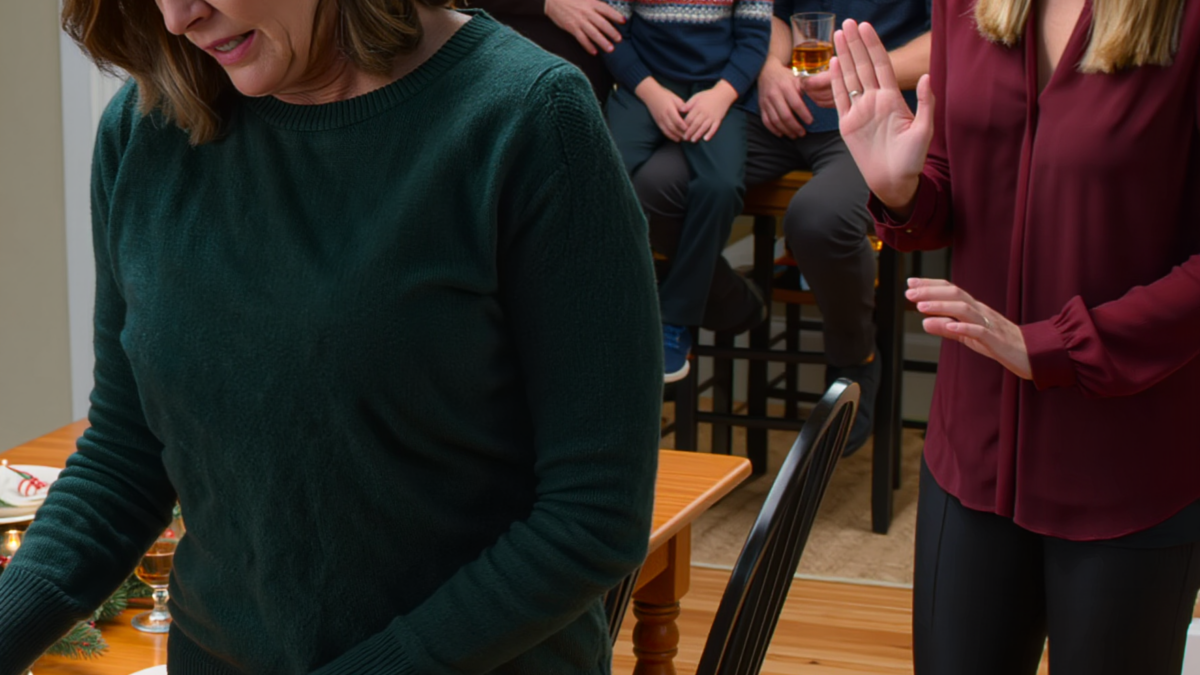
“Mom, my husband’s family eats first. You can wait.”
My daughter said it loudly enough for everyone at the Thanksgiving table to hear.
Nobody laughed.
Even my twelve-year-old grandson, Noah, lowered his eyes to his plate.
I stood behind an empty dining chair with one hand resting on its wooden back, trying to decide whether I had actually heard Emily correctly.
“Excuse me?”
She glanced toward her mother-in-law, Patricia, before looking back at me.
“There aren’t enough seats,” she said. “Just let them eat first. We’ll figure yours out afterward.”
That word bothered me.
Them.
As if I had suddenly become part of a different category of family.
Around the table sat Ryan’s parents, his sister, her husband, two cousins, several children, and people I had known for years. The dining room was crowded with plates, wine glasses, folded napkins and food I had spent most of the day helping prepare.
Then I looked at Emily.
“All right,” I said.
I walked into the kitchen, picked up the roasting pan containing the beef I had spent six hours preparing, grabbed my coat and left.
Twenty minutes later, Emily started calling me in a panic.
But to understand why I left with Thanksgiving dinner in my arms, you have to understand how I got to that chair in the first place.
My name is Linda Carter. I was fifty-four that Thanksgiving, and I had lived in Fort Collins, Colorado, for almost thirty years.
My husband, Michael, had died seven years earlier after a long illness. After he died, I sold his landscaping truck, paid off the small remaining balance on our mortgage and stayed in the three-bedroom ranch where we had raised Emily.
The house felt too quiet for the first year. For the second, it felt less quiet and more simply mine.
I wasn’t wealthy, but I was comfortable.
Three days a week, I did bookkeeping for a plumbing company off College Avenue. Tuesdays and Thursdays were usually mine, which meant doctor appointments, errands, coffee with my friend Janice and more trips to King Soopers than any reasonable adult needed to make.
Emily was thirty-three.
She and her husband, Ryan Dawson, lived about twenty minutes away in a newer subdivision southeast of town. Ryan sold commercial roofing supplies. Emily worked part-time for a dental office while raising Noah.
I loved my daughter.
And I adored my grandson.
That probably explains why helping had become such an ordinary part of my life that I rarely called it helping.
A hundred dollars for Noah’s baseball registration.
Groceries when one of Ryan’s commission checks came late.
A birthday cake.
A school trip.
A little money toward summer camp.
Nothing seemed unreasonable by itself.
When Emily called the Monday before Thanksgiving, she sounded overwhelmed.
“Mom, I’m drowning.”
I was standing in my kitchen with a mug of coffee in one hand and a stack of mail under the other.
“What happened?”
“Everything.”
Apparently sixteen people were coming.
She still had cleaning to do. Ryan was working late. Noah had basketball practice. The grocery bill was getting ridiculous.
“I can help,” I said.
Of course I did.
She asked if I could make Dad’s roast.
Michael had made that roast every Thanksgiving before he got sick. After he died, I took it over.
Chuck roast. Onions. Carrots. Rosemary. Garlic. A little red wine. Enough time in a low oven that the meat practically separated when you touched it with a fork.
“How many pounds?” I asked.
“Probably ten.”
“Ten?”
“Ryan’s whole family eats.”
“That isn’t a family. That’s a farm crew.”
Emily laughed.
That laugh mattered to me.
For a second, she sounded like the little girl who used to sit on my kitchen counter while Michael made pancakes on Sunday mornings.
So I agreed.
Then she asked whether I could pick up a few things.
“A few things” became two grocery bags of vegetables, dinner rolls, butter, sparkling water, wine, gravy ingredients and a pumpkin pie because Ryan’s father didn’t like pecan.
My receipt came to a little over four hundred dollars.
I didn’t mention it.
Thanksgiving morning, I started cooking before eight.
By two, my kitchen smelled exactly the way it had when Michael was alive.
That caught me off guard.
I stood over the roasting pan with a wooden spoon in my hand, remembering him stealing carrots before dinner and pretending he had no idea why the pan always seemed one carrot lighter.
“Get out of my kitchen,” I murmured.
Then I laughed at myself.
Grief is strange that way. Seven years later, it can still sit down beside you without warning.
I loaded everything into my Subaru and reached Emily’s house around 2:40.
The driveway was already full.
When I walked inside carrying the roasting pan, Emily kissed my cheek.
“Thank God.”
Not Happy Thanksgiving.
Not Hi, Mom.
Thank God.
She pointed toward the kitchen.
“Can you put that in the oven? Patricia needs more ice.”
I handled the ice.
Then someone needed coats carried upstairs.
Then the rolls needed warming.
Then Emily couldn’t find her serving spoons.
Ryan was standing near the living room with his father, drinking bourbon.
At one point, I passed him carrying six wine glasses.
“Linda,” he said, smiling, “you’re a lifesaver.”
At the time, I smiled back.
Later, I would think about that sentence differently.
Around five, Emily announced that dinner was ready.
Everyone moved toward the dining room while I stayed behind to bring out the roast.
Several people complimented it.
Ryan’s father, Richard, leaned forward to smell it.
“Now that’s Thanksgiving.”
I smiled.
Then I noticed there was no place for me.
At first, I thought someone had miscounted.
The room was crowded. It happened.
I found a folding chair in the hall closet and started carrying it toward the table.
Emily stopped me.
That was when she said it.
“Mom, my husband’s family eats first. You can wait.”
The room changed.
Patricia looked uncomfortable.
Richard stared down at his napkin.
Ryan said nothing.
Noah lowered his eyes.
I could have argued.
A part of me wanted to.
Instead, I thought about the six hours I had spent cooking.
The grocery receipt.
The ice.
The coats upstairs.
The serving spoons.
The fact that I had spent the entire afternoon making sure everyone else had what they needed.
Then I looked at that table.
I wasn’t angry enough to scream.
I was hurt enough to leave.
So I walked into the kitchen.
Emily followed me.
“What are you doing?”
I put the lid back on the roasting pan.
“You said I could wait.”
“Mom, don’t start.”
“I’m not.”
I lifted the pan.
Her eyes widened.
“You’re taking the roast?”
“I made it.”
“People are eating that.”
“Then they should have saved a seat for the cook.”
“Mom.”
I slipped on my coat.
Emily lowered her voice.
“You’re embarrassing me.”
I looked at her for a moment.
“No, Emily. I’m leaving.”
I carried the roast to my car.
My hands were shaking so badly that I nearly dropped my keys.
As I backed out of the driveway, I saw Noah standing at the front window.
That almost made me stop.
I didn’t.
Twenty minutes later, my phone rang.
Emily.
I let it go.
She called again.
And again.
By the seventh call, I was sitting in the King Soopers parking lot staring at a text.
Mom, please come back. We have a problem.
My first thought was Noah.
I called immediately.
Emily answered before the first ring seemed to finish.
“What happened?” I asked. “Is Noah okay?”
“What? Yes, Noah’s fine.”
I closed my eyes.
“Then what’s the emergency?”
“The roast, Mom.”
I actually looked at my phone.
“The roast?”
“You took the main dish.”
“You told me to wait until everyone else ate.”
“I meant wait for a seat. I didn’t mean take dinner home.”
“That distinction wasn’t very clear from where I was standing.”
She lowered her voice. I could hear people talking behind her.
“Can you please just come back for a second?”
I almost did.
That is the part I am least proud of.
I sat in a grocery-store parking lot with tears drying on my cheeks, and I was still wondering whether Richard had enough to eat.
Old habits are stubborn.
Then Emily said, “Everyone is asking what happened.”
There it was.
Not I’m sorry.
Not I shouldn’t have said that.
She was worried about explaining why I had left.
“I’m going home, Emily.”
“Mom—”
“I’ll talk to you later.”
I hung up.
Before I could start the car, another message came through.
This one was from Noah.
Grandma, I’m sorry. Mom shouldn’t have said that.
I read it three times.
Then I cried.
Not dramatically.
I sat behind the wheel and wiped my cheeks with an old fast-food napkin from the glove compartment.
That child had seen everything.
And somehow, at twelve years old, he had understood what the adults at the table had not.
I typed back:
You have nothing to apologize for. Eat some pie for me. Love you.
Then I drove home.
I ate Thanksgiving dinner alone at my kitchen counter.
A small slice of roast.
Carrots.
One dinner roll.
Around 6:30, my friend Janice called.
She had sent me a Thanksgiving message earlier, and apparently my reply—You wouldn’t believe my day—had gotten her attention.
Janice Moore and I had been friends for fourteen years. She was fifty-seven, twice divorced and incapable of pretending something was fine when it wasn’t.
I told her everything.
When I finished, there was a short pause.
“She made you wait?”
“Apparently.”
“After you cooked?”
“Yes.”
“And bought the food?”
“Some of it.”
“How much?”
“I don’t know. Four hundred and something.”
Another pause.
“Linda.”
“What?”
“How much of that Thanksgiving did you pay for?”
“About four hundred and thirty dollars.”
“No, I mean all of it. How much do you pay for Emily and Ryan?”
That irritated me.
“They’re not freeloaders.”
“I didn’t say they were.”
“They’ve had a rough year.”
“Okay.”
“Ryan works on commission.”
“Okay.”
“Noah had baseball and summer camp.”
“Linda.”
I stopped.
Her voice softened.
“I’m not criticizing your daughter. I’m asking you for a number.”
I didn’t have one.
The next morning, I decided to find out.
I made coffee, opened my laptop and pulled up twelve months of bank and credit-card statements.
At first, everything looked harmless.
One hundred forty-six dollars for Noah’s baseball equipment.
A few hundred for camp.
Eighty-nine dollars at Target before school started.
Then I found three hundred seventy-five dollars I had sent Emily in February.
Six hundred in April.
Another four hundred fifty in June.
Once I saw the transactions, I remembered each reason.
Car repair.
Mortgage shortage.
Ryan’s commission check delayed.
Then I reached the family vacation.
Emily had asked whether I could help with the rental because she wanted Noah to have “a real family vacation.”
I had sent twenty-eight hundred dollars.
At the time, it felt generous.
On a spreadsheet, it looked different.
By lunchtime, I was above eight thousand dollars.
That didn’t include cash.
Or groceries.
Or dinners where Emily discovered after the check arrived that she had left her wallet at home.
Still, the money itself wasn’t what bothered me most.
I opened Facebook.
There was Emily’s vacation album.
Amazing week with the Dawson family. So grateful we could make this happen.
Twenty-three photographs.
Ryan grilling.
Patricia drinking wine on the deck.
Richard standing beside Noah.
Nothing mentioning that I had paid most of the rental.
I felt petty for caring.
Then I found Noah’s birthday.
The cake I had ordered.
The decorations I had purchased.
Emily’s caption said:
We love making this boy’s birthday special.
Again, I had disappeared.
Maybe none of it should have mattered.
Before Thanksgiving, it probably wouldn’t have.
After that empty chair, it did.
Around two, my phone rang.
Patricia Dawson.
I almost didn’t answer.
“Hello?”
“Linda, it’s Patricia.”
“Hi.”
“I wanted to check on you after yesterday.”
That surprised me.
“I’m fine.”
“I also wanted to thank you for leaving the roast. Richard had seconds this morning.”
I sat straighter.
“What?”
“The roast.”
“I took the roast.”
Silence.
“No, you didn’t.”
“Patricia, I’m looking at it in my refrigerator.”
Another silence.
Then she said, “Emily told us you made it for her.”
“I did make it.”
“No, I mean she said she bought everything and you cooked because she was busy.”
I looked at the laptop.
The spreadsheet was still open.
“That isn’t what happened.”
Patricia sounded genuinely confused.
“Emily said she paid for Thanksgiving.”
“I spent more than four hundred dollars on groceries.”
“Oh.”
One small word.
But something changed inside it.
Then Patricia said, “Well, I suppose that explains Christmas.”
I froze.
“What about Christmas?”
She didn’t answer immediately.
“Linda?”
“Yes?”
“Emily said you wanted it to be a surprise.”
“A surprise for whom?”
“For everybody.”
I gripped the phone harder.
“Patricia, what are you talking about?”
Her voice changed.
The friendly tone disappeared, replaced by caution.
“Emily told us you rented a cabin in Estes Park for Christmas.”
I stood without realizing I had moved.
“What?”
“She said it was for the whole family.”
My kitchen suddenly felt very quiet.
“Patricia, I didn’t rent anything.”
Now it was her turn to go silent.
Finally she said, “Then I think you and I need to talk.”
Patricia arrived that afternoon carrying a folder.
That should tell you everything about how Patricia Dawson handled problems.
Some people brought wine.
Patricia brought documentation.
I poured coffee while she sat at my kitchen table.
Before we began, she looked at me.
“I owe you an apology.”
“For what?”
“For yesterday.”
I looked down at my coffee.
“You weren’t the one who said it.”
“No. But I sat there.”
That meant more to me than she probably knew.
Then she opened the folder.
Inside was a printed reservation for a five-bedroom cabin outside Estes Park.
Christmas Eve through December 27.
Mountain views.
Hot tub.
Game room.
The total was a little over seven thousand dollars.
My eyes stopped on one line.
Deposit: $3,600.
“Who paid that?”
Patricia frowned.
“We thought you did.”
“I definitely did not.”
She pulled out her phone.
“Emily sent this three weeks ago.”
She showed me the family group chat.
Mom wants to do something special this year. She’s covering the cabin, so everybody just needs to bring food and gifts.
I read it again.
Mom meant me.
Below it, Patricia had replied:
Linda, that’s incredibly generous. Are you sure?
Emily had answered for me.
She insisted. She loves doing things for the family.
I actually laughed.
Patricia looked worried.
“Are you okay?”
“No, but apparently I’m incredibly generous.”
She smiled despite herself.
Then she showed me another message.
The remaining balance is due December 8. Mom said she’ll take care of it.
December 8 was eleven days away.
“Did Emily make the reservation?”
“Yes.”
“With whose card?”
“I don’t know.”
That question was answered two days later.
Emily came to my house Sunday afternoon.
No Noah.
No Ryan.
Just Emily.
She walked into my kitchen and immediately noticed Patricia’s folder.
Her expression changed.
“You talked to Patricia.”
“She talked to me.”
“Mom, this is getting ridiculous.”
“Good afternoon to you too.”
Emily dropped her purse onto a chair.
“You made Thanksgiving into this huge thing.”
“I left.”
“You took the food.”
“My food.”
“See? That’s exactly what I mean.”
I folded my arms.
“What do you need from me, Emily?”
She hesitated.
Then she sat down.
“The cabin balance is due next week.”
There it was.
No apology.
No explanation.
Money.
“How much?”
“Thirty-six hundred.”
“And you expect me to pay it?”
“You’ve helped with Christmas before.”
“Not with a seven-thousand-dollar cabin.”
“We already paid the deposit.”
“Who is ‘we’?”
She looked away.
“Ryan and me.”
“With your own money?”
“Yes.”
I knew my daughter well enough to recognize that answer.
“Emily.”
She sighed.
“Credit card.”
I sat across from her.
“Does Ryan know?”
“Of course.”
The answer came too quickly.
I didn’t challenge it yet.
Instead, I asked the question that mattered more.
“Why did you tell everybody I offered to pay?”
“Because I thought you would.”
That sentence hurt more than I expected.
Not because she needed help.
Because somewhere along the way, asking me had become optional.
“You thought I’d simply hand you thirty-six hundred dollars?”
“You paid twenty-eight hundred for the vacation.”
“After you asked.”
“This is basically the same thing.”
“No. It isn’t.”
She leaned back.
“Mom, Ryan’s parents already invited everybody.”
“You invited everybody.”
“Do you want me to cancel Christmas?”
There was the trap.
If I said no, I paid.
If I said yes, I became the woman who ruined Christmas.
I recognized it because I had stepped into versions of that trap for years without naming it.
“I’m not paying for the cabin.”
Emily stared at me.
“Seriously?”
“Yes.”
Her eyes filled.
I hated that.
No matter how angry you are, seeing your child cry does something to you.
She wiped beneath one eye.
“We’ve had a terrible year financially.”
“I know.”
“Ryan’s commissions have been awful.”
“I know.”
“Noah deserves a good Christmas.”
“Don’t use Noah.”
Her expression hardened.
“I wasn’t.”
“Yes, you were.”
She stood.
“Dad would have helped me.”
That landed exactly where she intended.
Michael would have emptied his wallet for Emily.
He once drove through a snowstorm to bring her a laptop charger at Colorado State because she had a paper due the next morning.
But Michael wasn’t there to tell either of us what he would have done now.
I looked toward the framed photograph of him on the bookshelf.
For one dangerous second, I almost reached for my checkbook.
Then I remembered Noah staring at his plate on Thanksgiving.
“No.”
Emily grabbed her purse.
“You’ve changed.”
“Maybe.”
She left without saying goodbye.
I cried after she drove away.
That part isn’t satisfying to admit.
Stories about boundaries sound cleaner when you skip the nights where you wonder whether you’re the cruel one.
I nearly called her twice that week.
I didn’t.
Then Friday evening, Ryan called me.
“Linda, can I ask you something?”
“Sure.”
“What’s going on with this cabin?”
I sat down.
“You tell me.”
“Emily said you offered to pay for it.”
“No.”
Silence.
“She told me the balance was already handled.”
“It isn’t.”
Another silence.
Then Ryan said something that confirmed what I had begun to understand.
“I gave her the deposit because she said you had already agreed to reimburse us.”
Emily had told Patricia I volunteered.
She had told Ryan I agreed.
And she had told me his family expected me to help.
Three different stories.
One bill.
I wasn’t going to expose my daughter just to humiliate her.
But I wasn’t going to protect the lie either.
Three weeks later, Patricia invited me to her annual Christmas dinner.
I almost declined.
Then she added quietly, “I think you should come, Linda.”
“Why?”
“Emily has been telling people the cabin is still happening.”
I looked at the calendar.
Apparently my daughter had not cancelled anything.
Sooner or later, somebody would have to tell the truth.
Patricia’s dinner was December 21.
By 5:30 that evening, I had driven past her street twice.
The first time I told myself I missed the turn.
The second time I admitted I was avoiding it.
I parked three houses down and sat in my Subaru with the engine running.
I didn’t want to embarrass Emily.
That may sound ridiculous after Thanksgiving, but she was still my daughter.
I remembered teaching her to drive in an empty high-school parking lot.
I remembered sitting beside her after Noah was born.
I remembered Michael crying harder than anybody at her wedding.
You do not stop loving your child simply because they hurt you.
Sometimes that makes boundaries harder, not easier.
I reached for the gearshift.
I was going home.
Then someone knocked on the passenger window.
I jumped.
Noah stood outside in a Broncos hoodie.
I lowered the window.
“Grandma, what are you doing?”
“Thinking.”
“That’s dangerous.”
I laughed.
Michael used to say exactly that.
Noah opened the passenger door.
“Are you coming in?”
“I don’t know.”
He looked toward Patricia’s house and then back at me.
“Please.”
That settled it.
“All right.”
Inside, Patricia had enough food to feed half of Fort Collins.
Ham.
Scalloped potatoes.
Green beans.
Rolls.
Two pies.
And something Richard called his famous cranberry sauce, even though I watched him dump it from a can.
At least he admitted it.
Emily was already there.
When she saw me, her smile disappeared for half a second.
Then it returned.
“Hi, Mom.”
“Hi.”
Ryan hugged me.
That surprised Emily more than it surprised me.
Nobody mentioned Thanksgiving for the first hour.
Everything stayed polite.
I helped Patricia carry plates.
Richard complained about the Broncos.
Noah showed me a video from basketball practice.
For a while, I started wondering whether Patricia had been wrong.
Maybe Emily had cancelled the cabin.
Then dessert came.
Patricia cut the pecan pie and said almost casually, “So when should everybody send Linda their share for groceries at the cabin?”
Emily’s fork stopped halfway to her mouth.
Nobody else noticed immediately.
Ryan did.
He looked at his wife.
“Emily?”
She set down the fork.
“We’re still figuring out the details.”
Patricia looked at me.
I knew what she had done.
Not cruelly.
She had simply opened the door.
I could walk through it or keep paying for silence.
“There isn’t going to be a cabin,” I said.
Conversation stopped.
Richard frowned.
“What happened?”
“Nothing happened. I never agreed to pay for it.”
Emily’s cheeks colored.
“Mom.”
Ryan leaned forward.
“What do you mean?”
I looked at him.
“I mean exactly that.”
Emily shook her head.
“This is not the time.”
“Then when is?”
“We can talk privately.”
“We tried that.”
Ryan’s sister glanced between us.
“I thought Linda offered.”
“So did I,” Patricia said.
Ryan looked at Emily.
“You told me she had already agreed.”
Emily’s eyes moved around the table.
“I said she was going to help.”
“No,” I said. “You told different people different things.”
I reached into my purse.
I had printed the messages.
I had not planned to use them unless Emily denied everything.
I put the first page on the table.
Patricia read it aloud.
“Mom wants to do something special this year. She’s covering the cabin.”
Emily stared at me.
“You printed my texts?”
“They were sent to Patricia.”
Richard leaned over.
“There’s another one.”
Patricia read that too.
“Mom said she’ll take care of the remaining balance.”
Ryan rubbed his forehead.
Then I showed him the message Emily had sent me saying his family expected me to help.
He looked at his wife.
“You told me Linda had already paid.”
“I was going to work it out.”
“With whose money?”
Emily didn’t answer.
Richard cleared his throat.
“I’ve been married forty-one years, and even I know you don’t volunteer your mother-in-law’s money.”
Patricia slowly turned toward him.
“You volunteered me to make chili for your bowling league last February.”
Richard blinked.
“That was different.”
“No, it wasn’t.”
He considered that.
“Fair enough.”
A few people laughed.
Even I did.
The laughter helped.
This was not a courtroom.
It was a family dinner where one uncomfortable truth had finally reached everyone at the same time.
Emily looked at me.
“Are you happy now?”
“No.”
That quieted the table again.
“I didn’t come here to make you look bad.”
“Could’ve fooled me.”
“I came because I’m tired of being volunteered.”
“For one cabin?”
“No.”
I took out the spreadsheet I had made after Thanksgiving.
“I added it up.”
Emily’s expression changed.
“Mom, don’t.”
“Over the last twelve months, I’ve given you or spent a little more than eight thousand dollars helping you.”
Ryan stared at me.
“What?”
I listed only the larger items.
The family vacation.
Baseball.
Car repairs.
Groceries.
School expenses.
Ryan looked genuinely stunned.
“I didn’t know about half of that.”
“I know.”
That mattered.
I was not trying to turn him against my daughter.
I simply wanted the truth standing in the room without anyone dressing it up.
Emily’s voice cracked.
“I never forced you.”
“No. You didn’t.”
I folded the spreadsheet.
“I kept saying yes. That’s my part in this.”
She watched me.
“But somewhere along the way, you stopped asking.”
Nobody spoke.
Finally, Emily said what she had been avoiding.
“I just wanted them to think we were doing well.”
She glanced at Patricia and Richard.
“Ryan’s sister has the big house. Everybody takes expensive vacations. We were always the ones struggling.”
Patricia’s expression softened.
“Emily, nobody asked you to compete with us.”
“I know.”
“No,” Emily whispered. “I don’t think I did.”
I didn’t feel victorious.
I felt tired.
So I gave her the only rule I wanted going forward.
“If I offer something, you are welcome to accept it. If I don’t offer, don’t offer it for me.”
Emily wiped her eyes.
Then Noah spoke from the other end of the table.
He had been quiet the entire time.
“Grandma?”
“Yes, honey?”
He looked at his mother before looking at me.
“You should have had a seat at Thanksgiving.”
Emily closed her eyes.
Somehow, that one sentence did what my spreadsheet never could.
Emily did not speak to me for thirteen days.
I know because I counted.
Not proudly.
Every morning, I made coffee, looked at my phone and told myself I was not going to check whether she had texted.
Then I checked.
Nothing.
No pictures of Noah.
No questions about Sunday dinner.
Not even one of those meaningless thumbs-up reactions people send when they do not know what else to say.
Ryan called once.
“She’s embarrassed,” he told me.
“I know.”
“She knows she messed up.”
“Then she can tell me.”
He was quiet.
“I think she will.”
I appreciated that he did not ask me to apologize first.
Christmas itself ended up being surprisingly ordinary.
The Estes Park cabin was cancelled.
Emily and Ryan lost part of the deposit.
I felt bad about that until I reminded myself that I had not made the reservation.
Patricia hosted Christmas Day.
I stayed home that morning, called my sister in Arizona, watched an old movie and made myself eggs.
Around noon, Noah came over with Ryan.
He handed me a small wrapped box.
Inside was a coffee mug.
It read:
Grandma’s House, Grandma’s Rules.
I laughed so hard Ryan started laughing too.
“Did you pick this?” I asked.
“Noah did.”
Noah shrugged.
“It seemed appropriate.”
He was twelve going on sixty.
They stayed for an hour.
Emily did not come.
That hurt.
There is no clever sentence that makes that part easier.
I had drawn a boundary, and I believed it was necessary.
But I still missed my daughter.
More than once, I wondered whether thirty-six hundred dollars would have been cheaper than thirteen days of silence.
Then I reminded myself that the cabin had never really been the issue.
If I paid because I was afraid my daughter would stop speaking to me, it was not generosity anymore.
It was a fee.
On the fourteenth day, Emily knocked on my door.
It was Saturday morning.
I was still wearing sweatpants.
She stood on the porch holding two coffees.
“Peace offering.”
I stepped aside.
“Depends where they’re from.”
She named one of our favorite local coffee shops.
“Come in.”
She almost smiled.
We sat at the kitchen table for several minutes.
Neither of us said much.
Finally, Emily wrapped both hands around her cup.
“I owe you an apology.”
I waited.
Not because I wanted to punish her.
Because I had spent years helping people finish uncomfortable sentences.
This one belonged to her.
“What I said at Thanksgiving was awful.”
“Yes.”
She nodded.
“And the cabin was worse.”
“Yes.”
“I really thought you’d pay.”
“I know.”
She looked embarrassed.
“I hear how bad that sounds now.”
Then she told me something I had not fully understood.
When she married Ryan, she became intimidated by his family.
His sister and brother-in-law had a large house near Denver.
Patricia and Richard traveled several times a year.
Cousins talked about ski trips and new cars.
Emily and Ryan were doing fine.
But not spectacularly.
Somewhere along the way, Emily decided fine was not enough.
When I helped, she let people assume the money came from her.
Then she began depending on that assumption.
“I was embarrassed by what people might think of me,” she said. “So I made you pay for the version of me I wanted them to see.”
That was probably the most honest thing she had said to me in years.
I reached across the table and touched her hand.
“I would have helped you.”
“I know.”
“That’s what makes me angry.”
She nodded.
“I know that too.”
I did not demand the eight thousand dollars back.
Most of it had been given willingly.
Pretending otherwise would have been dishonest.
But things changed.
Ryan and Emily sat down with their finances.
They cut a few expenses.
Ryan began handling more of the bills instead of assuming Emily had everything covered.
Emily stopped calling me every time something cost more than expected.
I still helped Noah.
When baseball registration came around, I paid half because I wanted to.
The difference was that Emily asked.
Actually asked.
By spring, things between us felt almost normal again.
Almost.
Then came Easter.
Emily invited everyone to her house.
I nearly laughed when she asked me over the phone, “Are you sure you want me there, Mom? I’m checking.”
“Yes,” she said. “I want you there.”
I arrived around one carrying a lemon pie.
No giant roast.
No grocery bags.
Just one pie.
Emily opened the door.
“That’s all you brought?”
I stared at her.
Then her face broke into a grin.
“I’m kidding.”
“You’re getting brave.”
“I learned from you.”
Inside, the dining room was already set.
Then I noticed something on the table.
Place cards.
Richard.
Patricia.
Ryan.
Noah.
Then mine.
Mom.
I picked it up.
Emily stepped beside me.
“Your seat.”
I looked at her.
“Nobody gets it before you.”
For a second, neither of us spoke.
Then I smiled.
“Don’t overcorrect.”
From behind us, Patricia said, “Good, because I’m not waiting in the kitchen.”
Everybody laughed.
Even Emily.
I sat down.
And for once, I did not feel like the person responsible for making everybody else’s day work.
I was simply part of the family.
Looking back, taking that roast home was not revenge.
Neither was showing everyone the messages.
The real change came when I stopped confusing love with automatic rescue.
Generosity has to remain something we choose.
The moment somebody begins treating your time, your money or your dignity as something they have already been promised, a simple no can be more honest than another reluctant yes.
And whenever I think back to that Thanksgiving, I barely remember what the cabin cost.
I remember an empty chair.
I remember my grandson looking down at his plate.
And I remember how much it mattered, months later, to find a place card waiting for me at the table.