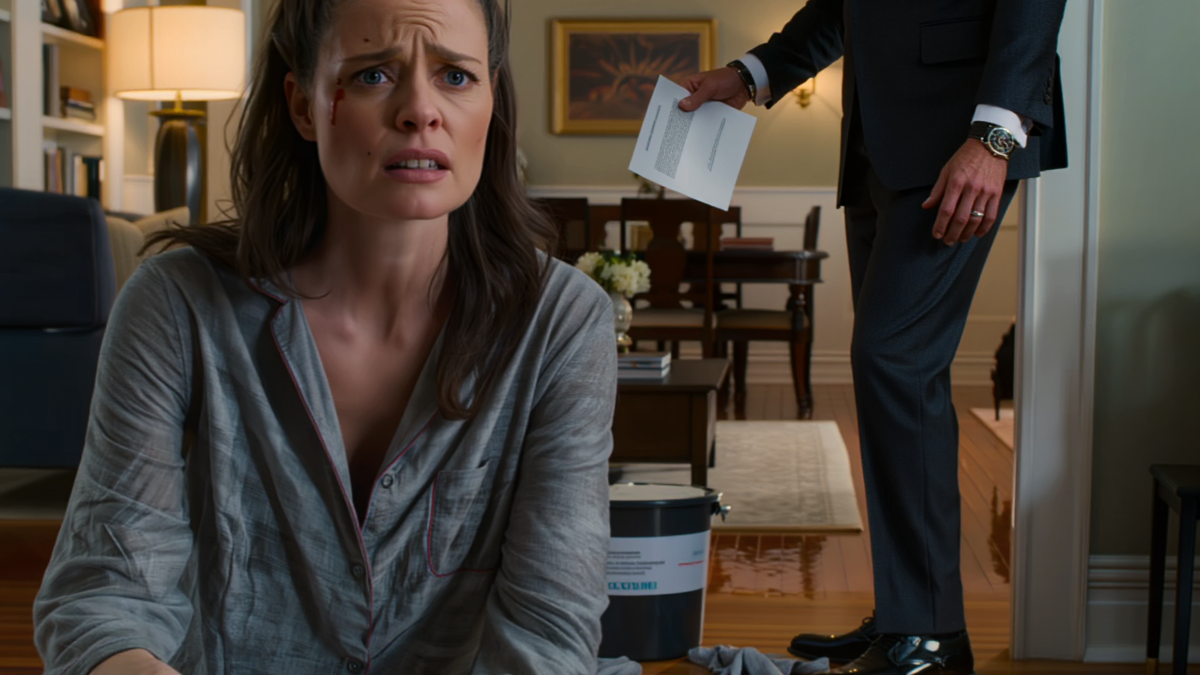
Logan slapped the divorce papers onto the coffee table and told me to sign so he could give Bianca our $150 million Hamptons estate. Dirty mop water spread across the hardwood between us. I picked up his pen and asked only one thing: “Are you sure you want to give her that estate?”
The helicopter cabin vibrated beneath my feet as Manhattan disappeared somewhere beyond the dark horizon and the Hamptons spread below us.
From the open side door, I could see Rosewood Estate glowing against the night.
For three years, Logan Miller had believed I was a woman who needed him.
Three hours earlier, he had been certain enough of that belief to throw divorce papers at me while I was cleaning the living-room floor.
The room had smelled faintly of lemon cleaner. I was on my knees wiping away the last streak of water from the hardwood when the papers struck the coffee table.
One page slid off and brushed my cheek.
I looked up.
Logan stood above me in a perfectly tailored charcoal suit. His dark hair was neat, his shoes polished, his expression carrying the impatience he had learned to use whenever he wanted me to feel small.
“Sign it.”
I gathered the papers.
“To make room for Bianca,” he added.
The words DIVORCE SETTLEMENT appeared across the first page.
I kept reading.
“The Rosewood estate in the Hamptons is my premarital gift to her,” Logan said. “I’m giving it to Bianca.”
I reached the property section.
According to the agreement Logan wanted me to sign, I would leave with almost nothing.
He watched me carefully.
When I didn’t protest, satisfaction crossed his face.
He had always mistaken quietness for weakness.
He nudged the cleaning bucket with his shoe.
Water spilled across the floor I had just dried.
“Serena, look at yourself.”
I rose slowly. My knees ached after kneeling so long.
Logan looked me over: old loungewear, inexpensive slippers, hair tied with a plain elastic.
“I’m embarrassed taking you anywhere,” he said. “What exactly do you contribute anymore?”
I let him continue.
He told me Bianca was younger.
More ambitious.
Better connected.
Her father had business relationships in Europe that Logan claimed would transform Miller Enterprises.
“She can actually help me build something.”
That sentence almost made me laugh.
Instead, I thought about a rainy afternoon three years earlier when I had stood in my father’s office defending Logan.
My father, Silas Vance, had disliked him from the beginning.
“He wants what surrounds you,” Dad had warned. “Make sure he loves you when nothing surrounding you is visible.”
I had called that cynical.
I had walked away from the family operation, from the offices bearing our name, from the board seat prepared for me, and from a fortune Logan never fully understood.
I wanted to know whether he loved Serena rather than the Vance family.
For a while, I convinced myself he did.
When Logan’s startup couldn’t obtain financing, I quietly guaranteed the loan.
When expansion required capital, I used structures that never displayed my name where he would easily notice it.
When suppliers hesitated, doors somehow opened.
When a crisis threatened payroll, money appeared.
Logan interpreted every rescue as evidence of his own brilliance.
I let him.
Eventually, helping him became easier than explaining why he still needed help.
Now he stood in front of me praising another woman for helping his career.
“Why aren’t you saying anything?” he demanded.
He tossed a metal pen toward me.
“Hurry up. I’m going to Rosewood tonight.”
I picked it up.
Then I asked the only question that mattered.
“Are you sure you want to give Bianca that estate?”
Logan laughed.
“Jealous?”
“No.”
“A woman like you couldn’t afford the property taxes on Rosewood in ten lifetimes.”
I looked at him for another second.
Then I signed.
The scratching of the pen across the paper seemed impossibly loud.
Logan checked my signature.
“Glad you finally understand where you stand.”
He placed the settlement inside his briefcase and left.
The front door closed.
The house became silent.
I stood beside the wet floor until the numbness in my legs faded.
Then I went upstairs and pulled an old suitcase from the closet.
I had arrived in our marriage with that suitcase.
Three years later, most of what mattered to me would still fit inside it.
I packed slowly.
Clothes.
A few books.
A cheap anniversary necklace Logan had bought at an airport after forgetting the date.
Then I opened the bottom nightstand drawer.
My jewelry box was missing.
I stared into the empty drawer.
The box itself wasn’t valuable.
What was inside was.
My mother’s platinum locket.
She had worn it for years. After she died, I could still remember the way she sometimes touched it while thinking.
It was the one piece of her I kept close.
I searched the room.
Then downstairs.
Then the study.
Nothing.
My phone was already in my hand when an Instagram notification appeared.
Bianca Sterling had posted a photograph.
She stood beside Rosewood’s fountain garden in the last orange light of sunset.
Around her neck was my mother’s locket.
For several seconds I couldn’t move.
The photograph bothered me more than the divorce agreement had.
Not because Bianca was wearing jewelry that belonged to me.
Because Logan had taken something he knew was irreplaceable.
He had not borrowed it.
He had not mistaken it for something else.
He had decided my memories were his to distribute.
I called him.
He answered after several rings.
“Where is my mother’s locket?”
“What?”
“You know exactly what I’m asking.”
“Oh. That.”
His voice became dismissive.
“Bianca liked it.”
“That belonged to my mother.”
“It’s an old necklace, Serena.”
I heard Bianca nearby.
Then her voice came through the call.
“Logan, stop wasting the evening.”
My fingers tightened around the phone.
“Give it back.”
Logan laughed softly.
“You’re making a scene over a piece of old metal.”
“No.”
My voice had become strangely calm.
“I’m telling you once.”
He told me to finish packing.
Then he ended the call.
I remained in the living room for a long moment.
The cleaning bucket still sat crooked beside the coffee table.
The signed settlement was gone.
The wet streak on the floor had begun to dry.
I walked upstairs.
At the bottom of my suitcase was a hidden inner compartment.
Inside it was a phone I had not powered on since marrying Logan.
I turned it on.
One number still mattered.
A man answered almost immediately.
“Serena?”
“Carter.”
The surprise disappeared from his voice.
“Yes.”
“I need Vanguard active again.”
A pause.
Then:
“Understood.”
Carter had managed security and special operations for my family for years, but the first thing I asked for was not confrontation.
I wanted records.
Ownership.
Financing.
Corporate exposure.
Everything involving Rosewood and Miller Enterprises that had passed through Vance-controlled entities.
The reports came quickly.
Rosewood sat inside a holding structure connected to one of our investment groups.
Logan had treated possession as ownership.
He had never looked closely enough to understand the difference.
By the time he reached the estate, a transfer already in progress was moving toward completion.
Bianca began broadcasting from Rosewood that night.
She showed viewers the fountain garden.
The terraces.
The main house.
The locket.
Logan stood beside her looking pleased with himself.
He announced that they planned to become engaged.
When someone asked about his former wife, he dismissed me as a woman who had never contributed anything meaningful to his success.
I watched only a few seconds of the recording.
Then I put the phone down.
Rosewood would soon be removed from his control through the property owner’s redevelopment process.
What followed became far more public than I wanted.
By dawn, images of the estate’s dramatic dismantling were circulating everywhere.
No one had been inside the restricted sections when work began, but the spectacle was enough to turn the property into a headline.
Logan called his assistant demanding explanations.
The answer was simple.
The company controlling the land was no longer his.
Rosewood had never been the personal kingdom he imagined.
It was an asset.
And the asset had changed hands.
The following morning, Logan arrived at Miller Enterprises exhausted and furious.
His executives had bigger problems.
The publicity had drawn attention to financing arrangements already under strain.
The CFO entered carrying a loan file.
“First Manhattan wants to discuss the commercial facility.”
“What about it?”
“The guarantor withdrew support.”
Logan frowned.
“What guarantor?”
The CFO stared at him.
“The original guarantor behind the company’s $50 million facility.”
Logan had barely read those documents when Miller Enterprises was young.
I remembered the evening clearly.
He had been terrified the company would fail before it truly began.
I had placed a stack of papers in front of him.
“I found a solution,” I told him.
He signed almost everything without reading beyond the payment terms.
Now, years later, his CFO opened those same documents.
“The guarantor was Serena Vance.”
Logan sat down.
For the first time, the story he had told himself about being completely self-made developed a visible crack.
Then his team found another.
Thirty-five percent of Miller Enterprises voting shares sat behind investment vehicles tied to an offshore holder.
Logan had complained about that mysterious investor for years.
He had called the investor passive.
Cowardly.
Lucky.
He had never discovered the name.
That morning, I walked into his office.
I no longer wore faded loungewear.
My black suit was tailored to fit perfectly. My hair was pulled back. Carter and a small professional security team remained outside the main conference area.
Logan stared at me.
“Why are you here?”
I walked to the window.
“Nice view.”
“Serena.”
I turned.
“You pulled support from the loan.”
“Yes.”
“You touched Rosewood.”
“An entity I control purchased the holding interest. Rosewood was never yours in the way you believed.”
His hands curled against the desk.
“You think this destroys me?”
“No.”
I placed a binder on his desk.
“I’m not interested in destroying you. I’m separating my assets from you.”
He opened it.
Inside was the beneficial ownership documentation connected to the voting block.
He read the first page.
Then the second.
Then stopped.
“That investor…”
“Was me.”
He looked up.
I could almost see three years of memory reorganizing itself.
The emergency financing.
The quiet introductions.
The contracts that arrived after doors had seemed permanently closed.
The banks willing to negotiate.
The investors who somehow returned his calls.
“You?”
“Yes.”
“You let me believe—”
“I let you run your company.”
“You hid this.”
“You never asked who was keeping it alive.”
I walked toward the door.
Before leaving, I turned back.
“The bank president is meeting with me today. Whatever happens next will follow the contracts you signed.”
For once, Logan had nothing to say.
I moved into a suite in Manhattan while the divorce proceeded.
Two days later, Logan’s mother Martha and his sister Maya arrived without an invitation.
They entered already angry.
Martha had spent years criticizing everything I did—from what groceries I bought to what coffee I drank—while assuming Logan paid for every dollar of my life.
Now she looked around the suite.
“You’re using Logan’s money for this?”
“No.”
Maya crossed her arms.
“You expect us to believe that?”
“I don’t particularly care what you believe.”
That answer angered Martha more than an argument would have.
She stepped toward me and raised her hand.
Carter moved between us before the confrontation went further.
He caught her arm and stopped her.
“Do not touch Ms. Vance.”
The room changed instantly.
For years, Logan had watched his family intimidate me and called it “keeping the peace.”
This time there was a boundary.
Martha shouted.
Maya threatened to call hotel security.
“Please do,” I said.
Hotel management arrived soon afterward and escorted them out.
Once the door closed, I looked at Carter.
“No retaliation.”
He nodded.
“Document everything.”
That evening, another report arrived.
Bianca was shopping on Madison Avenue using one of Logan’s supplementary cards.
Miller Enterprises’ financial problems had already started spreading through banking channels.
At the boutique, Bianca selected a rare handbag and several pieces of jewelry.
Her card was declined.
Then frozen.
By coincidence—or perhaps inevitability—I arrived while the staff were explaining the problem.
Bianca saw me.
Her embarrassment changed quickly into anger.
“Serena.”
I noticed the locket around her neck.
Nothing else in the room mattered.
“Take it off.”
Her hand went instinctively to it.
“Logan gave it to me.”
“It wasn’t his.”
She hesitated.
Carter stepped forward but remained several feet away.
“Please return Ms. Vance’s property.”
Bianca looked around the boutique.
The employees had stopped pretending not to listen.
Slowly, she unclasped the chain.
Carter accepted it and handed it to me.
I closed my fingers around the locket.
For the first time since the divorce papers landed on that coffee table, my breathing felt normal.
I bought nothing to humiliate Bianca.
I didn’t need to.
As I turned to leave, I told her one thing.
“The European contract your father celebrates so much came through a Vanguard-controlled vendor.”
She stared at me.
“It’s being reviewed.”
That was enough.
By the end of the week, Bianca had distanced herself from Logan.
The romance that had supposedly been based on ambition proved less durable when money stopped moving easily.
Miller Enterprises began losing partners.
Logan became desperate.
Desperation changed him.
Instead of accepting that the company had been overleveraged and dependent on support he never understood, he decided the problem was me.
He contacted people from his earlier real-estate days and arranged a meeting with men who promised they could pressure me into restoring his access.
Vanguard’s security desk learned of the arrangement before it happened.
Carter wanted to stop it immediately.
I refused.
“If we intervene before they act, Logan will call it a misunderstanding.”
“And if you let it continue?”
“We document exactly what he intended.”
I would not have agreed if innocent people were likely to be placed in danger.
We controlled the perimeter.
The men did not know that.
On the fifteenth of the month, I drove toward the cemetery where my mother was buried.
It was a routine Logan remembered.
A vehicle blocked the road.
Two vans appeared behind me.
Several men surrounded my SUV.
Their leader, Tommy Russo, demanded that I come with them.
Then Logan stepped into view.
He looked nothing like the executive who had thrown divorce papers at me.
His suit was gone.
His face was unshaven.
His confidence had become something frantic.
“Serena.”
I stared at him.
“What are you doing?”
“Taking back what belongs to me.”
“You mean what belonged to me.”
His expression tightened.
They took me to an unused industrial building a short distance away.
Vanguard’s teams remained outside, recording and waiting.
Logan placed a document on a table.
It transferred my voting rights and several investment interests to him.
“Sign it.”
The symmetry was almost absurd.
Days earlier, he had stood in our living room with divorce papers.
Now another document sat between us.
I read the first page.
Then I laughed once.
“What?”
“You still think signatures can make something yours simply because you want it.”
Tommy shifted near the doorway.
I looked directly at him.
“Mr. Russo.”
His expression changed.
Recognition arrived slowly.
He had encountered Vance security operations years earlier through people far above the level at which he normally worked.
He looked at Logan.
Then at me.
Then took several steps away.
“I wasn’t told who she was.”
Logan stared at him.
“What are you doing?”
Tommy’s loyalty disappeared as quickly as it had been purchased.
“I’m done.”
That was the moment Carter’s team entered and ended the confrontation.
There was a brief struggle. Logan was injured during the chaos and later received medical treatment under supervision.
I did not remain to watch.
Outside, I called Carter.
“Make sure all recordings go to counsel.”
“Yes.”
“And every relevant authority.”
“Already prepared.”
Three days later, I attended a major business forum in Manhattan.
For the first time publicly, Vanguard Omnicorp introduced me as its chief executive.
I had never planned to return under those circumstances.
But hiding no longer served any useful purpose.
Executives who had once known me only as Silas Vance’s daughter now saw the company I intended to build.
Vanguard had grown through private intelligence, security, investments and specialized contracting. Some of its older practices belonged to an era I did not intend to preserve.
My goal was simple.
Bring everything legitimate into daylight.
Clean up what could be cleaned.
Shut down what could not.
Logan appeared at the forum entrance.
His invitation had been revoked because of the investigation surrounding Miller Enterprises.
He argued with security.
Then he saw me.
“This is your fault!”
People turned.
I walked toward him.
“No, Logan.”
His chest rose sharply.
“You ruined my company.”
“I withdrew what was mine. What remained was yours.”
Security removed him.
I returned to the forum.
Later that week, Martha and Maya asked to meet me.
They had accumulated significant debts of their own.
Their house was in foreclosure.
For the first time since I had known them, neither arrived with an accusation.
“Please help us,” Martha said.
Maya stared at the table.
“We treated you badly.”
That was an understatement.
I had recordings from the house—ordinary security recordings from years of doors opening, arguments spilling into common areas and relatives arriving unannounced.
One clip came from my birthday.
Martha’s voice filled the room.
She had called me useless.
Maya had demanded I leave Logan before I damaged his future.
Neither woman looked up while it played.
When it ended, I closed the tablet.
“I’m not paying you to humiliate your son.”
They both looked surprised.
“I’m also not rescuing everyone from consequences they created.”
Martha swallowed.
“So that’s it?”
“I’ll connect you with a legitimate debt counselor and temporary housing resources. What happens after that is your responsibility.”
It was the first boundary I set with them that did not involve anger.
It felt better than revenge would have.
Logan, meanwhile, found another source of money.
A private investment group called Global Solutions offered him hundreds of millions in financing.
The terms were extraordinarily aggressive.
Future earnings.
Personal guarantees.
Control provisions.
Everything.
Carter showed me the agreement.
“He signed it.”
I read the signature page.
“That was fast.”
“He thinks it’s his comeback.”
I already knew the truth.
Global Solutions was connected through layered investments to my father.
Dad had not created the opportunity specifically for Logan, but once Logan approached them, the company saw exactly how desperate he was.
I called my father.
“You know about this?”
“I do.”
“Did you push them to approve it?”
“No. Your ex-husband begged for financing. They gave him terms no rational person should accept.”
“And he accepted.”
“He did.”
I closed my eyes.
Part of me still remembered the young man who once promised we would build a life together.
That man was becoming harder to locate inside the person Logan had chosen to be.
Using the new capital, Logan launched a fund and publicly challenged several Vanguard-linked companies.
For a few days, financial media treated it as an extraordinary comeback attempt.
He shorted securities.
Made aggressive public claims.
Sent me an invitation to a victory gala.
Carter placed the invitation on my desk.
“You going?”
“Yes.”
“Why?”
“Because Dad is.”
The gala filled an ornate Manhattan ballroom.
Logan stood beneath chandeliers wearing a tuxedo and receiving congratulations from people who believed he had found a powerful new financial sponsor.
When I entered, his smile widened.
“Serena.”
“Logan.”
“Did you come to negotiate?”
“No.”
The doors opened behind me.
My father walked in.
Silas Vance had aged since the last time Logan saw him, but not softened.
Logan recognized him.
Then his eyes moved from Dad to me.
Something connected.
Dad stopped in front of him.
“So you’re still borrowing money.”
Logan forced a smile.
“Mr. Vance.”
“You signed the Global Solutions agreement?”
“Yes.”
Dad nodded.
“Then you should read the ownership disclosure.”
Logan’s expression changed.
Global Solutions’ primary shareholder was one of my father’s investment companies.
The financing Logan believed would free him from the Vance family had placed him under stricter contractual control by that same network.
Dad did not threaten him.
He didn’t need to.
“The agreement you signed is enforceable through ordinary civil and financial channels,” he said. “What happens from here depends on whether you comply with it.”
Logan looked at me.
“You planned this.”
“No.”
That was the truth.
“You did this to yourself.”
Investigations into Miller Enterprises accelerated over the following months.
Transactions Logan authorized while trying to rebuild the company drew regulatory attention.
Several representations made to investors were challenged.
Financial records were subpoenaed.
The case eventually reached federal court.
Logan’s defense attempted to portray me as a vindictive former wife who had orchestrated his collapse.
On the witness stand, I answered the questions directly.
“Yes, I guaranteed financing.”
“Yes, I held an indirect investment position.”
“Yes, I withdrew my support after our marriage ended.”
“No, I did not instruct him to misrepresent investments.”
His attorney asked whether I had intentionally made his life difficult.
“I separated my property and financial backing from my former husband,” I said. “What he did afterward was his decision.”
Then prosecutors introduced communications recovered from Rosewood’s existing security system.
One recording changed the atmosphere in the courtroom.
Logan was speaking privately with Bianca.
He dismissed me as someone who would never survive independently.
Then he discussed ways to exploit my emotional state and financial position after the divorce.
The exact criminal significance belonged to the court.
The personal significance was simpler.
For years I had wondered when Logan stopped loving me.
Listening to that recording, I realized I had been asking the wrong question.
What mattered was the moment he stopped seeing me as a person whose trust imposed any obligation on him.
The jury convicted him on major financial offenses connected to his later conduct.
He received a lengthy sentence.
I believed the story was finally over.
It wasn’t.
During a later transfer, Logan escaped custody with outside help.
The escape triggered an immediate regional response.
Carter entered my office at Vanguard Tower.
“Serena.”
His expression told me everything before he spoke.
“Logan is free.”
“Where?”
“Coming here.”
Security locked down the building.
Outside, a vehicle forced its way toward the plaza during the confusion.
Several children nearby were caught in the incident.
Logan used one of them to prevent officers from approaching.
Watching from above, I felt something inside me go completely still.
This was no longer about a marriage.
Or a company.
Or humiliation.
A child was frightened because Logan could not accept the consequences of his own choices.
“I’m going downstairs.”
Carter blocked my path.
“No.”
“He wants me.”
“That doesn’t mean you give him what he wants.”
“It means we use what he wants to get that child clear.”
The plan belonged to trained security personnel and law enforcement, not me.
My role was simple.
Keep Logan’s attention.
I walked into the plaza while officers maintained distance.
“Serena!”
“I’m here.”
His focus moved toward me.
I kept talking.
I did not insult him.
I did not try to provoke him.
I reminded him that the child had nothing to do with us.
For several long seconds, he listened.
That was enough.
Security personnel created an opening, the child was moved to safety, and Logan was taken back into custody.
No victory speech followed.
I sat on the curb afterward while an emergency worker checked the child nearby.
My hands were shaking.
Carter crouched beside me.
“You okay?”
“No.”
It was the first completely honest answer I had given all day.
A month later, I stood before Vanguard’s board.
Removing Logan from my life had been easier than confronting what my own family organization had become.
Several senior executives resisted my plan to transition Vanguard away from opaque operations and toward fully legal corporate intelligence, risk management, security and defense contracting.
One executive, Frankie, challenged me directly.
“This company was built because we were willing to operate where other people wouldn’t.”
“And that is exactly why parts of it cannot survive another generation,” I said.
I displayed the results of an internal audit.
Unregistered accounts.
Improper transfers.
Billions in questionable activity.
Not all of it could simply be explained away as the habits of another era.
“We clean it up,” I said. “We disclose what must be disclosed. We cooperate where required. And anything that cannot operate legally gets shut down.”
The board remained quiet.
Frankie looked at the figures in front of him.
Then lowered his head.
“I’m in favor.”
One by one, the others followed.
A year later, I stood on the terrace of Vanguard’s Manhattan headquarters.
The evening light reflected from the buildings along the skyline.
My father joined me with two glasses of wine.
“You did better than I did,” he said.
“That’s generous.”
“It isn’t.”
He looked over the city.
“I built something people feared. You’re trying to build something that can survive without fear.”
I took the glass he offered me.
For a while, neither of us spoke.
Then Dad smiled faintly.
“I used to regret letting you marry Logan.”
“You didn’t let me.”
“That was the problem.”
I laughed.
He became serious again.
“I thought those three years were wasted.”
I looked through the glass doors at the boardroom behind us.
They weren’t.
Those years taught me what power looked like when nobody knew you possessed it.
They taught me the difference between being quiet and being powerless.
They taught me that rescuing someone repeatedly can become another way of preventing them from confronting who they are.
Most importantly, they taught me that love without respect eventually turns generosity into permission.
I reached beneath my blouse and touched my mother’s locket.
The metal had warmed against my skin.
For years, I thought leaving my old life meant becoming smaller.
In truth, I had simply learned what parts of myself I was unwilling to surrender again.
The woman who once knelt beside a bucket of cleaning water was still part of me.
So was the daughter who walked away from her father.
So was the wife who kept giving one more chance.
I did not need to erase any of them.
I only needed to stop mistaking endurance for obligation.
Dad raised his glass.
“To the future.”
I looked toward the horizon.
For once, the next chapter belonged entirely to me.