I had set my battered backpack on my first-class seat for four seconds when the woman across the aisle laughed and said, “I think he boarded the wrong cabin.” I sat down without arguing. Then the cockpit door opened, the captain saw me—and raised a salute no one understood.
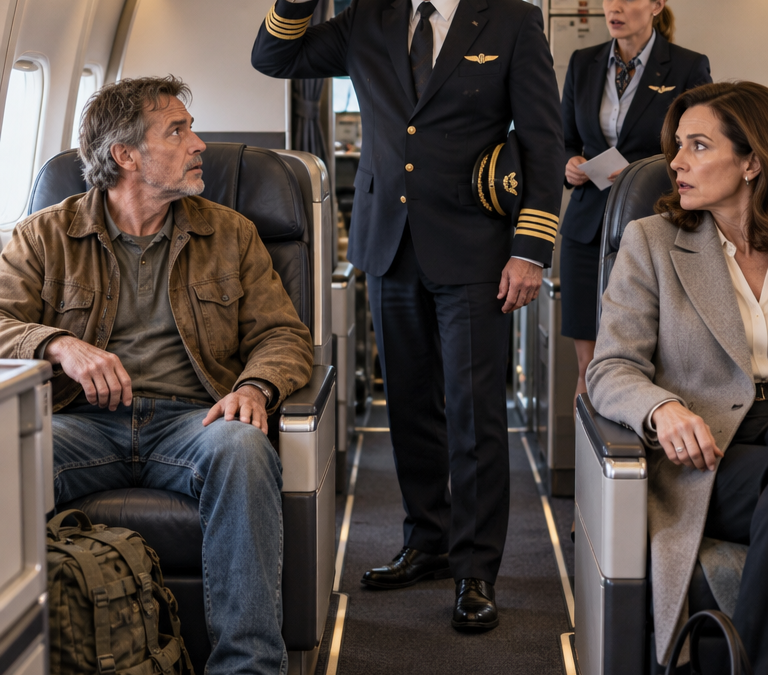
I had set my old backpack on the first-class seat for maybe four seconds when the woman across the aisle laughed.
She looked at my faded boots, then at the boarding pass in the airline employee’s hand.
“I think he boarded the wrong cabin.”
She said it loudly enough for the words to travel.
I heard every syllable.
I did not argue. I did not pull out a special card. I did not ask for a supervisor. I pulled my worn canvas jacket closer around me, took my seat, and let the moment belong to the people who had created it.
Much later, the cockpit door opened.
The captain stepped out.
He looked toward me and stopped.
Then he straightened his back and raised one hand to his brow.
The first-class cabin became very quiet.
That was the moment everyone remembered.
But it was not where the story began.
Denver International Airport has a particular kind of cold in late October. It comes through the concrete, works its way through old leather, and finds every weak seam in a pair of boots.
I had been standing in it for eleven minutes before the terminal doors finally opened.
My jacket had outlived two pickup trucks. My jeans had been washed so many times that most of the blue had given up. My boots had been resoled twice by a man who worked four blocks from my shop and still believed repairing good leather made more sense than throwing it away.
Over my shoulder hung an old military rucksack with a repaired strap. A name stencil had once been painted across the canvas. Time had erased almost all of it.
There was no expensive watch on my wrist. No designer suitcase rolling behind me.
Anyone looking at me for a few seconds would probably have guessed mechanic.
Maybe technician.
They would not have been completely wrong.
I was flying to Seattle that morning, and I needed to be back in Colorado by the following evening because my daughter, Clare, had a departmental presentation at her university.
She had mentioned it three weeks earlier in the flat, careful voice she used whenever she was trying not to ask me for something.
“It’s a small thing,” she had said. “Parents come sometimes.”
I had spent nineteen years learning that “sometimes” in my daughter’s vocabulary often meant please.
I had missed her seventh birthday because of a mission I still did not discuss in detail. I had missed a middle-school concert where she played a wooden recorder badly and beautifully. I had been on another continent when her uncle’s funeral arrangements were made.
I had missed enough.
When my earlier flight was canceled, I paid for the only seat that could still get me home in time.
That seat happened to be in first class.
I recalculated the price three times before buying it.
Then I bought it anyway.
Clare was more important than the number on the screen.
Inside my rucksack, beneath a rolled shirt and a bag of cashews, was a small dented metal box. It was roughly the size of a paperback novel, with one damaged corner from an old rough landing.
Whenever the bag tipped, the lid shifted slightly and exposed the edge of a brass insignia.
Each time it happened, I pushed it back into place.
I had not looked carefully at that insignia in nineteen years.
I was carrying the box to Seattle for reasons I had not completely admitted even to myself.
At the gate, I entered the priority line because my boarding pass told me to.
Small adjustments happened around me.
A man in an expensive quarter-zip moved half a step away even though there was plenty of room.
A woman checked the tag on her own luggage, then checked it again.
People do not always have to speak to tell you what they believe about you.
Sometimes they simply rearrange the air.
Then Meline Sterling arrived.
She was forty-six and dressed in a dove-gray coat that had clearly been tailored for her. Her assistant followed behind with luggage, maintaining the practiced distance of someone paid to be useful without being noticed.
Meline looked at me slowly from my boots to my collar.
Then she turned toward the woman in the airline blazer beside her.
“I think he’s standing in the wrong line.”
She had a talent for making a cutting remark sound almost reasonable.
I heard her.
I did not turn.
The airline employee was Blair Kensington, thirty-eight, a premium-services manager with a laminated badge and a professional smile she seemed able to raise and lower on command.
She extended her hand.
“May I see your boarding pass, sir?”
I gave it to her.
She scanned it.
Then she scanned it again.
The screen confirmed exactly what it had shown me at the kiosk.
Seat 2A.
First class.
Purchased eleven days earlier.
Passenger: Wyatt Rowan.
Payment cleared.
Blair looked at the screen, then at me.
“All right. The ticket’s valid.”
The sentence was technically correct.
It was also strangely revealing.
She said it the way someone might return a passport after a secondary inspection, turning an ordinary transaction into a test I had somehow passed.
Nobody else in line had been asked to pass it.
She handed the boarding pass back without apologizing, then turned toward Meline with noticeably more warmth.
I slid the pass into my jacket.
I had been through checkpoints in places where the stakes were considerably higher than embarrassment at an airport gate.
Still, I had learned something over the years.
The polite humiliations often lasted longer in memory.
As Blair held the boarding pass, I noticed Meline glance toward my name.
Wyatt Rowan.
Her eyes stopped moving.
The muscles around her mouth tightened in a small, involuntary way.
It lasted less than a second.
Then she turned to her assistant and asked something about Seattle weather.
The expression disappeared.
I filed it away.
I have spent much of my life filing small things away.
The jet bridge smelled like carpet cleaner and aviation fuel. I walked slowly because my left knee had developed strong opinions about inclines.
Seat 2A was by the window.
Meline took a seat across the aisle.
I kept my jacket in my lap instead of hanging it in the first-class closet. I had answered enough unspoken questions for one morning.
A man behind me leaned forward while passengers were still boarding.
He looked at my clothes and smiled.
“Lucky upgrade?”
“No,” I said. “I bought it.”
That was all.
I did not explain how much it had cost. I did not mention why I had bought it. I did not laugh to make him comfortable.
The silence afterward belonged to him.
He leaned back and became interested in his phone.
Across the aisle, Meline’s jaw tightened almost imperceptibly.
That was when I realized something.
My presence did not bother her nearly as much as my refusal to be embarrassed by it.
A few minutes later, she took out her phone and called her assistant, who had been seated farther back.
She discussed a Seattle meeting.
A hotel.
Ground transportation.
Then, in a tone almost affectionate, she said, “First class used to have standards.”
A flight attendant carrying water slowed slightly.
Blair, who had come aboard to oversee the premium cabin before departure, heard the remark.
She said nothing.
Silence can be a statement when the right person is speaking.
When I stood to place my rucksack in the overhead bin, Blair appeared beside me.
“I need to check the dimensions of that bag.”
“Is there a problem?”
“Policy.”
She said it pleasantly.
She took the rucksack and looked for a tag that was not there.
Several feet away, Meline’s expensive roller bag sat in an overhead compartment with part of its shell pressing slightly against the track.
I had watched Blair close that compartment herself.
She had complimented the leather while doing it.
Everyone in the first three rows could see the difference.
Nobody commented.
Neither did I.
I took my rucksack back, slid it beneath the seat in front of me, sat down, and fastened my seat belt.
There are two ways to handle a small injustice in a confined space full of strangers.
You can turn it into everyone’s problem.
Or you can decide there is something more important waiting at the other end of the flight.
I had promised Clare I would be there.
I chose the second option.
Someone noticed.
Her name was Tessa Lane.
Tessa was twenty-four and had been flying for only eight months, long enough to know the procedures but not long enough to stop seeing individual people.
She noticed that after sitting down, I checked the forward exit, the overwing exits, and the rear of the cabin in a particular order without obviously turning my head.
She noticed that when the auxiliary power unit changed pitch beneath the floor, I glanced automatically toward a wrist that no longer carried a watch.
She noticed that when a short fault tone sounded in the galley, my eyes moved toward the left wing before most passengers had registered the sound at all.
When she came through with a tray, she crouched slightly beside my seat.
“Are you in aviation, sir?”
“I was once.”
She waited for more.
Most people provide more when given silence.
I did not.
Tessa smiled and moved on.
I saw her glance back twice before the cabin door closed.
She remembered that exchange later.
So did I.
The aircraft did not leave on schedule.
A technical issue created a hold near the left side of the aircraft. The captain explained it over the intercom using the intentionally dull language airlines use when they want passengers to stay calm.
The delay grew.
Meline used the time productively.
She began talking with the man beside her, a fund manager headed to a board meeting.
Within a few minutes, I understood why airline employees seemed so alert to her presence.
Sterling Capital had recently taken a substantial position in a holding company with a major stake in the carrier.
No one had ordered anyone to treat her differently.
Nobody needed to.
Real leverage rarely announces itself.
It asks questions and lets other people imagine the consequences.
Meline turned toward Blair, who was still near the galley.
“You’re certain there’s no problem with that gentleman’s ticket?”
“No.”
“Only because it would be awkward later.”
She let the word awkward remain in the air.
It was a skilled move.
My continued presence in seat 2A had been reframed as a decision someone might eventually have to justify.
That time I turned.
“Is there something wrong with my ticket?”
I did not raise my voice.
Blair nevertheless took a step back.
“No, sir. Nothing at all, sir.”
Meline smiled.
“Don’t be so sensitive. I only asked a question.”
Then she looked at my jacket.
“What do you do for a living?”
“I fix airplanes.”
Her expression softened into satisfaction.
“Ah,” she said. “I see.”
And she believed she did.
She had found a category for me.
A maintenance technician who had used points.
A mechanic who had been bumped forward.
A man being tolerated in a seat he normally could not afford.
She returned to her conversation, satisfied.
I did not correct her.
Partly because I wanted to get home to my daughter without turning the day into a fight.
And partly because I have never completely lost my curiosity about how people behave when they believe there will be no consequence for behaving badly.
Then Meline said something that made me stop looking out the window.
She was discussing acquisitions.
Regional service companies.
Maintenance facilities.
Businesses most people never hear about even though commercial aviation could not function without them.
She listed three names.
The third was Rowan Aviation Services.
She pronounced it like a line on a spreadsheet.
“Small operation,” she said. “The owner is sentimental. Margins are better than you’d expect because the founder apparently never learned to raise his prices.”
I stared through the window for another second.
Rowan Aviation Services operated three facilities in Colorado: one in Colorado Springs, one near Pueblo, and one in Grand Junction.
We employed sixty-one people.
There was Darin in the parts room, who had been with us nine years and once found a mislabeled bearing that could have created a serious problem.
There were technicians I had hired straight out of training programs and others who had been passed over elsewhere because someone decided they did not look like management material.
I had started the company with a loan, a borrowed torque set, and a reputation I had not intended to build.
I had never put my face on the website.
I rarely attended industry dinners.
My attorney handled most discussions involving signatures because I disliked those rooms and because I had learned that people behaved more honestly when they did not recognize the name attached to the other side of the table.
So there I was.
The woman who had spent much of the morning implying I did not belong in first class was explaining to a stranger why her firm intended to buy the company I owned.
She did not know.
There was no reason she should have.
I kept quiet.
For a while, I assumed that would be the strangest part of the flight.
I was wrong.
Up front, Captain Owen Barrett was working through paperwork with his first officer while waiting for final maintenance clearance.
Owen was fifty-two and had been with the airline for twenty-two years.
Because of the operational delay and a connection issue involving several passengers, the lead flight attendant brought him a premium-cabin manifest.
Owen scanned the page.
Then his pen stopped.
Third line.
Rowan, Wyatt J.
He read it again.
The first officer asked him a question.
Owen did not answer immediately.
He asked the flight attendant which seat belonged to Rowan.
“2A.”
Owen unbuckled and stepped out of the cockpit.
Tessa was working near the galley when she saw his face change.
Meline was speaking to Blair about transportation.
I was watching a ground vehicle move away from the left wing.
Owen walked three rows into the cabin.
Captains generally do not do that at that point before departure.
He stopped beside my seat.
For a moment, he simply stood there.
I sensed him before I looked up.
When I turned, I saw gray at his temples and lines around his eyes that had not existed the last time we had been in the same place.
For two full seconds, neither of us moved.
Then I saw the younger version of him.
Twenty-nine years old.
Sunburned.
Standing on a dark ramp with a clipboard clutched too tightly.
His voice dropped.
“Colonel Rowan?”
“Nobody’s called me that in a long time.”
Owen straightened.
Then he raised his hand to his brow.
He saluted.
No regulation required it.
No commercial-airline procedure explained it.
He was not performing for anyone.
It was reflex.
The body remembered before the room understood.
I stood and shook his hand.
Behind me, the cabin changed.
Meline stopped in the middle of a word.
Blair froze with a bottle of sparkling water in her hand.
The passenger who had asked about my “lucky upgrade” stared at the seat back in front of him.
Tessa rested one hand on the galley counter.
Nobody knew what the salute meant.
That was important.
They had not suddenly discovered my biography.
They had only seen a commercial-airline captain come out of a cockpit and salute the man whose backpack had needed special inspection twenty minutes earlier.
Tessa quietly asked the lead flight attendant who I was.
The woman shook her head.
Owen heard them while returning to the cockpit.
He paused near the curtain.
He did not mention a rank.
He did not name a unit.
He did not give a year.
“That man brought a lot of people home,” he said.
Then the cockpit door closed.
We pushed back a few minutes later into a gray Colorado morning.
For the first time, Meline looked at me without contempt.
What replaced it was not exactly respect.
It looked more like calculation moving very quickly.
Something about my name had already bothered her.
Now the salute had added another piece.
I could almost see her searching through memory.
We climbed over the Front Range.
The cabin settled.
Service suddenly came to me first.
The passenger behind me offered his newspaper.
Blair had left the aircraft before departure after making a point of telling the crew that everything in the forward cabin was “perfectly in order,” the sort of phrase people use when they have already started thinking about documentation.
Across the aisle, Meline finally spoke.
“You flew?”
“Yes.”
“Air Force?”
“Yes.”
“Lieutenant colonel?”
I nodded.
She sat back.
Relief appeared on her face.
“Well, then I understand why your captain saluted you.”
I looked at her longer than either of us found comfortable.
“Not really.”
That relief disappeared.
About two hours into the flight, after the cabin lights had been lowered and most of the front rows had become quiet, Owen came back during his break.
He carried two cups of coffee.
He crouched in the aisle beside me.
We talked the way men talk after twenty years when neither knows which missing year to start with.
He asked about my knee.
I asked about his mother, who had been ill the last time I saw him.
Then Owen leaned slightly closer.
“Do they know?”
He meant everyone else.
“No.”
“Good.”
Then he told the story anyway.
Meline was three feet away.
Her reading light was off.
Her eyes were open.
Owen knew exactly what he was doing.
More than twenty years earlier, I had been mission commander for an airlift unit supporting relief operations after an earthquake badly damaged the road network in a mountainous region.
We had four aircraft, multiple crews, a maintenance detachment working from temporary shelters, and more requests than we could realistically satisfy.
Owen was a lieutenant then.
Twenty-nine.
Three months into the unit.
Still writing down almost everything anyone senior told him.
On the ninth day, one of our aircraft returned with a vibration the crew could not identify.
Our maintenance chief, Master Sergeant Del Hoy, pulled a component and reviewed its inspection paperwork.
Del had forgotten more about airframes than most people ever learn.
He found a discrepancy.
Not a dramatic one.
One lot number appeared on one document but not another.
A date stamp fell just outside the expected production window.
It was exactly the kind of thing an exhausted technician could have initialed and passed along after a long shift.
The aircraft had been operating.
People on the ground needed supplies.
Schedules had already been briefed.
Senior people cared deeply about one number: how much material was delivered.
Del came to me around two in the morning with grease still dark on his hands.
He did not say the components were defective.
He said something more important.
“I can’t prove they’re bad, sir. I just can’t prove they’re good.”
There is a large distance between those two statements.
Everything that followed lived in that distance.
Three aircraft scheduled to fly at dawn carried components from the same production batch.
I canceled the launch.
I grounded all four aircraft until the parts could be verified against source documentation.
I did it before I had permission because the approval process would have taken longer than we had before the first scheduled departure.
Then I put my name on the order.
I wanted no confusion later about who had made the decision.
We rearranged support through another staging field.
It cost us most of a day.
People were angry.
I did not rescue anyone personally.
I did not fly through impossible weather.
I did not do anything that looks impressive in a movie.
I looked at two pieces of paper that did not agree.
Then I trusted a sergeant with dirty hands more than a schedule approved by people sitting in clean offices.
Two days later, the verification returned.
The production run contained a flaw in a fitting.
Under sustained load, the component could eventually fail in a way that left almost no margin for recovery.
Three aircraft had been affected.
One of them was the aircraft Owen Barrett had been scheduled to fly the following morning.
He told the rest quietly in the dark cabin.
He had flown nineteen more years in uniform and twenty-two in civilian aviation.
He had two sons.
The older one was in medical school.
Then he looked at me.
“Sir, do you know why I still salute you?”
I did not answer.
“It isn’t the rank. It’s that you were the only person in that room willing to say no when every man with authority wanted to hear yes.”
People often want the meaningful part of a story to involve dramatic action.
Sometimes it does not.
Sometimes it is a person becoming unpopular on a Tuesday because a number on one page does not match the number on another.
Owen went back to the cockpit.
Meline remained very still.
She asked for water and did not drink it.
I watched her hands.
People learn to manage their faces.
Hands are less disciplined.
“You knew my name before the captain came out,” I said.
It was not a question.
“No, I didn’t.”
I let the answer sit.
There was no reason to force it.
Eventually, people either move toward the truth or build a larger wall around it.
Here was the truth she was approaching.
The company that had supplied the questionable component batch more than twenty years earlier was Sterling Aeronautics.
It had been the foundation of the Sterling family’s wealth.
At the time, it was run by Meline’s father, Richard Sterling.
Meline had been twenty-three and less than a year into her first job with the family business.
Most of her work involved carrying documents between offices and learning how little senior executives noticed when young employees stood quietly nearby.
She had been in a hallway when the inquiry letter arrived.
She had heard her father talking on the telephone.
Richard had argued that grounding aircraft over a documentation discrepancy would be disastrous for delivery commitments.
He pointed out that similar components had already accumulated hours without trouble.
He questioned whether the officer raising the concern understood the broader consequences.
Over the next few months, Meline heard my name repeatedly.
Rowan.
The officer who had halted operations.
The man who had cost the company money.
The problem that would not go away.
Richard Sterling was not a monster.
I never believed that.
When the deeper materials review confirmed the flaw, he accepted the result.
He funded the recall.
He changed suppliers.
He replaced people responsible for quality oversight.
But he also made sure the matter remained quiet.
The correspondence disappeared into internal legal files.
The company survived.
The public never learned how close the problem had come to becoming something worse.
My name survived inside the Sterling family for a different reason.
I was remembered as the officer who had cost Richard Sterling nearly a million dollars and almost damaged his company.
Nobody had apparently told Meline that the same decision was why her father never had to live with a very different kind of consequence.
That is how stories get inherited.
They often arrive already sorted.
Eventually Meline spoke.
“You were right.”
I looked at her.
“My father said so later. Once. At dinner. Then he never mentioned it again.”
“That is more than most men manage,” I said.
For a while, we watched the clouds.
Then Meline asked a question in a different voice.
“If you had a career like that, why did you leave?”
The answer was not related to aircraft.
It was a woman named Lauren.
Lauren married me when I was a first lieutenant with an unreliable car and more confidence than money.
She died on a Thursday in March when Clare was eleven.
Getting to that Thursday had taken four difficult years.
For much of those four years, I was somewhere else.
There was always another rotation.
Always another mission.
Always a reason that sounded responsible when written on paper.
I had convinced myself that doing my duty was how I took care of my family.
I missed a school play by sixteen hours.
I missed the appointment where a doctor used the word that changed the atmosphere inside our house.
I once called Lauren from a flight line nine time zones away and told her I would be home in three weeks.
“That’s fine, Wyatt,” she had said.
Her voice had stopped expecting anything.
At the time, I did not understand what that meant.
Later I realized it was the sound of someone slowly releasing a rope she had been holding alone.
After Lauren died, I stood in my kitchen at four in the morning and did arithmetic that should never require a tragedy.
Clare had one parent left.
She had roughly 2,600 days before adulthood.
I had already spent too much of her childhood as a voice coming through a telephone with static behind it.
So I put in my papers.
Nobody forced me out.
There was no scandal.
I left because I finally understood that sometimes the people who love you need you to come home more than the world needs you to be impressive.
I used my separation pay, borrowed money I probably should not have been approved for, and opened a small hangar in Colorado Springs.
There were two employees.
A coffee maker older than both of them.
A borrowed torque set.
I hired people others had overlooked.
I built the business around one rule that had stayed with me from the service:
The number in front of you is either true or it is not.
A schedule does not change it.
An investor does not change it.
A persuasive person on the telephone does not change it.
Somewhere over eastern Washington, I took out my phone.
My background photograph was Clare at eighteen, standing in front of a dormitory in a university jacket two sizes too large, laughing because I had insisted on taking another picture.
I turned the screen slightly toward Meline.
“She has never cared what rank I held,” I said. “She cares whether I show up when I say I will.”
That was why I had bought the first-class seat.
Not to be seen in it.
Not because I needed champagne or extra space.
The earlier flight had been canceled.
This one could still get me back to Colorado in time.
I had promised.
Meline attempted to repair the morning.
“I didn’t know.”
“You decided who I was before you knew a single fact about me.”
She looked down.
“The insult was the decision,” I said.
She had no response.
We sat quietly for a while.
Then she asked about my company.
I told her.
Three facilities.
Sixty-one employees.
Rowan Aviation Services.
I watched recognition arrive for the second time that day.
It was the third company on the acquisition list she had been discussing four hours earlier.
She repeated the name softly.
“Rowan.”
She had reviewed the file.
She had approved the outreach.
She had never met the owner because I routed negotiations through an attorney in Denver and generally declined meetings built around expensive dinner reservations.
“So you knew who I was at the gate?” she asked.
“I knew who you were.”
“And you didn’t say anything?”
“You didn’t ask.”
She looked out the window.
I could almost see her constructing the sentence that might rescue the transaction.
Then she discarded it.
That earned more respect from me than anything else she had done that morning.
People like a satisfying revenge line.
They expect the person who was underestimated to reveal his identity and say the deal is over.
I did not.
“I don’t decide contracts based on how people treat me after they find out who I am.”
Her shoulders lowered slightly.
For about four seconds, she thought she had been forgiven.
Then I finished.
“I decide them based on how people treat the people they’ve already decided don’t matter.”
She said nothing.
Before descent, the lead flight attendant came to my seat.
She told me an incident report had been opened regarding my treatment during boarding.
Two crew members and one passenger had provided statements.
The company intended to review Blair Kensington’s conduct.
“Would you like to add anything?”
“What is likely to happen to her?”
“That depends.”
The way she said it told me part of what it depended on.
“I don’t want her fired.”
The flight attendant seemed surprised.
It was not generosity.
If Blair lost her job because Captain Barrett had saluted the man in the worn canvas jacket, then every employee who heard the story would learn the wrong lesson.
They would learn to be careful with ordinary-looking people because one of them might secretly be important.
That was the same problem wearing better manners.
The correct lesson was simpler.
A passenger in worn boots deserved ordinary respect even if no captain ever came out of a cockpit.
“If she loses her job because I once wore a uniform,” I said, “then nobody understood what happened.”
I asked instead that the matter be addressed directly.
Training.
A clear explanation.
Someone she respected telling her exactly why her behavior had been wrong.
Owen heard part of that conversation while checking the cabin before descent.
He said nothing until we were on the ground.
Then he looked at me.
“Still you.”
“That’s debatable most mornings.”
We landed in Seattle beneath a sky the color of galvanized steel.
When the seat-belt sign turned off, everyone stood.
Not one person looked at my jacket the way they had looked at it in Denver.
The man behind me told me it had been an honor.
A woman farther back thanked me for my service despite knowing almost nothing about it.
Someone offered to carry my backpack.
I disliked it more than I expected.
Four hours earlier, the same jacket had been evidence of one story.
Now it had become evidence of another.
The jacket had not changed.
Neither had I.
Only the information had changed.
And everyone had rewritten me immediately.
Meline waited near the aircraft door.
Doing that in front of an audience required a certain amount of courage.
“Wyatt.”
I stopped.
“I’m sorry.”
No speech.
No explanation.
No attempt to rename what had happened as a misunderstanding.
I respected the brevity.
“Next time,” I said, “apologize to somebody before you find out they mattered.”
She nodded once.
Then she stepped aside.
Owen waited outside the cockpit door with his hat off.
We shook hands.
“Don’t ever do that in front of a full cabin again,” I told him.
He laughed.
“I waited twenty-two years. You could give me one.”
I let him have it.
Then he straightened and saluted me again.
There was almost no audience left.
This time I returned it.
The first salute had been interpreted by everyone else as rank.
The second belonged only to us.
One man had made an unpopular decision on an ordinary night.
Another had never forgotten what that decision allowed him to go on having.
A career.
Two sons.
An older child studying medicine.
Decades of unremarkable mornings that would never make anyone’s story.
Outside the terminal, Clare was waiting in a borrowed coat that looked as though it belonged to someone taller.
She saw the rucksack before she saw me.
“Dad, you’re still using that thing?”
“It isn’t broken.”
“It looks like it’s lived three lives.”
“Closer to four.”
She hugged me hard enough to force the air from my lungs.
“How was the flight?”
I looked back toward the terminal doors.
“Ordinary.”
Clare had known me long enough to understand that ordinary was the word I used when the real answer would take an hour.
She let it go.
We walked toward the parking structure.
My phone buzzed.
An email from Sterling Capital had arrived eleven minutes after landing.
Request to reopen acquisition discussion.
I stared at it for several seconds.
Then I shut off the screen and put the phone back in my pocket.
Clare glanced over.
“Important?”
“Not compared to tonight.”
We kept walking.
In the trunk of the rental car, inside the battered metal box, inside an old military rucksack, the brass insignia I had avoided looking at for nineteen years remained exactly what it had always been.
A piece of metal.
It did not prove character.
It did not make the man carrying it more worthy of respect.
Neither did a first-class boarding pass.
Neither did ownership of a company.
Neither did a salute from a captain.
The strangest part of that day was not that people learned something impressive about my past.
It was how quickly they changed after learning it.
Between Denver and Seattle, nothing about me improved.
Only what they knew improved.
The person wearing an old coat in front of you may have an extraordinary history.
Or he may have no hidden rank, no company, no dramatic past and no story anyone would ever tell.
The second person is entitled to the same basic dignity as the first.