I had been back in New York less than an hour when my best friend sent me a 27-second video of my fiancé, Ryan, sitting beside Maya and saying, “She’ll be angry, but she won’t actually leave.” Eight weeks later, he arrived at our Hudson Valley wedding venue wearing his tuxedo—and discovered he wasn’t the groom.
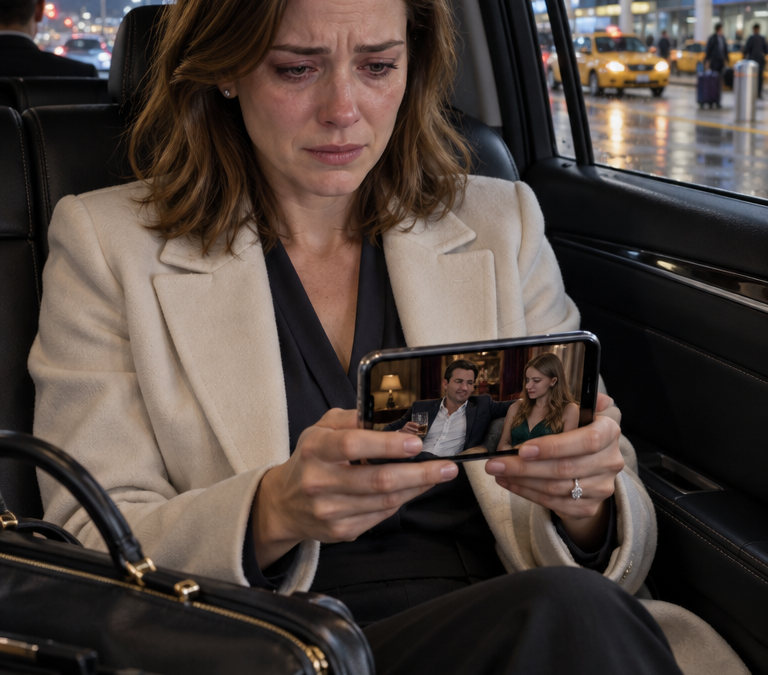
“Of course I’m marrying Clare.”
Ryan Whitmore lifted his glass as though the question were ridiculous.
“But I’m not cutting Maya out of my life.”
Someone off camera laughed.
Ryan leaned deeper into the leather sofa, completely relaxed.
“And if Clare doesn’t agree?”
He paused for one beat.
“She’ll be angry.”
Another beat.
“But she won’t actually leave.”
I had been back in New York for less than an hour when I heard my fiancé say those words in a twenty-seven-second video.
Eight weeks later, Ryan would drive to a private estate in the Hudson Valley wearing the tuxedo he had ordered for our wedding and discover, minutes before the ceremony, that he was not the groom.
But sitting in the back of a car outside Kennedy Airport that evening, I had no idea the story would end there.
All I knew was that some relationships do not end when you discover the betrayal.
They end when you finally hear how certain the other person is that you will stay anyway.
Ryan had not come to the airport.
His message was waiting on my phone when I landed.
Emergency meeting. Driver is outside. See you tonight.
A year earlier, I would have defended him before anyone even asked.
Whitmore Group was in the middle of a major medical-tech acquisition, and Ryan had recently taken responsibility for much of the deal. Last-minute meetings were normal. Missed dinners were normal. Calls that interrupted weekends were normal.
A car waiting for me instead of my fiancé could be explained.
I had become very good at explanations.
Then Olivia sent me the video.
My best friend had added only one sentence.
Watch this before you go home.
The clip had been recorded at a private members club in Manhattan.
Ryan sat in the middle of a low leather couch, looking completely at ease. Maya Collins sat beside him, close enough that her knee touched his.
I had seen Maya in too many photographs over the previous year.
She worked as a program manager for the Whitmore Arts Foundation. Her mother had died two years earlier, and she had little close family in New York.
Ryan described his involvement in her life with the same phrase every time.
“I’m just helping her out.”
Helping gradually came to mean paying the rent on her Upper East Side apartment.
He added her to his private car service.
He covered a concierge medical membership and part of her insurance premiums.
He gave her a spare key to his apartment.
Every time I questioned one of those choices, he had an answer prepared.
“She doesn’t have anyone else.”
“The money means nothing to me.”
“You don’t need to be threatened by her.”
The hardest part to admit was that those explanations had never fully convinced me.
I had used them to convince myself that no single incident was worth ending a fifteen-year relationship.
Ryan and I had known each other since high school.
We had become serious in college.
Our parents knew each other. Our families attended the same events. Over time, the Bennett and Whitmore names became linked in ways that had nothing to do with us, and that only made everyone more certain our wedding had been inevitable from the beginning.
Fifteen years created enormous weight.
It also created enormous inertia.
So I watched the video.
A man across from Ryan asked, “Clare lands today, right? Are you finally cleaning up whatever this thing is with Maya?”
Ryan laughed.
“Cleaning up what?”
“You’re getting married in eight weeks.”
“I know.”
Ryan took a drink.
“Of course I’m marrying Clare. We’ve known each other fifteen years. She knows what my life is like.”
Maya kept her eyes lowered.
Ryan continued.
“But Maya isn’t going anywhere either. She needs me. Those two things don’t conflict.”
Someone asked, half jokingly, “You sure Clare is that generous?”
Then came the sentence that ended us.
“She’ll be angry, but she won’t actually leave.”
I watched the screen go black.
I did not replay it.
I saved the file to cloud storage, asked Olivia to keep the original, and called my attorney, Mark Ellis.
“Mark, my engagement to Ryan is over.”
There was a brief silence.
“Are you sure?”
“Yes.”
“Do you want me to notify the Whitmore attorneys?”
“I don’t need a lawyer to end an engagement. I need you to pause the prenup negotiations. Contact the venue and vendors. I want a clean list of deposits, cancellation clauses, transfer options, and refund deadlines.”
“Understood.”
I ended the call and looked down at my left hand.
Then I removed my engagement ring.
I did not throw it through the open car window.
I did not drop it into a champagne glass.
I placed it inside the small zippered pocket of my handbag.
A ring did not need to perform the breakup for me.
Ryan finally arrived at my apartment at eleven that night.
He carried a box from my favorite French bakery and walked through the door with the easy confidence of someone returning to a life that had remained exactly where he left it.
“Welcome home.”
He leaned in to kiss me.
I stepped backward.
“We’re done.”
Ryan froze.
Then, to my amazement, he smiled.
“Olivia sent you the video?”
Not what video.
Not what are you talking about.
He knew.
“Yes.”
“Clare, I’d been drinking.”
“Your diction was excellent.”
His mouth tightened.
“What I have with Maya isn’t as complicated as you’re making it.”
“You gave her a key to your apartment.”
“She picks things up for me sometimes.”
“You pay her rent.”
“I can afford it.”
“Were you planning to keep doing all of that after we got married?”
“I was going to put better boundaries in place.”
“What boundaries?”
For the first time that evening, Ryan had no immediate answer.
He looked toward the windows.
Then back at me.
“I wasn’t going to let her interfere with our marriage.”
That sentence did more than the video.
In Ryan’s mind, the problem was not that he had constructed an intimate second relationship while planning a marriage to me.
The problem was whether that second relationship became inconvenient.
I picked up my tablet.
Mark’s first emails to the wedding vendors were already visible beside the paused prenup documents.
“The engagement is over,” I said. “The legal work is just cleanup.”
Ryan stared at the screen.
“You’re serious?”
“Yes.”
“Over twenty-seven seconds?”
“No. The twenty-seven seconds just translated the last year for me.”
He stood and walked once across the living room.
“You need time to cool down.”
“I’m not upset enough to need cooling down.”
“Fifteen years, Clare.”
He turned toward me.
“You’re going to throw away fifteen years over this?”
“I’m not the one who put fifteen years in this position.”
I tapped the tablet between us.
“You assumed those fifteen years would absorb anything you did.”
Ryan watched me.
Then he picked up his coat.
“I’ll give you a few days.”
I almost laughed.
He stopped at the door.
“When you’ve calmed down, we’ll talk.”
After he left, I stood alone in the apartment and finally understood the real problem.
Ryan had heard me say the engagement was over.
He had simply translated my decision into an emotion.
After fifteen years, the possibility that I might actually leave did not fit inside his view of me.
Three days later, I hosted the Bennett Children’s Health Foundation annual dinner.
The foundation had nothing to do with Whitmore Group. My grandfather had started it, and after college I had taken responsibility for much of its community-health work.
That evening we were announcing a pediatric cardiac initiative I had spent months preparing.
I was backstage reviewing the speaking order when our event director, Amy, approached me.
“We have a seating issue.”
“What kind?”
“Ryan Whitmore is here.”
I frowned.
“He didn’t RSVP.”
“He didn’t. And he brought Maya Collins. He says he always sits at the head table.”
I looked toward the ballroom entrance.
Ryan was already talking with two major donors.
Maya stood beside him with one hand lightly resting on his arm.
A few minutes later, they reached the head table.
Maya gave me a careful smile.
“Clare, I didn’t realize the seating had changed. Ryan said he usually sits here.”
“He used to.”
I turned toward Amy.
“Do we still have the two sponsor seats at Table 12?”
“Yes.”
“Please put them there.”
Ryan’s expression hardened.
“Clare, this isn’t necessary.”
“What isn’t?”
“Making a spectacle out of us.”
I glanced around the ballroom.
“You didn’t RSVP. Amy found two available seats. That’s all.”
Ryan looked toward Table 12.
“There?”
“Those are the seats available.”
I handed the seating chart back to Amy and walked away.
Behind me, Maya said quietly, “I can leave.”
Ryan answered immediately.
“You don’t have to leave.”
I could feel him waiting for me to react.
I gave him none.
Before the program began, Maya caught up with me outside the restroom.
She opened her handbag and held up a key.
“Ryan gave me this.”
Her voice was low.
“He said I can go to his place whenever I want.”
I looked at the key.
“Then keep it.”
Her face changed.
“You really don’t care.”
“I ended the engagement.”
“But you were together fifteen years.”
“Fifteen years is history between Ryan and me. It isn’t a competition between you and me.”
I stepped around her.
“You don’t have to beat me, Maya. I already left.”
That night I stood onstage and announced the foundation’s new pediatric cardiac program.
Ryan sat at Table 12 and watched me finish an entire evening without explaining myself to him once.
Olivia told me later that he looked more unsettled by my indifference than he would have been by a public confrontation.
The following afternoon, Ryan’s mother came to see me.
Catherine Whitmore arrived alone.
She did not ask me to forgive her son.
She did not tell me fifteen years was too much to lose.
She sat in my living room and said, “I’m sorry for what Ryan did. Whether you ever speak to him again is your decision, not mine.”
Some tension I had not realized I was carrying finally eased.
Catherine and my mother had been friends for years, but Ryan and I had never been a business arrangement. We had met in high school and become serious in college. The two families simply grew closer over time.
“Ryan thinks you’ll go back,” Catherine said.
“I know.”
She sighed.
“I told him to read the documents you sent. He said there was no point.”
I had nothing to add.
As Catherine stood to leave, her phone rang.
“Adrien?”
The name made me look up.
“Friday? You’re back in New York Friday? Good.”
She glanced at me before turning slightly away.
“Clare is fine. She doesn’t need anyone cleaning up Ryan’s mess for her.”
She ended the call and offered no explanation.
I did not ask.
Adrien Whitmore was Ryan’s older brother.
Unlike Ryan, Adrien had left the day-to-day operation of Whitmore Group years earlier. He and two partners had built a medical and infrastructure investment firm in London, and he rarely returned to New York for more than a few weeks.
But Adrien and I were not strangers who saw each other only at family holidays.
Three years earlier, we had worked side by side for four months.
The Bennett Foundation had been trying to save a pediatric rehabilitation center in Brooklyn that was close to shutting its doors.
Adrien’s firm had been brought in to restructure the property debt and create a long-term financing plan.
I represented the foundation and the community-health side.
Adrien handled financial modeling and negotiations.
We fought constantly over budgets.
I fought for service rooms.
He fought against projections unsupported by numbers.
We ate cold pizza in empty conference rooms after midnight.
The center stayed open.
At the celebration dinner, Adrien asked if I wanted another drink after everyone else left.
I lifted my hand to move my hair behind my ear.
My engagement ring tapped against the side of my wine glass.
Adrien’s eyes dropped toward it.
Only for a fraction of a second.
Then he changed what he had been about to say.
“Your car is here. I’ll walk you out.”
I had not thought much about the moment afterward.
Looking back, it may have been the first door between us that one of us deliberately closed.
I saw Adrien the day after he returned to New York.
Not at a Whitmore dinner.
Not because either family arranged anything.
The Bennett Foundation was preparing a pediatric rehabilitation center in Queens with a private healthcare group.
Adrien’s firm happened to be the group’s primary financing adviser.
He was seated across the conference table when I entered.
“It’s been a while.”
“Three years.”
He smiled.
“You remember that Brooklyn project nearly took three months off my life.”
“Hard to forget.”
Once the meeting began, our old rhythm returned almost immediately.
Two hours later, the rest of the group left.
Adrien closed his laptop.
“Clare?”
“Yeah?”
“I heard about you and Ryan.”
“There are no secrets in New York.”
“I’m not apologizing for him.”
“I know.”
He was quiet for a moment.
“Three years ago, there was a question I didn’t finish asking you.”
I looked at him.
“What question?”
“It’s not the right time yet.”
Then he stood.
I laughed despite myself.
“Why bring it up if you aren’t going to ask?”
“So you know I remember.”
Over the next three weeks, the Queens project put us together repeatedly.
Foundation office.
Hospital meetings.
Construction sites where old walls had been stripped back to concrete and steel.
What changed my mind about Adrien was not that he was flawless.
He was not.
He worked too much.
He could be painfully direct.
He hated admitting when he was tired.
But being around him was uncomplicated in a way I had forgotten relationships could be.
If he disagreed, he said so.
If he needed space, he said so.
If he wanted to see me, he did not create an excuse and call it coincidence.
One Friday, after a project meeting, we stepped into an elevator.
“Do you have dinner plans?” he asked.
“No.”
“I’d like to take you to dinner.”
“For the project?”
“No.”
“Because your mother told you to make sure I’m okay?”
He laughed.
“If my mother knew I was doing this right now, she’d probably tell me to keep my mouth shut.”
Then he became serious.
“If this is too soon, forget I asked.”
“Adrien?”
“Yeah?”
“Was that what you were going to ask me three years ago?”
The elevator doors opened.
He did not step out.
“Three years ago, I was going to ask a little more than that.”
“Why didn’t you?”
“Because you were wearing an engagement ring.”
There was no accusation in his voice.
“Liking you didn’t give me the right to step into your relationship.”
He said it like a rule he had chosen for himself years earlier.
I walked out of the elevator.
“So what about now?”
He followed.
“Now I’m asking whether the timing is right.”
“Start with dinner.”
Our first date was at a small Italian restaurant in the West Village.
No private room.
No extravagant gift.
Nothing expensive enough to demand gratitude.
Much of the evening was not even about romance.
He told me why he left Whitmore Group.
I told him why I had chosen children’s health instead of taking a seat on my family’s corporate board.
“You and Ryan are very different that way,” I said.
“Which way?”
“He always wanted to prove he deserved Whitmore Group. You left before anyone could hand it to you.”
Adrien thought about that.
“I didn’t want my entire career to become a competition with Ryan.”
“So you left.”
“Yeah. I wanted to find out what I could build when the family name wasn’t the only reason a door opened.”
That stayed with me.
For fifteen years, too much of my life had existed as a unit called Clare and Ryan.
Our wedding.
The apartment we planned to buy.
Vacations.
Holiday schedules.
The future children we had discussed in the abstract.
Even the way people introduced me.
After the engagement ended, I was learning how to be one person again.
Adrien did not rush to turn me into half of another pair.
He simply walked beside me.
The Monday after our first real date, I disclosed the relationship to the foundation’s executive committee.
Because both organizations were involved in the Queens project, I recused myself from votes involving Adrien’s firm, while both teams reassigned final approvals.
It was not romantic.
It was responsible.
And after a year of watching lines blur around Ryan, responsibility felt strangely intimate.
Meanwhile, Ryan and Maya encountered a problem neither had prepared for.
Once I was gone, Maya started asking what they actually were.
For months, their vagueness had been easy to blame on me.
Ryan was engaged.
Clare existed.
Clare complicated everything.
Now Clare was gone.
One afternoon outside Ryan’s office, Maya linked her arm through his.
“When do we stop telling people I’m your friend?”
Ryan hesitated.
“This isn’t the time.”
“Why?”
“Everything just happened.”
“Clare ended the engagement.”
“Exactly. We can’t make some public announcement right now.”
For the first time, Maya did not accept the answer.
“You used to say it was because she was there.”
Ryan said nothing.
“She’s not there now.”
That question exposed something he had avoided.
Ryan liked being needed by Maya.
He also liked believing I would always be somewhere in his future.
He had never seriously considered what happened if he could only have one life instead of two versions of himself.
Ryan also started noticing Adrien and me.
The first time was at the Queens construction site.
Whitmore Group’s medical-tech division was considering donating an imaging system, and Ryan attended a partner tour.
He found Adrien and me leaning over construction plans.
I was wearing a hard hat and sneakers.
Adrien had rolled his sleeves to his elbows and was carrying coffee that had gone cold an hour earlier.
We did not look remotely romantic.
That apparently bothered Ryan more.
There was nothing performative about the scene.
It was simply a life in which he was no longer present.
After the tour, Ryan stopped me near the temporary fencing.
“You’re working with my brother now, too?”
“We worked together three years ago.”
“Why didn’t you tell me?”
“Do you mean three years ago or now?”
Ryan opened his mouth.
Closed it.
“Clare, you know what I mean.”
“I don’t.”
I removed my hard hat.
“We aren’t together. My work and who I see are no longer things I report to you.”
His voice dropped.
“You’re doing this to get back at me.”
“Why do you need that to be true?”
He stared at me.
Because if this was revenge, everything I did was still about him.
I took the hard hat he had absentmindedly picked up from the railing and returned it to the table.
“It isn’t.”
Less than three weeks before what had once been our wedding day, the old Saturday returned to my life.
Mark called.
“We have five days before the estate needs a final decision. If you cancel now, you’ll recover most of the deposit. If the event is transferred, they allow a change of contracting parties and guest list as long as the event doesn’t grow beyond the original size.”
I had been ready to cancel.
That evening Adrien came to my apartment to review the Queens project’s revised capital budget.
When we finished, he did not immediately leave.
“Clare, can I finish the question I didn’t ask three years ago?”
I leaned against the dining table.
“You already asked me to dinner.”
“Not that one.”
He reached into his coat and removed a small ring box.
My first reaction was not excitement.
It was panic.
Adrien saw it immediately.
He placed the box on the table without opening it.
“You can say no.”
“This is fast.”
“I know.”
“I just ended a fifteen-year relationship.”
“I know.”
“Everyone outside this room will think I’m marrying you to punish your brother.”
“They can think that.”
He paused.
“I’m more interested in what you think.”
I said nothing.
Adrien sat across from me.
“I didn’t start liking you because Ryan lost his chance. Three years ago, on that Brooklyn project, I learned what it felt like to build something with you. You chose him then. I respected that. I’m not inheriting his engagement. I’m not offering to rescue anyone’s family reputation.”
He pushed the unopened box toward the middle of the table.
“I’m asking whether, if you want to redefine that Saturday, you’d let me stand beside you.”
I studied him.
“What if I say no to the wedding and just want to keep dating you?”
“Then we keep dating.”
“What if the Queens project ends and I decide I don’t want to see you anymore?”
He smiled slightly.
“I’ll be miserable, and I’ll still finish the project.”
That made me laugh.
And that, more than the ring, was why I eventually said yes.
Not because Adrien was richer or calmer or a better prize.
I said yes because I had finally learned what it felt like to say no without fearing my whole life would collapse around the answer.
I opened the box.
The ring was simple and elegant, nothing like the large family diamond Ryan had chosen years earlier.
“I have conditions.”
“Tell me.”
“Private ceremony. No press. No corporate guest list. No wedding announcement used as business news.”
“Done.”
“And I decide what happens with the venue.”
“Of course.”
The next morning, I called Mark.
“Transfer the estate reservation to a new contract.”
“Groom’s name?”
I paused.
“Adrien Whitmore.”
We moved quickly, but we did not skip the adult parts just because the story sounded dramatic.
Adrien and I hired separate attorneys.
We signed a straightforward prenuptial agreement.
Premarital assets stayed separate.
The Bennett Foundation and his investment firm remained independently controlled.
Marriage gave neither of us authority over the other’s organization.
Ryan and I had always intended the estate ceremony and civil paperwork to be separate.
Adrien and I instead went together to the New York City clerk’s office ten days before the wedding and obtained our marriage license.
A licensed officiant would conduct the legal ceremony at the estate.
We reduced the guest list to fewer than sixty people.
Family.
Real friends.
People whose connection to us existed outside corporate logos.
No press.
No advanced company announcement.
No formal rehearsal.
Ryan should not have arrived ignorant of what was happening.
But whenever reality moved toward him, he found a way to rename it.
The first formal notice came from the estate.
Because Ryan had been a party to the original contract, the venue sent him a cancellation and release confirming he no longer had financial responsibility.
The notice contained no new contract and made no reference to Adrien.
Ryan skimmed the subject line and forwarded it to his assistant.
Confirm I have no remaining liability. Ignore the rest.
His assistant replied that legal needed acknowledgement.
Handle it, Ryan wrote.
The second chance came from Adrien.
The subject line read:
About Saturday.
The first sentence was simple.
Clare and I are getting married this Saturday.
Ryan’s assistant flagged the email.
“Adrien sent you something marked personal.”
Ryan did not open it.
“If it’s about Clare, archive it.”
The third chance came four days before the wedding.
Ryan’s assistant sent the family weekend itinerary.
Page one listed transportation, hotel blocks, and the Hudson Valley estate.
“Saturday in the Hudson Valley,” his assistant said. “Do you want me to confirm a car?”
Ryan saw my name.
He saw the estate.
To him, that proved everything he wanted to believe.
“No. I’ll drive myself.”
He never opened page two.
Bride: Clare Bennett.
Groom: Adrien Whitmore.
Three days before the ceremony, Ryan saw us together one more time in New York.
We were at the pediatric rehabilitation center in Brooklyn that Adrien and I had helped save three years earlier.
A new therapy wing was opening.
After the ceremony, a gust of wind caught the papers in my hands.
Adrien reached over, straightened the stack, and slid one folder into his briefcase for me.
It was an ordinary movement.
Ryan watched from the parking area as though it were anything but ordinary.
He crossed the sidewalk.
“Clare, we need to talk.”
“This isn’t a good time.”
“Five minutes.”
“Ryan.”
Adrien started to speak.
I lifted a hand.
I did not need him to handle the conversation.
I faced Ryan.
“What do you want to say?”
“What exactly is going on between you and my brother?”
“You’ve asked me that already.”
“I want a real answer.”
“Why am I required to prove anything to you?”
Ryan stepped closer and, more from old habit than aggression, reached toward my arm.
I moved backward before he touched me.
“Don’t touch me.”
He stopped.
No one raised their voice.
But those three words seemed to land harder than a scene would have.
For the first time, Ryan looked like what he actually was now.
Someone outside my life.
Adrien came to stand beside me.
He did not put an arm around me.
He did not announce that I belonged to him.
He only said, “She answered you.”
Ryan looked from Adrien to me.
“You’re together.”
I did not deny it.
“Yes.”
“You can’t be. Not this fast.”
“Adrien and I knew each other before you left the relationship.”
Ryan frowned.
“What does that mean?”
“It means not every relationship in my life began the day you stopped being part of it.”
I got into the car.
Ryan did not follow.
On Saturday morning, he arrived at Asheford Estate in the Hudson Valley earlier than most guests.
He wore the tuxedo originally tailored for our wedding.
Until that morning, Ryan still believed I had pushed the breakup to some dramatic extreme and would eventually speak to him before the ceremony.
At the family entrance, a staff member found Ryan Whitmore on the guest list and directed him toward the upstairs family lounge.
At the end of the corridor, one door held a simple card.
Groom.
Ryan opened it.
The room was empty.
Adrien was downstairs taking photographs.
A second dinner jacket hung near the mirror.
Ryan touched it.
The shoulders were wrong.
The sleeves were too long.
He frowned and returned it.
A printed schedule rested on the dressing table.
The first line read:
Bride: Clare Bennett.
For one absurd second, relief loosened his face.
Then his eyes moved down.
Groom: Adrien Whitmore.
He stared at the name.
Turned the paper over.
Turned it back.
As though the ink might rearrange itself if he refused it long enough.
An assistant reached the doorway.
“Mr. Whitmore? This is Adrien’s room.”
Ryan slowly turned.
“What did you say?”
Downstairs, the string quartet had begun.
Ryan left the room.
Someone called after him.
He kept moving.
The ceremony doors had nearly closed when he reached them.
Through the narrowing opening, he heard the officiant.
“And now, please welcome the groom, Adrien Whitmore.”
Ryan stopped.
Across the room, beneath white flowers and late-summer greenery, I stood at the front of the ceremony.
Adrien walked toward me from the other side.
No family negotiated the distance for us.
No one pushed him there.
He reached me, took my hand, and leaned closer.
“Ready?”
I looked at him.
“Ready.”
Ryan pushed through the doors a few seconds later.
A member of the venue staff stopped him near the last row.
“Clare.”
I heard him.
I did not turn.
Adrien looked at me instead of Ryan.
“Do you want to pause?”
I closed my hand around his.
“No.”
The ceremony continued.
The wedding Ryan had been so certain belonged to him had not been cancelled.
It had simply stopped being his long before he bothered to notice.
Afterward, Ryan did not go looking for Maya.
He sat outside the estate for nearly an hour while the other guests moved toward dinner and evening light settled over the hills.
Catherine found him before she left.
“Are you okay?”
Ryan looked up at his mother.
“Why didn’t anyone tell me?”
She did not lecture him.
She did not wave printed emails in his face.
“Ryan,” she said, “I tried. Your assistant tried. Adrien tried.”
Ryan stared down at the gravel.
“I thought she was trying to make me jealous.”
“I know.”
Catherine waited.
“That may be the worst part.”
Then she left him there.
Two nights later, Maya came to Ryan’s apartment.
She did not arrive carrying photographs or threats.
She stood in the entryway with the spare key in her hand.
“I don’t know if I’m supposed to give this back now.”
Ryan looked at it.
“What do you mean?”
“Clare is married.”
Maya took a breath.
“So what are we?”
Ryan said nothing.
“You used to say it wasn’t the right time because of her.”
“I didn’t say that.”
“You said we had to wait until things settled down.”
“Maya, nothing is settling down.”
She looked directly at him.
“I don’t want to be the person who is always available when you need me and never allowed to ask what the future is.”
Ryan appeared startled by how ordinary the question was.
Maya’s voice became quieter.
“Do you love me?”
He remained silent.
Finally he said, “I don’t know.”
Maya gave a small, disbelieving laugh.
“Then what were we doing?”
Ryan still had no answer.
She set the key on the console table.
“You didn’t choose Clare.”
He looked up.
“You didn’t choose me either.”
She nodded toward the key.
“You just kept both doors open.”
Ryan opened his mouth.
Nothing came out.
“I’m done.”
This time he only nodded.
At the door, Maya stopped.
“Before you ask someone else to wait for you, figure out what you’re actually asking them to wait for.”
Then she left.
For the first few weeks after the wedding, Adrien and I did not immediately merge every part of our lives.
My apartment remained mine.
His place in Tribeca remained his.
We ate dinner together most nights.
Sometimes he stayed with me.
Sometimes I stayed with him.
Neither of us assumed that marriage required a moving truck, shared passwords, or a completely rebuilt calendar by Monday morning.
It was not distance.
It was two adults acknowledging that we had made one very fast decision and did not need to make every other decision at the same speed.
One night, Adrien stayed at my apartment after a late project call.
I was still at the kitchen island reviewing a foundation budget when he walked in for water.
“You’re still awake.”
“So are you.”
He filled a glass.
“Problem with one of the London projects.”
I watched him.
“Do you want me to listen, or do you want help solving it?”
He smiled.
“You stole my question.”
“Fair is fair.”
“Listen first.”
So I listened.
Halfway through, I remembered another late night three years earlier when we had sat in an empty conference room in Brooklyn trying to keep a rehabilitation center open.
The difference was that back then I had been wearing someone else’s ring.
Now I was not.
A few days later, I asked him, “How much did you actually like me three years ago?”
Adrien considered the question.
“Enough to delete a dinner invitation I’d already written.”
I laughed.
“That’s it?”
“Also enough that when the project ended, I took the London job instead of inventing reasons to stay in New York.”
I looked at him.
“Because of me?”
“Not entirely.”
The answer came without hesitation.
“I needed to leave Whitmore Group, too. I needed my own work.”
That reassured me more than any claim that he had waited years for me.
His life had not stopped because I belonged to someone else.
He had continued moving.
We had simply met again farther down the road.
Our first real kiss did not happen over candlelight.
The Queens Center received final city approval on a gray Tuesday afternoon.
I walked out of the municipal office carrying the stamped documents.
Adrien was waiting at the bottom of the steps.
“Approved?”
I tapped the folder lightly against his chest.
“Approved.”
He laughed and pulled me into a quick hug.
It was brief.
When it ended, I did not step away.
He looked down at me.
“Clare—”
I kissed him.
Not for Ryan.
Not for the wedding.
Not to prove our marriage was real.
Because I wanted to.
After the wedding, Ryan took a month away from Whitmore Group.
By the third week, he had asked to take over a stalled London expansion project.
It was the first time I knew of that he had chosen his own next step before his father chose one for him.
A few days before he left, he texted me.
I want twenty minutes. I’m not asking you to come back.
I stared at the message before answering.
We met at an ordinary coffee shop near Central Park West.
Ryan arrived early.
He looked thinner.
He also was not wearing the watch I had given him for his thirtieth birthday, something I noticed only because it had been on his wrist almost every day for years.
His first question was direct.
“Do you love him?”
I thought before answering.
“I’m falling in love with him.”
Ryan nodded.
“I kept thinking you couldn’t possibly move that fast.”
“Because you started counting my life from the day you left it.”
He looked at me.
“Adrien and I knew each other three years ago. We did real work together. We knew who the other person was before any of this happened.”
Ryan gave a tired smile.
“I didn’t even know you were busy.”
“I was busy while you assumed everything important would stay where you left it.”
This time he did not defend himself.
We sat quietly while someone at the counter called an order number.
Then Ryan asked, “When did you really decide there was no coming back?”
“The video.”
“Because of Maya?”
“No.”
I held his gaze.
“Because you said I wouldn’t leave.”
Ryan looked down at his coffee.
“I thought that meant you loved me.”
“It meant you were certain I’d absorb the consequences. Those aren’t the same thing.”
He stayed quiet for a long time.
“I understand something now that I didn’t understand then.”
I waited.
“I liked that Maya needed me. And I liked believing you would always be there. I wasn’t choosing either one. I was trying to keep both feelings.”
It was the first time he had said it without dressing it up as loyalty or kindness.
He rubbed his thumb along the cup.
“If I’d ended things with Maya that night, would it have changed anything?”
“Maybe.”
His eyes lifted.
“But you didn’t.”
The brief hope disappeared.
Ryan gave a small, painful laugh.
“You really don’t leave much room.”
“That’s not true.”
I picked up my bag.
“I used to leave too much.”
He did not argue.
Outside, we stood on the sidewalk.
“London is far enough,” Ryan said.
“Are you going there to avoid us?”
“No.”
He put his hands into his coat pockets.
“I want to find out who I am somewhere Clare isn’t waiting, Maya isn’t waiting, and my father isn’t watching every move I make.”
For the first time in a long time, I believed Ryan might actually grow into someone different.
That did not mean I wanted to remain close enough to watch it happen.
I did not go to the airport.
The following day, one last message arrived.
I used to think “you won’t leave” meant security. Now I know it was the most arrogant thing I ever believed. Take care, Clare.
I replied with two words.
You too.
By early fall, the Queens rehabilitation center finally looked like a real building rather than a construction site.
Half the glass facade was in place.
If the remaining approvals stayed on schedule, the first patients would enter the following spring.
One evening, Adrien and I drove back from the site after sunset.
He parked beneath my building.
We rode the elevator upstairs carrying takeout and two folders we had both promised not to open until morning.
Inside, I kicked off my shoes and watched him hang his coat near the door.
“Adrien?”
He looked back.
“Yeah?”
“That invitation you deleted three years ago.”
He narrowed his eyes slightly.
“What about it?”
“What did it say?”
He blinked.
“You still remember that?”
“Now I want to know.”
He thought.
“Something like, ‘The project is finally over. If you’re not completely sick of me, do you want to have dinner tomorrow?’”
I laughed.
“That’s very ordinary.”
“I’m not great at this.”
“What about now?”
“What about now?”
I crossed the room toward him.
“If you want to have dinner with your wife, do you still need to send an invitation?”
Adrien looked down at me.
“I think I should probably still ask.”
I did not let him finish the question.
I wrapped my arms around him.
He laughed softly and held me.
Outside the windows, New York was beginning to light up for the night.
This time, staying was my choice.