I counted 18 cattle at dusk and 39 at sunrise. My new brass padlock was still shut, the mud held no trailer tracks, and 21 unfamiliar cows carried the same H-inside-a-circle mark. Then Preston Blackwood drove in and demanded exactly 21. I asked, “How did you know?”
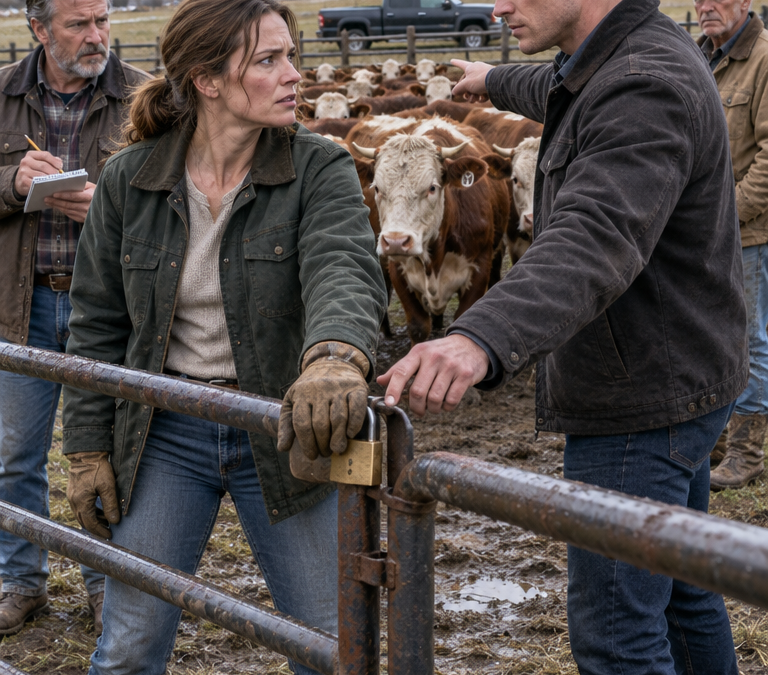
Marin Holt counted her cattle twice before she locked the gate.
Eighteen.
Not seventeen. Not nineteen. Eighteen.
She stood beside the east pasture fence with her breath hanging pale in the evening air, checked the number one more time against the red-and-white bodies scattered across the low grass, then wrote it in the green cloth notebook she carried under one arm.
October 17. Eighteen head. All present.
Then she snapped a new brass padlock through the gate latch and walked toward the house.
Holt Meadow Farm occupied seventy-four acres in a shallow fold of country east of Montana’s Bitterroot foothills. It was grass, gravel, stubborn sage, weathered fencing, one old barn, a modest house, and an irrigation system that seemed to have been installed when replacement parts were still made by blacksmiths.
The property had changed hands four times in thirty years.
Marin had bought it twenty-two months earlier with a loan large enough to make the banker in Corvallis raise both eyebrows and a divorce settlement that barely covered the down payment. She had arrived with a used pickup whose passenger-side mirror was cracked, a third-grade daughter named Sophie, and the conviction that she could learn faster than the land could punish her mistakes.
Nobody in the valley had openly told her she would fail.
They had not needed to.
At thirty-six, Marin was old enough to recognize the difference between courtesy and confidence.
The farm came with eighteen Hereford cows, and those animals were not decorative evidence of a rural dream. They were the farm’s business plan. They represented calves, feed bills, veterinary costs, winter hay, loan payments, fuel, repairs, school clothes, and the thin margin separating another season from a FOR SALE sign beside the cattle guard.
Marin had no hired crew. No foreman. No second truck.
A neighbor’s teenage son helped during haying and branding when she had enough cash to pay him. Wade Callahan, a fifty-eight-year-old veterinarian, drove out when something needed more than common sense. Elias Boon, who lived in a small house down the county road, appeared whenever a fence problem required knowledge accumulated over decades.
Everything else belonged to Marin.
She kept lists on the backs of envelopes, feed-store receipts, the margins of bank statements and, most importantly, in the green notebook on the shelf by the door.
Every evening before going inside, she counted.
She counted slowly and aloud, beginning at the ditch corner because that gave her the cleanest line across the pasture. Then she wrote the number down beside the date. If one animal was limping, off feed, carrying differently, or simply making her pay attention, she noted that too.
It was not romantic.
It was bookkeeping.
A cow that disappeared without a record could become somebody else’s version of events. Marin preferred numbers she had written herself.
The Blackwoods had noticed her almost as soon as she arrived.
Sterling Blackwood ran Blackwood Cattle Holdings, an operation spread across thousands of acres and three drainages. His family name appeared on trucks, association boards, feed accounts and land maps. Four generations of ranching had turned the name into something larger than ownership.
It had become credibility.
During Marin’s first spring, Sterling came to Holt Meadow personally.
He wore a dark wool coat that looked as though it cost more than her irrigation pump. He admired the mountains. He asked about her water. He complimented the lower pasture.
Then he offered to buy the entire property.
The number was roughly two-thirds of what Marin had paid.
She assumed he expected negotiation.
“I’m not selling,” she told him.
Sterling smiled as if she had said something understandable but temporary.
“Hard country,” he said. “This place needs a real rancher.”
He thanked her for her time and drove away.
Marin stood at the gate watching dust settle behind his car and had the uncomfortable sense that he had not been disappointed.
He had simply measured her.
His nephew Preston was less polished.
Preston Blackwood was thirty-one and handled much of the day-to-day operation. He liked an audience. At the feed store that August, Marin walked in while he was leaning against the counter with three local ranchers.
He did not lower his voice.
“The lady at Holt Meadow still running that backyard pasture?” he asked.
One of the men laughed.
Preston gave Marin a friendly smile.
“I say she makes it two winters.”
The other men laughed then too.
Marin paid for her mineral tubs, carried them out without accepting help, loaded them into her pickup and drove away.
She did not tell Sophie.
She did not tell Wade.
She did not even tell Elias.
There was too much work to do to give other people’s opinions a full evening.
The night everything changed began without drama.
Three days earlier, wind had brought down a cottonwood limb somewhere near the north ridge. Marin walked the fence at dusk looking for broken wire or a leaning post.
She found neither.
She latched the east gate, threaded her new brass padlock through it and checked it once.
Then she counted.
Eighteen.
She wrote the number in the green notebook.
As she turned toward the house, she heard cattle.
The sound came from the high ground north of her property, where none of her animals grazed. It was a deeper, fuller chorus than eighteen cows should have made.
Marin stopped and listened.
Blackwood cattle occupied several ranges in that direction, though the nearest active pasture was miles away. Cold air carried sound strangely through the valley.
She decided that was all she was hearing.
She went inside.
The next morning, cattle noise woke her before the alarm.
Marin pulled on her work coat and boots, poured coffee and opened the front door.
She made it three steps onto the porch before stopping so abruptly that coffee rolled over the rim of her mug and splashed onto one boot.
Her pasture looked full.
Not disturbed.
Not damaged.
Full.
Red backs and white faces stood shoulder to shoulder in the cold, their breath lifting in pale clouds. The grass beneath them had almost disappeared.
Marin set the mug on the porch rail.
She walked quickly toward the fence.
At the ditch corner, she began counting.
Thirty-nine.
She stared across the pasture.
Then she started over.
Thirty-nine.
A third time gave her the same number.
There were twenty-one cattle in Holt Meadow that had not been there the evening before.
Marin walked the entire perimeter.
No broken wire.
No sprung strand.
No leaning corner post.
The east gate remained locked with her brass padlock.
The key was still on the ring in her pocket.
Rain earlier that week had softened the driveway enough to preserve tracks. Marin found her pickup tires from the previous afternoon and the narrower marks from Sophie’s bicycle.
Nothing else.
A stock trailer carrying twenty-one adult cattle would have left deep ruts.
There were none.
She went into the pasture.
The newcomers did not behave like lost animals that had pushed through miles of brush. Their coats were thick and clean. Their feet had been maintained. They carried good flesh through the hip. They moved away from Marin without panic, then settled almost immediately.
Someone had managed them carefully.
Recently.
Marin caught the nearest cow gently and examined its tag.
That was when she noticed the other mark.
Behind the cow’s left ear was a small symbol, old enough to be deliberate rather than recent.
An H inside a closed circle.
Marin checked another cow.
Same mark.
A fifth.
Same.
A twelfth.
Same.
Every one of the twenty-one newcomers carried it.
Her own eighteen did not.
Marin called Wade Callahan before anyone else.
He arrived within the hour with a veterinary bag, a notebook and the patient expression of a man accustomed to being summoned by problems that could not explain themselves.
Wade examined the cattle one by one.
He checked eyes, feet, condition and teeth. He ran his thumb over the mark behind one animal’s ear.
“They’re sound,” he said.
“Strays?”
“Not the way most people mean it.”
He looked across the group.
“Whoever bred these cattle cared about cold tolerance. They’re not show-ring cattle. They were built to hold condition.”
Marin pointed at the mark.
“You know it?”
Wade studied it again.
“I feel like I’ve seen it.”
“Where?”
“That’s the problem. I don’t remember.”
Elias Boon came up the drive on foot about ten minutes later.
At sixty-seven, Elias had spent most of his adult life working for larger ranches before his knees forced him into smaller jobs. He had the kind of face that made silence look natural.
He leaned on the fence and watched Wade examine the herd.
Then he stepped closer.
One of the marked cows turned.
Elias saw behind its left ear.
His expression changed.
It happened so quickly that Marin might have missed it if Wade had not looked up at the same moment.
Marin pulled out her phone.
“I’m calling the sheriff’s office,” she said. “Then the brand inspector. Then every ranch within fifteen miles.”
Elias looked at her.
“Wait.”
“These belong to somebody.”
“I know.”
“Then what am I waiting for?”
Elias removed his cap, ran one hand over his hair and put it back on.
“Call anybody you want.”
He glanced toward the county road.
“Just don’t call Blackwood yet.”
Marin frowned.
“Why?”
Before Elias could answer, an engine climbed the road.
A dark pickup came fast around the bend, slowed at the cattle guard and turned into Marin’s drive.
Preston Blackwood stepped out.
He looked once at the pasture and walked toward the gate like a man entering his own property.
“You’re holding our cattle,” he said.
Marin did not open the gate.
She stood with one hand resting over the latch.
“How did you know they were here?”
Preston stopped.
The pause lasted no more than half a breath.
But Wade saw it.
Elias saw it.
Marin saw it.
Then Preston recovered.
“Morning count came up short,” he said. “Crew started searching.”
Marin let the explanation sit between them.
The nearest Blackwood ground carrying cattle was several miles north, separated from Holt Meadow by broken country. Even if the missing animals had been noticed at first light, a crew searching randomly could not reasonably have reached her gate this quickly.
Especially when Marin herself had made no call.
Preston stepped closer.
“Open it.”
Marin stayed where she was.
“You said your crew was searching.”
“That’s right.”
“How many are missing?”
His eyes moved beyond her.
He began counting.
Marin watched carefully.
He did not count all thirty-nine cattle.
His gaze tracked only the newcomers.
When he finished, he nodded slightly.
Twenty-one.
He had known the number before reaching the gate.
Marin felt something inside her become very quiet.
“Nothing leaves,” she said.
Preston gave a short laugh.
“You serious?”
“Until the identification is checked.”
“They’re ours.”
“Then paperwork should make that easy.”
His expression hardened.
“You have any idea what those cattle are worth?”
“No.”
“More than this little place.”
He gestured toward the house, barn and pasture.
“Fence posts and all.”
Wade lowered his pencil.
Preston looked at Marin again.
“You should think about the kind of trouble you’re volunteering for.”
The insult was not hidden inside the sentence.
It was the purpose of it.
Marin did not argue.
She kept her hand on the gate.
Preston returned to his truck, made a call with the windows closed and stayed parked in the driveway.
That told Marin something else.
He was waiting for someone already on the way.
Forty minutes later, Sterling Blackwood arrived in a dark sedan unsuited to muddy ranch roads.
He brought an attorney.
Victoria Harrington stepped from the passenger side wearing a courthouse-ready charcoal coat and carrying an open leather folder.
Sterling greeted Marin by name.
“Morning, Ms. Holt.”
He asked about Sophie.
He never raised his voice.
That made the pressure heavier, not lighter.
He listened to Marin’s description of the morning and then nodded sympathetically.
“Sounds like a strange situation.”
“It is.”
“We can make it simple.”
Sterling proposed that Marin open the gate. His crew would gather the twenty-one cattle and return them to Blackwood property. No complaint. No report. No inconvenience.
Everyone would forget the episode.
He said forget as though it were something generous he could give her.
Victoria took over smoothly.
“Once you have notice of an ownership claim,” she said, “continued control of livestock can become complicated.”
“I didn’t bring them here.”
“No one said you did.”
“My gate was locked.”
“I understand.”
“Then you understand why I want the inspector.”
Victoria’s expression did not change.
“Of course. I’m simply advising you that unnecessary delay can create civil exposure.”
In less than three hours, Marin had been transformed from the woman who woke to find strange cattle on her property into the person whose behavior required explanation.
She had opened no fence.
Moved no animal.
Taken nothing.
Called no one.
Yet Sterling, Preston and an attorney were now standing on her driveway explaining why cooperation was the safest option.
Wade spent most of that conversation at the far end of the pasture.
He wrote down tag numbers and examined each unfamiliar animal individually.
When Sterling finally turned toward his car, Wade walked up beside Marin.
He waited until Sterling was out of easy hearing.
“There’s a problem,” Wade said.
“What?”
“Whatever these cattle are, they aren’t carrying Blackwood registration numbers.”
Marin looked toward the pasture.
Wade closed his notebook.
“And Preston should know that.”
The valley had a version of the story by lunchtime.
By evening, it had become a joke.
At the feed store in Corvallis, people heard that the divorced woman playing rancher at Holt Meadow had somehow mixed up her own animals with Blackwood cattle.
At the auction barn, Preston told people his family had tried to make the situation easy.
Marin, he said, had decided to make it difficult.
He delivered the story with patient amusement rather than anger, and that made it more effective.
People nodded.
The Blackwoods had been in the valley for four generations.
Marin had been there twenty-two months.
That night, she lay awake listening to the cattle outside.
She had done nothing wrong.
That fact should have comforted her.
It did not.
In a contest between stories, the expensive story had already arrived with a head start.
Blackwood had land, trucks, history, a lawyer and a name people recognized.
Marin had a green notebook and a pickup with a cracked mirror.
Sterling returned the following Thursday alone.
This time he did not threaten anything.
He offered mercy.
Release the twenty-one cattle, he said, and Blackwood Cattle Holdings would seek no damages, feed reimbursement or legal remedy.
Then he changed subjects.
“I know the bank position on this place is tight.”
Marin watched him carefully.
Sterling smiled.
“That’s not criticism. Most small operations run tight.”
He offered to buy Holt Meadow.
The price would clear her loan entirely and leave enough money for Marin and Sophie to start somewhere easier.
He spoke warmly.
“This country is hard on people trying to do everything alone.”
For one dangerous moment, Marin believed the kindness in his voice.
Then he left.
She watched his sedan disappear toward the county road.
Inside the kitchen, Marin sat at the table without removing her coat.
The title-company folder from the purchase of Holt Meadow was stored in a drawer with insurance records and tax documents.
She pulled it out.
A question had come loose while Sterling talked.
He had arrived with an attorney to reclaim twenty-one cattle.
Now, days later, he wanted seventy-four acres.
Men did not increase the bid for something they were not actually trying to obtain.
Marin opened the purchase file.
The paperwork was thick with legal descriptions, recorded instruments and chain-of-title pages she had signed and initialed during closing without ever imagining she would read them again.
She followed the history backward.
Holt Meadow had once been part of a larger property.
The northern ridge, including the ground where Marin had checked her fence the night before the cattle appeared, had been carved decades earlier from an operation that no longer existed.
She read the name twice.
Hollow Circle Ranch.
The ranch had been dissolved more than thirty years earlier.
Some land became what was now Holt Meadow.
Another substantial portion had eventually become Blackwood property.
Marin sat very still.
After dark, she pulled on boots over her pajama pants, took a flashlight and walked into the pasture.
She found one of the strange cows.
The animal allowed Marin close.
She lifted its left ear and aimed the flashlight.
H.
Inside a circle.
Hollow Circle.
The symbol was not decoration.
It was a ranch name written as a picture.
The answer had been on every animal from the beginning.
Marin simply had not known how to read it.
Elias finally agreed to talk that Saturday.
He sat on an upturned bucket inside the equipment shed with coffee between both hands.
Wade leaned against the doorway.
“Hollow Circle wasn’t big,” Elias began. “Couple hundred head, maybe. But people knew the cattle.”
The owner had spent decades selecting Herefords for one purpose: animals that could hold flesh, calve efficiently and breed back through brutal Montana winters without expensive intervention.
Buyers came from Wyoming and the Dakotas.
The line became more famous than the ranch itself.
“What happened to it?” Marin asked.
Elias stared into his coffee.
“Owner died.”
“What was his name?”
“Caleb Holt.”
Marin put down her cup.
“My last name is Holt.”
“I know.”
“My father was Holt.”
Elias nodded.
Marin’s father had left Montana for Oregon before she was born. He had been a quiet man who avoided family history. He died when Marin was twenty-six.
Everything she knew about his relatives could have fit on a postcard.
Elias finished the connection for her.
“Caleb was your father’s uncle.”
Marin looked through the open shed door toward the pasture.
She had bought Holt Meadow because it was the only property she could afford with enough usable ground to matter.
She had considered the similarity between Holt and Holt Meadow a coincidence.
It had never occurred to her that the name might be residue.
“After Caleb died,” Elias continued, “Hollow Circle broke apart fast.”
There were no direct heirs nearby willing to run it.
Land went one direction.
Cattle went another.
Most people believed the herd had been dispersed at auction and absorbed into other lines.
Bloodlines disappeared that way all the time.
A rancher died.
Animals sold in groups.
A generation later, the cattle were still alive in somebody’s pasture, but the name was gone.
Elias paused.
“Not all of them disappeared.”
Marin looked at him.
Caleb, Elias explained, had been unusually cautious about his breeding program. During the years before his death, he had placed selected bulls and heifers with several neighboring operations under breeding agreements.
He did not sell everything outright.
It was a form of insurance.
Copies of something valuable stored in different places.
The animals left Hollow Circle quietly.
Their descendants continued long after the original ranch disappeared.
The line had not died.
It had simply lost its public name.
Marin looked toward the twenty-one cattle.
“Then why are they together?”
Neither man answered.
“If they were scattered among several herds thirty years ago, why did twenty-one direct descendants walk onto my property in one group?”
Wade folded his arms.
“And why did Preston know where they were?”
That was the more dangerous question.
Twenty-one cattle carrying Caleb Holt’s private mark had appeared together on the land where Hollow Circle once stood.
Blackwood had arrived before anyone called them.
Wade looked toward the old barn.
“These animals aren’t just cattle anymore.”
“What are they?”
“A record.”
The old barn at Holt Meadow predated the house.
Marin used two-thirds of it for hay, tools and equipment. The back portion contained a narrow room that had once been a tack room.
Inside stood a wooden cabinet secured by a rusted hasp.
Marin had noticed it during her first month and put OPEN OLD CABINET on a long list of tasks beneath FIX SOUTH IRRIGATION VALVE and REPLACE LOFT LADDER.
It had stayed there.
On Sunday afternoon, she carried a pry bar and Sophie’s flashlight into the tack room.
The hasp gave after several attempts.
There was no money inside.
No coins.
No valuable jewelry.
No romantic family treasure.
There were records.
Eleven hardbound herd ledgers.
Several brittle linen-backed maps.
Stacks of breeding certificates tied with cotton string.
Feed receipts.
Correspondence.
Old agreements.
Marin knelt on the wooden floor for four hours.
By the second hour, she understood that the least glamorous discovery imaginable might be the most dangerous thing she could have found.
The ledgers were written in the same small upright handwriting across decades.
Caleb Holt recorded animals one by one.
Breeding dates.
Calves.
Losses.
Sales.
Health observations.
Weather.
Marin ran one finger across a page and felt something unexpectedly personal.
The habit was familiar.
A man she had never met had kept cattle the same way she did.
One animal.
One date.
One fact at a time.
Near the end of the final ledger, the entries changed.
They began discussing an arrangement with a neighboring ranch.
The neighboring operator was Sterling Blackwood’s father.
A typed letter had been folded into the back cover.
The terms were straightforward.
Hollow Circle permitted Blackwood to use a defined section of upper grazing ground for a limited term. Blackwood also received access to selected Hollow Circle genetics through specific breeding animals.
In exchange, Blackwood provided winter feed and maintained certain fences and water improvements.
Marin read the agreement again.
Then once more.
It granted use.
Not ownership.
Nowhere did Caleb Holt transfer the land.
On Monday morning, Marin drove to the county offices.
She requested current parcel maps for the upper bench named in Caleb’s agreement.
Under fluorescent lights, seated in a plastic chair, she spread the current map beside a copy of the old description.
The land was now fully inside Blackwood holdings.
No visible qualification.
No note of temporary use.
No obvious dispute.
The map treated it as though Blackwood had always owned it.
Somewhere between Caleb’s agreement and the modern deed were thirty years, a death, a rapid ranch dissolution and a trail of filings Marin did not yet understand.
Two days after Marin’s courthouse visit, a letter from Victoria Harrington arrived.
That alone interested her.
Very few people knew what records she had requested.
Victoria’s letter described the Hollow Circle material as historical documents of uncertain provenance.
Private ledgers, she wrote, could not override a recorded chain of title.
Informal historical arrangements might have been superseded by later instruments.
The last paragraph suggested Marin carefully consider the expense of pursuing a theory against settled land records.
The letter was professional.
Polite.
Almost helpful.
Marin read it twice.
Then she put it beside Caleb’s ledger.
Sterling came to her house again at the end of the week.
He did not mention the twenty-one cattle.
Not once.
Six days earlier, he had brought an attorney onto Marin’s property to demand their immediate release.
Now he sat at her kitchen table talking about the coming winter, feed prices and her bank loan.
Then he made another offer for Holt Meadow.
Three times the county-assessed value.
Cash.
Thirty-day closing.
A leaseback allowing Marin and Sophie to remain through the school year.
The number was enormous.
It was also the loudest answer anyone had given her.
Sterling did not want the cattle issue simplified.
He wanted Marin and her title removed from the equation.
After he left, Wade came by.
Marin told him the offer.
He whistled softly.
“Three times assessment?”
“Yes.”
“For seventy-four acres?”
“Yes.”
Wade looked north.
“I have a theory.”
His theory had nothing to do with deeds.
“Cattle don’t teleport.”
Three mornings later, Wade, Elias and Marin started above Holt Meadow on foot.
If no truck came through Marin’s driveway and no fence had been broken, the twenty-one animals had reached her property by walking.
Animals walking in wet country left evidence.
They followed the north slope for more than a mile.
Elias found the trail in a dry draw choked with brush.
From twenty yards away, it looked like solid hillside.
Inside, the vegetation opened into a narrow corridor.
The ground was packed hard beneath waist-high grass.
Hoofprints remained in damp clay.
Dozens.
All pointed downhill.
All recent.
Half buried beneath decades of growth stood old cedar fence posts.
Marin touched one.
“What is this?”
“Stock driveway,” Elias said.
A fenced corridor designed to move livestock between seasonal ranges.
Hollow Circle had built it.
Marin remembered the linen map from the cabinet.
Two thin parallel lines ran north from the low ground.
She had assumed they represented a creek.
They represented fences.
The three of them followed the corridor uphill.
At its upper end, hidden completely from any public road, they found an old wooden gate.
One hinge post had rotted near the ground.
Recent rain had softened the soil.
The post leaned.
The latch pin had slipped free.
The gate had swung open.
That was all.
No midnight trailer.
No cut fence.
No secret delivery.
No one had planted twenty-one cattle in Marin’s pasture.
A rotten post had opened a forgotten livestock corridor.
The cattle had walked through it.
The explanation was so ordinary that Marin almost laughed.
For weeks, she had treated their arrival as an act committed against her.
It had not been.
The animals themselves had chosen the route.
But that solved only the mechanism.
It created a larger question.
Where did the corridor begin?
They continued another two miles uphill.
The brush eventually opened onto high bench country.
The grass was excellent.
A natural spring seeped near one edge.
One set of vehicle tracks entered from the north.
Elias turned slowly.
“Blackwood.”
The bench lay on Blackwood ground.
More precisely, it lay on the exact section of upper grazing land described in Caleb Holt’s final ledger.
Marin stood in the grass while every strange detail rearranged itself.
Blackwood Cattle Holdings had been running descendants of the Hollow Circle herd on original Hollow Circle upper range.
Preston knew twenty-one were missing because he knew the group.
He knew where to search because he knew the old corridor.
Sterling brought an attorney because the animals were never the primary exposure.
The cattle carried an identifier connecting a living herd to Hollow Circle.
Hollow Circle connected directly to the disputed ground.
The moment anyone traced one, they reached the other.
Sterling Blackwood had not been afraid of losing twenty-one cows.
He had been afraid of Marin learning what those cows represented.
Marin did not confront him.
She went home and began building a file.
For eleven days, Marin, Wade, Elias and a title attorney from Missoula named Ruth Vance assembled documents.
Ruth had no interest in dramatic theories.
“Paper first,” she said during their first meeting. “Then conclusions.”
Marin liked her immediately.
The green notebook became the starting point.
Twenty-two months of continuous nightly cattle counts.
Dates.
Numbers.
Observations.
The entry showing eighteen animals the night before.
The entry showing thirty-nine the morning after.
Ruth turned several pages.
“You kept this every day?”
“Almost every night.”
“Before any dispute existed?”
“Yes.”
“That matters.”
A record created routinely, without anticipation of litigation, was difficult to dismiss as something invented later.
Next came a motion camera Marin had installed near the calving shed to monitor heifers.
She had forgotten about it because the camera faced away from the driveway.
Wade asked to see the recordings anyway.
Between roughly two and four that morning, the camera captured cattle descending from the north slope.
One animal.
Then three.
Then a slow river of red-and-white bodies.
No trailer.
No vehicle.
No person.
Twenty-one animals entered Holt Meadow on foot.
Wade documented each one medically.
Tag numbers.
Age estimates.
Condition.
Photographs of the left-ear identifiers.
He wrote that the animals appeared closely related and consistent with a common breeding lineage.
Ruth matched the cattle against Caleb Holt’s breeding certificates.
The old papers named specific bulls.
Specific breeding arrangements.
Specific neighboring operations.
Then came Caleb’s final ledger and the typed use agreement involving Sterling’s father.
The brittle linen map followed.
Ruth hired a surveyor.
The survey confirmed that the old stock corridor existed physically in the exact location where Caleb had drawn the parallel lines.
Still, Ruth remained cautious.
“History is not ownership,” she warned Marin. “We need the recorded chain.”
That piece came from a county records clerk named Dolores Ames.
Dolores had worked in the recorder’s office for twenty-nine years and disliked being told that a file was complete when she suspected it was not.
During an early-2000s digitization project, some documents connected to Hollow Circle had been indexed incorrectly.
Dolores searched old instrument books manually.
Two days later, she called Ruth.
Among the misindexed documents was an addendum recorded during the dissolution of Hollow Circle.
It was signed.
Stamped.
Properly recorded.
And remarkably specific.
Blackwood’s interest in the upper bench was limited to the use described in Caleb Holt’s agreement.
Underlying ownership remained with the Hollow Circle estate and its successors.
Marin read the document with her hands flat on Ruth’s desk.
“So the land is mine?”
Ruth immediately shook her head.
“No.”
The answer hurt, but Marin appreciated it.
“Thirty years of possession matters. Taxes matter. Later filings matter. Boundaries don’t simply disappear because an old document turns up.”
“Then what does this do?”
Ruth tapped the addendum.
“It destroys the idea that their title is clean and unquestionable.”
That difference was everything.
Certainty had become a dispute.
A dispute could become negotiation.
Then Ruth placed a water map beside the parcel map.
A natural spring sat on the upper bench.
The spring supplied water that had been developed and piped over decades into four Blackwood summer pastures.
Without it, thousands of acres became much more expensive to use.
Water would need hauling.
Stocking patterns would change.
The forgotten corridor also connected two parts of the Blackwood operation.
Marin leaned back.
For two years, Sterling had tried to buy Holt Meadow.
Not because he loved her view.
Owning the lower parcel would have closed the geographic and documentary gap.
The upper bench, the spring and the old route could have been folded permanently into one undisputed Blackwood story.
Every polite offer had been an attempt to close a weakness in the title before someone noticed it.
Marin now understood why Sterling had called her land difficult.
Why Preston mocked her.
Why the offer increased after she found the ledgers.
Why an attorney appeared before an inspector.
And why twenty-one cattle had suddenly become worth forgetting.
There was no dramatic courtroom trial.
No packed gallery.
No shouted confession.
What happened instead took place on a Wednesday morning in a second-floor conference room at the county building.
Present were Marin, Ruth Vance, Sterling Blackwood, Victoria Harrington, a representative from the county surveyor’s office and a woman from the recorder’s office.
Marin wore her good coat.
She brought the green notebook.
Sterling remained gracious for the first forty minutes.
Victoria said very little.
She had reviewed Ruth’s file three days earlier.
Her silence told Marin more than Preston’s shouting ever had.
The Blackwood position had become trapped between two versions of the same fact.
If Blackwood insisted the twenty-one cattle were theirs, they had to explain those animals.
Where had they come from?
How had Blackwood acquired Hollow Circle genetics?
Under what agreements?
On what ground had those cattle been grazing?
Why were they using the exact upper bench described in Caleb Holt’s documents?
That road led directly to the misindexed addendum and the spring.
If Blackwood denied the cattle, then their original accusation against Marin collapsed.
They could no longer reduce the matter to an inexperienced woman holding somebody else’s stray livestock.
The animals had become the bridge between herd history and land history.
Preston had spent weeks joking that Marin could not count eighteen cows.
Now the entire problem depended on Blackwood explaining twenty-one.
Sterling withdrew the demand for immediate release.
He did it quietly.
He said the company wished to avoid burdening the county with an unnecessary livestock dispute.
Marin did not smile.
Ruth simply made a note.
It was the first formal concession.
Six weeks of negotiation followed.
The result was practical.
Blackwood Cattle Holdings acknowledged Marin’s ownership interest in the disputed section under a written settlement and corrected boundary record.
Marin granted Blackwood a defined long-term water-use right from the spring.
The rate was tied to market conditions.
Payments were annual.
Maintenance duties were written specifically enough that nobody could later pretend not to understand them.
The twenty-one cattle were resolved individually through records rather than reputation.
Some had been documented purchases made by Blackwood in good faith through descendants of old breeding arrangements.
Others were recognized as tied to the Hollow Circle estate and the parcel interest.
Every animal was inspected.
Tagged.
Recorded.
Nothing moved based on someone’s word alone.
Blackwood paid the survey expense, corrective filing costs and the legal fees required to clean up the record.
Ruth made that a condition.
Nobody argued very hard.
Marin kept Holt Meadow.
The annual water payment brought in more than the farm itself had cleared during either of its first two years.
More important, it arrived on a schedule.
Predictability changed a small operation.
Marin went back to the bank in Corvallis.
The same banker who had raised both eyebrows when she first borrowed against the farm reviewed the settlement and revised the loan.
This time Marin brought a document instead of optimism.
He did not raise either eyebrow.
Preston stopped making jokes at the feed store.
His original joke had depended on Marin being a woman who could not count.
The valley had now watched her record more carefully than anyone who laughed at her.
Several weeks later, aspens on the north slope turned yellow.
Elias and Marin loaded fence posts, wire and tools into her pickup and drove as far up the old draw as the truck could manage.
They spent the afternoon repairing the gate at the top of the stock corridor.
Elias unrolled Caleb’s linen map across the tailgate and weighted the corners with fencing pliers.
He rested one finger on the two thin parallel lines.
“You know why he built this?”
“To move cattle between pastures.”
“More than that.”
The upper bench was summer country.
Good grass.
Cold nights.
Open exposure.
When autumn weather shifted, the lower ground at Holt Meadow offered shelter, a creek that stayed reliable and protection from wind.
Caleb had designed the corridor so the herd could move with minimal handling.
Over time, the cattle learned the route.
Older cows followed it.
Younger cattle followed them.
Behavior passed through generations because animals learned from animals.
Thirty years after Hollow Circle disappeared, the route still existed beneath brush.
The herd still carried descendants of cattle that had walked it.
Then a wet week softened one old post.
The gate opened.
Twenty-one animals stood at that opening on a cold night and did what generations before them had done.
They moved downhill.
No conspiracy.
No magic.
No secret nighttime operation.
A rotten post.
A forgotten road.
A learned route.
And cattle carrying a history no person in the valley had bothered to preserve completely.
Marin stood at the top of the draw and looked toward Holt Meadow far below.
From that height, her pasture looked small.
So did the house.
So did the barn.
She remembered stepping onto the porch with coffee in her hand and seeing thirty-nine cattle where eighteen belonged.
At that moment, the number had represented disaster.
Twenty-one extra animals could mean liability, accusations, costs and a fight she could not afford.
Instead, those twenty-one cattle had walked down a mountain and exposed why a powerful family had spent two years trying to buy a farm most people considered marginal.
Marin had not survived because of a secret plan.
She had not been ten steps ahead.
She had spent much of the first week confused.
She had been frightened by legal language.
Humiliated by gossip.
Tempted by Sterling’s money.
What protected her was smaller.
She had counted.
Every night.
Long before anyone cared.
Long before there was a dispute.
Long before twenty-one unfamiliar animals appeared.
She had written the truth down while it was still ordinary.
Several months after the settlement, Holt Meadow remained a small ranch.
It did not become an empire.
Marin still repaired fences herself.
The cracked mirror stayed on her pickup longer than it should have because replacing it never became the most urgent expense.
In February, she still sat at the kitchen table calculating hay costs.
Sophie still named calves after weather.
The difference was that the arithmetic now landed on the right side of the line more often.
When something broke, Marin could fix it correctly instead of temporarily.
A new sign appeared at the gate.
Elias made it from barnwood and burned the lettering into the plank because, according to him, paint was for people in a hurry.
It read:
HOLT MEADOW
Below it, in smaller letters:
HOME OF THE HOLLOW CIRCLE LINE
Wade teased Marin about the sign every time he came out.
One afternoon, while washing his hands at the hydrant, he nodded toward the pasture.
“Woman of your standing ought to hire somebody to count those cattle.”
Marin looked at him.
“No.”
Wade grinned.
He kept asking because the answer became the joke.
Every evening, Marin still walked to the ditch corner with the green notebook under her arm.
The number was larger now.
Every animal carried a tag.
Every animal had a file.
Some lines of descent could be followed back to Caleb Holt, a man Marin had never met whose habits nevertheless felt strangely familiar.
Occasionally, a Blackwood truck passed along the county road while Marin counted.
It never slowed.
Marin never turned to watch it.
She never received an apology from Sterling Blackwood.
Eventually, she stopped wanting one.
The goal had never been to ruin him.
It had never been to hear Preston admit he was wrong in front of the men who laughed at the feed store.
The meaningful change was simpler.
Sterling could no longer look at Holt Meadow and see an easy piece of ground owned by someone who could be pushed into selling.
Preston could no longer turn Marin into a joke merely by repeating the joke louder.
The valley had learned that reputation was not the same thing as evidence.
Marin had learned it too.
Some evenings, after finishing the count, she opened Caleb’s old ledger beside her green notebook.
His handwriting was smaller than hers.
Straighter.
More patient.
But the rhythm was familiar.
Date.
Animal.
Observation.
Fact.
Thirty years after Hollow Circle disappeared, careful records had lasted longer than assumptions.
And on ordinary nights, with no audience and no reason to believe anything remarkable would happen, Marin kept adding new pages.