Greta Voss had one hand on the conference-room door, walking away from an $80 million deal, when the facilities worker holding the coffee carafe finally spoke. “Page eleven. Line three.” Six executives turned toward Marcus Bell—and the one man who had treated him like furniture suddenly stopped smiling.
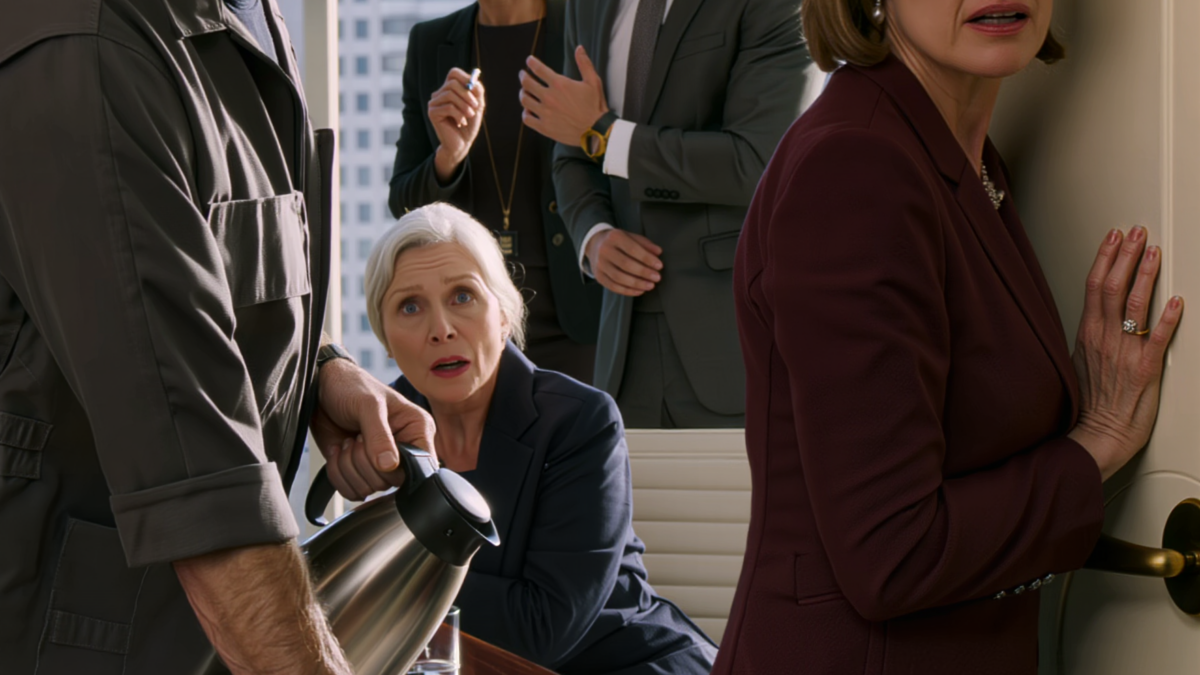
“I think we’re done here.”
Greta Voss didn’t raise her voice.
She didn’t slam her folder against the table or make a dramatic speech. She simply pushed her chair back, and the soft scrape of leather and steel across the conference-room floor managed to cut through the room more sharply than shouting would have.
On the far wall, an acquisition slide still glowed above the table.
$80 million.
That was the number six executives from the Hail Group had spent most of the morning talking about.
To them, it was a generous offer.
To Greta, it had become something else.
She gathered the dark leather folder in front of her and walked toward the door.
Eleanor Hail stood too quickly.
“Greta.”
The CEO of the Hail Group was in her early sixties, silver-haired and controlled even when she was tired. That morning, however, Marcus Bell had noticed something beneath the polish.
Fear.
Eleanor needed this acquisition.
That made her dangerous in a different way than someone who simply wanted it.
“Whatever the problem is,” Eleanor said, “tell me. Tell me the number. Tell me the term. We’ll fix it right now.”
Greta stopped.
“It’s not a number.”
For a room full of people trained to solve problems with numbers, the answer created an uncomfortable pause.
Marcus Bell stood beside the credenza holding a stainless-steel coffee carafe.
He was forty-six years old, wore a gray facilities uniform, and had been in and out of the conference room four times that morning.
Not one of the senior people seated around the table had asked his name.
Most of them probably assumed they would never need it.
Trevor Lang, the Hail Group’s vice president of strategy, had certainly never bothered.
Trevor called him “chief.”
Sometimes “big guy.”
More often, simply, “Hey, you.”
Marcus had learned not to react.
The job required flexibility, not pride.
Or at least that was what he had been telling himself for three years.
That morning, however, one sentence from his nine-year-old son had been following him all the way through the building.
Why do you let them talk to you like that?
Marcus looked at Greta.
She was three steps from the door.
Then he looked at the document open on the table.
Page eleven.
Line three.
Forty minutes earlier, while the acquisition team had been talking about valuation, efficiencies, synergies, and restructuring, Marcus had seen that line appear on the screen.
Facility A1 — Elkhart Falls, Ohio.
Original site: 1971.
Status: legacy asset.
Recommendation: decommission, Q3.
Nobody at the table had paused.
Marcus had.
Because he knew Facility A1.
He knew exactly what it was.
And he knew why Greta Voss was walking away.
Six hours earlier, none of this had seemed possible.
Marcus had awakened at 5:10 a.m., before the alarm.
His body had stopped trusting alarms during the years when his wife was sick. Even now, three years after her death, he usually woke a few minutes early and lay still in the darkness, listening to the apartment.
Two bedrooms.
A small kitchen.
A radiator that knocked when the heat came on.
And from the room down the hallway, the steady breathing of his son.
Marcus got up quietly.
He packed two lunches.
One for Elijah.
One for himself.
They were nearly identical because buying lunch downtown cost money Marcus didn’t currently have.
On the whiteboard beside the front door, he wrote reminders.
Reading log signed.
Field-trip form on counter.
I love you.
Be brave.
He had written those last two words every morning since his wife’s funeral.
Some days, he suspected they were more for himself than for Elijah.
A red envelope sat beneath the field-trip form.
FINAL NOTICE.
The landlord had underlined the deadline twice.
Eleven days.
Marcus turned the envelope facedown before Elijah came into the kitchen.
He had already done the math.
Doing it again wouldn’t make the numbers move.
At 6:40, father and son walked to the bus stop.
March in Chicago had turned the sky the color of old steel. Dirty snow remained in the shaded corners of parking lots, while cold wind pushed along the sidewalk as though winter were refusing to admit it had lost.
Elijah wore his hood up and his backpack straps pulled tightly across his shoulders.
He had his mother’s eyes.
Marcus noticed them every day.
“You have your inhaler?”
“Yeah.”
“Reading log?”
“In my bag.”
“Lunch?”
Elijah lifted the lunch bag.
Marcus nodded.
“Good.”
The school bus pulled toward the curb.
Its brakes hissed.
Elijah stepped toward it, then stopped.
“Dad?”
“Yeah?”
The boy looked down.
“Why do you let them talk to you like that?”
Marcus didn’t move.
“Who?”
“The men at your office.”
“What men?”
“The one with the shiny watch. When you picked me up there that time.”
Trevor.
Marcus remembered.
A late afternoon months earlier.
Elijah had waited near the service desk while Marcus finished breaking down a conference room.
Trevor had walked past and pointed toward the door.
“Get that for me, big guy.”
Elijah had watched.
Marcus had barely registered the interaction.
His son had.
“He talked to you like…” Elijah hesitated.
The bus doors were open behind him.
The driver waited patiently.
“Like what?”
Elijah shrugged in the frustrated way children did when they understood a feeling but hadn’t found the adult word for it.
“Like you weren’t even there.”
Marcus felt something tighten beneath his ribs.
“We’ll talk tonight.”
“Okay.”
“Go. You’ll miss the bus.”
Elijah ran up the steps.
Marcus stayed on the sidewalk until the bus disappeared around the corner.
Why do you let them talk to you like that?
Because I have to.
That was the answer he didn’t give.
Because three years ago I had a wife, a house, a profession, and a life that made sense.
Because illness took one piece after another.
Because medical bills survived even when the person they were meant to save didn’t.
Because contract mediation required travel, unpredictable hours, and a life he no longer had.
Because this facilities job allowed him to leave at a predictable time and be waiting when Elijah needed him.
Because dignity sometimes looked like swallowing an insult if swallowing it kept a roof over your child’s head.
Marcus didn’t say any of that.
You didn’t place adult burdens on a nine-year-old.
He caught the bus downtown.
The Hail Group occupied twelve floors of a glass tower on Wacker Drive.
Marcus worked in facilities and event logistics.
The title sounded more impressive than the job usually felt.
He set rooms.
Reset rooms.
Moved tables.
Troubleshot audiovisual problems.
Carried equipment.
Coordinated catering.
Replaced broken things before someone with a better office noticed they had been broken.
Marcus was good at it.
He had always been good at noticing the small things holding a larger system together.
That skill had once made him valuable in a different kind of room.
Around 7:30, his supervisor, Rosa, found him near the freight elevators.
She was holding a clipboard and looked as though she had already lived half a day before breakfast.
“Big one upstairs,” she said.
“What’s happening?”
“Voss acquisition. Forty. Main conference room. They want coffee service all morning, good carafes, water checked hourly, no interruptions.”
She lowered her voice.
“Lang is running point.”
Marcus kept his expression neutral.
“Got it.”
Then Rosa added, “Voss Manufacturing. Elkhart Falls.”
That stopped him.
He had not heard the company name spoken aloud in years.
“Something wrong?”
“No.”
But something was.
Marcus knew Voss Manufacturing.
He knew Elkhart Falls.
He had once walked the floor of that plant wearing a suit instead of a facilities uniform.
In 2014, he had spent five weeks there mediating a labor dispute that had come within days of shutting down the company.
More than four hundred jobs had been at risk.
Management and the union had stopped speaking directly to each other.
Marcus had gotten them back into the same room.
At the end, Henry Voss had shaken his hand.
The old man repeatedly forgot Marcus’s name and eventually started calling him “the quiet one.”
Marcus had never been sure whether it was a compliment.
Years later, he decided it probably had been.
Henry Voss had died the previous November.
Marcus remembered seeing the headline.
Now Henry’s daughter was upstairs preparing to sell the company.
Marcus said nothing to Rosa.
He needed the paycheck, not attention.
He took the service elevator to the fortieth floor and prepared the room.
Coffee carafes squared with the table.
Water glasses aligned.
Lighting adjusted slightly so the presentation screens remained readable without turning the people around the table into silhouettes.
Marcus had once arranged negotiations from the chair.
Now he arranged the chair itself.
At eight, the executives began arriving.
Eleanor Hail came first.
Then legal counsel.
The M&A team.
Trevor Lang arrived last.
Of course he did.
Marcus had known men like Trevor throughout his previous career.
They entered late because arriving late turned a normal entrance into an announcement.
Trevor wore an expensive charcoal suit and a watch polished enough to flash under the conference lights when he moved his wrist.
He didn’t acknowledge Marcus.
Greta Voss arrived last from the other side of the deal.
About fifty.
Dark suit.
Leather folder.
No entourage.
No jewelry chosen to impress anyone.
Marcus watched her scan the room once.
He recognized the expression.
She wasn’t there because she wanted to sell.
She was there because she had run out of ways not to.
Eleanor welcomed her and spoke respectfully about Henry Voss.
She said the Hail Group intended to honor what he had built.
Greta gave a small nod.
Marcus knew that nod too.
It was the nod people gave after hearing the word honor used by someone who meant acquire.
The presentation began.
Voss Manufacturing had been founded in 1971.
Three facilities.
A specialty machining business.
Roughly 410 employees.
Decades of reputation.
And debt Greta could no longer comfortably carry after her father’s death.
The Hail Group’s offer was worth approximately $80 million in cash and equity.
On paper, it looked generous.
For the first hour, nothing openly went wrong.
Marcus poured coffee and listened without appearing to listen.
He noticed Greta’s hands.
Flat on the table.
Very still.
He noticed the slight movement around her eyes whenever someone said “efficiency.”
He noticed Trevor checking his phone beneath the table.
Once, after reading a message, the corner of Trevor’s mouth moved.
Not quite a smile.
Something smaller.
More private.
Marcus filed it away.
Old habit.
A mediator learned to notice what people did when they believed nobody important was watching.
Around 9:40, the team reached the asset schedule.
Page eleven.
Facility A1.
Elkhart Falls.
Decommission, Q3.
Marcus saw it.
Then he watched Greta see it.
Her hands remained flat on the table, but the meaning of their stillness changed.
Marcus knew why.
Facility A1 was the original shop.
Henry Voss had built it after taking out a second mortgage.
Two employees had worked beside him in the beginning.
The original loading dock still carried his name in his own handwriting.
In Elkhart Falls, everyone knew the story.
The Hail Group executives apparently did not.
Or hadn’t considered it important.
Nobody paused on the slide.
They moved immediately into equity structure.
Greta said almost nothing for the next forty minutes.
Then she stood.
“I think we’re done here.”
Eleanor asked for a number.
A term.
Anything she could renegotiate.
Greta said it wasn’t a number.
The M&A lead offered to adjust the earnout.
Trevor leaned back.
His watch caught the light.
“Greta, with respect, this is the strongest offer you’re likely to see. Your company has real debt and real operating problems. There isn’t another buyer at this price.”
Greta looked at him.
Trevor continued.
“I’d hate to see emotion get in the way of the right decision for your people.”
Your people.
Marcus saw Greta’s jaw tighten.
She reached for the door.
He set down the carafe.
“Miss Voss.”
Everyone looked toward him.
Trevor’s expression hardened.
“You. We’re in a meeting.”
Marcus looked at the open presentation materials.
“Page eleven.”
Trevor’s eyes narrowed.
“Excuse me?”
“Line three. Facility A1. You’ve marked it for decommissioning in Q3.”
Eleanor frowned.
“The original site?”
One of the acquisition people nodded.
“Legacy facility. Operationally obsolete.”
“It isn’t obsolete,” Marcus said.
Trevor turned fully toward him.
Marcus kept going.
“It’s the first shop Henry Voss built. 1971. He took a second mortgage to open it. His name is still on the loading dock in his own handwriting.”
The room became still.
Greta had not moved.
Marcus looked at her.
“You’ve spent two hours listening to six people tell you what your father’s life is worth.”
Trevor opened his mouth, but Marcus continued before he could interrupt.
“Then you turned a page and discovered they plan to remove the place where he started it.”
Greta’s eyes shone.
Marcus asked quietly, “That’s why you’re leaving, isn’t it?”
She took a breath.
“Yes.”
Eleanor turned toward the screen.
For the first time all morning, she seemed to be seeing the line.
“Take it out.”
Trevor shifted.
“Eleanor—”
“Take the recommendation out.”
The analyst at the laptop changed the slide.
The line disappeared.
Nobody relaxed.
A sentence could be removed from a presentation.
Its meaning couldn’t.
Greta still held the door.
Marcus stepped forward once.
“Miss Voss, give them twenty minutes.”
Trevor stared at him.
Marcus ignored him.
“I don’t think the deal is dead. I think everybody in this room just learned what the deal is actually about.”
Greta studied Marcus.
For several seconds, neither of them spoke.
“Twenty minutes,” she finally said.
Then she released the door and returned to the table.
Eleanor called a recess.
People spilled into the hallway.
Marcus was heading toward the freight elevator when Trevor caught him by the elbow.
Not violently.
Casually.
That somehow made the gesture worse.
“That was a mistake,” Trevor said.
Marcus looked down at Trevor’s hand.
Trevor released him.
“I’m going to be very fair with you. You interrupted an eighty-million-dollar negotiation to hand a client a feeling.”
Marcus said nothing.
“When this deal comes apart, somebody is going to be blamed. It won’t be Eleanor. It won’t be me.”
Trevor adjusted Marcus’s collar with two fingers.
“It’ll be the temp who spoke out of turn. I’d start thinking about references.”
Marcus waited until Trevor withdrew his hand.
“You checked your phone eleven times.”
Trevor blinked.
Marcus continued.
“You smiled once.”
Nothing.
“When she stood up.”
Something crossed Trevor’s face.
Tiny.
Fast.
But Marcus knew the look.
Calculation.
Not embarrassment.
Not anger.
Calculation.
Trevor stepped backward.
“Watch yourself.”
Then he walked away.
Marcus stayed by the freight elevator.
He was almost certain of one thing.
Trevor wanted the deal to fail.
Marcus just didn’t know why.
Rosa found him moments later.
“What did you do?”
“Probably got myself fired.”
“The CEO’s assistant just came downstairs asking for your name.”
Marcus looked at her.
“My name?”
“By name.”
When the recess ended, Greta and Eleanor went back into the room.
Then an assistant appeared.
“Mr. Bell?”
Marcus looked over his shoulder before realizing she meant him.
“Ms. Voss has asked that you join them.”
Marcus entered the conference room.
This time, someone pulled out a chair.
He sat.
At the table.
His body remembered the position before his mind did.
Spine straight.
Hands relaxed.
Attention forward.
Eleanor studied him.
“Mr. Bell, Ms. Voss would like you to remain for the discussion.”
Marcus glanced at Greta.
She was looking at him with a question she hadn’t asked yet.
Eleanor asked it for her.
“How does someone from our facilities department know more about the founding history of Voss Manufacturing than the team acquiring it?”
Marcus considered giving a vague answer.
Instead, he told the truth.
“I used to mediate labor disputes.”
Greta leaned forward.
“What kind?”
“Contract disputes. Strike prevention. Plant negotiations.”
Marcus paused.
“In 2014, I spent five weeks in Elkhart Falls.”
Greta went still.
“Voss?”
“Yes.”
Her hand moved toward her mouth.
“You’re him.”
Marcus frowned.
“The quiet one.”
For the first time that morning, Greta almost smiled.
“My father talked about you for years. He never remembered your name.”
Marcus gave a tired half smile.
“That sounds like him.”
“He said you were the only person in the entire dispute who listened to what people were actually saying.”
Eleanor looked between them.
“If you were a certified mediator, why are you—”
She stopped.
Marcus finished the question for her.
“Pouring coffee?”
Eleanor looked embarrassed.
Marcus spared her.
“My wife became sick in 2021. I stopped traveling. Then I stopped taking enough contracts to stay current. Then she died.”
The room changed again.
“The medical bills didn’t disappear with her. Mediation is contract work. I also have a nine-year-old who needs me home at a predictable time. Facilities gives me that.”
He shrugged lightly.
“So here I am.”
Nobody spoke for several seconds.
Greta looked at Eleanor.
“I’ll keep talking.”
Eleanor nodded.
“But I want him in the room.”
Trevor shifted in his chair.
Greta did not look at him.
“Not the whole M&A team. Him.”
“Greta—”
“He has been honest with me twice in ten years. Your people have managed once this morning.”
Trevor stopped speaking.
They negotiated for another three hours.
The deal began changing.
Facility A1 would remain standing.
It would become a company museum and technical training center.
Henry Voss’s handwritten name on the loading dock would be preserved.
Employment guarantees for Elkhart Falls were discussed.
Greta began speaking about what mattered to her.
The 410 employees.
The company’s identity.
The idea that her father’s life should not be reduced to whatever could be sold most efficiently.
And once Marcus began reading the agreement as a mediator rather than an employee assigned to coffee service, another problem became visible.
The operational appendix.
Efficiency thresholds.
Consolidation targets.
Plant utilization requirements.
Individually, they looked technical.
Together, they looked like instructions.
Marcus took Eleanor aside during the next break.
“Can I ask you something directly?”
“After today, I’d prefer that.”
“This offer is eighty million dollars.”
“Yes.”
“For a company with real machinery, specialized contracts, a trained workforce, three plants, and a machining niche competitors can’t easily duplicate.”
Eleanor waited.
Marcus tapped the appendix.
“Then why does your own integration plan make it almost impossible to keep two of the three plants open beyond eighteen months?”
Eleanor stared at the pages.
“It doesn’t.”
“It does.”
“That wasn’t the strategy.”
“It’s the strategy written here.”
Eleanor reread the relevant clauses.
Her face changed slowly.
“The integration plan came from Trevor’s team.”
Marcus said nothing.
She looked toward the conference-room door.
Marcus finally spoke.
“He checked his phone eleven times this morning.”
Eleanor looked back.
“And smiled when Greta walked.”
Eleanor’s expression hardened.
“You’re implying a vice president has built a transaction to fail.”
“I’m telling you what the document says.”
“Why?”
“I don’t know.”
Eleanor walked toward the windows.
Forty floors below them, traffic moved beside the river.
After a long silence, she said, “There’s another buyer.”
Marcus waited.
“Croft Partners. Diane Croft. She’s been trying to acquire Voss for a year.”
“What does she want?”
“To break it apart. Sell the machining business. Sell the land. Sell the contracts. Henry refused every approach.”
“And if your deal fails?”
“Greta runs out of options.”
Eleanor turned.
“Croft gets it cheaper.”
“How much cheaper?”
“Possibly half.”
Marcus looked again at the appendix.
“And someone who created that outcome from inside your company might expect something from Croft.”
Eleanor’s jaw tightened.
“You’re going a long way on a hunch.”
“I know.”
“You have proof?”
“No.”
“Then get me some.”
Marcus looked at her.
Eleanor added, “I’m not ending the career of a fifteen-year vice president because a facilities employee noticed his expression.”
“I’m not asking you to.”
Marcus closed the document.
“I’ll tell you what I can prove.”
The thing Trevor had never understood about people he treated like furniture was that furniture was present for everything.
Marcus had been setting up conference rooms for eight months.
He knew who booked which spaces.
He knew who preferred which floors.
He knew which rooms had unreliable screens, which doors failed to latch, and which walls carried sound.
He also remembered fragments.
Croft.
After it collapses.
End of month.
None of those phrases had mattered when he first heard them.
Now they did.
At 4:15 p.m., Trevor booked conference room 39C.
Private call.
At 4:25, Marcus entered 39B next door to reset chairs.
The dividing wall had poor sound isolation.
At 4:30, Trevor began talking.
“No, it’s fine.”
Marcus froze.
Trevor’s voice continued through the wall.
“Hail brought in some maintenance guy to hold the client’s hand. Bought them a day. That’s all.”
Marcus slowly took out his phone.
“The integration plan is still in the deck.”
A pause.
“Nobody reads the appendix, Diane. That’s the whole point.”
Marcus started recording.
Trevor’s voice remained relaxed.
“The deal falls apart by the end of the month. Voss comes to you for forty, forty-five if she’s desperate.”
Marcus’s heart hammered.
Trevor laughed softly.
“The machining division alone is worth ninety on breakup.”
Then came the sentence Marcus had not expected.
“My piece.”
Marcus stopped breathing.
“We discussed this. Board seat. Two points of the breakup. In writing.”
Silence followed.
Marcus stood on one side of a thin wall, staring at his phone.
Nobody reads the appendix.
That’s the whole point.
The sentence stayed with him.
Because at the Hail Group, Marcus had become an appendix.
The part nobody important read.
The part everyone assumed couldn’t possibly contain anything consequential.
Trevor had built his plan on the assumption that invisible people were also deaf.
By six o’clock, Marcus was inside Eleanor Hail’s office.
Door closed.
She listened to the entire recording.
She didn’t interrupt once.
When it ended, she placed Marcus’s phone on the desk.
Very carefully.
“That’s Diane Croft.”
“You recognize her?”
“I’ve sat across from her in a hundred rooms.”
Eleanor covered her face briefly with both hands.
“Fifteen years.”
Marcus said nothing.
“I hired Trevor as an analyst.”
She looked toward the darkening windows.
“Promoted him four times.”
Then she looked at Marcus.
“Do you know what this recording is worth?”
“I know what it proves.”
“I mean financially.”
Marcus didn’t answer.
“There are people who would pay to make this disappear. Other people would pay to make sure it surfaced at precisely the right moment.”
Eleanor leaned forward.
“Why bring it to me?”
Marcus thought about Elijah at the bus stop.
Why do you let them talk to you like that?
“Because my son asked me something this morning.”
Eleanor waited.
“He asked why I let people speak to me as if I didn’t matter.”
Marcus looked at the phone.
“I didn’t have a good answer.”
“And now?”
“I think I do.”
“What is it?”
“That how someone treats me doesn’t decide who I am.”
He paused.
“I can sell the recording or use it to become the kind of man Trevor thinks everybody is.”
Marcus shook his head.
“I don’t want that answer waiting for me when I go home.”
Eleanor studied him for a long moment.
“Be here tomorrow at eight.”
“For what?”
“The signing.”
Marcus frowned.
“You’re still signing?”
“If Greta agrees.”
“And Trevor?”
“He thinks the deal is going to collapse.”
Eleanor’s expression became unreadable.
“I’d like him to continue thinking that.”
She looked toward the phone.
“And tomorrow, Mr. Bell, you won’t be standing beside the coffee.”
The next morning, Marcus entered the fortieth-floor conference room wearing a jacket he had pressed himself the night before.
Out of habit, he arrived early and checked the room.
Water.
Chairs.
Presentation.
Coffee.
Then he sat beside Greta.
At the table.
Trevor arrived last.
He stopped in the doorway when he saw Marcus.
“What is this?”
Eleanor smiled pleasantly.
“Sit down, Trevor.”
He looked around.
“We’re signing today.”
Marcus watched Trevor recover.
Surprise.
Calculation.
Confidence.
“Great,” Trevor said.
He took his seat.
“Glad everyone came to their senses.”
They reviewed the new terms.
Facility A1 preserved permanently.
Training center.
Museum.
Job guarantees.
Then Eleanor reached the operational appendix.
“We made some revisions.”
Trevor’s fingers stopped moving.
Eleanor continued.
“The previous version contained efficiency provisions that would have forced two plants toward closure inside eighteen months.”
Trevor sat straighter.
“That’s not accurate.”
“It’s exactly what the numbers produce.”
“The language was standard.”
“Was it?”
Eleanor looked toward him.
“Diane Croft says hello.”
Trevor stopped.
Marcus saw the recognition immediately.
The confidence vanished for only a second.
Then Trevor looked at him.
And understood.
Not everything.
Enough.
“You—”
Marcus remained seated.
“Board seat.”
Trevor said nothing.
Marcus continued.
“Two points of the breakup.”
The people around the table looked from Marcus to Trevor.
Marcus added quietly, “In writing. That was the deal, wasn’t it?”
Those had been Trevor’s exact words.
The sentence sounded very different repeated back to him in a room full of witnesses.
Trevor had no answer.
Eleanor asked him to wait in her office.
Security escorted him there.
The attorneys followed.
There was no shouting.
No dramatic scene.
Large corporations rarely handled serious problems the way television did.
They closed doors.
Made calls.
Preserved records.
Started processes.
By 10:15, Greta signed the revised acquisition agreement.
Voss Manufacturing had a buyer.
Facility A1 had a future.
The workers had protections.
And the deal that had almost collapsed became the first honest agreement anyone in that room had discussed all week.
Afterward, Eleanor asked everyone except Marcus to leave.
When the door closed, she placed a folder on the table.
“Before you open that, I need to tell you something.”
Marcus didn’t touch it.
Eleanor folded her hands.
“Trevor has a wife and children.”
Marcus waited.
“He also deliberately undermined this company’s transaction for his own financial benefit.”
She looked at the folder.
“There are several ways I can handle him.”
Marcus understood.
Eleanor could terminate Trevor quietly.
Or she could use every legal and professional mechanism available to make the consequences much larger.
“I’m asking for your opinion,” she said.
“Why mine?”
“Because he treated you as though you were nothing for eight months.”
“That doesn’t make me the right person.”
“It might make you the person who understands the choice.”
Eleanor leaned back.
“How far should this go?”
Marcus looked at the unopened folder.
For a moment, he allowed himself to imagine the harsher answer.
Trevor snapping his fingers.
Trevor calling him “big guy.”
Trevor treating him like a door that opened when ordered.
Elijah watching.
Get the door.
Like you weren’t even there.
Marcus thought about how satisfying retaliation might feel for an hour.
Maybe a week.
Then he thought about what he had told his son.
Don’t ever let them make you forget who you are.
“Can I ask you something?”
Eleanor nodded.
“If I tell you to ruin him and you do, what gets fixed?”
“He faces consequences.”
“He should.”
Marcus leaned forward.
“But Trevor didn’t build this by himself.”
Eleanor frowned.
“He built the scheme.”
“I mean the conditions that made the scheme possible.”
Marcus touched the table once.
“You have a company where a vice president could hide a plan in forty pages of boring material because he knew the people with authority wouldn’t read it and the people without authority wouldn’t be heard.”
Eleanor’s expression changed.
“You remove Trevor, and everybody feels better.”
Marcus continued.
“Then the next Trevor puts the next problem in the next appendix.”
The room was quiet.
“You want to fix something?”
Marcus looked directly at her.
“Fix that.”
“What are you asking for?”
“Terminate him for cause. No severance. No reference. Whatever normal process applies.”
Eleanor waited.
“But don’t spend the company’s energy destroying his family because you can.”
She said nothing.
“Use that energy to change the rule.”
“What rule?”
“Every large transaction gets read completely.”
Eleanor raised an eyebrow.
“Completely?”
“Every page.”
“That’s hundreds of pages.”
“Then divide the work.”
Marcus continued.
“And anyone involved in the building—not only executives—gets a way to flag something unusual and receive a hearing.”
“Facilities?”
“Facilities.”
“Assistants?”
“Yes.”
“Temps?”
“Yes.”
“Interns?”
“Anybody.”
Marcus leaned back.
“Trevor’s plan worked because he believed certain people mattered and certain people were furniture.”
He glanced toward the coffee service against the wall.
“He was wrong.”
Eleanor looked at him for a long time.
“You could have destroyed him.”
Marcus nodded.
“I know.”
“Most people would have.”
“Maybe.”
“He earned consequences.”
“He did.”
Marcus stood.
“But I don’t want my son learning that strength means waiting until you finally have enough power to treat somebody the way they treated you.”
Eleanor rose too.
For the first time, she extended her hand to him.
Not toward the facilities worker.
Toward Marcus Bell.
He shook it.
“I’d like to offer you a position.”
Marcus almost laughed.
“Doing what?”
“Making sure this never happens again.”
The eventual title was Director of Integration Standards.
It sounded invented because, technically, it was.
But the work was real.
Marcus would review large transactions.
He would sit in the rooms where integration plans were written.
He would make sure overlooked details were not dismissed simply because the person noticing them lacked the right title.
The salary made the red eviction notice on his kitchen counter stop being an impossible calculation.
That mattered.
More than the office.
More than the title.
More than the fact that, for the first time in three years, his name appeared on a door.
Correctly spelled.
After the meeting, Greta found Marcus near the elevator.
For a moment, she couldn’t speak.
Then she took both his hands.
“My father would have wanted to meet you again.”
Marcus smiled.
“He met me once.”
“No.”
Greta shook her head.
“He met ‘the quiet one.’ This time he would have learned your name.”
Her eyes filled.
“What is it?”
“Marcus Bell.”
She repeated it carefully.
“Marcus Bell.”
Then again.
“Marcus.”
He felt something tighten in his throat.
Greta looked toward the closed conference room.
“The training center at Facility A1.”
“What about it?”
“I want to fund a scholarship through it.”
“For workers?”
“For workers’ children. And people trying to rebuild after hard years.”
Marcus listened.
“People the world stopped seeing.”
Greta smiled faintly.
“I wanted to name it after you.”
Marcus shook his head almost immediately.
“No.”
She looked surprised.
“Why not?”
“Name it after your father.”
“Marcus—”
“Henry built the place.”
He thought for a moment.
“Add one rule.”
Greta waited.
“Anybody who gets the scholarship and makes something of the opportunity has to come back someday and notice somebody everyone else is walking past.”
Greta laughed softly through tears.
“My father would have loved that.”
That afternoon, Marcus left work early.
On purpose.
Nobody stopped him.
At the bus stop, March wind moved along the gray Chicago street.
The school bus arrived.
Elijah stepped down wearing his hood and backpack.
He stopped immediately.
“Dad?”
Marcus smiled.
“What?”
“You’re early.”
“I know.”
“Is everything okay?”
“Everything’s okay.”
Elijah approached slowly.
Marcus crouched so they were eye to eye.
“You remember what you asked me yesterday?”
Elijah nodded.
“About why you let those men talk to you like that.”
“Yeah.”
Marcus placed his hands lightly on his son’s shoulders.
“I told you I’d answer.”
Elijah waited.
“Sometimes you let people underestimate you because you need something.”
The boy listened carefully.
“A paycheck. A schedule. A roof. Time to be somebody’s dad.”
Marcus smiled.
“That isn’t weakness.”
“Okay.”
“But there’s another part.”
“What?”
“You can let someone underestimate you.”
Marcus tapped Elijah gently over the chest.
“You just can’t let them convince you they’re right.”
Elijah’s face changed as he worked through the words.
“Yesterday,” Marcus continued, “I was in a room where everybody thought I was the least important person there.”
“The shiny-watch man?”
Marcus smiled.
“He was there.”
“What happened?”
“I noticed something everybody else missed.”
“What?”
“Something that mattered to four hundred people.”
Elijah’s eyes widened.
“And I was scared to speak because nobody had asked me.”
“What did you do?”
Marcus paused.
“I remembered somebody told me to be brave.”
Elijah grinned.
“So I spoke.”
“And?”
“It turned out the quiet guy everyone ignored knew exactly the thing the room needed.”
Elijah looked impressed.
“What happened to the shiny-watch man?”
“He doesn’t work there anymore.”
“Because of you?”
“No.”
Marcus shook his head.
“Because of something he chose to do.”
Elijah thought about that.
Marcus continued.
“I had a chance to make things worse for him than they needed to be.”
“Did you?”
“No.”
“Why?”
“Because I don’t want you growing up thinking that winning means waiting until you get enough power to hurt someone back.”
Elijah looked down.
Marcus stood and took his hand.
“You know what I did instead?”
“What?”
“I got them to change a rule.”
“That sounds boring.”
Marcus laughed.
“It is incredibly boring.”
Elijah smiled.
“But it might help someone I’ll never meet.”
They started walking home.
After half a block, Elijah looked up.
“So tomorrow, are people at work going to talk to you like you’re not there?”
Marcus thought about the office.
His name on the door.
Greta saying it aloud.
Eleanor shaking his hand.
“No,” he said. “Probably not.”
Elijah nodded, satisfied.
Marcus squeezed his hand.
“But that isn’t the important part.”
“What is?”
“I’d still know who I was if they did.”
Six months later, the Hail Group had a new internal process.
People informally called it “reading the whole thing.”
Any transaction above the company’s threshold required complete review.
Not only the summary.
Not only the attractive slides.
Not only the pages senior executives expected to matter.
Every page.
Anyone involved could flag a clause for formal consideration.
Analysts.
Assistants.
Operations staff.
Facilities workers.
The rule had already stopped two bad transactions from moving forward unchanged.
Nobody officially called it Marcus’s Rule.
Not in front of him.
But everybody knew where it had come from.
Trevor Lang was terminated for cause the week of the Voss signing.
No severance.
No favorable reference.
Some executives thought Eleanor had been too restrained.
Marcus disagreed.
“He has to go home and explain to his family why he lost his career,” he once told Rosa. “There’s nothing easy about carrying the consequences of something you actually did.”
In Elkhart Falls, Facility A1 remained standing.
Henry Voss’s handwritten name still marked the old loading dock.
The building became a training center and company museum.
Young machinists learned there.
Experienced workers taught there.
The scholarship connected to the center carried Henry Voss’s name.
It also carried Marcus’s unusual rule.
Recipients were asked, after they became established, to return and help someone whose work or potential was being overlooked.
At first, most thought the condition sounded strange.
Years later, many understood it better.
And on Tuesday evenings in a two-bedroom apartment on Chicago’s West Side, Marcus still made spaghetti.
Elijah still worked on reading logs.
The old whiteboard remained beside the door.
For years, Marcus had written the same two words each morning.
Be brave.
Now, some mornings, he entered the kitchen and discovered Elijah had reached the board first.
The handwriting was uneven.
The message was the same.
Be brave.