Four minutes into the train ride, a terrified stranger dropped beside me, grabbed my hand, and whispered, “You’re my husband for the next three hours.” Then the man she was hiding from started down the aisle. I gave her my father’s wedding ring—and watched his smile change.
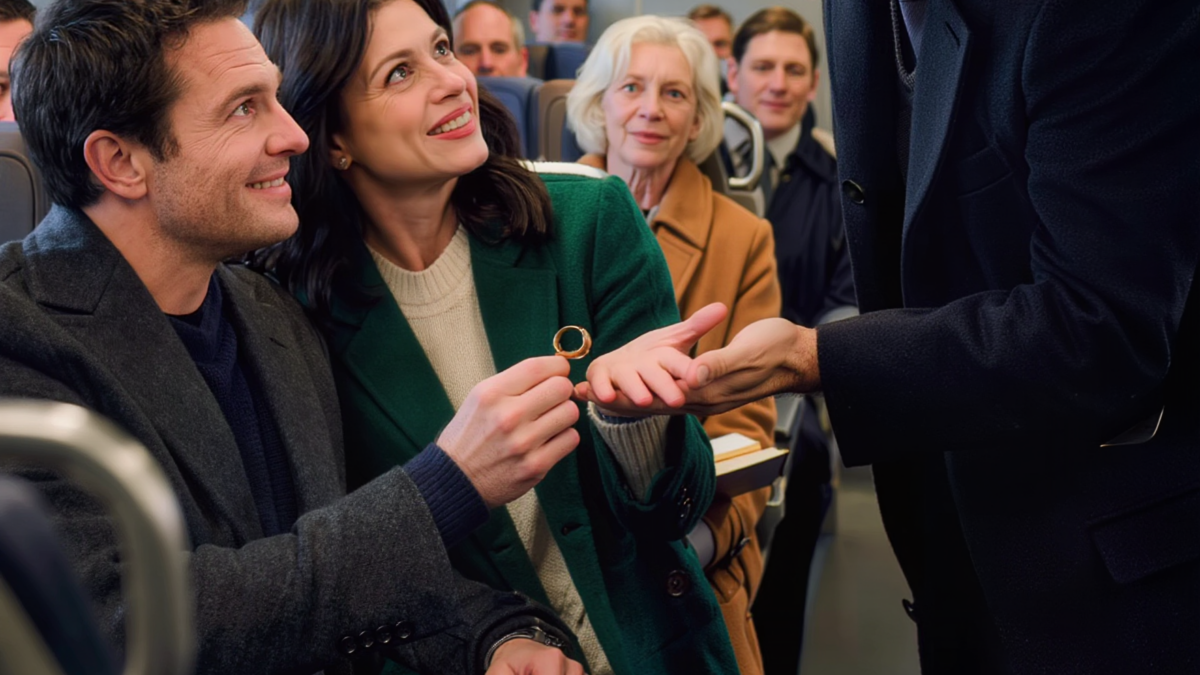
The train had been moving for maybe four minutes when a woman I had never seen before dropped into the empty seat beside me, took my hand in both of hers, and leaned close enough that I caught the faint scent of rain on her coat.
“Please don’t pull away,” she said quickly. “You’re my husband for the next three hours.”
For a second, I thought I had misheard her.
She looked about thirty. Dark brown hair. Green wool coat. Gray-green eyes that were trying very hard to appear calm. Her breathing was controlled, but the fingers wrapped around mine were ice cold.
Then she looked past me.
I followed her eyes.
Three rows behind us, a tall man had just stepped into the aisle. He wore a dark overcoat, carried himself like someone accustomed to being recognized, and had a smile on his face that didn’t quite reach his eyes.
He was looking for someone.
A moment later, he found her.
The woman beside me tightened her grip.
I had no idea who she was.
I did not know who he was.
I had no reason to involve myself.
Still, I turned my hand over and laced my fingers through hers.
“There you are,” I said loudly enough to carry down the aisle. “I saved you a seat.”
That was how I met Elise Warner.
My name is Miles Corbin. I was thirty-four then, and I worked as a paramedic in a small town on the north end of that rail line. My days were usually spent meeting strangers on the worst afternoons of their lives.
Car collisions. Falls. Chest pain. Panic attacks. People standing on front lawns in slippers while the world they understood changed shape around them.
I had learned to stay calm inside other people’s chaos.
My hands did not shake.
They never had.
It was one of the few things about myself I still trusted.
I was riding that train because of my father.
Dad had worked the same line for thirty years as a conductor. He wore a gray uniform, punched tickets with a silver hand tool, called every stop in the same steady voice, and somehow knew the names of half the regular commuters between the northern terminal and the city.
Even after he retired, his jackets smelled faintly of diesel, coffee, and the peppermint candies he kept in the breast pocket.
When I was a kid, I asked him once what he liked about the job.
He shrugged.
“I make sure strangers get home safe.”
I laughed because I expected something bigger.
He didn’t.
“That’s it, Miles. Doesn’t matter who they are. Doesn’t matter where they’re going. While they’re on my train, they’re mine to look after.”
Dad died three years before I met Elise.
It happened on an ordinary Tuesday.
That was the part that had always bothered me. Nothing about the morning warned me that my life was about to divide into before and after. I drank coffee. I complained about traffic. I ignored a voicemail from him because I was finishing a shift and figured I would call later.
There was no later.
After his death, I began riding his old route every year on the anniversary.
No ceremony.
No flowers.
No speeches.
I simply bought a ticket, got on near the northern end, rode the line toward the city, and spent a few hours pretending I could still see him moving through the aisle.
I wore his wedding ring on my right hand on those days.
It was plain yellow gold, slightly worn along one edge after decades against his skin.
My mother had given it to me after the funeral.
“He’d want you to have it,” she said.
I never wore it anywhere else.
Only the train.
Only that day.
That was the ring on my hand when Elise Warner sat beside me.
I was not in a particularly good place then.
After Dad died, some switch inside me had gone dark.
I kept working.
I answered calls.
I made dinner.
I paid bills.
I returned messages when absolutely necessary.
To the outside world, I functioned.
Inside, I felt as if my life were happening on the other side of thick glass.
Rachel, my wife at the time, lived with that version of me for almost a year.
She tried.
I want that understood.
She suggested counseling. She planned weekends away. She sat beside me through long silent evenings when I could barely make myself speak.
Eventually, she left.
“You disappeared, Miles,” she told me on our last night in the apartment. “You’re still breathing, but you left two years ago. I don’t know how to follow you.”
I did not argue.
She was right.
I had become very good at keeping strangers alive and completely useless at being present in my own life.
That was who I was four minutes into my father’s rail line when a terrified woman decided I looked safe enough to marry.
The man from three rows back started toward us.
I felt Elise’s thumb press hard against the side of my hand.
He stopped beside our row.
“Elise.”
Her posture stiffened.
“Grant.”
His smile widened.
“I thought that was you. Small world.”
He glanced toward the luggage rack, then back at her.
“You’re headed to the wedding too, I assume.”
“I am.”
Only I could feel how tightly she was holding my hand.
Grant’s eyes dropped.
First to our fingers.
Then to my father’s wedding ring.
Then back to my face.
“And who’s this?”
I am not naturally quick.
That surprises people because of my job. They assume emergency medicine must make you impulsive.
It does the opposite.
You learn to pause.
Look.
Confirm.
Act.
That habit has saved people.
It had also made me terrible at parties.
But something about the way Grant was standing there bothered me. Nothing obvious. His voice was controlled. He wasn’t yelling. He wasn’t touching Elise.
Yet he looked at her with the proprietary annoyance of someone discovering that an object had been moved from where he had left it.
And Elise had asked me not to pull away.
So I made a decision.
Beneath the cover of the seatback in front of us, I slipped my father’s wedding ring from my right hand.
Elise felt the movement.
She looked at me.
I placed the ring in her palm and closed her fingers around it.
Then I looked up at Grant.
“I’m the husband,” I said. “Miles.”
I put my arm along the back of Elise’s seat.
“She has told me approximately nothing about a wedding, so I’m assuming it involves somebody she would rather not discuss.”
Grant looked at me for a long second.
Then Elise slipped the ring onto her finger.
It was a little large, but not enough to be obvious.
She lifted her hand only slightly as she adjusted her sleeve.
Grant noticed.
His face did something small.
It recalculated.
“Husband.”
He said the word carefully.
“Elise, you didn’t mention you got married.”
“I don’t mention a lot of things to you anymore, Grant.”
That was the first moment I realized Elise was not fragile.
Frightened, yes.
Exhausted, certainly.
But not fragile.
Grant held the smile for another beat.
“Well. Congratulations.”
“Thank you.”
“I’ll leave you two lovebirds to it.”
The way he said lovebirds made it sound less like affection and more like an accusation.
He moved down the aisle.
Three rows behind us, a younger woman waited near his seat with a phone in her hand. She barely looked up when he returned.
Elise exhaled.
The final half of the breath trembled.
Then she immediately began removing the ring.
“I am so sorry.”
“Leave it.”
Her hand stopped.
“What?”
“He’s watching.”
I nodded toward the dark train window.
Grant’s reflection was visible behind us.
His head was angled in our direction.
Elise looked at the glass.
Her shoulders sank.
“You picked a husband,” I said quietly. “You’re stuck with me until he stops checking.”
A wet, surprised laugh escaped her.
“I promise I normally have better judgment.”
“I’ll assume panic affected your screening process.”
She looked at me for the first time without glancing over her shoulder.
“I saw him board. I’ve been dreading the possibility of being trapped in a train car with him for a week. Then there he was.”
“And I was the lucky available candidate.”
“You were the only person sitting alone who looked kind.”
She hesitated.
“And safe.”
That word lodged somewhere uncomfortable inside me.
I turned toward the window.
“Tell me what I’ve married into.”
She laughed again.
This time, it sounded more like herself.
Her name was Elise Warner.
She was thirty years old and taught violin at a small private music school.
Grant had been her fiancé.
They had dated for almost four years and been engaged for two.
Their wedding had been scheduled for eight months earlier.
It never happened.
“Everyone thinks I destroyed it,” she said.
She kept turning Dad’s ring around her finger.
“His family. Our friends. Some of my family.”
“What do they think happened?”
“That I cheated on him.”
She stared at the seatback.
“That I humiliated him. That I ended everything three weeks before the wedding for no reason. That I became unstable and cruel.”
“And what happened?”
“He cheated on me.”
There was no dramatic pause.
She said it almost flatly.
“For most of the second year of the engagement.”
I waited.
“I found out. I ended it. He called everyone before I could even figure out how to explain what happened.”
Her mouth tightened.
“He rewrote the whole thing.”
I had seen versions of that in emergency calls. Two people standing in the same kitchen describing entirely different realities while shattered glass remained on the floor between them.
“Why didn’t you correct it?”
“I tried with a few people.”
“What happened?”
“He had already told them I would say that.”
That stopped me.
She gave a humorless little smile.
“Smart, right?”
“Prepared.”
“Exactly.”
“He knew what you were going to say before you said it.”
“Because he knew what he had done.”
The train curved through a stretch of farmland. Gray afternoon light moved across her face.
“So why stay quiet after that?”
She looked at me.
“My sister.”
Her younger sister’s name was Katie.
Elise had helped raise her during the years their mother struggled with a long illness. Katie was not simply a sibling to her. She was the person Elise had protected since she was old enough to understand that sometimes the older child quietly becomes an extra adult in the house.
Katie was getting married that weekend.
To Grant’s cousin.
I understood the problem before Elise finished explaining it.
“The families are joining,” she said. “If I stand up right before their wedding and tell everyone what Grant did, I don’t only expose him. I turn Katie’s wedding into a family war.”
“You think she would blame you?”
“I don’t know.”
“That isn’t the same thing.”
“No. But I know she loves him. I know she has spent a year planning this weekend. I know his family thinks Grant is wonderful.”
Elise rubbed her thumb over the ring.
“So I stayed quiet.”
“For eight months.”
“Yes.”
“And let people blame you.”
“Yes.”
I studied her.
“Why?”
Her answer came immediately.
“Because Katie gets one wedding.”
There was no self-pity in the sentence.
That made it worse.
“I thought eventually the truth would matter less. People would move on.”
“But they didn’t.”
“No.”
“And now Grant is going to be at the wedding.”
“Yes.”
“With people who think you betrayed him.”
“Yes.”
“And you were supposed to arrive alone.”
She looked down.
“That was the part I couldn’t do.”
Outside, trees blurred past.
“I could survive them talking,” she said. “I’ve been surviving that for months. I just couldn’t walk into that room looking exactly the way they expect me to look.”
“Which is?”
“The bitter ex. Alone. Embarrassed. Still obsessed with Grant.”
Her voice broke on his name.
She cleared her throat.
“So I grabbed the nearest safe-looking stranger and called him my husband.”
I leaned back.
“Reasonable.”
She looked at me sharply.
Then laughed.
For the next half hour, we constructed a marriage.
We decided we had met one year earlier after Elise injured her ankle.
That part was close enough to reality that I could answer questions without inventing medical terminology. I was the paramedic who had treated her.
We had married in the spring.
Small ceremony.
We shared an apartment.
No children.
No dog yet, although Elise wanted one.
“Golden retriever,” she said.
“Too much hair.”
“Then our marriage is already in trouble.”
“Good. Makes it realistic.”
Somewhere during the exercise, we stopped rehearsing and started talking.
Really talking.
She told me about Katie.
Their mother had gotten sick when Elise was seventeen and Katie was eleven. Their father worked long hours. Elise learned to make school lunches, check homework, and sit in waiting rooms pretending she was not afraid.
Katie used to crawl into Elise’s bed during storms.
Even as an adult, she still called her older sister when she could not sleep.
I told Elise about Dad.
The peppermint candies.
The uniform.
The habit of knowing everyone’s name.
The way he used to say a train was a temporary little community.
“You’re strangers when you board,” he once told me. “Then for an hour or three, you’re all going somewhere together.”
Elise smiled at that.
“He sounds like he was lovely.”
“He was.”
“You miss him.”
“Every day.”
She did not say she was sorry.
I appreciated that.
People often reach for condolences because silence makes them uncomfortable.
Elise let the silence stay.
Eventually, she told me about her students.
Eight-year-olds learning violin sounded, according to her, like a collection of tiny emergency sirens until something suddenly clicked.
“And then one day,” she said, “they make one beautiful note.”
“One?”
“If you are lucky.”
I laughed.
She grinned.
“You’re making fun of my profession.”
“I spend my days listening to ambulance sirens. You spend yours producing them intentionally.”
“That is deeply unfair.”
It was the first conversation I had enjoyed in years without noticing that I was trying to enjoy it.
An hour later, she knew I drank coffee black.
I knew she hated olives.
She learned I had an unreasonable amount of emergency gear in my car.
I learned she hummed when nervous.
She denied it until I pointed out that she had been doing it every time Grant walked down the aisle.
She stopped.
Then started again thirty seconds later.
Grant returned around the halfway point.
He pretended he was on his way to the café car.
He stopped beside us.
“How long have you two been married again?”
“A year,” Elise and I said together.
We looked at each other.
Grant’s eyes narrowed.
“Spring wedding,” I added.
Elise nodded.
I put my hand over hers.
Dad’s ring was visible.
Grant stared at it.
His smile thinned.
“Well. Congratulations again.”
“Thanks,” I said.
He moved on.
When he was gone, Elise turned toward me.
“You’re good at this.”
“At lying?”
“No.”
She looked down at our joined hands.
“At making a person feel safe.”
I stopped smiling.
She noticed.
“What?”
“Nothing.”
“That was something.”
I looked at the window.
“My wife used to say I was emotionally switched off.”
Elise was quiet.
“Ex-wife?”
“Yes.”
“What happened?”
“My father died.”
“That is not an answer.”
“It’s most of one.”
I told her.
Not every detail.
But enough.
I explained how grief had settled into me so completely that I mistook numbness for stability.
How Rachel had tried to reach me.
How I continued working because emergencies were easier than ordinary life. In an ambulance, the rules were clear. Somebody needed help. You helped them.
At home, there were no protocols for grief.
No checklist.
No monitor displaying exactly what had gone wrong.
“She said you were switched off,” Elise said.
“Yes.”
She studied me.
“I don’t think you’re switched off.”
“You met me two hours ago.”
“I know.”
She leaned back.
“I think you’re steady.”
The word hit me strangely.
Rachel had looked at the same man and seen absence.
Elise looked at him and saw steadiness.
Both could have been right.
But only one interpretation made me want to inhabit my own body again.
A few minutes later, Elise looked at the ring.
“Whose is this?”
“My father’s.”
Her hand stopped.
“Your father’s wedding ring?”
“Yes.”
“Miles.”
“What?”
“I have been wearing your dead father’s wedding ring for two hours to fool my ex-fiancé.”
“That is technically accurate.”
She started pulling it off.
“I cannot keep wearing this.”
I put my hand over hers.
“Leave it.”
“No.”
“He spent thirty years looking after strangers on this exact train.”
Her expression changed.
“I cannot think of anything he would rather have the ring doing today than helping one more person get where she’s going.”
Elise stared at me.
“That is either the sweetest or strangest thing anyone has ever said to me.”
“Those are not mutually exclusive.”
Her eyes filled.
This time she did not stop them.
She cried quietly.
No dramatic sobbing.
No collapse.
Just tears sliding down her face while she stared at the ring.
I sat beside her feeling utterly unqualified.
Then I reached over and held her hand.
It was something Rachel had begged me to do during the worst year of our marriage.
Not specifically hold hands.
Reach.
Respond.
Come back into the room.
For reasons I still do not fully understand, I could do it with Elise.
A stranger.
A woman who had borrowed my father’s ring.
A person I had known for two hours.
Something opened in me.
Not healed.
Opened.
There is a difference.
The final hour of the train ride went too quickly.
When the announcement for Elise’s station came over the speakers, our conversation stopped.
The train began to slow.
She removed Dad’s ring carefully.
For several seconds, she held it between her fingers.
Then she pressed it into my palm and closed my hand around it.
The gesture mirrored the one I had made earlier.
“Thank you.”
“You’re welcome.”
“No.”
Her voice softened.
“You have no idea what you did.”
I looked down at our hands.
“I think I have a pretty good idea.”
“I can walk into that wedding now.”
She stood and put on her coat.
“For three hours, I got to be somebody who wasn’t alone.”
She lifted her bag from beneath the seat.
“Somebody who wasn’t the villain.”
The doors opened.
She looked at me.
“Go home safe, Miles.”
Then she glanced at the ring in my palm.
“Your dad would be proud of you.”
She walked toward the exit.
I watched her step onto the platform.
I stayed in my seat.
The doors remained open.
A warning tone sounded.
I looked at Dad’s ring.
For three years, I had ridden that route because I wanted to feel close to him.
But everything I had done was backward.
I had been sitting still, staring into memory, while his entire philosophy had been about movement.
Get people home.
Elise was not home.
She was walking into three days surrounded by people who thought she was dishonest, unstable, bitter, and alone.
The doors were about to close.
I grabbed my bag.
I got off the train.
“Elise!”
She turned on the platform.
I jogged toward her, immediately regretting that I spent more time treating people after exercise than exercising myself.
“Miles?”
“I have an idea.”
She stared.
“Your ideas have already caused one fake marriage today.”
“This one is worse.”
She laughed nervously.
“What?”
I held up my phone.
“I have a rental car app.”
“That is not reassuring.”
“And no reason to be anywhere for the next three days.”
Her smile disappeared.
I continued before good judgment returned.
“This was my father’s train. His rule was that you don’t leave somebody before they’re safe.”
“Miles—”
“Separate rooms.”
She blinked.
“What?”
“I’m offering to stay your husband through the wedding weekend.”
She stared at me as though I had suggested we steal the train.
“No strings. No expectations. I will sleep in the car if the hotel situation is weird.”
“Miles.”
“You should not have to walk into that place alone.”
Her eyes filled again.
“And I’m not ready to go back to being switched off.”
That was the most selfish part.
Maybe the most honest.
I opened my palm.
Dad’s ring lay there.
“You should keep this a little longer.”
She looked at it.
Then at me.
“You are the strangest man I’ve ever met.”
“You keep saying that.”
“Because you keep proving it.”
“You married me anyway.”
She laughed.
Then she took the ring.
We rented a car.
Four hours later, I arrived at Katie’s wedding hotel as Elise Warner’s husband.
The wedding was held at a restored inn outside a small town, the kind of place with old brick walls, white porch railings, and a ballroom added sometime much later to accommodate people willing to pay for charm with central air-conditioning.
Katie met us in the lobby.
She was younger than Elise, with the same eyes but lighter hair.
Her face registered surprise when Elise introduced me.
“This is Miles.”
Katie looked at the ring.
Then at me.
“Your husband?”
“That is usually how I introduce him.”
I almost admired her confidence.
Katie recovered and hugged her.
For one second, Elise’s entire body softened.
That was when I understood how much protecting Katie had cost her.
Grant arrived twenty minutes later.
He saw us at check-in.
His expression barely changed.
But he looked at my suitcase.
Then Elise’s.
Then our room keys.
We had booked separate rooms.
He did not know that.
He knew only that I had stepped off the train.
For the first evening, people were polite.
Too polite.
I learned quickly which relatives believed Grant.
They asked questions that were technically friendly.
Where had Elise and I met?
How long had we been together?
Why had nobody heard about me?
Why such a quiet wedding?
Each question sounded casual.
None was.
Fortunately, Elise and I had spent three hours preparing.
“Hospital,” she said.
“Ankle,” I added.
“She was an impossible patient.”
“He was insufferably calm.”
“One year.”
“Spring ceremony.”
“Very small.”
“His work schedule is terrible.”
“Her violin students are louder than sirens.”
By dinner, we had become disturbingly good at being married.
But the more people watched us, the more another problem emerged.
Grant’s story required Elise to be the unstable one.
Nothing about her behavior supported it.
She helped Katie with last-minute seating changes.
She found an inhaler one of the flower girls had misplaced.
She carried water to their father without being asked.
She disappeared from the rehearsal dinner for fifteen minutes and returned carrying a sewing kit because Katie’s dress lining had torn.
Meanwhile, Grant watched her.
Constantly.
People began noticing.
Not all at once.
Not dramatically.
But I saw it.
A cousin would look at Elise laughing with Katie, then glance toward Grant.
An aunt who had been distant the first evening softened the second morning.
One of Katie’s friends asked me privately how long Elise had really been doing okay.
The phrasing mattered.
Not whether.
How long.
Grant approached me during the reception while Elise was across the room.
He carried a drink and wore the controlled smile I had first seen on the train.
“You know she cheated on me, right?”
“I know you say she did.”
He paused.
“That’s cute.”
“What is?”
“The protective husband thing.”
I looked at him.
“You think she told you the truth because you spent three days playing hero?”
“I don’t think I’m a hero.”
“Then you should know what you married.”
His confidence irritated me less than it probably should have.
Maybe emergency work had ruined confrontations for me. Once you have heard someone calmly explain that they are fine while a monitor disagrees, you learn to respect evidence more than tone.
“I know what I’m standing next to,” I said.
Grant’s smile tightened.
“The question is whether everybody here is going to keep believing the version of events that always makes you look good.”
His eyes changed.
I continued.
“People are starting to notice which one of you relaxes when the other leaves the room.”
That was all.
I did not threaten him.
I did not expose him.
I went back to Elise.
He did not approach me again.
At the reception, the band leader eventually invited married couples onto the dance floor.
Elise stopped moving.
“No.”
I looked at her.
“What?”
“I cannot dance.”
“You teach music.”
“I teach violin.”
“That feels related.”
“It is absolutely not.”
Couples were standing around us.
People were looking.
Her breathing shortened.
“I’m serious, Miles.”
“So am I.”
“I will step on you.”
“Then step on me.”
She stared.
I held out my hand.
“My father used to say you don’t get people home safe by leaving them at the edge of the platform.”
“He definitely did not say that about dancing.”
“Spiritually, he did.”
She laughed despite herself.
That was enough.
We walked onto the floor.
She stepped on my left foot within fifteen seconds.
“Told you.”
“Barely noticed.”
“You made a face.”
“That was romance.”
“Your romance looks injured.”
“Occupational hazard.”
The room was watching us.
Elise felt it.
Her shoulders tightened.
I put my hand at the middle of her back.
“Look at me.”
She did.
“Not them.”
She swallowed.
“Three hours on a train.”
“What?”
“We managed three hours.”
I smiled.
“We can survive three minutes.”
Something in her expression released.
The music kept playing.
We swayed badly.
She stepped on me again.
I did not care.
For the length of one song, Elise stopped performing innocence for a room that had already judged her.
She simply existed.
And people saw her.
Not Grant’s story.
Her.
I could feel the social atmosphere changing.
You can tell when a room begins reconsidering a person.
Questions disappear.
Whispers become shorter.
The people who were once staring at Elise begin looking toward the person who gave them the original version.
Grant stood near the edge of the dance floor.
For the first time all weekend, he looked alone.
“They’re not staring at me the same way,” Elise whispered.
“No.”
“They’re looking at him.”
“Yes.”
She rested her forehead briefly near my shoulder.
“Miles.”
“Hmm?”
“I don’t think this is pretend for me anymore.”
I stopped moving for half a beat.
She noticed.
“I’m sorry.”
“Don’t be.”
“I just need you to know.”
She kept her voice low.
“Whatever happens when this weekend ends, it stopped being pretend somewhere on the train.”
I looked at her.
“I know exactly when it stopped being pretend for me.”
“When?”
“When you found out whose ring you were wearing and tried to give it back.”
She blinked.
“That’s your reason?”
“A person who wanted to use me would have kept it.”
She gave a small laugh.
“That is a very low bar.”
“Maybe.”
I looked at the ring.
“But you weren’t worried about getting caught. You were worried about disrespecting something that mattered to me.”
Her eyes filled.
“That is the opposite of what Grant told everyone you were.”
She held on more tightly.
We finished the song.
I did not feel switched off for a second.
Elise did not expose Grant at the wedding.
Neither did I.
That mattered.
The temptation existed.
I knew enough to challenge the story publicly.
Elise knew everything.
But she had protected Katie for eight months.
She refused to turn her sister’s wedding into the battleground she had worked so hard to avoid.
On the final night, Katie pulled Elise aside.
I was close enough to see them but not to hear everything.
Katie looked unsettled.
At one point, she glanced across the room toward Grant.
Then toward me.
Later, Elise told me one sentence.
Katie had said, “I don’t know your husband’s whole story, but he looks at you like you hung the moon. Grant never once looked at you like that.”
It was not proof.
It did not solve anything.
But it was doubt.
And after eight months of absolute certainty, doubt was a door.
We drove home the next morning.
The trip should have taken three hours.
We made it four.
We stopped for coffee.
Then breakfast.
Then gas we did not technically need yet.
Neither of us wanted the road to end.
Nothing happened quickly after that.
That is how I knew it was real.
Movies teach you that life-changing relationships announce themselves with certainty.
Ours did not.
We moved carefully.
I went back to work.
Elise taught lessons.
We called.
We met for dinner.
I learned the names of her students based on the noises coming through the practice-room doors.
“There’s Noah.”
“How can you tell?”
“He rushes every fourth measure.”
“It sounds exactly like the last child.”
She looked personally offended.
A month after the wedding, Dad’s ring was still on her hand.
Neither of us mentioned returning it.
Two months later, one of my coffee mugs lived permanently in her kitchen.
Her nervous humming changed.
At first, she hummed whenever she thought Grant might call.
Then only when she was late.
Then sometimes because she was happy.
Actual melodies replaced the tuneless little loop I had heard on the train.
Four months after Katie’s wedding, Elise’s phone rang just after ten at night.
We were eating takeout in her apartment.
She looked at the screen.
“Katie.”
She answered.
Her expression changed within seconds.
I started gathering the food containers quietly, expecting family news.
Then Elise stood.
“What?”
She crossed the room.
“Katie, slow down.”
I could hear crying through the phone but not the words.
Elise listened.
Her eyes closed.
“No. No, I’m not angry.”
Another pause.
Then she looked at me.
Grant’s cheating had surfaced.
Not because Elise exposed him.
Because Grant repeated his behavior.
His new girlfriend discovered overlapping messages, dates, and explanations that did not match.
She contacted someone from his past.
That person contacted someone else.
The timeline widened.
Eventually, Katie heard enough to begin asking questions about the period when Grant had been engaged to Elise.
She did the math backward.
Dates.
Trips.
Messages.
Weekends Grant had claimed he was somewhere else.
Suddenly the story he had told about Elise required too many coincidences.
Katie’s first words after explaining it were, “I am so sorry.”
Elise sat down.
“I spent a year believing him.”
“Katie—”
“I believed him instead of you.”
“You didn’t know.”
“I should have known you.”
That finally broke Elise.
She covered her mouth.
Katie continued crying.
“Can you forgive me?”
Elise answered before her sister had finished asking.
“Yes.”
No punishment.
No speech.
No satisfaction.
Just yes.
That was Elise.
Six months after the train, I transferred to a paramedic position closer to her neighborhood.
My coworkers noticed the difference before I did.
“You laugh now,” my partner told me during a slow afternoon.
“I laughed before.”
“No.”
He shook his head.
“You made sounds indicating amusement. Different thing.”
Apparently, I talked more too.
The lights were back on.
I still missed Dad.
Grief had not disappeared.
It had simply stopped being the only room in the house.
A year after the day Elise dropped into the seat beside me, we stood inside a small county courthouse.
Katie was there.
So was Elise’s father.
My mother cried before the ceremony even started.
My old partner stood in the back pretending his eyes were irritated by air-conditioning.
When the judge reached the part about rings, Elise looked down at her hand.
Dad’s ring was still there.
She had never removed it.
Technically, I had bought her another one.
A new wedding band.
Beautiful.
Properly sized.
She wore that too.
But Dad’s ring remained the important one.
At one point, the judge smiled.
“I believe you already have a ring.”
Elise held up her hand.
“I’ve been practicing.”
Everyone laughed.
I knew exactly what she meant.
She had been my wife for three hours before she became my friend.
Then three days.
Then something neither of us had planned.
Then, finally, for real.
We still ride Dad’s train.
Not every day.
But often.
Sometimes for no reason.
Elise likes sitting on the same side of the carriage where we met.
She claims she no longer remembers the exact row.
She does.
So do I.
Every anniversary of Dad’s death, we ride the old route together.
The first year after we married, I asked whether she thought it was strange to turn a day associated with losing him into something that now also belonged to us.
She looked at the ring.
“No.”
“Why?”
“Because maybe he got tired of you riding around being miserable.”
I laughed.
“I’m serious.”
She leaned against my shoulder.
“Maybe he wanted you to finally do something useful with the trip.”
Dad would have liked her.
I am certain of that.
She thinks I saved her.
That is the story she tells.
A stranger saw that she was frightened.
He played along.
He gave her courage.
He followed her off a train.
He stood beside her until everyone began questioning the lie they had accepted.
That is true.
But it is incomplete.
Elise Warner did not need saving.
She was stronger than almost anyone I had ever met.
She had spent eight months letting people misunderstand her because she would rather carry humiliation herself than risk turning her sister’s wedding into a disaster.
She would have stepped off that train without me.
She would have walked into that wedding.
She would have lifted her chin.
She would have survived every whisper.
I know that.
The person on that train who had forgotten how to survive ordinary life was me.
For three years, I had been moving through the world like a shell.
I knew how to keep people breathing.
I knew how to remain steady while other people panicked.
I knew how to stand beside grief as long as it belonged to someone else.
I did not know how to step back into my own life.
Dad had spent thirty years telling me his job was making sure strangers got home safely.
Three years after he died, on the anniversary of losing him, a stranger sat beside his son.
She took my hand.
She borrowed his ring.
She asked me to pretend I belonged to her.
And somehow, while I was busy helping her reach the place she was afraid to enter, she led me out of the place where I had been hiding.
She thought I was her husband for three hours.
She thought I was saving her from her past.
But Elise was the one who got me home.