For five years, my husband scrubbed our bathroom three times a day. Then my best friend, a forensic pathologist, walked in, came out without her purse, grabbed my wrist, and said, “Get out. Call the police.” My husband stayed at the sink—and never followed us.
For five years of our marriage, my husband cleaned the bathroom three times a day.
Not the kitchen. Not the hallway carpet with the stain near the closet. Not the dripping faucet over the kitchen sink.
The bathroom.
Morning before work. Again after he came home. Once more before bed.
Forty minutes each time.
For years, everyone who knew us treated it as one of those harmless domestic quirks that eventually becomes part of a family’s private mythology.
Then my best friend walked into that bathroom and came out without her purse.
That was the first thing I noticed.
Her name is Dosha Ryol. She had carried the purse down the hallway with her. When she returned, her hands were empty and her face looked so wrong that I stopped cutting the chicken on my plate.
Ubaldo was standing at the sink with a dish towel.
Dosha stopped in the kitchen doorway.
“Get out now.”
I stared at her.
“What?”
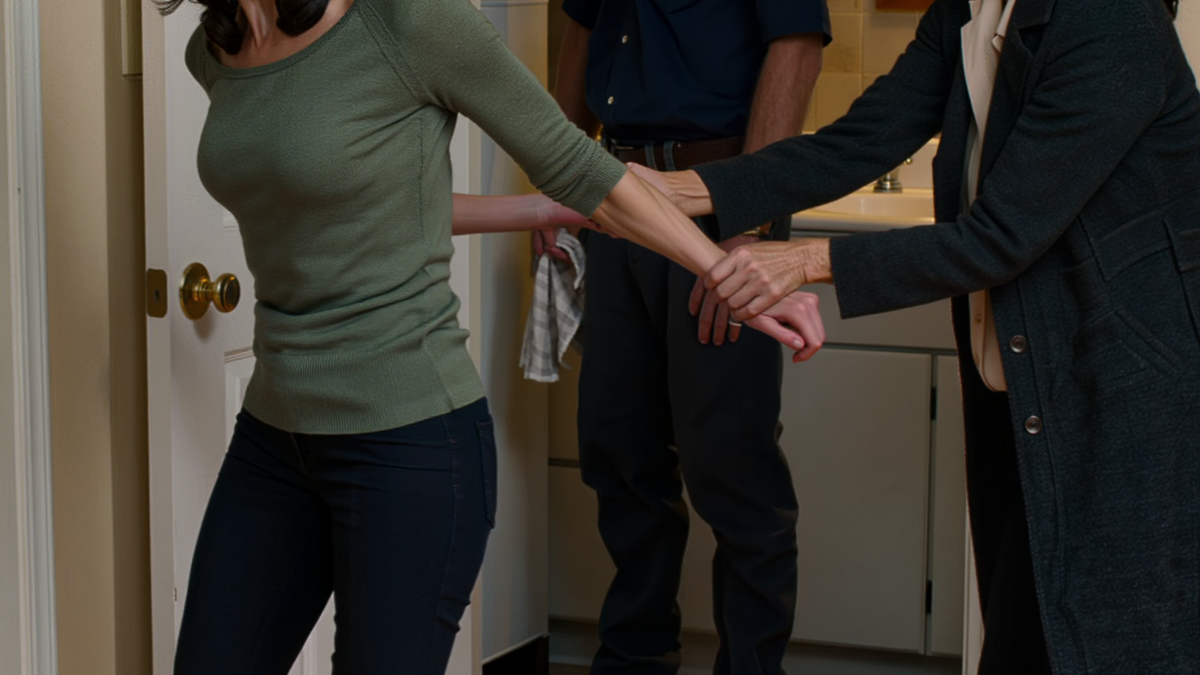
She crossed the room quickly and closed her fingers around my wrist.
They were cold.
Dosha’s hands were never cold.
“Call the police,” she said.
“Dosha, what are you talking about?”
“Get out.”
She pulled me across my own kitchen.
I remember the ridiculous things first: the plate on the table, the smell of roasted chicken, the fact that one of my socks had twisted under my heel.
I went through my own front door without shoes while my friend kept hold of my wrist.
Ubaldo stayed at the sink.
He did not ask where we were going.
He did not follow us into the yard.
At the time, I barely registered that.
Later, I would think about it constantly.
Dosha put me in her car, locked the doors, pulled onto Sylvania Avenue, and drove.
For eleven minutes she said almost nothing.
I asked four times what was happening.
Each time she said, “Wait.”
She eventually turned into a Denny’s on Reynolds Road and parked at the far edge of the lot, facing outward as though she expected to need to leave quickly.
A waitress came over after we sat down.
Dosha ordered coffee.
I ordered nothing.
When the coffee arrived, she wrapped both hands around the mug but never drank.
“I’m going to tell you several things,” she said. “You are going to want to argue with me. I need you not to do that for four minutes.”
My heart was beating hard enough to make my fingertips pulse.
“Fine.”
“Your bathroom.”
I waited.
“The trap under the sink is new.”
I almost laughed.
“That’s what this is about?”
“The chrome is bright. There’s fresh compound on the fittings. The collar is recent. The shutoff valves above it are original.”
“He fixes things.”
“I know.”
“He’s always fixing things.”
Dosha leaned forward.
“No, Marisella. He fixes that bathroom.”
The words sounded absurdly small compared with the way she had dragged me out of the house.
“The kitchen faucet has been dripping for two years,” she continued. “Your hallway carpet is stained. Half the caulk around the kitchen window needs replacing. But that bathroom looks surgical.”
“He likes it clean.”
“I know what he tells you.”
Something in her voice stopped me.
Dosha had spent twelve years working around forensic death investigations. She was not dramatic. She was not impulsive. She was the person who corrected other people when they overstated things.
“I’ve seen that pattern once before,” she said.
The case had been in 2019.
An elderly man in East Toledo had died after years of being cared for at home by his daughter. Initially, nothing about the death appeared unusual. Nearly a year later, financial irregularities caused the case to be reopened.
Dosha was involved in the second examination.
What stayed with her, she told me, was not the body.
It was the original scene photography.
The house looked like a house where an elderly person had been cared for over a long period of time: medicine bottles, laundry, stacked mail, mobility equipment, ordinary clutter.
Except for one room.
The bathroom.
It was immaculate.
Dosha said she had noticed it, filed the thought somewhere in her mind, and moved on because at the time it meant nothing by itself.
Years later, she had walked down my hallway.
And something in my bathroom matched the memory closely enough that she had come out without remembering to collect her purse.
“I cannot examine you,” she said carefully. “I’m a forensic pathologist. I work on the dead. I have no standing to diagnose you. I can’t order anything, and I can’t start touching objects in your house because if I’m wrong, I’ve contaminated your home and inserted myself into something I have no professional right to be in.”
My stomach tightened.
“Then what are you saying?”
“I’m saying what I think as your friend. Everything after that has to be done by someone else.”
“Tell me.”
She looked at me for a long second.
“I think you have been exposed to something for a long time,” she said. “And I think your husband may have been cleaning the places where evidence of it could collect.”
The waitress passed our booth.
Neither of us moved.
I had been sick for five years.
Before that, I had been a person who walked everywhere.
I had finished a half marathon in 2017 in two hours and eleven minutes, a time that impressed no serious runner but delighted me. I still had the medal in a drawer.
I worked as a branch library manager in Toledo. I ordered large-print books, ran reading programs, managed schedules, dealt with difficult patrons, covered staffing gaps, and spent most of my days solving problems ordinary enough that nobody remembered them after five o’clock.
In 2021, my feet started burning.
Not aching.
Burning.
The soles were worst at night and worse after heat. At first I blamed my shoes. Then I blamed standing at work.
By summer, my hair had started thinning.
Not dramatically.
It was the kind of change that makes you question whether anything is really happening.
More strands in the drain.
More on the pillow.
A wider part.
Then came nausea.
For several months in 2022, salt tasted wrong.
Then the exhaustion settled in.
Three doctors tried to help.
The first found severe vitamin D deficiency. We treated it. Nothing meaningful changed.
The next diagnosis was fibromyalgia.
Later came fibromyalgia plus small-fiber neuropathy of unknown cause.
A biopsy finally confirmed that the neuropathy was real.
I remember feeling almost euphoric when someone documented it.
Not because I wanted to be sick.
Because after years of uncertainty, there was finally a sentence on paper proving my body was not imaginary.
Still, the cause remained unknown.
That phrase followed me everywhere.
Unknown cause.
By then I had developed a standard answer whenever someone asked how I was doing.
“About the same. It’s manageable.”
Manageable became a shield.
I said it to coworkers.
To my mother.
To acquaintances.
To people who did not really want the answer.
What it meant was: please do not make me explain how much of my day is organized around pain, because once I start saying it out loud, both of us will have to hear it.
I apologized constantly.
If I sat down at work, I apologized.
If I took the elevator one floor, I made the joke before anyone else could.
I became skilled at performing impatience with myself before another person had the opportunity.
Underneath everything was a quieter fear.
What if I was exaggerating?
Five years of unexplained illness can do that.
It can take someone who once trusted her own body and turn her into a person who needs outside confirmation before believing what she feels.
Dosha sent me to the emergency department that night.
“Get blood drawn now,” she said. “Don’t go home first.”
I did not walk in and announce that my husband was poisoning me.
I said I had five years of neuropathy, hair loss, gastrointestinal symptoms, and other unexplained problems, and that a medically trained friend was concerned about possible heavy-metal exposure.
That was accurate.
The emergency team ordered a standard heavy-metals panel.
It came back negative.
The physician who spoke to me near dawn had been working all night. She was kind.
She sat beside the bed and explained that neuropathy without an identified cause was both common and genuinely miserable.
Then she gently asked about stress.
I finally said, “My friend thinks my husband may be exposing me to something.”
The doctor did not laugh.
She did not insult me.
She simply shifted into a different kind of caution.
Later, I read the note she wrote.
It was short.
Every sentence was defensible based on what she knew at the time.
The word anxiety appeared in my chart.
I mention that because people want stories like mine to have clear villains in every room.
There was no villain in that emergency department.
The test they ran was negative.
My claim sounded extraordinary.
The doctor made a reasonable decision from incomplete information.
That was exactly why what happened next was so difficult.
I stayed at my mother’s house.
On Monday I called my assistant at the library, Tarcilla Ripka, and told her I needed several days off and could not explain why.
There was silence for maybe a second.
Then she said, “Take eleven. We already have the summer schedule covered.”
She never pressed me.
During my absence she sent only practical messages.
One was a photograph of a display she had built.
Another said she had handled a patron complaint about parking.
When I returned, she had placed a lamp on my desk.
She never mentioned it.
Dosha met me in a parking lot because she did not want to contaminate anything at my mother’s house or blur her role any further.
She explained why hair might matter.
Hair grows over time, she said, and substances circulating through the body can become incorporated into it as it forms. Segmental testing can sometimes provide a chronological pattern.
My hair reached beyond my shoulders.
Years of history could be sitting in those strands.
“So I cut it?” I asked.
“No.”
She explained that anything I collected myself from the house could immediately become vulnerable to questions about contamination and handling.
“What you need,” she said, “is something with your hair on it that has been sitting somewhere naturally.”
My hairbrush.
It was on my dresser.
Inside the house I had left in my socks.
For four days, Ubaldo texted me.
Eleven messages.
None sounded threatening.
That was what made them so difficult.
He asked whether I was all right.
He said he was not angry with Dosha.
He offered to bring my medication.
On the third day, he wrote that he had fixed the kitchen faucet.
I read that message several times.
The faucet had leaked for two years.
The bathroom had been cleaned three times daily.
Seventy-two hours after I left, the faucet was suddenly repaired.
My mother did not ask questions either.
On the fourth night, she came into the spare bedroom and sat at the end of the bed.
The room was dark except for light from the hallway.
“Is he going to come here?” she asked.
“No.”
“All right.”
Then she looked down at her hands.
“I am not a stupid woman, Marisella.”
“I know.”
That was all.
My sister, Cresenzia, reacted differently.
She loved me.
She was also skeptical.
“Are you sure Dosha isn’t being dramatic?”
Later she said, “You’ve been sick for a long time. I don’t want you building something around that because you’re scared.”
Those statements hurt.
They were also exactly what a reasonable sister might say to a woman with years of unexplained symptoms and the word anxiety in her medical record.
She changed her mind later.
Neither of us has ever completely recovered from the fact that there was a period when I needed her to believe me and she did not.
Dosha eventually found a medical toxicologist in Ann Arbor, Dr. Ada Fist.
The doctor called me and spent almost an hour asking questions.
The order seemed strange.
When did the burning start?
Was heat worse?
Was nighttime worse?
What happened to my hair?
My nails?
My vision in low light?
My digestion?
My sense of taste?
She was arranging five years of symptoms into a sequence.
At some point she stopped.
“I’m going to tell you what I think,” she said, “and then I’m going to tell you why I may be wrong.”
She explained that the particular combination of symptoms made her concerned about an uncommon toxic exposure that was not included in the standard emergency panel.
Then she spent several minutes describing alternative possibilities.
That mattered to me.
She was not trying to force my life into a theory.
She was testing the theory against other explanations.
At the end, she ordered specialized laboratory work, including a twenty-four-hour collection and segmental hair analysis.
“My hairbrush is in the house,” I told her.
There was a pause.
“Then the question of how you retrieve it belongs to law enforcement,” she said.
That was how Detective Apolla Shrock entered my life.
She had eighteen years with the Toledo Police Department.
She came to my mother’s house with another detective and spent two hours asking questions.
She never said, “I believe you.”
She never said, “I don’t believe you.”
She wrote.
She clarified dates.
She asked about the house, my symptoms, Dosha’s observations, Ubaldo’s work, our finances, our routines.
When she left, she said she would make calls.
On Monday she returned with the problem.
There was no conventional crime scene.
The bathroom had been cleaned constantly for years.
The first hospital panel had been negative for the substances it actually tested.
The hairbrush was inside a residence both Ubaldo and I had lawful access to.
A forensic pathologist noticing a plumbing fitting was not enough on its own to establish probable cause for the kind of warrant investigators would need.
Then Detective Shrock told me the fastest way to obtain naturally handled samples.
I would have to go home.
People have told me since that they never could have done it.
I do not know whether that is true.
People do things they cannot imagine doing when the alternative is remaining inside uncertainty forever.
I drove home on a Tuesday afternoon.
Ubaldo came outside before I had fully stepped away from the car.
He hugged me.
Then he cried.
I stood in our driveway while the man I had married held me like he had been afraid I would never come home.
Those ninety seconds were worse than the fear.
The detective had given me written rules.
Do not confront him.
Do not suddenly search the house.
Do not change normal behavior.
Do not reveal the investigation.
If he gave me food or a drink, do not consume it—but do not create an obvious new pattern by refusing things I had routinely accepted.
The tea was the hardest part.
Every night since 2021, Ubaldo had made me mint tea.
Same blue mug.
Usually around 9:30.
I would sit on the couch with my feet elevated because of the burning, and he would bring it to me.
It was one of the things I had counted as evidence of a caring husband.
For four nights, he continued.
“Tea?”
“Yes, please.”
“Too hot?”
“No. It’s fine.”
I had a steel travel mug hidden beside the couch cushion.
When he began his forty-minute bathroom routine, I transferred most of the tea into it.
The next morning, I met a detective in a Kroger parking lot on Alexis Road and handed over the sealed sample.
Then I returned home.
The third night, Ubaldo sat on the arm of the couch while I held the mug.
“You’re not drinking it,” he said.
Every part of me seemed to go still.
I lifted the cup.
“It’s fine.”
I took enough of a sip to preserve the normal appearance of our routine.
He watched for another moment.
Then he stood.
At ten o’clock, he went to clean the bathroom.
Another evening was worse for an entirely different reason.
He sat at the opposite end of the couch and asked about my summer reading program.
Not casually.
He remembered the name of an elementary-school employee I had mentioned months earlier.
We talked for forty minutes.
It was the best conversation we had shared in perhaps two years.
He laughed at something I said.
I laughed too.
The sound came naturally before I could stop it.
Then the clock reached ten.
“Right,” he said.
He stood and walked toward the bathroom.
For the next forty minutes, I sat alone with the travel mug beside the cushion and listened to running water and the movement of a scrub brush.
I still cannot decide what that conversation meant.
Maybe nothing.
That possibility is harder than any explanation I have invented.
The hairbrush left the house on my second morning back.
I placed it into my work bag in front of Ubaldo because carrying a brush to work was something I had done hundreds of times.
Nothing unusual.
Nothing theatrical.
That was the point.
Then I went back to the library.
There followed eleven days that remain some of the strangest of my life.
I held staff meetings.
I planned programs.
I answered email.
I dealt with parking complaints.
I was strangely good at my job because work gave me somewhere to place my attention.
One colleague named Orsolia discovered something was wrong only because she asked me directly during a system meeting.
I answered in perhaps nine words.
She did not demand details.
“Do you want me to stay at your mother’s house?”
“No.”
“Offer stands.”
Then she returned to discussing parking.
The laboratory results came on a Thursday afternoon.
Detective Shrock called and asked me to come in.
She would not explain over the phone.
I understood why.
The tea sample was positive for the substance the toxicologist had suspected.
My twenty-four-hour sample was positive.
Then she showed me the hair analysis.
Sixty months of hair had been divided and tested.
Across those years were eleven distinct elevated bands.
Not a steady level.
Not a continuous plateau.
Eleven separated peaks.
The first several were roughly a month apart.
Later, the gaps became longer.
The most recent elevation occurred shortly before Dosha came to dinner.
I looked at the clean spaces between those bands.
And the thought I had was not scientific.
Those were my good months.
The months when I could walk.
The months when stairs were easier.
The October afternoon in 2022 when Ubaldo and I drove toward Route 2 and walked two miles on a flat trail.
I remembered sitting on the open tailgate afterward and crying because I had managed two miles.
He had stood beside me with his hand on the back of my neck.
I had thought he understood what that walk meant.
Now I was staring at a chart that made the gaps look deliberate.
The next connection came from his work.
Ubaldo was a quality technician at an optical-glass plant in Northwood.
The facility handled specialized compounds, including the substance found in my tests.
Because the material was expensive and hazardous, inventory was weighed, logged and cycle-counted.
Investigators contacted the company.
Its environmental health and safety manager reviewed years of records.
Small quantities had been missing across eleven inventory counts between 2021 and 2025.
Never a dramatic amount at once.
Always small enough that the discrepancy had previously been treated as ordinary measurement variance.
Ubaldo had inventory access.
More importantly, his job involved quality tolerances.
He understood how much variation could disappear inside a count without immediately triggering alarm.
I have never forgotten that fact.
The laboratory results explained my body.
The plant records explained access.
But three weeks later, investigators uncovered the part that changed their understanding of motive.
When I was nine years old, I had been seriously injured at a municipal pool.
The resulting civil case settled when I was still a child.
Because of my age, the settlement had been structured as an annuity rather than paid in one lump sum.
Beginning when I turned twenty-one, it paid $3,100 each month.
For life.
That income was one reason I could work in public libraries and still own a home.
The annuity also carried a death benefit.
If I died, the named beneficiary would receive the remaining value.
In 2026, that amount was approximately $410,000.
Ubaldo had been the beneficiary since shortly after our wedding.
I had signed the designation at our kitchen table.
There was another condition I had never thought about.
Divorce would not give him any part of the childhood settlement.
The annuity was separate property.
If our marriage ended while I was alive, the future payments remained mine.
Death was different.
Then investigators discovered what had happened in 2019.
Ubaldo had lost approximately $190,000 in a private investment connected to commercial storage units.
I had never known.
Around the same period, a court in Lucas County had approved the transfer of a portion of my future structured-settlement payments to a factoring company.
The lump-sum price was roughly $194,000.
The petition carried my name.
The disclosure carried my name.
The order stated that the payee—me—had appeared through counsel and consented.
I had never seen the petition.
I had never hired that attorney.
I had never gone to court.
Yet something even stranger had hidden the transaction from me.
My monthly $3,100 kept appearing in my bank account.
Ubaldo had simply replaced the missing annuity payment each month with a transfer from his own checking account.
Same amount.
Same timing.
I never looked closely.
Why would I investigate money that arrived exactly when it always had?
The signature on the 2019 paperwork was not mine.
It resembled an older version of my signature.
By 2023, the neuropathy had affected my hands as well as my feet, changing the way I wrote.
Investigators now had recent samples to compare with older documents.
The consent signature looked like someone imitating the way I had signed before my hands changed.
Detective Shrock placed that order in front of Ubaldo during an interview on March 27.
According to the transcript, he said nothing for approximately nine minutes.
The night before his arrest, I slept at my mother’s house.
Or tried to.
Detective Shrock had called and told me to make sure I was somewhere with other people the following afternoon.
She did not have to explain.
I lay awake in the spare bedroom where I had slept as a teenager.
A detective’s business card sat on the nightstand.
For eight hours, I did not think about laboratory charts or bank records.
I thought about that two-mile walk in October 2022.
A good month.
One of the gaps.
I kept remembering Ubaldo’s hand at the back of my neck while I cried from relief because I had managed to walk farther than I thought I could.
There are memories that do not survive new information.
There are others that survive but become impossible to place anywhere inside yourself.
That one stayed.
Ubaldo was taken into custody at the plant the next afternoon.
I did not watch.
My mother made lunch.
Neither of us ate.
She kept the radio low.
When Detective Shrock finally called, she said, “We have him. He is in custody. You are safe.”
My mother put one palm flat against the table.
“All right.”
Then she stood and began washing a pan that was already clean.
“Mom.”
“In a minute.”
She stayed at the sink with her back to me for several minutes.
When she finally returned, she sat across from me.
“I’ve thought something was wrong since about 2022,” she said.
I looked at her.
“I didn’t know what. And I never thought it was him.”
Her voice became unsteady.
“I thought you were dying from something they couldn’t find.”
She had carried that fear for four years while I visited every Sunday saying, “It’s manageable.”
I did not watch Ubaldo’s entire recorded interview.
I tried.
I made it through only a few minutes.
I did read the transcript.
After the long silence over the 2019 paperwork, he finally said something.
It was not a full confession.
It was not exactly a denial either.
“I never decided to do it,” he said. “I just never stopped.”
The sentence has stayed with me.
There had been a first time.
Then another.
Then another.
Eleven elevated periods over five years.
His words made the repetition sound like inertia.
The physical evidence told a different story.
The bathroom cleaning had begun before the first elevated band appeared in my hair.
That mattered.
My memory, once investigators made me work through dates carefully, became specific.
He began cleaning in the morning around January 2021.
By March it was morning and evening.
By summer it had become three times a day.
The first abnormal hair segment came later.
Dr. Fist explained why the timeline mattered.
The bathroom routine was not merely a response after exposure began.
It had been established beforehand.
The trap under the sink.
The drain.
The surfaces around the toilet.
The places where hair and bodily waste naturally leave traces.
The pattern Dosha had recognized was already in place before my first documented elevated period.
What I had thought was my husband developing an eccentric cleaning habit was, according to the prosecution’s interpretation of the evidence, preparation.
By the time there was something to conceal, the behavior no longer looked new.
It looked normal.
Three of my doctors were later required to provide records and testimony.
That process reopened a different kind of wound.
For years, my medical chart had contained phrases that embarrassed me.
Anxiety.
Fibromyalgia.
Unknown cause.
Very focused on symptoms.
During preparation for court, those same notes were read chronologically.
Suddenly, the record of not knowing became valuable.
Physicians who had no idea anyone might be deliberately exposing me had documented the progression in real time.
Burning feet.
Hair changes.
Gastrointestinal problems.
Taste disturbances.
Neuropathy.
The chart was not evidence that I had invented symptoms.
It was a five-year timeline created by independent professionals before anyone understood what the timeline meant.
I have never fully worked out how to feel about that.
The defense initially prepared for trial.
Their theory was not absurd.
They planned to argue that minor inventory variance at the plant was meaningless.
That workplace exposure could have been carried home accidentally.
That the 2019 financial transfer had been something I knew about and later denied.
They could point to the fact that I had signed financial documents in the past without reading every line.
Then the hair analysis became the central problem.
An accidental occupational exposure carried home continuously would be expected to create a different pattern.
My testing showed separated peaks with cleaner intervals.
Both sides had experts prepared to discuss what those gaps meant.
Ubaldo entered a plea during jury selection.
I had spent eleven months preparing to testify.
I had rehearsed answering questions about my marriage.
My medical history.
My finances.
My memory.
My anxiety diagnosis.
The possibility that I had misunderstood things.
I had built an internal structure for surviving a day when strangers might openly question whether I was truthful.
Then suddenly, I did not have to use it.
People assumed that should have felt like relief.
It did not.
It felt like carrying armor after the battle had been canceled.
I wrote a victim-impact statement.
About four hundred words.
It took six weeks and eleven drafts.
The final version did not use the word love.
It did not use the word why.
An earlier draft had asked him to explain the gaps in my hair analysis.
Why those months?
Why was I allowed to feel better sometimes?
Detective Shrock advised me gently to remove the question.
“He may never answer it,” she said. “Don’t build the next twenty years around waiting for him to.”
So I took it out.
Ubaldo did not look at me while I read my statement.
He looked at the table.
His mother sat in the second row.
By accident, she was seated on my side of the courtroom.
She cried throughout the hearing.
I have not spoken to her since.
I still think about her.
Ubaldo was ultimately convicted and received a twenty-two-year sentence.
The fraudulent 2019 transfer order was vacated.
My annuity rights were restored.
The civil consequences were messier.
The factoring company had paid approximately $194,000 in good faith after receiving a court-approved order.
From its perspective, it had purchased something legally.
When the order was later invalidated, the company was left trying to recover money from a man serving a lengthy sentence.
My attorney told me I would be fine.
I eventually learned that when attorneys say something will be fine, they may mean it will take years, cost money, generate large stacks of paper, and eventually become fine.
My health did not return to what it had been before 2021.
Treatment stopped the ongoing exposure and removed what could be removed.
It did not reverse all of the nerve damage.
I still use a cane on bad days.
There are usually several each month.
That sentence disappoints people.
They want the ending in which the cause is discovered and the body returns to normal.
Bodies do not understand narrative structure.
Sometimes finding the answer prevents the next injury.
It does not erase the previous ones.
In July, before the house went on the market, I walked through it one final time with a realtor and a clipboard.
Eleven minutes.
Every room except the bathroom.
The realtor made ordinary comments.
Good bones.
Kitchen dated.
Hall carpet should probably be replaced.
Then she looked toward the room I had refused to enter.
“And the bathroom is beautiful,” she said. “Looks almost new.”
“It has been kept up.”
“That’s rare in a house this age.”
She smiled professionally.
“Honestly, that room may help sell it.”
I thought about the sentence afterward.
She was right.
The house sold in August to a couple in their thirties for nine thousand dollars over asking.
To them, it was just a bathroom.
Bright chrome beneath the sink.
Clean grout.
A room someone had maintained unusually well.
There was nothing left there that meant anything.
The house became a house again.
Dosha and I now have dinner every second Wednesday.
She never says, “I told you so.”
She never would.
Months after everything was over, she finally told me what happened during the minute and a half after she walked out of my bathroom that first night.
She had stood in the hallway doing a calculation.
If she was wrong and accused my husband of something terrible, she could destroy our friendship and create professional consequences for herself.
If she was right and said nothing, I could continue getting sicker.
“That wasn’t a difficult calculation,” she told me. “It only looks difficult from the outside.”
Because she became a witness in an active investigation, her office formally separated her from the case.
She did not participate.
She did not receive confidential updates.
She did not see my laboratory analysis when investigators did.
She learned about public developments mostly the same way other people did.
The most consequential thing she had ever recognized professionally became something she was not permitted to investigate herself.
She still had the photograph she took of the plumbing before realizing she needed to stop touching the scene.
Once a year, during a continuing-education session for investigators, she displays an image of a bright chrome trap under a bathroom sink with old greenish shutoff valves above it.
She does not tell them whose bathroom it was.
She simply leaves the picture on the screen.
Then she asks one question.
“What is wrong with this room?”
And she waits while they learn to look at the plumbing.