Eighteen-year-old Cherry Cook had $17.42, one garbage bag, and a rusted 1978 Bluebird bus after her stepmother locked her out. Then the salvage-yard owner suddenly offered $500 for the “worthless” vehicle—while repeatedly glancing beneath it. Cherry refused. That night, someone began forcing the bus door open.
Cherry Cook owned exactly $17.42 when she arrived at Gallagher’s salvage yard in the freezing Oregon rain.
She knew the amount because she had counted it three times beneath the buzzing fluorescent lights of a twenty-four-hour gas station half a mile away. One ten-dollar bill. One five. Two ones. Four dimes. Two pennies.
Everything else she owned fit inside a thin black garbage bag.
Three shirts. Two pairs of jeans. Underwear. A toothbrush. A phone charger that only worked if the cord was bent at an angle. And a faded photograph of her father standing beside a fishing boat on the Columbia River, smiling into sunlight that felt as though it belonged to somebody else’s life.
Ahead of her stood the only property anyone had ever left in her name.
A 1978 Bluebird Wonder Lodge bus.
Rain slid down its cracked windshield.
Moss covered the roofline. Rust had eaten through patches near the wheel wells. One side mirror hung at an angle. The faded blue paint had turned almost gray.
Cherry stood in the mud and stared at it.
Less than twelve hours earlier, she had been sitting at the kitchen table in the house where she had grown up.
There had been one cupcake.
One candle.
Brenda had bought it from the discount bakery section at the grocery store and placed it in front of Cherry without a plate.
“Happy birthday,” she had said.
The words held no warmth.
Cherry had blown out the candle anyway.
She had tried to tell herself that eighteen was supposed to feel hopeful.
She was a straight-A senior with an acceptance packet from the University of Washington hidden in the bottom drawer of her bedroom desk. She wanted to study engineering. She wanted a campus library and late-night study sessions and an ordinary dorm room with cinderblock walls.
Mostly, she wanted a future that did not depend on Brenda’s mood.
At midnight, Brenda knocked on Cherry’s bedroom door.
“Pack what you can carry.”
Cherry had stared at her.
“What?”
“You’re eighteen.”
“I know.”
“My legal responsibility is finished.”
For several seconds, Cherry had assumed this was another threat.
Brenda liked threats.
They usually ended with extra chores, a slammed cabinet, or three days of silence.
This one did not.
She stood in the doorway until Cherry understood she was serious.
“My school year isn’t over.”
“You’ll figure it out.”
“Dad built this house.”
Brenda’s expression hardened.
“Your father is gone.”
The words landed harder than Cherry wanted Brenda to see.
Her father had died two years earlier.
Arthur Cook—Cherry’s grandfather—had died the year after that.
And now there was no one left in the house who looked at Cherry and saw family.
Cherry packed quietly.
When she stepped outside with the garbage bag, Brenda closed the door.
Then Cherry heard the deadbolt slide into place.
That sound followed her all the way to the salvage yard.
A metal office trailer sat near the entrance beneath a buzzing security light. Cherry knocked until a large man in stained coveralls finally opened the door.
Rick Gallagher looked her up and down.
“You lost?”
“I’m Cherry Cook.”
Nothing changed in his face.
“My grandfather stored a Bluebird bus here. Arthur Cook.”
That changed it.
Only slightly.
But Cherry saw it.
Rick’s eyes moved toward the far end of the yard before returning to her.
“You’re Arthur’s granddaughter?”
“Yes.”
“What do you want?”
“The keys.”
He gave a short laugh.
“You planning to drive that thing?”
“I’m planning to get inside it.”
“In this weather?”
“It belongs to me.”
Rick leaned against the doorframe.
Behind him, a space heater hummed.
Cherry could feel warm air touching her face.
For one humiliating second, she wanted to ask if she could stand inside for five minutes.
She didn’t.
Rick disappeared into the office and came back holding a brass key.
He tossed it.
Cherry barely caught it.
“Back corner,” he said. “Past the crushers.”
“That’s it?”
“What were you expecting? A welcome basket?”
Cherry closed her fist around the key.
Rick smiled without humor.
“Your granddad always said that bus mattered more than it looked.”
Cherry waited.
Rick’s smile disappeared.
“Crazy old man.”
She walked away before he could see how deeply the comment bothered her.
Arthur had not seemed crazy to Cherry.
Eccentric, yes.
Suspicious, certainly.
He had spent his final years in a small rental outside Portland surrounded by radios, mechanical parts, engineering magazines, handwritten diagrams, and boxes labeled with dates going back decades.
He distrusted banks.
He distrusted large corporations.
He distrusted anyone who became too interested in his past.
But when Cherry was a child, Arthur had been the person who taught her how to repair a bicycle chain, read a weather map, and calculate the distance of a thunderstorm by counting the seconds between lightning and thunder.
He never spoke to her as though she were too young to understand.
“Most things aren’t complicated,” he once told her. “People just make them complicated when they don’t want you looking too closely.”
When he died, Brenda had laughed after the reading of his simple will.
Arthur had left his entire estate to Cherry.
The estate consisted of the bus.
“That lunatic left you garbage,” Brenda had said.
Cherry had believed her.
Until now.
The Bluebird door resisted the brass key.
Cherry turned it harder.
Nothing.
She put her shoulder against the metal.
The hinges shrieked.
The door finally opened.
A wall of smell met her.
Old engine oil.
Mildew.
Dust.
Wet paper.
The interior was almost completely blocked by decades of junk.
National Geographic magazines leaned in unstable towers. Wooden crates filled the aisle. Bundles of wire hung from hooks. A radio chassis sat on the remains of a dinette. The driver’s seat upholstery had split open, exposing yellow foam.
Cherry climbed inside and closed the door behind her.
Rain hammered the roof.
For several minutes, she simply stood there.
Then she set the garbage bag down.
Her shoulders began shaking before she realized she was crying.
She sat on the steps and covered her face.
She cried for her father.
For Arthur.
For the University of Washington letter.
For the locked front door behind her.
For every adult who had told her that being smart would give her choices.
At that moment, she had exactly one choice.
Make the bus livable.
Or sleep outside.
Cherry wiped her face on her sleeve and stood.
Arthur had left tools everywhere.
That helped.
She found an old lantern. She cleared magazines from the aisle. She dragged a crate toward the rear.
The crate was much heavier than it looked.
Halfway across the floor, the bottom caught.
Cherry pulled harder.
It moved six inches.
Something beneath it caught the lantern light.
Metal.
Cherry crouched.
Most of the original floor was cheap vinyl over lightweight material.
This section was different.
Three thick oak boards ran across the center aisle.
Industrial steel bolts secured them.
Cherry touched the nearest bolt.
Her fingertip came away greasy.
She frowned.
Everything else inside the bus showed years of neglect.
The bolts did not.
There was almost no corrosion.
Someone had maintained them long after the Bluebird stopped traveling.
Arthur.
Cherry sat back on her heels.
“Why?”
The bus offered no answer.
Fatigue eventually won.
She found a sleeping bag in an overhead cabinet, shook it out, and spread it across the narrow rear mattress.
The wind rocked the bus through the night.
Cherry slept in short bursts.
Morning came gray and painfully cold.
Her breath fogged in front of her.
Her neck hurt.
Her stomach hurt more.
She stepped outside and nearly collided with Rick Gallagher.
He was standing beside the bus smoking.
Cherry looked past him.
The office was several hundred feet away.
He had come all the way to the back of the yard before sunrise.
“Morning,” Rick said.
“What are you doing here?”
“Checking my property.”
Cherry looked at the bus.
“This part of the yard?”
“All of it.”
His eyes dropped briefly toward the undercarriage.
Then back to her.
“That thing’s a health hazard.”
“It’s fine.”
“It’s rotting.”
“I noticed.”
“Could save you some trouble.”
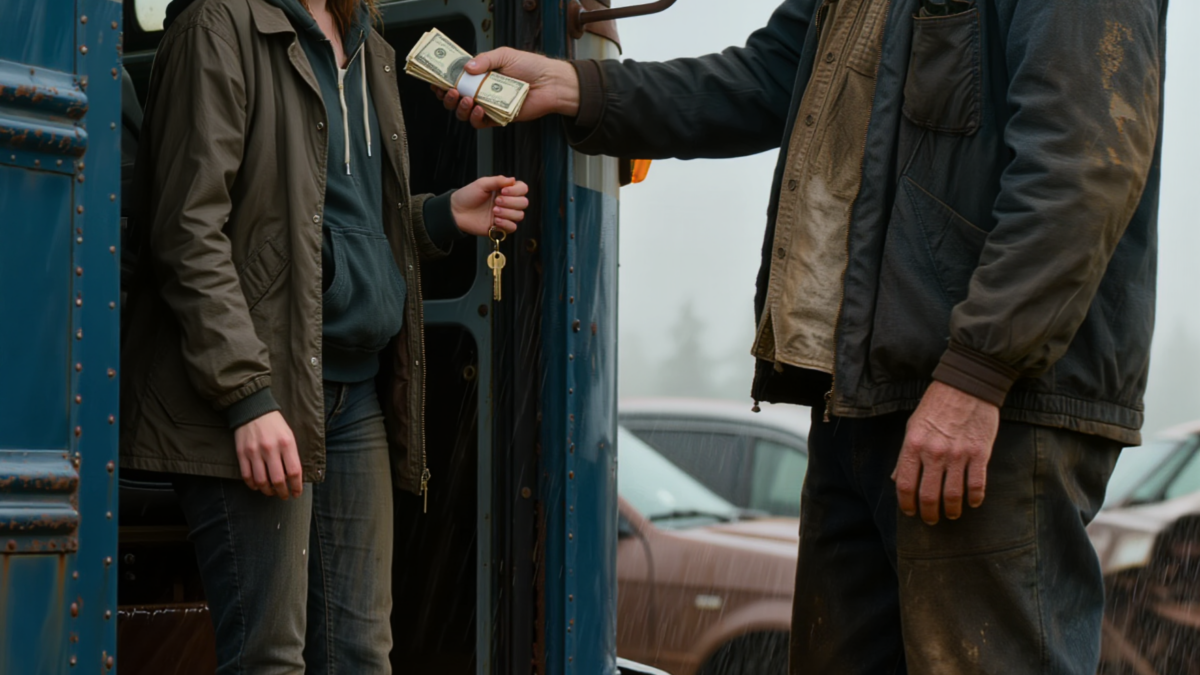
Rick reached into the front pocket of his coveralls and removed folded cash.
Cherry stared.
“I’ll buy it.”
“You just called it a health hazard.”
“Scrap is scrap.”
“How much?”
“Five hundred.”
Cherry almost laughed.
Then she realized he was serious.
Five hundred dollars.
A motel room.
Food.
Transportation.
Maybe enough to survive until she found a job.
Rick separated the bills slowly.
His eyes moved toward the Bluebird again.
Not the body.
The bottom.
Cherry remembered the floorboards.
“What would you do with it?”
“Crush it.”
“Then why pay five hundred?”
Rick stopped counting.
“Helping you out.”
Cherry looked at his face.
He looked annoyed that she was asking questions.
Arthur’s voice returned from memory.
People make things complicated when they don’t want you looking too closely.
Cherry closed her hand around the brass key.
“No.”
Rick stared at her.
“No?”
“I’m keeping it.”
The false friendliness disappeared.
“Your choice.”
He folded the cash.
Then, almost casually, he said, “Gets dangerous around here at night.”
Cherry felt the words settle between them.
Rick flicked his cigarette into the mud.
“Coyotes. Thieves. People looking for copper.”
He walked away.
Cherry watched until he disappeared between two rows of crushed vehicles.
The gas station sold bread for $2.49, peanut butter for $3.19, and gallon jugs of water for less than two dollars.
Cherry did the arithmetic before buying anything.
On the walk back, she kept thinking about Rick.
Five hundred dollars made no sense.
Neither did his interest in the underside of the bus.
She returned to the Bluebird before dark and searched Arthur’s tools.
She found a heavy length of metal that could brace the inside handle.
It was not much.
It was better than nothing.
Night settled over the salvage yard.
The place sounded different in darkness.
Loose sheet metal tapped in the wind.
Rainwater dripped from stacked vehicles.
Occasionally, tires hummed along the distant highway.
Cherry ate a peanut butter sandwich without turning on the lantern.
At approximately two in the morning, gravel crunched outside.
She stopped chewing.
Another crunch.
Closer.
Cherry lowered the sandwich.
A shadow moved across the rear window.
Then came a scrape.
Metal against metal.
Someone was trying one of the exterior compartments.
Cherry reached for the heavy wrench she had left beside the mattress.
A voice muttered outside.
Young.
Male.
Not Rick.
The person moved toward the front.
The door handle shifted.
Once.
Twice.
Then violently.
Cherry stood barefoot in the aisle.
Her heart pounded hard enough to make her lightheaded.
The door pushed inward a fraction.
The brace held.
Another push.
Harder.
The old metal groaned.
Cherry looked around.
There was nowhere to go.
The rear emergency window had rusted nearly shut.
She could not reach the ground safely from the side windows.
The person outside shoved again.
Cherry made a decision.
Instead of waiting silently, she raised the wrench and struck the inside metal panel.
The clang exploded through the bus.
Outside, the person jerked away.
Cherry struck the panel again.
“I called for help!” she shouted.
It was not true.
Her phone barely had service.
She hit the wall a third time.
“Get away from here!”
Footsteps scattered across the gravel.
Fast.
Then faded.
Cherry did not sleep again.
At sunrise, she returned to the floorboards.
The mystery was no longer optional.
She found a socket wrench in Arthur’s toolbox and fitted it to the first steel bolt.
It resisted.
Cherry leaned harder.
Finally, the bolt moved.
By the sixth bolt, her palms hurt.
She wedged a crowbar beneath the edge of the oak.
The plank lifted.
Underneath was darkness.
Cherry grabbed a flashlight.
A steel lockbox rested inside a compartment between the interior floor and the lower structure of the bus.
A small leather journal had been tied to its handle.
Cherry pulled the journal free.
On the first page, Arthur had written her name.
To my dearest Cherry.
Her throat tightened.
She kept reading.
Arthur wrote that if Cherry had found the journal, he was gone.
He warned her that people might already be looking for what he had hidden.
He named Gallagher.
He warned her about banks.
Then he wrote about property stolen from their family decades earlier.
Cherry reread the paragraph.
It sounded like one of Arthur’s old stories.
Then came the clue.
The key is where you used to hide when the thunder got too loud.
Cherry closed her eyes.
She was seven again, sitting beneath the passenger seat of Arthur’s old pickup while thunder rolled over the Cascades.
Arthur pretending not to notice her fear.
Arthur passing her a flashlight.
Arthur telling her to count between the lightning and the thunder.
Cherry crawled toward the front of the Bluebird.
She reached beneath the passenger seat.
Dust.
Old wiring.
Foam.
Then metal.
Her fingers found a small brass key taped against the seat frame.
Cherry pulled it loose.
For the first time since Brenda locked the house, she smiled.
Only briefly.
Then she returned to the floor.
The key fit the lockbox.
Inside were bundles of documents.
Old bearer bonds.
Engineering drawings.
Letters.
Financial records.
Cherry expected photographs or family papers.
Instead, the first blueprint she unfolded showed a complex gyroscopic navigation assembly.
Arthur’s handwritten calculations covered the margins.
The date was October 14, 1968.
Cherry recognized another name printed on the page.
Albbright Aerospace Dynamics.
She had seen the company name in news stories, textbooks, airport displays, and documentaries about American aviation.
Thomas Albbright was treated as an industrial legend.
A visionary.
A pioneer.
But the signature on the original design did not say Thomas Albbright.
It said Arthur Cook.
Cherry opened the next document.
Then another.
The history inside the box emerged piece by piece.
Arthur and Thomas had once been partners in a small engineering company.
Arthur designed.
Thomas negotiated.
Arthur developed the stabilization technology.
According to the documents Arthur preserved, Thomas maneuvered him out of the company before the technology became enormously valuable.
Arthur claimed records had been altered, agreements misrepresented, and his reputation damaged so thoroughly that challenging the public story became nearly impossible.
Cherry sat on the floor for a long time.
Her grandfather had spent decades being called paranoid.
Now she was holding original documents that at least explained why he had believed powerful people wanted them gone.
Then she found a letter Arthur had written shortly before his death.
It mentioned Cherry’s father.
Arthur believed his son’s sudden death deserved closer scrutiny.
He had hired someone to examine financial records around the family.
Cherry read the final line.
Especially Brenda.
Her fingers went cold.
Another sheet rested behind the letter.
A photocopied bank record.
Brenda’s name appeared at the top.
Highlighted below it was a transfer.
$250,000.
The sender was a company Arthur connected to the Albbright corporate network.
The date was two days after Cherry’s father died.
Cherry stared until the numbers blurred.
She did not know what the transfer proved by itself.
She knew what it changed.
Brenda had not been a random outsider to Arthur’s fears.
Money had connected her directly to the same network Arthur had spent years documenting.
Then came another sound.
Three hard knocks against the side of the Bluebird.
Cherry jolted.
“Hey, kid.”
Rick.
She moved immediately.
Bonds back into the box.
Blueprints folded.
Letters inside.
Lock turned.
Box lowered.
Oak plank replaced.
A dirty rug dragged over the floor.
The front door rattled.
“I got somebody wants to talk to you,” Rick called.
Cherry approached the cracked door window.
Rick stood in the mud.
Bolt cutters hung from one hand.
Beside him stood a man in a charcoal suit.
Late twenties.
Blond hair combed neatly back.
Expensive shoes already darkened by mud.
He looked like he belonged in a financial district elevator, not a salvage yard.
“Cherry Cook?” he called.
She said nothing.
“My name is Harrison Albbright.”
Cherry’s stomach tightened.
“Thomas Albbright is my grandfather.”
Every question in the bus seemed to become one question.
Why was he here?
Harrison smiled.
“I believe you have some property that belongs to my family.”
“This bus belongs to me.”
“I’m not talking about the bus.”
Cherry gripped the doorframe.
“I don’t know what you mean.”
Harrison’s smile sharpened.
“I think you do.”
“Leave.”
“Let’s be reasonable.”
He removed a checkbook from his jacket.
“Fifty thousand dollars.”
Cherry stared at him.
“You take the money. You leave the bus. You walk away.”
Yesterday, Rick had offered five hundred.
Now Harrison was offering one hundred times that amount.
Cherry finally understood how little either man believed their own story about worthless scrap.
“No.”
Harrison blinked.
“Think carefully.”
“I did.”
His tone became colder.
“You have no home.”
Cherry said nothing.
“No job.”
Nothing.
“You are eighteen years old.”
Cherry kept looking at him.
“Fifty thousand dollars is more than enough to restart your life.”
“Then why is this worth fifty thousand to you?”
Harrison’s smile disappeared.
Rick shifted beside him.
Cherry felt something inside her settle.
Fear remained.
But confusion did not.
Harrison wanted the contents of the bus.
And he believed Cherry was still too desperate to understand what they were worth.
Then he made his mistake.
“Brenda assured us you had no idea what Arthur kept in there.”
Cherry stopped breathing for a beat.
She had never mentioned Brenda.
Not to Rick.
Not to Harrison.
She looked from one man to the other.
“So you know my stepmother.”
Harrison did not answer.
That was answer enough.
Cherry stepped backward from the door.
“I’m calling for help.”
Harrison gave a humorless laugh.
“Do that.”
Rick lifted the bolt cutters.
“By the time anyone gets through this yard,” Harrison said, “we’ll have handled this privately.”
Rick moved toward the door.
Cherry’s fear returned all at once.
The exterior chain snapped beneath the bolt cutters.
The door pushed inward.
Cherry shoved the interior brace into place.
Rick drove his shoulder against the metal.
The brace strained.
Cherry backed toward the driver’s seat.
Her eyes moved across Arthur’s dismantled dashboard.
Old switches.
Unlabeled wiring.
Mechanical levers.
Then she remembered something Arthur told her when she was ten.
They had been sitting inside the Bluebird during one of his repair projects.
He pointed beneath the driver’s seat at a faded red emergency control.
“Never touch that unless you absolutely need it.”
Cherry had laughed.
“What does it do?”
Arthur smiled.
“It makes unwanted visitors reconsider their choices.”
At ten, Cherry assumed he was joking.
Now Rick hit the door again.
The brace shifted.
Cherry found the red control.
She did not know every detail of what Arthur had built, and she had no intention of experimenting.
But the label beside it was unmistakable.
EMERGENCY EXTERIOR DETERRENT.
Rick forced the door open several inches.
“Move!”
Cherry activated the control.
A harsh electrical hum filled the vehicle.
Rick jerked backward from the metal doorway with a shout and fell into the mud.
The effect was immediate enough to stop him.
Cherry deactivated the system just as quickly.
Rick lay stunned but moving.
Harrison stumbled backward across the wet gravel.
For the first time, he looked frightened rather than angry.
Cherry raised her prepaid phone.
“I recorded you.”
That part was true.
The phone’s voice recorder had been running since Harrison introduced himself.
She had started it without thinking, remembering Arthur’s warning that memory could be argued with but records were harder to dismiss.
Harrison stared at the phone.
“You recorded us?”
“Your offer.”
His eyes narrowed.
“Your connection to Brenda.”
Rick groaned behind him.
“And your order to force your way inside.”
Harrison’s confidence returned slightly.
“You think anyone is going to believe you?”
Cherry looked toward the floorboards behind her.
“I don’t need them to believe me.”
She lifted the phone.
“I have the original 1968 drawings.”
Harrison stopped moving.
Cherry continued.
“I have Arthur’s letters.”
Nothing.
“And the bank record showing the transfer to Brenda.”
Harrison’s face changed.
Not dramatically.
His eyes simply stopped shifting.
For several seconds, no one spoke.
Then sirens sounded in the distance.
Cherry had not called.
Someone nearby had apparently heard the disturbance and reported it.
The sirens grew louder.
Harrison looked toward the salvage-yard entrance.
Rick was sitting up now, dazed and furious.
Cherry stayed inside the bus until vehicles reached the yard.
When officers arrived, she deactivated everything, stepped away from the door, and kept her hands visible.
She told them there had been an attempted forced entry.
She gave them the recording.
She showed them the broken chain.
She did not explain every document beneath the floor.
Not there.
Not yet.
Medical personnel examined Rick.
He was conscious by then.
Harrison tried to describe the confrontation as a misunderstanding about property.
Cherry listened.
Then an officer asked why bolt cutters had been used on a vehicle Harrison admitted did not belong to him.
Harrison stopped talking.
That was the first time Cherry saw someone else look at him instead of at her.
By afternoon, she had made a decision.
The documents could not remain in the Bluebird.
Too many people knew where Arthur had hidden them.
She packed the lockbox.
She packed the journal.
She packed her garbage bag.
Then she left Gallagher’s yard.
For the second time in two days, Cherry Cook walked away carrying everything she owned.
This time, however, everything had changed.
She traveled to Seattle.
The city had always represented college to her.
Now it represented protection.
Cherry did not walk randomly into the first office she saw.
She spent hours at a public library researching firms with experience in complex corporate disputes and intellectual-property cases.
Then she chose one.
The receptionist looked confused when an exhausted eighteen-year-old entered carrying a scratched steel box.
“I need someone to look at old engineering documents,” Cherry said.
“Do you have an appointment?”
“No.”
“Are you a client?”
“No.”
The receptionist hesitated.
Cherry placed Arthur’s journal on the counter.
“My grandfather designed something in 1968.”
Still nothing.
Cherry opened the box and carefully lifted the edge of one original blueprint.
The receptionist stopped reaching for the phone.
“What company?”
“Albbright Aerospace Dynamics.”
That got attention.
An associate came downstairs.
Then another.
Within an hour, Cherry sat in a conference room overlooking downtown Seattle while three attorneys examined the documents without touching them more than necessary.
They did not promise her anything.
Cherry appreciated that.
They asked questions.
Where did she find them?
Who else knew?
Were there originals?
Were there copies?
What did Arthur claim?
What could be independently authenticated?
Cherry answered everything she knew.
When she did not know something, she said so.
That mattered too.
Over the following weeks, the story became less dramatic in appearance and more serious in substance.
Experts examined paper.
Ink.
Dates.
Corporate records.
Old filings.
Employment documents.
Historical patent information.
Bank records.
The original blueprints did not tell the entire story by themselves.
But they opened doors.
Arthur’s annotations matched other verified samples of his handwriting.
Corporate records placed him inside the early partnership.
Several pieces of old documentation contradicted the cleaner history promoted by the Albbright organization.
The financial trail to Brenda required separate review.
So did the events at Gallagher’s salvage yard.
Cherry spent most of those weeks in borrowed clothes, temporary housing arranged through people working on the case, and long meetings where adults used phrases she had never heard before.
She kept Arthur’s journal beside her.
Whenever the process became overwhelming, she remembered the oak floorboards.
One fact.
Then another.
Then another.
Nothing magical.
Just details people had assumed no one would ever assemble.
Brenda called after the first legal notice reached her.
Cherry watched the name flash across her phone.
For several seconds, she considered ignoring it.
Then she answered.
“What have you done?” Brenda demanded.
Cherry sat quietly.
“You had no right to drag me into whatever nonsense Arthur filled your head with.”
Cherry looked at the copy of the bank record on the desk.
“Why did you receive $250,000 two days after Dad died?”
Silence.
Then Brenda laughed.
A strange, breathless sound.
“You’re eighteen. You don’t understand finances.”
“Explain it.”
“It was private.”
“Explain it.”
“You don’t get to interrogate me.”
Cherry closed her eyes.
For years, Brenda had ended arguments that way.
Authority instead of explanation.
Volume instead of facts.
This time it did not work.
Cherry spoke softly.
“You locked me out because you thought I would sell the bus.”
Brenda said nothing.
That silence hurt more than denial would have.
Cherry ended the call.
The public story grew slowly.
Then suddenly.
Records became court filings.
Filings became news.
Journalists began waiting outside buildings.
The Albbright organization disputed major parts of Arthur’s account and fought hard over responsibility, ownership, and the meaning of the historical documents.
Cherry’s attorneys expected that.
The case was never as simple as opening one lockbox and being handed a fortune.
It involved authentication.
Negotiation.
Historical records.
Claims and counterclaims.
Questions of ownership and compensation.
And separate proceedings concerning the confrontation at Gallagher’s yard.
Harrison’s recorded statements became particularly difficult for his side to explain.
He had acknowledged knowing about Arthur’s “insurance policy.”
He had connected Brenda to the family’s effort to recover material from the bus.
He had offered Cherry money.
And his presence at a forced entry complicated any argument that the meeting had been an innocent negotiation.
Rick’s role became its own problem.
The $500 offer.
The warning.
The attempted nighttime intrusion, though Cherry could not personally identify that intruder.
The later forced entry.
Investigators had questions.
Cherry let them ask.
For the first time in her life, she did not have to convince everyone alone.
The evidence could speak beside her.
Brenda’s finances received scrutiny as well.
Cherry learned that discovering one suspicious transfer did not automatically explain every event surrounding her father’s death, and responsible investigators refused to pretend otherwise.
What the records did show was enough to change the story Cherry had been told about Brenda’s relationship with the Albbright network.
There had been money.
There had been communication.
There had been cooperation.
And Brenda had pushed Cherry out of the house at the exact moment she gained full control over Arthur’s inherited property.
Months passed.
Cherry turned nineteen.
Her University of Washington acceptance had originally seemed impossible to use.
Now, through a combination of delayed enrollment and financial arrangements made while the legal matter continued, college became possible again.
The first time she walked across campus, she cried in a bathroom so no one would see.
Not because she suddenly felt wealthy.
She didn’t.
She felt tired.
And lucky.
And angry that something as ordinary as sitting in a lecture hall had once seemed farther away than any aerospace technology Arthur had designed.
The dispute eventually ended in a massive financial settlement.
The final number associated with Cherry’s claims and inherited rights reached approximately $85 million.
News reports described her as the teenager who found a fortune beneath a bus floor.
Cherry disliked that description.
She had not found a suitcase of free money.
She had found Arthur’s unfinished argument.
The money came later.
So did consequences for the people whose actions became part of the investigations and litigation.
Harrison faced criminal allegations connected to the salvage-yard confrontation and forced entry.
Rick faced consequences tied to his role in the incident.
Brenda’s financial dealings were examined, and the life she had assumed would continue unchanged did not.
Thomas Albbright’s celebrated public history was permanently challenged by documentation that had survived far longer than anyone expected.
Cherry never celebrated any of it the way strangers imagined she did.
There was no champagne moment.
No cinematic room full of enemies admitting she had won.
There were signatures.
Meetings.
Tax planning.
Therapy.
College orientation.
Phone calls.
And one afternoon when Cherry returned to the old house her father had built only long enough to collect a few boxes that legally belonged to her.
Her old bedroom looked smaller.
The University of Washington acceptance packet was still in the drawer.
Cherry held it for a long time.
Then she slipped it into her backpack.
She did not take anything else from the room.
Two years after the night she arrived at the salvage yard, the University of Washington unveiled a new engineering facility supported in part by Cherry’s settlement funds.
The name had been her decision.
The Arthur Cook Center for Aerospace Innovation.
On opening day, Cherry stood near the entrance wearing her graduation gown.
She was twenty.
Students moved around her carrying backpacks and coffee.
Professors talked beneath the polished metal letters mounted above the doors.
No one there could smell mildew.
No rain leaked through the ceiling.
No oak floorboards hid documents beneath their feet.
Cherry looked up at her grandfather’s name.
For most of his life, Arthur Cook had been described by other people.
Difficult.
Paranoid.
Eccentric.
Unstable.
Unsuccessful.
Cherry had learned that one of the most dangerous things about an accepted story was how permanent it could become when the people who knew otherwise stopped speaking.
Arthur had never stopped.
He had simply hidden the proof where nobody wanted to look.
Inside something abandoned.
Something rusted.
Something everyone else had already decided was worthless.
Cherry touched the old brass key in her pocket.
She still carried it sometimes.
Not because it opened anything anymore.
Because it reminded her of the first night.
Seventeen dollars and forty-two cents.
One garbage bag.
Freezing rain.
A deadbolt behind her.
A rusted bus ahead.
And six strangely clean bolts in a floor that should have been rotting.
The entire truth had not appeared at once.
It had started with one detail that did not fit.