e doctor had spent the entire night calling me reckless and preparing a complaint against me when a wounded stranger arrived gripping a locked case and repeating one word: “Sentinel.” I denied knowing what it meant. Then a colonel crossed the emergency department, pointed directly at me, and said, “That’s her.”
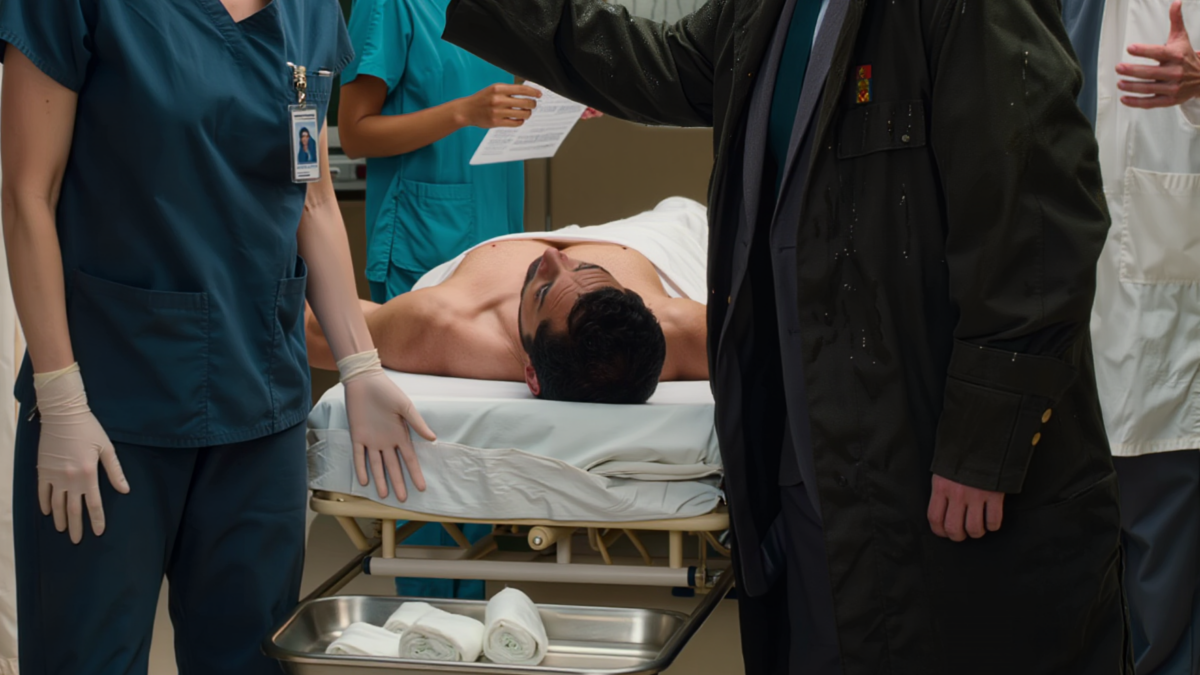
The rain had been falling since midnight when Colonel Renata Ashworth crossed the ambulance bay at Fairview General.
Her coat was dark at the shoulders, her boots wet from the parking lot. Major Daniel Pru followed half a step behind her, carrying a leather folder against his chest. Two escorts remained near the entrance.
Nobody in the emergency department mistook them for visitors.
Ashworth scanned the room once.
Then she found me.
I was standing beside a trauma gurney in blue scrubs with dried antiseptic on my forearms and a roll of gauze in my hand.
She crossed the department without asking for the charge nurse, security, or a physician.
She stopped several feet from me.
“Only Sentinel can read that file.”
Every conversation near the desk seemed to stop.
I didn’t move.
Twenty-two minutes earlier, none of them had known the name Sentinel.
Four hours earlier, most of them had known me only as Elena Cade, one of the night nurses.
And Dr. Grant Halsey had been trying to convince half the department that even that was more authority than I deserved.
The night had started with Curtis Fenn.
Forty-one years old, delivery driver, married, two children according to his intake form. He walked into triage with what he described as mild pressure in his chest.
His vital signs looked reasonable.
His face did not.
I saw him while passing the bay with a medication tray.
His color was slightly wrong. Not dramatically. Not enough for somebody glancing in from the hallway to sound an alarm.
But wrong.
Then his left hand moved toward his jaw.
He rubbed it once.
Dropped it.
A few seconds later he did it again.
I stepped inside.
“Curtis?”
He looked at me.
“Yeah?”
“Any nausea?”
“A little.”
“Shortness of breath?”
“Maybe.”
Dr. Grant Halsey came in behind me, already looking at the monitor.
Halsey had been at Fairview for about eighteen months. He was smart. Nobody seriously disputed that.
The problem was that he knew it.
He had trained at a prestigious residency program, arrived with glowing recommendations, and carried himself like the department was something he had temporarily agreed to improve.
He checked Curtis’s chart.
“Numbers look fine.”
I looked at Curtis.
His fingertips were flexing against the sheet.
“They’re not going to stay fine.”
Halsey’s eyes came up.
“What are you seeing?”
“Color change. Referred discomfort. He keeps touching his jaw.”
“So?”
“So I want another line ready.”
“We don’t start procedures because somebody looks uncomfortable.”
I was already reaching for supplies.
Halsey exhaled through his nose.
“Elena.”
“Give me ninety seconds.”
He looked offended by the request itself.
“Nursing care is not a matter of intuition.”
I didn’t answer.
I placed the line.
Curtis looked at me.
“Am I in trouble?”
“We’re going to stay ahead of it.”
Less than two minutes later, the monitor changed.
Everything after that happened fast.
Curtis’s body gave us the warning the machine had been late to confirm.
The room shifted instantly from disagreement to action.
Priya Chandra pushed the crash cart toward me before anybody asked.
I called out what I needed.
Respiratory came in.
Halsey stepped toward the bed.
The line I had prepared was already there.
That mattered.
The crisis was brief compared with what it could have become.
Curtis stabilized.
The room slowed.
Someone let out a breath.
Halsey stood at the foot of the bed with his stethoscope around his neck.
He looked at the equipment.
Then at me.
“Why did you initiate before I gave an order?”
Priya stopped moving.
The respiratory therapist glanced sideways.
I stripped off my gloves.
“Because he was getting worse while you were still reading the chart.”
Nobody spoke.
I walked to the sink.
Cold water hit my hands.
A minute later Priya appeared beside me.
She was twenty-eight, new enough to emergency nursing that she still replayed every code afterward in her head.
“How did you know?”
I reached for soap.
“The hands.”
She frowned.
“What?”
“Watch people’s hands. The monitor tells you what already happened. Sometimes the hands tell you what’s coming.”
She looked toward Curtis’s bay.
“That’s not exactly in our training manual.”
“No.”
“Where did you learn it?”
I dried my hands.
“Working.”
It was the kind of answer Deb Whitlock had learned not to question.
Deb had managed the night shift for nineteen years.
She had noticed things about me from the beginning.
The way I tracked exits without appearing to.
The way loud voices rarely made me turn.
The way I could walk into a chaotic room and immediately know who was frightened, who was angry, and who was about to become dangerous.
She had once asked where I worked before nursing school.
I gave her a vague answer.
She never asked again.
Some people considered that indifference.
It wasn’t.
Deb understood privacy as a form of kindness.
The department settled back into its usual rhythm.
I restocked a cart.
Checked circulation beneath a child’s cast.
Charted.
Ate half a sandwich standing up.
Nothing remarkable.
That was the point.
For four years, I had built my life from ordinary tasks.
Medication times.
Shift reports.
Supply counts.
Patients who wanted blankets.
Families who needed someone to explain what the physician had said in words that did not sound like a textbook.
I liked that life.
I had chosen it because people came into my care one person at a time.
You could help the person in front of you.
You could see the consequence.
You could go home afterward knowing exactly whose pulse you had checked and whose pain you had reduced.
My first career had not been like that.
I did not think about my first career often.
At least, that was what I told myself.
That night Curtis ruined the illusion slightly.
The way his hand moved toward his jaw had reminded me of another man years earlier.
Different room.
Hotter country.
Worse lighting.
The memory rose toward me.
I put it down.
Four years of practice had made me good at that too.
Halsey found me forty minutes later.
He approached the nurses’ station with a tablet tucked beneath one arm.
“Elena.”
I kept typing.
“Yes?”
“I reviewed what happened with Curtis Fenn.”
“Okay.”
“I consider your intervention aggressive and procedurally irregular.”
Priya was three feet away.
Two residents were charting at the opposite side of the desk.
Halsey had chosen the location deliberately.
“In this department,” he continued, “nurses do not freelance based on gut feeling.”
I stopped typing.
“Would you rather I had waited until the monitor agreed?”
His expression tightened.
“That isn’t the issue.”
“It’s exactly the issue.”
“You acted before receiving an order.”
“And he deteriorated immediately afterward.”
“You’re missing the point.”
“No. I think we disagree about the point.”
One of the residents looked down quickly.
Halsey shifted his weight.
“I’m documenting the incident.”
“All right.”
He seemed surprised.
“I’m recommending review of your privileges.”
“Fine. Write it up.”
His mouth opened slightly.
I went back to the chart.
He stood there another second, then walked away.
Priya stared at me.
“That’s it?”
“What else is there?”
“He’s trying to get you removed from the unit.”
“He can write whatever he wants.”
“You’re not angry?”
I looked at her.
“I didn’t say that.”
The disrespect did not stop.
Halsey corrected me in front of a patient over an IV rate that matched the written order.
Ten minutes later, after checking, he quietly changed his own note rather than acknowledge it.
He sent me to handle the department’s least desirable cleanup tasks twice.
Near midnight, I passed him talking to a resident.
“Our self-appointed doctor of the night shift.”
The resident gave an uncomfortable laugh.
Halsey let it hang in the air.
I kept walking.
There was a difference between having no reaction and deciding which reactions deserved your energy.
I had learned that distinction years before nursing.
The one moment that nearly broke my restraint happened around one in the morning.
An elderly woman named Marjorie had fractured her hip.
She was eighty.
Her daughter Susan stood beside the bed gripping her purse with both hands and asking one question before the previous answer was finished.
“Will she need surgery? How long will she stay? Can I go with her? She gets confused at night.”
I lowered myself until I was closer to Marjorie’s eye level.
“We’re going to keep her comfortable first. Orthopedics will review the imaging. Nobody is taking her anywhere without explaining it to both of you.”
Marjorie’s fingers relaxed slightly around the sheet.
Halsey appeared in the doorway.
Susan turned toward him.
“Doctor?”
He looked at me.
Then at her.
“You’re always welcome to request an actual physician if you want medical guidance instead of relying on whatever nursing staff feels like telling you.”
Susan’s expression changed immediately.
Embarrassment.
Confusion.
Apology.
As though she had accidentally participated in insulting me.
I kept my voice even.
“Your mother’s pain medication is already ordered. We’re waiting on orthopedics, and I’ll let you know the moment they call.”
Susan nodded.
“Thank you.”
I finished the explanation.
Only after the curtain closed did I let myself look toward the hallway.
Priya was there.
She had seen it.
“You okay?”
“Yes.”
My jaw hurt from clenching it.
An hour later Deb came to find me.
She held her phone at her side.
“He emailed the interim nursing officer.”
I looked at her.
“About Curtis?”
“And copied the medical director.”
“Of course he did.”
“He requested formal competency review.”
I continued restocking the crash cart.
Deb stepped closer.
“Do you want to file a response tonight?”
“No.”
“Elena.”
“Not tonight.”
Something in the way I said it made her stop.
She watched me for a second.
“All right.”
At 2:09 a.m., the ambulance doors opened.
The gurney that came through them was not attached to any normal dispatch record.
Two paramedics I did not recognize pushed it.
A man in a soaked field jacket walked beside them.
The patient was in his thirties.
His face was gray.
A heavy bandage covered his upper shoulder.
A black hard-shell case was secured to his left wrist.
Halsey intercepted them immediately.
“Where did you come from?”
The man in the field jacket didn’t answer.
“Who called this in?”
“Trauma bay,” he said.
“You don’t get a trauma bay without intake.”
The man looked past him.
His eyes landed on me.
“Now.”
I was already moving.
I don’t know why.
Maybe it was the tone.
Maybe it was the way the patient’s shoulder dressing had darkened.
Maybe some part of me recognized the entire shape of the situation before my conscious mind had caught up.
I pulled on gloves.
“What happened?”
The escort gave me the minimum.
“Sergeant First Class Owen Castillo. Penetrating shoulder injury. Significant blood loss.”
I checked the dressing.
“We need blood.”
Halsey followed us.
“We need identity information first.”
“He needs a line first.”
“Elena.”
I ignored him.
Castillo opened his eyes.
His gaze moved without focus.
Then his hand came up and closed around my wrist.
The strength surprised me.
His lips moved.
I leaned closer.
“What?”
“Sentinel.”
My body went still.
Only for a second.
Priya noticed.
Nobody else did.
Castillo swallowed.
“Only Sentinel.”
I looked at him.
A name I had not heard in four years moved through me like a current.
I reached for fresh gauze.
“Second line.”
Priya handed it over.
Halsey appeared near the foot of the gurney.
“Sentinel?”
Nobody answered.
He laughed once.
“Sounds like somebody’s been watching too many movies.”
A tired resident smiled.
Halsey looked toward me.
“Maybe Elena knows. She seems to have all the answers tonight.”
My hands did not stop.
“I don’t know what he’s talking about.”
Priya looked directly at my face.
I felt it.
She had worked with me long enough to understand something had changed.
The escort understood too.
He studied me for less than a second.
Then stepped into the hallway and removed a phone from inside his jacket.
It was thicker than a normal phone.
He turned away.
I caught two words.
“Confirm location.”
Deb arrived near the trauma bay doors.
She folded her arms.
“What exactly came into my department?”
Nobody answered.
I stabilized Castillo’s dressing as well as we could.
The shoulder injury was serious but manageable if we stayed ahead of the blood loss.
The strange part was not the wound.
It was the locked case.
The escort.
The absence of normal transfer documentation.
And the word Castillo kept trying to say whenever he surfaced.
Sentinel.
I had not asked who they were.
Priya noticed that too.
She told me later it was the detail that bothered her most.
Anybody else would have asked.
Why the case?
Why the escort?
Why here?
I asked none of it because some part of me already understood the category of answer.
Then the ambulance doors opened again.
Colonel Renata Ashworth entered with Major Daniel Pru.
My past walked into Fairview General wearing wet boots.
Halsey moved toward them.
“This is a restricted clinical area.”
Ashworth kept walking.
“You need to stop.”
She finally looked at him.
“I’m Colonel Renata Ashworth.”
Halsey hesitated.
She continued.
“I have a wounded operative in this facility carrying material that cannot leave controlled custody. I need Sentinel.”
Halsey looked toward Castillo.
“There is no operative here. There’s a patient with a serious wound who keeps repeating a word.”
Ashworth’s expression did not change.
“You have ninety seconds to clear anyone who isn’t treating him.”
“You cannot issue orders in my department.”
Major Pru had stopped listening.
His eyes moved past Halsey.
Past Deb.
Past Priya.
To me.
He looked older.
Four years older, technically.
It seemed like more.
His gaze held mine.
I knew immediately.
He said something quietly to Ashworth.
She turned.
The department disappeared around us.
For a moment she simply looked at me.
Then she crossed the floor.
Six measured steps.
She stopped.
Raised one hand.
Pointed.
“Only Sentinel can read that file.”
Priya lowered the chart she was holding.
Deb stopped in the doorway.
Halsey turned toward me.
Ashworth continued.
“That’s her.”
Nobody spoke.
I set down the gauze.
“I retired that name.”
“The situation didn’t.”
“Colonel—”
“We have less than an hour.”
Major Pru stepped forward.
He did not call me Sentinel.
He did not call me Elena.
He said, “We need a secure room.”
Deb recovered first.
“This way.”
She took us to a small conference room normally used for family consultations.
Pru placed the folder on the table.
He opened it.
Inside was one page.
Characters.
Clusters.
Symbols.
Nothing recognizable to anyone else.
For the first second, almost nothing recognizable to me either.
Then one structure opened in my mind.
Then another.
I sat down.
“No.”
Ashworth stood opposite me.
“We need you.”
“No. Why is this system active?”
“Read first.”
“I asked why it’s active.”
Pru spoke quietly.
“Because it was never formally decommissioned.”
I looked at him.
“That is not an answer.”
He nodded.
“Six months ago a station chief needed a method that had never been technically compromised.”
My stomach tightened.
“And someone chose mine.”
“Yes.”
“Without asking.”
“Yes.”
I looked back at the page.
Four years earlier I had helped build the system with Frank Doyle.
Frank was a cryptologist, mentor, and one of the gentlest men I had ever known.
Our cipher had never depended entirely on mathematics.
That was the point.
We built portions around private references no external system could reconstruct.
A bad coffee shop.
Coordinates from training exercises.
Misquoted lines from books.
A running joke involving a broken vending machine.
Things that meant nothing outside two human memories.
Frank died during the operation that ended my old career.
I resigned not long afterward.
I changed industries.
Went through nursing school.
Moved.
Became Elena Cade in a life where nobody used code names.
Now Frank’s structure was sitting on a hospital conference table.
“What’s in the file?” I asked.
Ashworth answered.
“Nine embedded sources. Their handler disappeared two nights ago.”
I kept my eyes on the page.
“Where?”
“Three provinces.”
“Why wasn’t the information transmitted?”
“Networks are compromised.”
“Castillo carried it physically.”
“Yes.”
“How long do we have?”
“Fifty-eight minutes before our next extraction window closes.”
I looked toward the door.
“Why him?”
“He was closest.”
“That’s not what I asked.”
Ashworth understood.
“Because he volunteered.”
I looked at Pru.
He gave the smallest nod.
The page blurred for half a second.
Then Priya opened the door.
“Elena.”
Her face told me before her words did.
“Castillo’s pressure is falling.”
I stood.
Ashworth said, “The file—”
“Comes with me.”
Back in the trauma bay, Castillo’s dressing had started failing again.
I put the page on the bedside tray.
“More blood.”
Priya moved.
I adjusted the dressing.
Called for what I needed.
The monitor sounded sharply.
With my right hand I worked on Castillo.
With my left I held the paper flat.
My eyes moved between both.
Something happened then that I had not expected.
The two lives I had treated as incompatible stopped feeling separate.
Patient.
Cipher.
Pulse.
Pattern.
One set of information arriving through hands and skin and numbers.
The other through marks on paper.
Both asking the same question.
What happens if you misread the warning?
Halsey returned.
“This is absurd.”
Nobody answered.
He stepped closer.
“This patient needs a surgical consult, not a nurse doing puzzles beside the bed.”
Colonel Ashworth moved between him and the gurney.
“You will not interrupt her again.”
Halsey stopped.
Ashworth’s voice remained controlled.
“She is decoding information connected to nine people whose extraction window is closing, while simultaneously keeping your patient stable.”
“My patient?”
“Yes. The one she recognized was deteriorating before you did.”
Halsey looked at me.
For the first time all night, he had nothing ready to say.
“Unless you have something clinically useful to contribute,” Ashworth continued, “step away.”
His eyes moved around the room.
Priya was no longer looking toward him for guidance.
Deb wasn’t either.
He stepped back.
The silence he left behind felt heavier than any argument.
I continued decoding.
Line by line, the system returned.
Then I reached a location cluster near the bottom.
Something was wrong.
I read it again.
The coordinates resolved cleanly.
Too cleanly.
I looked at the fourth character.
Then the seventh.
A memory surfaced.
Frank standing beside me years earlier, holding a paper cup.
“You know what they gave me?”
“Coffee?”
“A personal insult.”
I had laughed.
He spent the next week pretending the burned drink represented the collapse of civilization.
Later he used the shop’s name inside a training cipher as a marker for a false branch.
I stared at the page.
“Frank.”
Pru heard me.
“What?”
“There’s a decoy.”
Ashworth stepped closer.
“Where?”
“The first location is false.”
“How sure?”
I hated the question because four years earlier the answer would have come instantly.
Now I doubted myself.
The old language felt familiar but distant.
Ashworth saw it.
Her voice softened.
“Take enough time to be right.”
I looked at her.
“We don’t have time.”
“We have more time than we’ll have if we send people to the wrong coordinates.”
That steadied me.
I traced the cluster again.
There it was.
The coffee shop.
The private joke.
The alternative branch.
“The true location is embedded underneath.”
Pru leaned forward.
“That sounds like Frank.”
My hand paused.
Hearing his name aloud hurt.
I continued.
The monitor changed.
Priya called out Castillo’s pressure.
I responded automatically.
Another unit of blood.
Adjustment.
Check.
Then back to the page.
Two minutes later the branch opened.
Coordinates.
Names.
Nine ordinary names.
A teacher.
Shop owner.
Radio repairman.
People who had trusted a system built in part from a language Frank and I thought nobody would ever need again.
“I have it.”
Pru uncapped a pen.
I read the coordinates twice.
He repeated them.
Ashworth was already moving toward the door.
She spoke into a secure radio.
I turned entirely back to Castillo.
His eyes opened.
“You did it?”
“Save your strength.”
His mouth moved in what might have been a smile.
“You’re Sentinel.”
“I’m your nurse.”
His eyes closed again.
“That works too.”
Twenty minutes later, Ashworth received confirmation.
She listened.
Said nothing.
Closed her eyes for one second.
Then opened them.
“All nine.”
The tension in my chest loosened.
Not disappeared.
Loosened.
That was enough.
The rest of the night returned slowly to ordinary medicine.
Curtis remained stable.
Marjorie was transferred upstairs.
Castillo went for definitive surgical care once he was ready.
And Grant Halsey discovered that an email could become evidence against the person who wrote it.
The complaint he had filed against me documented his own decisions during Curtis’s deterioration.
His attempt to interfere with Castillo’s treatment triggered a broader review.
Within days, hospital leadership placed him on administrative leave while they examined the shift.
His recommendation to revoke my privileges disappeared.
He never apologized.
I did not ask him to.
Watching somebody lose authority was not why I became a nurse.
Near the end of the shift Priya found me restocking supplies.
For several seconds she said nothing.
Then she asked, “How do you know what to trust when everybody around you says you’re wrong?”
I smiled faintly.
“You watch the hands.”
She laughed once.
“I knew you were going to say that.”
“And then you trust what you already know, even when saying it costs something.”
She absorbed that.
I think she understood part of it.
Years later, perhaps, she would understand more.
Deb caught me near the conference room.
She leaned against the doorway.
“I’m not asking.”
“Thank you.”
“But I am saying this.”
I waited.
“Whatever title those people walked in here looking for, your job here isn’t going anywhere.”
I looked down.
“You don’t know what that title means.”
“No.”
“That doesn’t bother you?”
“I know what you do here.”
Something inside me shifted.
Deb continued.
“And if you ever need to sit in my office and say absolutely nothing, the door’s open.”
“Thank you.”
She nodded.
That was all.
After she left, Major Pru entered.
He carried something in his hand.
A badge.
Old.
Worn at the edges.
He placed it on the table.
I recognized it immediately.
“You kept that?”
“I wasn’t sure why.”
I did not touch it.
“Now you know?”
“I think I always suspected we weren’t finished with you.”
“I am.”
“With us?”
“Yes.”
He nodded.
“I believe you.”
“That sounds like there’s a ‘but.’”
“There is.”
I looked at him.
“Nobody is asking you to go back.”
“Good.”
“Ashworth wants an irregular consulting arrangement.”
I almost laughed.
“You walk into my hospital at two in the morning and expose a code name I buried four years ago, then offer part-time work?”
“When you say it like that, it sounds badly managed.”
“It was badly managed.”
He smiled faintly.
“Fair.”
I looked at the badge again.
“What would consulting mean?”
“Rare cases. Nothing routine. No roster under your old name. You keep your hospital job. You keep your life.”
“And when somebody builds another file around Frank’s cipher?”
Pru’s expression changed.
“That shouldn’t happen.”
“But it did.”
“Yes.”
“Who authorized it?”
“The station chief.”
“Who gave the chief access to Frank’s full construction notes?”
Pru did not answer immediately.
That silence mattered.
“Daniel.”
“We’re reviewing that.”
“That is not an answer.”
“No.”
I looked at the badge.
Then at him.
“You don’t know.”
“We know who approved reactivation.”
“That wasn’t my question.”
He nodded slowly.
“No. We don’t yet know who supplied every historical element.”
The room seemed suddenly smaller.
The false branch had required more than technical access.
It required knowledge of Frank.
Not the official Frank Doyle.
The man who complained about burned coffee for a week.
The man who hid jokes inside safeguards because he believed human memory could sometimes outlast compromised machines.
Somebody knew enough to reproduce that.
“You came here because you needed me to read the file,” I said.
“Yes.”
“But that isn’t the only reason you stayed.”
Pru looked toward the closed door.
“No.”
“What did you find?”
He pulled the folder toward himself.
Turned to the final page.
There, beneath the administrative authorization for the cipher’s reactivation, was a date.
Six months earlier.
And beside it was a reference number tied to a source archive that should have been sealed after Frank died.
I looked up.
Pru said nothing.
He didn’t need to.
The locked door I had spent four years avoiding had already opened.
Now there was another one behind it.
And somebody else had apparently been using the key.