Clare pushed two dozen red roses back into my chest in front of twelve coworkers and said, “Ethan, I told you I don’t like big gestures.” Twenty minutes later, I carried the same bouquet back to the florist—where one rose, one joke, and one unexpected invitation changed what I thought that humiliation meant.
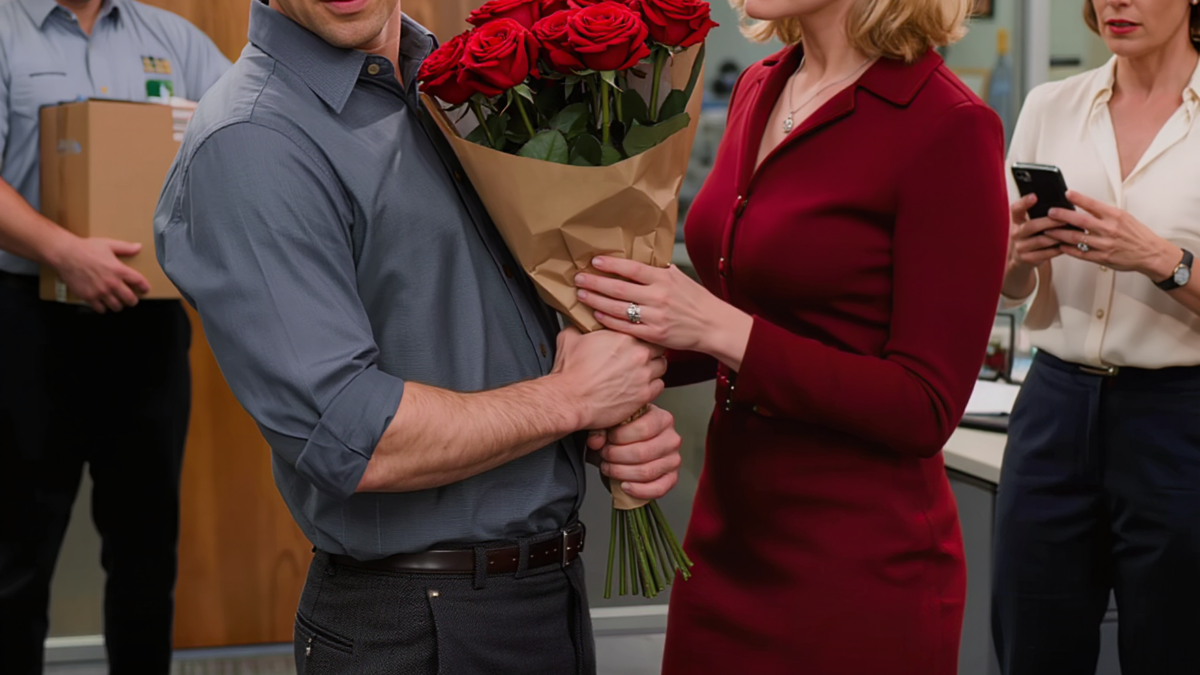
The worst part wasn’t that Clare rejected the flowers.
It was that she did it in front of twelve people from her office and one delivery guy who had stopped checking his phone long enough to watch me fail in real time.
I stood outside a glass-walled conference room holding two dozen red roses wrapped in brown paper, looking like a man who had accidentally brought evidence to his own trial.
Clare looked at the bouquet, then at me.
Her shoulders dropped.
“Ethan, I told you I don’t like big gestures.”
She wasn’t angry. She wasn’t cruel. If anything, she looked tired.
That made it worse.
Then she placed both hands against the paper around the roses and gently pushed them back toward my chest.
Nobody laughed.
Nobody needed to.
I nodded, because apparently humiliation turns me into a man who behaves as if everything is perfectly reasonable, and walked toward the elevator carrying all twenty-four roses.
The delivery guy looked back at his phone.
I hated him for that almost as much as I hated myself.
Twenty minutes later, I pushed open the door of the flower shop where I had bought them.
The florist looked up.
She took one glance at my face, another at the bouquet, and started laughing.
Not loudly. Not cruelly.
But definitely laughing.
“No refunds for emotional damage,” she said.
I stared at her.
She held up the card reader.
“And yes, you still have to pay.”
Her name tag said MIA.
I had met her less than an hour earlier, when I had walked into Second Bloom feeling extremely confident about buying the most romantic flowers money could reasonably obtain.
Mia had been behind the counter with her dark brown hair twisted into a messy knot. She wore a green apron dusted with leaves and had the relaxed expression of someone who had already watched three customers make questionable decisions before lunch.
“Red roses?” she had asked.
“Very romantic.”
“Very specific.”
I thought she was trying to upsell me.
She asked twice more whether I was sure.
Each time, I said yes.
Now I understood she had not been trying to sell me anything.
She had been trying to save me from myself.
“You knew,” I said.
Mia was still looking at the bouquet.
“Knew what?”
“That this was a bad idea.”
She pulled one rose free, tucked it behind her ear, and looked at me.
“I knew you were buying apology flowers without knowing what you were apologizing for.”
“I wasn’t apologizing.”
She considered that.
“Then congratulations. You somehow made it worse.”
I stared at her.
She stared back.
Then, against my will, I laughed.
It was the first time I had laughed since Clare pushed the flowers back toward me, and something about it loosened the knot that had been sitting under my ribs since the elevator doors closed.
Mia pointed toward a tiny round table beside the front window.
“Coffee?”
“You were serious?”
“I don’t joke about coffee.”
She disappeared behind the counter and returned with two paper cups.
“You have coffee here?”
“I own a flower shop. I start work at six in the morning. Of course I have coffee.”
She sat across from me.
I placed the bouquet on the empty chair between us.
It looked like an unwanted third guest.
Mia nodded toward it.
“So. How long have you been dating?”
“Eleven months.”
“And she doesn’t like big gestures.”
“Apparently not.”
“Did she tell you that before today?”
I took a sip.
The coffee was strong enough to qualify as construction material.
“Possibly.”
Mia raised one eyebrow.
“Fine. Yes.”
“And you brought twenty-four red roses to her office.”
“I thought the office part made it more romantic.”
“It made it more public.”
I winced.
Mia softened slightly.
“Sorry. Occupational hazard. People tell florists everything, but usually after they’ve ignored our advice.”
“Is this normal for you?”
“Not the returning part. Most people throw the flowers away somewhere dramatic.”
“I considered a dumpster.”
“You paid one hundred eighty dollars for those roses.”
“I’m aware.”
“No, I don’t think you are emotionally aware yet.”
I laughed again.
That was the first thing about Mia that unsettled me in a good way.
Most people tried to rescue you from awkwardness. They rushed to reassure you, changed the subject, or pretended the embarrassing thing hadn’t happened.
Mia treated awkwardness like furniture.
She worked around it.
The second strange thing was that I told her the truth.
Clare had not broken up with me in front of her office.
She had rejected the bouquet and quietly told me to stop trying to fix our relationship with gestures instead of conversations.
I had left because I was embarrassed.
But somewhere between the elevator and Second Bloom, I had also realized she might be right.
“We haven’t been good for a while,” I admitted.
Mia turned her cup slowly between her palms.
“Nobody cheated?”
“No.”
“Anything dramatic?”
“No. We just keep missing each other.”
“That can hurt more than the dramatic stuff.”
I looked at her.
“You sound experienced.”
“I sell flowers.”
“That’s not an answer.”
“It’s the answer you get on the first coffee.”
I blinked.
“The first coffee?”
She smiled.
“Relax. I’m not proposing. You already have enough flowers.”
I looked at the bouquet.
“You want the rest?”
Mia considered it.
“No. Keep them.”
“What am I supposed to do with two dozen rejected roses?”
“Find twenty-four people who deserve one.”
“That sounds suspiciously meaningful.”
“It’s actually inventory management.”
Before I could answer, the bell over the door rang.
An older man stepped inside holding a handwritten note and looking nervous.
Mia stood immediately.
“Mr. Alvarez. Anniversary?”
“Forty-three years.”
She smiled.
“White lilies and blue delphinium. I remembered.”
Something changed in her face.
The teasing disappeared.
She moved behind the counter with quick, practiced hands while Mr. Alvarez explained that his wife was recovering from knee surgery and had threatened to divorce him if he made too much fuss over their anniversary.
“So naturally,” Mia said, “you’re making a fuss.”
“Forty-three years. I’ve earned the right to ignore her.”
Mia laughed and began building the arrangement.
For ten minutes I watched her ask about his wife’s physical therapy, remember the name of their granddaughter, and tuck a small sprig of rosemary into the arrangement because she knew his wife liked the smell in her kitchen.
When Mr. Alvarez left, he looked ten years younger.
Mia came back to the table.
“You do that with everybody?”
“Do what?”
“Remember everything.”
“Only the important things.”
I glanced at the roses.
She followed my eyes.
“You can start with the delivery guy who watched you get rejected.”
“I hate that you noticed him.”
“Everyone noticed him.”
For the next half hour, she helped me dismantle my grand romantic failure one stem at a time.
She wrapped individual roses in brown paper and tied them with thin twine.
“One for your receptionist.”
“We don’t have one.”
“Security guard.”
I thought about Gerald, who worked nights in our building.
“Okay. Good.”
“Security guards see everything and receive nothing.”
“One for my neighbor, Mrs. Patel.”
“Perfect.”
“One for my mother.”
“Two.”
“Why two?”
“She raised a man who spent one hundred eighty dollars on the wrong flowers. She’s suffered enough.”
By the time Mia finished, the bouquet no longer looked like evidence from a failed relationship.
It looked like twenty-four small opportunities.
I stood and pulled out my wallet.
Mia held up the card reader.
“You really weren’t joking about making me pay.”
“Sir, heartbreak is not legal tender.”
I paid.
She handed me the receipt.
Then, in a tone so casual I almost missed the hesitation behind it, she said, “There’s a decent place across the street that serves actual coffee after six. Mine is basically a workplace violation.”
I looked at her.
“You’re asking me out?”
“I’m asking you to drink coffee when I’m not being paid to listen to your problems.”
“I have a girlfriend.”
Her expression changed immediately.
Not hurt.
Not challenging.
Just clear.
“Then don’t come unless you don’t.”
There was no flirtatious game in the sentence.
No suggestion that I should cheat.
No pressure.
Just a line.
I respected it more than I wanted to admit.
I left Second Bloom carrying twenty-three roses.
Mia kept the one behind her ear.
Two hours later, Clare and I sat across from each other in a quiet neighborhood restaurant and ended our relationship.
It was sad.
It was also surprisingly undramatic.
Clare stirred her iced tea for so long the cubes had nearly stopped moving before she spoke.
“You’re not a bad boyfriend, Ethan.”
“Strong opening for a breakup.”
She smiled faintly.
“You’re a good person. But you keep trying to solve feelings like they’re event problems. Book the table. Order the flowers. Fix the schedule.”
“That is literally my job.”
“I know.”
I looked down.
She reached across the table.
“I should have said something sooner too.”
“We both should have.”
There were no accusations.
No hidden betrayal waiting to be exposed.
No dramatic confession.
Just two people admitting that effort and compatibility were not the same thing.
When we stepped outside afterward, Clare hugged me.
“Next time,” she said, “ask what kind of flowers she likes.”
“I’m retiring from flowers.”
“You say that now.”
I watched her walk away.
Then I checked the time.
6:17 p.m.
I could have gone home.
Instead, I crossed town to the café across from Second Bloom.
Mia was already there.
She had changed out of her apron and let her hair down. The rose was gone, which disappointed me more than I wanted to admit.
She sat near the window with a mug between both hands and a paperback facedown beside her.
When she saw me, she looked toward the empty chair across from her.
“Should I congratulate you or apologize?”
“Probably both.”
She waited until I sat.
“You ended it?”
“We ended it.”
“That sounds healthier.”
“It was also depressing.”
“Healthy things often are.”
I stared at her.
“You have a remarkably dark philosophy for someone surrounded by flowers all day.”
“Flowers are plants people cut off at the knees and put in decorative water.”
I laughed so hard the barista looked over.
For the next hour, we talked about everything except romance.
She told me Second Bloom had originally belonged to her aunt June, who opened it after getting divorced at fifty-two and deciding she wanted a second career.
Mia started working there during college because she needed money.
Then she discovered she was good at the strange combination of botany, memory, design, counseling, and crisis management required to run a flower shop.
When June’s arthritis became bad enough that she needed to retire, Mia bought the business from her through a payment plan.
“So you own it?”
“Technically, the bank, my aunt, and a landlord with the emotional warmth of a parking meter own it. I’m involved.”
“How long?”
“Eighteen months.”
“That’s impressive.”
“It’ll be impressive if I’m still open in another eighteen.”
She smiled when she said it.
But the words had weight.
I almost asked what she meant.
Then I remembered her rule about first-coffee answers.
Instead, I told her about my work.
Corporate conferences.
Launch parties.
Employee retreats.
Executive dinners where six adults could spend forty-five minutes deciding whether stage lights were too blue.
“So,” Mia said, “you’re professionally responsible for making people have fun on schedule.”
“That is painfully accurate.”
“And privately you bring public roses to women who hate public gestures.”
“I thought we were moving past that.”
“We never will.”
At eight, Mia closed her book and stood.
I stood too.
“That’s it?”
“That’s coffee.”
“I thought coffee implied a second.”
“You listen when it benefits you.”
“Is there going to be a second?”
She studied me, then reached into her bag.
She handed me a Second Bloom business card.
The shop number was printed on the front.
Her personal number was written in blue ink on the back.
Underneath it, she had added:
Wait 48 hours before doing anything stupid.
I looked up.
“You think I’m going to call tonight?”
“I think you ended an eleven-month relationship three hours ago.”
“That’s fair.”
Her expression softened.
“I like you, Ethan. That’s why I’m not volunteering to become your emotional emergency exit.”
The joke was still there.
So was the boundary.
I nodded.
“Forty-eight hours.”
“Minimum.”
“Can I text at hour forty-nine if it’s a good text?”
“What counts as a good text?”
She opened the café door.
“You plan corporate events. Figure it out.”
I waited fifty-two hours.
Not because I wanted to play a game.
Friday night, I sat alone in my apartment with a frozen pizza and realized silence felt different now.
Clare had never lived with me, but she had occupied the shape of my week.
Friday dinners.
Sunday groceries.
Wednesday phone calls.
Without those habits, the empty spaces became obvious.
I didn’t want to fill them with Mia just because she was funny, attractive, and unlike anyone I had met in years.
So I did something Clare had accused me of not doing enough.
I sat with the feeling.
It was terrible.
By Sunday evening, I had given away every rose.
Gerald, the night security guard in my building, stared at his and asked, “Is this a threat?”
Then he placed it in a plastic water bottle beside his monitor.
My mother received two and immediately asked what I had done wrong.
Mrs. Patel next door kissed my cheek and tried to introduce me to her niece before I escaped.
Three went to coworkers who had survived a brutal client presentation with me.
One went to a grocery cashier who had just been berated over an expired coupon.
The rest went to friends, neighbors, and people I realized I saw regularly without ever really seeing.
At 7:13 Sunday night, I texted Mia a photograph of Gerald’s rose standing in that plastic bottle.
One rose successfully rehomed. Recipient suspicious but hydrating it.
Her reply came less than a minute later.
Hour count?
52.
Acceptable.
I smiled.
Is this a good text?
Barely.
Can I improve my score with dinner?
There was a longer pause.
Then:
Dinner would be a date.
I know.
Another pause.
Then ask like you know.
I laughed at my phone.
Mia, would you like to have dinner with me Friday night? No roses, no public gestures, no emotional refunds requested.
Her answer arrived quickly.
Yes. But I’m choosing the restaurant.
Why?
You chose the flowers.
Fair.
Our first real date happened at a tiny Mexican place with eight tables and a handwritten menu taped to the wall.
Mia knew the owner, the owner’s mother, and apparently half the customers.
She ordered for both of us after asking whether I trusted her.
“That depends. Are flowers involved?”
“Not anymore.”
Dinner was easy in a way I wasn’t used to.
Clare and I had not been miserable.
That mattered.
I didn’t want to rewrite my past because something new felt exciting.
But with Clare, we had both been careful.
We chose restaurants with reservations.
Vacations with itineraries.
Conversations with safe exits.
Mia stole one of my tacos because hers was too spicy, declared mine better, then refused to return it.
“You understand theft on a first date is a red flag?”
“You voluntarily handed me one hundred eighty dollars two days before this.”
“I did not voluntarily hand it to you.”
“You inserted your card yourself.”
“Under emotional duress.”
“Tell it to the bank.”
After dinner, we walked three blocks toward the river.
Chicago was warm for early September, and the sidewalks were crowded.
Mia told me about her younger brother finishing trade school in Wisconsin and her mother in Indiana, who still introduced her as “my daughter who plays with flowers” despite the fact that Mia owned an actual business.
“What does she call your brother?”
“An electrician.”
“That feels unfair.”
“I have mentioned this.”
She asked about my family.
I told her my father had died suddenly when I was nineteen.
My mother still had my younger sister at home then.
I had spent the years afterward trying to become the reliable man in the family overnight.
Mia didn’t offer the automatic “I’m sorry” people usually did.
She asked a question instead.
“Did anyone ever tell you that you didn’t have to replace him?”
I stopped walking.
“No.”
She looked at me and seemed to realize she had stepped into something more personal than she intended.
“Sorry. That was—”
“No,” I said. “It was accurate.”
We began walking again.
The question stayed with me.
For years, I had been the person who fixed things.
Flights.
Bills.
My mother’s leaking kitchen faucet.
My sister’s moving truck.
Work emergencies.
Relationship tension.
Maybe that was why the flowers had seemed logical.
A problem existed.
I purchased a solution.
Mia glanced at me.
“You got quiet.”
“I’m thinking.”
“Dangerous.”
“I’m starting to understand why you warned me about the roses.”
“That took only four days. I’m proud of you.”
At the corner near her apartment, we stopped.
I wanted to kiss her.
She knew I wanted to.
I could tell by the change in her smile.
But she didn’t step closer.
Neither did I.
“Too soon?” I asked.
“Maybe.”
“Okay.”
Her shoulders relaxed.
That tiny reaction told me more than a kiss could have.
Then she stepped forward and kissed my cheek.
“Good night, Ethan.”
I stood there like a fourteen-year-old discovering human contact.
Mia walked backward two steps.
“Try not to buy anyone flowers tonight.”
“No promises.”
She pointed at me.
“Growth. We discussed growth.”
I went home smiling.
The next morning, my phone rang at 6:38.
Mia.
I answered half asleep.
“If this is about roses, I have an alibi.”
“I need a favor.”
Her voice sounded different.
Fast.
Tense.
I sat up.
“What happened?”
“My delivery driver called in sick. Not normal sick. Emergency room. He’s okay, but I have eleven arrangements that have to be delivered before noon, including a wedding bouquet, and the backup driver is in Milwaukee.”
I rubbed my face.
“You’re asking me to deliver flowers?”
“I’m asking the professional event fixer whether he owns a car.”
“I do.”
“Then yes.”
It was Saturday.
I had no plans until the afternoon.
“I’ll be there in twenty minutes.”
“Ethan?”
“Yeah?”
“Wear something you can get wet.”
“Why?”
She hung up.
That should have been my warning.
Twenty-three minutes later, I walked into Second Bloom and discovered what panic looked like when arranged alphabetically in buckets.
Mia stood behind the counter with three phone lines flashing, scissors in one hand, floral tape between her lips, and a smear of green on her cheek.
She pointed toward six labeled arrangements.
“Hospital. Hotel. Retirement. Home. Restaurant. Apartment. Church.”
“That’s seven.”
“The other four aren’t ready.”
“Great.”
“You still have time to run.”
I picked up the first delivery sheet.
“I already paid for the roses. I’m financially committed to this place.”
She laughed despite herself.
For four hours, I became the least qualified flower delivery driver in Chicago.
At the hospital, I went to the wrong nurses’ station because I confused east and west after parking in a garage designed by someone who clearly hated humanity.
At a retirement home, a woman named Dorothy informed me the flowers were beautiful but that I was underdressed for lunch.
At the hotel, a concierge asked whether I was part of the wedding party.
“No. Vendor.”
He looked at my expression.
“Emotionally?”
“Unfortunately.”
The wedding bouquet nearly finished me.
Rain started the moment I left the shop.
Not gentle rain.
Chicago rain.
Sideways.
Determined.
I held the bouquet under my jacket and sprinted from the car to the church, arriving soaked from the waist down and looking like I had stolen the flowers during a flood.
The bride looked at me.
Then she started crying.
I panicked.
“What’s wrong?”
“They’re perfect.”
I almost sat on the floor.
When I returned to Second Bloom at 12:15, Mia was sitting on a stool behind the counter eating crackers directly from the sleeve.
She looked exhausted.
I set the empty delivery bins down.
“All delivered.”
Her eyes widened.
“All eleven?”
“Yes.”
“Any casualties?”
“Only my dignity.”
“That wasn’t in great condition when we met.”
She stood and walked around the counter.
For a second, I thought she was going to hug me.
Instead, she reached into my hair.
“A leaf,” she said.
“Of course.”
She held it between two fingers.
Then she hugged me.
Quick.
Warm.
Completely different from the careful kiss on my cheek the night before.
“Thank you,” she said.
I wrapped one arm around her before she stepped away.
“You’re welcome.”
That was when I learned something important about Mia.
She could ask for help.
She simply hated needing it.
I stayed until closing.
I told myself it was because the shop floor looked like a botanical disaster and she clearly needed another pair of hands.
The truth was simpler.
I liked being there.
Mia assigned me cleanup, which required less artistic ability than arranging flowers and slightly more competence than breathing.
“You’re sweeping petals into the wrong pile.”
I leaned on the broom.
“There are correct petal piles?”
“Compost and trash.”
“I’ve made a terrible mistake.”
“Several. This one is reversible.”
At four, a woman came in looking for flowers for her sister, who had recently finished chemotherapy.
Mia didn’t steer her toward the expensive displays.
She asked what her sister liked.
Sunflowers.
Bright colors.
Nothing that looked too solemn.
Mia built a loose, cheerful arrangement for half the price of the largest bouquet.
At five, a teenage boy entered with twenty-three dollars in crumpled bills and asked for flowers for his mother’s birthday.
Mia made him an arrangement that looked as if it cost twice that.
Then she quietly slipped his five dollars in change into the envelope with the care card.
I noticed.
She noticed me noticing.
“Don’t.”
“I didn’t say anything.”
“Your face did.”
“My face is impressed.”
“Tell your face to mind its business.”
After we locked the front door, Mia flipped the sign to CLOSED and exhaled.
Second Bloom was narrow, with exposed brick, old wooden shelves, and a battered brass cash register her aunt June had refused to throw away.
In the back corner, behind stacks of boxes, was an empty area roughly the size of a small bedroom.
“What’s back there?”
“Currently? Shame and unused square footage.”
“Long-term?”
She hesitated.
Then she gestured for me to follow.
The back room had a sink, a long worktable, mismatched chairs, and a wall covered in sketches.
Some showed table layouts.
Others had notes:
Weekend workshops.
Date-night bouquets.
Grief and memory class.
Corporate team events.
I stepped closer.
“You want to turn this into an event space.”
“Small one. Floral workshops. Private classes. Maybe birthdays, bridal groups, company events, if I can figure out how to let twelve adults use scissors without creating an incident.”
“This is good.”
“It’s expensive.”
“You already have the room.”
“I have a leaking sink, bad lighting, six chairs from three different decades, and a landlord raising the rent in January.”
That explained her comment about surviving another eighteen months.
“What do you need to make it work?”
“Money.”
“Besides money.”
“Customers.”
“Besides customers.”
Mia narrowed her eyes.
“Are you about to turn into Work Ethan?”
“Work Ethan is extremely useful.”
“I’ve met Flower Ethan. He concerns me.”
I took out my phone and opened a notes app.
“Capacity twelve comfortably. Maybe sixteen if nobody has elbows.”
She pointed at herself.
“That is not a booking system.”
“It has been a system for eighteen months.”
“It is a woman with a phone.”
“Same thing.”
For twenty minutes, I asked questions.
She answered reluctantly at first, then with growing energy.
The more she talked, the clearer it became that she had thought through every creative detail but never had enough time to build the business structure around it.
“You need a pilot,” I said.
“I need plumbing.”
“One workshop. Eight to twelve guests. Minimal renovation. Use what you have. If nobody comes, you learn cheaply.”
She looked at the sketches.
I recognized the expression.
I saw it in clients all the time when they cared enough about an event to be frightened by the possibility of failure.
“What would you teach first?”
“Flowers for people who think they’re bad at flowers.”
“That’s the title.”
“No.”
“It should be.”
“That’s terrible.”
“You remembered it.”
She tried not to smile.
“Let me help.”
“You already spent your Saturday delivering arrangements.”
“I mean with the pilot. Logistics. Registration. Layout. Timing. Guest flow. Vendor costs. You know the product. I know how to get twelve adults into a room and convince them the schedule was effortless.”
“What do you want in return?”
“Nothing.”
Her expression changed.
I realized immediately how that sounded.
“Not because I’m trying to impress you. Okay, maybe ten percent because I’m trying to impress you. Mostly because it’s a good idea and I can help.”
“Ten?”
“Fifteen.”
“At least you’re honest.”
She looked back at the wall.
“One pilot.”
“One pilot.”
“No taking over.”
“I advise. You decide.”
“No spending my money without asking.”
“Obviously.”
“No red roses.”
“That feels unrelated.”
“It’s company policy now.”
I held out my hand.
She shook it.
“Deal.”
That workshop changed the rhythm of the next month.
I saw Mia three or four times a week, but not every meeting was a date.
Some were twenty-minute planning sessions.
Some were late-night calls about registration software.
Some involved me measuring the back room while Mia accused me of holding the tape crooked.
Our second date was a baseball game where she spent six innings pretending she understood the rules before finally asking why the shortstop didn’t stand closer to home plate.
Our third was dinner at my apartment.
I burned the garlic bread because Mia kissed me for the first time while I was supposed to be checking the oven.
Three weeks after the roses.
She pulled back.
“Something’s burning.”
“I don’t care.”
She kissed me again.
The smoke alarm cared.
We ate pasta with blackened bread while standing on chairs and waving dish towels at the ceiling.
It was the best date I’d had in years.
The workshop sold out in thirty-six hours.
Twelve people crowded around the long table in Second Bloom’s back room.
Two sisters celebrating a birthday.
A married couple on a date.
Three coworkers.
Four women who appeared to have brought enough wine for a maritime voyage.
And a widower named Frank whose daughter had purchased his ticket.
Mia stood at the front in her green apron.
For the first five minutes, she kept smoothing the same fold in the fabric.
Then someone held up an arrangement and asked why it looked like it had “lost a fight.”
Mia laughed.
After that, she was herself.
She taught people how to choose a focal flower, cut stems properly, and stop chasing perfection.
“Flowers are already doing most of the work,” she said. “Your job is to stop fighting them.”
I handled drinks, timing, photographs, and cleanup near the register.
Halfway through the workshop, Frank raised his hand.
“My wife always did this,” he said.
He turned a carnation between his fingers.
“She died in February. My daughter thought maybe I should learn.”
The room quieted.
Mia walked to him.
“What flowers did she like?”
“Daisies. Cheap ones. Drove me crazy. I’d offer roses, and she’d say daisies looked happier.”
Mia smiled.
“Then let’s make something happy.”
She sat beside him for ten minutes.
I watched her help without making him feel helpless.
That distinction mattered to her.
I was beginning to understand why.
When everyone left, Frank’s arrangement remained on the table for a few minutes in a yellow ceramic pitcher while he helped gather his coat.
Before leaving, he hugged Mia.
She locked the front door afterward and leaned against it.
I looked around the room.
“Well?”
She looked at the chairs.
The glasses.
The scattered greenery.
Then she grinned.
“We did it.”
“You did.”
“We.”
That one word hit harder than it should have.
I crossed the room.
She met me halfway.
The kiss was slower than the one in my apartment.
No smoke alarm.
No burned bread.
Just her hands at my waist and mine resting carefully at her shoulders.
When we separated, she leaned her forehead against my chest.
“I hate that you were useful.”
“I get that a lot.”
“You’re going to be unbearable.”
“Probably.”
She looked up.
“I can still charge you for those roses again.”
“That feels illegal.”
“I know a lawyer who buys peonies.”
Over the next two weeks, Mia scheduled three more workshops.
Then my boss called me into his office.
Daniel Cho had the calm expression of a man who delivered complicated news for a living.
“Denver wants you,” he said.
I thought he meant for a meeting.
“For what?”
“Regional experience team. Senior manager. Six-month relocation, then potentially permanent depending on expansion.”
I sat back.
Six months earlier, I had applied for that position.
Clare had encouraged me.
Better salary.
Bigger clients.
A title that LinkedIn would congratulate me for automatically.
“When do they need an answer?”
“Two weeks. Start date three weeks after that.”
I should have been excited.
Instead, my first thought was of a flower-shop back room with mismatched chairs.
That bothered me.
Not because Mia didn’t matter.
Because five weeks should not have had enough power to rearrange a plan I had wanted for six months.
I told Daniel I needed time.
That night, Mia and I were supposed to have dinner.
For a moment, I considered waiting to tell her.
It was her first free evening in nine days. I didn’t want to drop a complication onto the table before appetizers.
Then I remembered Clare telling me I tried to manage feelings instead of having conversations.
So before the server took our order, I said it.
“I got offered a promotion in Denver.”
Mia’s hand stopped on the menu.
“Oh.”
“For six months. Maybe longer.”
“When?”
“I have two weeks to decide.”
She nodded slowly.
Her face became carefully neutral.
“You should be proud.”
“I think I am.”
“You think?”
“It’s complicated.”
“Because of me?”
“Partly.”
She looked down.
The server approached, saw our expressions, and wisely said she would give us another minute.
“I don’t want to be the reason you don’t take a job you wanted before you met me,” Mia said.
“I didn’t say you were.”
“You said partly.”
“Because you’re part of my life now.”
Something tightened in her expression at the word life.
We had been dating barely more than a month.
I heard it too.
“I’m not asking you to decide anything for me. I’m telling you because I don’t want to pretend this isn’t happening.”
“Good.”
“But I also don’t want you pretending you don’t care.”
Her eyes lifted sharply.
“I didn’t say that.”
“You went neutral.”
“What does that mean?”
“You look like a customer asked whether carnations are appropriate for a funeral and you’re trying not to have an opinion.”
For half a second, she almost smiled.
Then she sighed.
“I care.”
“Okay.”
“A lot more than is convenient.”
“Also okay.”
“No, Ethan. It’s not automatically okay.”
There was more behind the sentence.
I waited.
She pushed the menu aside.
“My last serious boyfriend moved to Seattle.”
I said nothing.
“He told me it was temporary. We did long distance for four months. Then six. Then he started talking about me moving there like this shop was a hobby I could pack in a box.”
“He sounds—”
“He wasn’t cruel. That would’ve been easier. He just assumed his opportunity was real and mine was flexible.”
“Do you think I’m doing that?”
“No.”
“Then why are you angry?”
“I’m not angry.”
“You’re using your florist voice.”
She stared at me.
Then laughed once without humor.
“Maybe I am.”
I reached across the table but stopped before touching her hand.
“I’m not asking you to move anywhere. I haven’t even decided whether I want to go.”
“That’s the part that scares me.”
“Why?”
“Because if you stay, I don’t want to spend the next year wondering whether you gave something up for a woman you met because she mocked your roses.”
“That is a very specific fear.”
“It’s an efficient one.”
For the first time since meeting Mia, humor didn’t make the tension easier.
It only outlined it.
We ate dinner anyway.
It was polite.
Polite was worse than fighting.
At her building, she touched my sleeve but didn’t kiss me.
“I need a little space to let this be your decision.”
I wanted to argue.
Instead, I nodded.
“Okay.”
She studied my face as if she expected negotiation.
I didn’t give her any.
For the next week, we texted less.
I still helped with the workshop schedule because I had promised.
But I stopped dropping by without asking.
Mia didn’t punish me.
She didn’t create drama.
She simply protected the part of her life she had built before I arrived.
Inconveniently, that made me respect her even more.
I spent the same week asking myself what I actually wanted from Denver.
The answer was uncomfortable.
I wanted proof that I was moving forward.
After my father died, progress had become something close to religion.
Better job.
Better salary.
Bigger responsibility.
If I kept climbing, maybe I could convince myself I was doing everything right.
But the work I had enjoyed most in months wasn’t a national conference or executive launch.
It was helping twelve strangers make imperfect flower arrangements in the back of a neighborhood shop.
So I went to Daniel with a proposal.
Our company had been trying to improve local client retention.
I suggested a Chicago-based community events program.
Smaller workshops.
Local partner experiences.
Neighborhood venues.
Lower costs than the giant productions we usually sold.
I brought numbers from previous projects and a six-month pilot plan.
Daniel read it twice.
“This is because you don’t want Denver?”
“It’s because I realized I applied for Denver because it was the only promotion path I could see.”
“And now?”
“Now I see another one.”
He leaned back.
“If leadership says no?”
“Then I’ll decide whether Denver is actually what I want. But I’m not moving across the country just because the word ‘senior’ is in the title.”
For the first time all week, I felt calm.
Two days later, Daniel called me back.
Leadership had approved the pilot.
No guaranteed promotion.
No shiny title.
Six months to prove the idea worked.
I accepted before he finished explaining the reporting structure.
Then I went to Second Bloom.
Mia was closing.
She saw me through the window and unlocked the door.
“You look suspiciously pleased with yourself.”
“I turned down Denver.”
Her face went still.
Before she could speak, I raised one hand.
“Not for you.”
That sounded terrible.
She blinked.
“I mean—not only for you.”
“Wow.”
“I had this speech better in the car.”
Her mouth twitched.
“I realized I didn’t want that job. I wanted proof I was advancing. So I pitched a local program instead.”
“And?”
“They approved a pilot.”
Mia stared.
“You created your own job.”
“Technically, I created six months of additional work with no guaranteed promotion.”
“There he is. My favorite event planner.”
“Your favorite?”
She stepped closer.
“Don’t ruin the moment.”
I looked at her.
“I need you to know I chose this because it fits the life I want. You’re part of that life, but you’re not responsible for the choice.”
Her eyes softened.
“That,” she said quietly, “is what I needed to hear.”
“Because the version in the car was much better.”
She laughed.
The tension that had been sitting between us for a week finally broke.
Then she kissed me.
Not cautiously.
Not on the cheek.
I wrapped my arms around her and nearly knocked over a bucket of eucalyptus.
She pulled back.
“Careful. That’s forty dollars wholesale.”
“Romance is alive and itemized.”
Three months later, Second Bloom’s workshop room had matching chairs, working lights, and a sink that no longer leaked.
Mia paid for the upgrades with workshop revenue and a small-business grant she applied for herself.
I proofread the application only after she made me swear not to rewrite it.
The landlord still raised the rent.
Mia still complained about him.
But the back room was booked most weekends, and two local companies had hired her for private events.
One of them was mine.
Clare came into Second Bloom once during that period.
I wasn’t there.
Probably for the best.
She needed flowers for her mother’s birthday.
Mia later told me she chose tulips.
That was all I asked.
“What were you expecting?” Mia said. “A duel with pruning shears?”
“I don’t know. It feels narratively significant.”
“It was a flower sale, Ethan.”
Then she smiled.
“She did tell me I was right about the roses.”
“Absolutely not.”
“Completely true.”
“I need witnesses.”
“You have none.”
By spring, Mia and I had been together seven months.
On a Thursday afternoon, almost exactly eight months after Clare rejected my bouquet, I walked into Second Bloom carrying flowers.
Mia looked up from the counter.
She froze.
“No.”
I lifted the bouquet.
“You haven’t even seen them.”
“I see red.”
“They’re not roses.”
She came around the counter suspiciously.
The bouquet was ridiculous.
Daisies for Frank’s wife.
Rosemary for Mr. Alvarez.
Sunflowers from the first workshop.
One carnation for the teenage boy’s mother.
And a single red rose in the center.
Mia stared.
“What is this?”
“A summary.”
“Of what?”
“The worst flower purchase of my life.”
She looked at me.
She was smiling now.
I took a breath.
“The day I met you, I thought getting rejected in public was the disaster.”
Her smile changed.
“It wasn’t. The disaster was that I had gotten really good at doing the correct-looking thing without asking whether it meant anything.”
She said nothing.
“You taught me flowers don’t fix conversations. You taught me helping someone isn’t the same as managing them. And you taught me the best plans leave room for another person to choose.”
Mia looked at the bouquet.
“That’s dangerously sincere.”
“I know. I’m uncomfortable.”
“Good.”
“I love you.”
She went completely still.
I had never said it before.
Neither had she.
A year earlier, I would have rushed to fill the silence.
I would have explained.
Made a joke.
Solved the pause.
I didn’t.
Finally, Mia reached for the bouquet.
She took it directly from my hands.
Then she pulled out the single red rose.
She tucked it behind her ear exactly the way she had the first afternoon we met.
And smiled.
“I love you too.”
I exhaled hard enough to make her laugh.
Then she added, “You still have to pay.”
I stared at her.
“For my own bouquet?”
“Emotional handling fee.”
“That is not a real thing.”
“It is now.”
“What does it cost?”
She put both hands around my neck.
“Coffee.”
“Just coffee?”
“Coffee tonight. Dinner tomorrow.”
“That seems manageable.”
“And maybe, if you behave, the next forty or fifty years after that.”
I smiled.
“That seems expensive.”
“You can afford it.”
Then she kissed me beside the same counter where she had charged me for twenty-four rejected roses.
A year later, we celebrated the second anniversary of the workshop program with a sold-out class.
Frank still came occasionally.
Mr. Alvarez and his wife attended a date-night workshop and spent half the evening lovingly disagreeing about vase height.
Gerald, the security guard, became a customer after discovering that giving his wife flowers for no reason produced what he called “excellent household returns.”
Mia framed the original receipt from my roses and hung it behind the register.
Underneath, she wrote in small letters:
NO REFUNDS FOR EMOTIONAL DAMAGE.
I protested.
She ignored me.
That evening, after the last guest left, we sat on the floor in the back room eating takeout among buckets of leftover flowers.
Mia leaned against my shoulder.
“Do you regret it?”
“What?”
“One hundred eighty dollars on a bouquet that got rejected.”
I looked through the open doorway toward the shop.
The counter.
The old register.
The worktable.
The framed receipt.
Then I looked at the woman beside me.
“Not even a little.”
She tilted her head.
“That is a terrible financial lesson.”
“I’m dating the florist. I can’t win this argument.”
“No,” she said, smiling.
Then she rested her head against my shoulder again.
“But you finally learned to ask before buying the flowers.”