At twenty-three, Maren Feld paid $12 for a wooden crate everyone at a Nebraska grain elevator had already written off as scrap. Curtis Voss watched her load it herself. What he couldn’t see was why she had been studying that pile for eight months—or what 311 pieces inside it could still become.
In the late summer of 1987, the Garfield County Co-op Elevator in Talmage, Nebraska, received four hundred worn sickle sections from three different hay operations.
On the ledger, the entire lot was recorded as scrap metal.
The collective value was a little over eleven dollars.
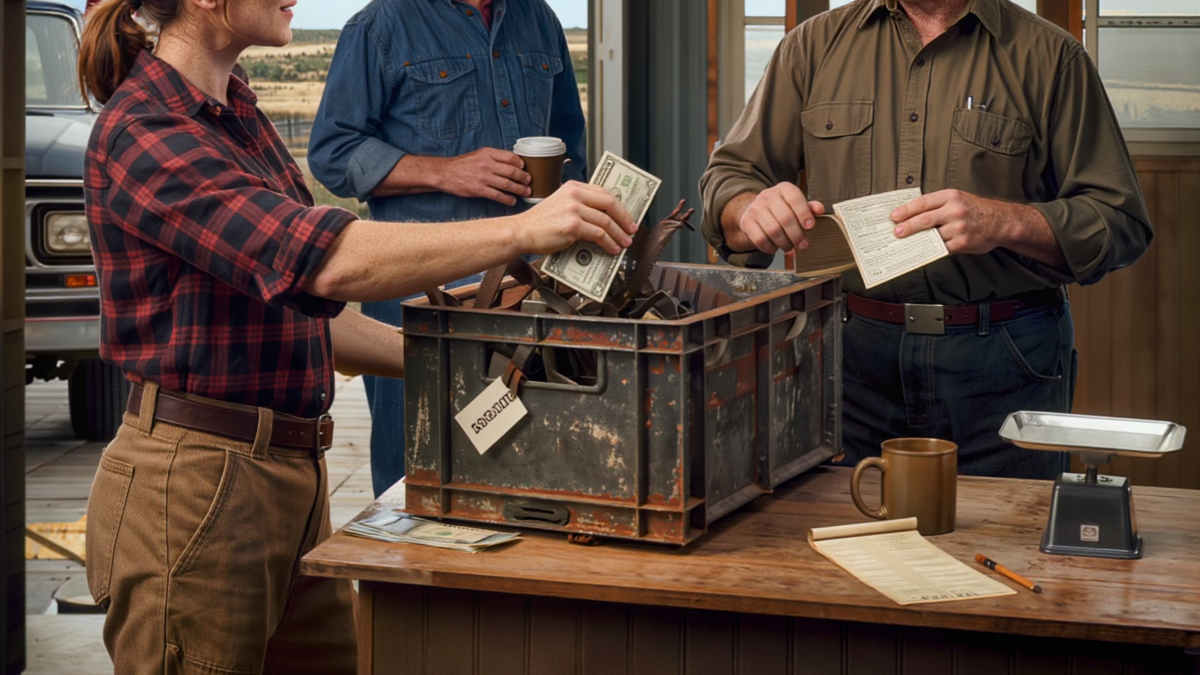
Curtis Voss, the elevator manager, had the sections dumped into a single wooden crate and moved beside the loading dock. He tied a handwritten tag to one slat.
SCRAP. PICKUP PENDING.
There was nothing unusual about it. Worn guards, broken knife clips, bent hold-down clips and old sections passed through the elevator regularly. Farmers replaced parts. The old steel accumulated. Eventually somebody hauled it away.
The crate sat near the loading dock for nine days.
On the ninth day, twenty-three-year-old Maren Feld drove fourteen miles in her father’s faded 1974 Dodge pickup from the family farm south of town.
She parked beside the elevator, stepped down in canvas work pants and a flannel shirt with the cuffs rolled past her wrists, and walked into Curtis’s office.
He was behind the counter working through paperwork.
Maren nodded toward the dock.
“What do you want for that crate?”
Curtis looked through the office doorway.
“The sickle sections?”
“Yes.”
He studied her for a moment, then glanced at his ledger.
He figured the scrap value and paperwork came to around eleven dollars and change.
Maren reached into her pocket, placed a ten-dollar bill and two ones on the counter, and pushed them toward him.
“Keep the change.”
Curtis looked at the money, then at her.
“All right.”
That was the entire transaction.
Maren walked back outside, wrestled the wooden crate into the bed of the Dodge and secured it for the drive home.
Curtis watched from the loading area without saying anything else.
There was little to say.
In his professional judgment, a young woman had just paid twelve dollars for a box of worn cutter-bar parts that were worth approximately twelve dollars less than what she had paid.
He went back to work.
Maren drove east.
That was the beginning.
To understand why she bought the crate, you had to go back thirteen years to a workbench on the Feld farm.
Maren had grown up on roughly 280 acres of mixed hay and row-crop ground south of Talmage.
Most of what she understood about worn steel came from her grandmother, Freda Feld.
Freda had spent much of the 1950s and 1960s keeping the farm running while her husband worked on a railroad section crew and returned home when the schedule allowed.
When cutting equipment failed during a narrow stretch of good weather, Freda could not always wait for somebody else to repair it.
Hay did not care when a husband came home.
Weather did not care whether a replacement part was available in town.
So Freda learned to maintain the equipment herself.
She developed a simple philosophy.
Worn was not the same as finished.
In the summer of 1974, when Maren was ten, Freda called her over to the workbench in the equipment shed.
Three used sickle sections lay on the bench.
Beside them were three new ones.
“What do you see?” Freda asked.
Maren looked.
“The old ones are dull.”
“That’s right. What else?”
Maren leaned closer.
She knew her grandmother would wait as long as necessary.
“The edge is thinner.”
Freda nodded.
“What else?”
Maren picked up one of the sections.
“The rest of it looks almost the same.”
That was the answer Freda wanted.
She took a small brass loupe from her shirt pocket and handed it to Maren.
“The body is where the section lives,” she said.
An edge could be reground.
A bevel could be corrected.
But a cracked body, a damaged rivet hole or steel that had been overheated beyond recovery was another matter.
Freda showed her how to inspect the wear.
The primary bevel was ground at roughly twenty-two degrees.
The secondary angle was much smaller, but it mattered enormously.
Most people skipped it.
Freda did not.
She showed Maren how different wear patterns could reveal other problems in a cutter bar.
An uneven edge might mean a guard was bent.
A strange polished spot might mean a hold-down was wrong.
Dragging crop left one kind of evidence.
A badly aligned component left another.
To Freda, a worn sickle section was not just a damaged part.
It was a record.
If you knew how to read it, the discarded steel could tell you what the machine had been doing before somebody removed it.
Maren never forgot that.
By sixteen, she was sharpening sections for her father and for two neighbors who had noticed that the Feld cutter bar often worked cleaner than theirs under similar conditions.
She did not charge them.
She was still learning.
Her father, Neils Feld, rarely praised anyone in elaborate language.
One afternoon, after watching Maren work at the bench, he finally said, “You’ve got your grandmother’s eye.”
He said it once.
For Maren, once was enough.
Freda died in the spring of 1983, when Maren was nineteen.
She left her granddaughter the bench grinder, an angle grinder, the brass loupe and an old coffee can containing section rivets she had collected for years.
Neils told Maren about the inheritance while they were standing in the equipment shed.
She did not cry in front of him.
She picked up a section from the work tray, studied it through Freda’s loupe, set it back down and stood quietly beside the bench.
Neils understood.
Two years later, Maren moved her work out of the farmhouse and into a rented former small-engine repair building on the east edge of Talmage.
The structure was thirty-two by forty feet.
Concrete floor.
Two overhead doors.
A wood stove.
A single-phase electrical panel she upgraded to handle the equipment she was gradually collecting.
Freda’s grinder came with her.
Maren added an inexpensive belt sander from an estate sale and a used drill press from a farm auction.
The rent was eighty dollars a month.
It was not an impressive building.
It did not need to be.
Maren’s early income came from sharpening sections for several hay operations and selling a smaller number of reconditioned pieces when customers needed replacements.
A local implement dealer sold new sections for considerably more than she charged.
Maren’s sharpening price undercut new replacement cost enough to give operators a reason to try her.
The margins were small.
Very small.
On a good week, she might process eighty or a hundred sections and clear only a few dozen dollars after abrasives.
Reconditioning was even more labor intensive.
Each section had to be cleaned, inspected, reground and sometimes reriveted.
But Maren understood something many people around her did not yet see.
The immediate margin was not the entire business.
She was building two things at once.
A reputation.
And access to raw material.
Around Garfield County, enormous quantities of worn steel were being discarded because buying replacements was easy and familiar.
Maren saw inventory.
For eight months before she bought Curtis Voss’s crate, she quietly watched the elevator’s scrap accumulation.
She stopped by on other errands.
She looked at what came in.
She estimated how much was recoverable.
Then she went back to her shop and worked on capacity.
She found a second bench grinder at an estate sale.
Its tool rest was cracked, so she repaired it.
She built a jig from angle iron and flat bar that held each sickle section at a consistent primary bevel.
That reduced wasted passes and abrasive use.
She timed herself through batches.
Forty sections.
Two hours and twenty minutes.
Then another batch.
Same quality.
Similar time.
By the time Curtis’s four-hundred-piece crate appeared beside the loading dock, Maren had been ready for a large lot for nearly three months.
She simply needed the material.
That was why she put twelve dollars on the counter without hesitation.
When she returned to the shop, she set the crate on the concrete floor.
The following Saturday, she began sorting.
She worked with a wire brush, Freda’s loupe and a piece of chalk.
Pick up a section.
Clean it.
Inspect the body.
Check the rivet hole.
Examine the bevel.
Read the wear.
Mark it.
Set it down.
Then the next.
By late afternoon, two piles had formed.
Eighty-nine sections were genuinely beyond practical recovery.
Some had cracks.
Some had broken rivet holes.
Others showed signs of overheating from careless grinding.
Those pieces would eventually go to a metal recycler.
The other pile contained 311 sections.
They were worn.
But they were serviceable.
Maren had paid less than four cents per piece for the entire lot.
She calculated her abrasive consumption carefully and estimated that processing each recoverable section cost only a few additional cents in consumables.
She sold reconditioned sections at thirty cents each.
The profit on the first crate would not make anyone wealthy.
After she accounted for time and shop expenses, the net result was modest.
But that was not why she stared so long at the numbers.
The numbers proved the model worked.
Maren wrote them on graph paper and pinned the sheet above her bench.
In Talmage, meanwhile, the story of the twelve-dollar crate began moving.
Curtis mentioned it casually at the feed store.
The feed-store owner repeated it to a couple of regular customers.
A young woman had paid twelve dollars for a box of worn-out sickle sections.
Some people found the story mildly funny.
Others found it confusing.
Nobody knew Maren well enough to call her foolish outright.
They simply understood worn sections as scrap.
That was how the system worked.
New parts came from the dealer.
Old parts went into a pile.
Maren was operating in the narrow space between those assumptions.
She did not try to convince anyone with speeches.
She kept working.
In the spring of 1988, she approached the three hay operations whose discarded sections had helped fill Curtis’s crate.
She proposed a standing arrangement.
At the end of each cutting, she would buy their worn sections for a nominal per-piece price regardless of condition.
In exchange for the reliable volume, she would sell reconditioned sections back to them below her ordinary price.
Two operations accepted.
One did not.
The man who declined was Lambert Reinhold.
Lambert farmed about five hundred acres of brome and alfalfa north of town.
He listened politely.
“I appreciate it,” he said. “But I’ve got a system that works.”
Maren did not argue.
“I understand.”
She left him a card.
Lambert kept it.
The two operations that accepted gave Maren something more valuable than a single sale.
They created predictable flow.
Worn sections came into the shop.
Reconditioned sections went back out.
In 1988, Maren processed more than two thousand sections under the new arrangement.
The shop itself was still barely profitable.
Sharpening work paid much of the rent.
She added worn guards and knife clips to the things she reconditioned.
She sold metal that could not be recovered to a recycler.
At the end of the year, after expenses, her net income from the operation was under seven hundred dollars.
She wrote the number on another piece of graph paper.
Then she pinned it beside the first.
The shop began developing its own rhythm.
Freda’s two grinders sat on a heavy steel table Maren fabricated from angle iron and plate.
The table was anchored to the concrete so it would not creep under vibration.
Her homemade bevel jig stayed within reach.
The belt sander had its own stand.
Grinding belts hung above it by grit.
The drill press sat in the back corner.
Freda’s coffee can of rivets remained on the shelf beside it.
Incoming sections went into one wooden tray.
Inspected pieces went into another.
Then regrind.
Finished.
Scrap.
Maren built the trays from pallet lumber and labeled them by hand.
The floor was swept every evening.
Anyone who walked through the door could tell quickly that the person running the place knew exactly where everything belonged.
The trouble was that not many people walked through the door yet.
The county had habits.
Operators knew the implement dealer.
They trusted new parts.
They had routines that had worked for years.
Maren did not ask them to abandon those routines on principle.
She offered a price and waited.
In June of 1989, Lambert Reinhold called.
His cutter bar was producing an uneven cut.
Some sections left a ragged edge.
He had installed new sections that spring, but the problem remained.
“You still look at cutter bars?” he asked.
“Yes.”
“Would you come out?”
Maren drove to his place on a Wednesday morning.
She walked the length of the cutter bar.
She crouched beside it.
She measured.
Then she looked at Lambert.
“Your sections aren’t the problem.”
Three guards were bent enough to alter section geometry.
Two hold-downs were worn beyond useful limits.
Maren showed him the measurements.
No new section, however sharp, was going to perform correctly while the bar was running in that geometry.
She replaced the worn parts that afternoon and charged him for parts and labor.
The cutter bar ran clean for the rest of the season.
In March 1990, Lambert called again.
This time, he asked about the standing arrangement.
The second story that traveled around Talmage was different from the first.
The first story had been about a young woman buying scrap.
The second was about a young woman who had identified in less than an hour what a new set of sections had failed to fix during an entire season.
People listened differently to the second story.
Maren did not know how quickly it was spreading.
She was busy at the bench.
One morning, while inspecting a tray of sections from another customer, she noticed an unusual scalloped wear pattern along a secondary bevel.
She stopped.
Looked again through the loupe.
The wear suggested that the section had repeatedly been contacting something at the wrong angle.
She set it aside in a tray marked diagnostic and made a note to inspect that customer’s cutter bar before the next cutting.
There was no invoice attached to the visit.
She went because the steel was telling her something.
That was how Freda had worked.
By 1990, referrals began arriving.
Then more.
A custom hay operator named Jasper Radkey drove to Maren’s shop after hearing Lambert’s story from two different people.
Jasper had been cutting hay commercially for almost two decades.
Equipment reliability mattered to him in a way casual operators did not always understand.
A four-head crew could not afford repeated delays during a narrow weather window.
He stood in Maren’s doorway for a moment before knocking.
She was at the grinder and did not hear him immediately.
Jasper waited until she finished the section.
Then he introduced himself.
“I’ve got a question about section life in abrasive soil.”
Maren pulled over a stool.
The conversation lasted about twenty minutes.
She showed him examples from the diagnostic tray.
Normal abrasive wear.
Wear caused by soil entering through an incorrect guard gap.
Damage created by bad geometry rather than age.
Jasper asked another question.
Then another.
Finally, he asked her price for servicing a crew cutting several thousand acres per season.
Maren told him.
“When do you need the first lot?” he asked.
By the end of 1991, Maren’s annual processing volume had climbed above eight thousand sections.
The graph paper above her bench no longer showed a nearly flat line.
She hired a sixteen-year-old named Tobin Ivers to work a few afternoons each week after school.
He started with the simplest jobs.
Incoming sort.
Wire-brush cleaning.
Tray organization.
But Maren did not teach him merely to follow instructions.
She placed three worn sections beside three new ones.
“What do you see?”
Tobin answered.
She waited.
“What else?”
It was Freda’s lesson again.
Passed forward without ceremony.
Then came the spring of 1993.
Rain settled over Garfield County and the surrounding region at exactly the wrong time.
Fields stayed too soft.
Cutting schedules slid later.
When the ground finally firmed during the third week of June, nearly every hay operator in the area faced the same problem.
They all needed to cut at once.
That meant everybody needed working equipment at once.
The local implement dealer had ordered inventory months earlier using ordinary seasonal projections.
Those projections could not anticipate a compressed regional cutting window.
By early June, his stock of sickle sections was gone.
Replacement orders were backed up.
Warehouses were under the same pressure.
A farmer who needed parts immediately might be told the shipment would take more than a week.
For someone staring at a narrow stretch of dry weather, eight days was not a delay.
It was the difference between getting the hay in and losing quality.
At the shop on the east edge of Talmage, Maren had 4,300 reconditioned sections sitting on shelves.
She had not predicted the rain.
She had not predicted the shortage.
She had prepared for uncertainty.
For six years, she had continued processing during slower months instead of waiting for a customer to order.
She believed finished inventory had value precisely because demand did not arrive on a convenient schedule.
A section sitting on a shelf in May was one thing.
The same section during a three-day cutting window in late June was something else entirely.
On Monday morning, June 21, Jasper called.
“I need six hundred by Wednesday.”
“I have them.”
There was a pause.
“What price?”
“Thirty cents.”
“Same as before?”
“Same as before.”
“I’ll have the truck there Tuesday.”
The next call came that afternoon.
Then another from an operator Maren had never met.
Two more came the following morning.
By Wednesday, she had committed 3,200 sections to six operations.
Four were new customers.
Maren called Tobin and asked whether he could work full days through the end of June.
He could.
The shop ran from morning until evening.
Trucks pulled onto the gravel.
Crates went in.
Finished trays went out.
Checks accumulated beneath a clip beside the ledger.
Maren did not raise the price.
It was an obvious opportunity to do so.
Demand had exceeded supply across the region.
Customers were calling because their regular dealer could not fill orders.
A shortage price would have been easy to justify.
Dwayne Kesler, one of her early customers, finally asked while Tobin loaded his truck.
“You know you could be charging more.”
Maren looked up from the order sheet.
“I set a fair price.”
Dwayne waited.
“I intend to keep it.”
He nodded.
Then he wrote the check.
That detail traveled almost as quickly as news of the shortage.
People remembered who had parts.
They also remembered that the price had not changed when everyone was desperate.
The dealer’s delayed shipment finally arrived in early July.
By then, most of the first cutting was already complete.
Maren sat down in August and ran the season’s numbers.
More than four thousand sections sold.
Additional guards and clips.
Sharpening revenue.
Material cost.
Abrasives.
Tobin’s wages.
Rent.
She wrote the net figure on graph paper.
Then she added something she had never written on the yearly sheet before.
New accounts acquired this season: seven.
She pinned it above the bench.
The shift in Talmage did not happen with applause.
There was no public moment when everyone announced that Maren had been right.
The change was quieter.
People behaved differently.
In the spring of 1994, three operators Maren had never met drove to the shop without calling first.
Each arrived on a different day.
Each paused in the doorway, looking at the organized benches and labeled trays.
Each had a question.
Maren answered.
Each eventually opened an account.
Later that year, Curtis Voss changed the way he handled worn sickle sections at the elevator.
He stopped automatically treating every lot as anonymous scrap.
When enough sections accumulated, he called Maren.
She came down.
Looked through the lot.
Made an offer.
Curtis accepted.
Neither of them ever discussed the twelve-dollar crate.
They did not need to.
Maren carried cash in a small envelope in her coat pocket.
She paid him.
Loaded the material.
Went back to work.
Lambert Reinhold had been using Maren’s standing arrangement for several years when he brought his seventeen-year-old son Wendell to the shop in the spring of 1995.
Wendell watched her inspect a section.
Then he watched her move it to the grinder and finally to the belt sander.
“What are you looking for with the loupe?” he asked.
Maren stopped.
She took two worn sections from a tray.
One was serviceable.
The other was not.
She set them side by side.
“What do you see?”
Wendell leaned over them.
He looked for a long time.
“The bad one has a crack near the rivet hole.”
“That’s right.”
He looked again.
“What else?”
“The bevel is uneven.”
Maren nodded.
Someone had previously ground it incorrectly.
Correcting another person’s damaged geometry on top of ordinary wear was often less sensible than starting with a clean worn section.
Wendell listened.
The following Saturday, he came back without his father.
“Mind if I watch again?”
“No.”
He returned the next week.
Then again.
What Freda had taught Maren in 1974 was moving forward into another person.
The lesson did not look important from outside the shop.
It looked like a teenager standing beside a grinder while a woman worked.
But the tools connected the years.
Freda’s loupe was still in Maren’s pocket.
Freda’s old coffee can still sat beside the drill press.
Maren’s homemade jig still held the primary bevel at the angle her grandmother had taught her.
The knowledge had accumulated in the shop the same way wear accumulated on steel.
By 1996, nine years had passed since Maren carried Curtis Voss’s crate out of the elevator.
The building on the east edge of Talmage still had the same rusted metal wall and rattling overhead doors.
The gravel apron had been improved.
There were usually two trucks parked outside in the morning now—Maren’s and Tobin’s.
Sometimes a third belonged to a customer making a pickup.
A simple painted sign identified the business.
Inside, much of the shop looked familiar.
The original grinders still sat on the steel bench.
The bevel jig remained within reach.
The first belt sander had gained a newer companion.
The drill press stood in the same corner.
Freda’s coffee can of rivets was still on the shelf, now surrounded by additional cans.
The wooden trays were still labeled.
Incoming.
Inspection.
Regrind.
Finished.
Scrap.
The floor was still swept every evening.
Above the bench hung years of graph paper.
One sheet per year.
Viewed left to right, the sequence of numbers told the story better than any speech could.
Twenty-three standing accounts now stretched across three counties.
Most of them had come through referrals.
People found Maren the way rural communities have always found useful people.
Someone told somebody else.
By then, the story circulating around Talmage was no longer that Maren Feld had once paid twelve dollars for a crate of scrap.
That anecdote survived, but now it served as the beginning of a longer story.
The story people told in 1996 was that if your cutter bar was giving you trouble, or the dealer was backordered, or you wanted a section that had been inspected by someone who understood what she was looking at, you drove to the metal building on the east edge of Talmage.
You knocked.
The woman inside would look at what you brought.
Then she would tell you what it needed.
Tobin Ivers was twenty-two by then.
He had been in the shop six years.
He had gone from brushing sections after school to processing them from incoming inspection through finished condition.
He had studied agricultural mechanics for a semester and returned with a notebook of ideas.
Maren adopted some.
Rejected others.
She expected him to explain why an idea was better, not merely that it was newer.
In 1994, she had asked whether he planned to stay or move on.
Tobin had looked around the shop.
“This is the most interesting work I’ve found.”
Maren gave him a raise.
Then both of them returned to the bench.
Wendell Reinhold kept returning too.
At first, he only watched on Saturdays.
Then he began helping.
By the winter of 1995, he was spending time in the shop twice a week.
In the spring of 1996, Maren offered him a part-time wage.
He accepted.
Lambert learned about it from his son.
He never came to the shop to make a speech.
That autumn, he sent Maren a case of canned tomatoes from his wife’s garden.
A small note rested on top.
Thanks for the time you put in.
Lambert was not a man known for writing notes.
Maren read it once.
Then she placed it on the shelf above the drill press.
The shop continued operating.
Freda’s loupe remained in Maren’s shirt pocket.
It was a small brass instrument with a ten-power lens.
The glass had a tiny chip near one edge.
Freda had learned to compensate for it.
Maren had learned the same.
She taught Tobin where the chip was during his first week.
It did not make the tool useless.
It was simply a characteristic you had to understand.
The same was true of the old grinder.
The sound of its motor.
The slight change in vibration as a wheel loaded.
The feel of resistance through the section.
The shop contained years of information that had never been written in a manual.
Some of it lived in tools.
Most of it lived in people.
On a Tuesday morning during the first week of May 1996, a truck Maren did not recognize rolled onto the gravel apron.
A man climbed out.
He stood at the open east door and knocked against the frame.
Maren was at the bench grinder.
Tobin went to the doorway.
The stranger said he had driven from Holt County, roughly thirty-five miles away.
A custom operator had given him Maren’s name.
His four-head crew would begin cutting in ten days.
He needed sections.
Tobin asked him to wait.
Maren finished the piece she was grinding before turning off the machine.
She placed it in the finished tray.
Then she walked over.
“I hear you’re the person to talk to about sections,” the man said.
“That’s right.”
“I need eight hundred in ten days.”
Maren thought about the finished inventory.
“I can do that.”
“What do you charge?”
She told him.
His eyebrows moved slightly.
“That’s less than the dealer in O’Neill.”
“I know.”
“How?”
Maren explained plainly.
The sections she sold began as worn material she acquired cheaply.
She inspected each one.
Pieces with damaged bodies or rivet holes were rejected.
Recoverable pieces were cleaned, reground to the correct geometry and reriveted when necessary.
Her material cost was low enough that the selling price left sufficient margin.
The man looked around the shop again.
“I appreciate you explaining it.”
Maren asked him to bring an old section from his equipment so she could verify the pattern and spacing.
“I’ve got one in the truck.”
He retrieved it.
Maren checked the rivet spacing, section width and notch geometry.
“I’ve got stock that matches.”
The man shook her hand.
Then he drove back to Holt County.
His truck was not the only unfamiliar one that arrived that spring.
Over roughly six weeks, vehicles from outside Maren’s original customer circle began pulling onto the gravel apron.
Each represented the same invisible chain.
Someone had told someone else where to go.
By the end of May, Maren had added nine accounts—more than she had once added in an entire year.
She did not throw a party.
She recorded the accounts on the 1996 sheet above the bench.
Then she returned to the incoming tray.
The cutting window was approaching.
The work did not wait.
Years earlier, Maren had placed twelve dollars on Curtis Voss’s counter.
A ten and two ones.
Keep the change.
The original crate had contained four hundred worn sickle sections.
Three hundred eleven proved recoverable.
The remaining eighty-nine were eventually sold for scrap metal.
Measured only as a single purchase, the crate produced a respectable return.
But that calculation was almost meaningless compared with what followed.
By 1996, the little operation had twenty-three standing accounts across three counties.
Annual revenue had climbed past eleven thousand dollars.
Rent, equipment and wages had been covered for several years.
Maren now had enough demand that she needed to protect longtime customers from being crowded out by newer ones.
She created another wooden tray.
PRIORITY.
The label was written in the same hand as the others.
The tray was built from the same kind of pallet lumber.
Nothing about it looked impressive.
That was fitting.
The most important things in the shop rarely did.
The twelve dollars was not the point.
The crate was not even the point.
The real beginning had occurred in 1974, when Freda Feld placed three worn sickle sections beside three new ones and asked a ten-year-old girl a simple question.
What do you see?
Twenty-two years later, the answer could be found throughout the shop.
In the labeled trays.
In the graph sheets pinned above the workbench.
In Tobin’s practiced hands.
In Wendell returning on Saturdays without being asked.
In a truck from thirty-five miles away pulling onto the gravel because somebody had said this was where you went when you needed sections.
And in the small brass loupe still carried in Maren’s shirt pocket.
Freda’s old bench grinder was still running too.
A 1949 Baldor single-phase machine with one coarse wheel and one fine wheel.
Freda had bought it used decades earlier.
The bearings had been replaced once.
Maren had fabricated a new tool rest when the original wore out.
The guards and switch were still there.
When the motor came up to speed, it produced the same steady sound it had made through thousands of sections.
Contained.
Patient.
Unhurried.
Every working day in the metal building on the east edge of Talmage, worn sections arrived.
Maren and the people she trained inspected them carefully.
The ones that were truly finished went into the scrap tray.
The others went through the process Freda had begun teaching on a farm workbench years before.
And they left sharp.