At the battalion dinner, Captain Trent Voss lifted my framed citation and joked that “the diversity hire” wanted a ceremony. Then he read it aloud for laughs. By the third line—about the eastern wire and two soldiers—his voice changed. A command sergeant major quietly stood up. “Keep reading, sir. I was there.”
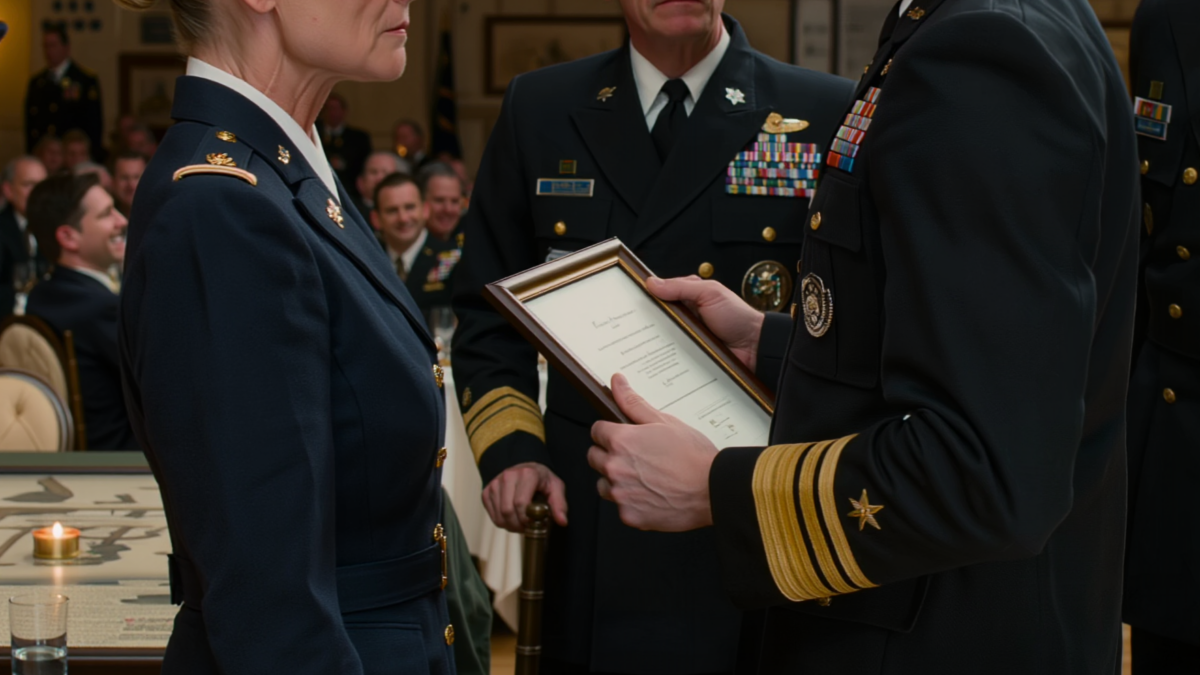
Captain Trent Voss had a voice designed for rooms like that one.
It carried easily beneath the chandeliers without sounding forced, the kind of clear, confident voice that belonged to a man accustomed to people listening before he had given them a reason. When he lifted the framed citation from the green cloth of the history table, he held it beneath the light as though he had just discovered something entertaining.
“The diversity hire wants a ceremony,” he said.
His table laughed before he had really begun.
I was four tables away with a glass of water in my hand. I had not taken a sip. My service uniform had been pressed twice that afternoon, not because it needed it the second time, but because rituals give your hands something harmless to do.
I did not move.
By forty-one, I had learned that there were moments when interruption was necessary and moments when correcting someone only rescued them from understanding what they were doing. Sometimes the most useful thing you could do was remain still and allow a person to walk all the way to the edge of his own certainty.
This was one of those moments.
Voss turned the frame toward himself.
“Let me translate the paperwork for the class,” he said.
He began reading.
“For gallantry in action…”
He paused deliberately and glanced toward his table.
“That’s a pretty big phrase for a staff officer, isn’t it?”
A few people laughed.
“I didn’t know we handed those out for spreadsheets.”
The second laugh was thinner.
Near the wall, several senior noncommissioned officers had stopped smiling.
Voss had not noticed them yet.
He kept reading.
I watched him with something closer to disappointment than anger. He was thirty-one, a rifle company commander, decorated enough to know difficult work firsthand. He wore the badges that said he had passed hard schools and earned difficult assignments.
That mattered.
He was not pretending to be something he was not.
That was what made the moment sadder.
Trent Voss was a capable officer who had become too comfortable assuming that capability in one part of life automatically made his first judgment reliable in every other part.
Certainty had stopped being something he carried.
It had become somewhere he lived.
He reached the second line of the citation.
His voice was still strong.
Then he reached the line about the eastern wire.
Two soldiers.
Open ground.
The cadence changed.
Only slightly.
But I heard it.
So did some of the older soldiers.
Voss slowed down.
That was the mistake that saved him from making a worse one.
Once he slowed down, he began actually reading the words instead of performing them.
There is a difference.
When you perform language, you keep it outside yourself. You shape it, project it, use it to produce a reaction.
When you read something carefully, you risk understanding it.
The framed citation had never been a trophy to me.
People saw medals and imagined pride first.
I understood why.
Awards were polished. They were pinned to uniforms. They appeared beneath glass. Somebody read formal language while people applauded.
From a distance, all of that looked like celebration.
But to the person named in the citation, the paper could mean something else entirely.
Mine was a receipt.
It documented a morning I would have given almost anything not to have experienced.
Fifteen years earlier, I had been twenty-six and newly confident in the way young officers sometimes are before experience teaches them that plans are mostly agreements with uncertainty.
I was assigned to operations and attached to an infantry element.
I was useful.
I was not supposed to be the person at the center of anything dramatic.
That was the plan.
The morning that changed my career began before sunrise at a small outpost whose nickname belonged to the soldiers who served there, not to any story I might tell later.
The sky was in that gray state between night and morning when the body wants sleep most badly.
The trouble came quickly.
The eastern side of the perimeter began failing after its section leader was taken out of action early. Confusion moved faster than information. Soldiers were trying to understand what had happened while also responding to it.
I was near enough to see the problem developing.
So I went toward it.
That sentence is much cleaner than the experience was.
Official language likes clean verbs.
Moved.
Directed.
Held.
Recovered.
The verbs hide the ground beneath them.
When I reached the eastern position, I found frightened young soldiers looking around for someone to make decisions.
I was the officer standing there.
So I made them.
I put people where they needed to be. I helped get a silent position functioning again. I kept instructions short because frightened people do not need speeches.
The citation later described what happened in polished terms.
What I remember is noise, gray light, dry ground, and faces that seemed much younger afterward than they had the day before.
The position needed time.
We gave it time.
The official report later said it was about eleven minutes.
Eleven minutes is almost nothing.
Eleven minutes can also contain an entire life.
During those minutes, two soldiers ended up in open ground between the eastern perimeter and better cover.
One was Specialist Gus Hartley.
He was nineteen.
When I reached him, he was more embarrassed than frightened, which remains one of the saddest reactions I have ever seen in a young soldier.
He tried to apologize.
Not dramatically.
He simply seemed convinced that needing help meant he had inconvenienced everyone around him.
I got an arm beneath his gear.
“Stop apologizing,” I told him.
He started again.
So I changed tactics.
“You’re heavy.”
That surprised him enough to shut him up.
It was ridiculous.
That was the point.
Sometimes, in an impossible moment, the kindest thing you can give someone is one ordinary sentence.
Something too mundane to belong to the danger around them.
I got Hartley behind cover.
Then I went back for Rojas.
The second trip frightened me more because daylight had strengthened.
Darkness allows the imagination to hide details from you.
Morning does not.
Rojas had gone quiet.
Quiet frightened me more than shouting ever could.
I pulled him toward cover using the handle on the back of his gear.
The distance was not far.
It felt endless.
He survived.
Hartley survived too.
That mattered more to me than anything later written about the morning.
People sometimes describe courage as if fear disappears and leaves a person cleanly heroic.
That was not my experience.
I was afraid.
I moved anyway because movement was the only useful thing available to me.
From a distance, fear that keeps functioning may resemble bravery.
Citations are written from a distance.
That is not criticism.
It is simply how records work.
They capture the shape of an event and leave the interior out.
Afterward, when daylight had become normal and the danger had passed, I sat near the aid station feeling as if my body had finally remembered it was exhausted.
A sergeant named Roy Tibet sat beside me.
He had been on the eastern wire.
Roy was one of those noncommissioned officers who made organizations work without requiring anyone to tell them they were doing it.
He sat on an ammunition crate and said nothing for a while.
I appreciated that.
Silence can be a form of competence.
Eventually he looked at me.
“Thank you.”
Two words.
I had no idea what to do with them.
Being thanked for the worst morning of your life is a strange burden.
Gratitude is supposed to feel good.
That one did not.
It gave the morning names.
Faces.
People whose later birthdays and marriages and ordinary Tuesday afternoons suddenly seemed connected to decisions I had made while frightened and exhausted.
I said something back to Roy.
I do not remember what.
He nodded as though it was enough.
We both knew it was not.
Years later, other people would look at the medal and see achievement.
I would see Hartley apologizing for being heavy.
I would see Rojas in the growing light.
I would hear Roy saying thank you.
That was the thing Captain Voss had picked up from the green tablecloth.
And he had no idea.
Three days before the dining-in, Lieutenant Colonel Grace Amara had come to my office.
I was still unpacking.
Maps were leaning where they should have been hanging, boxes sat beneath the desk, and the operations shop had not yet decided whether it belonged to me.
Grace leaned against the doorframe.
“Corwin.”
“Yes, ma’am?”
“The dining-in Friday.”
I waited.
“I want the history table to mean something this year. Unit colors. Old shadow boxes. Real objects instead of whatever somebody found in storage. I heard you have something worth displaying.”
I knew immediately what she meant.
“I have a frame in a box.”
“Bring it.”
“The younger officers can look at everybody else’s.”
She studied me.
Grace had a talent for waiting long enough that people eventually supplied the argument she had decided not to make.
“They should know who’s running their operations,” she said.
“They’ll know when I run their operations well.”
That earned a small smile.
It was the answer she expected from me.
Then she said, “It isn’t vanity if someone else asks you to show it.”
I looked back at the boxes.
“Bring it,” she repeated. “Let the history speak. You don’t have to.”
That argument got through.
I had spent much of my career trying not to become the woman with the medal.
Once people knew the extraordinary thing, they often stopped noticing the ordinary things.
They forgot that you were good at logistics.
They forgot you remembered people’s names.
They forgot you could be wrong about small things, irritated about stupid things, tired on Mondays, funny on occasion, boring most of the time.
You became the story.
Stories are exhausting things to be.
I wanted to arrive at this battalion as Major Corwin, the operations officer.
Not the citation.
Not the medal.
Not the morning.
Just the woman who made the training calendar work and knew the plan before everyone else walked into the briefing room.
Grace understood most of that.
She still thought the younger soldiers ought to see the history.
Eventually I agreed.
Before the crowd arrived Friday evening, I placed the frame face up on the green tablecloth between older unit objects.
It felt simultaneously brave and foolish.
Most worthwhile decisions contain a little of both.
I went back to my quarters to dress.
I laid the uniform coat flat on the bed and pinned everything exactly where regulation required.
There is relief in regulations sometimes.
They remove choice from small moments.
Measure here.
Place this there.
Align these.
No interpretation required.
When I finished, I stood in front of the mirror.
Forty-one.
Major.
Three weeks into a new assignment.
I had spent years learning that people underestimated me easily.
When I was younger, I resented that.
Eventually I discovered it could be useful.
People reveal a great deal in front of someone they have prematurely decided does not matter.
I had been in meetings where men explained my own plans back to me.
I had watched people redirect questions toward junior male officers after I had introduced myself as the person in charge.
Sometimes I corrected them.
Sometimes I let them keep talking.
Underestimation was a currency.
You did not need to spend it every time somebody handed it to you.
That night, I wanted no dramatic moment at all.
I wanted dinner.
Professional conversation.
A reasonable departure time.
The frame could sit quietly on a table and do nothing.
That was the plan.
Then Captain Trent Voss picked it up.
Back beneath the chandeliers, he had reached the third line.
The room had started turning before he understood it.
Older sergeants recognized the language first.
They had attended ceremonies.
They had heard citations read properly.
They knew that phrases about open ground and soldiers being recovered did not belong inside a joke.
Their expressions closed.
The quiet spread inward.
One young officer stopped laughing.
Then another.
The humor disappeared from the edges until Voss was standing in the center of a room where nobody was giving him the reaction he had expected.
His body noticed before his pride did.
His voice slowed.
He read about the two soldiers.
Then somebody at the head table placed a glass down.
I heard the small sound because almost everything else had stopped.
A man stood.
I looked toward him.
For a second, my mind refused to fit the older face over the younger one I remembered.
Then it did.
Roy Tibet.
Fifteen years had put gray at his temples and more weight through his shoulders.
His uniform now carried the rank of command sergeant major.
He had traveled a long distance from the sergeant sitting beside me on an ammunition crate.
I had no idea he was in the battalion.
I had not seen him since that deployment.
But I recognized the way he stood.
Unhurried.
Certain.
Not performative certainty like Voss’s.
The other kind.
The kind earned by seeing something and remembering exactly what it was.
Everyone noticed.
A command sergeant major rising in the middle of a battalion function is not background movement.
Voss looked up.
Roy’s eyes were on the frame.
“Read the rest, sir.”
Voss did not answer immediately.
Roy’s voice remained level.
“I’ll tell you if you get it wrong. I was there.”
Something changed in Voss’s face.
He looked down.
Then at me.
Then down again.
I watched him perform the arithmetic.
The staff officer he had dismissed.
The citation.
The senior enlisted leader confirming it.
The words about the wire.
The two soldiers.
Me.
“Nobody told me who she was,” he said.
Quietly.
Almost to himself.
Nobody had.
That was the point.
I had deliberately avoided telling people.
I had wanted them to meet me slowly, through work.
Now Voss had undone three weeks of carefully maintained anonymity in less than two minutes.
Every face in the ballroom seemed to turn toward me.
That was almost worse than the mockery.
The exposure.
The instant transformation from person to story.
And then something else happened.
The room wanted a performance.
I felt it as clearly as if someone had announced it.
The captain had embarrassed himself publicly.
The major he mocked turned out to possess a record he had badly misunderstood.
The command sergeant major had confirmed it.
Everyone knew the next scene.
They had seen it in movies.
They had heard versions of it in stories.
Now the wronged officer walks across the room and destroys the arrogant captain with one perfect sentence.
A satisfying ending.
A clean ending.
The problem with satisfying endings is that somebody has to live inside them the next morning.
Lieutenant Colonel Amara had already begun rising.
I knew what she intended.
She would stop the evening from deteriorating further.
Later there would be counseling.
Possibly command consequences.
Professional channels.
Documentation.
Everything an organization should do when one officer humiliates another publicly.
Her instinct was correct.
But if she intervened immediately, the story would become something else I did not want.
The woman rescued by the commander.
The captain crushed by the chain of command.
Everyone would leave remembering punishment.
I wanted something different.
Voss had begun trying to set the frame down.
He could not find a graceful place for it.
The crowd had subtly shifted.
Tables and bodies limited his path to the door.
The object he had picked up so casually now looked heavy in his hands.
For one brief moment, I felt satisfaction.
I am not proud of it, but I distrust stories where the injured person claims to have felt nothing.
I felt it.
A hot, small pleasure at seeing certainty collapse.
Then I let it pass.
The whole room already had an ending prepared for me.
I decided not to use it.
I crossed the ballroom.
Not quickly.
There is a deliberate pace people learn in jobs where panic must remain private.
I used that pace.
Grace caught my eye.
I gave her the smallest possible shake of my head.
I have this.
She stopped.
That remains one of the kindest things a commander has ever done for me.
She let the moment remain mine.
Voss looked at me as I approached.
Up close, he seemed younger.
Not because age had changed, but because certainty had.
Confidence puts years on a face.
Shame removes them.
I stopped in front of him.
I did not reach abruptly for the frame.
“May I?”
He understood.
He handed it to me.
His hands were not steady.
For the first time that night, I saw not the man who had made me into a joke, but a man watching himself become a story other people might tell for years.
The captain who mocked the major’s citation.
The captain who did not know.
The captain who read until the command sergeant major stood.
I knew what it meant to become a story you had not chosen.
That did not excuse him.
It did make him human.
I folded the stand closed and held the frame against my side.
Then I spoke quietly.
“You read it fine, Captain.”
He looked at me.
“The hard part isn’t the reading.”
That was all.
I turned the frame so the glass faced inward against my body.
I did not need the room looking at it anymore.
Roy was still standing.
He waited until I had stepped away from Voss.
Then he addressed the room.
Not dramatically.
Roy rarely wasted drama on facts.
“I was a sergeant on the eastern wire that morning.”
Forks remained still over plates.
He continued.
He described the position beginning to fail.
The section leader gone.
The confusion.
Then an officer arriving where nobody had expected her.
He told them what the second line meant in human terms.
He described us holding long enough for the position to stabilize.
Then he moved to the next part.
“Line three is the two soldiers.”
I looked down at the closed frame.
Roy said they had been in open ground.
He described watching me go for them.
One at a time.
Then he named Hartley.
The name nearly broke my composure more effectively than Voss’s joke ever could.
Roy told the room that Hartley had gone home.
That he had built a life.
Then Roy looked across the tables.
“Two of us walked off that outpost who shouldn’t have.”
His voice remained completely flat.
“She’s the reason.”
A pause.
“I’m one of the two.”
Nobody challenged him.
Nobody needed to.
That is the power of specific truth.
It does not require decoration.
When Voss finally tried to speak, he barely got through the beginning.
“Ma’am, I didn’t—”
I stopped him gently.
“Sit down, Captain.”
He hesitated.
“You’re making them watch.”
That reached him.
He sat.
I did not want his public apology any more than I had wanted his public mockery.
Both turned two people into performers.
I wanted the evening to stop being a stage.
Gradually, conversation returned.
Forks touched plates.
People looked at their glasses.
The machinery of an ordinary dinner restarted.
I walked back to my chair carrying the frame.
My face was calm.
My heart was not.
I thought about one thing.
Truth rarely needs volume.
Sometimes it only needs one witness willing to stand.
An hour later, I stepped outside.
The night air was cool.
Military installations have a particular quiet around parking areas after formal events, the artificial brightness ending suddenly at the edge of the building.
Grace found me near a low wall.
She stood beside me without speaking for a while.
Then she said, “I can make his life very small.”
I almost smiled at the phrasing.
She was not joking.
“A counseling statement tonight. Formal action Monday. He humiliated a field-grade officer in front of the battalion. I have room to move.”
I considered it.
Actually considered it.
Every time I tell myself I would have answered instantly, I know I am editing the memory.
I remembered years of being underestimated.
Coffee girl.
Paperwork officer.
The person someone assumed had been promoted for reasons other than ability.
Meetings where ideas changed ownership in the space between my mouth and somebody else’s.
There was a part of me that wanted to watch consequences arrive.
Then I thought about Voss.
He had earned his command.
He was, according to everything I had observed, good at his actual job.
The mistake was not proof that every previous achievement was false.
It was proof that one area of his judgment had gone badly unchallenged.
“Don’t make him small,” I said.
Grace turned toward me.
“Make him better.”
She studied me.
“You’re certain?”
“He isn’t a fraud.”
“No.”
“He earned his tab. He earned his command. He made an ugly mistake because somebody let him believe being certain was the same thing as being right.”
Grace folded her arms.
I continued.
“If you break him, every lieutenant in that room learns that being wrong ends you. So the next time they’re wrong, they’ll hide it.”
“And if I don’t?”
“Make him face it. Then give him work that requires him to be better.”
Grace looked through the ballroom windows.
“You could have destroyed him in there.”
“I know.”
“The room wanted you to.”
“I know that too.”
“Why didn’t you?”
“Because the room doesn’t have to wake up tomorrow as the person who did it.”
She was quiet.
Eventually she asked, “Where did you learn that?”
I looked across the dark parking area.
“On a wire.”
That was as much explanation as I needed to give.
Later, alone in my quarters, I opened the frame.
The installation had gone quiet.
I switched on the lamp and read the citation privately.
Slowly.
That was the only way I could read it.
I reached the line about the two soldiers.
I tried to say it aloud.
I could not.
The first words stopped somewhere between thought and voice.
For fifteen years, strangers had been able to read that line more easily than I could.
Voss had demonstrated that dramatically.
I laughed once, quietly, at the absurdity.
Then I set the frame facedown on the nightstand.
A citation contains the people you reached.
It rarely contains everyone you did not.
That morning had names that never appeared in the frame.
Roy carried those names too.
Everyone who had been there carried some version of the same ledger.
Official records close.
Private accounting does not.
Three days later, Roy knocked on my office door.
“Come in.”
He stepped inside.
For a second, neither of us behaved like a major and a command sergeant major.
We were simply two people who had last known one another inside a morning neither had fully left.
“Command Sergeant Major.”
“Ma’am.”
The door closed.
Then I said, “Roy.”
He almost smiled.
“Corwin.”
He sat in the chair across from me without waiting for permission.
He had earned that privilege a long time ago.
“I didn’t know you were here,” I said.
“I didn’t know you were coming until I saw the personnel roster.”
“You recognized the name?”
“I thought there had to be another Corwin.”
“There usually is.”
“I checked.”
That almost-smile again.
“There you were.”
I looked at him.
“You didn’t have to stand up Friday.”
Roy stared at me as if I had just misunderstood gravity.
“Yes, I did.”
“You could have let Grace handle it.”
“That isn’t what I mean.”
He leaned back slightly.
“A man can sit through plenty of foolishness. That wasn’t one of those things.”
I said nothing.
Roy continued.
“I could no more have stayed in that chair than I could have stayed behind that morning while you went for Hartley. Some things the body decides before the brain gets a vote.”
The name changed the room.
“Hartley,” I said.
Roy’s expression softened.
“He’s good.”
I waited.
“Really good.”
Something in my chest loosened.
I had not realized it had remained tight.
Roy saw that and slowed down.
“He has a little girl.”
I looked at him.
“Four years old. Stubborn as a fence post.”
I laughed unexpectedly.
“Of course she is.”
“He runs a hardware store back home now. Same town. Still only one traffic light unless they finally added another and nobody told me.”
“He stayed?”
“Yeah.”
Roy nodded.
“He limps when it’s cold. Coaches some youth sports thing on weekends. Happy marriage. Good business. By every honest measurement I know, he has a good life.”
I lowered my eyes toward the desk.
There were maps spread across it.
Training schedules.
Ordinary problems.
Things that could be fixed with enough planning.
Roy let the silence remain.
Then he said, “He asks about you.”
I looked up.
“Every year.”
My throat tightened.
“I talk to him a few times a year. Every year he asks whether I ever found you.”
Roy smiled faintly.
“For fifteen years I kept telling him I didn’t know where you’d ended up.”
I could not answer.
Roy understood.
He always had.
After a while he glanced toward the side cabinet.
“You still put the frame facedown?”
“Every time.”
He nodded.
As if that were the only answer that made sense.
Maybe for people like us, it was.
The frame could exist.
The past could exist.
Neither had to perform.
Captain Voss came to my office later that week.
He arrived looking as if he expected judgment to be waiting behind the desk.
I had something else waiting.
A field training problem.
His company had an exercise approaching, and the existing plan was harder than the unit was ready for.
Not impossible.
Hard.
Exactly the kind of assignment where confidence had to make room for listening.
I walked him through the problem.
He stood very straight.
At first he looked confused.
Then suspicious.
Eventually he realized I was not giving him humiliation disguised as professional development.
The job mattered.
I expected him to do it well.
That realization affected him more than punishment would have.
When I finished, he remained standing.
“Ma’am.”
I knew what was coming.
“About the dining-in—”
“We’re not having that conversation.”
He stopped.
“Not because it didn’t matter,” I said. “It did.”
He waited.
“You know what you did. I know what you did. The battalion knows what you did.”
His eyes dropped once, then came back up.
“Nothing you say in this room changes Friday.”
“Yes, ma’am.”
“An apology right now would mostly make you feel better.”
He absorbed that.
“The version of you I care about is the one who runs this exercise correctly.”
I turned the map toward him.
“Can you give me that officer?”
His answer came without hesitation.
“Yes, ma’am.”
I believed him.
He justified that belief.
The company performed better than I expected.
Not perfectly.
Better.
During the after-action review, Voss stood in front of his lieutenants and did something I had not seen him do before the dining-in.
He named his own mistakes first.
No excuses.
No protective language.
No attempt to move responsibility sideways.
He identified where his assumptions had failed and what he would change.
His officers watched him.
That mattered more than anything he might have said to me privately.
A leader being wrong is not remarkable.
Every leader is wrong.
The important part is what everyone learns from watching the wrongness become visible.
If they watch a leader hide it, they learn concealment.
If they watch the organization destroy him for admitting it, they learn silence.
If they watch him face it, correct it, and remain responsible for the next decision, they learn something better.
Voss learned.
So did the younger officers who had laughed too early that night.
I stayed with the battalion.
People often imagine that after becoming known in a way you tried to avoid, you must leave.
I did not.
I had come there to work.
So I worked.
I ran the operations shop.
I briefed.
I answered email.
I solved scheduling conflicts that nobody would remember the following year.
I learned which officer needed more preparation before briefings and which sergeant could fix a broken plan in three sentences.
I drank bad coffee.
I went home at reasonable hours when the job allowed it.
I became exactly what I had wanted to become when I arrived.
An ordinary competent major.
The only difference was that now the battalion knew what some of that ordinariness had been built upon.
People stopped explaining things to me slowly.
They listened the first time.
I never asked them to.
Respect demanded continuously is exhausting.
It becomes another task.
The kind that arrives because people have watched you long enough to decide for themselves lasts better.
Weeks passed.
The frame remained in my quarters for a while.
Then one afternoon I brought it to the office.
I opened a drawer.
I placed it inside.
Not in shame.
Not in triumph.
Just away.
It had said what it needed to say.
More accurately, Roy had said what it could never say.
Hartley was alive.
Rojas was alive.
Roy had survived that morning and grown into the senior enlisted leader standing in a ballroom fifteen years later.
Voss had made a cruel joke and then been forced to understand the human ground beneath the words he had mocked.
Grace had given me room to own my response.
The younger officers had watched someone be wrong without watching him be erased.
That was enough.
I closed the drawer.
Then I turned back to the map hanging on the wall.
The map mattered.
It had always mattered.
Planning tomorrow’s work.
Keeping people ready.
Giving good officers difficult problems.
Listening when experienced sergeants told you the plan had a flaw.
Revising assumptions before reality revised them for you.
The worst morning of my life had never been valuable because someone placed a medal beside it.
The value was in the people who went home.
The work afterward was learning how to help more people do the same.
There is no citation for most of that.
There should not be.
Years ago, I thought being underestimated was the most exhausting burden a person could carry.
Later I thought being recognized was.
Eventually I understood that both were forms of weather.
They moved through.
The work remained.
So did the people.
Sometimes, late at night, I still remembered Hartley apologizing for being heavy.
Now another image came with it.
A hardware store.
A stubborn four-year-old girl.
A father coaching children on a weekend.
That information did not erase the morning.
Nothing could.
It changed its weight.
Roy had given me that.
The same man who had once thanked me while sitting on an ammunition crate had stood fifteen years later because he believed silence would have been a betrayal of something we both carried.
And maybe that was the part of the story I had resisted longest.
I had spent years insisting I could carry the morning alone.
I could not.
Nobody does.
We carry pieces for each other.
Sometimes the person doing it does not appear until fifteen years later, beneath chandeliers, after a captain with too much confidence decides to pick up the wrong frame.
When that happens, you do not always need the perfect speech.
You do not always need revenge.
Sometimes you take the frame back.
You turn it facedown.
You let the witness speak.
Then you return to the map.
Because the map was the point.