At our fifteenth-anniversary dinner, a woman in a pearl-gray dress leaned toward my husband and said, “I didn’t realize she’d be here.” Brixton was twenty-two minutes late, his phone face-down, her hand on his elbow. Then I remembered the rideshare pickup address—and knew the affair might not be the only lie.
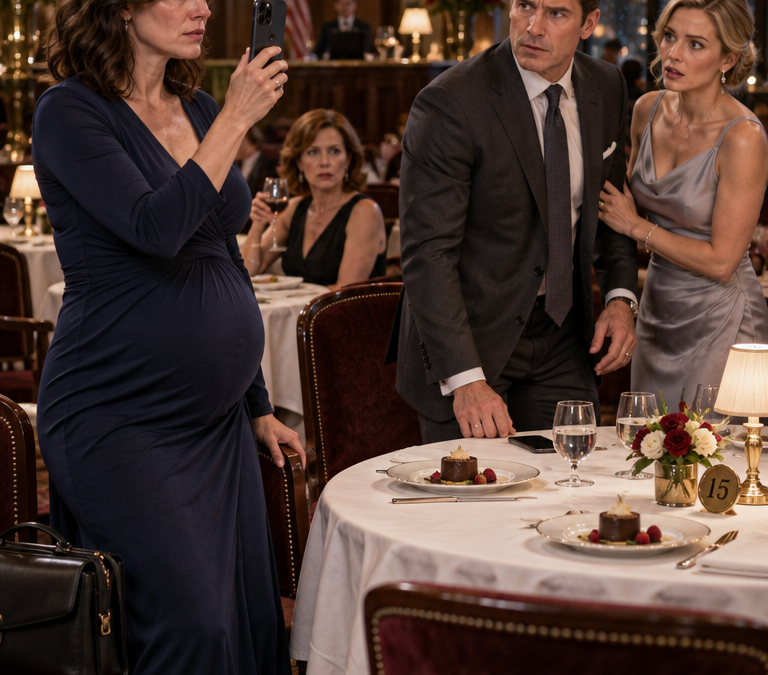
She said it without raising her voice, which was the detail Annie Kovar Drenan would remember longest.
The woman in the pearl-gray dress leaned toward Brixton’s ear at table 15 and said, “I didn’t realize she’d be here.”
There was an ease to the movement that made Annie look at her twice. Not because Vzna Tadic had touched Brixton’s elbow. People touched each other in crowded restaurants all the time. It was the familiarity of it, the absence of hesitation, as if Vzna had occupied that exact space beside him before.
Brixton Drenan had arrived twenty-two minutes late to their fifteenth-anniversary dinner.
He blamed a permitting problem at the Harborview construction site.
Annie had accepted the explanation for almost three minutes.
Then she noticed the rideshare charge in the shared calendar on her phone. The pickup address was two blocks from the Whitmore Hotel and nowhere near Harborview.
She had not confronted him.
She had simply registered the discrepancy.
That was how Annie’s mind worked. Years before, when she still reviewed structural plans herself, a fraction that did not belong in a load calculation could bother her for hours. She did not assume a building was failing because one number looked wrong.
But she circled the number.
Tonight, she had mentally circled several.
Brixton’s late arrival.
The rideshare pickup.
The way he kept angling his phone toward the linen tablecloth whenever the screen lit.
The fact that he had barely looked at the architectural case beside Annie’s chair even though he had asked her to bring it.
Annie was seven months pregnant. She had worn the only anniversary dress she could still button, a deep-navy maternity dress her sister Singi had found and altered twice.
The shoes had been a mistake.
By the time Annie crossed the Whitmore lobby, her lower back ached and the baby had settled into a position that made sitting at a formal dining table an exercise in patience.
She had ordered sparkling water and waited for her husband to notice how much effort she had made for an evening that had been his idea.
He did not.
Then Vzna appeared.
Annie recognized her immediately. Vzna was thirty-one and had joined Kovar House nine months earlier as development director. She had excellent donor contacts and moved with a professional precision that had impressed half the board.
Annie had approved the hire.
She had also distrusted it.
At the time, she had told herself she was tired. She was managing a zoning appeal, a contractor dispute, an expansion plan and a pregnancy three doctors had described as high risk. Distrusting a polished new executive without evidence felt unfair.
So Annie had ignored the instinct.
Now Vzna looked at her, then at Brixton, and performed surprise with too many separate movements.
Her shoulders drew back.
Her eyes widened.
Her hand left Brixton’s elbow, then returned to it for half a second before dropping.
“I’m sorry,” Vzna said. “You said the dinner was—”
She stopped.
Brixton stood.
“Vzna, this isn’t—”
“I know what it is,” Annie said.
She was looking at Brixton, not Vzna.
A server carrying two plates slowed three feet from the table. At the next table, a woman stopped cutting into her dessert.
Annie reached into her bag and took out her phone.
She photographed the table.
The two untouched dessert plates.
The brass 15 marking the anniversary reservation.
Vzna beside Brixton.
Brixton’s wedding band.
Vzna’s hand still close enough to his arm to tell its own story.
A restaurant photographer had been circling the dining room that evening for the hotel’s anniversary-week social media campaign. Annie saw his lens turn toward them.
She did not ask him to stop.
“The reservation is in your name,” she said to Brixton. “The check will be, too.”
She picked up the flat architectural case beside her chair.
Inside were four years of work on Kovar House’s South End expansion, two years of grant applications, engineering revisions, donor commitments and the latest plans for the first major building that would carry her mother’s vision into another Boston neighborhood.
Annie slid the case beneath her arm and walked out.
Brixton said her name once.
Then again.
He did not reach her until the revolving door had already released her into the November night.
Boston had gone nearly two weeks without rain. That streak ended while Annie stood under the hotel awning.
Water came off the harbor in hard silver sheets, streaking the streetlights across the wet pavement.
She requested a car.
Brixton came outside without his coat.
“She misread the situation,” he said.
Annie watched rain gather along the collar of his shirt.
“She knew the restaurant.”
He said nothing.
“She knew the table number.”
His expression tightened.
“She knew the color of your car.”
“Annie—”
“What exactly did she misread?”
He did not deny the affair.
He disputed its meaning.
That mattered.
“Come home,” Brixton said. “Let me explain it properly.”
Annie’s car pulled to the curb.
“I’m going somewhere your explanations haven’t reached yet.”
She opened the rear door.
Brixton caught it before she could close it.
“It’s our anniversary.”
“I’m aware.”
Her hand remained on the inside handle.
“That’s why I’ll remember exactly where I was when this marriage ended.”
She pulled.
For once, Brixton let the door go.
Kovar House occupied a converted brick schoolhouse in Roxbury. Annie’s mother, Hannah Kovar, had bought the original building for thirty-eight thousand dollars in 2001 after spending years learning what unstable housing could do to a family.
Hannah had arrived in Boston at nineteen with one suitcase and the name of a contact who turned out to be useless. She had spent years moving through temporary housing before earning her nursing license.
When she eventually had enough money to own a building, she did not buy something impressive.
She bought something useful.
The schoolhouse became the first Kovar House.
By the time Hannah died eleven years earlier during an incident at a property she had been evaluating, the organization had four sites serving dozens of families.
Annie was twenty-nine then, newly married and pregnant with Brid.
She had stepped into Kovar House almost before the funeral flowers faded.
For two years she took no salary.
She expanded four locations into nine.
She learned zoning, fundraising, municipal politics, construction scheduling, crisis management and the strange diplomacy required to persuade wealthy donors that women in unstable circumstances were not charitable abstractions.
Brixton had attended the ribbon cuttings.
He called the work Annie’s calling.
For years, she heard that as admiration.
Much later, she understood how convenient it had been for him to admire work he never had to perform.
Wander Reyes, Kovar House’s night supervisor, opened the side entrance before Annie reached for her key.
Wander was sixty-seven, broad-shouldered, patient and almost impossible to shock.
“Mr. Drenan called,” she said.
Annie looked at her.
“I didn’t answer.”
Wander’s eyes moved to the architectural case, Annie’s wet coat and the careful way she was standing.
“Come upstairs. There’s a couch and bad coffee.”
The second-floor office overlooked the rear courtyard.
Annie placed the drawings on the desk.
Then she allowed her hands to shake.
Thirty seconds.
No more.
Afterward, she opened a drawer, took out a legal pad and made three lists.
The first contained what belonged to her separately.
Kovar House.
The nine properties held through her mother’s trust structure.
Her consulting business, which she had created before the marriage.
The second contained what Annie and Brixton shared.
The Back Bay townhouse.
A brokerage account.
Two vehicles.
Fifteen years of purchases, routines, compromises and financial entanglements no legal document could turn back into separate lives without leaving marks.
The third list was different.
Things Annie would stop doing.
Stop softening Brixton’s language before meetings with city officials.
Stop explaining his absences to Brid.
Stop telling her sister he was simply busy.
Stop sitting beside Brixton at dinners where men who distrusted his aggression relaxed because Annie was there.
Stop lending him moral credibility and calling the arrangement mutual.
At 12:40 a.m., Singi called.
Annie and her sister had not spoken properly in five weeks.
The argument had started when Annie missed the anniversary service for their mother because of a zoning appeal Brixton had promised to monitor and allowed to lapse.
“Mama’s candle burned without you,” Singi had said.
Then she had gone quiet.
Now her first words were, “Wander texted me. Tell me what happened.”
Annie told her.
The restaurant.
Vzna.
The sentence.
The touch.
The photograph.
Singi was silent for several seconds.
“Lock the side door,” she said. “I’m coming.”
She arrived from Medford with a canvas tote, two blankets and a container of soup.
She walked directly to Annie, put both hands around her face and studied her the way Hannah once checked her daughters for fever.
Her eyes dropped briefly to Annie’s stomach.
“Did he hurt you?”
“Not with anything I can photograph.”
Singi nodded once.
She did not say I told you so.
She heated the soup on the office hot plate and watched Annie eat.
“I kept rearranging my life around his emergencies,” Annie said.
Singi sat beside her.
“Don’t turn his betrayal into a verdict on every choice you made. You were generous. He used it.”
“You were angry with me.”
“I still am.”
Annie looked at her.
Singi’s voice softened.
“Being angry with you isn’t the same as leaving you alone in it.”
Something inside Annie finally gave way.
She covered her face and cried.
Singi put an arm around her without speaking.
The baby shifted slowly against Annie’s side. Annie rested one hand over the movement and cried until exhaustion replaced the need to stay controlled.
At three in the morning, Singi slept on the office couch.
Annie could not.
She walked.
Kovar House sounded different at that hour. Pipes clicked softly behind old walls. A vending machine hummed near the stairs. Children’s shoes sat outside one apartment door because someone had cleaned mud from them and left them to dry.
Fifty-one women and sixty-eight children were sleeping throughout the building.
Some residents had arrived with organized folders containing referrals and records.
Others had arrived with almost nothing.
At the far end of the second-floor corridor, Annie saw Dileia Okonquo sitting outside apartment 207.
Dileia’s five-year-old daughter slept against her shoulder.
An envelope lay across Dileia’s knees.
“I thought the lease review was in January,” Dileia said when Annie approached.
Annie took the envelope.
Kovar House letterhead.
Thirty days to vacate.
Planned redevelopment.
She read it twice.
At the bottom appeared a printed trustee signature.
Annie Drenan.
Except Annie had not signed it.
The last loop curved in the wrong direction.
Annie had signed enough contracts, grants and architectural approvals to know the movement of her own name.
Her gaze traveled down the hallway.
An hour earlier, she had believed the worst thing Brixton had taken was her trust.
Now the affair felt like a light switched on in a much larger room.
“You are not being evicted,” Annie told Dileia.
Dileia stared at her.
“Tell anyone else who received one of these not to sign anything and not to pack.”
Brixton was waiting in the courtyard at seven.
He wore the same clothes from dinner. Two site managers stood near the gate.
Annie walked outside alone and left the door open behind her.
“Send them home.”
Brixton studied her.
“You need sleep. You need to see your doctor today.”
“Do not use our child to manage this conversation.”
He stopped.
For several seconds, the only sound was traffic moving beyond the brick wall.
Then Brixton said, “The affair started in April.”
Annie waited.
“Vzna was effective with donors. Frederick said she could be useful to the foundation.”
“Frederick Holt?”
“Yes.”
Brixton looked toward the courtyard wall instead of Annie.
“Things developed.”
“You ended it?”
“In September.”
“She apparently didn’t think so.”
“She had trouble accepting it.”
“You told her our marriage was an arrangement.”
Brixton did not deny it quickly enough.
Annie nodded.
“Was I there when we arranged that?”
“Annie—”
“You mentioned Frederick.”
Brixton stopped talking.
Frederick Holt was sixty-one, Brixton’s chief financial officer and operating partner. He had worked with Brixton’s father before Brixton inherited Drenan Developments.
Frederick was unfailingly polite to Annie.
He was also the kind of man who called her “the philanthropist” as though her work were a pleasant personality trait.
Annie removed Dileia’s notice from her coat.
“Why is Meridian Property Group sending eviction notices from my mother’s building using my signature?”
Brixton took the page.
His first reaction looked like genuine confusion.
Then Annie saw recognition.
The sequence lasted less than two seconds.
“Meridian was evaluating the South End property,” he said.
“For what?”
“The expansion financing.”
Annie did not move.
“Frederick arranged bridge financing for Harborview. Kovar House was included as temporary collateral.”
“You pledged my mother’s property?”
“Temporarily. The asset was never in real danger.”
“Residents received notices during the night.”
“Those notices weren’t supposed to—”
“Dileia’s daughter is five.”
Brixton’s expression changed.
It became the patient face he used at negotiating tables when he thought the other side was about to make an emotional mistake.
“You’re upset. You’re seven months pregnant. You haven’t slept. Don’t make decisions you’ll need to walk back.”
Fear moved through Annie.
But for the first time in years, she did not interpret fear as a command.
It was information.
“You should have thought about reversible decisions before April.”
She turned and went inside.
Plette Cross arrived at nine with twenty-five years of experience and no interest in anyone’s excuses.
She reviewed the Kovar trust.
The eviction notices.
The collateral documents.
Annie’s list of separate and joint assets.
Then she listened without interrupting as Annie described the affair and Brixton’s explanation.
Plette folded her glasses on the desk.
“Preserve every message. Change passwords only on accounts that belong solely to you. Move no joint money except ordinary expenses.”
She began preparing an emergency filing to prevent transfer of Kovar House property.
“Men with resources sometimes try to make a wife’s reaction the story,” she said. “Do not give anyone a performance they can substitute for the documents.”
“He already told me I was tired and pregnant.”
“Then we move quickly and cleanly.”
By noon, Meridian Property Group had been notified.
By midafternoon, a Suffolk County judge issued a temporary preservation order covering all nine Kovar House properties.
For forty-eight hours, Annie believed documentation might be enough.
Then someone entered Kovar House during the night.
The person came through an emergency exit whose alarm had been disabled during a renovation months earlier.
Very few people knew that.
The intruder opened the locked cabinet containing Hannah Kovar’s founding documents.
The original trust charter disappeared.
A card remained on the desk.
You don’t own what you didn’t build.
Wander found it before six in the morning.
Annie called the police before she called Brixton.
Officers documented the cabinet and the entry point.
Brixton arrived while they were still working.
“You should have called me first,” he said.
Annie turned toward him.
“That sentence is the reason I didn’t.”
Brixton examined the emergency door.
“Only my site crew and your staff knew the alarm was disabled.”
“Then investigators can start there.”
“I’ll handle it.”
“No.”
He looked at her.
“Not anymore, Brixton. Not one more thing you handle while I explain it away.”
Plette brought in fraud examiner Adeline Park.
Adeline reviewed seven years of Kovar House operating accounts alongside the foundation’s consolidated filings.
She followed bundled payments authorized electronically through Drenan Development systems.
One vendor immediately stood out.
Cascadia Site Services.
The company had received hundreds of thousands of dollars beyond documented renovation costs.
The money led to a holding entity connected to Frederick Holt’s brother-in-law.
Then Adeline found an invoice for forty-eight mattresses.
Annie went upstairs and counted.
Thirty-one.
The gap was no longer accounting.
It was seventeen places where someone should have been able to sleep.
There were invoices for a job-training laboratory that had never opened.
Equipment that never appeared.
Renovation work residents had been waiting months to see.
Each number had a human outline.
Brid Drenan came home from her nursing program in Providence after footage from the restaurant appeared online.
At twenty, Brid had Brixton’s height and Annie’s refusal to accept incomplete explanations.
She walked into the office with a backpack over one shoulder.
“Tell me the video is out of context.”
Annie could not.
Brid sat quietly for almost half a minute.
“Dad called me from the airport.”
Annie looked up.
“He said people around you had turned you against him.”
Brid pressed her lips together.
“I told him being afraid of your husband isn’t evidence of a conspiracy.”
The word afraid stayed in the room.
Annie had not used it herself.
Brid glanced toward her mother’s stomach.
“He didn’t ask about the baby.”
Annie looked away.
“What happens now?” Brid asked.
“I file for divorce. The court handles the marriage and property. Other proceedings handle the documents.”
Annie crossed the room and took her daughter’s hands.
“You decide what relationship you have with your father.”
Brid searched her face.
“I will never ask you to punish him to prove you love me.”
Four days before Kovar House’s annual gala, Vzna Tadic appeared at the side entrance.
She wore a dark coat and none of the assurance Annie remembered from the restaurant.
“Frederick called me.”
Annie waited.
“He said if I don’t help move the archive, he’ll tell investigators I proposed the collateral structure.”
Vzna looked into the lobby, then back at Annie.
“He hired me eight months before I applied to Kovar House.”
Annie’s expression did not change.
“He told me to get close to Brixton. He said Brixton would eventually position me publicly.”
“You were paid to make yourself available.”
Vzna held Annie’s gaze.
“Yes.”
“You knew he was married.”
“Yes.”
There was no useful lie left between them.
Then Vzna said, “The archive is being cleared from a warehouse on Frontage Road. One of Frederick’s companies controls it.”
“Tell Plette everything tonight.”
Vzna looked surprised.
“You’re not going to promise me anything?”
“No.”
Annie opened the door.
“She will decide whether what you know is worth what you hope it is.”
Investigators obtained authority to search the Frontage Road facility based on the forged trust documents, Adeline’s financial work and records linking funds to related entities.
They arrived Wednesday morning.
Before the second storage room had been cataloged, smoke appeared beneath a rear door.
The building’s sprinkler system failed to operate properly.
Fire crews contained the damage before most records were affected.
More importantly, Adeline had already sought the independent vendor’s cloud backup.
Whatever someone hoped to remove physically still existed digitally.
The incident widened the investigation.
Then Brixton’s operations team discovered something else.
Internal camera systems at the Drenan townhouse had been routing selected footage to an outside server.
The destination was associated with Frederick’s operations office.
The records indicated Frederick had been able to monitor Brixton’s home office, garage and main kitchen for months.
He had known when Annie worked late.
He had known when Brixton was alone.
He had known when to encourage Vzna’s presence.
Brixton sat in his dark kitchen staring at the report.
For years, he believed Frederick was the man helping him control his organization.
Now he learned Frederick had been observing the organization from inside.
Brixton called Plette Cross.
The annual Kovar House gala filled a South End hotel ballroom with donors, residents, dark suits and white flowers.
Annie entered with Singi, Brid, Wander, Dileia and nine Kovar House residents.
She was eight months pregnant.
Singi had found her a dark-green dress and altered it the week before.
They sat together in the first two rows.
Brixton stood near a side entrance with his attorney and a financial monitor.
The difference was visible before anyone said a word.
City officials who once crossed rooms to greet him did not.
Men who once gathered around him were suddenly occupied elsewhere.
Annie carried only two papers to the podium.
Dileia’s eviction notice.
And the unsigned collateral agreement Brixton had once expected her to approve.
“My mother built Kovar House because she believed safety should not depend on whether a person in crisis could impress someone powerful,” Annie began.
The ballroom quieted.
“For years, I believed putting the Drenan name beside that work strengthened it.”
Her hand rested on the podium.
“I was wrong about what makes a name trustworthy.”
She lifted Dileia’s notice.
“This document told a mother and her five-year-old daughter to leave their home. It carried my signature. I did not sign it.”
No one moved.
“The money behind documents like this does not disappear into abstract accounting. It becomes programs that never open. Supplies that never arrive. Beds that exist on invoices but not in rooms.”
Annie paused when the baby shifted beneath her hand.
“Tonight is not about a private marriage, although a private betrayal is what finally made me look closely enough at the public one.”
Brid stood first.
Then Dileia.
Then Wander.
Residents rose.
Donors followed.
Within seconds, most of the ballroom was standing.
Brixton remained seated.
Near the back of the room, a door opened.
Vzna entered in a plain coat accompanied by two state officers.
She had information.
Frederick had contacted her that morning from an unfamiliar number.
Wander’s sixteen-year-old grandson, Noel Reyes, had failed to return from basketball practice.
According to Vzna, Frederick was holding him and demanding Hannah Kovar’s original trust charter and the deed to the Roxbury property in exchange for releasing him.
The demand was not really about Roxbury.
Frederick believed the charter identified another parcel Hannah had quietly added to the trust in 2008.
A small industrial property near the Neponset River.
Its value had increased dramatically.
Frederick wanted control of it before investigators froze more of his assets.
State prosecutor Sandra Obi coordinated the response.
Frederick instructed Annie to come alone to a waterfront storage building formerly used for development archives.
Annie knew the building.
Her mother had once inspected it as a possible Kovar House annex and rejected it because of safety problems.
Brixton heard Noel’s name and moved toward the door.
Annie stepped into his path.
“Frederick expects you angry.”
“The boy is there because of my company.”
“Yes.”
Annie held his gaze.
“That doesn’t make your first impulse the right one.”
Vzna, seated beside an officer, spoke quietly.
“There’s a loading corridor from the river side. He doesn’t know I walked it last year.”
Annie knew that corridor too.
Hannah had shown it to her when Annie was fourteen, during a summer when her mother evaluated buildings with a flashlight, notebook and the suspicion of someone who had lived in too many unsafe places to trust an exit she had not checked herself.
Sandra’s team prepared a controlled approach.
Annie agreed to cooperate under their supervision.
Brixton stood across the room.
For once, he did not issue an order.
“Don’t go,” he said.
“I’m not asking your permission.”
“I know.”
His voice weakened.
“I’m asking because I’m afraid.”
For fifteen years, Brixton had disguised fear as management.
The honesty did not repair the marriage.
It made him human for one moment.
“Then sit with it,” Annie said. “A lot of people have had to.”
The storage building sat beside the river beneath a starless November sky.
Annie entered shortly before midnight with the requested documents visible beneath her arm.
The building was colder inside than outside.
Frederick Holt waited beneath a bare work light.
Noel sat several yards away.
He was frightened but appeared physically unharmed.
A gray box rested on the floor near him.
“Mrs. Drenan,” Frederick said. “You always did arrive when someone needed organizing.”
“Let him go.”
“The charter first.”
“Then we discuss the documents.”
Frederick smiled slightly.
“You negotiate like Brixton taught you.”
Annie kept her voice even.
“His father taught me. Brixton, I taught.”
Something moved behind Frederick’s eyes.
Then he began talking.
He told Annie that Hannah had discovered discrepancies involving the Neponset parcel years earlier.
Hannah had asked questions.
She had threatened to bring in outside auditors.
Frederick referenced the building where Hannah later died.
Annie listened without interrupting.
Then Frederick said enough to confirm what Annie had spent eleven years refusing to imagine.
Hannah’s concerns had not been random.
Frederick had known about them.
He had known she intended to challenge the records.
Annie heard a signal through the communication equipment provided by Sandra’s team.
She needed only a little more time.
“The attachment you want isn’t in this charter,” Annie said.
Frederick’s attention sharpened.
“My mother moved the parcel survey.”
“Where?”
“She knew you’d come looking.”
Annie moved toward the building’s old fire-suppression control area.
Her mother had once shown her the system while explaining why the property was unsuitable for housing.
Annie activated the emergency suppression system.
Water surged through the overhead lines.
Alarms sounded.
The work light failed.
In the confusion, Noel’s chair shifted away from the object beside him.
Frederick moved toward Annie.
She avoided him and used the building layout she remembered from childhood to keep space between them.
Officers entered through the loading corridor seconds later.
They restrained Frederick and released Noel.
Investigators later determined the gray box had been a bluff intended to increase pressure.
Noel stood shaking after officers freed him.
Then, with the oddly precise priorities of a sixteen-year-old under stress, he told them he had missed the second half of a playoff game.
Wander reached him at the ambulance and wrapped both arms around him.
Brixton waited behind the perimeter.
When Sandra finally allowed him closer, he stopped several feet from Annie.
He did not touch her.
“Did you know?” Annie asked.
He knew what she meant.
Her mother.
Brixton looked toward the river.
“Hannah sent me a note two days before she died.”
Annie stared at him.
“She said Frederick wanted her to sign something that didn’t match her original deed.”
“And?”
“After the accident, I asked him whether she had raised formal concerns.”
Brixton swallowed.
“He produced a file showing nothing unusual.”
“You believed him.”
“I wanted the file to be accurate.”
The words landed with more force than any denial could have.
“So you stopped asking.”
“Yes.”
Annie closed her eyes.
“You held me at her service.”
Brixton did not answer.
“You watched me blame myself for sending her to inspect that building.”
“Yes.”
When Annie looked at him again, her voice was quieter.
“That betrayal is eleven years older than Vzna.”
Brixton did not defend himself.
“Yes,” he said.
The investigation continued for months.
Frederick Holt was prosecuted for offenses involving Noel, the warehouse fire, obstruction, financial fraud, theft from charitable funds and conduct connected to Hannah Kovar’s death.
Investigators corroborated his recorded statements with old photographs, altered inspection records and financial records tied to people involved with the original property work.
He went to trial.
He was convicted.
Vzna entered a cooperation agreement covering her role in the fraud and evidence tampering. She served fourteen months.
She admitted she had known throughout the affair that Brixton was married.
Brixton provided prosecutors with the financial structure of Drenan Developments, including related entities and approval packets he had signed without properly reviewing.
He did not present himself as another victim.
In court, he acknowledged that Frederick had created opportunities for wrongdoing, but no one had forced Brixton to stop asking where money moved.
No one had forced him to tell another woman his marriage was merely an arrangement.
No one had forced him to betray Annie.
Brixton pleaded guilty to financial crimes and bribery-related offenses.
He received a seven-year sentence.
Six weeks after the gala, Annie went into labor on a Sunday morning in January.
The hospital room overlooked Boston Harbor.
Brid stayed with her.
Singi paced the hallway.
Annie named her daughter Hannah Mela.
Hannah for her mother.
Mela for peace.
Hannah Kovar had once told her daughters that peace did not mean difficulty disappeared.
It meant there was finally something worth protecting without surrendering yourself in the process.
Plette filed the final divorce documents while Annie was still recovering.
The financial settlement followed the evidence rather than the mythology surrounding Brixton’s wealth.
Annie retained the nine Kovar House properties, the Neponset parcel and the consultancy she had created before the marriage.
The townhouse became part of separate financial proceedings.
The law did not reward Annie for adultery by handing her an empire.
It also did not require her to absorb liabilities created through fraud.
Before Brixton was taken into custody, he requested one final meeting in Plette’s office.
He sat across from Annie and looked at the bare place on her finger.
“I told my attorneys not to contest Kovar House, the trust or anything that belonged to your mother.”
“Whatever legitimate marital share exists will be determined by the court.”
“I know.”
Brixton looked at his hands.
“Is there anything I can do that matters to you?”
Annie thought about Hannah trying to leave a building eleven years earlier.
She thought about Dileia’s daughter sleeping against her mother in a hallway beneath an eviction notice.
She thought about mattresses that had existed only on invoices.
“Tell the truth when telling it no longer improves your sentence.”
Brixton listened.
“Don’t ask Brid to carry your shame just to prove she loves you.”
He nodded.
“And stop calling cooperation a gift to people you harmed. It’s a debt. Pay it without expecting gratitude.”
His eyes filled, but he did not look away.
“Will you ever forgive me?”
“Possibly.”
Hope moved too quickly across his face.
Annie stopped it.
“Forgiveness won’t restore access. It won’t restore the marriage. It won’t restore the years my mother lost.”
Brixton lowered his gaze.
“It would only mean I no longer need anger to keep the door closed.”
“I understand.”
“Not yet.”
Kovar House’s South End expansion opened the following spring.
Twelve new housing units replaced numbers that had once existed only in false invoices.
The ground floor contained a legal clinic, a workforce-training center and a childcare room that still smelled faintly of fresh paint.
Annie refused to name the building after herself.
A brass plaque near the entrance carried Hannah Kovar’s name and the founding year.
Below it were the names of Wander Reyes, Dileia Okonquo and the first fifty-one women who remained at Kovar House during the preservation order.
Dileia became resident-services coordinator.
Noel returned to basketball, complained for months about the playoff game he had missed and eventually began tutoring middle-school students in the after-school program.
Brid visited her father on a schedule she chose herself.
She explained that schedule to no one.
Annie never asked her to.
Singi came every Sunday carrying food made from Hannah’s recipe cards.
She and Annie resumed arguing about seasoning, parking and everything else sisters are allowed to argue about when silence is no longer doing the work.
On the first anniversary of the gala, Kovar House held dinner in the South End building.
Sandra Obi came without official papers.
Plette Cross wore red and corrected two guests who called the outcome a miracle.
“It was documentation,” she said.
Near the entrance, Annie had installed a small glass display case.
Inside were three objects.
The unsigned collateral agreement.
Dileia’s eviction notice bearing Annie’s forged signature.
And the brass key Hannah Kovar had carried during her final property inspection, recovered during the investigation and eventually returned.
A board member stood beside Annie and studied the case.
“Is this supposed to be a warning?”
Annie considered the question.
Four-month-old Hannah Mela slept against her shoulder.
“No.”
“A memorial?”
“Not exactly.”
Annie looked through the glass.
“A warning means I’m still afraid of what it represents.”
She adjusted the baby against her shoulder.
“This is a record.”
The board member waited.
“Records outlast people who preferred they didn’t exist.”
Later, after the guests had left and caterers folded tables inside, Annie stood beneath the entrance awning.
November rain came off Boston Harbor in cold sheets.
The weather felt almost identical to the night she walked out of the anniversary dinner one year earlier.
Brid came outside and slipped an arm through hers.
“Dad called.”
Annie waited.
“He’s been assigned to the kitchen.”
Annie glanced at her daughter.
“He says he’s learning how to make soup.”
A smile touched Brid’s mouth.
“He asked about Hannah Mela.”
“What did you tell him?”
“That she has his ears and your stubbornness.”
“And?”
“He said that was probably fair.”
They stood in the rain-smelling air for a moment.
Then Brid said, “He didn’t ask whether you were okay.”
Annie looked toward the wet street.
“No?”
“I think he’s finally learning the difference between asking and being owed an answer.”
Annie considered that.
“That’s growth.”
Through the glass doors behind them, a child ran across the multipurpose room in socks.
Wander was explaining the building to a group of new residents—what doors opened from which side, who answered the emergency number, where residents could find supplies and why staff never disclosed the location of anyone who came there seeking safety.
A year earlier, Vzna Tadic had leaned toward Annie’s husband in a pearl-gray dress.
“I didn’t realize she’d be here.”
The sentence had been intended to make Annie sound like the unexpected person in her own marriage.
Instead, it exposed everything that had depended on Annie continuing not to look too closely.
The affair ended the marriage.
The investigation exposed the organization Brixton had spent years mistaking for control.
Annie did not bring that structure down through revenge or some hidden reserve of power.
She simply stopped protecting it from its own records.
Behind her, Kovar House remained lit.
The building Hannah had bought for thirty-eight thousand dollars and years of weekends was still standing.
Still occupied.
Still useful.
And it had outlasted every plan created in rooms where Hannah Kovar’s name was treated as something that could be erased.