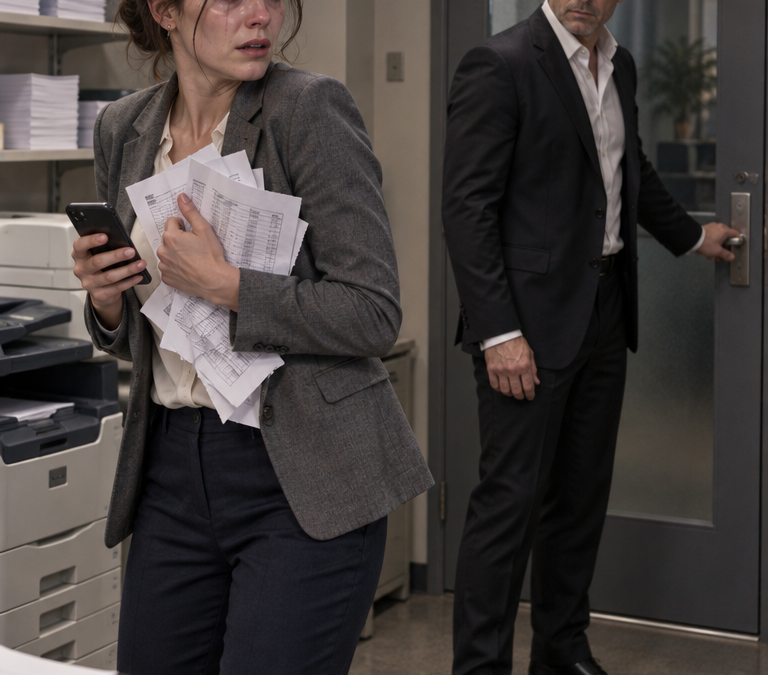
At 11:47 p.m., Aara Voss was crying alone in Bellavaro Tower’s copy room, clutching torn payment records, when Matteo Ror closed the door behind him. “No more hiding. Tell me who made you cry.” Then her phone buzzed. Someone knew she was there—and the floor cameras were already offline.
She was not supposed to be in Bellavaro Tower at midnight.
At 11:47 p.m., Aara Voss stepped out of the elevator on the fourteenth floor with a torn file pressed against her chest and the careful posture of a woman trying not to be seen.
She had spent three years perfecting that skill.
Bellavaro Holdings occupied six floors of glass, steel, smoked conference-room walls, and quiet money. On paper, the company managed property acquisitions, private investment portfolios, and international development projects. Its internal structure was complicated enough that most employees understood only the small section touching their own work.
Aara understood more than most people assumed.
She was thirty-one, average height, slender without looking fragile, with dark brown hair she usually pinned into a severe professional twist. Her wardrobe seemed designed to leave no memory behind: gray blazer, ivory or pale-blue blouse, navy or black slacks, sensible shoes.
She answered questions precisely.
She spoke only when necessary.
And in meetings, people regularly looked past her toward someone with a larger title.
For years, she had considered that useful.
The fourteenth floor was nearly empty at that hour. Administrative staff had left around six. Senior leadership used a different elevator bank and, after normal business hours, seemed to inhabit a different version of the company altogether.
The copy room sat at the end of the corridor beyond rows of dark workstations, a frosted-glass conference room, and a dying plant nobody seemed willing to throw away.
Aara pushed inside.
The room smelled of warm toner and paper.
A fluorescent fixture buzzed overhead.
She let the door close behind her, leaned against the wall beside the largest printer, and covered her mouth with one hand.
Her shoulders shook anyway.
She hated crying at work.
More accurately, she hated crying where another person might see it.
She had learned young that visible distress did not necessarily bring help. Sometimes it merely gave another person more information about where you could be hurt.
But that night had stripped away most of her defenses.
Three weeks earlier, she had found a $12,000 discrepancy in a quarterly routing report.
It was small by Bellavaro standards.
That was why it bothered her.
Large discrepancies attracted attention. Small ones slipped through because people assumed someone else had checked.
The payment had been rerouted through a vendor account that did not exactly match the approved vendor list.
Aara flagged it, entered the standard notation, and sent the report through the usual internal chain.
Four days later, the document returned to her desk.
Her notation was gone.
The vendor had been approved retroactively.
Attached to the back was a yellow sticky note in a handwriting she recognized instantly.
Vincent Carol.
Bellavaro’s chief accountant.
His handwriting was as controlled as the rest of him—narrow, angled, exact.
Sign the verification.
Aara read the sentence twice.
She did not sign it.
That was the first decision that changed the course of everything that followed.
She said nothing, either.
Instead, she began watching.
Quiet people often saw things precisely because no one adjusted themselves when quiet people entered a room.
She noticed Vincent leaving at strange hours.
She noticed security chief Gareth Sims had begun refusing routine surveillance-log requests unless his own team was copied.
She noticed Marcus Healey, one of Bellavaro’s senior attorneys, answering certain calls on a second phone he kept inside his jacket.
None of those details proved anything.
Together, they created pressure.
Aara began comparing dates.
She reread payment chains.
She looked at vendor approvals that had never interested her before.
And one Thursday afternoon, during the twelve minutes Vincent was away from his office after a meeting, she photographed a document lying half-covered beneath a ledger on his desk.
The decision was reckless.
She knew that before she did it.
She did it anyway.
The photograph gave her fragments, not certainty.
But the fragments suggested that money was being routed out of Bellavaro through a sequence of companies and accounts whose structure made no commercial sense.
She still could not see the entire pattern.
Then Vincent came to her workstation at 6:15 one evening.
Most of the floor had emptied.
He sat in the unused chair beside her desk and placed a manila envelope directly over her keyboard.
Nobody ever sat in that chair. Employees used it for bags, folders, or things they intended to collect later.
Vincent did not look at her.
“Open it after I leave.”
Then he stood and walked away.
Aara waited until the elevator doors closed behind him.
Inside the envelope was a photograph.
At first, it looked ordinary.
Then she recognized her own hand.
Her own pen.
Her own signature.
Two months earlier, during an unusually chaotic afternoon, someone had slid a document beneath her hand while she was on a call. She had assumed it was a routine vendor verification. Her workload frequently required her to acknowledge standard forms quickly, especially when they had already passed through departments she trusted.
The photograph showed what she had not noticed at the time.
The document was not routine.
It authorized a $2 million payment through a company she had never knowingly verified.
Her signature appeared at the bottom.
Aara sat at her desk for several minutes without moving.
The next morning, another note appeared.
This one was printed.
Four lines.
Sign the Friday report.
Trust no one above you.
If you talk, the photograph goes to Ror.
You are already guilty.
She folded the note and put it inside her bag.
She did not sign the Friday report.
Not yet.
Instead, she spent the next three days trying to understand what she had already been made part of.
That was why she returned to Bellavaro Tower at 11:47 on Friday night.
She told herself she only wanted to inspect the report before deciding what to do.
The truth was more frightening.
She had run out of safe choices.
She printed the quarterly verification record, vendor approval histories, and every payment authorization she could access without triggering a higher security clearance.
Twenty minutes earlier, footsteps had sounded in the hallway.
She had panicked and torn the first page in her hands before realizing the footsteps belonged to the cleaning crew.
Now she stood in the copy room with the damaged pages, trying to calculate what an employee with no powerful allies, incomplete evidence, and her own signature attached to a suspicious payment was supposed to do next.
The door clicked behind her.
She had not heard it open.
Only close.
Aara turned.
Matteo Ror stood with his back to the door.
He wore a black suit without a tie, the top button of his white shirt open. He was tall, broad-shouldered, dark-haired with silver beginning at the temples. His expression was not angry.
That made him harder to read.
Aara had seen him before, but never truly met him.
Once in an elevator for twenty-two seconds.
Twice during large presentations.
From a distance at quarterly reviews.
Matteo Ror was the founder and principal owner of Bellavaro Holdings, and almost everyone in the company behaved differently when he entered a room.
Not because he demanded theatrics.
Because he noticed things.
His eyes moved from Aara’s face to the papers in her hands.
Then back to her face.
“Voss.”
It was not a question.
She said nothing.
“Third year. Senior administrative routing. Southeast portfolio.”
Aara stared at him.
He continued.
“You’ve cried on this floor three times in the last eighteen months. Always in this room. Always after ten.”
Her embarrassment momentarily overtook her fear.
“You noticed that?”
“I notice things.”
Her throat tightened.
“I can explain.”
“I know.”
He remained by the door.
“That’s why I’m here.”
The printer hummed behind her.
“Those papers,” he said. “Are they from my files?”
“Yes.”
“Did you take them to use against me?”
“No.”
“Did someone ask you to?”
Aara hesitated.
One second.
Maybe less.
Matteo’s jaw tightened almost imperceptibly.
“That hesitation tells me more than your answer would.”
“It’s complicated.”
Her voice broke on the second word.
She hated that.
“It usually is.”
He reached behind himself.
Aara flinched.
The response came before thought.
Matteo stopped.
Something changed in his expression.
Not pity.
Recognition.
He moved more slowly and turned the lock on the door.
Aara stared at it.
“No one comes in,” he said. “No one interrupts. You tell me what you know. Then we decide what happens next.”
“You won’t believe me.”
“Try me.”
She looked at the papers.
“There’s a photograph.”
“Of what?”
“Me signing a document.”
“What document?”
“I didn’t know when I signed it. It was put under my hand while I was on a call. I thought it was routine.”
“And now?”
“Now it looks like I authorized money that shouldn’t have moved.”
“How much?”
“Two million.”
His expression did not change.
Aara swallowed.
“The photograph makes it look like I knew.”
“Who gave you the document?”
Her phone vibrated.
The sound was small.
In that room, it felt enormous.
Aara looked down.
Unknown number.
Three words.
Don’t say anything.
Her fingers went cold around the phone.
“Someone knows I’m here.”
Matteo’s eyes flicked toward the screen.
“Yes.”
She looked up.
“You knew?”
“I knew someone would react.”
“Are they watching the cameras?”
“The cameras on this floor went offline eleven minutes ago.”
He paused.
“That wasn’t me.”
The meaning took a moment to settle.
“You have access to the surveillance system.”
“Yes.”
“And you didn’t disable it.”
“No.”
“So whoever did—”
“Expected something to happen on these floors without a permanent record.”
Aara’s grip tightened around the phone.
For the first time that night, Matteo moved away from the door.
Not toward her.
Toward the printer.
“Start with names.”
She looked at him.
“Vincent Carol.”
No reaction.
“Marcus Healey.”
Still nothing.
“Gareth Sims.”
Matteo went completely still.
Aara noticed because she had spent three years studying people who did not think she was studying them.
“Sims,” he repeated.
“Your head of security.”
“I know who he is.”
His tone ended that line of explanation.
“How long?”
“The transfers I found go back at least eight months. There may be older ones.”
Matteo held out his hand.
“The pages.”
Every instinct in Aara told her to keep them.
Three weeks of operating alone had trained her to distrust anyone asking for what she possessed.
She thought about the photograph.
The notes.
The message on her phone.
Then she thought about the fact that she had nowhere left to take any of it.
She extended the pages.
Matteo took them without looking away from her.
Only after she released them did he lower his gaze.
He read quickly.
Not carelessly.
Quickly.
His eyes stopped on one line.
“Meridian.”
Aara leaned forward.
“What?”
“The Meridian account.”
“What is it?”
“A dormant Bellavaro subsidiary.”
He turned a page.
“It was kept clean for a legitimate acquisition.”
Another page.
“If Carol ran these transfers through Meridian, he didn’t choose the account randomly.”
“What acquisition?”
Matteo did not immediately answer.
Then he looked at her.
“Forty-seven million dollars. Eighteen months of work. Closing in nine days.”
Aara felt the shape of the situation change.
“If that account is flagged—”
“The entire transaction becomes vulnerable.”
She stared at the pages.
“This isn’t just about taking money.”
“No.”
“What are they doing?”
Matteo put the papers on top of the printer.
“They may be creating the appearance that Bellavaro is financially unstable before the acquisition closes.”
“Why?”
“So someone else can benefit when the deal fails.”
Aara thought about the photograph.
Her signature.
The report Vincent wanted signed.
“They needed someone to blame.”
“Yes.”
“Someone low enough that nobody would believe she controlled anything.”
Matteo looked at her.
“Someone invisible.”
The word landed harder than she expected.
She had built a career around invisibility because invisibility felt safe.
Now she could see how useful that quality had made her to people who needed a disposable signature.
“I have the photograph against me,” she said. “Even if you believe me, everyone else sees my name.”
Matteo nodded.
“I believe you.”
“That isn’t enough.”
“No.”
He removed a second phone from his pocket.
Older.
Plain.
He dialed.
“It’s me,” he said when someone answered. “I’m on fourteen. Primary surveillance is compromised. Floors twelve through sixteen. I need you inside through Clement Street.”
A pause.
“Ten minutes.”
Another pause.
“I’m not asking.”
He ended the call.
Aara stared at the device.
“What was that?”
“A secondary network.”
“Sims doesn’t control it?”
“He wasn’t supposed to know it existed.”
“Wasn’t?”
Matteo looked at her.
“The primary cameras were disabled using his administrator credentials.”
“Then he did it.”
“Possibly.”
“Possibly?”
“Sims has been at a charity dinner at the Hartwell Hotel since eight.”
Aara frowned.
“You’re sure?”
“Yes.”
“Then someone used his credentials.”
“Or he provided them.”
Her phone buzzed again.
Another unknown number.
Get out of that room now.
Use the northeast stairwell.
Level B2.
Someone will meet you.
Aara handed Matteo the phone without being asked.
He read the message.
“They want you away from me.”
“Why B2?”
“Freight access.”
The answer made her stomach tighten.
“They can still see us.”
“They know enough to know you’re here.”
“The cameras are offline.”
“Which means they have another source.”
Aara looked toward the frosted glass.
“A person.”
Matteo followed her gaze.
“Maybe.”
His phone rang.
He listened.
“How many?”
Another pause.
“Stay where you are.”
He disconnected.
Aara could read the answer before he spoke.
“Three men entered through the freight bay at 11:40.”
“Before the cameras went down.”
“Yes.”
“They were already inside when I arrived.”
“Yes.”
She stared at the message on her own phone.
Level B2.
Someone will meet you.
“They weren’t trying to help me leave.”
“No.”
Matteo’s voice contained no comfort.
“They weren’t.”
Aara looked down at the papers on the printer.
“The archive.”
Matteo’s gaze sharpened.
“What archive?”
“Your original records. Before Carol changed anything.”
He did not answer immediately.
“You have one.”
“Floor twenty-one.”
“Can you access it from here?”
“Not through the primary network.”
“Then through the secondary.”
He studied her.
“You’re asking me to pull original financial records while three unidentified men are moving through the building.”
“I’m asking you to preserve the only records that can prove what happened before someone reaches them.”
That reached him.
Matteo took out the secondary phone.
At that exact moment, the hallway outside went dark.
Not dim.
Dark.
The strip of light beneath the copy-room door disappeared.
The copy machine’s green standby indicator became the brightest thing in the room.
Neither of them moved.
A sound carried through the corridor.
Footsteps.
Slow.
Measured.
Aara heard them approaching.
Matteo reached out and closed his hand around her wrist.
Not painfully.
Precisely.
A silent instruction.
Stay still.
The footsteps stopped outside.
A male voice came through the door.
“Ror.”
Aara recognized it.
Her stomach dropped.
Gareth Sims.
He was not at the Hartwell Hotel anymore.
“We know you’re in there,” he said.
A pause.
“Both of you.”
Aara looked at Matteo.
His face remained unnervingly calm.
“Bring her out,” Gareth said. “We can finish this without making it worse.”
Matteo leaned closer to Aara.
His voice was barely audible.
“Third printer. Ceiling panel.”
She looked toward the industrial printer in the rear corner.
“Maintenance corridor,” he whispered. “It connects to the upper stairwell.”
Aara stared at him.
“You knew about that?”
“I designed the emergency routes.”
A keycard reader beeped outside.
The lock disengaged.
Matteo crossed the room and braced himself against the door as the handle turned.
“Go.”
Aara climbed onto the third printer.
The metal casing shifted slightly under her shoes.
She pushed at the ceiling tile.
It lifted.
Dust dropped across her sleeve.
“Matteo—”
“Go.”
Pressure increased against the door.
Aara pushed the tile aside, grabbed the aluminum support frame, and hauled herself upward.
Her blazer snagged and tore at the shoulder.
She pulled harder.
Finally, she managed to drag herself into the shallow maintenance space above the ceiling.
She looked down through the opening.
Matteo still held the door.
“Count to five,” he said.
“What?”
“Count.”
She did.
On three, he stepped away.
On four, the door swung open.
On five, Gareth entered.
Aara crawled.
The space above the office ceiling was dark, dusty, and barely high enough for her to move on hands and knees.
She forced herself toward the northeast corner, locating the maintenance panel by memory of the room beneath her.
Behind her came voices.
She refused to listen.
The panel finally appeared beneath her hand.
She released the latch.
Cool air entered.
A narrow service stairwell waited beyond.
Aara climbed through and went up.
Fifteen.
Sixteen.
Seventeen.
She kept counting floors.
Nineteen.
Twenty.
Twenty-one.
The access panel there was different.
Steel.
Keypad.
Authorized access only.
Aara leaned against the concrete wall.
Matteo had said biometric access.
But she had spent three years routing executive schedules, authorization documents, and temporary credential requests.
Twice, his personal assistant had asked her to enter temporary override codes when his normal credential had expired.
Aara remembered both.
The first would certainly be dead.
She entered the second.
The keypad blinked.
For one terrible second she thought it had failed.
Then the lock released.
The archive room was smaller than she expected.
Climate controlled.
Four server racks.
One workstation.
Isolated power.
Aara sat and typed MERIDIAN.
Forty-seven results.
The first dozen appeared legitimate.
Due-diligence documents.
Acquisition planning.
Environmental reviews.
Normal corporate records.
The thirteenth stopped her.
A payment authorization.
Fourteen months old.
$11.4 million.
She leaned closer.
The authorization signature was not Vincent Carol’s.
Not Gareth Sims’s.
Not Marcus Healey’s.
Aara knew that signature.
Every employee in her position did.
It was Matteo Ror’s.
She opened another file.
$6.2 million.
Same signature.
Another.
$3.8 million.
Same signature.
One after another.
Fourteen authorizations.
Matteo’s signature on all of them.
Aara sat very still.
The operation she thought she had discovered—a group of senior employees stealing from the owner—was not the full operation.
The money had been moved by the owner himself.
She remembered Matteo outside the copy room for four minutes before entering.
His secondary surveillance network.
His knowledge of the outage.
His knowledge of the building.
The escape route he had given her.
For the first time that night, she considered a possibility more disturbing than Vincent’s scheme.
What if Matteo had sent her to exactly the place he wanted her to reach?
She opened the acquisition file.
Target company: Veltran Partners.
Aara stopped breathing.
She knew the name.
Before Bellavaro, she had spent two years at a smaller financial-services firm controlled through Veltran’s corporate network.
And her direct supervisor there had been Daniel Crest.
Daniel Crest had spent the final four months of Aara’s employment steadily reducing her professional world until every assignment, review, opportunity, and conversation seemed to pass through him.
She had never filed a formal complaint.
Formal complaints required faith in the system receiving them.
At twenty-eight, she had not possessed that faith.
She simply left.
Bellavaro had felt safe partly because Crest’s name never appeared there.
Yet now Bellavaro was preparing to acquire his company.
Aara looked back at Matteo’s signatures.
Eighteen months of transfers.
Eighteen months of acquisition work.
Same timeline.
The archive door opened.
Aara turned.
Matteo stood there.
His suit remained intact.
He was breathing normally.
He looked at her.
Then at the screen.
“You found it.”
“You knew I would.”
“I hoped you would.”
She stood.
“You signed the transfers.”
“Yes.”
“You set up Carol, Sims, and Healey.”
His expression changed.
“No.”
“You let them believe they were stealing from you.”
“Yes.”
“You let them use my signature.”
“No.”
The answer came differently.
Sharper.
“I did not know they had pulled you into it.”
Aara stared at him.
“My secondary system flagged the altered verification three weeks ago,” he continued. “That was when I first saw your name.”
“What exactly were you doing?”
“Letting Carol, Sims, and Healey move money the way whoever hired them expected.”
“They work for Crest.”
“They work for an organization connected to him.”
“And you knew.”
“I knew they were not acting alone.”
“Then why allow it?”
“Because I needed them to lead me to the person directing them.”
Aara looked toward the acquisition file.
“Veltran.”
Matteo’s attention changed.
“You know the name.”
“I know Daniel Crest.”
“How?”
“I worked for one of his firms before Bellavaro.”
Silence.
The kind that rearranged the room.
Matteo watched her.
Aara did not give him every detail.
She did not need to.
“I left because of him.”
Matteo looked away once, toward the server rack, then back.
“Crest has been positioning himself for a hostile takeover for two years,” he said. “He believes he’s been weakening Bellavaro from inside.”
“But you knew.”
“For eighteen months.”
“The Meridian money?”
“Exactly where I wanted it.”
“You’ve been feeding him a false picture.”
“Yes.”
Aara looked at the signature again.
“So when he thinks Bellavaro collapses—”
“The money he positioned to absorb Bellavaro becomes evidence of how the takeover was constructed.”
She understood.
Crest had been building a trap.
Matteo had built a larger structure around it.
But there was one part Aara still could not accept.
“You listened outside the copy room for four minutes.”
Matteo said nothing.
“You didn’t come in immediately.”
“No.”
“That wasn’t hesitation.”
“No.”
“You were deciding whether I was useful.”
He met her eyes.
“Yes.”
The honesty hurt less than denial would have.
Aara nodded once.
Then Matteo spoke again.
“But that isn’t why I finally opened the door.”
She looked at him.
“I heard you crying.”
Aara almost laughed at the absurdity of that being offered as evidence of anything.
Matteo continued.
“Then you stopped.”
His voice had lost some of its polished neutrality.
“Not because you felt better. You stopped because you decided something. I wanted to know what.”
A metal door slammed somewhere below them in the service stairwell.
They both turned.
Footsteps began climbing.
Matteo pointed toward the workstation.
“Copy the archive.”
Aara looked at him.
“All of it?”
“Everything relevant.”
“Your signature is in those files.”
“I know.”
“Then why give me a copy?”
“Because in nine days Crest’s lawyers will argue those transfers prove Bellavaro committed internal fraud. The only thing that defeats the partial picture is the complete one.”
“You want me to present it.”
“You’re the only person in this situation who belongs to none of the principal sides.”
“That is a strange way to describe someone whose signature was used.”
“Which is exactly why your record has to be cleared first.”
Footsteps came closer.
Aara crossed to the rack, removed the drive Matteo indicated, inserted it into the workstation, and started the transfer.
Thirty percent.
Forty.
Fifty.
Sixty.
The access panel opened.
A man stepped into the archive.
Gray suit.
Medium height.
Controlled expression.
Aara knew him immediately.
Daniel Crest looked at her as though two years had been a long meeting break.
“Hello, Aara.”
The transfer reached seventy percent.
And stopped moving.
Aara did not look away.
Crest’s face had changed less than she expected.
In memory, he had seemed larger.
Power did that.
It changed scale.
Now she saw an ordinary-sized man in a carefully tailored suit whose strength had always depended on other people accepting the version of reality he presented.
“You look well,” he said.
Aara said nothing.
Crest glanced at Matteo.
“I expected you to be farther along.”
His gaze drifted toward the workstation.
“Archive drive?”
Neither answered.
Crest smiled.
“Aara, whatever Ror told you tonight, you understand he has used you.”
Still she said nothing.
“The files you are copying contain his signature on transfers that can be presented as serious financial misconduct. If you walk out carrying them, his opponents will call you a participant, not a witness.”
“You’ve used that word on me before.”
Crest paused.
“Complicit.”
His smile weakened.
“That was a long time ago.”
“Two years and four months.”
“People remember difficult situations differently.”
“Don’t.”
One word.
Crest stopped.
Aara watched him recalculate.
She had watched that expression before.
Years earlier it had frightened her.
Now it informed her.
He looked toward Matteo.
“How much did you tell her?”
“Enough for her to decide for herself.”
Crest laughed softly.
“You didn’t know her history.”
“No.”
That unsettled him more than if Matteo had claimed otherwise.
Aara could see the calculation.
Her presence was not part of either man’s original architecture.
Crest reached into his jacket.
Matteo moved immediately.
Two steps.
His hand closed around Crest’s wrist before the object emerged.
It was only a phone.
The two men held still.
“Careful,” Crest said. “You’re creating another problem.”
“Put the phone down.”
Crest placed it on a filing cabinet.
Matteo released him.
The workstation chimed.
Aara looked back.
100%.
She pulled the drive free.
Crest stared at it.
“Give it to me.”
“No.”
“You won’t make it out of the building with it.”
Aara held the drive at her side.
Crest continued.
“Walk away. Bellavaro’s acquisition fails. You leave clean. The photograph disappears. Your name never enters a regulatory filing. I can make sure you’re compensated.”
There it was.
The same structure he had used years earlier.
First create the conditions.
Then present himself as the reasonable man offering escape from them.
“No.”
Crest blinked.
Aara continued.
“The photograph is a real signature in a false context. The original surveillance files can show who placed the document in front of me. The archive preserves the unaltered routing record. The confidentiality amendment shows how my reporting channels were redirected.”
She held his gaze.
“I’ve had three weeks to think about your version.”
Crest no longer smiled.
Matteo stepped slightly forward.
“The acquisition closes in nine days,” he said. “Everything your contractors built around Meridian is now a record of their own activity.”
Crest looked at him.
“You’re assuming the board accepts your explanation.”
“I’m assuming evidence survives explanations.”
Crest turned back to Aara.
“Nine days.”
She understood what he meant.
Not surrender.
An appointment.
“Nine days,” she answered.
He picked up his phone.
Then he left.
For five seconds after the panel closed, Aara remained standing.
Then her knees weakened enough that she sat.
Matteo watched the door.
“You all right?”
“I have absolutely no idea.”
Something almost human crossed his face.
“We need to move.”
They took the maintenance route down, bypassing the fourteenth floor.
Sublevel one opened onto a utility corridor smelling of metal and rainwater.
A steel emergency door led into an alley.
Matteo listened for several seconds before pushing it open.
Cold night air struck Aara’s face.
It felt startlingly clean.
They moved toward Clement Street.
At the corner, a stocky man in his forties leaned against a wall with one hand pressed to his temple.
“Reyes,” Matteo said.
The man nodded.
Crest’s people had intercepted him earlier, but he remained on his feet and alert.
A dark sedan approached.
Reyes opened the rear door.
Aara stopped.
Matteo turned immediately.
“Where are we going?”
“My personal attorney.”
“Not Healey.”
“Definitely not Healey.”
“Does she know what’s happening?”
“She knows the acquisition structure. Not tonight’s full sequence.”
Aara looked at the car.
“My name gets cleared first.”
“Yes.”
“No. I need you to understand me. Before Meridian. Before Crest. Before your acquisition. My name.”
Matteo held her gaze.
“Your name is first.”
Only then did Aara enter the car.
She sat beside Matteo as the sedan pulled away.
Bellavaro Tower receded behind them.
She pressed one hand against the inside pocket containing the archive drive.
Matteo called his attorney.
Aara heard fragments.
Archive complete.
Crest present.
Voss first.
Documentation of coercion.
Original verification.
Acquisition sequence second.
She looked out the window.
Her phone buzzed.
Another unknown number.
Eight words.
Boardroom. Nine days. Don’t be late, Ms. Voss.
Aara read the message twice.
Then showed Matteo.
“Crest?”
“Yes.”
“He isn’t running.”
“No.”
Aara put the phone away.
He had changed the way he addressed her.
Not Aara.
Not the familiar tone he once used to reduce professional distance without permission.
Ms. Voss.
He had recalculated.
The attorney’s name was Sonia Ren.
She answered her door at 2:43 a.m. wearing reading glasses and an old cardigan, holding a mug of coffee she did not offer anyone because one glance at them apparently told her coffee was not the main problem.
Sonia was in her sixties, compact, silver-haired, with the stillness of someone who had spent decades listening while other people tried to control rooms.
She looked at Aara first.
Not Matteo.
“Come in.”
The simplicity of that welcome nearly undid her.
Sonia’s home office occupied a converted study with bookshelves, three monitors, file stacks, and a printer already running.
Aara inserted the drive.
“Walk me through it,” Sonia said.
Matteo took the other chair.
He did not speak for the next hour and forty minutes.
Aara started with herself.
The first discrepancy.
The deleted notation.
The confidentiality amendment.
The sealed envelope.
The photograph.
The Friday report.
Then the financial trail.
She showed Sonia how the reporting system had been closed around her.
How every discrepancy was redirected toward Vincent.
How the confidentiality language discouraged outside escalation.
How her signature had been collected on a routine-looking document.
Sonia wrote continuously.
“The photograph?” Sonia asked.
“Vincent had the physical copy I saw.”
“If a digital version exists, we preserve the device records.”
She wrote again.
“The original document?”
“Probably Vincent’s office.”
“We’ll seek an emergency preservation order when the court window opens.”
Then Aara explained Meridian.
Matteo’s transfers.
The apparent misconduct.
The counter-operation.
Veltran.
Daniel Crest.
When Aara finished, Sonia removed her glasses.
“The first filing identifies you as a material witness and as the subject of documented coercion. Your status comes before the acquisition dispute.”
Aara looked at Matteo.
He nodded once.
“The actions by Carol, Sims, and Healey are referred separately,” Sonia continued. “Their conduct doesn’t disappear because it occurred inside a larger corporate strategy.”
“Good.”
Sonia put her glasses back on.
“I’ll start drafting now. Emergency submission opens at six.”
It was after four before Aara finally lay down in Sonia’s guest room.
She did not undress.
She stared at the ceiling and listened to typing through the wall.
Sometime near dawn, she slept.
At 7:15, Sonia knocked.
“Filed at 6:07. Receipt confirmed. Investigator wants your statement at eleven.”
Aara sat up.
Her hair had fallen completely from its pins.
Her blazer was torn.
“I need clothes.”
“There’s a bag outside.”
Reyes had somehow obtained a blouse and blazer close enough to her size.
Both still carried store tags.
Aara dressed, drank coffee in Sonia’s kitchen, and studied the drive lying on the counter.
At 10:45, they arrived at a downtown financial oversight office.
The investigator was Patricia Osawa.
Mid-forties.
Precise.
Professional.
She placed a recorder between them.
Then she asked Aara to begin.
Aara gave her everything.
The early discrepancy.
The notes.
The photograph.
The pressure to sign.
The midnight return.
The camera failure.
The archive.
Crest.
She did not dramatize.
She sequenced.
Dates.
Documents.
People.
Decisions.
When Aara finished, Patricia switched off the recorder.
“The filing from Veltran’s legal team arrived at 9:17 this morning.”
Aara had expected it.
“What does it say?”
“They characterize the Meridian transfers as evidence of internal asset misuse by Bellavaro.”
“Do they mention me?”
“Yes. They identify you as the employee whose verification appears on one of the transactions.”
Aara’s jaw tightened.
Patricia continued.
“Based on the archive records and the coercion documentation, our preliminary assessment is that Veltran’s filing presents an incomplete picture.”
“But it still has to be reviewed.”
“Correct.”
“How long?”
“Several days.”
“Nine?”
Patricia nodded.
“We should know before closing.”
Then she looked at another page.
“The employment component is separate. You can pursue it independently.”
“I am.”
Patricia seemed unsurprised.
Aara leaned forward.
“One more thing.”
“Yes?”
“The record needs to show I flagged the discrepancy before the photograph. Before the threats. I noticed the problem and reported it.”
“It’s documented.”
“I know.”
Aara held her gaze.
“I want it identified as something I did. Not something that happened around me.”
Patricia considered that.
Then she wrote on her pad.
“Noted.”
The next seven days were less dramatic than the night that began them.
They were harder in a different way.
Statements.
Document reviews.
Calls.
Waiting.
Aara gave two additional recorded interviews.
She reviewed four evidence packages prepared by Sonia’s team.
She identified three more irregularities in Bellavaro’s archive.
On the third day, Gareth Sims was taken into custody in connection with the internal security breach and related conduct.
Aara read the legal update twice.
She felt no rush of triumph.
Only the sensation of weight moving from one place to another.
Vincent Carol retained counsel on the fourth day.
The photograph of Aara signing the verification entered the discovery record.
Placed beside the original surveillance timeline, pre-alteration documents, and coercive reporting changes, it looked entirely different from the isolated image Vincent had used to frighten her.
Context had changed its meaning.
On the fifth day, Marcus Healey cooperated.
That surprised everyone.
Sonia called Aara herself.
“He made the calculation before anyone else did.”
Healey turned over documentation linking payments from Daniel Crest’s network directly to Carol, Sims, and himself.
One document carried a countersignature from Crest’s organization.
A direct connection.
Not inference.
Not theory.
Paper.
Aara was staying in a hotel by then.
Her apartment building, they had discovered, was managed through a company connected indirectly to Veltran.
That fact did not prove anyone had been watching her there.
She did not need proof to know she would sleep better elsewhere.
On the morning of the boardroom session, Aara dressed in a blazer she had purchased herself.
That mattered more than she expected.
The hearing took place on the forty-fourth floor of a downtown financial building chosen as neutral ground.
Representatives from Bellavaro.
Representatives from Veltran.
Regulatory monitor.
Attorneys.
Investment-bank representatives.
Sonia.
Matteo.
And Aara Voss.
She arrived at 8:45.
Daniel Crest entered at 8:57.
Gray suit.
Two attorneys.
Calm expression.
He looked at her when he sat.
Aara looked back.
She did not break eye contact first.
At nine, the monitor opened the proceeding.
Veltran’s lead attorney spoke for eleven minutes.
He presented the Meridian transfers as evidence that Bellavaro was financially unstable and internally compromised.
He referred to Aara’s signed verification.
He used the word fraud.
When he finished, Sonia waited two seconds.
Then she said, “Bellavaro will present its factual record through Ms. Aara Voss.”
Aara stood.
Seven days earlier, she had been crying beside a copy machine because she thought no one would believe her.
Now three teams of attorneys were waiting for her to speak.
She opened her folder.
“Six weeks ago, I flagged a discrepancy in Bellavaro Holdings’ quarterly routing summary.”
She placed the first page on the table.
“I flagged it through the proper internal channel. My notation was removed by the person controlling that channel.”
Second page.
“That is where the sequence begins.”
She did not speak dramatically.
She did not have to.
She spent fifty-three minutes presenting documents in order.
The original discrepancy.
The deleted notation.
The modified confidentiality procedure.
The photograph.
The original surveillance timeline.
The Meridian account.
Matteo’s fourteen authorizations and their full context.
The Veltran ownership chain.
The payments to Carol, Sims, and Healey.
Healey’s cooperation documents.
And finally, the countersigned communication from Crest’s organization.
Each page changed the meaning of the one before it.
The photograph that once seemed to prove Aara’s guilt now showed how deliberately she had been positioned.
The Meridian transfers that appeared to prove Bellavaro’s instability now revealed the financial architecture of Matteo’s counter-operation.
The contractors who seemed to be independent insiders now connected directly to Crest’s network.
When Aara finished, she sat.
The regulatory monitor made a note.
Across the table, Crest’s attorney leaned toward him.
They whispered briefly.
Crest remained composed.
He would never collapse publicly.
Aara understood that about him better than anyone in the room.
His attorney responded for eight minutes.
The argument was competent.
Some points were technically strong.
But it was now a response to Aara’s record rather than an explanation of the record.
That difference mattered.
During the first recess, Matteo sat beside Aara.
“Healey’s document,” he said quietly.
“The countersignature?”
“Yes. That’s the piece I never had.”
Aara nodded.
“Of course Healey kept it.”
“Why?”
“He’s an attorney.”
Matteo almost smiled.
“More specifically?”
“People keep records when records are the only leverage they have.”
Matteo looked at her.
“You’re describing yourself.”
“I’m describing everyone who has ever had information instead of authority.”
He was quiet.
Then he said, “Your original flag is in the monitor’s summary.”
Aara looked at him.
“The one you insisted they identify as your action.”
“Yes.”
“It’s there.”
The fact affected her more than she expected.
At 1:15 p.m., the monitor issued a preliminary finding.
Not final.
But enough.
Veltran’s submission did not establish sufficient grounds to delay the acquisition.
Evidence that Bellavaro records had been manipulated and an employee had been pressured to verify disputed transactions substantially weakened Veltran’s position.
The acquisition could proceed while the written determination was completed.
Veltran’s attorney entered an objection.
The monitor recorded it.
Crest looked toward his legal team.
Then he looked at Aara.
For two years and four months, she had imagined what vindication might feel like.
She expected satisfaction.
Instead, she felt something quieter.
A door closing.
From the inside.
By her own hand.
She looked away first this time because she chose to.
The session ended at two.
Sonia told her the employment matter would proceed separately.
“You’ll need to appear again.”
“I know.”
“The documentation is strong.”
Aara nodded.
“Are you all right?”
“I will be.”
That was enough.
As the room emptied, Matteo approached.
“The acquisition closes on schedule.”
“I heard.”
“Bellavaro’s position is clean enough to proceed.”
“I heard that too.”
He looked at her.
“What do you need?”
The question surprised her.
Not what happens next.
Not what should we file.
Not what does the company need.
What do you need?
“A few days.”
“All right.”
“No hearings. No statements. No document packages.”
“All right.”
“And then I want to talk about what comes next.”
Matteo nodded.
“There’s a position on the executive floor.”
Aara stared at him.
He continued.
“Compliance strategy. It’s been open six months.”
“You’re offering me a job.”
“I’m telling you the position exists.”
A small smile almost escaped her.
“What I do with that information is my decision?”
“Yes.”
“I’ll think about it.”
They rode the elevator down together.
Forty-four floors.
Aara watched the numbers descend.
The last time she had watched an elevator display late at night, she had been holding torn paper with shaking hands.
The lobby doors opened.
Afternoon sunlight filled the glass entrance.
Aara walked outside.
Cold air moved across her face.
Reyes waited at the curb.
Aara stopped.
“The copy room.”
Matteo looked at her.
“I want to go back eventually.”
“Why?”
“Not today. Before I decide anything about Bellavaro.”
She looked up at the tower.
“I want to stand in that room once when it’s just a room.”
Matteo considered that.
“It will be.”
For the first time, he looked less like the owner of Bellavaro Holdings and more like a tired man who had spent a week discovering the cost of a plan he once believed he controlled.
Aara shifted her bag onto her shoulder.
“Take care of Reyes.”
“He’s had worse.”
“Still.”
That almost-smile appeared on Matteo’s face.
“Still.”
She started walking.
Not toward the car.
Just down the sidewalk.
After three blocks, she stopped at a corner.
Traffic moved past.
A dog strained gently at its leash.
A food cart sent steam into the cold afternoon.
Someone laughed across the street.
The city had continued during everything.
Aara thought about the copy room.
The fluorescent light.
The printer.
The torn pages.
The moment she stopped crying.
Matteo had been right about one thing.
She had stopped because she had decided something.
At the time she had not known what.
Now she did.
For years, she had confused invisibility with safety.
Then other people had treated that invisibility as permission.
They had assumed the woman who routed the paperwork did not understand the system.
They had assumed the employee no one remembered would be easy to blame.
They had assumed silence meant absence.
They had been wrong.
Aara had noticed the first number that did not match.
She had preserved the contradiction.
She had remembered the sequence.
And when the room finally asked what happened, she had been the person who knew.
She adjusted the strap of her bag.
The archive drive rested inside the inner pocket, no longer a secret she carried alone.
Then Aara stepped off the corner and kept walking.
For the first time in years, she did not feel like she was trying to disappear inside the city.
She felt like she was arriving.