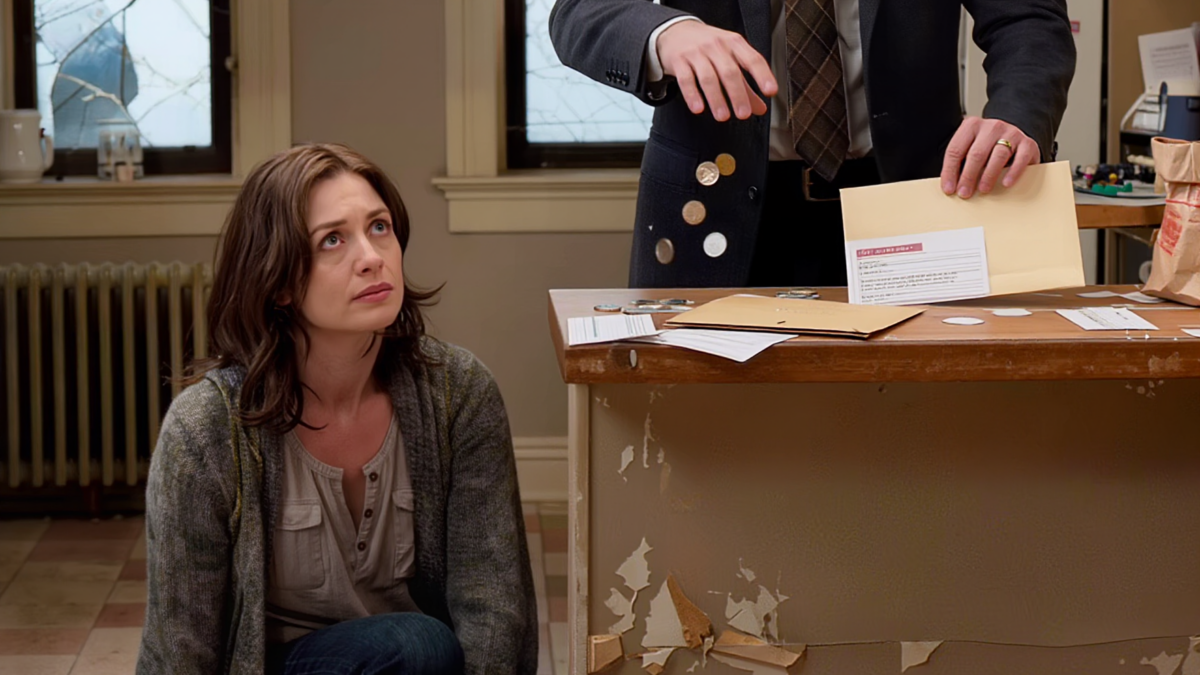
After Derek scattered our last quarters across the kitchen floor, he dropped divorce papers onto the overdue electric bill and told me I had twenty-four hours to leave. I was still kneeling beside the coins when he mentioned changing the locks—unaware that certified letters bearing my maiden name had already been refused at our address.
The heating vent rattled twice, gave a tired metallic cough, and stopped.
Sarah Sterling waited for it to start again.
It did not.
The silence that followed seemed colder than the wind pressing through the narrow crack in the kitchen window. Outside, Chicago had dropped into a hard November freeze. Frost feathered the edges of the glass, and every few seconds a draft slipped through the gap and touched Sarah’s face.
She pulled her cardigan tighter around herself and looked back at the kitchen counter.
Four dollars and eighty-seven cents.
She counted it again.
Three quarters. Eleven dimes. A handful of nickels. Far too many pennies.
The electric bill beside the coins carried a bright red FINAL NOTICE across the top. She had already moved the due date once. The power company had been patient until patience became policy.
Sarah stared at the refrigerator.
There was half a carton of milk, mustard, three eggs, and enough bread for maybe two sandwiches.
The heat had failed again.
Her interview at the diner on Fifth was tomorrow morning.
She had spent most of the day applying for jobs from a library computer because their home internet service was also a week behind.
The irony was not lost on her. Until two months earlier, she had worked at that same library.
Then the branch had closed.
Sarah had gone from helping people find books and fill out résumés to borrowing a computer so she could submit résumés of her own.
The front door opened hard enough to shake the frame.
Derek stepped inside carrying a leather briefcase and a gust of freezing hallway air.
“God, it’s cold in here.”
He shut the door and kicked snow from his shoes without looking at her.
Sarah smelled office coffee, winter air, and a cologne that was too expensive for their budget.
She knew because she balanced every dollar they spent.
“Pilot light went out again,” she said. “I tried relighting it. It won’t stay on.”
Derek dropped his keys onto the counter.
“Did you call maintenance?”
“They said tomorrow.”
He crossed to the thermostat.
“Why is this set at sixty?”
“Because the heating bill—”
“Sarah.”
She stopped.
Derek hated explanations when they involved money, which was strange considering money was usually the reason he was angry.
He opened the refrigerator.
The interior light illuminated three mostly empty shelves.
He stared for a moment, then shut the door harder than necessary.
“What are we supposed to eat?”
“I was going to get groceries after I figure out the electric payment.”
He finally noticed the coins.
His eyes moved from the small pile to Sarah.
“There’s me depositing a paycheck every two weeks,” he said, “and there’s you somehow turning it into this.”
Sarah felt the familiar heat rise into her face.
“I was laid off.”
“You keep saying that.”
“Because it happened.”
“You’ve had two months.”
“I’ve applied everywhere.”
Derek laughed once without humor.
“Everywhere?”
“I applied to twenty places this week.”
“What places?”
“Reception jobs. A bookstore. The grocery store. A medical office. I have an interview tomorrow at the diner on Fifth.”
“A diner?”
His mouth twisted.
“My wife waiting tables.”
Sarah stared at him.
“Work is work.”
“Maybe to you.”
He loosened his tie and walked past her.
“I am trying to build a career at Oak Haven. Do you know how hard I work to be taken seriously there? I’m trying to get in rooms with vice presidents, and you’re talking about carrying plates.”
“That would still help pay the bills.”
He looked again at the coins.
Then, almost casually, he extended one finger.
Sarah understood what he was doing a fraction of a second too late.
He flicked the top of the largest stack.
Quarters scattered across the counter and dropped to the floor.
Metal struck linoleum in sharp little bursts.
One rolled beneath the table.
Sarah reacted without thinking.
She crouched and reached for it.
Another quarter spun near the refrigerator.
She grabbed that one too.
“Look at you.”
She stopped.
Derek stood above her.
Something in his face had changed during the past year.
It was not that he had become angry.
Derek had always been ambitious and impatient.
What had changed was the contempt.
“Crawling around for change,” he said. “It’s pathetic.”
Sarah closed her fingers around a quarter.
For six years she had told herself every hard season was temporary.
When Derek had been finishing his MBA, she worked double shifts at a call center because his internship paid almost nothing.
When tuition costs rose, Sarah paused the art degree she had been slowly completing at night.
When their savings disappeared, she said they were investing in their future.
When Derek needed a professional wardrobe, she used a credit card she had spent two years paying down.
When he needed a better briefcase for client meetings, Sarah sold the gold locket her grandmother had left her and surprised him with the leather one now sitting beside the refrigerator.
She had not resented those decisions.
Not then.
She had believed they belonged to both of them.
Sarah stood.
“I’m crawling because every quarter matters.”
Derek rolled his eyes.
“And every quarter matters because I’m trying to keep us afloat while you spend three hundred dollars at places like the Sapphire Lounge.”
His expression stopped moving.
Sarah had seen the charge while balancing their credit-card statement.
Three hundred and twelve dollars.
The description had read CLIENT DINING.
The restaurant website showed velvet booths, cocktails that cost more than Sarah’s weekly grocery budget, and a dress code that did not resemble any client dinner Derek had ever described.
“You went through my statement?”
“Our statement.”
“You’ve been checking up on me?”
“I pay the bills.”
Derek’s jaw tightened.
Then something unexpected happened.
He became calm.
“All right.”
He opened the leather briefcase.
Sarah watched him remove a thick manila envelope.
“You won’t have to worry about the bills much longer.”
He let the envelope drop onto the counter.
It landed directly on top of the electric notice.
Sarah looked at the first visible page.
PETITION FOR DISSOLUTION OF MARRIAGE.
For several seconds, she did not understand the words.
“Derek.”
“I’m done.”
She looked from the papers to him.
“With what?”
“This.”
He motioned around the apartment.
“The struggle. The constant problems. The cheap food. The broken heat. The overdue bills.”
His eyes settled on her.
“And you.”
Sarah’s throat tightened.
“We’re married.”
“Technically.”
“We made promises.”
“Sarah.”
His tone suggested that she was embarrassing herself.
“For richer or poorer,” she said.
Derek gave a small smile.
“We’ve done enough poorer.”
“We can get through this.”
“I can.”
The sentence landed strangely.
Sarah blinked.
“What?”
Derek adjusted his cuff.
“I got the promotion.”
For one second, her brain refused to make sense of the statement.
“What promotion?”
“Junior vice president of operations.”
Sarah stared at him.
“When?”
“Last week.”
The room suddenly seemed very quiet.
“You got it last week?”
“Yes.”
“And you didn’t tell me?”
“I’m telling you now.”
“How much?”
He hesitated only because he enjoyed the question.
“Eighty-five base. Bonuses on top.”
Sarah looked at the coins still scattered near her shoes.
“You knew?”
“Knew what?”
“That we were sitting here deciding whether we could afford milk. You knew you had a raise coming.”
“I knew I had a promotion.”
“And you said nothing.”
Derek stepped closer.
“Because I didn’t want you thinking you were entitled to my new salary.”
Sarah felt something inside her go still.
Not numb.
Clear.
“Your salary.”
“Yes.”
“The career I helped you build.”
“There it is.”
“What?”
“That attitude. As if anything I accomplish belongs to you.”
Sarah looked at the briefcase.
Derek noticed.
His mouth tightened.
“That was a gift.”
“I know what it was.”
“I sold Grandma’s locket to buy it.”
“And I didn’t ask you to.”
That sentence hurt more than she expected.
Derek continued.
“My life is changing. I’m going to be around executives. Investors. People who expect a certain level.”
“A certain level of what?”
He looked at her worn cardigan.
He did not need to answer.
Then Sarah thought about the Sapphire Lounge.
The late-night messages.
A name she had tried not to think about.
“Jessica?”
Derek did not deny it.
His silence was enough.
Jessica worked in marketing at Oak Haven.
She was younger than Sarah, polished, confident, always dressed as if somebody might photograph her. At the company Christmas party, Sarah had watched Jessica laugh with one hand resting lightly on Derek’s sleeve.
Derek had called Sarah insecure when she mentioned it later.
Now he picked up his car keys.
“You have twenty-four hours.”
Sarah thought she had misheard him.
“What?”
“I’m having the locks changed tomorrow afternoon.”
“You can’t do that.”
“The lease is in my name now.”
“Since when?”
“I spoke to the landlord.”
Sarah took a step back.
“You changed the lease?”
“I handled it.”
“Where am I supposed to go?”
Derek glanced at the clock.
“That’s not my problem.”
“I have less than five dollars.”
“Go to a shelter.”
The words were so casual that Sarah initially thought she had imagined them.
“Derek.”
“Call a friend.”
“You know I barely talk to anyone anymore.”
“Then call family.”
He stopped.
Sarah’s parents were dead.
Both had passed within three years of each other after long illnesses that had consumed most of Sarah’s savings.
Derek knew that better than anyone.
“Oh,” he said. “Right.”
Sarah stared at him.
He picked up his briefcase.
“You’re resourceful. Figure it out.”
He left.
The door closed behind him.
Sarah remained in the kitchen beside the scattered coins.
After a while, she bent down and collected every one.
The next twenty-four hours passed in pieces.
She packed clothes into two old suitcases.
She wrapped her sketchbooks in a grocery bag so snow would not damage them.
She filled one heavy-duty trash bag with sweaters, shoes, and toiletries that would not fit anywhere else.
Derek had marked the television, furniture, coffee maker, and kitchen appliances as his.
Sarah did not argue.
By late afternoon, her belongings looked painfully small.
Six years of marriage had been reduced to three containers lined against the wall.
She was carrying the second suitcase down four flights of stairs when she heard a car pull up outside.
Derek’s car.
Jessica sat in the passenger seat wearing a white faux-fur coat and oversized sunglasses.
Derek lowered the window.
“Keys?”
Sarah approached.
He extended his hand.
She dropped the apartment keys into his palm.
“Did you clean?”
She looked at him.
“What?”
“The place. Did you clean before you left?”
“I swept.”
“Good.”
Jessica leaned across the center console.
“Good luck, Sarah.”
Her tone was light and bright.
Like they were parting after brunch.
Derek rolled the window up.
The tires sprayed gray slush along the curb as he drove away.
Sarah stood there for several minutes.
Then she began walking.
She did not have enough money for a hotel.
She was too ashamed to call the few people she still knew after years of declining invitations because Derek always said money was tight or he had work events.
By the time she reached Eighth Street, she could barely feel her fingers through her gloves.
A fluorescent sign glowed ahead.
WASH & DRY — 24 HOURS.
Sarah entered.
Warm air carrying the smell of detergent and dryer sheets wrapped around her.
An older man behind the counter looked at the suitcases, then at Sarah.
His name tag read HENDERSON.
Sarah began preparing an explanation.
He stopped her.
“You buying anything?”
She found enough change for one small wash cycle.
“Yes.”
He nodded toward orange plastic chairs near the back.
“You can sit there.”
Sarah swallowed.
“Thank you.”
“Don’t block the aisle.”
It was the gentlest thing anyone had said to her all day.
Around three in the morning, Sarah was awake watching clothes turn behind a dryer window when her phone vibrated.
Unknown number.
She almost ignored it.
Collection agencies had been calling for weeks.
Something made her answer.
“Hello?”
“May I speak with Sarah Elizabeth Hayes?”
Sarah frowned.
Nobody called her Hayes anymore.
“This is Sarah Sterling.”
“Formerly Sarah Hayes?”
“Yes.”
“My name is Arthur Pembbrook. I am a senior partner with Pembbrook Stone and Associates.”
The accent was British.
The voice was formal.
Sarah closed her eyes.
“If this is about a debt—”
“It is not.”
“Then I’m sorry, but it’s three in the morning.”
“I am aware.”
“I’m in a laundromat.”
There was a pause.
“Mrs. Sterling, my firm has been attempting to locate you for three weeks.”
Sarah looked around.
“To locate me?”
“We sent certified correspondence to your registered address.”
“No one sent me anything.”
“That is the problem.”
Arthur shuffled papers on his end.
“Every letter was returned as refused.”
Sarah sat straighter.
“Refused by whom?”
“We were hoping you could tell us.”
Derek always collected the mail.
Sarah suddenly remembered a morning two weeks earlier when she had seen a thick envelope beneath his briefcase.
He had moved it before leaving.
At the time, she had assumed it belonged to him.
“Why were you contacting me?”
Arthur’s tone changed.
“Do you recognize the name Silas Hawthorne?”
The name floated at the edge of memory.
“My mother mentioned him once. An uncle or cousin.”
“Her uncle.”
Sarah rubbed her eyes.
“She said he lived overseas.”
“He did.”
“She also said he hated the family.”
Arthur gave a quiet sound that might have been agreement.
“Mr. Hawthorne was a complicated man.”
“What does this have to do with me?”
“He died last month in Zurich.”
Sarah waited.
“I’m sorry.”
“He had no children. His siblings are deceased. During the last decade of his life, he spent considerable effort determining how his estate should be distributed.”
Sarah looked at her suitcases.
“Did he leave me something?”
“Yes.”
“A few thousand?”
Arthur was silent.
Sarah almost laughed.
“Honestly, even two thousand would change my life right now.”
“Mrs. Sterling.”
“Yes?”
“I need you to listen carefully.”
She did.
“Silas Hawthorne was the majority shareholder of Hawthorne Blackwood Real Estate Group and the controlling beneficiary of several related holdings.”
Sarah said nothing.
Arthur continued.
“His estate includes major commercial property in New York and London, resort interests, land holdings in Montana, and substantial liquid assets.”
“I don’t understand.”
“You are the sole beneficiary.”
The dryer turned behind her.
A zipper tapped rhythmically against metal.
“What does that mean?”
“It means that after required deductions, charitable distributions, fees, and taxes, the trust created for your benefit is valued at approximately one-point-three billion U.S. dollars.”
Sarah dropped the phone.
It struck the floor and came apart.
Mr. Henderson lowered his newspaper.
“You all right?”
Sarah stared at the pieces.
Then she dropped to her knees, put the battery back in, and pressed the power button with shaking fingers.
When she called the number again, Arthur answered immediately.
“I’m still here.”
“This is a scam.”
“I understand why you believe that.”
“Derek put you up to this.”
“I do not know Derek.”
“My husband.”
“The husband currently petitioning to dissolve your marriage?”
Sarah stopped.
“How do you know that?”
“Public filings.”
The dryer kept turning.
Arthur said, “I am currently in Chicago.”
Sarah looked toward the front windows.
“I can come to you.”
“You expect me to believe a billion-dollar attorney is going to drive to a laundromat?”
“Yes.”
“Why?”
“Because I have spent three weeks looking for you, and I would prefer not to lose you again.”
Twenty-two minutes later, a black Bentley stopped outside.
Mr. Henderson stood from his chair.
A driver stepped out first.
Then an older man with silver hair and a tailored dark coat entered carrying a leather case.
He walked directly toward Sarah.
“Mrs. Sterling?”
She stood.
“Arthur Pembbrook?”
He offered a business card made from heavy cream stock.
The firm name matched the information Sarah found online.
So did his photograph.
Arthur opened his case and showed her certified probate documents, official correspondence, identity verifications, and copies of letters that had been returned from her apartment.
Sarah touched one envelope.
REFUSED.
The handwriting beside the notation was not Derek’s, but the return date matched a week when Derek had been working from home.
“You believe my husband intercepted these?”
Arthur chose his words carefully.
“I believe you did not receive them.”
Sarah sat down.
For the first time since the phone call, the scale of what had happened began to feel real.
Arthur looked at the trash bag near her shoes.
“We should get you somewhere warmer.”
“I don’t have anywhere.”
“You do now.”
He had booked a hotel suite downtown while driving.
When Sarah lifted the trash bag, Arthur reached for it.
“Allow me.”
He looked at the plastic.
“Or perhaps we leave this behind.”
Sarah pulled it back.
“No.”
He raised an eyebrow.
“I want to keep it.”
“The bag?”
“I want to remember.”
Arthur looked at her for a moment.
Then he smiled.
“Fair enough.”
As they entered the Bentley, Sarah’s phone buzzed.
Derek.
FOUND YOUR OLD ART SUPPLIES. THREW THEM OUT. DON’T COME BACK FOR THEM.
Sarah read the message twice.
Then she typed:
THANKS FOR LETTING ME KNOW. ENJOY THE APARTMENT.
She turned the phone off.
The next several hours were a blur of signatures, verification calls, banking instructions, and explanations that sounded like they belonged to somebody else.
Arthur never rushed her.
By morning, the essential transfer structure had been confirmed.
The inheritance was real.
Silas Hawthorne had created a protected trust.
Sarah was its sole beneficiary and trustee.
More importantly for the divorce, the structure excluded spouses from any beneficial claim.
“Derek cannot touch it?” Sarah asked.
“Not the trust assets.”
Sarah sat back.
For the first time in two days, she exhaled fully.
Then Arthur placed another document in front of her.
“There is something else.”
Sarah read the property schedule.
The name OAK HAVEN LOGISTICS appeared beside a commercial building in downtown Chicago.
She looked at Arthur.
“That’s Derek’s company.”
“I know.”
Sarah read the page again.
The building belonged to Blackwood Group.
Blackwood Group now belonged to the trust she controlled.
“They’re my tenants.”
“Yes.”
“And Derek works there.”
“Yes.”
Arthur turned one more page.
“The lease comes up for renewal next month.”
Sarah stared at him.
That evening, Oak Haven hosted a strategic partnership gala at the Grand Illusions Ballroom.
Derek had been preparing for it for weeks.
His promotion placed him near the center of the presentation.
According to Arthur, the company was also desperate to negotiate more office space with Blackwood.
Sarah stood by the window of her hotel suite.
The city glittered beneath her.
Twenty-four hours earlier, she had been gathering quarters from a dirty floor.
Now one of Derek’s career-defining business negotiations depended on a signature she controlled.
Arthur watched her carefully.
“What do you want to do?”
Sarah thought about the apartment.
The divorce papers.
Jessica’s white coat.
Derek asking whether she had swept before leaving.
“I want to attend.”
The ballroom was bright with chandeliers when Sarah arrived.
She wore a tailored dark coat over an ivory blouse and fitted black trousers.
Her hair had been cut into a clean shoulder-length bob.
The difference was not that she suddenly looked like another person.
It was that somebody had finally given her clothes that fit properly, enough rest, and a room warm enough that she was no longer hunched against the cold.
Arthur walked beside her.
The crowd shifted when they entered.
Oak Haven’s CEO, Roger Caldwell, moved toward them immediately.
Sarah saw Derek near the bar.
Jessica stood beside him in a red dress.
Derek looked in Sarah’s direction without recognizing her.
Then Sarah removed her sunglasses.
The glass in Derek’s hand slipped.
It struck the floor and broke.
Jessica jumped backward.
“What is wrong with you?”
Derek did not answer.
“Sarah?”
Roger Caldwell turned.
Derek stepped forward quickly.
“What are you doing here?”
He lowered his voice.
“You cannot just show up at my work.”
Sarah looked at him.
“Hello, Derek.”
“If this is about the divorce, this is not the place.”
Jessica stared at Sarah.
Then recognition reached her.
“You’re the ex-wife.”
Sarah looked at Arthur.
Arthur gave Roger Caldwell his card.
“Mr. Caldwell, perhaps introductions would help.”
Caldwell read the card.
Arthur continued.
“My client is Sarah Elizabeth Hawthorne Sterling, sole beneficiary and trustee of the Hawthorne estate.”
Caldwell’s expression changed.
Arthur gestured lightly toward the room.
“Which controls Blackwood Group.”
Caldwell looked at Sarah.
Then upward.
Then back at her.
“You own our building.”
Sarah nodded.
“And the parking structure.”
Derek stepped closer.
“Wait.”
His entire voice changed.
“Sarah, you knew?”
“No.”
“When?”
“After you told me to leave.”
He stared at her.
Jessica looked from Derek to Sarah.
“Is this real?”
Caldwell answered for her.
“Yes.”
Derek reached for Sarah’s arm.
Arthur’s security specialist simply stepped between them and raised a hand.
Derek stopped.
“Sarah, come on. We were angry.”
“You were not angry.”
“What?”
“You were organized.”
She thought of the changed lease.
The divorce papers prepared in advance.
The refused letters.
“You had already planned it.”
Derek glanced at the executives around them.
“Can we talk privately?”
“No.”
His eyes narrowed.
Then he remembered who was listening.
His expression softened again.
“Baby.”
Sarah almost laughed.
The word sounded absurd.
Twenty-four hours earlier, she had been an anchor.
Now she was “baby.”
Caldwell did not miss the change.
Neither did the board members standing nearby.
Sarah looked at the CEO.
“I understand Oak Haven wants to discuss its lease.”
“Yes.”
“Then perhaps we should.”
Caldwell nodded quickly.
“Of course.”
Derek stepped toward him.
“Roger, I can explain.”
Caldwell did not look at Derek.
That was the first public sign that the room had changed.
Sarah did not ask Caldwell to fire Derek.
She did not need to.
The company’s leadership had just learned that one of their new vice presidents had created a scene with the owner of the building while his romantic partner insulted her.
By the time Sarah left, Derek had been removed from the evening’s presentation pending an internal discussion.
The next morning, Oak Haven terminated his employment.
The apartment lease also became a separate legal issue.
Sarah did not personally throw Derek into the street.
The landlord handled the matter through the terms Derek himself had changed.
Within days, the comfortable future Derek imagined began to disappear.
Jessica did not stay.
At a motel outside Chicago, she packed a suitcase and told Derek she was leaving for her sister’s place in Ohio.
“This is temporary,” Derek insisted.
Jessica zipped her bag.
“You’re unemployed.”
“I’ll sue.”
“Who?”
“Sarah.”
Jessica looked at him.
“She has a billion dollars.”
“We’re married.”
“She has lawyers.”
“I deserve half.”
Jessica stopped.
“Yesterday you said she was worthless.”
Derek said nothing.
Jessica pulled the suitcase toward the door.
“You didn’t leave Sarah because of me.”
“Yes, I did.”
“No.”
She opened the door.
“You left because you thought you were better than her.”
Then she left.
Derek found an attorney named Gavin Cross.
Cross saw publicity value immediately.
Within two days, Derek appeared on a sensational podcast.
He told a completely different version of their marriage.
He said Sarah had refused to work.
He said he had supported her for years.
He claimed she had secretly known about the Hawthorne inheritance and manipulated him into filing for divorce so he would receive nothing.
The story spread.
Sarah watched part of the interview from her hotel suite.
Messages arrived by the hundreds.
Some called her calculating.
Others said she had used Derek.
A few demanded that she “share the money.”
Sarah closed the tablet.
“He’s lying.”
Arthur sat across from her.
“Yes.”
“People believe him.”
“Some do.”
“What do I say?”
“Nothing yet.”
Sarah stared at him.
Arthur continued.
“Derek has confused attention with evidence.”
A day later, Cross filed a legal claim alleging fraudulent concealment.
Arthur almost smiled when he received it.
Sarah noticed.
“What?”
“They requested financial discovery.”
“Why is that good?”
“Because discovery works both ways.”
Sarah frowned.
Arthur opened a folder.
“Derek wants to examine your records to prove you knew about the inheritance.”
“I didn’t.”
“We can document that.”
Arthur turned a page.
“And now we may examine his records.”
Sarah shrugged.
“He has nothing.”
“Today, perhaps.”
Arthur looked at her.
“But he spent several years as a manager with access to vendor accounts.”
Sarah sat straighter.
Blackwood’s ownership interest in Oak Haven’s building had already triggered a broader financial review related to the lease negotiations.
During that review, forensic accountants noticed irregular vendor payments connected to Derek’s department.
The first company was Vanguard Supplies.
Its listed address led to a commercial mailbox.
The second was J&D Consulting.
The third was Bluewater Logistics.
All three had received payments for services accountants could not verify.
Authorization records repeatedly led back to Derek.
Banking data showed funds leaving the vendor accounts shortly afterward.
The amounts were not small.
Across several years, the transactions totaled approximately $420,000.
Sarah read the summary twice.
“Did he take this?”
Arthur folded his hands.
“The records indicate money was diverted.”
Sarah looked at him.
She remembered every argument about groceries.
Every lecture about spending.
Every time Derek asked why the electricity bill was so high.
“While I was counting pennies.”
Arthur did not answer.
He did not need to.
Mediation was scheduled for a rainy Thursday in downtown Chicago.
Derek arrived in a new suit beside Gavin Cross.
Sarah sat opposite them with Arthur.
Cross opened confidently.
“My client has suffered substantial financial and reputational damage.”
Sarah listened.
Cross demanded a settlement large enough to end the dispute immediately.
Derek leaned forward.
“You can afford it.”
Sarah looked at him.
“You think that matters?”
“I supported you for six years.”
The words were almost impressive.
He had repeated them so often that he seemed to believe them.
Sarah remembered working nights while he studied.
She remembered delaying her degree.
She remembered paying her parents’ medical bills while still covering Derek’s tuition shortfalls.
She remembered the coins.
Then she slid a black folder toward him.
Derek looked down.
“What’s this?”
“A financial audit.”
His hand stopped above the cover.
Arthur spoke calmly.
“It concerns vendor activity inside your former department.”
Cross turned toward Derek.
Derek opened the folder.
The first page listed Vanguard Supplies.
Then J&D Consulting.
Then Bluewater Logistics.
His eyes moved faster.
“This is wrong.”
Arthur placed supporting transaction summaries beside the audit.
Cross began reading them.
“These payments were approved through credentials associated with your client.”
Derek shook his head.
“Anybody could have done that.”
Arthur added network records.
“The vendor registration activity also traces back to connections associated with his residence.”
Derek looked at Sarah.
She said nothing.
Cross reread one page.
Then he moved his chair several inches away from Derek.
It was a small movement.
Sarah noticed it immediately.
“You didn’t tell me any of this,” Cross said.
“It wasn’t—”
“Did you create these companies?”
Derek’s mouth opened.
He looked at Sarah instead.
“It was temporary.”
Cross closed his eyes.
Derek leaned forward.
“I was going to replace it.”
Sarah spoke for the first time in several minutes.
“With what?”
“My bonus.”
“The bonus you hid from me?”
His jaw tightened.
“You don’t understand.”
Sarah almost smiled, but there was nothing funny about it.
“No, Derek. I understand now.”
The money had not vanished because Sarah failed at budgeting.
Their financial instability had not been entirely accidental.
While Sarah was deciding whether to buy milk or keep the electricity on, Derek had been living another financial life.
Some of the restaurant charges connected to the same period.
So did purchases Sarah had never known about.
The audit did not simply prove Derek had lied publicly.
It changed the meaning of years of private arguments.
Cross asked for time alone with his client.
When they returned, Derek looked smaller.
He offered to withdraw his financial claim.
Arthur said that was not enough.
Sarah required a public correction of the statements Derek had made about her.
She also wanted the divorce settlement completed without claims against her protected inheritance.
Derek agreed.
The documents were signed.
Sarah watched him grip the pen so tightly his fingers turned pale.
When he finished, he looked at her.
“Are we done?”
Sarah thought about the question.
“We are.”
Derek left.
The evidence connected to Oak Haven remained Oak Haven’s issue.
Sarah did not use it as a personal threat.
Arthur forwarded the audit to the company’s leadership because the company had a legitimate interest in the suspected diversion of its funds.
Roger Caldwell reviewed it with his own advisers.
The matter was reported for investigation.
Two weeks later, Derek attempted to leave Chicago on a one-way international ticket.
He did not get far.
Authorities had already been reviewing the financial records.
He was detained at O’Hare before boarding.
Across town, Sarah stood in a sunlit loft in the arts district when Arthur showed her the news alert.
She looked at the screen only briefly.
Derek appeared frightened.
For one moment, Sarah felt something close to pity.
Not because she wanted him back.
Not because what happened between them had been erased.
She simply remembered the man he had been six years earlier, before ambition turned every relationship into a transaction.
Then she set the tablet down.
“I don’t want to watch.”
Arthur nodded.
The legal process would take its own course.
Sarah had something else to do.
The loft smelled like primer, wood, coffee, and fresh canvas.
A six-foot painting stood near the window.
Dark gray and blue filled the lower portion.
Above them, the colors opened into warmer reds and golds.
It was the first painting Sarah had completed in six years.
Arthur studied it.
“I thought you said your degree was unfinished.”
“It is.”
“You’re going back?”
“Yes.”
Sarah picked up a brush.
She had spent years treating her own ambitions as luxuries.
Derek’s degree mattered.
Derek’s internship mattered.
Derek’s wardrobe mattered.
Derek’s networking dinners mattered.
Sarah’s art could always wait.
Not anymore.
The Hawthorne money changed what she could afford.
It did not tell her who she was.
Silas Hawthorne had left her a fortune because investigators had documented the way she lived before she had one: double shifts, family medical bills, delayed ambitions, careful spending, persistence.
Sarah decided that if those qualities were what had put the money in her hands, then the money should preserve them rather than erase them.
She created the Hayes Foundation for the Arts.
The name mattered.
Hawthorne was the source of the inheritance.
Hayes was the name Sarah had before Derek.
The foundation would offer scholarships and emergency grants for artists who had postponed education because rent, food, caregiving, or medical bills came first.
Arthur read the early proposal.
“Silas would have disliked this.”
Sarah looked at him.
“Why?”
“He thought artists were financially irresponsible.”
Sarah laughed.
“Then I definitely want to do it.”
Arthur smiled.
She turned toward the painting.
For the first time in years, nobody was waiting for her to shrink a dream so somebody else could expand theirs.
Months earlier, Sarah would have measured freedom in dollars.
Enough for groceries.
Enough for heat.
Enough to pay a utility bill without rearranging everything else.
Now she understood it differently.
Freedom was finishing a painting without apologizing for the hours it required.
It was answering her own phone without wondering whether Derek would criticize the call.
It was seeing friends again.
It was choosing a home because she liked the windows instead of because the rent was barely possible.
It was opening a bank statement without feeling ashamed.
It was remembering that being generous did not require being invisible.
The last object Sarah placed in her new studio was not expensive.
It was an ordinary glass jar.
Inside were the coins she had gathered from the kitchen floor.
Four dollars and eighty-seven cents.
Arthur saw the jar one afternoon.
“You kept them.”
Sarah nodded.
“I told you I wanted to remember.”
He looked through the glass.
“Remember Derek?”
Sarah considered the question.
Then she shook her head.
“No.”
She picked up her brush.
“I want to remember her.”
“Who?”
“The woman who still picked up every quarter.”
Arthur looked at Sarah for a moment, then nodded.
Outside the loft windows, Chicago moved through another cold afternoon.
Cars crossed wet streets.
People hurried beneath coats.
Somebody somewhere was staring at an overdue bill and wondering how much longer they could keep going.
Sarah understood that feeling better than most people who would ever see her name attached to a billion-dollar trust.
Money had changed almost everything around her.
It had not rewritten what happened.
Derek had made his choices before either of them knew what Sarah would inherit.
That fact was what stayed with her.
He had not abandoned a billionaire.
He had abandoned the woman who had stood beside him when neither of them had much.
He had looked at Sarah while she was down on the kitchen floor gathering coins and decided that was the most she would ever be.
Sarah dipped the brush into paint.
Then she turned back toward the unfinished canvas.
There was still work to do.