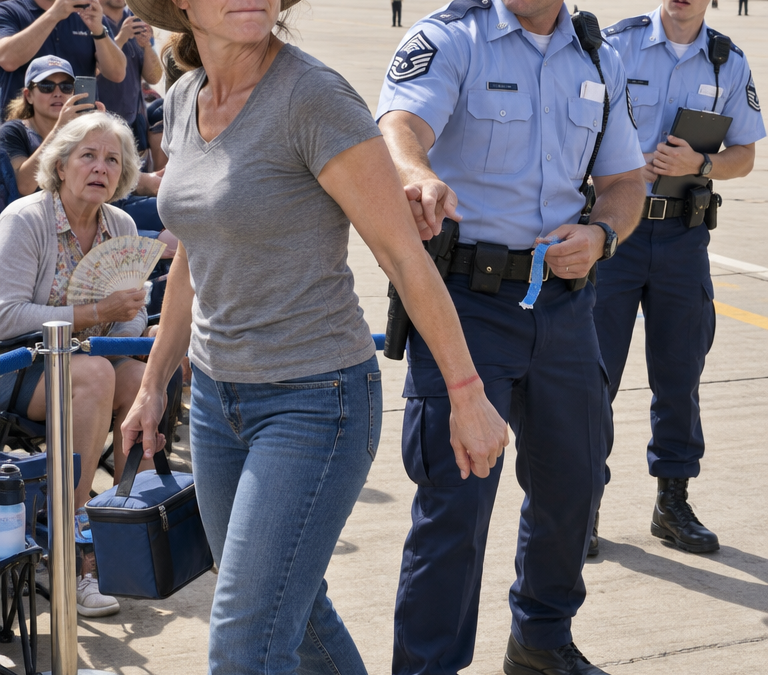
A security sergeant tore my blue guest band off, called me a trespasser, and marched me past 10,000 people while phones came up. I didn’t argue. Then six demonstration jets shut down on the taxiway, and a young airman whispered, “Ma’am… I think he’s looking for you.”
The envelope came on a Tuesday, the day the mail always arrived late on my street.
It was heavy, cream-colored, and square, the kind of envelope people choose for wedding invitations when they want you to notice the paper before you read a word. In the upper-left corner was a crest I recognized immediately: six jets in a diamond formation, smoke trailing behind them.
I held it over the kitchen trash can long enough for the kettle to begin making noise.
Then I put it on the table and made tea.
I knew who had sent it. There was only one person in the world who still wrote to me on paper, and he did it once a year, every March, like a man making a payment on a debt he did not believe could ever be settled.
But this was September.
That was new.
I have never liked new things arriving in my mailbox without an appointment.
I opened the envelope with a butter knife.
Inside was one handwritten card and a blue plastic wristband, the same kind you might get at a hospital, concert, or water park. There was no name printed on it. A small silver snap closed the band.
In white letters so thin I had to tilt it toward the window, it said:
TEAM GUEST.
Nothing else.
The card contained four words in handwriting I recognized because I had spent nine years refusing to read more of it.
Show center. Please come.
Below that were a date, a base, and a single initial.
S.
I set the card down.
I picked up my tea.
Then I put the tea down too.
I went to the hall closet and reached behind the winter blanket on the top shelf for a shoe box.
There were eight letters inside.
Eight Marches.
All sealed.
I had a system for his letters. I did not open them, and I did not throw them away.
It was not a healthy system. It was simply mine.
It had carried me through eight years without incident, which was more than I could say for many systems people considered respectable. I had come to trust it the way you trust an old truck that starts every morning despite the noise under the hood.
I did not open anything that night.
I placed the September card and blue wristband on top of the eight sealed envelopes, closed the box, and returned it behind the blanket.
Then I sat at the kitchen table until the room went dark around me.
Two houses away, a neighbor tried to start a lawn mower eleven times. On the twelfth pull, the engine caught.
I remember thinking that was probably a good sign for somebody.
My name is Clare Beckett, though for a while that did not matter.
What mattered was that I was forty-one years old, lived alone in a two-bedroom house on the edge of a small town in northern Nevada, and taught aviation maintenance at a community college.
I taught nineteen-year-olds to safety-wire a turnbuckle so it could not back itself out at eleven thousand feet.
Sometimes I made them do the same job three times.
They thought I was cruel.
I thought I was keeping somebody I would never meet from falling out of the sky, which is a kind of cruelty I can live with.
I walked with a slight hitch on my left side most days. You would not notice unless you were watching carefully.
I spent a fair amount of energy making sure nobody watched carefully.
The show was nine days away.
I spent eight of those days telling myself I was not going.
On the ninth morning, I woke at 3:40.
The military would call it 0340.
I called it evidence of poor judgment.
I packed a small cooler with water, two sandwiches, and a bag of grapes. I put on jeans, a plain gray shirt, running shoes with good arch support, and a wide canvas sun hat.
Then I took the shoe box down again.
I removed only the invitation card and wristband.
The eight letters stayed behind.
Six hours is a long time to argue with yourself.
I lost most of the arguments.
The highway carried me south and east through country that looked like the moon if the moon had cattle guards. The sun rose in my rearview mirror. For the first two hours I listened to an oldies station playing songs from when I was in high school, which was a mistake because apparently every song written during my adolescence involved somebody leaving.
Around hour three, my back began filing its usual report.
My back is honest.
Every forty-five minutes of sitting, it tells me precisely what it thinks of the arrangement.
I stopped at a truck stop and walked a slow circle around the diesel pumps while a trucker with a gray braid watched me stretch against the side of my pickup.
“You look like you got hit by something,” he said.
“A long time ago.”
He took a sip of coffee.
“It still counts.”
Then he walked away.
I thought about those three words for the next forty miles.
It still counts.
I had spent six years arranging my life so that it would not.
At the county line, I pulled into a gravel turnout shaped like a half moon. A historical marker stood beside it describing a stagecoach robbery nobody living remembered.
I left the engine running.
The wristband rested on the passenger seat.
TEAM GUEST.
No name.
Turning around would have been easy.
I thought about Monday’s unfinished lesson plan.
I thought about the eight sealed letters.
I thought about how a man who had written to me for nine years could surely wait for a tenth.
A tanker truck passed and rocked my pickup.
I put the transmission into drive.
I would like to tell you courage made that decision.
Mostly, the turnout was on the wrong side of the highway, and turning around would have required crossing traffic.
I have always been a careful driver.
An hour later, a white water tower appeared through the heat shimmer.
HARLO AIR FORCE BASE.
HOME OF THE WAR HORSES.
I had never been stationed there.
That was one reason I had agreed to come. Nobody at Harlo knew me. I could stand behind a rope for an afternoon, watch six jets fly, then return to Nevada without answering questions.
That was the plan.
Traffic backed up nearly two miles from the main gate.
The base was holding an open house. Minivans crawled along with their windows down. Children waved from back seats. A grandfather stood through a sunroof in a ship-emblem ball cap as if commanding a tank.
It took forty minutes to reach the parking area, which on ordinary days was apparently a hayfield.
An airman in a reflective vest guided me into a row.
“Shuttles are at the end, ma’am. Take water. It’s ninety-four now and heading for a hundred.”
“Density altitude’s going to be ugly,” I said automatically.
He blinked at me.
I wished the sentence back into my mouth.
“Thank you,” I added.
Old habits have excellent posture.
I read the windsock before I read the event program.
It stood about three-quarters full with a right crosswind. I noticed a KC-135 tanker at the east end of the ramp. I noticed the fire truck positioned near midfield.
And I noticed the helicopter pad beyond it was empty.
The empty pad bothered me more than I could explain to anyone who had never flown one.
The shuttle was an old school bus painted white.
I sat in the back beside a woman with two little boys wearing matching FUTURE PILOT shirts.
One looked at me.
“Do you like airplanes?”
“Some of them.”
“Which ones?”
“The ones that come back.”
The answer came out before I could stop it.
His mother glanced toward me.
I corrected myself.
“The loud ones. I like the loud ones.”
That satisfied him.
His mother had clearly heard the first answer, but she let it pass.
I appreciated that.
The bus unloaded us onto a ramp crowded with thousands of people. Static aircraft displays stood between food trailers, tents, lawn chairs, strollers, bounce houses shaped like airplanes, and families taking photographs.
The air base had temporarily become a county fair located on one of the most dangerous pieces of pavement in the state.
A waist-high rope separated the public from the active flight line.
Near the middle was an opening guarded by security personnel. Behind them, someone had painted a large yellow X on the concrete.
SHOW CENTER.
I saw it.
I did not go there.
Not yet.
Instead I walked.
I told myself I needed to loosen my back, which was true.
It was also true that I was stalling.
I passed a C-17 with families climbing its rear ramp.
I passed an A-10 with a sign saying DO NOT TOUCH while a little girl did exactly that.
I passed an old B-52 being guarded by a crew chief young enough to be its grandson.
Near the far end of the display line stood a gray rescue helicopter behind another rope.
An HH-60 Pave Hawk.
I stopped.
There are machines you learn to operate, and machines you learn the way you learn the house where you grew up.
I knew where that helicopter’s step complained when weight hit it at the wrong angle.
I knew how the cabin smelled after midnight: hydraulic fluid, canvas, old coffee, and people who had been working too long.
I knew what the rotors sounded like when you were asking for more lift than the aircraft wanted to give you.
A young staff sergeant in a flight suit approached.
“You fly?”
“Used to.”
I nodded toward the helicopter.
He looked at me differently.
“What squadron?”
I told him.
He whistled.
“That’s my squadron. When were you there?”
“Before you.”
“We’ve got a wall back home with everybody who flew for us. You might be on it.”
“I might be.”
I felt the next question forming.
So I smiled.
“Thank you for standing out here in this heat. She looks good. Take care of her.”
Then I walked away before he could ask my name.
I had become good at leaving before the next question.
Ten days before the show, my department chair, Hector Villaina, had leaned through my classroom door after a lab.
Hector was a large, gentle man who had been an Army helicopter mechanic in a war before mine. He had hired me four years earlier after an interview lasting nine minutes.
He had read my résumé, looked at my hands, and asked one question.
“Can you teach them to be afraid of the right things?”
“Yes.”
“Good. Most people teach them to be afraid of the wrong things.”
That had been the entire interview.
Now he watched me clean a workbench.
“You’re taking Friday off.”
“I am.”
“You never take Fridays.”
“I’m going to an air show.”
He stared over his glasses.
“You hate air shows.”
“I hate crowds. Airplanes are fine.”
Hector had never asked about my service.
I had never asked about his.
There are people who have both spent time in certain rooms and understand one another without describing the furniture.
“Bring me a T-shirt,” he said.
“What size?”
“The size of a man who has let himself go.”
Then he returned to his office.
So if you had asked anyone at the college who Clare Beckett was, they would have described an aviation-maintenance instructor with a limp, a strict streak, and an unusual commitment to safety wire.
That description was not false.
It merely omitted one afternoon in March nine years earlier.
In March 2017, I was thirty-two years old and a captain in the United States Air Force.
I flew combat rescue helicopters.
If you strip away the acronyms, combat rescue is simple to explain.
Somebody’s aircraft stops being an aircraft.
They come down somewhere people may not want them to survive.
Then a rescue crew goes to bring them back.
We were operating from a forward base in the desert.
The place was mostly gravel, tents, temporary buildings, fencing, and a runway built by people who appeared unconvinced anyone would use it for long.
We sat alert in a plywood building with an air conditioner that functioned according to its own moral code.
We watched movies.
Played cards.
Waited.
We were bored in the way people are bored in an emergency room while knowing somebody else’s worst day could begin at any moment.
My crew that night included my copilot, First Lieutenant Joe Kamura.
Joe was twenty-six and the best natural stick I ever flew beside. She hated small talk and completed crossword puzzles in pen.
In back were rescue specialists, including Master Sergeant Abe Coyle.
Abe was forty, which made him the old man by our standards. He had a wife in Georgia, an out-of-regulation mustache, and a radio voice calm enough to lower your blood pressure.
At the right cabin door was my flight engineer, Technical Sergeant Lou Petraus.
Lou was thirty-four, short, square-built, deliberately bald, and from outside Tampa.
His wife Marisol mailed him boxes of her mother’s cookies. He shared them with us while reminding us we did not deserve them.
He had a laugh that arrived in two parts: first a bark, then a wheeze, so you were always fooled into thinking he had finished.
Lou had flown with me for three years.
On the intercom, he called me “ma’am” even at three in the morning.
I repeatedly told him not to.
He said somebody on the aircraft needed manners.
At 10:50 that night, the call came.
An F-16 was down.
The pilot had ejected over a river valley.
He was alive.
He had a radio.
He was hurt.
We were airborne eleven minutes later.
His name was Captain Sam Whitaker.
He was twenty-nine.
We found him along a riverbank among reeds, one arm badly injured, a strobe in his other hand.
Vehicles were moving on the road above him.
We had arrived just in time.
I brought the helicopter low over the water.
Landing was impossible. The bank was steep, soft, and scattered with rocks.
So we hovered.
Abe went down on the hoist.
Lou managed the hoist while monitoring the cabin and our surroundings.
Joe called what she saw outside.
I held the aircraft steady.
Six minutes.
Six minutes does not sound like much until you are holding a helicopter in one place while everyone aboard depends on that position not changing.
Lou’s voice came through my headset.
“Ma’am, we have him. Hold what you got. Hold it.”
So I held.
Abe reached Sam.
Lou brought them both back aboard.
Only after they were inside did the situation change.
Lou was helping pull them into the cabin when he was critically struck.
He said one quiet word.
“Oh.”
I did not understand what had happened.
I was flying.
Joe was calling directions.
I accelerated down the river and away from the threat.
Behind me, Abe worked on two people.
His voice became calmer.
That was how I knew it was bad.
Abe always became calmer when things were bad.
Back at the forward base, I landed harder than I ever had before or ever would again.
The helicopter had taken damage.
One hydraulic system was weakening, and the tail rotor did not feel right.
When the wheels hit gravel, something in my lower back shifted hard enough that I felt it through my teeth.
Adrenaline kept me from caring.
Three weeks later, I began caring.
I would continue caring every day for the rest of my life.
On the ramp, the medical team took Lou first.
Sam came out afterward on a litter, soaked from the river, shaken, his injured arm stabilized.
He kept trying to sit up.
A medic kept telling him to stay down.
When I walked around the nose of the helicopter, Sam grabbed my shoulder with his good hand.
“Captain, I owe you. I owe your crew. I owe you my—”
I gently removed his hand.
“Get on the litter, sir.”
Then I walked toward the tent where they had taken Lou.
I have thought more about that moment than about the six minutes over the river.
I was not angry with Sam.
He had done nothing wrong.
His aircraft failed. He ejected. He survived.
That was what he was supposed to do.
But inside that tent, my mind reduced everything to a transaction.
One man would go home.
One man would not.
And I had been the pilot holding the helicopter in place.
I had decided to stay.
I began thinking of it as a trade.
If I allowed Sam to thank me, some part of me believed I would be accepting payment for that trade.
I could not do it.
Abe entered the tent about an hour later.
He had washed his hands.
He sat on the cot across from me without speaking.
Eventually he produced a small paper cup of coffee from one of his cargo pockets and set it near my boot.
“You held it,” he said.
“I know.”
“No. Listen to me. I’ve been doing this eighteen years. I’ve been under a lot of pilots. Most would have pulled away earlier. Nobody would’ve blamed them.”
He looked toward Lou.
“He wouldn’t have blamed them either. But you held it, so he got to do his job all the way to the end. That’s the only thing any of us ever get to ask for.”
I never drank the coffee.
It went cold beside my boot.
But I remembered every word.
Four months later, they awarded me the Distinguished Flying Cross with Valor.
Joe received one too.
Abe received a Silver Star.
Lou received one posthumously.
Marisol came to accept it.
She stood in the front row wearing a navy dress and holding a folded flag.
After the ceremony, she found me behind the hangar, where I had gone because I could no longer stay in the room.
“Captain Beckett.”
That was my name.
Clare Beckett.
I suppose it is time I gave it to you.
Marisol stopped beside me.
“Lou wrote me about you every week. Want to know what he said?”
I did not.
“Yes, ma’am.”
“He said you were the only pilot he’d ever flown with who would hold it as long as it took. He used to tell me, ‘She’ll hold it, Mari. Don’t worry. She’ll hold it.’”
She put her hand on my arm.
“So don’t you dare stand back here feeling sorry that you held it. That was his favorite thing about you.”
I kept those words too.
I made major the following year.
For a while, I continued flying.
Then my back stopped sending reports and began sending ultimatums.
In 2019, a flight surgeon with kind eyes and extremely clear X-rays told me I was finished.
In 2020, at thirty-five years old, I signed medical-retirement paperwork at a steel desk beside a dying office fern.
I remember wanting to water it.
I did not.
It was not my fern.
Every Christmas after that, Marisol sent me a card.
Every Christmas, I answered.
Every March, Sam Whitaker sent a letter.
The first came on the anniversary in 2018.
I recognized his name and left the envelope on my kitchen counter for two days.
Then I placed it in a shoe box.
The next March, another arrived.
Shoe box.
Then another.
By the fourth year I had stopped leaving them on the counter.
Mail arrived.
Envelope went into box.
Box returned behind winter blanket.
Avoidance is extraordinarily efficient once you stop thinking about what it costs.
I followed Sam’s career from a distance.
He recovered enough to fly again.
He made major.
Then lieutenant colonel.
In 2024, I saw a short news item announcing that he had been selected to command the Air Force’s jet demonstration squadron.
It was the kind of assignment fighter pilots dream about as children and stop admitting they dream about as adults.
I read the announcement at my kitchen table.
I decided the feeling in my chest was indigestion.
I was glad he was flying.
Truly.
I simply did not want him to thank me.
So I kept the lid on the box.
Then, in the ninth year, instead of another March letter, September brought a wristband.
At 11:40 on the day of the show, the announcer came over the speakers and told the crowd the demonstration pilots would soon walk toward their jets.
Ten thousand people applauded themselves when he announced the attendance.
Across the taxiway stood six sleek jets in formation, canopies open, crew chiefs waiting beside them.
A rock song started over the speakers.
The crowd pressed closer to the rope.
I reached into my pocket.
The blue wristband clicked around my left wrist.
TEAM GUEST.
No name.
I walked toward Show Center.
It took almost six minutes to work through lawn chairs, strollers, coolers, umbrellas, and families packed several rows deep.
People who had waited hours for the front were not delighted when a woman in a sun hat began working toward the rope.
At the gate stood three security airmen.
The youngest was thin, wore glasses, and had sunburned ears above his collar.
His name tape said SATO.
I lifted my wrist.
“Hi. I was asked to come to Show Center.”
Sato examined the wristband.
Then his clipboard.
Then the wristband again.
“Ma’am, can I ask who gave you that?”
“Someone on the team.”
“It doesn’t have a name.”
“I know.”
“The guest bands usually have names.”
“I know. I don’t know why this one doesn’t.”
He looked behind him.
“Sergeant Dempsey?”
Technical Sergeant Dempsey stood in the tent’s shade with folded arms.
He was around thirty, broad through the shoulders, with a face reddened by too many hours in the sun.
He took a folded page from his breast pocket as he approached.
He had clearly read it before.
He looked at my wristband.
Then at me.
Sun hat.
Gray shirt.
Jeans.
Small cooler.
I watched him place me into a category.
It took him perhaps a second and a half.
“Fans stay behind the rope, ma’am.”
“I was asked to come to Show Center.”
“Everybody was asked,” he said. “It’s printed on the program.”
Someone behind me laughed.
He heard it.
“Can I see the band?”
I extended my arm.
Instead of touching the plastic, he took my wrist and rotated it toward the light.
Then he held the memo beside it.
“Morning memo,” he told the others loudly enough for several rows of spectators to hear. “Counterfeit guest bands being sold in the parking lot. Two hundred dollars each. Blue. No name.”
He turned toward me.
“Look familiar?”
I said nothing.
“Where’d you buy it, ma’am?”
“I didn’t buy it.”
“Then where did you get it?”
“It came in the mail.”
“From who?”
There was the door.
I could have opened it with two words.
Sam Whitaker.
That probably would have ended the confrontation.
But it would have started another one.
I had driven six hours and still did not know whether I could stand in front of Sam and allow him to say whatever he had been trying to say for nine years.
I certainly did not want to open that door with ten thousand strangers listening.
“Someone on the team.”
Dempsey’s expression said he had heard enough.
“Right.”
Then he tore the wristband from my arm.
He did not unsnap it.
He hooked his thumb under the plastic and pulled.
The band stretched, separated, and remained in his hand while the silver snap stayed against my wrist.
A temporary red line appeared across my skin.
I stared at it.
It was the first mark anyone else had put on me in six years.
“Hey,” Sato said quietly.
Dempsey ignored him.
“Ma’am, I need you to come with me.”
He took my elbow and turned me toward the far gate.
We began walking.
People watched.
Most already held phones because the flying demonstration was about to begin.
Those phones came toward us.
A man in an eagle hat shouted something accusing me of pretending to be a veteran.
Several people laughed.
Someone booed.
An older woman seated with a church fan called, “Oh, leave her alone. She isn’t hurting anybody.”
Nobody listened.
I did.
I never learned her name.
I wish I had.
A teenager walked backward ahead of us filming until his father grabbed the back of his shirt and pulled him away.
I have been in situations where people genuinely meant me harm.
It is strange which experiences still locate the softest part of you.
I did not argue.
I did not pull my arm away.
I did not tell Dempsey who I had been.
I walked.
His stride was longer than mine, and matching it made the hitch in my left side obvious.
I felt people notice.
Part of me was embarrassed.
Another part was relieved.
I had come.
I had driven six hours.
I had reached the rope.
Someone else had decided I did not belong.
Now I could return to my truck and drive home.
The torn wristband could go into the shoe box with the eight unopened letters.
The lid could close again.
Very efficient.
Then the rock song ended.
The announcer returned.
“And here they come, folks.”
Across the taxiway, six jet engines started one after another.
The sound rose through the ramp until it vibrated through your sternum.
Phones turned away from me.
For a moment, I was grateful to stop being the most interesting thing on the base.
Dempsey guided me around a stroller.
Sato followed several steps behind carrying his clipboard.
I could hear him breathing the way young people breathe when they are considering saying something to someone senior.
The engines settled into a heavy taxi roar.
The lead jet moved.
Five others followed.
They began rolling parallel to the crowd in our direction.
We continued toward the gate.
About thirty seconds before the jets would pass us, I heard something a pilot hears differently from everybody else.
The lead engine note dropped.
Not slightly.
Completely.
Roar became whine.
Whine became the descending mechanical whistle of a turbine reducing power.
Then the aircraft behind it slowed.
Then the next.
One after another, six jets stopped on the taxiway.
The loudest place in Nevada became strangely quiet.
The announcer had been halfway through a pilot biography.
He stopped speaking.
Behind me, Sato’s boots stopped.
“Sir,” he said.
Dempsey kept walking.
“Sir, the whole show just stopped.”
“Keep walking, ma’am.”
The gate was maybe thirty yards ahead.
Beyond it waited the shuttle stop.
Beyond that, somewhere among thousands of windshields, was my pickup with half a bag of grapes on the passenger seat.
I could be gone in a minute.
People behind the rope were standing now.
Children asked why the airplanes had stopped.
Dempsey’s radio crackled.
“Lead is shutting down on the taxiway.”
Another transmission followed.
“Canopy’s coming up.”
Then a woman’s voice cut across the channel.
“All stations, this is Harlo Six.”
Wing commander.
“Somebody tell me who he is walking toward.”
Dempsey pulled the radio from his belt.
“Harlo Six, Security Two. Unknown, ma’am. We’re clearing a trespasser off the line at the moment.”
Trespasser.
That word clarified something inside me.
I wanted the gate.
I wanted reasonable behavior.
I wanted good manners.
At forty-one, fear often looked exactly like those things.
I thought about Lou.
Not Sam.
Lou.
Lou standing at the right cabin door with one hand on the hoist control.
Lou’s voice in my headset.
Hold what you got.
Hold it.
For six years, I had been holding the wrong thing.
Not a helicopter.
A shoe-box lid.
Ten yards from the gate, the airman stationed there straightened and prepared to open the panel wider.
Behind me, Sato spoke again.
“Ma’am.”
His voice cracked.
“I think he’s looking for you.”
I stopped.
Dempsey had my elbow, so he stopped too.
For the first time, he looked directly at my face.
I turned my forearm quietly until his hand released.
“Sergeant, I’m going back now.”
“Ma’am, if you walk back toward that line, I’ll detain you.”
“I know.”
I looked at him.
“I’d rather you didn’t.”
Then I turned around.
Ten thousand people faced the taxiway.
Every folding chair seemed empty because everyone had stood.
Phones rose overhead.
The six jets sat motionless, heat shimmering around them.
The lead canopy was open.
A crew chief ran toward it carrying a ladder.
The pilot did not wait.
He climbed onto the side rail, swung his legs over, and dropped the last few feet to the concrete.
He removed his helmet, tucked it under his left arm, and began walking toward Show Center.
I began walking back.
My back hurt.
My limp showed.
For once, I did not try to hide it.
The people I passed had been laughing minutes earlier.
Now some looked from me to the approaching pilot and back again, performing arithmetic they did not yet understand.
The man in the eagle hat stood on his cooler.
He said nothing.
Dempsey’s boots followed behind me.
He had not detained me.
When I reached Show Center, the pilot was already at the opposite side of the rope.
He searched the crowd.
Then he saw me.
Nine years had altered him.
The twenty-nine-year-old I remembered had become a thirty-eight-year-old man with gray beginning at the temples and lines around his eyes from years of sun.
Below the rolled sleeve of his flight suit, a long pale surgical scar crossed his left forearm.
He had kept the arm.
I had never been sure he would.
He did not salute.
I mention that because people expect stories like this to contain salutes.
Real life is usually less organized.
Sam Whitaker simply stood there.
His mouth opened.
Nothing came out.
He closed it and looked down at the concrete.
Then he looked at me again.
“You came.”
“You stopped an air show.”
He laughed once, but the sound broke in the middle.
“I’ve been trying to reach you for nine years, Clare. I wasn’t going to lose you to a parking lot.”
I had no answer.
He looked down at my wrist.
At the red line.
At the silver snap where the blue band used to be.
His expression changed.
He turned toward the announcer.
“Gordon.”
The announcer, a heavy man in his sixties wearing a headset, had come down from his platform with everyone else.
Without a word, he handed Sam the microphone.
Sam stared at it for a second.
Then he raised it.
His voice came from every loudspeaker on the base.
“Folks, I’m sorry for the delay. We’ll get you back to the show in a few minutes, but I need you to know why we stopped.”
Silence settled over the crowd.
“In March 2017, I was on a riverbank in the Middle East with a broken arm and very little time. There were vehicles above me. I had a radio, a strobe, and not much else.”
He paused.
“A rescue helicopter came over the ridge and held a hover over me for six minutes while their team got me out.”
He lifted his chin toward me.
“The pilot of that helicopter is standing at Show Center.”
I felt the crowd turn.
Sam continued.
“Her flight engineer, Technical Sergeant Lou Petraus, did not come home that night.”
He let the sentence remain there.
“Everything you’re about to see today—every maneuver, every pass—I get to fly because of them.”
He lowered the microphone.
Then raised it one more time.
“So I stopped my jet. That’s all. Thank you for your patience.”
He returned the microphone.
He never looked at Dempsey.
He did not need to.
Everyone else did.
For several seconds nobody moved.
Then one person along the rope stood straighter.
Then another.
Then an entire section.
The Boy Scouts stood.
The man in the eagle hat removed his hat.
Only afterward did someone begin clapping.
The applause spread.
I put both hands on the rope because I did not know where else to put them.
Dempsey stood several feet away holding the torn blue wristband.
He stared at it.
“Lou,” I said.
I was not speaking to anybody in particular.
It was simply the first time in years I had said his name aloud in front of strangers.
“His name was Lou.”
“I know,” Sam said.
“I’ve got it written on my helmet.”
He turned the helmet.
On the back, below his own name, two small hand-painted letters were visible.
L.P.
The demonstration resumed thirty-eight minutes late.
Before returning to his aircraft, Sam pointed toward the yellow X at Show Center and spoke to Sato.
Sato ran into the tent and returned carrying a folding chair.
He placed it on the flight-line side of the rope, directly on the yellow X.
Then he looked at me.
“Ma’am, I think that’s for you.”
I sat.
A few minutes later, a white government SUV arrived along the service road.
A colonel stepped out.
She was around fifty, compact, silver-haired, and carried herself with the particular straightness of someone who rarely had to introduce herself twice.
Her name tape read ADAIR.
Harlo Six.
The wing commander looked at me.
Then at Dempsey.
Then at the torn wristband in his hand.
She had clearly been briefed.
“Sergeant.”
“Yes, ma’am.”
“You put hands on a guest of the demonstration team in front of ten thousand people and walked her toward the gate while approximately four hundred phones recorded you.”
“Yes, ma’am.”
He did not offer an excuse.
I noticed that.
“Anything to say?”
“No, ma’am.”
I rose from the folding chair.
My back objected.
“Colonel, may I?”
She turned.
“Major Beckett, I’m told you’re retired.”
“Yes, ma’am.”
“Then you may say anything you like.”
“The memo was real. Somebody was selling counterfeit bands in your parking area. Mine was blue. Mine had no name. He was working with the information he had.”
Adair watched me.
I looked toward Dempsey.
“He put his hands on a woman he thought was lying to him in front of a crowd, and he enjoyed the crowd.”
Dempsey’s eyes dropped.
“That second part is the lesson,” I said. “The first part is just a Saturday.”
Adair was quiet.
“You’re asking me to go easy on him?”
“I’m asking you to keep him.”
That surprised her.
“A man who learns from this will be more useful than a man ruined by a video.”
She studied Dempsey for several seconds.
“My office. Monday. 0700.”
“Yes, ma’am.”
Then she looked at me.
“Enjoy the show, Major.”
She returned to the SUV.
Dempsey came over after it left.
He held out the torn wristband.
“I’m sorry, ma’am.”
I took it.
“I didn’t look,” he said.
“Next time, look.”
“Yes, ma’am.”
Sato appeared with a black zip tie from one of his cargo pockets.
Without saying much, he laid the torn plastic across my wrist and carefully joined the ends with the zip tie.
His ears seemed even redder than before.
It was an excellent repair.
I told him so.
I watched the entire demonstration from the folding chair sitting on the yellow X.
I will not attempt to describe the flying.
Some things become smaller when you explain them.
I will say that when all six jets crossed Show Center in a low diamond formation, I felt the sound through my spine.
Not the injured part.
Something underneath it.
I knew what it cost to hold an aircraft precisely where you wanted it.
And the man leading that diamond was doing it with an arm that nine years earlier had been badly damaged on a riverbank.
For years I had told myself I understood the price of those six minutes.
Sam lived because we stayed.
Lou died during the same rescue.
Both statements were true.
What I had misunderstood was the belief that refusing Sam’s gratitude would somehow allow me to carry only one truth at a time.
The shoe box had never set anything down.
I had simply carried everything alone, in a dark kitchen, with the lid closed.
Sitting on that yellow X in daylight, I let both things exist at once.
It hurt almost exactly as much as I had feared.
It also weighed less.
That evening, after the crowd had left and the ramp had become ordinary concrete again, Sam found me at my truck in the hayfield.
He had changed into a polo shirt.
Without the flight suit, he looked like any man in his late thirties except for the scar.
We sat on my tailgate and ate the rest of my grapes.
We talked about Lou.
Mostly, Sam talked.
He told me he had visited Marisol three times in Florida.
He had helped pay for Lou’s name to be engraved on a bench outside the fire station in Lou’s hometown.
Before every flight, Sam said Lou’s name aloud.
Every single flight.
“Every flight?” I asked.
“Every one.”
“Nine years?”
“You can do the math.”
“I don’t want to.”
He nodded.
Then he told me about waking in a hospital in Germany two days after the river.
His injured arm was surrounded by an external frame.
The first thing he asked the nurse was whether my entire crew had returned.
She did not know.
It took another day for him to learn the answer.
“That day was worse than the riverbank,” he said.
I looked at him.
“On the river I knew what was happening. In the hospital I just lay there thinking I’d cost somebody everything, and I didn’t even know his name yet.”
“You didn’t cost him anything. I made the call.”
“Clare.”
He said my name with the patience I use with students who have installed safety wire backward for the third time.
“We both know that isn’t how it works. He made the call too. He had his hand on my harness.”
I did not have an answer.
Eventually, I stopped believing I needed one.
Sam reached into his back pocket and removed a cream-colored square envelope.
The March letter.
This year’s.
My address was written across it.
It even had a stamp.
But he had never mailed it.
“I wrote it,” he said. “Then I thought, she isn’t going to open it. So I sent the wristband instead. I figured you’d have to open that.”
He held out the letter.
“You can read it or not. I just wanted you to have one from me by hand.”
I took it.
I opened it while sitting on the tailgate.
Sam looked toward the sunset and pretended not to watch me.
It was one page.
I will not tell you what it said.
That belongs to him and me.
I will tell you what it did not say.
Thank you.
Not once.
After nine years without receiving a single answer, Sam had apparently figured that much out.
I drove home that night.
Six hours.
I stopped at the same truck stop.
The man with the gray braid was not there.
Probably for the best.
I reached my house close to three in the morning.
I did not sleep.
I went to the hall closet, removed the shoe box from behind the winter blanket, and carried it to the kitchen.
Then I turned on the light.
I opened all eight letters.
It took until sunrise.
Later that morning I called Marisol.
I told her about the air show.
The helmet.
The yellow X.
Ten thousand people standing.
The repaired wristband.
She was silent for a while.
Then she laughed.
It came out in two pieces.
A bark.
Then a wheeze.
For the first time, I understood where Lou had gotten it.
“He would’ve loved that,” she said. “He’d have loved that you made them stop the show. He always said you were stubborn.”
“He said I would hold it.”
“Same thing, honey.”
By Sunday afternoon, a video of the confrontation had spread online.
Apparently someone near the rope had recorded nearly everything from Dempsey taking my wrist to the demonstration stopping.
Joe Kamura, now a lieutenant colonel flying from Georgia, texted me.
You made a colonel drive onto the flight line in an SUV. Proud of you.
Abe Coyle was retired and fishing somewhere in the Florida Keys.
He called.
For almost a minute, neither of us said anything.
Then Abe spoke.
“Good hover, Captain.”
He hung up.
That was the longest telephone conversation we had ever had.
That week, I wrote Sam back.
It took four drafts.
The final letter was not long.
I mailed it on a Tuesday.
The following February, I loaded eleven aviation-maintenance students into a college van and drove them to the demonstration squadron’s winter training base.
For most of them, it was their first time standing on an operational flight line.
Sam met us at the hangar.
He spent two hours walking them around the jet from nose to tail.
My students asked every reasonable question imaginable and several unreasonable ones.
Near the end, one of my best students—a serious young woman from Elko who could safety-wire almost anything better than I could—asked Sam how he knew me.
He looked over the students’ heads toward me.
I gave him a very small nod.
“Your instructor once held a rescue helicopter in a hover for six minutes,” he said. “I was underneath it.”
Every student turned.
I stared at the airplane.
“She makes us safety-wire everything three times,” a boy in the back complained.
“Good,” Sam said.
In my classroom today, there is a corkboard above my desk between torque charts and a photograph of my first graduating class.
Pinned to that board is a blue plastic wristband held together with a black zip tie.
TEAM GUEST.
No name.
My students have asked about it.
I tell them it came in the mail.
Hector got his T-shirt.
He wears it on Fridays.