A federal snowplow stopped twelve feet from my locked ranch gate while an ambulance waited behind it in a Colorado blizzard. The HOA president raised her phone and said, “You cannot open that gate.” Then the road supervisor looked at the new steel chain—and asked me who had authorized it.
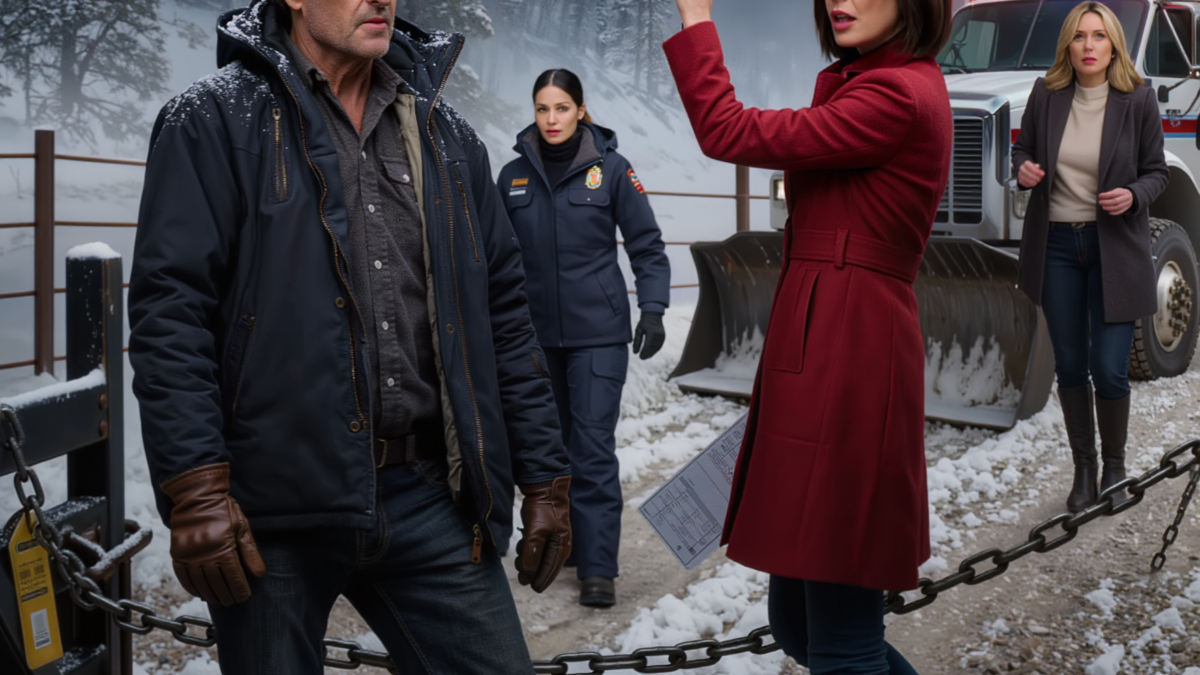
The federal snowplow stopped twelve feet from Owen Mercer’s locked farm gate.
Its headlights filled the blowing snow with white glare and caught the new steel chain stretched around the post, the reinforced sleeve covering the latch, and a yellow security tag snapping violently in the wind.
Beyond the gate, Owen’s ranch road vanished between dark pines.
Somewhere beyond those trees, more than a mile uphill, a federal field technician was stranded beside a disabled utility vehicle with an injured leg while the storm closed around him.
A county ambulance waited behind the plow.
Owen stood near the hood of his pickup, snow collecting on his shoulders and melting along the brim of his cap.
Across the fence, Vanessa Caldwell held her phone upright.
She was recording.
“You cannot open that gate,” she called through the wind. “The HOA has secured this entrance.”
Owen looked at the chain before he looked at her.
The gate itself was familiar down to every weld.
He had installed it fifteen years earlier after a spring flood weakened the old posts. He had helped set the replacement posts with his father, hung the steel gate, adjusted the hinges and spent an entire afternoon getting the latch to close cleanly.
The lock was not familiar.
Neither was the heavy steel sleeve bolted over the latch.
“That’s my gate,” Owen said. “And that’s my road.”
Vanessa raised a laminated access diagram.
“It’s a protected neighborhood entrance. You were notified.”
Behind Owen, Elena Ruiz stepped down from the federal plow truck.
Elena supervised winter road access for the Forest Service installation above the ranch. She had no interest in Vanessa’s title, Owen’s anger or three weeks of increasingly hostile correspondence.
Her attention went to the physical problem.
The gate was closed.
The route beyond it was the route the response team needed.
The technician above the ranch was still conscious, according to the latest radio call, but the weather was deteriorating.
Elena walked toward the chain.
She asked Owen one question.
“Do you authorize us to clear this gate from your road?”
“Yes,” he said. “The lock isn’t mine.”
That night would become the part of the dispute people remembered.
The snowplow.
The ambulance.
The steel bending under the blade.
The chain tearing free.
But the conflict had not begun with a rescue.
It had begun three weeks earlier with two orange stakes in frozen ground.
Owen’s ranch sat outside a foothill subdivision west of Fort Collins, Colorado. Cedar Veil Estates had been built long after Owen’s grandparents began running cattle on the surrounding land.
His operation was smaller now.
He kept a modest herd, cut hay from the lower fields and maintained a private gravel road that climbed from the county highway toward a boundary with national forest land.
The road was functional rather than picturesque.
It passed the barn, crossed a cattle guard, curved beside a windbreak and climbed toward a second gate near the federal boundary.
Owen paid to grade it.
He kept the culverts open.
He replaced washed-out gravel.
During winter he stored chains, fuel and hydraulic fluid in the barn because one afternoon of wind could turn the upper switchback into a wall of snow.
The Forest Service used a limited portion of the road under a recorded access agreement.
Authorized federal crews and contractors could travel through the ranch to reach a remote weather and communications installation on public land.
The agreement did not make the ranch road public.
It did not give unrestricted access to neighbors.
It certainly did not transfer control of Owen’s lower gate to Cedar Veil Estates.
For ordinary work visits, federal personnel called ahead.
Owen opened the gate.
He checked the cattle.
He made sure vehicles passed safely through the pasture.
Then he closed it again.
The arrangement had worked for years.
Owen liked the idea that part of his road could serve a useful regional purpose without becoming a road that everyone else assumed they owned.
Cedar Veil sat on the opposite side of a drainage swale.
Its houses looked across the meadow from slightly higher ground, and residents reached the subdivision through paved entrances connected directly to the county road.
Near the southern edge of the development, HOA common land came close to Owen’s property.
Close was not the same as connected.
A drainage ditch, fencing and uneven ground separated the subdivision loop from his private road.
That distinction was obvious if someone stood outside and looked at the land.
On paper, it had become less obvious.
Decades earlier, when the subdivision was being planned, the developer had considered creating a secondary emergency connection toward Owen’s road.
On the original planning exhibit, the idea appeared as a dashed line.
It was never built.
A note stated that any future connection across the adjoining property would require a separate agreement with the landowner.
No agreement was completed.
No drivable crossing was constructed.
The dashed line, however, survived.
It was copied onto a landscape contractor’s base map.
Years later it appeared in a reserve study illustration.
Later still, someone used that illustration in an emergency preparedness presentation.
With every copy, the line became cleaner.
The explanation attached to it became weaker.
Eventually the dashed concept became a solid colored route.
By the time Vanessa Caldwell became HOA president, the map in the association’s working file made the connection look real.
Vanessa had spent her career in operations management.
She liked schedules, checklists and measurable deadlines.
That fall, Cedar Veil’s insurer had requested an updated winter access plan after a storm caused problems on the subdivision’s steep internal streets.
The local fire district had also suggested examining emergency turning space near the southern end of the neighborhood.
Those concerns were legitimate.
Vanessa hired contractors.
She updated snow-removal procedures.
She marked fire lanes.
She asked the property manager, Erica Vaughn, to gather every map the association had.
The mistake was not in caring about winter access.
The mistake came when Vanessa treated the bold line on the newest map as proof of a right that had never been created.
On a gray Monday morning, Owen drove past the lower gate and saw orange against brown grass.
He stopped his pickup.
Two survey stakes stood on his side of the fence.
One carried a strip of pink ribbon.
The other had been driven into the soil beside the tire rut his tractor used during feed deliveries.
Owen sat in the truck for a moment, studying them through the windshield.
Then he stepped out and took photographs.
He did not pull the stakes.
He did not throw them across the fence.
A business card was tied to the wire nearby.
He called the number.
Luis Ortega answered.
Luis’s company had been hired to inspect drainage and identify locations where winter snow storage might interfere with emergency access.
He said his crew had received a map showing a connection to Owen’s road.
“Did you put stakes inside my fence?” Owen asked.
Luis paused.
“My technician may have marked the alignment. We were told the association had access there.”
“Who told you?”
“Management.”
“Have you moved equipment across it?”
“No.”
“Good. Please don’t.”
Luis agreed to meet him later that afternoon.
When he arrived, they walked the property line together.
Luis carried a tablet.
Owen carried nothing.
The screen showed a straight colored route passing from Cedar Veil’s internal loop across the drainage area and onto the ranch road.
On the ground, the supposed connection dropped into a shallow swale.
There was no culvert.
No roadbed.
No opening.
No gate belonging to the HOA.
Luis looked from the tablet to the terrain.
“To build this, we’d need grading and a crossing.”
“Yes.”
“And permission.”
“Yes.”
Luis zoomed the map.
“This is a concept line, isn’t it?”
“That’s what I’ve been trying to find out.”
Luis shut off the screen.
“I’m not taking a machine across your fence without written access.”
Owen thanked him.
Luis removed the stake nearest the barn and left the other temporarily because it might correspond to an actual property corner.
Then he emailed Erica and told her his crew would stop work at the HOA boundary until ownership and access were verified.
That could have ended the dispute.
A contractor had looked at a map, compared it with reality and asked for documentation.
But deadlines were already moving faster than verification.
Vanessa called Owen the next morning.
Her tone was polite.
“We’re reviewing the south emergency connection. Our contractor says you objected to the markers.”
“I objected to markers being placed on my land.”
“The development plan shows a connection.”
“The development plan shows a proposed crossing.”
“Our emergency plan depends on access to that road.”
“Then we should discuss an agreement.”
Owen waited.
“You can’t skip that part.”
Vanessa said the board would review the matter.
Before hanging up, she asked whether Owen could leave the lower gate unlocked until the winter inspection was complete.
“No.”
“We need dependable emergency access.”
“There are cattle in the lower pasture.”
She sighed.
Owen continued.
“The Forest Service calls before it comes through. I open the gate.”
“That isn’t dependable for an emergency route.”
“Then don’t list it as one.”
The conversation ended without agreement.
Ben, Owen’s ranch hand, came into the barn office soon afterward carrying the morning feed numbers.
He had worked with Owen for eight years and knew the property well enough to notice when a tire track was new.
Owen told him about the map.
Ben leaned against the door frame.
“Did they check the upper gate?”
“Why would they?”
“If they think their road connects to yours, maybe they think they have access all the way through.”
Owen had not considered that.
The federal boundary was more than a mile uphill, but the thought stayed with him.
He called the local Forest Service office.
Elena Ruiz answered.
She confirmed what Owen believed.
The agency’s access was limited and recorded.
Federal crews did not control his lower gate.
They called ahead because that was part of operating safely through active ranch land.
Elena asked him to send photographs of the orange stakes.
She did not claim authority over the HOA dispute.
Her concern was practical.
If somebody altered the lower entrance or narrowed the road, federal crews needed to know before sending a truck into winter conditions.
Owen sent the pictures.
Then he called Rachel Kim, a property attorney he had used once before for a boundary issue.
Rachel asked him to gather the recorded federal access agreement, subdivision plat and original developer exhibit.
“Do I need to file something immediately?” he asked.
“First I want to know exactly what they believe they own.”
He looked toward the gate.
“They believe the road connects.”
“Where does their common land end?”
“At the drainage swale.”
“Where is your gate?”
“On my property.”
“What recorded document crosses the boundary?”
“As far as I know, none.”
“Then start there.”
Rachel also told him to keep a written log.
Owen wrote down the date of Vanessa’s call.
He saved Luis’s email.
He photographed the stakes again.
He did not expect any of it to become important.
Two days later, a cold front moved down from Wyoming.
Several inches of snow covered the fences and made the gravel road look narrower.
Cedar Veil’s contracted plow cleared the paved loop.
Luis’s crew stayed away from Owen’s fence.
Vanessa and Erica drove to the southern end of the subdivision to inspect the proposed route.
From the HOA side, Owen’s road looked close.
A person could see the lower gate across the swale.
On the map, the distance disappeared entirely.
On the ground, it did not.
Erica pointed toward the ditch.
“Even if Owen agreed, we would need an actual crossing.”
Vanessa stared toward the ranch road.
“Then we need to get the crossing approved.”
“We need the agreement first.”
Vanessa nodded.
But her phone kept buzzing with messages from residents anxious about winter access.
One board member had circulated a photograph of Owen’s locked gate with a caption asking why a rancher was allowed to block the subdivision’s emergency exit.
Vanessa had not written the caption.
She also had not corrected it.
That afternoon, Owen received a formal request from management.
The HOA wanted an emergency access key.
A map was attached.
Owen forwarded it to Rachel.
She called him almost immediately.
“This isn’t the original exhibit.”
“How can you tell?”
“The source line references an older developer drawing.”
She paused.
“Ask them for that.”
Owen did.
Erica said the archive vendor might need several days.
Meanwhile, Vanessa sent a separate message stating that the HOA expected the gate to remain available while records were reviewed.
Owen replied with a photograph of the drainage swale.
He wrote one sentence beneath it.
There is no physical HOA connection to my road, and I have not granted the association access through my gate.
The first physical consequence appeared before the new lock.
Ben drove the feed trailer toward the lower gate and discovered an HOA barrier positioned near the common strip.
The barrier did not sit on Owen’s land, but it narrowed the space he used when turning the trailer.
Ben stopped rather than risk backing toward the ditch.
He called Owen.
Together they unhitched the trailer and rerouted the delivery through the barnyard.
A ten-minute job took nearly an hour.
From the subdivision side, the barrier probably looked like ordinary winter preparation.
From Owen’s side, it was the first sign that a line on a map was beginning to interfere with actual work.
He sent Erica photographs.
She apologized and said the snow contractor had followed the current emergency diagram.
The barrier was moved that afternoon.
Owen thanked her.
Then he asked for the document supporting the claimed connection.
This time Erica did not send another map.
She said she was still looking for the underlying agreement.
Vanessa read the email exchange after spending the day answering insurance questions.
Instead of treating the barrier problem as evidence that the route itself might be wrong, she treated it as another scheduling complication.
The inspection date was approaching.
The storm forecasts were worsening.
She wanted the south access issue settled.
For several days, nothing happened.
Owen repaired a tractor hose.
He stacked more hay under cover.
He checked the weather radio.
Then, on Friday morning, Ben called from the lower gate.
“You need to come down here.”
Owen heard something different in his voice.
“What happened?”
“They locked it.”
Owen drove down.
The gate was secured with hardware he had never seen.
A heavy chain had been wrapped around the post.
The latch itself was covered by a reinforced steel sleeve bolted into place.
A yellow tag hung from the assembly.
Temporary security control.
HOA authorized.
Ben stood with his hands in his jacket pockets.
“They locked you out of your own road.”
Snow gathered on his shoulders.
Owen tried the gate once.
Nothing moved.
He did not reach for a grinder.
Instead, he took photographs.
The lock.
The bolts.
The tire tracks.
The installer’s label.
Then he called Vanessa.
She answered.
“Yes, we secured it.”
Owen looked at the chain.
“Why?”
“There was concern the entrance could be opened during the storm without a coordinated access plan.”
“It is my entrance.”
“The association is responsible for the emergency connection.”
“There is no connection.”
“The board approved temporary control until the documents are verified.”
Owen stared at the new steel sleeve.
“You cannot create control while you’re checking whether you have it.”
Vanessa said the attorneys could discuss the issue.
Owen ended the call.
He moved cattle away from the lower pasture and rearranged feed deliveries through the barnyard.
Then he called Rachel.
Her response was immediate.
“Don’t damage their hardware yet.”
“What if I need the road?”
“Call me and the relevant responders.”
She paused.
“Your safety and your animals are not a paperwork exercise. But don’t manufacture an emergency just to win the argument.”
Owen appreciated the distinction.
He could have removed the lock himself.
He chose not to.
Rachel sent a written demand for immediate removal.
Owen notified Elena that a third party had locked his lower gate without permission.
Elena added the obstruction to the federal access file and warned crews not to rely on the route until it was resolved.
The HOA’s attorney, Mark Sullivan, called Rachel late that afternoon.
He had only just received the file.
He was not prepared to defend the lock.
He asked for the weekend to review the documents.
Rachel told him the hardware needed to be removed immediately.
A winter storm was approaching.
The landowner had not authorized it.
Mark said he would recommend that the association reverse the order.
The problem was that Vanessa had already signed the security instruction, and the installation company did not have a crew available until Monday.
In her mind, closing the gate protected the emergency route from uncontrolled use.
The logic had become circular.
The HOA had locked the entrance in order to preserve access to it.
Saturday morning brought the first decisive document.
Erica retrieved the original developer exhibit.
The difference was obvious.
The early drawing showed a dashed route ending at Owen’s boundary.
A note required a separate negotiated access agreement.
The later HOA map had filled the gap with a solid line and labeled it as an existing emergency connection.
The required agreement had disappeared from the graphic.
Erica sent the exhibit to Vanessa and Mark.
Mark called Rachel within the hour.
“I don’t see an executed access agreement in the records management gave me.”
“Then tell them to remove the lock.”
“I am.”
“When?”
Mark could not give an exact time.
The installer was trying to find a crew willing to work under the storm watch.
Owen read Rachel’s email at his kitchen table.
Outside the window, the clouds had darkened to the color of sheet metal.
Winning the argument no longer interested him.
He wanted the gate open.
At the clubhouse, Erica placed the original developer exhibit beside the newer reserve-study map.
One showed a proposal.
The other showed what looked like infrastructure.
Once the pages were together, the mistake was impossible to miss.
Erica asked Vanessa to sign a cancellation order.
Vanessa signed it.
Then she asked whether removing the lock before the insurance inspection would make Cedar Veil appear unprepared.
Mark was on speakerphone.
“A locked gate on property the HOA does not control is not an emergency plan.”
He told them to document the subdivision’s actual paved entrances, mark the south connection as proposed and negotiate separately if the board wanted to pursue it in the future.
Vanessa called the installer.
A crew might reach them the next morning if the roads remained passable.
She asked whether Owen could remove the reinforced sleeve himself.
The installer refused to instruct a property owner to dismantle disputed hardware without written authorization.
Mark sent the authorization.
By then the wind was rising.
At noon, Elena called Owen.
Two federal technicians had gone to the remote installation the previous day to replace a failing power component.
They had planned to return before the storm.
A mechanical delay had kept them there.
Snow was already drifting across the upper road.
The agency was preparing a federal plow escort in case conditions worsened.
“Your lower gate is still blocked?” Elena asked.
“Yes.”
“Tell me the moment it is open.”
Owen walked down with Ben.
No installer had arrived.
He photographed the chain again.
Then he used his tractor to open the barnyard bypass.
The alternate route allowed a pickup to reach the county highway, but it passed close to the cattle pens and included a soft shoulder that could not safely support the heavy federal plow.
By late afternoon, snow swept across the meadow in long horizontal sheets.
Owen secured the barn doors.
He moved the youngest calves inside.
Ben left before the highway iced over.
Owen remained alone at the ranch.
At six o’clock, Vanessa left a voicemail.
The board had reviewed the original map and was preparing a correction.
She did not say the gate had been opened.
Owen called her.
“Your lock is still on my gate.”
“I know. The installer is coming as soon as conditions allow.”
“You could have removed it yesterday.”
“I was told we had to secure the emergency corridor.”
“You were told the corridor was proposed.”
Vanessa went quiet.
“I didn’t have that page when I signed the order.”
“You had a contractor standing at the fence telling you he needed permission.”
She did not answer.
The call broke up as wind rattled the porch light.
Owen went inside.
He placed dry gloves beside the stove.
He charged his phone.
At 7:40 p.m., it rang again.
Elena.
The technicians had completed their repair, but their utility vehicle had slid into a drift.
One man had injured his leg while trying to position traction boards.
His partner reported swelling and increasing pain.
They had heat and emergency supplies.
They were not abandoned in the snow.
But the weather was getting worse, and the response team wanted them out before conditions made the road inaccessible.
Elena asked about the barnyard bypass.
Owen explained why it would not support the heavy plow.
She did not ask him to decide whether the injured technician could wait.
That was a medical and incident-command decision.
She asked for the gate dimensions, photographs of the new locking assembly and a safe staging location.
The county dispatcher called next.
A paramedic unit would meet the federal escort.
A sheriff’s vehicle would help manage the county-road entrance.
Owen confirmed he owned the lower gate and authorized emergency personnel to use his road.
Then he called Vanessa.
“There is an injured federal technician above my property. They are sending a plow and an ambulance. Remove your lock now.”
She sounded startled.
“Are they coming through that gate?”
“Yes.”
“Can they use our south access?”
“There is no south crossing.”
He looked toward the dark road outside.
“Your own original map proves it.”
“I’ll call the installer.”
“Call him. And tell your attorney what’s happening.”
Owen pulled on his coat and drove down.
Snow hissed against the windshield.
The lock looked smaller in his headlights than it had during daylight.
It was still just as solid.
He heard the federal plow before he saw it.
Its diesel engine climbed the grade beyond the bend.
Vanessa arrived in a black SUV with Erica.
They parked on the subdivision side and walked toward the fence.
Vanessa carried the laminated map.
Owen noticed it immediately.
It was the newer version.
Not the original exhibit Erica had found that morning.
“Do not touch the gate until our contractor gets here,” Vanessa called.
“The responders are already coming.”
“This is a designated emergency corridor.”
Erica looked at the drainage swale.
Then at the page in Vanessa’s hand.
“Vanessa, that line was proposed. We know that now.”
“I know what the old exhibit says.”
Vanessa’s voice remained controlled.
“I’m trying to keep everyone safe.”
“So am I,” Owen said.
He pointed at the lock.
“And right now that is the only thing stopping them.”
Headlights rounded the bend.
The federal plow descended slowly toward the lower gate.
Its blade was positioned to clear drifting snow from the road.
An ambulance followed.
Elena rode in the lead vehicle.
A sheriff’s utility vehicle remained closer to the county highway.
The plow stopped before the chain.
Elena got out.
She inspected the gate without touching anything.
The paramedic remained in contact with the incident team.
No one rushed.
The technician was still sheltered above the ranch.
The goal was to reach him before the upper road closed completely.
Elena confirmed the property arrangement with Owen.
She already had the federal access agreement in her office file.
Owen showed the ranch parcel diagram on his phone.
Elena was not there to decide the civil dispute.
She needed to know whether the landowner authorized the response and whether the incident team had selected the road.
Vanessa approached.
“The HOA installed that security hardware.”
Elena turned to her.
“Can your installer remove it immediately?”
“He is on his way.”
“How long?”
Vanessa checked her phone.
There was no new message.
“Twenty minutes. Maybe more.”
A paramedic spoke from the ambulance.
The technician’s partner had reported that he was becoming drowsy.
Elena stepped back toward the incident lead.
They discussed the weather.
The available cutting tools.
The reinforced sleeve.
The risk of damaging Owen’s gate.
A portable cutter could eventually remove the hardware, but the sleeve sat awkwardly against the latch and the wind was driving snow across the work area.
The plow was already aligned.
The operator believed he could apply controlled pressure directly to the locking assembly.
Elena returned to Owen.
“We can open it with the blade. The hardware will be damaged. The gate might be.”
“Open it.”
“I need you to understand what I’m asking.”
Owen looked at the steel gate he had installed with his father.
“I understand.”
He watched snow collect along the top rail.
“I’ll deal with the damage later.”
Elena established a safe line.
The ambulance moved back.
Erica guided Vanessa away from the gate.
Owen repositioned his pickup.
The plow operator got out to examine the angle.
He checked where the blade would meet the reinforced sleeve.
The first contact should hit the locking assembly, but no one could guarantee the hinge would remain straight.
Dispatch estimated that retrieving a different tool would create a delay the incident team was unwilling to accept.
Elena reconfirmed Owen’s permission.
Then she gave the signal.
The blade moved forward slowly.
It did not ram the gate.
Metal met metal with a low groan.
One bolt began to pull.
The chain tightened.
For a second, nothing moved.
Then the anchor tore loose.
The gate swung inward, struck its stop and settled at an angle.
The driver stopped immediately.
Elena inspected the opening for loose metal.
When she signaled again, the plow pushed aside the drift and rolled through.
The ambulance followed.
Vanessa stood behind the sheriff’s vehicle.
Her phone hung at her side.
Owen watched the damaged chain lying near the post.
He did not feel victorious.
He wanted the gate intact.
He simply wanted the road open more.
The rescue convoy climbed toward the pines.
Owen followed only as far as the safe turnaround near the federal boundary.
Amber lights flickered through the trees.
The plow needed two passes to clear one of the deeper drifts at the upper switchback.
The stranded technician’s partner eventually appeared through the snow waving a headlamp.
Paramedics reached the injured man inside the utility vehicle.
They stabilized his leg and moved him into the ambulance.
He was cold and hurting but conscious when they brought him down.
Owen heard the update over the radio.
Only then did he let out a breath he had been holding for most of the evening.
The ambulance’s taillights disappeared toward the highway.
At the lower gate, the sheriff’s deputy photographed the damaged lock.
He took statements.
He did not arrest Vanessa.
He did not announce that the HOA had committed a federal crime.
He documented who installed the hardware, who owned the gate, why responders needed access and why the response team had removed the obstruction.
The property dispute would be handled separately.
Vanessa approached Owen after the ambulance left.
“Can the gate be secured before the cattle reach it?”
Owen looked at her.
It was the first practical question she had asked him in weeks.
“I have a livestock panel in the barn.”
Erica offered to contact a fencing contractor.
“Coordinate through Rachel,” Owen said.
He was tired.
He did not want to negotiate beside a bent hinge in blowing snow.
By dawn, the storm had weakened.
Ben returned.
Together they installed a temporary livestock panel across the damaged opening.
They braced it with steel posts.
Owen photographed the gate before moving anything else.
One hinge had twisted.
The reinforced latch assembly was ruined.
The chain lay bent in the snow.
Rachel arrived carrying coffee and a folder.
She spread three documents across the hood of Owen’s pickup.
The original developer exhibit.
The recorded subdivision plat.
The federal access agreement.
The developer drawing showed a proposed connection requiring a future agreement.
The plat showed Cedar Veil’s common property ending at the drainage area.
The federal document showed a limited access route through Owen’s land to the public installation above.
None of them gave Cedar Veil authority over his lower gate.
Rachel did not need six more maps.
The physical evidence was lying beside them.
Mark called before lunch.
He acknowledged that the original developer exhibit did not create an HOA access right.
The later map Vanessa relied upon had omitted the condition attached to the proposed route.
The installation company had acted on written instructions from the association, not on a recorded property interest.
Rachel requested the work order, board authorization and full history of the map.
Mark agreed to preserve the files and discuss documented costs.
Owen did not ask for a dramatic settlement.
He wanted his gate repaired.
He wanted the extra labor reimbursed.
He wanted a written assurance that Cedar Veil would stop treating his road as association property.
The map history explained how the mistake had grown.
The earliest developer plan contained a tentative line.
A later maintenance map reused it.
The reserve study copied the route without the note requiring another agreement.
The emergency presentation relied on the reserve study.
Vanessa’s security order then described the lower gate as a controlled entrance to an established emergency corridor.
At every stage, the graphic became more definite.
The condition attached to it became less visible.
Nobody forged a deed.
Nobody created a secret plan to seize Owen’s ranch.
The problem was more ordinary.
And in some ways, more unsettling.
A sequence of unverified copies created certainty where none existed.
Then a deadline turned that certainty into a steel lock.
Luis Ortega’s original email remained in the file.
He had warned management that his crew would not cross Owen’s boundary without proof.
Erica had also asked where the underlying agreement was.
Vanessa received both warnings.
The inaccurate map explained why she initially believed a connection existed.
It did not explain why she continued after people began telling her the documents needed verification.
When Rachel showed Owen the sequence, he sat at the kitchen table and read the emails again.
He thought about the orange stakes.
Luis standing beside the fence with his tablet.
The temporary barrier.
Vanessa asking for a key.
The chain.
Each had been a chance to stop.
Any one of those moments could have become a normal conversation about negotiating a future emergency connection.
Instead, the association tried to secure an entrance it did not control.
The Forest Service wrote its own operational report.
Elena documented the road conditions, Owen’s consent, the blocked gate and the decision to use the plow after other options were considered.
The report did not award damages.
It did not decide who was legally liable for the gate.
It explained why the response team used the route and how the obstruction was removed.
That mattered to Owen.
He did not want the story turned into a fantasy in which the federal government arrived to punish his neighbors.
The crew had come for an injured technician.
The broken lock was a consequence of reaching him.
Two days later, Vanessa returned to the ranch.
She did not bring the laminated map.
Erica came with her.
They parked near the county road and walked toward the barn.
Snow loosened from the roof in thin sheets as the afternoon warmed.
Owen met them outside.
Vanessa stopped several feet away.
“I saw the original exhibit.”
Owen waited.
“I should have asked for it before authorizing the lock.”
Still he said nothing.
“I thought we were protecting an emergency route.”
“You were protecting a line on a map.”
He pointed toward the damaged gate leaning beside the fence.
“The route on the ground was mine.”
Vanessa looked toward it.
“I’m sorry.”
Owen did not tell her it was fine.
It was not.
“I need the gate repaired. I need the extra work covered. And I need those maps corrected so this never happens again.”
“That’s what we came to discuss.”
Erica unfolded a new draft.
This version separated the existing subdivision roads from a possible future connection.
The future route was marked clearly as proposed.
The winter plan directed residents and emergency responders toward the actual paved entrances Cedar Veil controlled.
It also identified a turnaround that could be widened entirely on association property.
Owen studied the page.
“That’s a start.”
Vanessa asked whether he would consider negotiating a limited emergency connection someday.
Owen looked across the drainage swale.
A properly engineered crossing might be useful under certain conditions.
But it would change how the ranch operated.
Cattle control.
Winter maintenance.
Insurance.
Keys.
Responsibility for the gate.
All of it would need to be addressed.
“I’ll consider a proposal,” he said. “Not another assumption.”
During the following month, Cedar Veil paid the documented gate repair and reimbursed Owen for temporary livestock fencing and work caused directly by the lock.
The remaining costs were handled through the attorneys.
The HOA changed its map-control procedure.
Any route crossing land the association did not own had to be labeled proposed unless recorded documents proved otherwise.
Any enforcement action affecting adjoining property required verification of the legal basis first.
The board also changed the winter plan.
Instead of pretending Owen’s road was a free secondary exit, Cedar Veil improved the emergency turnaround on its own common land.
Luis’s crew returned to complete drainage work.
This time they remained on the correct side of the fence.
During the next board walkthrough, a maintenance pickup drove the southern loop while a local fire district representative observed.
The pickup turned without difficulty.
A larger vehicle needed additional room where a decorative stone planter narrowed the inside edge.
Erica did not solve the problem by drawing a wider line across Owen’s meadow.
She marked the planter for removal.
She measured the shoulder Cedar Veil already owned.
The board approved the work after checking the parcel boundary.
It was less dramatic than the imaginary connection.
It was also real.
It could be built.
Maintained.
Plowed.
Used.
Nobody needed a neighbor’s gate.
Vanessa instructed management to retain the original developer exhibit beside the corrected map so future boards could see the difference between proposed and existing infrastructure.
When Owen heard about the new plan, he asked Erica one question.
“Will the HOA plow push snow across my fence?”
She checked the contractor’s route.
“No.”
That small answer mattered more to him than any grand apology.
A workable agreement did not require one side to disappear.
It required a clear line showing where each person’s responsibility began and ended.
Owen and Ben repaired the gate on a clear Saturday.
They replaced the twisted hinge.
They set a stronger post.
They installed a new latch Owen could operate easily from his pickup during bad weather.
The old chain remained in the workshop.
Owen did not hang it on the wall as a trophy.
He tossed it beneath a workbench beside worn tractor parts.
But he kept it.
Not because he enjoyed remembering the night it broke.
Because it reminded him how small the problem had looked in the beginning.
Two orange stakes.
A copied line.
A request for a key.
Each had seemed manageable.
Each had been documented.
That documentation was what allowed everyone later to reconstruct what had happened.
In early spring, Elena called before another routine visit to the weather installation.
Exactly as she always had.
Owen drove to the lower gate and opened it.
The federal service truck rolled through at walking speed.
No plow blade touched the latch.
No ambulance waited behind it.
No one argued beside the fence.
The cattle remained in the pasture.
After the truck passed, Owen closed the gate.
Later that afternoon he drove toward the southern property line.
On the Cedar Veil side, compacted gravel had replaced the muddy area where Vanessa once stood pointing toward the nonexistent route.
A county brush truck was performing a routine access check.
It entered the subdivision’s new turnaround.
The driver made the turn entirely on HOA property and drove back toward the paved loop.
Owen watched from his side of the fence.
The subdivision had an emergency plan it could actually use.
His ranch still had the road he maintained.
The federal agency still had the access it had arranged.
None of those facts required pretending one organization owned another person’s gate.
When Owen returned home, he parked beside the barn and walked down to the repaired entrance.
The gate stood square between its posts.
He lifted the latch.
It moved easily.
He swung the gate open and looked up the ranch road toward the pines.
Three weeks earlier, another person’s lock had made that simple motion impossible.
In the middle of a storm, a federal response team had removed the obstruction because an injured technician needed the road.
Now the gate opened for the people who had a legitimate reason to use it.
And when the work was finished, it closed again.
Owen pulled it toward him.
The latch settled into place with one quiet click.
This time, the sound meant exactly what it should.