Three-year-old Zuri stepped into Nathaniel Callaway’s wedding aisle clutching a microphone almost as large as her arm and whispered, “Mr. Nate, don’t marry her. The bad man said you go bye-bye.” Two hundred guests turned toward her. Harold Hart calmly suggested she had suffered a nightmare—until Nathaniel noticed an unfamiliar man in a gray suit quietly moving toward the side exit while Harold’s son refused to look at him.
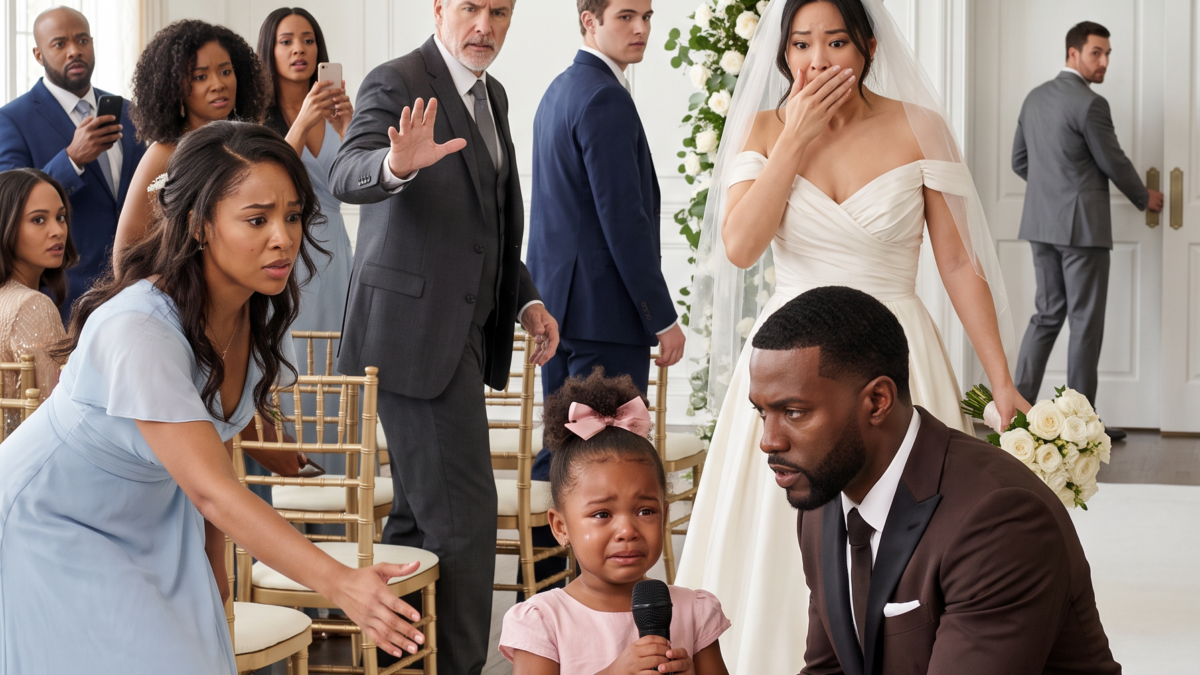
The first thing three-year-old Zuri Johnson said when she stepped into Nathaniel Callaway’s wedding aisle was his name.
“Mr. Nate.”
Her small voice came through the ballroom speakers so clearly that the organist stopped with his fingers still resting on the keys.
Nearly two hundred guests turned.
Nathaniel turned before any of them.
He knew that voice.
At the edge of the aisle stood a little girl in a wrinkled pink dress. One of the bows in her curls had slipped sideways, and she was gripping a black wireless microphone with both hands as though it weighed almost as much as she did.
Behind Nathaniel, the white roses climbing the wedding arch glowed in the afternoon light. Beside him, Vivien Hart held a bouquet of white ranunculus and garden roses against the fitted ivory bodice of her gown.
For one suspended second, the ceremony remained exactly what everyone had expected it to be.
Then Zuri looked directly at Nathaniel.
“Don’t marry her.”
A nervous ripple moved through the back rows.
Nathaniel heard someone laugh uncertainly, then stop.
Vivien slowly lowered her bouquet.
“Zuri?” Nathaniel said.
The child’s chin trembled.
“The bad man said you go bye-bye after the wedding.”
No one laughed after that.
Callaway Manor had been designed for spectacle.
The estate stretched over forty acres of rolling Connecticut hillside, with long stone terraces, formal gardens and an old east wing Nathaniel had spent the previous year restoring. The main ballroom was large enough for several hundred people but elegant enough, at least according to the architect, to feel intimate beneath three crystal chandeliers.
Nathaniel had never believed the second part.
Rooms that large were built to impress people.
Not comfort them.
His grandfather had owned a much smaller property two states away, and Nathaniel still remembered sitting beneath an oak desk there as a boy while adults discussed money as if children could not hear it.
He had built Callaway Manor after his company became large enough that private dinners and shareholder events no longer fit inside ordinary houses. He had told himself the place was practical.
The fountain shaped like a swan suggested otherwise.
At forty-four, Nathaniel had spent more than two decades building Callaway Technologies from a garage workshop and one licensed patent into a global company.
Business magazines estimated his fortune at approximately twelve billion dollars.
The number had become so detached from ordinary life that Nathaniel rarely thought about it unless someone else brought it up.
Vivien’s family thought about it often.
Her father, Harold Hart, had spent thirty years building a financial empire of his own. His firm managed private capital, commercial property and investment vehicles across several states. He was polished, persuasive and almost unnervingly composed.
Nathaniel had respected him.
Vivien was thirty-four, educated, elegant and accustomed to rooms filled with important people.
She and Nathaniel had been together for two years.
Their relationship had never been wild or unpredictable.
It had been orderly.
Mutually beneficial, some people would have called it.
Vivien understood public events. Nathaniel understood privacy. She enjoyed hosting. He preferred leaving early. She knew which fork belonged with which course. He knew exactly how long he could tolerate a charity dinner before inventing an early meeting.
Nathaniel had believed affection might deepen with time.
On the morning of their wedding, however, he had stood in front of the mirror in his private suite tying a brown silk tie and noticed his hands were trembling.
He had tied thousands of ties.
He blamed the wedding.
Downstairs, Amara Johnson was polishing silverware she had already polished twice.
At thirty-one, Amara had been head housekeeper at Callaway Manor for nearly two years.
She was also a widow.
Her husband, Daniel Johnson, had died when their daughter was barely a year old.
Amara rarely discussed him at work.
There were photographs in the small apartment she rented twenty minutes from the estate, and Zuri knew her father’s name, but grief had settled into Amara’s life in a quiet, disciplined way. She went to work. She raised her daughter. She paid the bills. She rarely asked anyone for anything.
Nathaniel had first interviewed her because her references were exceptional.
That was the explanation he had given everyone.
It was not the complete truth.
Years earlier, Nathaniel had briefly met Daniel through an auditing project involving several companies that crossed paths with Callaway Holdings.
Daniel had been serious, careful and difficult to impress.
Nathaniel respected that.
When he later heard that Daniel had died in a single-vehicle accident on a rural road, the circumstances had bothered him for reasons he had never been able to articulate.
Nothing had been proven improper.
Nothing had been formally questioned.
Nathaniel had put the uneasiness away.
Then Amara’s résumé appeared among the candidates for the manor position.
He hired her.
Zuri became part of the arrangement almost immediately.
Child care was expensive. Amara worked unusual hours. Nathaniel had more empty rooms than he knew what to do with.
Soon there was a small reading corner in his study where Zuri could nap during long events.
Then crayons appeared in a drawer.
Then a plastic step stool appeared beside the kitchen sink after Zuri complained she could not reach the faucet.
Nathaniel ordered the stool online himself one night after a fourteen-hour call with shareholders.
He never mentioned it.
The staff noticed.
Staff noticed everything.
Zuri learned the estate the way children learn any place where they feel secure.
She knew which hallway echoed most loudly when she skipped.
She knew the pastry chef sometimes kept cookies behind a metal flour container.
She knew the rose garden smelled strongest after rain.
She also knew Nathaniel.
To everyone else, he was Mr. Callaway.
To Zuri, he was Mr. Nate.
Occasionally, when she was half asleep, she called him Daddy Nate.
No one corrected her quickly enough for the habit to disappear.
Three weeks before the wedding, one of Vivien’s stylists mentioned Zuri during a fitting.
“I think it’s sweet,” the woman said. “How attached Nathaniel is to the housekeeper’s little girl.”
Vivien had smiled.
“Very sweet.”
The subject changed.
But later that evening, Vivien asked Nathaniel how often Zuri stayed at the manor.
“Whenever Amara needs help,” he said.
Vivien stirred her drink.
“She’s staff.”
“Amara is. Zuri is three.”
“I know.”
That was the end of it.
Or Nathaniel assumed it was.
On the wedding morning, Amara dressed in the pale blue uniform reserved for senior staff during formal events.
Zuri sat nearby on an overturned wooden crate, kicking her patent leather shoes against the side.
Her stuffed rabbit rested in her lap.
The rabbit had once possessed two ears.
A washing machine incident had reduced that number to one.
“Stay right here,” Amara said, crouching to straighten the pink bow in Zuri’s curls. “Mommy has to help with the reception tables.”
Zuri nodded.
“Miss Dolores is staying with you.”
Another nod.
“Do not wander.”
“I won’t wander.”
Amara narrowed her eyes.
“Zuri Marie.”
“I won’t.”
Amara kissed her forehead and left carrying folded table linens.
Dolores, one of the senior kitchen assistants, remained behind for approximately three minutes.
Then a call came through about missing centerpieces.
She stepped into the hallway.
The old closet door drifted partly open behind her.
Zuri climbed down from the crate.
At first she only intended to find Dolores.
Then she noticed a hallway she had never explored.
The east wing had been closed for renovations for nearly a year. Furniture sat beneath dust sheets. Several windows had been painted shut during restoration. Contractors usually used an exterior entrance, and most manor employees had no reason to go there.
Zuri did not know any of that.
She only knew the hallway was quiet.
Her shoes clicked against the old floor.
She hugged the rabbit under one arm and followed the sound of voices.
Two men were talking inside a cold sitting room.
One was Preston Hart.
Vivien’s thirty-six-year-old brother had spent much of the morning acting relaxed. He joked with guests, accepted champagne and behaved like someone with nothing more serious on his mind than whether his sister’s ceremony started on schedule.
The second man was named Doyle.
Most people at the wedding did not know that.
He had arrived in a gray suit that seemed intentionally forgettable.
Doyle worked around troubled corporations and private financial disputes. His name appeared rarely in official paperwork.
That was useful to people who preferred certain arrangements not to appear in official paperwork.
Zuri stood behind a tall piece of furniture covered by a sheet.
She could not understand the legal language.
She understood Preston’s tension.
“The amendment activates when the vows become legal?” Preston asked.
“Immediately,” Doyle said.
“And Callaway signed it?”
“He signed a large restructuring package three weeks ago.”
Doyle lowered his voice.
“The important language is on page sixty-three.”
Preston stared toward the dark fireplace.
“And the drive?”
“Exactly as scheduled.”
“Vivien will be in the car.”
“Only until the overlook.”
Doyle spoke as though discussing logistics for a delivery.
“The itinerary has her getting out for photographs. Callaway continues along the coast road before returning.”
Preston rubbed both hands over his face.
“My father said this would be clean.”
“It will be.”
Doyle paused.
“The vehicle only has to reach the estate gates normally.”
Zuri did not understand any of that.
Then she heard a phrase she understood.
After the wedding.
Then another.
Callaway.
Everyone called Nathaniel Mr. Callaway.
In Zuri’s mind, the connection was immediate.
Then came the word bye-bye.
It was enough.
Children did not need legal vocabulary to understand when adults sounded afraid of what they themselves were saying.
Zuri backed away.
The rabbit’s remaining ear caught briefly on the corner of the furniture. She tugged it free.
Neither man noticed her.
She slipped into the hallway and began searching for Nathaniel.
She did not look for Dolores.
She did not look for Amara.
In Zuri’s small understanding of the world, if something bad might happen to Mr. Nate, then Mr. Nate was the person who needed to know.
By the time Amara discovered she was missing, the ceremony was less than forty minutes away.
“Have you seen Zuri?”
Dolores stared at her.
“I thought she was with you.”
Amara’s expression changed.
“No.”
They searched the staging area first.
Then the kitchen.
Then the pantry where Zuri sometimes hid during games.
Nothing.
Amara checked beneath tables, behind curtains and inside the smaller guest sitting rooms.
The manor suddenly felt enormous.
Forty-one rooms.
Three staircases.
Several service corridors.
A garden pond.
A hedge maze.
Places that had seemed elegant when Amara was working now looked like hundreds of locations where a three-year-old could disappear.
She did not check the east wing.
No one checked the east wing.
Meanwhile, guests were filling the ballroom.
White folding chairs had been arranged beneath the chandeliers. White roses and eucalyptus climbed the arch behind the officiant.
Harold Hart sat in the front row wearing a charcoal suit.
Preston sat nearby.
They exchanged one brief glance.
A small nod passed between them.
No guest noticed.
Near a side entrance, Zuri stood partly hidden behind a floral pillar.
Nathaniel was already at the front of the room.
He looked different in his wedding clothes.
More formal.
Less like the man who sat on the floor helping her build wooden towers in his study.
For the first time since leaving the east wing, Zuri hesitated.
The room was full of strangers.
Music had begun.
Then Vivien appeared.
Every guest stood.
Harold escorted his daughter down the aisle.
Vivien’s veil caught the afternoon sunlight streaming through the tall windows.
The scene was perfect.
At least from a distance.
Harold looked once toward an exterior door.
Then at his watch.
Near the sound equipment, a wireless microphone lay unattended while a technician adjusted a cable.
Zuri noticed the small red indicator light.
She picked it up.
By the time Vivien reached Nathaniel, the child was holding the microphone with both hands.
The officiant opened his book.
“Family and friends, we are gathered—”
“Mr. Nate.”
The sound filled the ballroom.
Nathaniel turned.
Zuri stepped into the aisle.
“Sweetheart,” he said gently. “What are you doing here?”
She swallowed.
“Don’t marry her.”
Vivien looked sharply toward Nathaniel.
A few guests shifted.
Then Zuri delivered the rest.
“The bad man said you go bye-bye after the wedding.”
The room changed.
Amara reached the ballroom doors at that moment.
“Zuri!”
Her voice cracked.
She rushed forward.
“Oh, my goodness. I’m sorry. She wandered off. I’ve been looking everywhere.”
Nathaniel barely heard her.
He crouched so his eyes were level with Zuri’s.
“Who said that?”
Zuri’s lower lip moved.
“The bad man.”
“Where did you see him?”
The child looked toward the corridor leading to the east wing.
Harold stood.
“This is clearly a misunderstanding.”
His voice was calm and warm.
“Poor thing probably heard something frightening and turned it into a story.”
For a moment, Nathaniel almost accepted it.
It was the easiest explanation.
Then Zuri looked across the ballroom.
Her face changed.
Nathaniel followed her eyes.
A gray-suited man stood near the side exit.
He had been partly concealed behind a floral column.
Now he was leaving.
Not running.
That would have attracted attention.
Simply moving toward the door with careful efficiency.
Nathaniel rose.
He noticed Preston next.
Vivien’s brother was not looking at Zuri.
He was looking at Harold.
Harold looked back.
The exchange lasted less than two seconds.
Nathaniel had spent twenty years reading rooms full of people who wanted something from him.
He trusted patterns.
This pattern bothered him.
Marcus Reyes, Nathaniel’s security director, had already moved away from the wall where he had been standing.
Nathaniel crossed to him.
“Close the property quietly.”
Marcus’s eyes narrowed.
“Problem?”
“I don’t know yet.”
Nathaniel glanced toward the side door.
“I want to know who the man in the gray suit is. Hold the vehicles until we understand what happened.”
Marcus nodded.
“Done.”
Harold approached.
“Nathaniel, surely you aren’t shutting down an entire wedding because of something a toddler said.”
“No.”
Nathaniel kept his voice calm.
“I’m pausing it because someone I don’t know just left the room immediately after she said it.”
Vivien looked between them.
“Nathaniel?”
“I need twenty minutes.”
The ceremony did not resume.
Nathaniel lifted Zuri into his arms.
She pressed her face against his shoulder.
Her heart was beating hard enough for him to feel it through his jacket.
“I’ve got you,” he said.
Amara reached them.
“Baby, where were you?”
Zuri would not answer.
“Take her to my study,” Nathaniel told Amara. “Stay there until I come.”
Amara looked worried.
“Is something wrong?”
“I don’t know.”
That answer frightened him more than anything else.
Outside, a valet named Tobias approached the champagne-colored convertible designated as the wedding car.
Earlier, someone wearing a catering badge had told him to bring the vehicle around ahead of schedule for photographs.
Tobias had almost opened the driver’s door when his radio came alive.
“Hold all vehicles,” Marcus ordered. “Nobody touches the wedding car.”
Tobias stepped away.
Two security officers arrived within minutes.
The convertible remained exactly where it was.
Inside Nathaniel’s study, Amara sat with Zuri on the leather sofa.
The room smelled of cedar and old books.
It was the only space in the manor Nathaniel had designed to resemble his grandfather’s house.
Zuri had spent many afternoons there.
Her missing rabbit was found beneath a table in the hallway and returned to her.
She pressed it beneath her chin.
Marcus entered twelve minutes later carrying a laptop.
Nathaniel recognized the expression on his face.
“What did you find?”
“Motion activity in the east wing.”
Nathaniel frowned.
“That wing is closed.”
“Apparently not this morning.”
Marcus placed the laptop on the desk.
A security camera mounted near the renovation corridor had recorded two men entering an unused sitting room.
One was Preston.
The other was Doyle.
Zuri appeared briefly in the hallway.
Amara covered her mouth.
“She really was there.”
“Yes,” Marcus said.
That eliminated the nightmare explanation.
Whatever Zuri had heard, she had heard it in a real room containing real adults.
Marcus played the available audio.
The recording was poor.
Old walls distorted the sound.
Three phrases were understandable.
Page sixty-three.
Coast Road.
After the ceremony.
Nathaniel replayed it.
“Who is the second man?”
“We’re working on the full identity. He goes by Doyle.”
“Profession?”
“Consulting, apparently. Mostly around companies in financial trouble.”
Nathaniel looked toward the closed study door.
“Get Warren.”
Warren Ellis had served as Nathaniel’s estate attorney for nearly fifteen years.
He was seventy and rarely seemed surprised by anything.
When he entered the study carrying a slim document folder, he looked surprised.
“I found the package you signed three weeks ago.”
Nathaniel stood behind the desk.
“Page sixty-three.”
Warren opened it.
The restructuring package contained dozens of routine revisions to trusts, beneficiaries and holding companies.
Near the bottom of page sixty-three was a paragraph Nathaniel did not remember approving.
Warren read silently.
Then again.
“What?”
Nathaniel leaned over the page.
Warren pointed.
“This provision takes effect upon legal marriage.”
“Explain it.”
“It restructures control over approximately four hundred million dollars in liquid holdings.”
“To whom?”
“Joint authority would pass to your spouse and her designated family representative.”
Nathaniel looked up.
“Upon my death?”
“No.”
“Incapacity?”
“No.”
“When?”
“The moment the marriage becomes legally effective.”
Amara shifted on the sofa.
“That’s why the wedding mattered.”
No one answered her because everyone had reached the same conclusion.
Nathaniel read the language again.
“That wasn’t the provision I approved.”
Warren’s shoulders lowered.
“It was presented inside a technical correction. I should have caught it.”
“So should I.”
Vivien was brought into the study.
She still wore her wedding gown.
Her veil had been removed.
Nathaniel showed her the page.
“I didn’t know about this.”
She stared at the paragraph.
Nathaniel watched her carefully.
“Your brother discussed it this morning.”
“My brother discusses dozens of financial documents.”
Her answer came quickly, but not defensively.
She looked frightened.
Harold arrived shortly afterward.
He reviewed the paragraph and shook his head.
“You people are jumping from a child’s misunderstanding to an administrative clause.”
Warren looked at him.
“This is not administrative.”
“It may still have a legitimate explanation.”
Harold remained composed.
For several minutes, his argument was plausible.
Then Marcus’s phone vibrated.
He read the message.
Nathaniel saw his jaw tighten.
“What?”
“The wedding car.”
“What about it?”
Marcus chose his words carefully.
“One of the brake components was intentionally altered.”
Vivien stopped breathing for a moment.
Harold’s expression remained still.
Marcus continued.
“The work was concealed well enough that the vehicle could have left the estate normally. The failure would likely have occurred later under harder driving conditions.”
Nathaniel looked at the printed wedding itinerary on his desk.
The post-ceremony schedule included a drive along Coast Road.
A photography stop at the overlook.
Vivien was supposed to leave the car there.
Nathaniel would continue several minutes farther for a separate arranged photograph before returning.
Doyle’s words returned.
Coast Road.
After the ceremony.
Vivien slowly sat.
Harold finally spoke.
“That does not connect this family to the car.”
“No,” Nathaniel said. “Not by itself.”
The first evidence had proved Zuri was telling the truth about being in the east wing.
The second showed Preston had discussed a financial provision linked directly to Nathaniel’s marriage.
The third connected that conversation to a route involving a compromised vehicle.
The explanations were shrinking.
Preston was brought to the study.
He said little.
When Nathaniel asked whether he had met Doyle that morning, Preston admitted he had.
“Business.”
“What business?”
“A private matter.”
“Did it involve page sixty-three?”
Preston looked toward Harold.
Vivien saw it.
So did Nathaniel.
“Stop looking at Dad,” she said.
Preston’s eyes returned to her.
“Answer him.”
“I’m not discussing confidential financial matters in front of staff.”
Amara looked down.
Nathaniel’s voice stayed level.
“Amara and Zuri are not leaving.”
Preston’s mouth tightened.
Zuri, apparently exhausted by the adults around her, was tracing the stitched edge of her rabbit with one finger.
Then she looked at Nathaniel.
“Mr. Nate?”
“Yes?”
“I heard the road word before.”
Amara looked down at her.
“What road word?”
“The road Daddy went on.”
The room went very quiet.
Amara’s fingers stopped moving.
Nathaniel felt an older uneasiness return.
Daniel Johnson.
He turned to Marcus.
“Pull Daniel’s accident file.”
Amara stared at him.
“Why?”
Nathaniel did not want to answer until he understood more.
But she deserved the truth.
“I knew Daniel professionally.”
“You never told me that.”
“Briefly.”
“Doing what?”
“He was an outside auditor on several projects connected to firms we worked with.”
Amara stood.
“Connected to whom?”
Nathaniel looked at Harold.
“Hart Financial was one of them.”
Harold’s face changed so slightly most people might not have noticed.
Nathaniel did.
Amara sat again.
“My husband died while he was doing that work.”
“I know.”
“And you thought something was wrong?”
“I thought the circumstances were unusual. I had no proof.”
“You hired me because of Daniel?”
“Partly.”
Amara looked hurt rather than grateful.
“I wish you had told me.”
“So do I.”
Marcus returned to the laptop.
Daniel’s original accident had been classified as a single-vehicle loss of control.
Nothing in the public record had triggered a formal challenge.
But another record existed.
Daniel’s final unfinished audit assignment.
Marcus located the archived project through Callaway’s old corporate records.
The client was connected to Harold Hart.
The subject concerned liquidity gaps, pension exposure and transfers among several related entities.
Vivien covered her mouth.
“My father’s company has been struggling.”
Harold turned to her.
“Vivien.”
“No.”
She looked at Nathaniel.
“For about three years. I knew some investments were bad. I didn’t know how bad.”
Harold’s composure thinned.
“This is a family matter.”
“No,” Vivien said. “Apparently it stopped being a family matter when you attached it to his marriage documents.”
Warren pulled up a second record.
Daniel’s unfinished audit contained notes about transfers he had not been able to reconcile.
Three days later, Daniel died.
Nathaniel looked at the date.
Then the final name listed beside one unresolved transfer.
Preston Hart.
Preston stood.
“That proves nothing.”
It was the strongest sentence he had offered all afternoon.
And technically, he was right.
A name on an audit did not prove responsibility for what happened to Daniel.
But it changed the meaning of the morning.
Vivien removed her father’s hand from her shoulder.
That single movement seemed to age Harold more than any accusation.
Nathaniel asked everyone except Vivien to leave the study.
He wanted to speak with her alone.
They moved to the manor library.
Vivien sat near the cold hearth.
Her gown spread across the dark rug.
The perfect bride from an hour earlier was gone.
“What did you know?” Nathaniel asked.
“About the money?”
“About any of it.”
“Nothing about the clause. Nothing about the car.”
She wiped beneath one eye.
“My father’s business has been losing money. There were investments that went badly. A lawsuit. A pension shortfall.”
“How serious?”
“I don’t know.”
“Your brother?”
“He always does whatever Dad tells him.”
Vivien looked toward the shelves.
“I thought this marriage mattered to my family because they wanted the connection. Prestige. Access. Influence.”
She gave a short, humorless laugh.
“I knew they were ambitious. I didn’t know they were desperate.”
Nathaniel sat opposite her.
“Daniel Johnson was reviewing their books when he died.”
Vivien looked up.
“Amara’s husband?”
“Yes.”
“Oh, God.”
“We don’t know yet what happened.”
“But you think it could be connected.”
“I think we have to find out.”
Vivien stared at the floor for a long time.
“What do you need from me?”
“The truth.”
“You’ll have it.”
“And if your father and Preston are involved?”
She met his eyes.
“Then I help you stop them.”
Nathaniel believed her.
Not because of tears.
Not because of the wedding dress.
Because for the first time since he had known Vivien, she stopped thinking about how something looked.
Marcus interrupted without knocking.
“Nathaniel.”
One word was enough.
“What happened?”
“Two unfamiliar vehicles entered through the rear service gate.”
Nathaniel stood.
“Who authorized them?”
“No one.”
Marcus continued.
“Harold was seen heading toward the east wing.”
Nathaniel’s attention sharpened.
The study was adjacent to that corridor.
Amara and Zuri were there.
Nathaniel moved before Marcus finished speaking.
Vivien gathered her wedding skirt and followed.
They crossed the hallway quickly.
The study door stood partly open.
The frame near the lock had been damaged.
Nathaniel entered.
Amara stood near the far wall with Zuri in her arms.
Harold stood between them and the doorway.
Nothing in the room looked chaotic.
That made the situation worse.
“Harold,” Nathaniel said.
Harold turned.
“Let them come out.”
“You have no idea what’s happening.”
“I know enough.”
“No, you don’t.”
Harold’s voice shook for the first time all day.
“I spent thirty years building that firm.”
Nathaniel did not move closer.
“So?”
“So one bad stretch was not supposed to erase everything.”
Vivien entered behind Nathaniel.
“Dad.”
Harold looked at her.
“You shouldn’t be here.”
“You used my wedding.”
“That isn’t what happened.”
“Then explain it.”
Harold’s eyes moved toward the floor.
Vivien’s voice became quieter.
“Explain the clause.”
No answer.
“The car?”
Still nothing.
Then Nathaniel said one name.
“Daniel Johnson.”
Harold looked at him.
The lack of surprise mattered.
Amara saw it too.
“What about my husband?” she asked.
Harold turned toward her.
His response came slowly.
“He found irregularities in records he was auditing.”
Amara’s face emptied.
“What did you do?”
“I didn’t personally do anything.”
“That is not what she asked,” Nathaniel said.
Harold’s jaw tightened.
“Preston handled the problem.”
Amara pulled Zuri closer.
“You knew?”
Harold looked exhausted.
“I told myself I did not know exactly what he intended.”
The room remained still.
For two years, Amara had lived with an unanswered loss.
Now the man standing several feet away was talking about it as though it had been an administrative mistake.
Zuri buried her face against her mother.
“I want to go home.”
Amara kissed her hair.
“I know, baby.”
Nathaniel shifted until he stood between Harold and them.
“Whatever happens next, they leave this room.”
Harold stared at him.
“You think this is over?”
“Yes.”
“You have no idea what losing everything does to a man.”
Nathaniel did not answer the philosophy.
“Marcus has the footage.”
Harold’s eyes moved toward Marcus.
“Warren has the document.”
Another pause.
“The vehicle has already been secured.”
Vivien stepped beside Nathaniel.
“And I contacted the authorities.”
Harold stared at his daughter.
“You did what?”
“I told them what I know.”
“You know nothing.”
“I know enough to know I’m not protecting you.”
Her voice broke slightly, but she continued.
“You were going to let me get into that car.”
Harold said nothing.
“You knew I would be sitting beside Nathaniel.”
“You were getting out at the overlook.”
Vivien’s eyes widened.
The sentence had escaped him before he could stop it.
Nathaniel saw Marcus react.
So did Amara.
Vivien took one step backward.
“You knew the itinerary.”
Harold closed his eyes.
There was no convincing explanation left.
The distant sound of approaching sirens carried through the open window.
Harold’s shoulders lowered.
No one celebrated.
The moment was too ugly for that.
County officers arrived through the front and rear entrances.
The two unfamiliar vehicles at the service gate were stopped.
Preston was detained while still inside the ballroom.
Doyle had already left the property, but Marcus had provided a vehicle description.
A patrol unit stopped him less than two miles from the estate.
Harold walked through the grand foyer under escort.
Many wedding guests were still there.
No one seemed certain where to look.
The flowers remained perfect.
Champagne still waited on silver trays.
An elaborate wedding cake stood untouched in the reception room.
The ceremony had never reached the vows.
Nathaniel did not care.
He returned to his study.
Amara sat on the floor beside the sofa.
Zuri crawled into Nathaniel’s lap without asking.
He had removed his jacket.
Her stuffed rabbit pressed between them.
“Is it over?” she asked.
Nathaniel looked at Amara.
Then toward the doorway where Marcus stood.
“For tonight,” he said carefully, “you’re safe.”
Zuri considered that.
“Mommy too?”
“Your mom too.”
“And you?”
“Yes.”
She leaned against him.
“No bye-bye?”
Nathaniel swallowed.
“No bye-bye.”
The investigation that followed took months.
Financial records revealed that Hart Financial had been concealing significant losses for several years.
Bad investments had created a growing liquidity crisis.
A confidential legal dispute threatened further exposure.
The pension accounts of several affiliated entities had been used to cover shortfalls that should never have been mixed together.
Daniel Johnson had discovered enough of the discrepancies to begin asking questions.
His unfinished audit became important evidence.
Investigators reopened the circumstances surrounding his death.
What had once looked like an unexplained single-vehicle accident now required a much closer review.
Amara sat through interview after interview.
Nathaniel offered to accompany her.
At first she refused.
Later she stopped refusing.
Vivien cooperated fully.
The engagement ended without a public confrontation.
There was nothing left to fight about.
Nathaniel and Vivien had cared about one another.
But both of them finally admitted that their relationship had contained more respect than love.
“I think we would have figured that out eventually,” Vivien told him during one of their final conversations.
“Probably.”
“Zuri accelerated the schedule.”
Nathaniel almost smiled.
Vivien did.
Then her expression turned serious.
“I’m sorry.”
“For what?”
“My family.”
“You didn’t do what they did.”
“I benefited from not asking questions.”
Nathaniel did not argue.
Vivien eventually left Connecticut.
She wanted distance from the Hart name and from the society pages that had spent years treating her family like a brand.
Nathaniel wished her well.
He meant it.
Three months after the interrupted wedding, Daniel Johnson’s professional record was formally cleared of the suspicions that had quietly followed his unfinished audit.
Nathaniel funded a scholarship in Daniel’s name for young auditors entering financial oversight.
The dedication was deliberately small.
No press.
No cameras beyond one family photograph.
Amara stood beside a brass plaque carrying her late husband’s name.
“He would have hated this much attention,” she said.
Nathaniel looked at the modest crowd.
“There are twenty-four people here.”
“Exactly.”
He smiled.
Zuri was crouched nearby studying an ant on the walkway.
Amara looked at her.
“He would have loved seeing her.”
Nathaniel followed her gaze.
“She’s brave.”
“She’s three.”
“Those things aren’t mutually exclusive.”
Amara laughed.
It was a sound Nathaniel realized he had rarely heard from her during the previous two years.
Not polite laughter.
Not the small smile employees offered employers.
A real laugh.
Their relationship did not change all at once.
There was no dramatic confession.
No sudden shift from employer and employee into something else.
Instead, boundaries softened in small places.
Nathaniel began joining Amara and Zuri for dinner when they worked late.
Amara stopped calling him Mr. Callaway when no guests were present.
Zuri continued entering his study without knocking.
He pretended to object.
She ignored him.
On Sunday afternoons she built towers from wooden blocks on the rug while Nathaniel worked.
Sometimes Amara sat near the window reading.
The manor grew quieter after the scandal.
Nathaniel discovered he liked it.
One evening, six months after the wedding that never happened, Zuri fell asleep against him on the sofa.
Amara stood nearby holding a blanket.
“Daddy Nate,” Zuri murmured.
Nathaniel looked down.
“You’re supposed to be asleep.”
Her eyes remained closed.
“You didn’t go bye-bye.”
“No.”
“You promise?”
Something in Nathaniel’s chest tightened.
“I’m not going anywhere, Little Bean.”
Amara spread the blanket across them.
Her hand remained on Nathaniel’s shoulder for a moment longer than necessary.
Neither of them commented on it.
Several weeks later, Nathaniel asked Amara to dinner.
Not in the staff dining room.
Not with Zuri present.
At an actual restaurant.
She stared at him.
“Are you asking your employee on a date?”
“I’m asking you on a date.”
“That sounds like exactly the same thing.”
“Then I’ll make the employment arrangements before you answer.”
Amara folded her arms.
“You planned this.”
“For approximately forty-eight hours.”
“Impressive restraint.”
She said yes.
Their relationship developed carefully.
Amara had already lost one husband.
Nathaniel understood that affection did not erase grief.
He never tried to replace Daniel.
Neither did Zuri.
Children seemed capable of holding more than one kind of love without needing complicated explanations.
Sometimes she talked about her father Daniel.
Sometimes she climbed into Nathaniel’s chair and called him Daddy Nate.
Both things were allowed to be true.
Six months after Nathaniel and Amara began dating, he proposed in the study.
The same study where Zuri had once hidden beneath a blanket while adults reconstructed a wedding-day conspiracy.
Nathaniel had prepared a speech.
Amara interrupted halfway through it.
“Yes.”
He stopped.
“I had another paragraph.”
“No.”
“It was good.”
“I’m sure.”
“You could at least let me finish.”
She kissed him instead.
A year after the wedding that never happened, Callaway Manor hosted another ceremony.
This one had fewer than thirty guests.
No towering indoor flower arch.
No society photographers.
No carefully negotiated list of investors, executives and family acquaintances.
The ceremony took place in the garden on a Saturday afternoon in June.
Late-summer roses climbed the stone wall.
Marcus served as best man.
Warren Ellis cried considerably more than anyone expected a seventy-year-old estate attorney to cry.
Several members of the household staff sat in the first rows.
Zuri wore another pink dress.
This one survived most of the day without becoming wrinkled.
She carried flower petals in a small basket and scattered them down the aisle with exaggerated concentration.
When Nathaniel saw Amara approaching, he realized something he wished he had understood years earlier.
A wedding did not feel right because the flowers were expensive.
It did not feel right because important people attended.
It did not feel right because families approved.
It felt right because the person walking toward you made every alternative seem less like a life you wanted.
Amara reached him.
“Ready?” she whispered.
“Yes.”
“No shaking hands?”
He glanced down.
“Barely.”
She smiled.
Their vows were simple.
Afterward, everyone moved onto the lawn for dinner.
Vivien had sent a card.
There was no return address.
Nathaniel read it once and gave it to Amara.
It wished them happiness.
Nothing more.
Nothing less.
“I hope she found somewhere quiet,” Amara said.
“So do I.”
At the reception, someone made the questionable decision to hand Zuri a microphone.
The adults who remembered the previous wedding laughed nervously.
Zuri held it confidently.
Nathaniel sat beside Amara at a long outdoor table.
Zuri looked directly at him.
“I’m glad you didn’t go bye-bye.”
The garden erupted into laughter.
Amara covered her face.
Nathaniel shook his head.
Zuri seemed pleased with herself.
Later, after most guests had left, Nathaniel walked through the manor carrying a sleepy child against his shoulder.
The great rooms were quiet.
The chandeliers had been dimmed.
Outside, the swan fountain continued its endless performance for no audience at all.
Amara walked beside him.
Nathaniel paused in the foyer.
For years, Callaway Manor had been an estate.
A headquarters.
A place where important people attended impressive dinners and discussed matters they believed were important.
Now there were crayons in his desk.
A child’s shoes beside the stairs.
A stuffed rabbit missing one ear on a library chair.
Amara’s coat hanging beside his.
The evidence of ordinary life was everywhere.
Nathaniel looked toward his wife.
“It finally feels different.”
Amara knew what he meant.
“Like a home?”
He nodded.
Zuri stirred against his shoulder.
“Daddy Nate?”
“Yes?”
“Don’t forget Bunny.”
Nathaniel looked back toward the library.
“I won’t.”
He carried her upstairs while Amara retrieved the rabbit.
The manor settled around them.
The same house that had once held secrets behind closed doors now held the quiet, imperfect sounds of a family getting ready for bed.
For Nathaniel, that was worth more than anything written on page sixty-three.
This story is a dramatized work of fiction created solely for storytelling and entertainment purposes. It is not presented as a factual report or news account. Any resemblance to actual people, places, organizations, or events is purely coincidental. Names, dialogue, locations, timelines, occupations, and identifying details have been invented, combined, or altered to protect privacy and support the narrative. Some accompanying images or visual elements may be AI-generated or digitally enhanced.