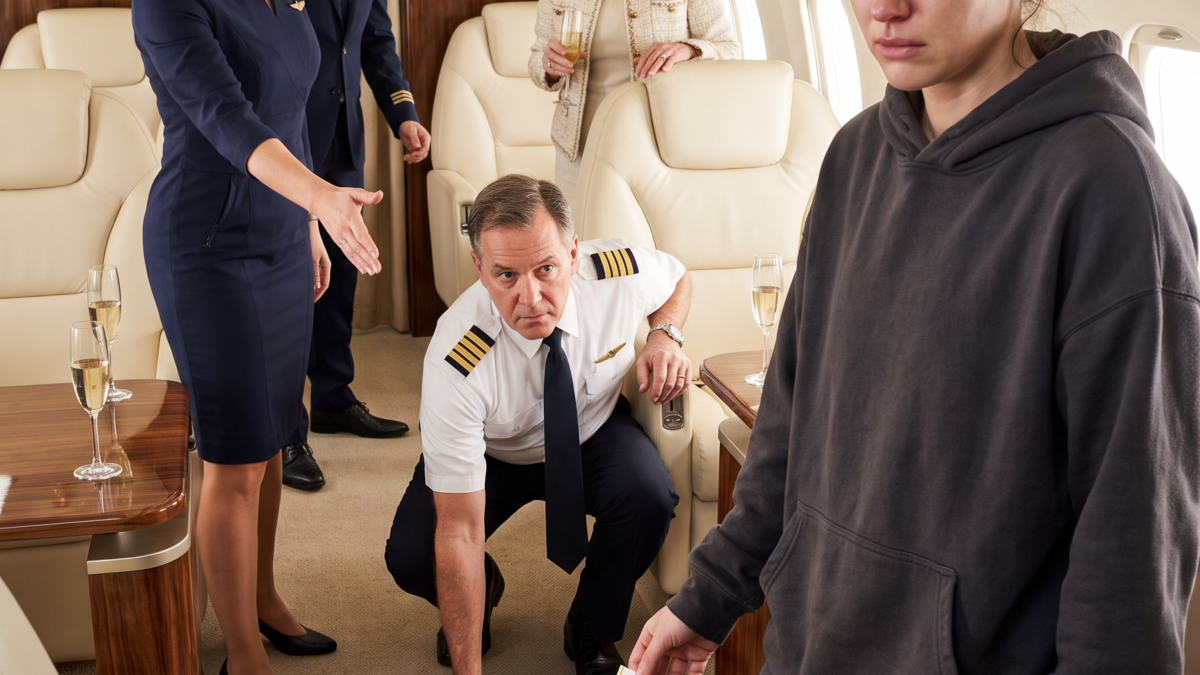
The senior flight attendant had already told the captain I was disruptive and should be removed from first class when she knocked my business card onto the galley floor and said I needed to “learn my place.” I didn’t argue. I simply asked the captain to pick the card up. He read my name, checked the aircraft identification beside the door, then stopped defending her. The strangest part wasn’t that my company controlled the lease on that jet. It was what her next lie revealed about the airline behind it.
The first thing Zara Mitchell noticed about Terminal 4 at John F. Kennedy International Airport was how tired everyone looked.
Travelers moved beneath the bright ceiling lights with coats over their arms, children half asleep on rolling suitcases, and phones held close to their faces as gate changes and boarding announcements echoed above them. The air carried the mixed smell of coffee, perfume, recycled air, and rain dampened into wool coats.
Zara fit into the crowd more easily than anyone would have guessed.
At thirty-two, she was the founder and chief executive of Mitchell Vanguard Leasing, an aviation asset company whose name appeared in contracts worth hundreds of millions of dollars. But that afternoon there was nothing about her appearance that advertised any of it.
She wore an oversized charcoal hoodie, faded black leggings, and sneakers that had survived too many airports. Her dark hair was twisted into a loose bun. A battered leather duffel hung from one shoulder.
The bag alone had cost more than some used cars, but age and travel had erased anything obviously expensive about it.
That suited her.
For the previous forty-eight hours, Zara had been in Manhattan working through the final details of a major aircraft leasing transaction. Her attorneys had argued over maintenance reserves. Bank representatives had reviewed guarantees. Technical advisers had gone line by line through utilization limits, inspection requirements, and service obligations.
By late afternoon, the agreements covering twelve long-haul aircraft were finally ready.
Zara had signed the final documents, left the conference room, changed into comfortable clothes, and booked the next available first-class seat to London.
She wanted water.
She wanted silence.
Most of all, she wanted sleep.
At the gate, a man in a dark Italian suit stood in front of her and held out his phone.
The gate agent scanned it.
“Welcome aboard, Mr. Henderson. Have a good flight.”
The man thanked him and disappeared down the jet bridge.
Zara stepped forward.
She held out her own digital boarding pass.
The gate agent scanned it, glanced at the screen, then looked at Zara.
His eyes dropped briefly to her hoodie.
Then to her sneakers.
Then back to the screen.
“First class?”
Zara looked at him.
“Yes.”
The agent typed something into the terminal.
Zara waited.
After a few seconds, she asked, “Is there a problem?”
“No. Just checking.”
He typed again.
“Sometimes upgrades display strangely.”
“It isn’t an upgrade,” Zara said. “I purchased the ticket.”
The fare had been roughly twelve thousand dollars.
She had booked it less than three hours earlier.
The agent finally nodded.
“Everything’s fine.”
He waved her through.
There was no “welcome aboard” this time.
Zara noticed.
Then she forgot about it.
She had spent enough years around airports to know that travelers read one another in seconds. Shoes, watches, bags, accents, jackets, boarding groups—people built entire biographies from fragments.
Most of the time Zara found it mildly amusing.
That evening, she was too tired to care.
The jet bridge hummed beneath her shoes as she walked toward the aircraft.
At the door, she turned left into the first-class cabin.
The space was quiet and polished, designed to make passengers forget they were inside an aluminum tube crossing an ocean. Cream leather suites sat beneath soft lighting. Walnut trim framed the walls. Small reading lamps glowed beside privacy panels. Everything had the restrained, expensive finish common to international premium cabins.
A flight attendant stood near the entrance.
Her name badge read Taylor.
Taylor was polished in a way Zara recognized immediately. Her navy uniform was immaculate. Her blonde hair was arranged with careful precision. Makeup softened every feature without appearing heavy.
She smiled at the businessman entering behind Zara.
Then her eyes moved to Zara.
The smile changed.
“Boarding pass?”
No welcome.
No greeting.
Just an open hand.
Zara showed her phone.
Taylor took it from her instead of simply looking at the screen.
She enlarged the boarding pass.
Checked the flight number.
Checked the date.
Then checked the seat.
“1A,” she said.
“Yes.”
Taylor handed the phone back.
“First suite on the left.”
Her gaze shifted to Zara’s leather duffel.
“Make sure that bag fits completely inside the overhead compartment. We can’t have personal items damaging the cabin.”
“It fits.”
Zara continued toward the seat.
She placed the bag in the overhead compartment without difficulty, sat down, and let her head rest against the seat.
For five seconds she closed her eyes.
Then someone said, “Excuse me.”
Zara opened them again.
A woman in her early sixties stood in the aisle. Her blonde bob was perfectly shaped, and her cream tweed jacket looked newly pressed. Pearls rested at her throat. She held a structured designer handbag against one hip.
“Yes?” Zara asked.
“You’re blocking the aisle.”
Zara looked down.
Her feet were inside the boundaries of her suite.
There was enough room beside her for a service cart.
“I don’t think I am.”
The woman stared at her.
“I need to get to my seat.”
“There’s plenty of room.”
The woman lifted her chin.
“Taylor?”
The flight attendant appeared almost immediately.
Her entire expression changed when she recognized the passenger.
“Mrs. Price. Welcome back.”
“Thank you.”
“Is everything all right?”
Mrs. Price gestured toward Zara.
“I’m trying to reach 1K, and the space here feels unnecessarily cramped.”
Taylor looked at Zara.
The warmth disappeared.
“Ma’am, please pull your legs in.”
“They are in.”
Taylor’s mouth tightened.
“We have premium passengers boarding.”
Zara sat up.
“I’m also a passenger.”
“That isn’t what I said.”
Mrs. Price moved past before the exchange could continue.
Her handbag brushed Zara’s shoulder.
Not hard enough to cause more than momentary discomfort, but deliberate enough that Zara noticed.
Mrs. Price settled into the suite across the aisle.
Taylor took her coat.
“Champagne?”
“That would be lovely.”
Zara watched Taylor arrange the coat inside a closet and return with a hot towel.
The contrast was almost theatrical.
Still, Zara put on her noise-canceling headphones and closed her eyes.
She did not turn the headphones on.
They were simply a signal that she did not want to talk.
The cabin filled around her.
A technology executive took a seat behind her. Another passenger Zara vaguely recognized from television settled across the aisle farther back.
Taylor appeared with a tray.
She offered champagne to Mrs. Price.
Then to the passenger behind Zara.
Then to several others.
She passed Zara without stopping.
Zara did not want champagne.
But her mouth was dry from the long day.
When Taylor returned toward the galley, Zara removed one side of her headphones.
“Excuse me.”
Taylor stopped.
“Yes?”
“Could I have a glass of water, please?”
“We’ll begin water service after takeoff.”
Zara glanced at the cart.
Several sealed bottles were clearly visible.
“There’s water on the cart.”
“That’s for the flight crew.”
Zara looked at her for a moment.
“Predeparture service includes water on request.”
Taylor’s expression sharpened.
“I know our service procedures.”
“I’m sure you do. I’m just asking for water.”
Taylor leaned slightly closer.
“We’re serving champagne right now.”
“I don’t drink before overnight flights.”
“Then you can wait.”
The conversation was quiet enough that nobody farther back would have heard every word.
Mrs. Price heard it.
Zara noticed the woman glance over her glass.
Zara also noticed something else.
The service standard Taylor had just denied was written into a manual Zara had reviewed months earlier during a service-quality negotiation.
“Page forty-two,” Zara said.
Taylor blinked.
“What?”
“The cabin-service manual. Water is available during predeparture beverage service.”
For the first time, Taylor looked genuinely surprised.
It lasted less than a second.
Then she recovered.
“I don’t need a passenger telling me how to do my job.”
“I’m not trying to.”
“It certainly sounds like you are.”
Zara exhaled.
“I’d like to speak with the senior cabin crew member.”
Taylor straightened.
“You are.”
“Then I’d like to speak with the captain.”
Taylor gave a short laugh.
“The captain is completing preflight procedures. He isn’t going to interrupt that because you’re upset about water.”
“I’m not upset about the water.”
Taylor folded her arms.
“Then sit back and relax.”
Mrs. Price leaned slightly into the aisle.
“Is everything all right?”
Taylor looked toward her.
“Just a passenger having difficulty with expectations.”
Zara stared at Taylor.
There it was again.
Not service.
Not policy.
Expectations.
The story being built around her had little to do with anything she had actually done.
Zara checked the aircraft door.
It remained open.
Ground employees were still moving through the jet bridge.
She unfastened her seat belt and stood.
Taylor turned.
“Where are you going?”
“To the galley.”
“The seat-belt sign—”
“Is off.”
Taylor looked toward the sign.
Zara was correct.
She walked forward.
A junior attendant named Jason stood inside the galley checking supplies.
Taylor followed Zara.
“What are you doing?”
“I need your full name and employee identification.”
Taylor touched her badge.
“It’s on my uniform.”
“Then please let me read it.”
Taylor covered the badge with her hand.
“You can submit whatever complaint you want after the flight.”
Jason looked between them.
“Taylor, maybe we should just—”
She shot him a warning glance.
He stopped.
Zara kept her voice level.
“I’m giving you an opportunity to end this professionally. Please provide the service I purchased and acknowledge that the interaction has become inappropriate.”
Taylor took a step closer.
“You really don’t understand, do you?”
“Understand what?”
“This is an international first-class cabin. There are standards.”
“I agree.”
“No. You don’t.”
Taylor gestured toward Zara’s clothing.
“You come in dressed like that, you challenge crew instructions, you make other passengers uncomfortable, and then you demand the captain.”
Jason’s expression tightened.
Zara noticed it.
“Which passenger said I made them uncomfortable?”
Taylor looked toward Mrs. Price.
“People notice things.”
“That isn’t an answer.”
Taylor’s jaw moved.
She stepped even closer.
“You are a guest in my cabin.”
“No,” Zara said quietly. “I’m a customer on an aircraft your employer operates.”
“I decide what happens in this cabin.”
Jason spoke again.
“Taylor.”
She ignored him.
Zara reached into the leather wallet she carried inside the hoodie.
She removed a business card.
Heavy white stock.
Her name embossed across the front.
She held it toward Taylor.
“I think we should start over. My name is Zara Mitchell.”
Taylor looked at the card.
Then at Zara.
She flicked it away with the back of her hand.
The card fluttered to the galley floor.
Jason stared at it.
Zara did too.
Then she raised her eyes.
“That was unnecessary.”
Taylor pointed toward the cabin.
“Go back to your seat.”
Zara remained where she was.
“Or what?”
“I’ll have you removed.”
“You’re going to remove a ticketed passenger because she asked for water?”
“I’m going to remove a disruptive passenger who refuses crew instructions.”
Jason shook his head slightly.
Taylor saw him.
“Go get the captain.”
“Taylor—”
“Now.”
Jason hesitated.
Before he moved, the flight-deck door opened.
Captain Robert Miller stepped into the galley.
He was in his mid-fifties, broad-shouldered, with gray beginning to overtake the brown in his hair. Four stripes marked his epaulets.
“What is happening out here?”
Taylor’s transformation was immediate.
She stepped back.
Her voice softened.
“Captain, thank goodness.”
Miller looked at her, then Zara.
Taylor continued.
“This passenger has been difficult since boarding. She ignored instructions. She became confrontational when I explained the service procedure, and then she followed me into the galley.”
Zara said nothing yet.
Taylor’s voice grew more emotional.
“She threatened my job.”
Jason looked up sharply.
Miller frowned.
“She threatened you?”
“Yes.”
“No,” Zara said.
The captain turned.
“Miss?”
“I asked for water. Then I asked to speak to the senior crew member. When Taylor told me she was the senior crew member, I asked for you.”
Taylor interrupted.
“She also tried to interfere with the service cart.”
“I did not.”
“She kept demanding alcohol.”
“I asked for water.”
Mrs. Price was now watching from the aisle.
Several nearby passengers had gone quiet.
Captain Miller looked at Taylor.
Then at Zara’s hoodie and sneakers.
Zara saw the moment he made a decision.
He was tired.
The aircraft needed to depart.
Taylor was his senior attendant.
Zara was an unknown passenger involved in a dispute.
“Ma’am,” he said, “I’m going to rely on my crew’s assessment.”
Zara nodded once.
“All right.”
“If Taylor believes the situation may affect cabin safety, I can’t ignore that. I’m going to ask you to collect your bag and return to the gate.”
Taylor stood slightly behind him.
She said nothing.
She did not need to.
Her expression said enough.
Zara looked at Jason.
He was staring down.
Then Zara looked at the white business card lying near Captain Miller’s shoe.
“Captain.”
“Yes?”
“Before I leave, would you pick up that card?”
Miller glanced down.
“What card?”
“The one Taylor knocked out of my hand.”
Taylor spoke quickly.
“It’s nothing.”
Miller looked at her.
Then back at the floor.
Zara said, “Please.”
Something in her tone made him bend down.
He picked up the card.
Adjusted it beneath the galley light.
His eyes moved across the embossed letters.
Zara Mitchell
Founder and Chief Executive Officer
Mitchell Vanguard Leasing
The captain stopped.
Zara watched recognition arrive slowly.
Aviation was a small industry at the level of leasing, financing, and fleet management. Pilots did not necessarily know every executive, but Mitchell Vanguard was not an obscure company.
Miller turned the card over.
A handwritten note appeared on the back.
Zara had written an internal fleet reference while reviewing documents earlier that afternoon.
Miller glanced at the identification plate near the aircraft doorway.
Then he looked at the card again.
Taylor crossed her arms.
“Anyone can print a business card.”
Captain Miller ignored her.
“You’re Zara Mitchell?”
“I am.”
He looked toward the cabin.
Then back to the aircraft identification.
Zara could see him assembling the connection.
Most commercial passengers assumed airlines owned the aircraft painted in their colors.
Many did not.
Modern fleets were financed through complex arrangements involving banks, special-purpose companies, leasing firms, investors, and operators.
Mitchell Vanguard owned or controlled a significant group of aircraft leased to Stratosphere Air.
This aircraft was among them.
Zara had signed renewal documents involving it that afternoon.
Taylor gave a nervous laugh.
“Captain, seriously?”
Miller lifted one hand.
“Taylor.”
“She could have printed that at any shop in Manhattan.”
“Taylor.”
“I’m telling you—”
“Stop.”
The single word changed the atmosphere.
Taylor stared at him.
Behind her, Jason raised his head.
Mrs. Price slowly lowered her glass.
Zara did not smile.
She did not feel victorious.
She felt deeply disappointed.
“I did not board this aircraft to inspect your crew,” she told Miller. “I boarded because I needed to get to London.”
He nodded.
“I understand.”
“No, I don’t think you do yet.”
She looked toward Taylor.
“I was questioned at the gate because my ticket didn’t match what someone thought I should look like. Then your senior attendant checked the same valid ticket again. Another passenger claimed I was blocking an aisle I wasn’t blocking. I was denied water that was available to the rest of the cabin. And when I asked for the captain, Taylor created an entirely different version of what happened.”
Taylor shook her head.
“That is not true.”
Jason finally spoke.
“She asked for water.”
Taylor turned.
“What?”
Jason swallowed.
“She asked for water. I heard that part.”
Taylor’s expression tightened.
“You weren’t there at the beginning.”
“I was here when she asked for your name.”
Miller looked at him.
“Did she threaten Taylor?”
Jason hesitated.
Zara understood why.
Taylor outranked him.
They would continue working together if the flight departed normally.
“She said she wanted the situation de-escalated,” he said.
Taylor stepped toward him.
“Jason.”
Captain Miller lifted a hand again.
“Let him finish.”
Jason looked at the captain.
“She offered her card. Taylor knocked it away.”
Nobody said anything for several seconds.
Miller looked down at the card still in his hand.
Then he returned it to Zara.
“I owe you an apology.”
“This is larger than an apology.”
“I know.”
Taylor spoke quickly.
“She was still making Mrs. Price uncomfortable.”
Everyone looked toward Gwendolyn.
The woman froze.
Earlier, she had been eager to participate.
Now she studied the glass in her hand.
Captain Miller asked, “Mrs. Price, did Ms. Mitchell threaten you?”
“No.”
“Did she interfere with you?”
Gwendolyn shifted in her seat.
“She was… there.”
Zara almost laughed.
Miller waited.
Gwendolyn finally added, “The aisle was tight.”
Jason looked toward the aisle.
It was not tight.
Miller noticed.
Taylor noticed him noticing.
Zara pulled out her phone.
“I’m calling Marcus.”
Taylor frowned.
“Marcus who?”
Zara dialed.
The call rang twice.
A man answered.
“Zara. I thought you’d be airborne by now.”
“I should be.”
Marcus Thorne was the chief executive of Stratosphere Air.
He and Zara had spent part of the previous week negotiating the fleet arrangement.
“Something wrong mechanically?” he asked.
“No.”
“Then what happened?”
“I’m standing in the forward galley of Flight 909.”
There was a pause.
“You’re on 909?”
“Yes.”
“That’s one of the renewed aircraft.”
“I know.”
Marcus’s tone changed.
“What happened?”
Zara gave him the facts in order.
She did not exaggerate.
She explained the boarding-pass questions, Mrs. Price’s complaint, the water request, Taylor’s comments, the business card, and the accusation made to Captain Miller.
Taylor began shaking her head.
“That isn’t how it happened.”
Marcus heard her.
“Who is speaking?”
“Taylor, the senior attendant.”
“Put her on.”
Zara extended the phone.
Taylor did not take it.
Captain Miller said quietly, “Take the phone.”
Taylor looked from him to Zara.
Then she accepted it.
“Mr. Thorne?”
“Taylor, did you refuse service to passenger 1A?”
Taylor glanced around.
“I was maintaining cabin standards.”
“That wasn’t my question.”
“She was disruptive.”
“Did she ask for water?”
Taylor’s mouth opened.
Nobody moved.
Finally she said, “She didn’t look like she belonged up here.”
The sentence settled over the galley.
Jason stared at her.
Captain Miller slowly looked away.
Gwendolyn stopped pretending not to listen.
Marcus was silent for several seconds.
Then he said, “Give the phone back to Zara.”
Taylor handed it over.
Her confidence had not vanished completely, but it had cracked.
Zara lifted the phone.
“I’m here.”
Marcus exhaled.
“I’m sorry.”
“Don’t apologize yet.”
“I’m serious.”
“So am I.”
Zara looked around the cabin.
“I need you to review this as an operational problem, not a VIP problem. The problem is not that Taylor treated the CEO of Mitchell Vanguard this way. The problem is that she believed it was acceptable to treat any paying passenger this way.”
“I agree.”
“Do you?”
“Yes.”
“Then don’t solve it because my name is on the contract.”
Marcus was quiet.
Zara continued.
“Review the incident the same way you would if I were exactly who Taylor believed I was.”
Marcus said, “Understood.”
Then he added something Zara had not expected.
“There may be another issue.”
“What issue?”
“I’m opening our complaint system.”
She heard typing on his end.
“Your description sounds familiar.”
Taylor’s eyes moved toward the phone.
Zara noticed.
“Familiar how?”
“Give me a second.”
More typing.
Then Marcus stopped.
“I have a complaint from seven months ago. Same route. Same senior attendant.”
Captain Miller’s posture changed.
Zara looked at Taylor.
“What happened to it?”
“That’s the problem.”
Marcus read from the record.
“It was closed as resolved.”
“Was it investigated?”
Another pause.
“No.”
Taylor spoke.
“That complaint was nonsense.”
Miller turned toward her.
“You remember it?”
Taylor realized too late what she had just admitted.
Marcus asked through the speaker, “Taylor, how do you know which complaint I’m talking about?”
She said nothing.
Jason took half a step away from her.
The original dispute had changed.
Until then, Zara had believed she was dealing with one employee making a series of poor decisions.
Now there was evidence of something older.
Something the system had already been given an opportunity to examine.
“Marcus,” Zara said, “preserve that complaint.”
“I will.”
“And every complaint connected to this crew for the past two years.”
“Done.”
Zara ended the call.
Captain Miller looked at her.
“What do you want to do?”
It was a complicated question.
Contractually, Mitchell Vanguard had leverage over the aircraft.
Operationally, Stratosphere controlled the flight.
Personally, Zara wanted nothing more than to sit down.
But allowing the flight to continue as if nothing had happened would send the wrong message.
“I’m not asking you to punish anyone on my behalf,” she said. “I am telling you I’m not comfortable flying while the employee who just made false statements about me remains responsible for passenger service.”
Miller nodded slowly.
“I understand.”
Taylor stepped forward.
“You’re going to remove me because she’s rich?”
Zara looked at her.
“No.”
Taylor laughed bitterly.
“That’s exactly what this is.”
“No. You’re being removed because you lied to your captain.”
Taylor looked at Miller.
He did not defend her.
“And because,” Zara continued, “you just admitted that you decided who belonged here based on how they looked.”
Taylor’s eyes filled.
“I’ve worked for this airline for ten years.”
“That should have made your judgment better, not protected it.”
Miller called the gate.
A supervisor arrived within minutes.
Taylor was relieved from the flight pending review.
She argued.
She said the situation had been misunderstood.
She said Zara had provoked her.
She said Marcus had heard only one side.
Captain Miller responded with the detail she could not explain away.
“Jason heard it.”
Taylor looked toward the junior attendant.
He did not look down this time.
He met her eyes.
“I heard enough.”
The supervisor asked Taylor to collect her personal bag.
Taylor’s shoulders dropped.
As she walked past Zara, she stopped.
“You’ve ruined my career.”
Zara shook her head.
“I reported what happened.”
Taylor opened her mouth.
Then closed it.
The supervisor escorted her into the jet bridge.
Nobody applauded.
Zara was grateful for that.
The whole situation felt too uncomfortable for celebration.
She returned to seat 1A.
Jason approached a minute later.
His hands were still slightly unsteady.
“Ms. Mitchell?”
“Zara is fine.”
“Would you like some water?”
For the first time that evening, she smiled.
“Yes.”
He brought a bottle and a glass.
Before leaving, he said quietly, “I’m sorry I didn’t speak sooner.”
Zara looked at him.
“You spoke.”
“Eventually.”
“You were afraid.”
He nodded.
“That’s worth remembering.”
Jason looked toward the galley.
“I should have said something before the captain came out.”
“Then next time, say it sooner.”
He nodded again.
The aircraft departed after a delay.
Once they reached cruising altitude, the cabin became unusually quiet.
Gwendolyn remained silent for nearly an hour.
Then she leaned across the aisle.
“Ms. Mitchell?”
Zara looked up from her book.
“I wanted to apologize.”
Zara waited.
“I was influenced by Taylor’s behavior.”
“You complained before Taylor said anything.”
Gwendolyn’s mouth tightened.
“That’s fair.”
“You thought I didn’t belong here.”
Gwendolyn glanced toward Zara’s hoodie.
“I made an assumption.”
“Yes.”
“I regret it.”
Zara studied her.
The apology sounded sincere enough to be uncomfortable.
But Zara also knew fear could sound remarkably similar to sincerity.
“You don’t need to be afraid of me,” she said.
“I’m not.”
“You are.”
Gwendolyn looked down.
Zara continued.
“The useful part of this is not whether you apologize to me now. It’s whether you notice the next time you make the same assumption about someone whose name you don’t recognize.”
Gwendolyn nodded.
She did not speak again.
Zara tried to sleep.
She could not.
Instead, she opened her laptop.
The incident had stopped feeling personal.
That made it more serious.
She created a new document.
Operational Review: Stratosphere Air Passenger-Service Standards
She wrote down the sequence while every detail was still fresh.
Gate interaction.
Boarding.
Seat 1A.
Mrs. Price.
Water request.
Manual reference.
Galley confrontation.
Business card.
False accusation.
Jason’s hesitation.
Captain’s initial reliance on Taylor’s account.
The earlier complaint.
That final item became the center of the document.
One bad interaction could be a training failure.
A previous complaint closed without meaningful review suggested a process failure.
By the time the plane crossed the Atlantic, Zara had outlined several proposed changes for the next lease discussions.
Independent complaint review.
Anonymous service audits.
Clear escalation channels for junior crew members.
Bias and customer-treatment training.
Preservation requirements for complaints involving crew conduct.
Protections for employees who contradicted more senior colleagues during internal reviews.
At Heathrow, Captain Miller waited near the cockpit door.
“Ms. Mitchell.”
Zara stopped.
“I want to apologize again.”
“You already did.”
“I know. This one is different.”
She waited.
“I trusted Taylor because I’d flown with her before.”
“That makes sense.”
“It doesn’t excuse what I ignored.”
“No.”
He rubbed one hand across his jaw.
“I should have asked Jason what he saw before telling you to leave.”
“Yes.”
Miller nodded.
“I will remember that.”
Zara extended her hand.
He shook it.
“Trusting your crew is usually necessary,” she said. “But trust can’t replace verification when the facts are disputed.”
“I understand.”
Zara stepped into the terminal.
She did not see Taylor again that day.
Back at JFK, Taylor sat in an employee office waiting for an internal review.
Her badge and secure-area access had been temporarily surrendered.
The room was ordinary: gray table, gray chairs, fluorescent lights, a wall clock that seemed louder than it should have been.
Taylor kept telling herself the same thing.
It had been a misunderstanding.
Zara had overreacted.
The captain had been intimidated by money.
Marcus had panicked because of contracts.
When the door opened, Taylor expected a junior human-resources representative.
Instead, Sarah Jenkins, Stratosphere’s vice president of in-flight services, entered carrying a file.
She sat across from Taylor.
“Do you understand why you’re here?”
Taylor straightened.
“I maintained first-class standards.”
Sarah did not respond immediately.
Then she opened the file.
“We interviewed Jason.”
Taylor’s confidence shifted.
“He’s inexperienced.”
“We also interviewed Captain Miller.”
“He only arrived at the end.”
Sarah turned a page.
“And we reviewed available operational records and the earlier passenger complaint from seven months ago.”
Taylor stared at her.
“That complaint was closed.”
“It was.”
“So why are you reopening it?”
“Because it was closed improperly.”
Taylor looked toward the door.
Sarah continued.
“The passenger reported nearly the same pattern Ms. Mitchell described. Questioning of a valid premium ticket. Unequal service. Escalation after the passenger challenged the treatment. A crew report characterizing the passenger as disruptive.”
“That person was disruptive.”
“Did you write the crew report?”
“I contributed.”
“Did you participate in closing the complaint?”
Taylor did not answer.
Sarah slid a printed document across the table.
Taylor looked at it.
The earlier complaint had been marked resolved after an internal note stated that multiple crew members had confirmed the passenger was disruptive.
Sarah tapped the page.
“We contacted two of those crew members.”
Taylor’s fingers stopped moving.
“One says she was never interviewed.”
Taylor swallowed.
Sarah continued.
“The other says she disagreed with your account.”
Taylor leaned back.
“That’s not what happened.”
“Then we have a larger problem.”
Sarah closed the file.
“This is no longer about Zara Mitchell.”
Taylor’s voice became defensive.
“She owns half your fleet.”
“That fact is irrelevant to the conduct review.”
“It’s obviously not irrelevant.”
Sarah looked at her steadily.
“Do you know what Ms. Mitchell asked Marcus to do?”
Taylor said nothing.
“She asked him to investigate the incident as if she were an anonymous passenger.”
Taylor stared at the table.
Sarah continued.
“That is what we did.”
The internal process lasted several days.
Records were compared.
Crew members were interviewed.
The earlier complaint was reopened.
Additional passenger reports were identified.
Not every complaint involved Taylor.
Not every complaint was substantiated.
But enough inconsistencies existed that Stratosphere began a broader review of how cabin-service complaints were classified and closed.
Taylor’s own conduct presented fewer ambiguities.
Jason confirmed the water request.
Captain Miller confirmed the statements she made before Zara’s identity was established.
Taylor herself had admitted to Marcus that she believed Zara did not look as though she belonged in first class.
The employment decision arrived after the review.
Taylor was terminated for misconduct, dishonesty during an operational incident, and violations of passenger-service standards.
She appealed through the available process.
The decision was upheld.
For Zara, the matter did not end with Taylor.
Within weeks, Mitchell Vanguard and Stratosphere Air added service-quality provisions to their fleet agreement.
Stratosphere introduced independent audits on selected routes.
Junior employees received clearer procedures for reporting concerns involving senior crew.
Passenger complaints involving disputed crew accounts received additional review.
Zara refused requests from public-relations staff to turn the incident into a promotional story.
She had no interest in becoming the woman who secretly boarded airplanes to test employees.
She had been tired.
She had wanted water.
The rest had happened because several people thought clothing told them everything they needed to know.
Five years passed.
Airlines changed schedules.
Aircraft moved between routes.
Companies merged, expanded, and rebranded.
Mitchell Vanguard grew significantly.
Zara spent more time in boardrooms than cabins, though she continued to fly commercially often enough to understand the passenger experience.
She became more recognizable inside the aviation business but remained largely anonymous to the public.
One autumn morning, she returned to JFK.
This time, she was traveling from a private terminal on the far side of the airport.
A black SUV dropped her near the entrance.
Her assistant, Chloe, walked beside her.
Zara was dressed differently than she had been five years earlier: tailored navy blazer, dark jeans, simple loafers, sunglasses.
She was scheduled to travel to Tokyo later that morning.
Before heading to the private terminal, she stopped.
“I want coffee.”
Chloe checked the time.
“We can have something brought to the aircraft.”
“I want the vanilla latte from Terminal 4.”
Chloe looked at her.
“The terrible one?”
“The nostalgic one.”
They walked into the main terminal.
The place sounded exactly as Zara remembered.
Announcements.
Rolling bags.
Children protesting long lines.
Espresso machines hissing from cafés.
The coffee shop line stretched toward a newsstand.
Chloe looked at it.
“I can get it.”
“I can stand in line.”
“You have a call in forty minutes.”
“Then I have thirty-nine minutes.”
Zara joined the queue.
The experience felt strangely grounding.
Five years earlier she had moved through the same terminal wearing a hoodie and hoping nobody spoke to her.
Now she stood in a blazer expensive enough to make strangers move aside.
The difference amused her more than it pleased her.
When she reached the register, the employee behind it did not look up.
“Next.”
The voice caught Zara’s attention.
Not the words.
The cadence.
Rougher than she remembered.
More tired.
But familiar.
Zara looked at the woman.
Blonde hair pulled into a practical ponytail.
Green apron.
Name tag tilted slightly.
Taylor.
For a second, Zara genuinely wondered whether she was mistaken.
Five years changed people.
Taylor looked older.
Not dramatically.
Just honestly.
There were lines beside her eyes Zara did not remember. Her hair was less carefully styled. Her expression carried the fatigue of someone halfway through an early airport shift.
“Order?” Taylor asked.
Zara stepped forward.
“A large vanilla bean latte.”
“What milk?”
“Whole.”
Taylor tapped the register.
“Name?”
Zara hesitated.
Then answered.
“Zara.”
Taylor’s hand stopped above the screen.
Slowly, she raised her head.
Their eyes met.
Recognition happened instantly.
Taylor stared.
Zara removed her sunglasses.
“Hello, Taylor.”
For several seconds, neither spoke.
Steam hissed behind the counter.
Somebody farther down called out an order number.
The line shifted impatiently.
Taylor gripped the edge of the register.
“You.”
“Yes.”
“What are you doing here?”
“Buying coffee.”
Taylor looked past Zara at Chloe.
Then at Zara’s blazer.
Her mouth tightened.
“You came here deliberately.”
“I didn’t know you worked here.”
Taylor gave a short, humorless laugh.
“Of course you didn’t.”
Zara remained still.
Taylor’s voice dropped.
“Do you know what happened after that day?”
“Yes.”
“No, you know the company version.”
A customer behind Zara shifted.
Chloe moved slightly closer, but Zara gave her a small gesture to stay where she was.
Taylor looked toward the manager at the other end of the counter.
Then back at Zara.
“I lost the airline job.”
“I know.”
“I lost my travel benefits.”
Zara said nothing.
“I had to move.”
Taylor swallowed.
“I work openings here. Four in the morning sometimes.”
“I’m sorry things have been difficult.”
Taylor stared at her.
“Don’t.”
“Don’t what?”
“Don’t stand there and pity me.”
“I’m not.”
“You ruined my life.”
The sentence came out quietly.
That made it heavier.
Zara studied her.
“I reported what happened.”
“You made one phone call.”
“No.”
“One call to Marcus and suddenly everybody cared.”
“The review lasted several days.”
“Because of who you were.”
“The review found more than what happened to me.”
Taylor looked away.
“That old complaint should never have been reopened.”
Zara’s expression changed.
“Why?”
Taylor realized what she had said.
Again.
Five years later, the same mistake.
She shook her head.
“It doesn’t matter.”
“It mattered to the passenger.”
Taylor pressed her lips together.
Zara continued.
“You still think the problem was that I had more power than you.”
“What else was it?”
“You lied about me.”
Taylor looked down.
“You decided I wasn’t entitled to ordinary service because of what I was wearing.”
Taylor said nothing.
“You gave Captain Miller a version of events that Jason contradicted.”
“I was under pressure.”
“You closed an earlier complaint with information other crew members disputed.”
Taylor’s fingers tightened around the edge of the counter.
“That job was my entire life.”
“And that made your choices acceptable?”
“No.”
It was the first time Taylor had said it.
Zara waited.
Taylor looked up.
“No,” she repeated.
Her voice had changed.
“I made terrible decisions.”
The admission seemed to surprise Taylor as much as Zara.
A customer behind them sighed.
Taylor wiped one hand across her cheek.
“I spent years being angry at you.”
“I know.”
“How could you know?”
“Because you’re still angry.”
Taylor almost smiled.
It disappeared quickly.
“I thought if you had just been somebody ordinary, none of it would have happened.”
Zara looked at her for a long moment.
“That sentence is the entire problem.”
Taylor closed her eyes.
“I know.”
This time, Zara believed her.
She took a twenty-dollar bill from her wallet and placed it on the counter.
Taylor looked at it.
“The latte is six twenty-five.”
“Keep the rest.”
Taylor’s eyes hardened briefly.
“I don’t need charity.”
“It’s a tip.”
“For what?”
“For making the coffee.”
Taylor stared at the bill.
Then at Zara.
“Does seeing me here make you feel better?”
“No.”
“Really?”
“Really.”
“Why not?”
“Because there is nothing shameful about working here.”
Taylor looked around the shop.
Zara continued.
“The job was never the thing that made anyone better than anyone else.”
Taylor’s eyes shifted downward.
“That was what I failed to understand.”
“Yes.”
The manager called Taylor’s name from the espresso station.
Taylor straightened.
Her shift continued whether the past had returned or not.
Zara stepped aside.
A few minutes later, Taylor placed the latte on the pickup counter.
“Zara.”
Zara walked over.
Taylor held the cup for half a second before releasing it.
“I am sorry.”
Zara looked at her.
“For the plane?”
“For the plane.”
Taylor swallowed.
“And for what happened before the plane. The way I looked at you before you even spoke.”
Zara took the cup.
“Thank you.”
Taylor nodded.
Zara started to leave.
Behind her, a young man in a faded gray hoodie reached the register.
Taylor looked at him.
For one brief second Zara saw the old reflex—the quick visual assessment, the judgment formed before a word was spoken.
Then Taylor stopped herself.
Her shoulders lowered.
“I’m sorry about the wait,” she said. “What can I get you?”
The young man smiled.
“Just black coffee.”
“Sure.”
Zara continued walking.
She did not turn the moment into a lesson.
She did not tell Chloe what it meant.
She simply carried her coffee through the terminal while the morning crowds moved around her.
At the private terminal, her aircraft was waiting.
Zara climbed the steps, settled into her seat, and placed the vanilla latte beside a stack of documents.
Chloe sat across from her.
“That was Taylor, wasn’t it?”
“Yes.”
“The flight attendant?”
“Yes.”
Chloe waited.
Zara looked through the window at the airport ramps beyond the glass.
“What did she say?”
Zara thought about the question.
“She said she was sorry.”
“Did you believe her?”
Zara watched a commercial jet taxi toward the runway.
“I think she finally understood what she was apologizing for.”
The engines outside began to rise.
Years earlier, Zara had walked onto an airplane exhausted and anonymous, only to discover how quickly people could confuse appearance with worth.
Five years later, she understood something more complicated.
Consequences could stop behavior.
Only reflection could change it.
The aircraft began to move.
Zara took a sip of the latte.
It tasted exactly as mediocre as she remembered.
She smiled and opened the first document on her desk.
This story is a dramatized work of fiction created solely for storytelling and entertainment purposes. It is not presented as a factual report or news account. Any resemblance to actual people, places, organizations, or events is purely coincidental. Names, dialogue, locations, timelines, occupations, and identifying details have been invented, combined, or altered to protect privacy and support the narrative. Some accompanying images or visual elements may be AI-generated or digitally enhanced.