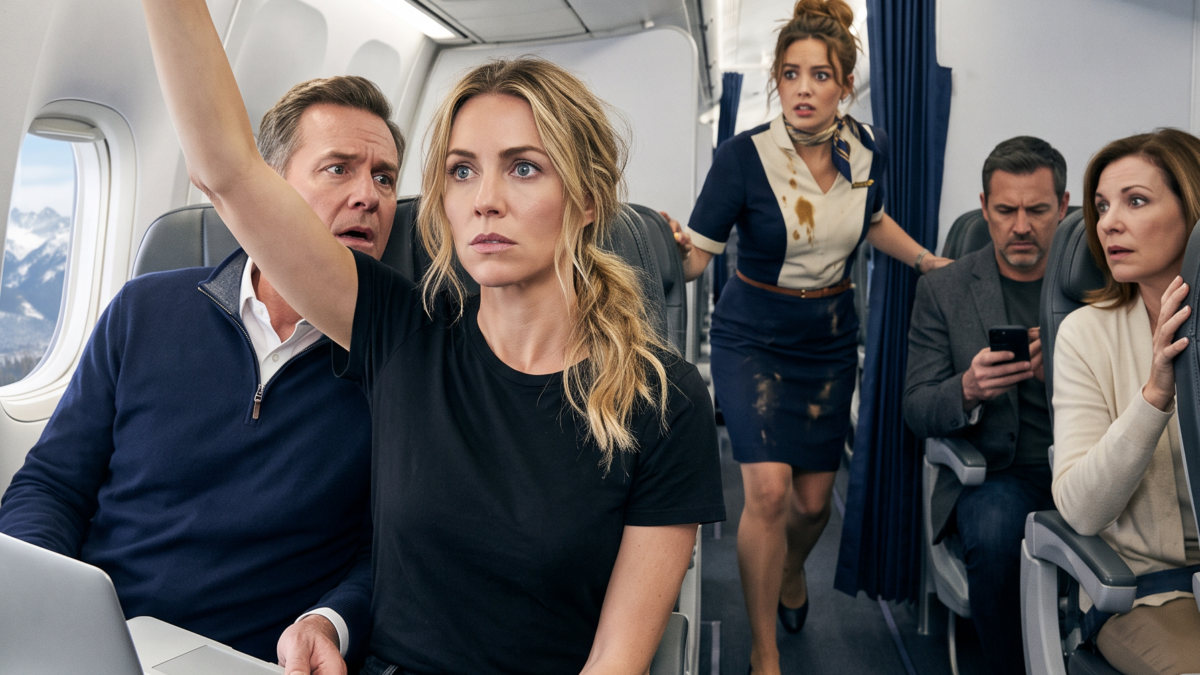
The announcement came just after the airliner dropped hard enough to send laptops off tray tables: “If there are any military pilots on board, please ring your call button.” Harper Cole stayed still in seat 8A. She had spent years flying fast military jets, but she had never touched the controls of a Boeing 767. Then the plane rolled unevenly again, no reassuring voice came from the cockpit, and Harper noticed the detail that changed everything: nobody else was pressing a call button.
The overhead chime did not wake Harper Cole.
The airplane did.
She opened her eyes because the pitch of the engines had changed beneath her, a thin descending whine subtle enough that most passengers would never have noticed it. After years of listening to aircraft through helmets, headsets, flight decks, and long hours in the air, Harper’s nervous system recognized changes before her conscious mind did.
She remained still for a moment, her temple resting against the cool window beside seat 8A.
Outside, sunlight spilled across distant snow-covered mountains. Inside, the Boeing 767’s premium-economy cabin had been dimmed enough to encourage sleep. Window shades farther back were closed. Reading lights glowed above a few seats. Somewhere behind her, ice shifted inside a plastic cup.
Everything looked ordinary.
That was why the engine sound bothered her.
Harper had boarded in Dallas exhausted in a way that a single night’s sleep could not repair. She had recently returned from months away with her squadron, and what she wanted from the flight to Seattle was simple: four quiet hours in which nobody expected anything from her.
No briefings.
No radios.
No schedules built around weather.
No responsibility for an aircraft.
Just seat 8A, a window, and the olive-drab duffel bag shoved beneath the seat in front of her.
The man beside her had noticed the bag almost immediately after boarding.
He was somewhere in his late forties, wearing a navy quarter-zip sweater over a white shirt. A laptop bag had been wedged carefully beneath his seat, and he had the permanently hurried air of a person who spent a great deal of time moving through airports while answering emails.
He had introduced himself as Greg.
His eyes had dropped to Harper’s duffel.
“Military?”
Harper had given him a small closed-mouth smile.
“Yeah.”
“What do you do?”
She had considered the question for perhaps half a second.
“Fly.”
His eyebrows had lifted.
Before he could ask the follow-up she had heard hundreds of times, Harper had slipped on her noise-canceling headphones.
Greg understood the message.
He opened a spreadsheet.
Harper closed her eyes.
At cruising altitude, commercial travel usually felt almost unnaturally calm to her. She was accustomed to aircraft that transmitted information directly through her body—the smallest change in acceleration, the pressure of a turn, vibration in the controls, the rapid conversation between pilot and machine.
An airliner was different.
It felt detached.
The airplane flew while passengers ate pretzels and watched movies.
That afternoon, Harper had been grateful for that detachment.
She drifted into sleep.
She did not know how long she had been out when the first major jolt came.
The airplane dropped.
Not a mild pocket of rough air. Not the quick bump that made coffee tremble in a cup.
The bottom seemed to disappear beneath the cabin.
Harper’s seat belt caught her hard across the hips.
Greg’s laptop lifted off his tray table and struck it again with a sharp crack.
Several passengers shouted.
Overhead bins rattled. Plastic trim creaked. A cup rolled into the aisle farther back.
Harper’s eyes were fully open before the aircraft recovered.
“Turbulence,” Greg said, as if giving it a name could control it.
Harper did not answer.
Severe clear-air turbulence happened. Sudden altitude changes could be violent enough to frighten even experienced travelers. Nothing about the first drop, by itself, meant the airplane was in serious trouble.
Then the left wing dipped.
Harper’s shoulders shifted against her seat as the aircraft banked farther than she expected.
The correction came abruptly.
The nose rose.
Engine noise increased.
The airplane felt slow to respond, then responded too much.
Harper reached up and removed her headphones.
Greg noticed.
“What?”
She looked out through the window.
The visible horizon was tilted.
“Nothing yet.”
It was the word yet that made him stop looking at his spreadsheet.
The Boeing rolled back toward level flight. For perhaps three seconds, everything steadied.
Then it began drifting the opposite direction.
Greg’s hand closed around the armrest.
“What are they doing up there?”
Harper watched the wing.
“Overcorrecting.”
“What does that mean?”
“It means somebody’s hand-flying.”
Greg waited for more.
Harper gave him nothing.
Her attention had moved to the heavy curtain separating their cabin from the forward section. It swayed with the aircraft.
After significant turbulence, commercial flight crews usually communicated quickly. A captain did not need to deliver a speech. A simple announcement—rough air, remain seated, cabin crew take jump seats—was enough to reassure passengers that the cockpit understood what had happened.
No announcement came.
The cabin grew louder with whispers instead.
A woman across the aisle turned to her husband.
Someone farther back pressed a flight-attendant button.
Harper kept listening.
The engines surged again.
The airplane’s movements lacked the precise, locked-in feel she associated with an autopilot holding altitude and heading.
Someone was controlling it manually.
Whoever it was did not seem comfortable.
Then came a double chime.
The cabin went quiet almost immediately.
The public-address system clicked.
A woman’s voice emerged through light static.
“Ladies and gentlemen, this is your lead flight attendant. We are experiencing a medical situation.”
She stopped.
Harper heard her breathe.
The next sentence came more carefully.
“If there are any military pilots on board, please ring your call button.”
Greg slowly turned his head.
Harper kept staring at the seatback in front of her.
Her first thought was immediate and unreasonable.
No.
Her second thought was more practical.
Someone else will answer.
Airliners carried enormous cross-sections of people. Retired pilots. Airline employees commuting home. Cargo crews traveling as passengers. Military aviators with transport experience. Surely someone on a Dallas-to-Seattle flight had more relevant time in a large multi-engine aircraft than she did.
Harper had thousands of hours in tactical jets.
That did not make a Boeing 767 familiar.
It made it almost comically unfamiliar.
The systems were different.
The cockpit philosophy was different.
The weight was different.
The control response was different.
She waited.
Five seconds.
Nothing.
Ten seconds.
Still nothing.
No call-button lights appeared ahead of them.
Nobody stood.
The Boeing rolled right.
This time there was an ugly hesitation in the correction. Engine power increased a moment late, as though the pilot had fallen behind the airplane and was trying to catch up.
Harper shut her eyes briefly.
Then she raised her hand.
The button clicked beneath her fingertip.
An amber light appeared overhead.
Greg stared at it.
Then at her.
“You’re a pilot?”
Harper released her seat belt.
“Navy.”
His expression changed.
“What kind?”
“Not this kind.”
She stood.
“Let me out.”
Greg pulled his knees back immediately.
A young flight attendant appeared through the forward curtain before Harper had fully stepped into the aisle. A dark coffee stain marked one side of her navy skirt. Several strands of brown hair had escaped what had once been a tidy bun.
Her name tag read CHLOE.
She saw the illuminated button above 8A.
Then she saw Harper.
“You called?”
“Lieutenant Commander Harper Cole.”
Chloe looked relieved too quickly.
“What do you fly?”
“F/A-18s.”
The relief became uncertainty.
Harper saw it and understood.
“Tell me what’s happening.”
Chloe glanced toward the forward cabin.
“Come with me.”
She reached for Harper’s wrist, caught herself, then instead gestured urgently toward the curtain.
Harper followed.
First class had become unnaturally quiet. Passengers watched them pass with the strained expression of people trying to learn something from body language.
Harper gave them nothing.
The civilian passenger in her was disappearing now.
Her mind began sorting information into categories.
Aircraft control.
Crew condition.
Weather.
Fuel.
Navigation.
Communications.
Unknowns.
At the forward galley, an older male flight attendant stood beside the reinforced cockpit door with a handset pressed to his ear. He ended the call as Harper approached.
“Jason,” Chloe said. “This is Lieutenant Commander Cole.”
Jason looked Harper up and down.
Jeans.
Black T-shirt.
Hair tied back loosely.
No uniform.
No airline wings.
No reassuring gray-haired captain from a movie.
“Commander,” he said. “We hit severe turbulence. Both pilots were out of their harnesses for a moment.”
Harper’s eyes sharpened.
“What happened to them?”
“Captain Miller is unconscious. We have someone with medical training checking him now.”
“And the first officer?”
“Davis is awake. His right arm is badly injured. He’s controlling the airplane with his left hand.”
Harper looked at the door.
“Autopilot?”
“Disconnected during the drop. He hasn’t been able to get it back.”
That explained everything she had felt from seat 8A.
The wandering.
The late corrections.
The uneven banks.
A large airplane was being hand-flown at altitude by an injured first officer using his non-dominant arm while trying to stay conscious.
“How long has he been alone?”
“Several minutes.”
Harper nodded once.
“Open the door.”
Jason entered the access code.
The lock released.
When the cockpit door opened, sound hit Harper first.
Warning tones.
Electronic alerts.
Air rushing around the fuselage.
The air inside smelled faintly of coffee, warm electronics, and the sharp sterile scent of emergency first-aid supplies.
Captain Miller remained in the left seat, supported by the harness, clearly unable to fly.
First Officer Davis sat on the right.
His face looked drained of color.
His injured arm had been secured as well as circumstances allowed, but his left hand remained wrapped around the yoke.
His breathing was fast.
His eyes were fixed on the attitude display.
Harper stepped inside.
“Davis.”
He did not react.
“Davis, look at me.”
The airplane rolled slightly.
His left hand made a sudden correction.
Harper braced herself against the jump seat.
She moved closer, entering his peripheral vision.
“Davis.”
This time his eyes shifted.
“I’m Lieutenant Commander Harper Cole. I’m a pilot.”
He stared at her.
“What?”
“I’m taking the left seat. I need you to hold the airplane steady long enough for us to move Captain Miller.”
Davis shook his head once.
“I can’t—trim’s—”
“I know. Don’t solve anything else right now. Just hold what you have.”
Jason and Chloe entered behind her.
Moving Captain Miller in the confined cockpit required slow coordination. No one rushed more than necessary. They supported him carefully and transferred him into the forward galley, where another passenger with medical experience was waiting.
As soon as the left seat cleared, Harper slid into it.
The cockpit seemed even larger from there.
She had spent years in aircraft where controls fell naturally beneath her hands because muscle memory had been built through repetition.
Here, every switch required thought.
The yoke itself felt enormous.
She tightened the harness until the straps held her firmly against the seat.
“Davis.”
He looked toward her.
“When I say it, you’re giving me the airplane.”
He swallowed.
“Okay.”
Harper placed both hands around the yoke.
“I have the aircraft.”
Davis released his grip.
“You have the aircraft.”
His shoulders dropped.
For a second, Harper thought he might pass out immediately.
She focused forward.
The attitude display showed a slight bank.
The nose sat higher than she wanted.
Airspeed was decreasing.
Harper reduced the pitch.
The 767 answered slowly.
That delay was the first major surprise.
In the aircraft she knew, small control movements produced immediate feedback.
The Boeing carried enormous momentum.
Every command required patience.
She added power.
The engines responded a moment later.
The nose stabilized.
Harper corrected the bank, then waited instead of chasing the instruments.
The horizon moved toward level.
She adjusted trim.
The pressure in the yoke eased.
Airspeed began recovering.
“Come on,” she murmured.
The airplane settled.
For the first time since she had awakened, the flight felt stable.
Harper reached toward the flashing master warning and silenced what she could identify safely.
The sudden reduction in cockpit noise was startling.
Only airflow and Davis’s breathing remained.
“Still with me?” she asked.
“Yeah.”
“Good.”
He sounded anything but good.
Harper located the radio controls.
She pressed the transmit switch.
“Seattle Center, Heavy 442. Declaring an emergency.”
Static answered.
Then a controller’s calm voice.
“Heavy 442, Seattle Center. State the nature of your emergency.”
“Both operating pilots are incapacitated. I am a non-revenue military pilot and have taken control of the aircraft. Request vectors to the nearest suitable runway and immediate contact with a Boeing-qualified pilot who can talk me through the systems.”
There was a short pause.
“Copy emergency, Heavy 442. Radar contact. What is your experience in the Boeing 767?”
Harper looked at the panel.
Hundreds of switches.
Multiple displays.
Systems she understood conceptually but had never operated.
“Zero.”
Another pause.
“I have approximately two thousand hours in F/A-18s. No time in type.”
“Understood, Heavy 442. Maintain present heading and altitude. We’re arranging assistance.”
Harper exhaled once.
Davis shifted beside her.
She looked over.
His eyes were closed.
“Davis.”
They opened slowly.
“Don’t check out on me yet.”
“Trying.”
A new voice entered the frequency several minutes later.
“Heavy 442, this is Captain Jim Reynolds with Boeing Flight Standards.”
Harper almost smiled at the calmness of his tone.
“Captain Reynolds, Lieutenant Commander Harper Cole.”
“I hear you’re sitting somewhere you didn’t plan to sit today.”
“That would be accurate.”
“All right, Commander. We’re going to make this simple. First job is to get the autopilot working so you can stop wrestling the airplane.”
“That sounds excellent.”
Reynolds began with landmarks Harper could identify visually.
“Look at the glare shield. Center section. Mode control panel.”
Harper found it.
“Got it.”
“You should see command buttons for the autopilot.”
She located them.
Before touching anything, Reynolds had her confirm that the aircraft was straight, stable, and properly trimmed.
Harper made a small correction.
Waited.
The Boeing settled again.
“Ready.”
“Engage command A.”
Harper pressed the button.
A green indication appeared.
The yoke stiffened as the system took control.
The aircraft locked onto its selected attitude with a steadiness Harper had not felt since before the turbulence.
Her forearms began aching the moment she released the controls.
She flexed her fingers.
“Autopilot engaged.”
“Good work. Now we can think.”
Harper looked to the right.
Davis had deteriorated noticeably.
His skin was pale and damp.
His injured arm remained supported against him, and his breathing had become shallow.
“He’s fading,” Harper said quietly.
“Can he assist?”
“Not reliably.”
“Then we’ll treat this as single-pilot.”
Harper looked through the windshield.
“What airport?”
“Seattle-Tacoma. Runway 16 Left gives you roughly twelve thousand feet. More than enough.”
“Weather?”
Reynolds paused.
Harper knew before he answered that she was not going to like it.
“Low overcast. Light rain. Visibility reduced.”
“How low?”
“Ceiling around eight hundred feet.”
Harper leaned back against the seat.
Of course it was Seattle.
“Understood.”
Normally, a Boeing crew could program a sophisticated instrument approach and use layers of automation Harper had never been trained to operate.
Reynolds chose another path.
He would keep the systems simple.
Air traffic control would give Harper headings, altitudes, and speeds. She would enter them into the mode-control panel. The autopilot would fly the descent.
When the runway became visible, Harper would take over manually.
“You comfortable with that?” Reynolds asked.
“Comfortable isn’t the word I’d use.”
“Can you do it?”
Harper looked at the instruments.
“Yes.”
It was not confidence.
It was a decision.
Reynolds walked her through the altitude selector.
Harper dialed down.
The auto-throttles retarded.
Engine sound softened.
The nose lowered.
Flight 442 began descending toward Seattle.
The cockpit door opened behind her.
Jason stepped inside holding a small paper cup of water.
“How are they?” Harper asked.
“Captain Miller is stable. Still unconscious. We have two medically trained passengers with him.”
“Good.”
Jason handed Harper the water.
She drank it in one swallow.
“What do I tell the passengers?”
Harper considered the question.
“The truth, but not every detail.”
Jason waited.
“Tell them both pilots need medical attention. Tell them another qualified pilot is controlling the airplane and we’re landing in Seattle. Keep everyone seated. Cabin secure early.”
Jason nodded.
“Anything else?”
“Nobody comes forward unless you need them for medical care.”
“Understood.”
He started to leave.
“Jason.”
He looked back.
“Make sure Chloe sits down too.”
For the first time, Jason’s expression softened slightly.
“I will.”
He closed the cockpit door.
The altimeter wound downward.
Twenty thousand feet.
Fifteen thousand.
Twelve thousand.
Then the outside world disappeared.
The airplane entered thick gray cloud.
Daylight faded.
Rain began streaking across the windshield.
Harper’s body immediately offered information she knew not to trust.
Without a visible horizon, the inner ear could insist an aircraft was banking when instruments showed level flight.
She had learned that lesson years ago.
The answer was discipline.
She narrowed her attention.
Attitude.
Airspeed.
Altitude.
Heading.
Again.
Attitude.
Airspeed.
Altitude.
Heading.
Seattle Approach came onto the radio.
“Heavy 442, turn left heading one-niner-zero. Descend and maintain four thousand.”
Harper dialed the heading.
Set the altitude.
Confirmed both.
The autopilot began the turn.
Rain moved diagonally across the windshield.
Davis’s head leaned back.
“Davis.”
No response.
Harper reached across and touched his good knee.
“Davis.”
His eyes opened for a moment.
“You’re doing fine,” she said. “Stay with me.”
He tried to answer.
Nothing clear came out.
Harper returned her attention to the instruments.
Several minutes later, Approach issued another instruction.
“Heavy 442, reduce speed to one-six-zero. Prepare landing configuration.”
Harper repeated the numbers.
Reynolds came on immediately afterward.
“Commander, we’re going to configure gradually. Don’t rush anything.”
“Copy.”
He identified the flap lever and explained each position.
Harper moved it as instructed.
The airplane changed beneath her.
She could feel the drag increasing.
The engines added power to maintain speed.
“Gear next.”
Harper found the landing-gear lever and lowered it.
Deep mechanical sounds traveled through the aircraft.
Three green indicators illuminated.
“Three green,” Harper said.
“Good. Gear down and locked.”
The airplane now felt completely different from the aircraft she had first taken over.
Slower.
Heavier in the air.
Built for landing rather than cruise.
At five thousand feet, Harper tightened her harness again.
“Commander,” Reynolds said, “there’s one thing I want very clear before you disconnect the autopilot.”
“Go.”
“You cannot land this airplane the way your muscle memory expects.”
Harper understood exactly what he meant.
Carrier aviation rewarded precision in a very different landing environment. The control inputs, sight picture, energy management, and touchdown technique were not interchangeable with those of a wide-body passenger jet.
Reynolds continued.
“This airplane wants a flare. At the right height, you reduce the descent and let the main gear meet the runway. Don’t force it onto the pavement.”
“Understood.”
“Say it back.”
“I flare. I don’t fly it like the Hornet.”
“Good.”
The altimeter passed two thousand feet.
Still cloud.
Fifteen hundred.
Gray.
Twelve hundred.
Rain.
Harper leaned slightly forward.
“Where is it?”
Reynolds remained calm.
“You’re on profile. Trust the instruments.”
One thousand feet.
Nine hundred.
The cloud thinned.
At roughly eight hundred feet, the gray suddenly opened beneath them.
Seattle appeared.
Wet streets.
Dark trees.
Moving traffic.
Rooftops blurred through rain.
And directly ahead, a runway stretched across the windshield.
Harper’s entire world narrowed.
“Runway in sight.”
“Copy,” Approach replied.
Reynolds’ voice followed.
“When you’re ready, disconnect autopilot.”
Harper placed her left hand firmly on the yoke and her right on the thrust levers.
She pressed the disconnect.
A warning sounded.
She canceled it.
The full physical weight of the airplane returned to her hands.
The crosswind began pushing the nose.
Harper corrected with rudder.
The Boeing responded slowly.
She added a small bank.
Waited.
The centerline came back.
“That’s it,” Reynolds said. “Small corrections. Let the airplane answer.”
Harper breathed through her nose.
Five hundred feet.
An automated voice called the altitude.
The runway grew wider.
Four hundred.
Harper eased the thrust fractionally.
Three hundred.
Rain hammered the windshield.
Wipers moved rhythmically.
She could see runway markings now.
Two hundred.
The 767 crossed the airport boundary.
Harper’s shoulders tightened.
Her body wanted faster corrections than the airplane needed.
She forced herself not to chase every movement.
One hundred.
The runway filled the windshield.
“Stay with it,” Reynolds said.
Fifty.
Harper began raising the nose.
“Flare,” Reynolds told her. “Now.”
She increased back pressure carefully and reduced thrust.
For an unnerving second, the Boeing floated.
Runway passed beneath them.
Harper resisted the instinct to force it down.
Then the main landing gear touched.
The impact was firm.
The airplane rebounded slightly before settling fully onto its struts.
Harper held it straight.
The nose gear came down.
She deployed the spoilers.
The panels rose across the wings, shedding remaining lift.
“Reverse available,” Reynolds said.
Harper engaged reverse thrust.
Engine noise deepened dramatically.
Deceleration pressed her into the harness.
She kept the airplane aligned on the wet runway.
One hundred knots.
Eighty.
Sixty.
The violent sense of speed began draining away.
Harper returned the reversers toward idle.
At taxi speed, the roar subsided.
Only tire noise and rain remained.
Tower directed her toward a taxiway.
Harper followed it cautiously.
She cleared the runway.
Then she stopped the Boeing.
Parking brake.
Set.
For several seconds, nobody spoke.
Rain drummed against the windshield.
Cooling fans hummed behind the instrument panels.
Harper slowly removed her hands from the controls.
Her fingers remained curled.
She opened and closed them.
The shaking began only after everything was over.
Not panic.
Not exactly fear.
The delayed physical release after thirty minutes of concentration.
“Heavy 442,” the tower said.
Harper reached for the radio.
“Go ahead.”
“Emergency vehicles are approaching from your right. Welcome to Seattle.”
Harper looked across the rain-covered tarmac.
Red emergency lights reflected faintly in the glass.
“Copy.”
She looked at Davis.
His head had fallen to one side.
“My first officer needs medical attention immediately.”
“They’re coming.”
The cockpit door opened.
Jason stood there.
For a second he did not say anything.
Behind him, the forward cabin had come alive with voices.
Some passengers were clapping.
Others were crying.
Some seemed to be doing both.
Harper unfastened her harness.
“Open the main door as soon as ground crews give you clearance.”
Jason nodded.
“You did it.”
Harper shook her head.
“We landed. That’s enough.”
Emergency medical crews arrived within minutes.
The narrow forward galley became crowded with uniforms, medical equipment, and precise instructions.
Davis received attention first inside the cockpit.
Captain Miller was being treated only a few feet away.
Harper moved against the rear cockpit wall to stay out of the way.
An older paramedic entered, assessed Davis, then looked toward Harper.
Her gaze paused on the black T-shirt, jeans, and travel-worn hair.
“You were flying?”
Harper glanced toward the captain’s seat.
“For part of it.”
The paramedic gave her a look that suggested this answer was not going to remain adequate for long.
Harper stepped into the galley.
Chloe was there now, seated in a jump seat while another crew member spoke to her.
The coffee stain still marked her uniform.
When she saw Harper, she stood.
“You were right,” Chloe said.
“About what?”
“You told us to tell people somebody qualified was up there.”
Harper looked back toward the cockpit.
“Qualified was doing a lot of work in that sentence.”
Chloe almost laughed.
Instead, she covered her mouth for a moment.
The emotion she had held back during the emergency finally reached her face.
Harper touched her shoulder once.
“You did your job.”
“So did you.”
The cabin door opened.
Cool Seattle air entered with the smell of rain.
Passengers began leaving slowly as airport personnel directed them.
Harper remained near the front until she knew medical crews had what they needed.
Only then did she remember the duffel bag beneath seat 8A.
She walked back through the cabin.
Passengers recognized her almost immediately.
A few began clapping again.
Harper lowered her eyes.
She did not know what to do with applause inside an airplane cabin.
At row eight, Greg was still standing beside his seat.
He had his laptop bag over one shoulder.
Harper reached beneath the seat and pulled out her duffel.
Greg watched her.
“So,” he said.
Harper glanced up.
“You made your connection?”
He stared at her for a second.
Then he laughed once, partly from disbelief.
“I think I’m going to stop complaining about delays.”
“That would be a healthy adjustment.”
He stepped aside to let her pass.
Outside the aircraft, the terminal windows were streaked with rain.
Emergency vehicles surrounded Flight 442 on the ramp.
Airport workers moved beneath flashing lights while medical personnel transferred the injured crew members for further care.
Harper stopped briefly near the jet bridge window.
From there, the Boeing looked enormous.
Far larger than it had felt from seat 8A.
Far larger than anything she normally flew.
She thought about the moment the public-address system had crackled overhead.
The waiting.
The empty cabin.
Nobody else pressing a call button.
If another qualified person had answered first, Harper would have remained in her seat.
She would have preferred that.
There was no secret fantasy involved in taking over an unfamiliar aircraft carrying hundreds of people.
No desire to prove anything.
The entire experience had been a long sequence of uncomfortable facts followed by the next necessary action.
The first officer could no longer safely manage alone.
Someone had to help.
Harper happened to be there.
That was all.
A man wearing an airport operations jacket approached.
“Commander Cole?”
Harper adjusted the strap of her duffel.
“Yes?”
“There are going to be people who need statements from you.”
“I assumed so.”
“Airline representatives, safety personnel, probably several others.”
Harper looked toward the terminal.
“Can I get coffee first?”
The man hesitated, then smiled.
“I think we can arrange that.”
Harper followed him down the jet bridge.
Her forearms still hurt.
Her shoulders ached from the unfamiliar yoke.
Her hands had finally stopped shaking.
Behind her, Flight 442 sat quietly in the rain while technicians and emergency personnel moved around it.
Hours earlier, seat 8A had been intended as a place where nobody needed anything from her.
For most of the flight, it had been exactly that.
Then an announcement had asked a cabin full of strangers for a pilot.
Harper had waited for someone better suited to answer.
Nobody had.
So she pressed the button.
This story is a dramatized work of fiction created solely for storytelling and entertainment purposes. It is not presented as a factual report or news account. Any resemblance to actual people, places, organizations, or events is purely coincidental. Names, dialogue, locations, timelines, occupations, and identifying details have been invented, combined, or altered to protect privacy and support the narrative. Some accompanying images or visual elements may be AI-generated or digitally enhanced.