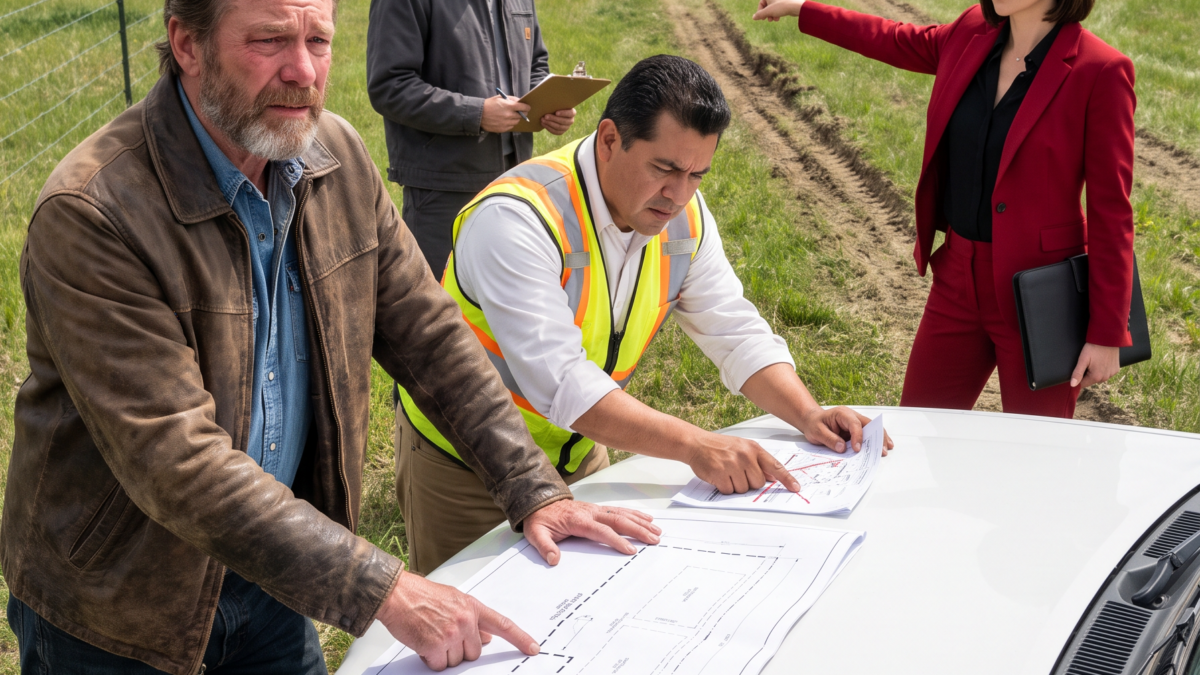
Six dump trucks had already crossed my fence when Dana Whitmore stood in my half-buried meadow and told me, “The HOA has authorization to raise this entire low area.” I almost believed she had paperwork I had missed—until the site foreman spread the stamped county plan across his truck hood. Its construction boundary stopped before my fence. Dana’s copy looked almost identical, except someone had extended the work onto my land. And the contractor already knew there was a boundary problem.
Six dump trucks were already inside my gate when I reached the lower meadow.
Behind them, most of the field still carried the bright green of late spring, but a wide brown-gray scar had been cut through the middle of it. Fresh fill lay in rough bands where hay had been standing less than twenty-four hours earlier. Deep truck tires had carved dark grooves through the damp turf, turning one of the quietest parts of my ranch into something that looked, at least for that morning, like an active construction site.
For several seconds, I forgot Dana Whitmore was talking.
I had worked that ground long enough to know where it softened after three days of rain, where the mower pulled harder in June, and where runoff found the shallow seasonal swale before disappearing toward the creek. Now some of those landmarks were buried.
The feeling that hit me was not anger at first. It was closer to the sick disorientation of walking into a familiar room and realizing someone had moved the walls.
Dana stepped into my line of sight.
She wore a crimson blazer over black slacks and held a folded grading sheet against a leather portfolio. A faint half smile sat on her face, the kind that suggested she expected resistance but not uncertainty.
“The HOA has authorization to raise this entire low area,” she said.
I looked past her at the nearest truck, then at the raw soil spreading across my grass.
“What plan number?”
Her smile changed.
It was a small thing. Her jaw tightened beneath her left cheek for perhaps a second.
But the site foreman noticed it too.
He was standing beside a white contractor pickup with a rolled plan set under one arm. Behind him, the sixth truck idled at my gate, its backup alarm sounding at slow intervals.
I stepped away from the entrance so there could be no argument that I was preventing anyone from leaving.
“I’m not stopping anybody from leaving,” I said. “I’m stopping another load from being dumped until someone shows me why this work crossed onto my property.”
Dana’s expression hardened.
“You are interfering with an approved drainage project.”
“Then the approved plan should make this easy.”
I pointed toward the sheet in her hand.
Even from where I stood, the heavy construction boundary appeared to stop before my fence.
Not somewhere inside the meadow.
Before it.
The foreman walked to his truck, opened the passenger door, and pulled out a full-size construction set. While he unfolded it across the hood, I took out my phone.
I recorded the open gate first. Then the trucks. Then the contractor logo on the nearest cab, the unit numbers, the tire tracks cutting through turf, and the fresh soil covering the lower ground. Grass blades protruded from beneath one mound where the fill had not yet settled.
I photographed the edge where imported material met untouched grass. I photographed the fence posts where equipment had passed. I photographed Dana holding her sheet.
There was no shouting and no attempt to touch the equipment.
I wanted a record, not a confrontation.
The foreman spread the construction set flat across the pickup hood. The title block carried a county project number and an engineering stamp.
Dana moved closer.
“That’s the same plan.”
The foreman studied both sheets.
His finger stopped at a heavy dashed line.
“They’re related,” he said.
Dana gripped her portfolio a little tighter.
“Related how?”
“This one has additional markup.”
For the first time since she had arrived, she did not answer immediately.
Behind her, another loaded truck sat outside the gate with its diesel engine rumbling. On one side of the disturbance, my meadow was green. On the other, it was brown.
Suddenly the difference between those two drawings seemed more important than anything either of us could say.
I stopped all additional dumping until the boundary issue could be clarified.
The trucks left one at a time.
When the final engine faded down the county road, the meadow felt unnaturally quiet.
From my kitchen window that afternoon, the damage looked worse.
The untouched field formed a broad sheet of green. The imported fill crossed it like a dirty brushstroke. I put my closing file on the kitchen table and began pulling out documents.
First the deed.
Then the survey.
Then the county parcel map.
Then the drainage easement.
I had seen all of them before, but ownership documents become different objects when six dump trucks have just crossed the line they supposedly describe.
I stopped treating them as paperwork and started treating each one as a question.
Who owned the lower meadow?
The deed answered that.
I did.
Where did my property stop?
The survey placed the eastern boundary at the fence.
The county parcel map agreed.
The lower meadow covered roughly eleven acres along the eastern side of my eighty-four-acre ranch. Most of my land was hay ground and pasture. The seasonal swale crossed the low side before the terrain rose toward Cedar Hollow, a subdivision built years after the ranch had already been established.
I had repaired that fence, mowed that field, paid taxes on it, and watched spring runoff follow the same shallow route for years.
No one had ever treated the entire meadow as HOA property.
But the drainage easement complicated the picture.
When Cedar Hollow was developed uphill, runoff from its streets, roofs, driveways, and yards had to be controlled rather than simply discharged onto neighboring agricultural property. The recorded easement gave the developer, and later the association, certain rights connected to the drainage feature crossing part of my land.
That meant Dana had not invented the underlying issue.
The HOA had a document.
The question was what that document actually allowed.
I carried the easement outside with the survey folded beneath my arm.
The legal description traced a relatively narrow corridor around the seasonal swale. I stood inside that corridor and then looked across the fresh fill.
The disturbed area was much broader.
That did not automatically make me right.
Old property documents can be amended. Surveys can be misunderstood. Legal descriptions sometimes turn on a sentence nobody notices until there is a dispute.
So I measured.
I used a measuring wheel to mark the length and width of the disturbed area. I flagged the transition between imported soil and untouched turf. I photographed truck ruts, fence posts, the swale, and every place equipment appeared to have crossed.
Back inside, I found an aerial image dating from the early development of Cedar Hollow. The same fence line was visible. So was the swale. An old fencing invoice identified several corner posts that still existed.
None of those items decided anything by themselves.
Together, they gave me a record of what the property looked like before this grading project existed.
Late that afternoon, storm clouds built over the ranch.
Wind rolled across the field in waves. The grass moved.
The imported fill did not.
Dana emailed before dinner.
The subject line read: Required Drainage Correction — Cedar Hollow.
She wrote that the association possessed maintenance rights affecting the lower meadow and warned me not to interfere when contractor operations resumed.
I printed the message.
Then I reopened the county parcel viewer.
My meadow was still exactly where I expected it to be—inside my parcel and outside Cedar Hollow’s property boundary.
The easement was the only connection between the HOA and that land.
That was what made the situation harder rather than easier.
Dana did not need to prove Cedar Hollow owned the meadow if she could prove it possessed a separate right to enter and perform the work.
I looked from the narrow easement corridor on the survey to the broad scar beyond the window.
The dangerous part of the dispute was not that Dana had no paperwork.
It was that she had just enough paperwork to make her version sound possible.
The next morning, Luis Ortega called at 8:10.
“I wanted to talk before anyone sends another truck,” he said.
“Are deliveries stopped?”
“For now.”
That phrase caught my attention.
“For now?”
“Until the property issue is clarified.”
Twenty minutes later, Luis drove up in the same white pickup I had seen at the gate.
He brought a clipboard, a rolled plan set, and a thick stack of carbon-copy delivery tickets.
Dana was not with him.
Luis lowered the tailgate and spread the records across it. The wind caught the top ticket, and he pinned it with two fingers.
“I checked yesterday’s production,” he said. “The crew made more cycles before you arrived than I realized.”
“How many?”
He ran his finger down the ticket numbers.
“Fifty-eight confirmed deliveries to the lower placement area. Two more are coded to the same job, but the placement notation is missing.”
“So potentially sixty.”
“Yes.”
I looked past him.
The meadow seemed to divide itself into two colors.
Green grass above.
Brown-gray soil below.
“What was being hauled?”
“Clean fill. Mostly sandy loam and compactable material from another permitted site.”
“Any reason to think there’s contamination?”
“Not from our source records.”
I nodded.
That was not the dispute in front of us.
“Why did your drivers cross my fence?”
Luis unrolled the full-size grading plan on the tailgate. The wind snapped the paper until he placed a wrench on one corner and his clipboard on another.
“This is the issued set.”
Then he placed a smaller printed sheet beside it.
“This is what we received later.”
The second sheet was Dana’s version.
Same roads.
Same drainage features.
Same base drawing.
But someone had colored beyond the official heavy dashed line.
Luis moved his finger along the stamped limit of disturbance.
It stopped before the fence.
Then he moved his finger to the later sheet.
The colored extension continued across the fence into my meadow.
“Who sent this?”
He turned the page over.
Dana Whitmore.
Cedar Hollow HOA.
The subject line referred to a lower drainage transition.
A few drops of water left from an earlier shower slid from the roof of his truck and landed on the margin. Luis covered the sheet with his hand.
Before he moved it, I saw part of Dana’s instruction.
Proceed with feathering beyond existing fence to eliminate low pocket and create positive drainage transition.
I looked at Luis.
“You followed this instead of the stamped plan?”
“We treated it as an owner-directed field adjustment.”
“Owner meaning?”
“Project owner. Cedar Hollow.”
I looked toward the fence.
“They don’t own this side.”
“I understand that now.”
He did not try to defend the wording.
Instead, he took out the foreman’s daily log.
The entries were written in block letters between equipment hours, load counts, and weather notes.
One line stood out.
Extended fill placement beyond east fence per owner representative direction. Authorization to be verified.
I touched the entry with one finger.
“Who wrote that?”
“My foreman.”
“Before or after the extension started?”
“After Dana told him to continue.”
“So someone on your crew raised the boundary issue.”
“Yes.”
“And the trucks kept moving.”
Luis nodded.
“We had an active project, a representative directing the work, and what appeared to be a field change. I’m not telling you that resolves the property issue.”
It did not.
But it gave me a chain of action.
Before noon, scanned copies of the delivery tickets, field log, marked-up plan, and Dana’s instruction email were in my inbox.
I saved them in two places.
Then I printed the most important pages and carried them outside.
I held the official grading plan in front of the meadow.
On paper, the dashed line stopped.
On the ground, the brown fill continued.
A line on a plan.
A line on the land.
Potentially sixty truckloads on the far side of both.
That afternoon, the weather gave me another piece of information.
A hard thunderstorm moved across the ranch.
It was not extraordinary. No historic rainfall. No emergency conditions. Just the kind of spring storm we received regularly.
I stood beneath the porch roof and watched the imported material darken almost black.
Water behaved differently on the newly compacted surface than it did on the grass.
Thin streams ran across the fill.
When the heaviest rain passed, I walked down carrying my phone, a measuring rod, and the survey inside a clear plastic sleeve.
Water had collected against one raised section near the seasonal swale.
Three or four inches at the deepest point.
Nothing dramatic.
That was precisely why I paid attention.
The storm had been ordinary.
The ground had changed.
I pushed the measuring rod into the deepest portion and photographed it. Then I stepped sideways until the old drainage route, standing water, and imported fill appeared in one frame.
The next morning, some water remained.
There were no washed-out roads or damaged buildings. I had no interest in turning ordinary ponding into a disaster story.
What mattered was simpler.
After the grade changed, the drainage pattern changed with it.
I called an excavation contractor I had used on the ranch before.
He looked at the tickets and then walked the field.
“That’s a lot of imported material,” he said.
“If it has to come out?”
“You’re not just talking about hauling dirt away. There’s compaction, topsoil, reseeding, access repair, maybe drainage restoration.”
That landed harder than Dana’s emails.
Stopping another truck had been easy.
Restoring what dozens of loads had changed would not be.
At 3:25 that afternoon, another email arrived from Dana.
Notice of Interference With Required Stormwater Work.
I printed it too.
She wrote that Cedar Hollow had an obligation to address drainage affecting its residents and that my refusal to allow completion increased risk to homeowners.
Then I reached the sentence that mattered.
The association’s recorded drainage rights authorize all work reasonably necessary to correct the contributing condition.
I read it twice.
If I wanted to challenge that claim, I needed to establish where legitimate maintenance rights ended and unauthorized grading began.
So I built a timeline.
Delivery ticket.
Truck number.
Time.
Dana’s direction.
Luis’s log.
My photographs.
Rainfall.
Measurements.
Then Luis called again.
“There’s another note in the project file.”
He sent a PDF.
Between equipment entries sat one sentence.
Property boundary concern raised. Owner representative states easement permits continuation.
I read it twice.
“Owner representative means Dana?”
“Yes.”
That changed the dispute again.
The contractor had not simply wandered over the fence without noticing.
Someone had raised the boundary before the work was complete.
Dana had answered the concern by invoking the easement.
Now the question was whether her interpretation had any authority behind it.
I went through every photograph from the first morning and matched visible truck numbers to delivery records. One silver cab appeared at 7:14. The same unit appeared again shortly after eight. Another truck had made several cycles before I reached the gate.
I made a simple board across my dining table.
On the left, what I could see.
On the right, what the records claimed.
Truck.
Time.
Load.
Direction.
Location.
By midnight, the physical record and the paperwork were beginning to align.
Then I drafted a public-records request to the county engineering office.
I requested the issued permit, every stamped grading sheet, approved revisions, inspection notes, erosion-control documents, and any correspondence changing the project’s limit of disturbance.
I was not asking the county to decide whether Dana had acted improperly.
I wanted a cleaner answer.
Show me the approved line.
If Cedar Hollow possessed a legitimate revision, it should exist somewhere beyond Dana’s inbox.
When the county file arrived, the answer was almost disappointingly plain.
Limit of disturbance.
I spread the stamped sheets across the kitchen table while rain tapped against the window.
Outside, the meadow remained half green and half brown.
Inside, the official dashed boundary stopped before my fence.
I checked the revision table.
There had been changes to a storm-drain inlet and to erosion-control sequencing.
Nothing moved the grading operation onto my parcel.
I wrote four questions on a yellow note card.
Where did the approved construction stop?
At the stamped limit of disturbance.
Was there an approved revision crossing my fence?
No.
Did the project engineer approve Dana’s extension?
I still needed to ask.
Did the drainage easement create some separate right that could change the analysis?
Still unresolved.
That framework kept the paperwork from swallowing the problem.
Every document had to answer a question.
Then I found correspondence between the county reviewer and the engineer.
The reviewer had asked whether the design preserved drainage patterns outside the development.
The engineer replied that the work would remain inside approved construction limits and would not require grading on adjacent private property.
I underlined the sentence.
Then I carried the page outside in a plastic sleeve.
Orange construction stakes were still visible on Cedar Hollow’s side. I lined up the plan with the ground.
The stamped limit stopped.
The brown fill did not.
I measured from the nearest approved stake to the disturbed edge.
Then I crouched and took one photograph containing three things.
The orange stake.
The fence.
The fill beyond both.
Dana’s argument did not disappear.
But it became narrower.
I called the engineering firm whose stamp appeared on the plans.
The receptionist transferred me to Maya Bennett, the civil engineer who had signed the drainage calculations.
I gave her the permit number.
There was a pause.
“I’ve heard there’s an issue,” she said.
“I’m trying to keep the issue narrow. Did your office approve grading across my fence?”
“No.”
The answer came quickly.
Two days later, Maya agreed to meet at the site.
She arrived wearing practical field shoes already marked with mud.
Dana pulled in a few minutes later wearing black pointed heels beneath the same crimson blazer.
Dana began confidently.
“The eastern transition was necessary to complete the drainage correction.”
Maya continued looking at the plan.
I placed Dana’s version beside the stamped copy on the hood of Maya’s vehicle.
A light drizzle started.
“Did your office approve this extension?” I asked.
Maya traced the official dashed line.
“No.”
Dana’s eyebrows lifted slightly.
“Did your office create this version?”
Maya examined the colored markup.
“No.”
Dana’s jaw set.
“It’s based on your design.”
“The base drawing is ours,” Maya said. “The extension is not.”
For half a second, Dana looked toward the fence.
Then she looked back.
Her confidence did not disappear.
It became more rigid.
“The HOA has easement rights.”
Maya nodded once.
“That’s a property-rights question. I’m telling you what our construction drawings authorized.”
There was no dramatic accusation.
No raised voice.
Just two plans on a wet hood and an engineer declining to stand behind one of them.
The rain intensified.
Water darkened the fresh fill. Small streams began traveling across the compacted surface toward the depression I had photographed after the previous storm.
Maya watched the water collect against a raised section.
She took out her phone.
Dana watched too.
Her mouth tightened.
Maya did not announce a conclusion.
“That needs elevations,” she said.
That restraint mattered.
The land could become evidence, but only after someone qualified measured it.
Maya later opened the project revision log on her laptop.
No amendment moved the limit east.
No revised grading sheet included my meadow.
No engineering field directive authorized fill beyond the fence.
I asked her to say it without engineering shorthand.
She turned the screen toward me.
“This permit does not show approved grading on your parcel.”
The construction question was becoming clearer.
The easement question was not.
I ordered a certified copy of the complete drainage easement, including exhibits and amendments.
The packet was thick.
I reduced it to three questions.
What area?
What purpose?
What conditions?
The legal description followed a defined strip around the drainage feature.
The easement allowed access for inspection, clearing, maintenance, repair, and restoration under specified conditions. It described notice obligations outside certain circumstances. It identified access provisions. It mentioned restoration of disturbed surfaces.
It did not describe my entire lower meadow.
It did not contain Dana’s shaded extension.
One clause allowed work reasonably necessary to maintain the drainage function.
Another limited the granted rights to the property described in the legal exhibit.
That was where the dispute stopped being something I could solve by standing beside a fence with a measuring wheel.
Before calling counsel, I requested Cedar Hollow’s own project records.
Meeting minutes.
Project approvals.
Engineering emails.
Contractor instructions.
Invoices.
Communications about extending the work.
The first batch arrived several days later.
I spread the records across the kitchen floor in a rough sequence.
Board.
Engineer.
Contractor.
Dana.
Then I followed the sequence.
The board minutes revealed why the project had become urgent.
Homeowners near the lower end of Cedar Hollow had complained about standing water.
The engineer’s approved design corrected drainage on the HOA side without grading my meadow.
An internal memo, however, referred to a low pocket near the fence.
Dana proposed extending the fill beyond the fence to create a smoother transition, simplify maintenance, and reduce future complaints.
Then I found a question in the minutes.
A board member named Paul Reyes had asked:
“Do we have written authorization to grade private land east of the fence?”
I stopped reading.
The next line summarized Dana’s response.
She said the drainage easement provided maintenance authority.
Paul had followed up.
Had that interpretation been confirmed against the grading permit?
The minute entry ended with a note that counsel review was to be confirmed.
There was no opinion attached.
No signed permission from me.
No county revision.
Then came the contractor emails.
The contractor had asked whether the east-side feathering was within owner-controlled property or within established easement rights.
Dana replied that the HOA possessed drainage maintenance authority and directed the contractor to proceed.
Then I found Maya’s message, sent before the dumping began.
Any grading outside the stamped LOD should be held pending confirmation of property authorization and permit implications.
I placed her email beside Dana’s.
One said hold.
The other said proceed.
The trucks had followed the second.
I called Luis.
“Did your project manager have Maya’s warning before the trucks crossed?”
“Yes.”
“And Dana still told you to continue?”
“Yes.”
“Why?”
“She said the easement covered it and the HOA would take responsibility for authorization.”
Take responsibility.
That was not the same phrase as possess authority.
Luis sent me the internal daily report.
I printed the relevant page and temporarily clipped it to the fence post nearest the disturbance so I could photograph the document against the actual land.
The entry read:
East extension questioned due to LOD. Owner rep confirms easement authority and directs continuation. Engineering revision not received.
Paper in the foreground.
Brown fill in the background.
That image connected the administrative trail to what had physically happened.
By then, several records were pointing in different directions.
The county plan said stop at the construction limit.
The engineer said hold pending authorization.
The contractor raised a question.
Dana said proceed.
Yet the easement remained real.
That was why I refused to reduce everything to a simple story about a rogue HOA.
Cedar Hollow possessed legitimate rights along part of my property.
The stronger question was more precise.
How far did those rights extend?
And could they justify material grading outside a permitted construction boundary that had never been revised?
I arranged my documents into five piles.
Property.
Permit.
Easement.
Contractor.
HOA.
The deed answered ownership.
The permit answered where the approved project stopped.
The easement described a drainage right.
The contractor records showed who directed the off-plan work.
The board records showed why.
The next step was not another pile of paper.
It was someone capable of explaining how the piles fit together.
Evan Price drew three boxes on a yellow legal pad.
Drainage easement.
Maintenance authority.
Grading authority for this project.
“Cedar Hollow has been talking about these as if they’re interchangeable,” he said. “They aren’t.”
He started with the easement.
“That’s the property right. It tells us where the burden exists and what the document grants.”
He placed my survey beside it and traced the narrow corridor.
Then he placed a photograph of the broad fill area next to the survey.
“A right involving this drainage feature doesn’t automatically create authority over every nearby acre.”
He moved to the second box.
Maintenance.
Inspection.
Clearing.
Repair.
Restoration.
“Those can involve real physical work if the grant allows it.”
Then he tapped the third box.
The county grading plan.
He followed the stamped dashed line with his pen until it stopped before my fence.
“This answers a different question. What was this permitted construction project authorized to disturb?”
I looked at the three boxes.
“So Cedar Hollow can possess an easement and still exceed it.”
“Yes.”
“And work potentially permitted by an easement does not automatically enlarge a county construction permit.”
“Correct.”
He placed Dana’s marked-up sheet between us.
“This is where the dispute becomes specific.”
I preferred that.
Specific was useful.
The legal description confined the easement to a defined corridor.
My photographs showed fill extending beyond it.
The county permit separately stopped before the fence.
“So they may have crossed two lines,” Evan said, “for two different reasons. Don’t collapse them.”
He drew an arrow from the easement box.
“This line answers what property rights Cedar Hollow may possess on your land.”
Then he drew an arrow toward the grading box.
“This line answers where this construction project was approved to operate.”
He circled the space between them.
“A field instruction does not automatically bridge that gap.”
That changed the shape of the dispute.
The question was no longer whether Cedar Hollow possessed drainage rights.
It did.
The question was whether those rights authorized this specific grading operation, at this scale, in this location, under this permit.
Evan also laid out Dana’s strongest argument.
He read from her email.
“The association’s recorded drainage rights authorize all work reasonably necessary to correct the contributing condition.”
He put the page down.
“That is the position they’ll likely rely on. They’ll say the fill was necessary maintenance.”
Then he began asking narrower questions.
Was the work inside the recorded easement area?
Was importing dozens of truckloads maintenance or material regrading?
Were notice requirements satisfied?
Was there an emergency?
Did the easement authorize work at this scale?
Did the county approve the expanded disturbance?
Had I consented?
Each question corresponded to something already in the record.
The facts did not require exaggeration.
He asked whether I had received any earlier notice claiming the swale had failed.
No.
Any opportunity to perform maintenance myself?
No.
Any notice of an emergency condition requiring immediate entry?
No.
“If the easement contains notice or trigger requirements,” he said, “sequence matters.”
Then he pulled a blank page toward him.
The next communication was formal.
Cedar Hollow was asked to stop grading and fill placement beyond whatever rights it could actually establish. Relevant emails, markups, board communications, tickets, logs, invoices, engineering records, and permit correspondence were to be preserved.
The association was asked to identify who authorized the work outside the stamped limit and what legal basis supported treating the lower meadow as part of the project.
A stabilization plan was requested.
So was a restoration proposal.
There were no dramatic accusations.
No threats.
No fantasy settlement number.
Scope.
Evidence.
Correction.
Near the end, Evan drafted one paragraph carefully.
“A limited easement for drainage maintenance does not, without additional authority, grant a right to materially regrade private land outside the easement area, nor does it enlarge the approved limits of a separate permitted construction project.”
For days, Dana had used one word—drainage—as though it resolved every other question.
It did not.
Drainage described the purpose.
It did not define the scope.
The demand went out by certified mail and email.
Luis’s company received a preservation notice.
Maya’s firm was asked to retain its project file.
The county was informed that work outside the permitted disturbance limit was part of an active private-property dispute.
Dana replied that evening.
Cedar Hollow continued to maintain that its easement rights authorized the necessary work and refused to commit to removing the fill until the issue was formally resolved.
I forwarded the response to Evan.
He called within minutes.
“She’s entitled to make that argument,” he said.
“What happens now?”
“Someone outside Cedar Hollow checks the line.”
For the first time since the trucks appeared, I no longer needed Dana to agree with me.
I needed an independent authority to determine what had been approved.
Mark Ellison arrived from the county and did not ask Dana where she thought the project boundary belonged.
He went directly to the construction stakes.
That was the moment the dispute changed again.
The meadow still carried its two colors.
Green where the project had not reached.
Brown where it had.
Dana stood nearby in her crimson blazer.
Luis held the contractor file.
Mark opened the stamped plan on a tablet and began measuring.
He located the stakes on Cedar Hollow’s side. He compared their positions to the plan. Then he followed the approved disturbance boundary on the ground.
After that, he crossed the fence.
The truck tracks remained obvious.
Mark hooked a measuring tape near one approved reference point and extended it toward the disturbed area.
The metal tape clicked through the grass.
For a few seconds, I noticed almost nothing else.
Not the pickup.
Not the wind.
Not Dana shifting behind me.
If Mark concluded that Dana’s interpretation was sufficient, the greatest problem would not be the soil already placed there.
It would be precedent.
Cedar Hollow could begin treating my lower meadow as available space every time another drainage concern appeared.
Mark checked his tablet, the tape, and then the stake again.
“How far outside the approved limit?” I asked.
He did not answer immediately.
“I want to document it before giving you a number.”
He photographed the fill. He verified the fence location. He compared his measurements to the county plan.
Dana stepped closer.
“The work was required for drainage.”
Mark looked up.
“I’m reviewing the permit footprint.”
“The HOA has easement rights.”
“Those may be relevant to the private property question. I’m checking whether this permitted grading stayed inside its approved disturbance limits.”
Dana pressed her lips together.
Mark asked Luis for the field records.
Luis handed him the daily log, Dana’s markup, and the email directing the eastern extension.
Mark read them.
Then he asked one question.
“Did the county approve this revised limit?”
Luis shook his head.
“Not that we received.”
Mark turned to Dana.
“Do you have an approved revision?”
“The easement authorized the work.”
He repeated the question more precisely.
“Do you have a county-approved revision moving the limit of disturbance onto this parcel?”
Dana paused.
“No.”
That single word did not resolve the easement dispute.
It did not need to.
Mark’s written notice arrived the next afternoon.
Grading and fill placement had occurred outside the approved limit of disturbance.
The unapproved portion required corrective action or a properly reviewed revision before additional work could occur.
The contractor also had to stabilize the off-site area while a correction plan was developed.
That was the first formal outside decision.
Cedar Hollow’s attorney contacted Evan.
The association’s insurer requested my photographs, delivery tickets, engineering correspondence, and contractor logs.
Luis’s company confirmed that no additional work would occur on my parcel without authorization from every required party.
Then we reached the harder question.
What had the fill actually done to the land?
Rachel Kim, a civil engineer brought in to evaluate restoration, had little interest in HOA politics.
She cared about elevations.
She surveyed the meadow, shot grades along the swale, and compared undisturbed areas to the filled sections.
Her conclusion was practical.
Some of the imported material could remain if reshaped correctly.
Some needed to be removed because it had raised the natural low path enough to contribute to ponding after ordinary rain.
“Can you put it back exactly the way it was?” I asked.
“No engineer should promise exactly,” Rachel said. “But we can restore the drainage function and rebuild the surface to a defensible grade.”
Dana continued to defend the project’s purpose.
I never argued that protecting homes from runoff was illegitimate.
The issue was whether that legitimate goal permitted the HOA to extend a specific construction project beyond both the approved grading boundary and whatever limits the recorded easement actually imposed.
By that point, even Cedar Hollow’s counsel stopped asserting that the county grading plan itself authorized work inside my meadow.
The discussion shifted.
From authority.
To responsibility.
Then to restoration.
And finally to the question everyone had avoided since the first truck crossed the gate.
Who would pay to repair the wrong side of the line?
The first excavator bucket lifted a section of brown fill and exposed dark original topsoil beneath it.
That was the first time the meadow looked recoverable.
Nobody proposed hauling exactly sixty truckloads back out simply to make a symbolic point.
Rachel’s restoration design was more careful than that.
She divided the affected ground into three areas.
One section could remain if reshaped to reestablish the intended drainage path.
A second required partial excavation because the imported material had raised the grade too far.
A third required most of the added fill to be removed, followed by topsoil replacement, seed, and erosion protection.
She also identified the access point where repeated truck traffic had widened the opening near my fence.
Evan sent her report to Cedar Hollow’s attorney, the insurer, and the contractor.
The insurer wanted evidence of the pre-project condition.
I had photographs.
The contractor wanted documentation showing who directed the field change.
Its own log contained that answer.
The HOA wanted its legitimate drainage rights preserved.
We were not asking Cedar Hollow to surrender those rights.
We were asking it to stop treating a limited right as permission to redesign everything around it.
The eventual agreement was practical.
Cedar Hollow funded the corrective grading plan.
The contractor removed or redistributed material according to Rachel’s elevations.
Topsoil was replaced where the original surface had been buried too deeply.
The seasonal swale was reopened.
Disturbed sections were reseeded.
The widened fence access was restored to its previous dimensions.
Cedar Hollow reimbursed my documented engineering expenses and an agreed portion of my legal costs.
Every payment was tied to an invoice, survey, repair, or professional service.
The written resolution also addressed future projects.
Before any Cedar Hollow work crossed onto property the association did not own, the board had to confirm its authority in writing and verify that the applicable permit covered the proposed work.
Contractors received a new instruction as well.
No field directive could move construction beyond a stamped limit of disturbance without written engineering review and documented property authorization.
Dana did not vanish after the agreement.
She completed the remainder of her board term.
By the next election cycle, another director was chairing Cedar Hollow’s meetings, and Dana did not return as president.
I never needed to see her publicly humiliated.
I needed trucks to stop entering my meadow because one person had treated a drainage easement as if it meant more than the recorded document and approved plan actually said.
Luis visited once during restoration.
We stood near one of the deeper excavation areas while an operator peeled back another section of imported material.
“I should have stopped when my foreman flagged the boundary,” he said.
I nodded.
“And I should have demanded the county revision before accepting a colored markup.”
He looked toward the fence.
“Next time, I will.”
Months later, the meadow looked ordinary again.
That was the result I had wanted from the beginning.
Ordinary.
The new seed established itself. The repaired swale carried water after rain instead of holding it against a raised strip of fill. The fence opening returned to its original width. The broad brown bands disappeared from the places where they had never been approved.
One evening after a light storm, I walked the lower field.
Water moved quietly through the shallow channel almost exactly as it had before the trucks came.
Beyond the fence, Cedar Hollow was still there.
So was the drainage easement.
The association still possessed legitimate rights connected to that narrow corridor.
I still owned the meadow around it.
What changed was not the existence of either right.
What changed was that everyone involved finally had to respect the difference between them.
A drainage problem can justify fixing drainage.
It does not automatically turn the land next door into construction space.
And when an approved line stops at a fence while the trucks keep moving, the line itself is worth checking before anyone accepts the explanation for why they crossed it.
This story is a dramatized work of fiction created solely for storytelling and entertainment purposes. It is not presented as a factual report or news account. Any resemblance to actual people, places, organizations, or events is purely coincidental. Names, dialogue, locations, timelines, occupations, and identifying details have been invented, combined, or altered to protect privacy and support the narrative. Some accompanying images or visual elements may be AI-generated or digitally enhanced.