Richard Coington drove his massive yacht straight into the redwood bridge my family had maintained for decades, then looked across the broken span and called, “Guess it wasn’t built to code.” By the next afternoon, his HOA was blaming me for the collision—and demanding that I pay for the damage to his boat. I almost looked powerless. But one detail in their story didn’t fit: Richard had accelerated after I warned him to turn around. And beneath my house was a 1928 property record none of them had bothered to read.
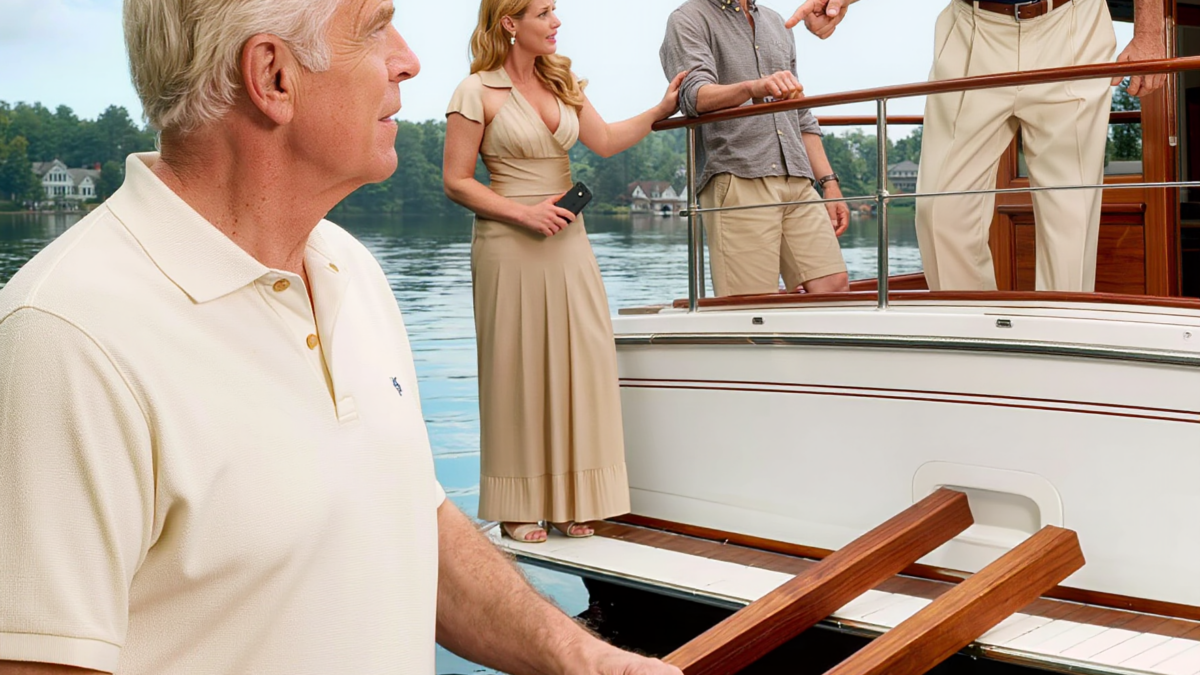
When Richard Coington brought his new yacht into my cove on the Fourth of July, I knew before he reached the bridge that something was wrong.
The engine was too loud for that narrow stretch of Lake Oak Haven, and the boat was far too large. People stood on the rear deck with drinks in their hands, laughing over the noise. Richard was at the helm in a white captain’s hat, looking less like a man carefully navigating a private cove and more like someone making an entrance.
I walked down from my porch and stopped near the shoreline.
“Richard!” I called. “Turn around. You won’t clear the bridge.”
He saw me.
That detail would matter later.
His head turned. For a moment, our eyes met across the water.
Then the engine rose.
My name is Arthur Hastings. I was sixty-eight years old that summer, a retired civil engineer living on forty acres at the southern end of Lake Oak Haven in upstate New York. The property was heavily wooded, quiet, and increasingly strange compared with everything that had grown up around it.
Five years earlier, the Reserve at Oak Haven had been built along much of the opposite shoreline.
Its houses began near two million dollars and climbed quickly from there. The development had private docks, landscaped entrances, stone retaining walls, security gates, and an HOA that marketed the community as a private boating retreat.
My land was not part of it.
The Hastings family had been on that valley since 1918.
Long before the Reserve existed, before luxury docks and wake boats and glossy brochures, my great-grandfather owned a substantial piece of the land surrounding what would eventually become Lake Oak Haven.
When county officials decided to create a reservoir in the 1920s, they needed property from several landowners, including him. Family stories always described him as stubborn, but the surviving records showed something more complicated. He understood land, water, and leverage.
He did not simply sell everything.
He negotiated.
The valley was flooded, but the Hastings family kept the southern peninsula, along with several unusual easements intended to protect the remaining property from changes in reservoir levels.
One of those provisions concerned emergency water management.
For generations, it barely mattered.
The county maintained the reservoir. The lake remained stable. The old manual system associated with the Hastings land became more historical curiosity than practical tool.
Nobody in my lifetime had needed to rely on it.
I certainly never expected to.
My own attachment to the property was simpler.
I grew up there.
I knew where the spring mud stayed longest after snowmelt, where deer crossed the woods near dawn, and which side of the peninsula caught the first light in October.
About forty years before Richard arrived, I had helped maintain and later rebuild an arched redwood footbridge connecting the main property to a small half-acre island.
It was not a highway bridge.
It was not meant for vehicles.
It was a graceful wooden span across a narrow channel, high enough for small fishing boats, kayaks, and canoes to pass beneath.
For decades, that was more than enough.
Then the Reserve arrived.
The residents did not buy canoes.
They bought powerful wake boats, cabin cruisers, and increasingly large recreational vessels.
The bridge became inconvenient because it interrupted what would otherwise have been a complete loop around the lake.
Most residents accepted that.
Richard did not.
Richard Coington had made his money in finance and purchased one of the Reserve’s largest properties. Within a short time, he became president of the HOA.
Our first disagreements came by mail.
I received a formal notice informing me that my bridge failed to meet the Reserve’s architectural standards.
I read it twice because I assumed I had misunderstood.
Then I wrote back.
“My property is not within the Reserve at Oak Haven and is not subject to your association.”
That should have ended it.
Instead, another letter arrived.
This one called the bridge a navigational concern.
A third referred to shoreline aesthetics.
A fourth suggested that continued refusal to cooperate might result in legal action.
I sent each one to a local attorney named Frank Mercer, who had handled land matters for me for years.
Frank called after reading the fourth letter.
“They don’t have jurisdiction over you,” he said. “They know that, or their lawyer should.”
“So why keep sending them?”
“Pressure.”
That answer turned out to be accurate.
Richard came to my dock himself near the end of May.
I was sitting on the back porch with coffee when I heard a boat idle close to shore.
He stayed aboard rather than tying up.
“Hastings,” he called.
I walked to the railing.
Richard lifted one hand.
“I’m trying to resolve this reasonably. Your bridge is creating problems for the community.”
“My bridge is on my property.”
“It’s affecting everyone’s enjoyment of the lake.”
“That isn’t the same thing.”
He looked toward the redwood span.
“We’re trying to maintain a certain standard at the Reserve.”
I waited.
He reached down beside the console.
“I’ll give you ten thousand dollars to take it down.”
I almost laughed, but his expression told me he was serious.
“The bridge stays.”
“Think about it.”
“I have.”
For the first time, irritation showed clearly in his face.
“We’ll see.”
He pushed the throttle forward and left behind a broad wake that rocked my dock long after his boat disappeared around the cove.
After that, the pressure became harder to dismiss as paperwork.
Drones occasionally appeared over my property.
Noise complaints were filed even though the nearest occupied house was too far away to hear my television, much less anything else I was doing.
A law firm representing the HOA sent arguments involving navigable waterways that Frank described as imaginative.
“The lake doesn’t connect to interstate traffic,” he told me. “They’re throwing language at the wall.”
“Can they force me to remove it?”
“Not on what I’ve seen.”
The trouble was that Richard seemed to understand something Frank and I both underestimated.
He did not need to win quickly.
He only needed to make defending myself expensive.
By early July, his letters had become part of the background of my life.
Then came the holiday weekend.
The Reserve held a large summer celebration on July Fourth. Music carried across the lake from the clubhouse lawn. Boats moved continuously between private docks. Jet skis traced bright wakes through coves that were usually quiet.
I stayed home.
At a little after four in the afternoon, I was in my kitchen when I heard the deep engine note.
I knew almost immediately that it was not one of the ordinary boats.
I stepped onto the deck.
A large white yacht was entering the cove.
Even from a distance, it looked misplaced on Lake Oak Haven.
Richard stood at the helm.
People crowded behind him.
He was aiming toward the bridge.
I walked quickly down toward the water.
“Turn around!” I shouted. “You won’t clear it.”
Richard looked at me.
Then the engine pitch increased.
I remember that sound more clearly than almost anything else.
The yacht moved deeper into the channel.
People on the rear deck were still laughing.
Someone raised a phone.
Richard held course.
Only when the bridge was directly ahead did the engine note suddenly change.
He tried to slow.
But a vessel that size does not stop instantly.
The bow struck the center area of the bridge.
There was a heavy cracking sound, followed by the long complaint of timber shifting under pressure.
The middle section sagged.
A support gave way.
Part of the bridge dropped into the water.
People on the yacht grabbed railings and furniture. Drinks tipped over. Someone shouted.
Then everything became strangely quiet except for water slapping against damaged wood.
I stared at the bridge.
I had repaired that structure after storms. I had replaced boards one at a time. I had walked across it with my wife when she was still alive. I had carried lumber over it with my father.
Now the center hung broken over the lake.
The yacht’s bow had suffered obvious scraping and surface damage, but the vessel remained afloat.
Richard stepped away from the controls.
For one brief second, I expected an apology.
Instead, he looked at the bridge and then at me.
“Guess it wasn’t built to code, Hastings.”
I said nothing.
He backed the yacht slowly away.
Before leaving the cove, he added, “You should have marked that hazard.”
That line stayed with me because it sounded prepared.
I called the sheriff’s office.
Deputy Higgins arrived about an hour later.
I knew him by sight. He had occasionally worked security events at the Reserve.
He walked along the shoreline taking photographs.
“This is going to be complicated,” he said.
“How?”
“Mr. Coington says the sun was in his eyes and he misjudged the clearance.”
“He didn’t misjudge anything. I warned him.”
Higgins looked across the water.
“He says he didn’t hear you.”
“He looked directly at me.”
“That’s your account.”
“He accelerated.”
Higgins put his phone back into his pocket.
“There are a lot of people on that boat saying it was an accident.”
I looked at the broken span.
“So twenty friends on his yacht outweigh what happened?”
“I’m saying intent is difficult to establish. With disputed water access and property issues, much of this may be civil.”
He was not rude.
That almost made it worse.
Richard’s version had arrived first, surrounded by witnesses.
Mine was one voice from the shoreline.
After Higgins left, I stayed outside until dusk.
The Reserve’s party continued.
Music still crossed the water.
Every so often I looked toward the dark gap in the bridge where reflected light moved between broken boards.
I felt older that evening than I had that morning.
Two days later, a certified envelope arrived.
I signed for it at the front door and opened it at my kitchen table.
Mitchell Gallagher, the attorney representing the HOA, had filed a claim alleging that my bridge was unsafe and responsible for damage to Richard’s yacht.
The requested amount for vessel repairs was approximately $45,000.
More troubling was an effort to prevent me from rebuilding the bridge while the alleged navigation issue was litigated.
I called Frank.
He had already received a copy.
His voice was quieter than usual.
“They have resources, Arthur.”
“So do I.”
“I don’t mean money for ordinary litigation. I mean enough money to make the process itself punishing.”
“They destroyed my bridge.”
“I know.”
“And now they’re suing me.”
“I know that too.”
I heard paper moving on his desk.
“I can fight it. But I need you to understand the economics. They can file motions, request studies, hire experts, challenge old surveys. Even when you’re right, defending land disputes can become expensive.”
I looked through the window at the damaged bridge.
“So what are you telling me?”
“I’m telling you not to make a decision while you’re angry.”
That was probably good advice.
After we hung up, I folded the complaint and placed it beside my coffee.
I did not feel angry in the way people imagine anger.
I felt tired.
That was different.
For weeks, Richard had treated every boundary as a negotiating position.
My deed lines.
My bridge.
My right to refuse his money.
Now even the collision was being converted into leverage.
I read the complaint again.
Near the middle, the HOA described the disputed area in language implying authority over lake access around my peninsula.
I stopped.
I read the paragraph once more.
Then I went downstairs.
The basement of my house is not mysterious. It contains the same assortment of old furniture, tools, Christmas decorations, paint cans, and family boxes found in any house occupied for decades.
Against the back wall sat a heavy wooden chest containing old Hastings land records.
I had opened it many times.
That afternoon, I looked at it differently.
The documents included county maps, old survey descriptions, tax records, and copies of agreements signed when the reservoir was created.
One deed was dated 1928.
I carried it upstairs.
The paper itself was old enough that I handled it carefully.
The important language concerned an easement retained by the Hastings estate.
In modern terms, it preserved limited water-level control connected to protection of the southern peninsula and structures located there.
I remembered my father mentioning it.
I had always thought of it as one of those family provisions that survived on paper long after practical responsibility passed to modern agencies.
But Richard’s lawsuit had changed the question.
I called Frank.
“This deed from 1928,” I said. “Do you have a recorded copy?”
“What section?”
I read the language.
He became quiet.
“Send me photographs.”
I did.
An hour later, he called back.
“Arthur, don’t do anything yet.”
“That sounds promising.”
“It means I need to verify it.”
The next morning, he checked the county record.
The provision remained.
It had never been extinguished.
Never formally amended out.
Never surrendered by the Hastings estate.
“That doesn’t mean unlimited authority,” Frank warned.
“I know.”
“But it is real.”
That mattered.
For the first time since the yacht hit the bridge, I had something stronger than my memory of Richard’s expression.
A record.
The bridge supports had also been damaged below the waterline.
As a retired engineer, I understood enough to know that rebuilding the visible span without examining the submerged foundation would be irresponsible.
I arranged for the structural condition to be documented and consulted the relevant reservoir provisions.
The water level could be lowered under the old easement for protective inspection.
I did not need to turn the event into a spectacle.
I needed access to my damaged property.
The level began coming down gradually.
By sunrise, the change was obvious along shallow coves.
Mud appeared beneath several docks.
Rocks that had not been visible in years emerged near the shoreline.
My phone started vibrating shortly after seven.
The Reserve’s neighborhood group was full of photographs.
People were asking whether a water main had failed.
Someone blamed county maintenance.
Another resident posted a picture of a dock sitting several feet above the waterline.
By midday, larger boats were having trouble leaving their slips.
I stood on my porch with coffee and watched the shoreline change.
It was not satisfying in the simple way people might imagine.
Lake Oak Haven had been part of my entire life.
Seeing it recede felt unnatural.
But seeing the broken bridge exposed from below also confirmed something important.
The impact had damaged more than the visible deck.
Several supports required a complete inspection.
Late that afternoon, Richard called.
I let it ring.
He called again.
Then Gallagher called.
I saved the voicemail.
The next morning, the water was lower still.
Richard’s yacht rested awkwardly near his dock because the marina depth had dropped below what the vessel required.
Other residents began moving smaller boats while they still could.
The Reserve’s summer celebration atmosphere had vanished completely.
Frank called.
“The HOA says you’re doing this maliciously.”
“They said the same structure they destroyed was dangerous.”
“I’m aware of the irony.”
“Have they read the deed?”
“They’re reading it now.”
That afternoon, vehicles arrived at my property.
Deputy Higgins was among them.
So was Gallagher.
Richard came with them.
Two state vehicles followed.
A dam-safety inspector named David Bradley stepped out and introduced himself.
Richard did not wait.
“You drained the lake because of me.”
I looked at Bradley.
“I assume you’re here about the water level.”
“I am. I need to understand the authority under which the reservoir level was changed.”
Gallagher opened his briefcase.
“We can save everyone time. Mr. Hastings has relied on an obsolete private document to interfere with a regulated water body.”
I handed Bradley a copy of the deed.
“Page four.”
Richard laughed.
Bradley read.
His expression remained neutral for longer than Richard seemed comfortable with.
Then he returned to the beginning and read the section again.
“Do you have the recorded county copy?”
I handed it to him.
Gallagher leaned closer.
Bradley compared the two.
“This was never amended?”
“Not according to the county.”
He made a phone call.
While he waited, nobody spoke much.
Higgins stood beside his vehicle.
Richard walked several feet away and returned.
Gallagher checked his watch twice.
Finally Bradley’s phone rang.
He listened.
“Understood.”
He ended the call.
“The easement is active.”
Richard stopped moving.
Gallagher spoke immediately.
“An old easement cannot supersede every modern environmental regulation.”
Bradley looked at him.
“I did not say that it does.”
Then he turned to me.
“What was the stated purpose of lowering the level?”
I pointed toward the bridge.
“The collision damaged supports below the normal waterline. The reduction allows the affected structure and shoreline to be examined.”
Bradley studied the bridge from where we stood.
“That is consistent with the protective language in the recorded provision,” he said. “Any additional environmental or engineering requirements still apply, but the property authority itself appears valid.”
That was the first clean answer.
Richard’s attorney had come to my house expecting to establish that I had no right to touch the reservoir level.
Now a state inspector was holding a document saying otherwise.
Richard folded his arms.
“This is retaliation.”
I looked at him.
“You hit the bridge.”
“It was an accident.”
That sentence returned us to the beginning.
An accident.
The accepted explanation.
The version backed by his guests.
For a few seconds, I almost answered.
Then I looked past him toward the Reserve’s marina.
The lowered water had exposed a strip of lakebed I had never seen clearly before.
Something about its shape had bothered me since the previous afternoon.
Near most natural shorelines, depth changes gradually.
There are irregularities, of course, but the underwater contours still reflect geology and sediment patterns.
Near the Reserve’s marina, the exposed lakebed showed a much sharper cut.
I pointed across the water.
“Inspector Bradley, can I ask you something?”
He followed my hand.
“What?”
“Do the Reserve’s permits include substantial excavation near that marina?”
Richard turned toward me.
“What does our marina have to do with your bridge?”
Bradley continued looking across the lake.
“Why are you asking?”
“The bottom contour.”
Gallagher stepped forward.
“Mr. Hastings is not here as an expert witness.”
“No,” I said. “I’m here as the man who has looked at this lake for most of his life.”
Bradley raised one hand, stopping the argument.
He asked one of his engineers to retrieve the filed shoreline plans.
They opened digital records beside the truck.
The plans showed ordinary marina work.
Nothing resembling the exposed corridor.
Bradley called two members of his team over.
“Take measurements.”
Richard objected.
“This has nothing to do with why you came here.”
Bradley looked at him.
“If the exposed lakebed reveals unrecorded work near a regulated structure, it becomes relevant.”
The engineers crossed toward the eastern shoreline.
The wait lasted hours.
July heat settled over my driveway.
Gallagher spent most of it on his phone.
Richard paced.
Higgins eventually sat in his vehicle with the door open.
I went inside once and returned with bottled water for everyone.
Richard refused his.
Gallagher accepted one.
Around midday, I sat on the porch step.
For the first time since the bridge fell, exhaustion caught up with me.
My hands shook slightly when I opened the bottle.
I thought about my father.
He had taught me to repair the bridge without ever speaking much about sentiment. If a board warped, we replaced it. If a railing loosened, we tightened it. Maintenance was how men like him expressed attachment.
I wondered what he would have thought of all this.
The lawsuit.
The HOA letters.
The lake pulled away from shore.
A family property agreement written before he was born suddenly becoming the center of an argument almost a century later.
Frank called while I sat there.
“How bad is it?”
“Depends which part.”
“Arthur.”
“The deed checked out.”
“That part I know.”
“Now the state is surveying the Reserve marina.”
There was a pause.
“Why?”
“I noticed something.”
Frank exhaled slowly.
“You spent forty years looking at civil plans. Of course you noticed something.”
“I could be wrong.”
“That would be refreshing.”
Despite everything, I laughed.
When I returned to the driveway, Richard was standing beside Gallagher.
Their posture had changed.
They were no longer confronting me.
They were waiting.
That difference was subtle but unmistakable.
Eventually the engineers returned.
One carried a tablet. Another had mud nearly to his knees.
Bradley met them beside the state truck.
They spoke quietly.
He looked at the tablet.
Then toward the eastern side of the lake.
Then back to the tablet.
Gallagher walked closer.
“What did you find?”
Bradley did not answer immediately.
He enlarged a site image.
One engineer pointed to a measurement.
Bradley’s expression tightened.
He walked toward Richard.
“Mr. Coington, who performed the excavation work near your marina?”
Richard frowned.
“What excavation?”
“The deepened corridor along the eastern shoreline.”
“We had contractors improve the marina.”
“Under what permit?”
Gallagher stepped between them conversationally rather than physically.
“We would need to review the association’s records before answering technical questions.”
Bradley nodded.
“Please do.”
Richard’s confidence returned for a moment.
“This is routine maintenance.”
The engineer with the tablet looked up.
“No.”
Everyone turned toward him.
He pointed toward the exposed lakebed.
“The cut is too deep and too wide to match the filed maintenance plan.”
Richard stared at him.
Bradley took the tablet.
“How wide?”
“Roughly fifty feet in sections.”
Gallagher stopped opening his briefcase.
Bradley turned the screen toward him.
“Show me the permit for this.”
Nobody answered.
The investigation changed direction after that.
What had begun as a confrontation over my use of the old easement became a review of construction work performed along the Reserve’s shoreline.
The lowered lake made areas visible that inspectors normally could not examine without specialized equipment.
Surveyors found that significant sediment had been removed near the marina.
That mattered because the lakebed was part of a larger engineered system.
You cannot alter one portion of a reservoir shoreline indefinitely and assume nothing else is affected.
Bradley’s team requested engineering records.
The HOA produced some.
Others were incomplete.
The contractors had apparently performed more extensive work than the submitted plans reflected.
Richard insisted he had relied on professionals.
Gallagher became increasingly careful with his wording.
By evening, he was no longer describing me as reckless.
He was asking the inspectors whether the association could provide supplemental records the following morning.
Higgins left before sunset.
Richard remained until Bradley told him there was nothing more he could contribute that day.
As Richard walked toward his vehicle, he stopped near the bottom of my porch steps.
“You think you won something.”
I looked at him.
“This was never supposed to be a contest.”
He gave me a hard stare.
Then he left.
The next several days were less dramatic than the story people later told about them.
There were no instant courtroom confessions.
No single document magically solved everything.
There were inspections, calls, engineers, insurance representatives, county records, and long conversations between attorneys.
The state determined that the marina work required a deeper review because of its proximity to the dam system.
The HOA’s shoreline modifications had exceeded the scope reflected in available approvals.
That did not mean the dam was moments from failure.
It did mean the work raised structural and regulatory concerns serious enough that repairs and stabilization would be required before the reservoir returned to normal operation.
For residents of the Reserve, the discovery was devastating.
Most of them had known nothing about any questionable excavation.
They had purchased homes based on the promise of a carefully managed private lake community.
Now their docks were sitting above exposed mud while state engineers investigated construction decisions made years earlier.
Several residents came to see me.
The first was a woman named Carol Benson, who lived three coves north.
“I owe you an apology,” she said.
“For what?”
“I signed one of the HOA petitions about your bridge.”
I remembered the petition.
“You weren’t the only one.”
“We were told you refused every safety proposal.”
“Nobody proposed a safety inspection.”
She looked toward the bridge.
“I know that now.”
Another resident admitted that the HOA had presented the bridge as an uncooperative holdout blocking community navigation.
Few people had been told that my property predated the development by generations.
Even fewer knew I was outside the association entirely.
The story Richard had told them was simple.
One stubborn old homeowner versus an entire community.
Simple stories travel well.
The truth usually needs paperwork.
As the state review continued, the HOA scheduled an emergency meeting.
I was not a member and did not attend.
Frank later told me what happened because residents began calling his office afterward.
Richard was removed as president.
It was not unanimous in the theatrical sense people like to imagine, but the opposition to him was overwhelming.
The board hired independent counsel.
That mattered more.
Within weeks, the association began negotiating separately from Richard.
Their position on my bridge changed too.
The allegation that it was simply an illegal navigational hazard became difficult to maintain once old surveys, shoreline maps, and property boundaries were reviewed.
The bridge had existed in substantially the same location for decades.
The Reserve had been built around it.
Not the other way around.
Richard’s yacht claim also became more complicated.
Insurance investigators examined the collision.
Witness statements were not as uniform as the original twenty-person story had suggested.
A few passengers remembered me standing near the shoreline.
One recalled seeing me wave.
Another said Richard had been joking earlier about finally proving the bridge was “not permanent.”
Nobody could establish what he intended with certainty, and I learned quickly not to expect legal proceedings to deliver perfect answers about a man’s thoughts.
But his claim that nobody had warned him no longer looked as clean as it had on the first afternoon.
That was enough for the dispute to change.
The HOA eventually stopped pursuing me for his yacht repairs.
Richard continued arguing through his own representatives for a time.
Then his insurance problems became more pressing.
The yacht had suffered damage during the bridge collision and additional stress while resting improperly after the water receded.
It required major work.
I never celebrated that.
A damaged boat is still property somebody paid for.
The satisfaction, if there was any, came from something else.
Richard had spent months telling people that rules applied only in one direction.
The HOA could send me letters, but my deed meant nothing.
His marina improvements were progress, but my bridge was obstruction.
His yacht belonged on the lake, but a structure standing for decades was somehow the intruder.
Once records were examined carefully, that story stopped working.
The state required significant corrective work along the Reserve shoreline.
The reservoir could not simply be returned to its previous condition overnight.
Engineers needed stabilization plans.
Environmental reviews had to be completed.
Contractors had to restore affected areas.
What began as a local property conflict became a long infrastructure project.
Residents were furious.
Some directed that anger at Richard.
Some at the old HOA board.
A few still blamed me because the lowered lake had exposed the problem.
I understood that reaction.
People had bought waterfront homes.
For a long period, their waterfront was mostly mud and construction equipment.
Human beings rarely separate inconvenience from blame neatly.
But the state’s position remained consistent.
The unauthorized shoreline alterations had to be addressed.
My bridge had to be addressed too.
The new HOA board approached me through counsel.
They wanted an agreement ending the various disputes.
I wanted three things.
First, the bridge restored properly.
Second, a clear acknowledgment of the existing property boundaries and easements.
Third, reasonable limits on oversized motorized vessels entering the narrow channels where they did not belong.
Negotiations took months.
There were arguments over wording.
There were engineering studies.
There were meetings I attended reluctantly.
Eventually, we reached terms.
The HOA funded the reconstruction of the redwood bridge.
I insisted the work respect the original design rather than replacing it with something glossy and modern.
A master carpenter from Vermont supervised much of the timber work.
The new span looked almost exactly like the old one from a distance, but the hidden structural elements were stronger.
The association also adopted boating restrictions that made sense for the scale of the lake and its narrower coves.
The change did not ban recreation.
It simply ended the era of treating Lake Oak Haven as if it were designed for increasingly enormous vessels.
Richard was gone before the bridge was finished.
His financial circumstances became complicated by multiple disputes connected to his property, the marina investigation, and the yacht.
He sold his house.
I never saw him again.
People later asked whether I felt victorious.
The word never fit.
Victory suggests that I had wanted the conflict.
I had wanted coffee on my porch.
I had wanted the bridge left alone.
I had wanted my property to remain what it had been before the Reserve arrived.
What I felt when Richard left was relief.
The reservoir restoration took far longer.
State engineers supervised work along the eastern shoreline. Sediment and support areas were rebuilt in stages. Monitoring continued through changing seasons.
Winter came while portions of the lake remained below their historic level.
Snow settled across exposed ground.
The Reserve looked different without summer boats and patio parties.
So did my property.
I crossed the newly rebuilt bridge for the first time on a cold November morning.
Frost covered the boards.
The redwood smelled new.
Halfway across, I stopped.
Beneath me, the reduced water reflected the pale sky.
For a moment I remembered the day of the collision—the engine, the cracking timber, Richard calling across the water as though destroying something old made him right.
Then I remembered something my father once told me while replacing a railing on that same bridge.
“Anything worth keeping,” he said, “needs maintenance.”
At the time, I thought he meant wood.
Years later, I understood he also meant boundaries.
The lake eventually returned.
Not all at once.
Water rose gradually as repairs were approved and operating conditions allowed.
Coves filled.
Mud disappeared.
Docks floated again.
Fish returned to familiar shallows.
One spring morning, I woke before sunrise and walked outside with coffee.
Mist hung over Lake Oak Haven.
For the first time in a long while, the view looked almost exactly as I remembered it.
Almost.
The enormous wake boats were mostly gone.
So were the oversized yachts.
Kayaks crossed the center of the lake.
A father and daughter fished from a small aluminum boat near the north bank.
Somebody paddled beneath my bridge and raised a hand.
I waved back.
The Reserve still existed.
Its houses remained large.
Its landscaping remained immaculate.
There were still wealthy residents and expensive cars and arguments about property values because people do not become different human beings merely because one HOA president leaves town.
But the relationship between the development and the older properties around the lake had changed.
The new board stopped sending me citations.
They called before planning shoreline work.
Once a year, representatives from the county and state reviewed the relevant reservoir systems and property agreements.
My old deed stopped being a forgotten family curiosity.
Frank had several archival copies made.
One went into a fireproof document box.
Another stayed with his office.
I kept the original where it had always been.
The old emergency equipment remained controlled and maintained under the applicable procedures, no longer something anyone treated casually.
I did keep one old iron piece from the historical mechanism in my house as a reminder of how easily people ignore systems they do not understand.
Visitors sometimes ask about it.
I usually tell them it belonged to my great-grandfather.
That answer is enough.
The longer version takes nearly half an hour.
Sometimes, when I sit on the porch, I think about the strangest part of everything that happened.
Richard believed the dispute was about power.
At first, maybe I did too.
He had money, lawyers, an HOA title, and enough confidence to make his version of events sound official before anyone had examined the facts.
I had forty acres, an old bridge, a modest attorney, and boxes of records most people would have considered useless.
But the documents were not powerful because they were old.
They mattered because they were accurate.
The inspection did not matter because it embarrassed Richard.
It mattered because it exposed work that needed to be corrected.
The bridge was not important because destroying it gave me a reason to retaliate.
It mattered because it connected my home to a small island where generations of my family had spent their lives.
People often retell stories like mine as revenge stories because revenge is easy to summarize.
Man destroys bridge.
Owner lowers lake.
Yacht gets stranded.
Rich HOA president loses everything.
That version is dramatic.
It is also incomplete.
What actually happened was slower.
One person assumed his resources would make his account of events more believable than mine.
For a short time, he was right.
Then details began to accumulate.
A warning he claimed not to hear.
Passengers who did not remember the collision quite the same way.
A deed nobody had checked.
An easement nobody expected to remain valid.
An exposed lakebed with contours that did not match approved plans.
A marina project larger than the documents showed.
Once those details were placed beside one another, the story changed.
That is what I remember most.
Not Richard shouting.
Not the yacht.
Not even the lake at its lowest point.
I remember the state inspector standing in my driveway with the survey in his hand while Richard waited for him to confirm the story everyone had arrived believing.
Instead, Bradley looked at the exposed eastern shoreline.
Then he looked at Richard.
And he asked one quiet question.
“Where is the permit for that trench?”
Nobody had an answer.
Years have passed since then.
The restored bridge has weathered to a softer red.
The handrail carries small scratches from fishing rods, coolers, grandchildren of old friends, and the ordinary traffic of a structure being used rather than admired.
That pleases me.
A bridge should carry people.
A lake should be treated like a shared natural and engineered system, not a private stage.
And a property line should mean the same thing whether the person standing behind it owns forty wooded acres or a forty-two-foot yacht.
Most mornings, I still sit on the porch with coffee.
The lake is quieter now.
When the sun comes through the trees, the redwood bridge casts a long reflection across the narrow channel.
Sometimes a kayak passes beneath it.
Sometimes nothing moves except the mist.
Those are my favorite mornings.
The kind where nobody is arguing about ownership.
Nobody is sending letters.
Nobody is trying to prove anything.
The bridge simply stands where it has always stood, connecting one piece of family land to another.
And for me, that was the only outcome that ever mattered.
This story is a dramatized work of fiction created solely for storytelling and entertainment purposes. It is not presented as a factual report or news account. Any resemblance to actual people, places, organizations, or events is purely coincidental. Names, dialogue, locations, timelines, occupations, and identifying details have been invented, combined, or altered to protect privacy and support the narrative. Some accompanying images or visual elements may be AI-generated or digitally enhanced.