Rhett Dugan had just lost five rounds in front of ten thousand people when he saw my nine-year-old daughter holding a stranger’s fallen phone and decided she had been filming him. I stepped between them. He shoved me twice, then grabbed my jacket collar while dozens of phones rose around us. I told him one word three times: “Stop.” Hours later, a five-second clip made me look like the aggressor—but one arena camera had recorded what happened before it.
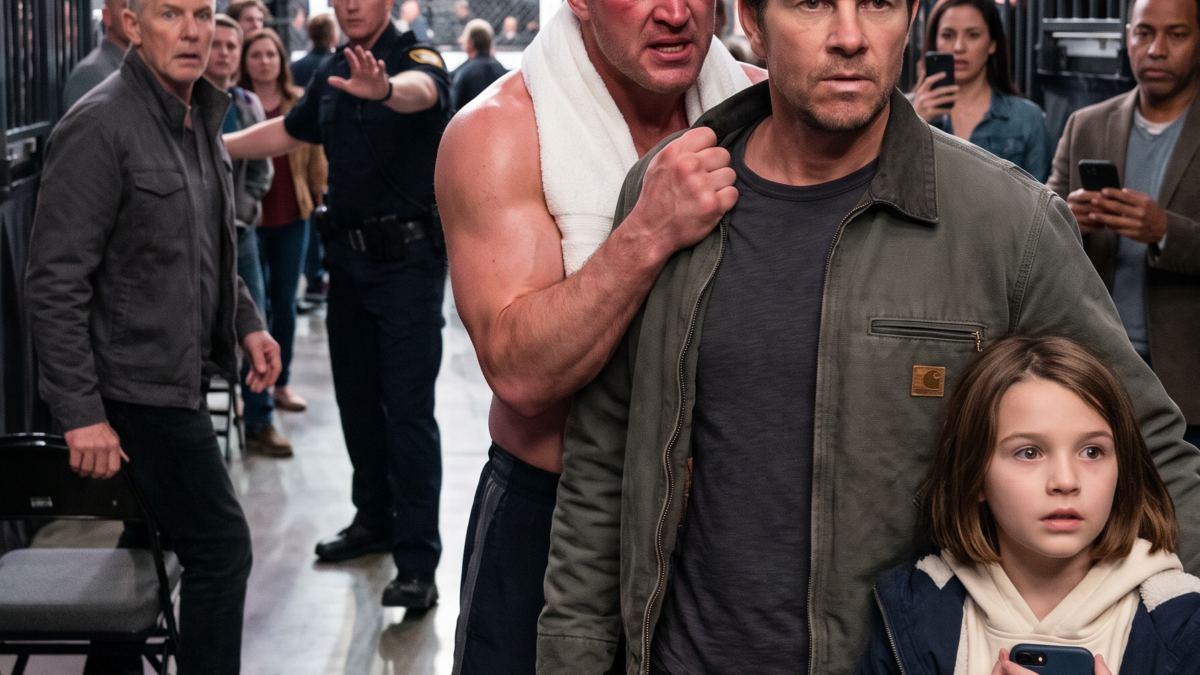
“Stop. Take your daughter and go home.”
Grant Mercer heard the words clearly despite the noise still rolling through Hawthorne Crown Arena.
Ten thousand people had spent the previous half hour shouting themselves hoarse. The main event was over now, but the building still carried the restless energy of a place that had not yet decided how to come down from what it had witnessed.
Grant stood in a corridor beside the floor seating, one shoulder slightly ahead of the other, his nine-year-old daughter behind him.
Across from him stood Rhett Dugan.
Six-foot-two. Roughly 230 pounds. Professional heavyweight. Seven stoppage victories in his previous nine fights.
And, less than five minutes earlier, the loser of the most important fight of his career.
Rhett’s expression suggested he had not yet accepted that final fact.
Grant’s hands remained down.
“Stop,” he said.
It was the second time.
Rhett laughed.
The sound was short and meant for the people around them, several of whom were already turning to see why one of the evening’s fighters was confronting an ordinary-looking man in a dark work jacket.
Grant did not look at them.
He did not look toward the security officers struggling through the crowd farther down the corridor.
He looked only at Rhett.
What Rhett did not understand was that Grant’s stillness was not confusion.
It was a decision.
Grant had spent much of the previous six years building a life in which nobody had any reason to notice what he could do under pressure.
He liked that life.
Most mornings he arrived at the Belidge Community Sports Center a few minutes before seven with a thermos of black coffee and a list folded into his pocket. His official title was maintenance manager, although the job was broader than that implied.
He repaired cable machines, replaced damaged electrical outlets, found plumbing leaks, negotiated with vendors, inspected emergency lighting, and knew which basketball hoop had a bolt that needed tightening every three months whether it looked loose or not.
He rarely complained.
He rarely talked about himself.
His coworkers knew he lived twelve minutes away in a modest house with a small yard. They knew he drove an aging pickup with rust beginning around both rear wheel wells. They knew he had a daughter named Sadie and that he left early on certain Thursdays because her school schedule changed.
Beyond that, Grant’s history existed mostly as unanswered questions nobody felt strongly enough to keep asking.
Years earlier, one of the trainers at the center had learned that Grant knew more about combat sports than someone normally acquired from television.
“You train somewhere?” the man had asked.
“Used to be around it,” Grant had replied.
“In what way?”
Grant had smiled.
It was not an unfriendly smile.
It was simply the one people eventually learned meant the subject was finished.
Sadie had never been as willing to accept that boundary as the adults around him.
She had inherited her mother Leah’s eyes and Grant’s persistence, along with an almost scientific need to understand whatever interested her.
At nine, she could turn a grocery trip into an interview.
She once spent fifteen minutes asking a retired marine biologist at a farmers market about whale migration because she had overheard him mention Alaska. Another time, a mechanic at a gas station mentioned racing motorcycles in his twenties and Sadie had stayed beside him until she understood why he preferred certain tires on wet tracks.
She liked finding the hidden part of people.
Her father was the largest unfinished project in her life.
Her interest in mixed martial arts had started almost accidentally.
One night Grant fell asleep on the couch while a sports documentary played in the background. Sadie quietly took control of the television and watched nearly forty-five minutes before he woke.
By breakfast the next morning, she had questions.
Within weeks she knew the names of active champions in several divisions. She learned the difference between a choke and a joint lock. She decided grappling interested her more than striking because, in her words, it looked like “two people solving a puzzle while trying to keep the other person from solving it first.”
Grant had laughed.
“That’s not the worst description.”
She noticed immediately that his answers were too good.
If she described a sequence she had watched, Grant could explain why a fighter had changed position, where the weight should have shifted, what mistake had opened a transition, and what the fighter might have done instead.
“You know this stuff,” she said one morning.
“A little.”
“How?”
“I spent time around it.”
“Doing what?”
Grant buttered his toast.
“What do you want on yours?”
Sadie narrowed her eyes.
She recognized a closed door when she saw one.
But she kept collecting details.
When a fight played on television, Grant did not watch the moments everybody else reacted to.
He watched feet.
Hips.
Shoulders.
Hands before they moved.
Sometimes he would say, “He’s getting tired,” thirty seconds before the commentators mentioned it.
Other times he would shake his head before a fighter attempted something that failed a moment later.
Sadie noticed.
Grant pretended not to notice that she noticed.
The equilibrium held until Marcus Webb dropped two arena passes on Grant’s desk one Tuesday afternoon.
Marcus worked the front desk at the sports center and approached tickets the way some people approached community service. He attended nearly every sporting event within driving distance and seemed genuinely offended by empty seats.
“I can’t use them,” he said. “Scheduling disaster. Main event in three weeks. Rhett Dugan.”
Grant looked at the tickets.
Floor seating.
Close.
Too close, in his opinion.
“I’m sure somebody else wants them.”
“Your daughter watches every card.”
Grant looked up.
Marcus smiled.
“That obvious?”
Grant almost said no.
Then he made the mistake of mentioning the tickets over dinner.
Sadie stopped moving.
She did not squeal or beg. She simply looked at him carefully, as if excessive enthusiasm might cause the opportunity to disappear.
Grant knew that expression.
He had first seen it after Leah died.
Sadie had been six.
For a while afterward, she had learned to hold good things carefully. Not because she understood grief, but because she had already discovered that wanting something did not guarantee it would stay.
Grant hated seeing that caution in her.
“We’re going,” he said.
Her smile appeared so quickly she almost looked embarrassed by it.
For the next three weeks, she talked about little else.
Hawthorne Crown Arena held just over ten thousand people for a full combat-sports card.
The night of Rhett Dugan’s fight, nearly every seat was occupied.
Grant and Sadie arrived twenty minutes before the main event and found their places near the floor.
Sadie sat upright with a water bottle in her lap and forgot to drink from it.
She watched everything.
Corner teams.
Camera operators.
Lighting crews.
Officials checking the cage.
Grant found himself watching her more than the event.
Rhett Dugan entered to a roar strong enough to register physically.
He carried himself with the confidence of a man accustomed to rooms changing when he entered them.
At thirty-four, he had built a reputation around power.
Seven finishes in nine fights.
One victory away from a title opportunity.
Most analysts expected him to control the evening.
His opponent had other plans.
The other fighter was patient, technically disciplined, and apparently prepared specifically for Rhett’s habits.
He refused to stand in the range Rhett preferred.
When Rhett tried to create open space, the opponent closed distance.
When Rhett loaded his right hand, the opponent moved away or tied him up.
There was nothing flashy about the strategy.
That was what made it effective.
By the third round, Rhett was frustrated.
Late in that round, he landed the kind of right hand that usually changed a fight.
The crowd rose.
His opponent absorbed it, immediately closed distance, and walked Rhett backward against the cage before another clean strike could follow.
Grant watched the sequence and understood.
The fight was not going to become the fight Rhett wanted.
By the fifth round, the pattern was too established to reverse.
The final horn sounded.
The judges returned a unanimous decision.
Rhett Dugan had lost.
The reaction began in his shoulders before it appeared anywhere else.
Grant saw it immediately.
Rhett questioned the referee. He struck the cage door with his foot as he exited. One glove came off harder than necessary. A coach stepped toward him and Rhett redirected the man’s arm away.
Grant had spent too many years watching people under pressure not to recognize the progression.
He touched Sadie’s shoulder.
“Come on.”
She looked up.
Something in his face told her not to ask why.
They moved toward the aisle.
A young man two rows away apparently did not read the same danger.
As Rhett passed the seating section, the man lifted his phone.
Rhett’s hand came down.
The phone left the man’s grip and slid across the floor.
It stopped near Sadie.
She looked down.
Then, without thinking much about it, she picked it up.
Rhett turned.
He saw a child holding a phone.
His anger supplied the rest of the story.
His voice cut through the corridor.
Grant was already moving.
He stepped between Rhett and Sadie.
Not aggressively.
Not theatrically.
He simply occupied the space.
“She picked it up,” Grant said. “The phone isn’t hers. You should go.”
Rhett looked him over.
Grant knew the assessment.
He had watched professional fighters make versions of it for years.
Size.
Posture.
Confidence.
Threat.
Grant wore a dark jacket over a plain shirt. He was fit, but not physically imposing beside a heavyweight.
To someone who did not know what to look for, he appeared ordinary.
Rhett put a palm against Grant’s shoulder and pushed.
It was not a full effort.
It was a message.
Move.
Grant took half a step with the pressure rather than resisting it.
His expression did not change.
“Stop.”
Sadie heard the word.
She had heard her father say it hundreds of times in ordinary life.
Stop leaving cabinet doors open.
Stop kicking the table.
Stop pretending homework disappears if you put it underneath a jacket.
This sounded different.
Not louder.
He never raised his voice.
It simply carried more weight.
Rhett laughed.
“Take your kid and go home.”
Then he pushed Grant again.
Both hands this time.
Harder.
Grant moved backward two steps and stayed balanced.
Then he returned to the same position.
“Stop.”
The atmosphere changed.
People nearby stopped walking.
Phones appeared.
Security officers were visible down the corridor trying to reach the area, but the crowd was flowing against them.
Rhett noticed the audience.
Grant hoped the attention would make him reconsider.
It had the opposite effect.
Rhett had spent much of his adult life performing under observation.
Being watched did not restrain him.
It hardened the decision he had already made.
He stepped in and grabbed the front of Grant’s jacket.
“What’s a man like you going to do?”
Grant’s eyes shifted for an instant past Rhett.
Sadie stood behind him.
She held the stranger’s phone against her chest with both hands.
She was not crying.
She was studying him.
That expression landed harder than Rhett’s pushes had.
Grant thought about the years separating the man he had once been from the father Sadie knew.
He thought about Leah.
He thought about what he had spent nearly a decade trying not to carry into this child’s understanding of strength.
Then he looked at Rhett.
“Last time,” he said.
“Stop.”
Rhett did not release him.
Grant understood what remained.
There was no anger in the realization.
Only clarity.
That clarity was old.
For more than a decade, Grant had taught athletes that panic displaced preparation. Under stress, people did not rise magically to a better level of performance. They usually fell toward whatever habits had been trained deeply enough to remain accessible.
Rhett’s anger had changed his stance.
Grant saw it.
His weight was too far forward.
His arm was extended.
His lead foot had committed beyond the position he would normally accept inside the cage.
The fighter standing in front of Grant was not the disciplined athlete who had won seven of nine fights.
This was the same athlete without discipline.
Grant did not think of the grip on his jacket as strength.
He saw leverage.
Years earlier, an old trainer in Nashville had told him something after dropping him onto a gym mat during a lesson.
“The other person decides how much force to bring. You decide what happens to it when it arrives.”
At twenty-two, Grant thought he understood.
He spent the next decade discovering what the sentence actually meant.
He stepped forward rather than backward.
One hand guided Rhett’s wrist.
The other controlled above the elbow.
Grant rotated.
Dropped his center slightly.
Changed the angle.
Rhett felt his balance leaving and instinctively pulled against it.
That reaction completed the movement.
Grant used a short, controlled sweep.
Rhett went down.
Grant followed only far enough to prevent an immediate scramble.
He controlled the shoulder and arm without striking.
The entire transition lasted seconds.
The corridor changed.
Grant held the position just long enough to make one point.
“I asked you to stop three times.”
Then he released Rhett.
He stood.
He stepped backward.
He returned to Sadie.
Rhett remained on the floor for a moment, looking upward.
The anger was still there.
Now something else had entered it.
Confusion.
He had expected resistance, fear, or a clumsy attempt at aggression.
He had not expected technical control from a stranger wearing an ordinary jacket.
His head turned.
For a moment he looked directly at Sadie.
She was still holding the stranger’s phone.
Then he looked away.
Security arrived moments later.
By then the confrontation was finished.
Unfortunately, the story was only beginning.
An older man named Warren Pike had watched everything from near the cage-side seats.
Warren had coached fighters for roughly thirty years. He was not famous outside regional combat-sports circles, but within them he had the kind of authority that did not require introductions.
He had been approximately a dozen feet away.
His expression changed when Grant moved.
First curiosity.
Then recognition.
Then certainty.
“Grant Mercer?”
The name carried farther than Warren intended.
A nearby commentator turned.
Grant heard it.
He did not look toward Warren.
His attention remained on Sadie.
She set the stranger’s phone on an empty seat.
“Dad?”
“Yeah?”
She hesitated.
“Did you do that on purpose?”
Grant placed a hand on her shoulder.
“Yes.”
Her eyes widened slightly.
“We should go.”
He guided her toward the exit.
Grant could feel phones following them.
He knew immediately that anonymity, once lost, could be difficult to restore.
He underestimated the speed.
By the time he drove Sadie home, made sure she was settled, and checked the locks, clips were already circulating.
He sat at the kitchen table with a cup of coffee he did not drink.
The first version he found was five seconds long.
It began with his hand touching Rhett’s wrist.
Then movement.
Rhett falling.
Grant controlling him briefly.
The video stopped shortly after Grant stood.
No phone being knocked away.
No Sadie picking it up.
No first push.
No warning.
No second push.
No second warning.
No collar grab.
No final warning.
Just a stranger taking down a professional fighter.
The clip reached hundreds of thousands of views before Grant fully understood it was spreading.
By morning, several versions existed.
The headlines emphasized the same elements.
Single father.
Heavyweight fighter.
Five seconds.
The internet began searching for Grant.
Someone found an old photograph taken twelve years earlier at a regional title bout in Memphis.
Grant stood behind a fighter near the cage, arms resting casually, eyes fixed on the action.
The caption appearing beneath reposts asked:
Who is Grant Mercer?
Warren Pike answered.
He gave an interview that afternoon.
Grant did not know about it until Sadie found the video after school.
Warren confirmed that Grant had spent more than a decade as a respected grappling and close-combat coach.
He had worked with fighters who later held national-level titles.
“He understood what happened when strength stopped being enough,” Warren told the interviewer.
When Grant came home that evening, Sadie sat at the kitchen table with her laptop open.
A full glass of water stood beside it.
Untouched.
She looked at him.
“You trained those fighters.”
It was not a question.
Grant put his keys on the counter.
“Yes.”
“The ones he named?”
“Yes.”
Sadie studied him.
“Why didn’t you ever tell me?”
Grant sat across from her.
For nine years, he had imagined versions of this conversation.
None survived contact with the actual child sitting in front of him.
“It’s complicated.”
Sadie waited.
“I meant to tell you.”
She waited longer.
“I didn’t know how to explain it.”
Her expression changed in a way Grant could not repair with another sentence.
She closed the laptop.
Then she went to her room.
Grant remained at the table.
His keys sat on the counter.
The past sat between him and the hallway.
Meanwhile, the public story shifted again.
Rhett went live from the back seat of a vehicle.
For roughly forty seconds, he stayed composed.
He said he had just finished a five-round professional fight when a man he did not know confronted him in a corridor.
He said Grant escalated the situation.
Then he described the encounter as an ambush.
He claimed Grant had been looking for an opportunity.
That Grant had wanted attention.
That Grant had approached him at a vulnerable moment in order to make a name for himself.
For people already suspicious of the viral takedown clip, Rhett’s explanation sounded plausible.
Then another edited version began circulating.
This one was even shorter and cleaner.
It began almost exactly when Grant’s hand contacted Rhett’s wrist.
It removed everything before that moment.
No dropped phone.
No child.
No pushes.
No warnings.
In that edit, the story was simple.
A professional fighter had just lost.
A stranger approached.
The stranger put him on the floor.
Simple stories spread quickly.
The event organization announced a formal inquiry.
The next morning, Grant’s phone rang repeatedly.
Some calls came from unknown numbers.
Two came from the sports center.
At seven, Grant called the director.
The man sounded apologetic.
“We need you to take a little time away while this gets sorted.”
Grant said nothing.
“Just precautionary.”
Grant looked at the coffee cooling beside him.
“Your access badge is temporarily inactive.”
“I understand.”
He did understand.
The sports center had families, children, and public programs. Its leadership could not ignore a viral video involving one of its employees.
Grant ended the call.
Outside the kitchen window, November had flattened the backyard into shades of gray.
There was rust along the bottom of the fence he had been planning to repair before winter.
Thirty-six hours earlier, that repair had seemed important.
Now he stood unemployed, at least temporarily, while millions of strangers debated the character of five seconds.
Sadie came into the kitchen already dressed.
She poured cereal.
Grant made toast and poured orange juice.
Neither spoke at first.
Then Sadie set her spoon down.
“You always tell me not to lie.”
Grant looked up.
“You tell me hiding something on purpose can be the same thing as lying.”
She did not sound angry.
That made it worse.
“So why did you hide this from me?”
Grant had no answer that would fit inside a morning before school.
Two days after his access badge stopped working, Warren Pike came to the house.
The knock came at 8:45.
Grant knew before opening the door that Warren had not driven across town for small talk.
Warren stood on the porch with his hands in his coat pockets.
“You going to let me in?”
Grant stepped aside.
Sadie sat at the kitchen table with a cereal bowl and a library book she was not actually reading.
Grant introduced them.
“This is Warren Pike. We worked together a long time ago.”
Warren nodded.
“I hear you’re the serious fight fan in the family.”
Sadie looked at him.
“I guess.”
They sat.
For several seconds nobody pretended the visit was casual.
Warren looked at Grant.
“The arena has corridor cameras.”
Grant’s attention sharpened.
“Full coverage.”
Warren rested his hands on the table.
“The organization has the footage. Legal has it because of the inquiry.”
Grant said nothing.
“Carol Finch already contacted them.”
Carol handled media for the sports center.
“She can make the formal request as soon as you authorize it.”
“How long has she been waiting?”
“Two days.”
Grant looked down at his hands.
“I don’t want to make this bigger than it is.”
Warren waited.
Then he said, “Grant, the question of how big this is was settled without your permission.”
Sadie stopped pretending to read.
Warren continued.
“You can keep hoping the internet gets bored. Or you can let the complete record speak.”
Grant stared at the table.
The irony was difficult to miss.
For most of his adult life, he had taught people to respond to pressure with deliberate action.
Now he was trying to disappear until pressure lost interest.
Warren glanced toward Sadie.
“There’s something else.”
Grant knew what was coming.
“She deserves the reason.”
Sadie looked from Warren to her father.
“What reason?”
Warren kept his eyes on Grant.
“The reason you left.”
The kitchen became very quiet.
Grant exhaled.
Warren was right.
Not because the public needed Grant’s history.
They did not.
Sadie did.
Grant looked at his daughter.
“There was a fighter named Cal Brennan.”
He told the story carefully.
Cal had entered Grant’s gym at twenty-three with exceptional natural ability.
Fast.
Strong.
Instinctive.
Grant had worked with talented athletes before, but Cal was different.
Technical instruction did not create his talent.
It organized it.
For two years Grant helped shape Cal’s raw instincts into a disciplined game.
He taught him control.
Position.
Patience.
Recovery.
Timing.
The work mattered to Grant.
Perhaps too much.
As Cal began winning larger fights, the environment around him changed.
More money appeared.
More people depended on schedules.
Promoters planned future cards.
Managers discussed momentum.
Cal began to represent income for people who were not the ones entering the cage.
Grant noticed warning signs.
Cal was moving differently.
Recovering slower.
Compensating physically.
Grant raised concerns.
The first time, management thanked him.
The second, they said the medical staff had cleared Cal.
The third conversation ended quickly.
Six days before a major fight, Cal entered a sparring session.
Grant watched him for several minutes.
The asymmetry was obvious.
“Stop the session.”
The manager disagreed.
Grant repeated himself.
The manager insisted Cal had been cleared.
Cal himself wanted to continue.
He was twenty-five and believed his body could absorb whatever ambition required.
Grant should have shut the session down.
He should have stood in the center of the room and refused.
Instead, the argument continued.
Then Grant walked outside.
He sat in his truck for twenty minutes.
He was angry.
Frustrated.
Unsure whether returning would make a difference.
Eventually he decided it did not matter whether it made a difference.
He needed to go back.
His phone rang before he reached the door.
Cal had taken a hard impact during sparring.
He recovered from the immediate medical issue.
But evaluations afterward showed that the accumulated physical strain made continued professional competition too risky.
His career was over at twenty-five.
Grant paused.
Sadie did not interrupt.
“I didn’t cause what happened to him,” Grant said. “But I helped build the system around him. And when I knew something was wrong, I left the room.”
Warren remained silent.
Grant continued.
“Your mom was pregnant with you.”
Sadie’s eyes shifted.
Grant had rarely spoken about that time in detail.
“I kept thinking about what kind of person I wanted you to see when you got old enough to understand me.”
He folded his hands together.
“I didn’t hate fighting. I hated what I had become willing to accept around it.”
Sadie looked down.
“I didn’t want you growing up thinking that hurting someone was what strength looked like.”
Grant’s voice remained steady.
“I needed to learn what strength actually looked like before I tried teaching you.”
Sadie sat quietly for a long time.
Then she asked, “Did you?”
“Did I what?”
“Become different?”
Grant considered the question.
“I’ve spent nine years trying.”
Sadie looked at him.
“I think you did.”
The sentence was simple.
Grant was not prepared for how much it affected him.
Across the table, Warren finally spoke.
“Mistakes weren’t the problem, Grant.”
Grant looked at him.
“You learned when to stop fighting.”
Warren leaned back.
“But you never learned when to stop running from the fact that you knew how.”
That afternoon Grant called Carol Finch.
“Request the footage.”
Carol did not ask him twice.
The formal request went through the inquiry process within hours.
The arena recording lasted four minutes and thirty-seven seconds.
It changed everything.
The video showed Rhett leaving the event floor.
It showed the young spectator raise his phone.
It showed Rhett knock it away.
It showed the phone sliding across the floor.
It showed Sadie pick it up.
It showed Rhett turn.
Grant move.
The first push.
Grant stepping back.
“Stop.”
The second push.
Grant returning to position.
“Stop.”
The growing crowd.
Security trying to reach them.
Rhett grabbing Grant’s jacket.
Grant looking behind him toward Sadie.
“Last time. Stop.”
Then the takedown.
The control.
The release.
Grant immediately stepping backward.
No follow-up.
No additional aggression.
No celebration.
The organization released the complete corridor footage that evening with a statement.
By morning, the public conversation had changed.
The edited clip still existed.
But once viewers could compare five seconds with four minutes and thirty-seven seconds, its power weakened.
Rhett’s livestream also looked different beside the complete sequence.
His claim of an ambush became increasingly difficult to reconcile with the recording.
The inquiry concluded within seventy-two hours.
Rhett received a substantial suspension for his conduct toward attendees and for publicly misrepresenting the confrontation.
Grant was cleared.
The sports center director called.
“Your badge is active again.”
Grant leaned against the kitchen counter.
“Your position is here whenever you want it.”
“Thank you.”
There was a pause.
“And Grant?”
“Yes?”
“I’m sorry.”
Grant looked toward the hallway.
Sadie was doing homework in the living room.
“I know.”
Over the following week, three fight organizations contacted him.
Two regional promotions.
One national organization.
They offered consulting work, coaching roles, and compensation that exceeded what Grant earned at the community center.
Years earlier, he might have imagined that kind of return.
Now the offers felt like letters addressed to someone who no longer lived there.
He declined them.
He was not going back.
Warren offered something different.
The idea came together quickly.
A program at the community sports center.
Not a professional fight team.
Not a competitive training pipeline.
A community course built around personal safety, awareness, de-escalation, confidence, and basic physical control.
People raising children alone.
Teenagers who had experienced intimidation.
Adults who wanted to feel less helpless in stressful situations.
Warren would help organize the structure.
Grant would teach.
“You interested?” Warren asked.
Grant answered before Warren completed the pitch.
“Yes.”
Two weeks after the complete footage became public, Grant agreed to a short interview with a regional reporter.
He insisted it remain brief.
Most of his answers were shorter than the questions.
Near the end, the reporter asked the obvious one.
“You let Rhett push you twice. Why?”
Grant looked past the reporter.
Sadie stood roughly fifteen feet away wearing her coat and backpack.
They planned to get dinner afterward.
She met his eyes.
She had that familiar expression again.
Watching.
Learning.
Grant turned back.
“Being able to hurt somebody isn’t the same thing as having a reason to.”
The reporter’s pen stopped.
Grant continued.
“Strength gives you a choice. Character is how you make it.”
The reporter wrote the sentence down.
It became the line people repeated most often.
Grant found that mildly strange.
Millions of viewers had focused on the five-second movement that placed Rhett on the floor.
The sentence mattered more to him than the movement ever had.
The community program began in a room that smelled faintly of rubber mats and old paint.
It could hold approximately twenty people comfortably.
By the third week, twenty-three attended.
There were no arena lights.
No cages.
No television cameras.
No crowds demanding spectacle.
There was a whiteboard.
A mat.
A handful of padded training equipment.
And people who wanted to understand how to remain calm when someone else tried to take control of a situation.
Grant found the work familiar and completely different.
He taught posture.
Distance.
Awareness.
Verbal boundaries.
How to notice exits.
How to recognize escalation early.
He spent far more time teaching people how to avoid physical confrontation than how to participate in one.
Warren approved.
Sadie attended whenever school allowed.
She sat near the edge of the mat and watched with the same concentration she had shown at Hawthorne Crown Arena.
At the end of the first month, the final participants collected their coats and left.
The room quieted.
Sadie remained.
She walked across the mat.
“Dad?”
“Yeah?”
“Are you going to teach me?”
Grant smiled.
“Of course.”
She considered her next question.
“The thing from the arena?”
“What thing?”
“You know.”
She made a tiny motion with her hands.
“The five-second thing.”
Grant crouched until they were nearly eye level.
She was getting old enough that he no longer needed to crouch as far as he once had.
“No.”
Sadie frowned.
“No?”
“No.”
She thought about that.
“Then what are you teaching me first?”
Grant placed a hand on her shoulder.
“How to recognize when you don’t need to.”
Sadie was quiet.
Then she smiled.
Not the huge smile that could take over a room.
A smaller one.
The kind she used when something had confirmed an idea she had already been carrying.
She picked up her backpack.
Grant watched her cross the room.
The space around them was small.
Quiet.
Plain.
Exactly right for what he wanted it to become.
The five seconds that made Grant Mercer visible to the world had never been the most important part of that night.
The important part was everything before them.
A phone knocked to the floor.
A child who picked it up because she thought she was helping.
A father who stepped between her and an angry stranger.
Three warnings.
Three opportunities.
Three doors held open long enough for someone to choose another direction.
Rhett Dugan kept walking past them.
Grant had once believed strength was measured by what a person could impose.
Cal Brennan taught him what that belief could cost.
Leah’s death taught him how little control anyone truly had over the things they most wanted to keep.
Raising Sadie taught him something slower.
Strength was not the absence of capability.
It was the presence of choice.
For nine years, Grant had tried to build a life around that distinction.
His daughter had been watching the entire time.
She simply needed the whole story to understand what she was seeing.
This story is a dramatized work of fiction created solely for storytelling and entertainment purposes. It is not presented as a factual report or news account. Any resemblance to actual people, places, organizations, or events is purely coincidental. Names, dialogue, locations, timelines, occupations, and identifying details have been invented, combined, or altered to protect privacy and support the narrative. Some accompanying images or visual elements may be AI-generated or digitally enhanced.