Passengers watched as a senior flight attendant blocked Marcus Ellison from returning to first-class seat 2A, even though the boarding pass in his hand matched the seat exactly. “May I know what policy I violated?” he asked. She never gave him one. Then airport security appeared at the door, a woman across the aisle began recording, and Marcus quietly picked up his worn leather briefcase. What the crew had reported about him—and what three independent records would later show—were not the same story.
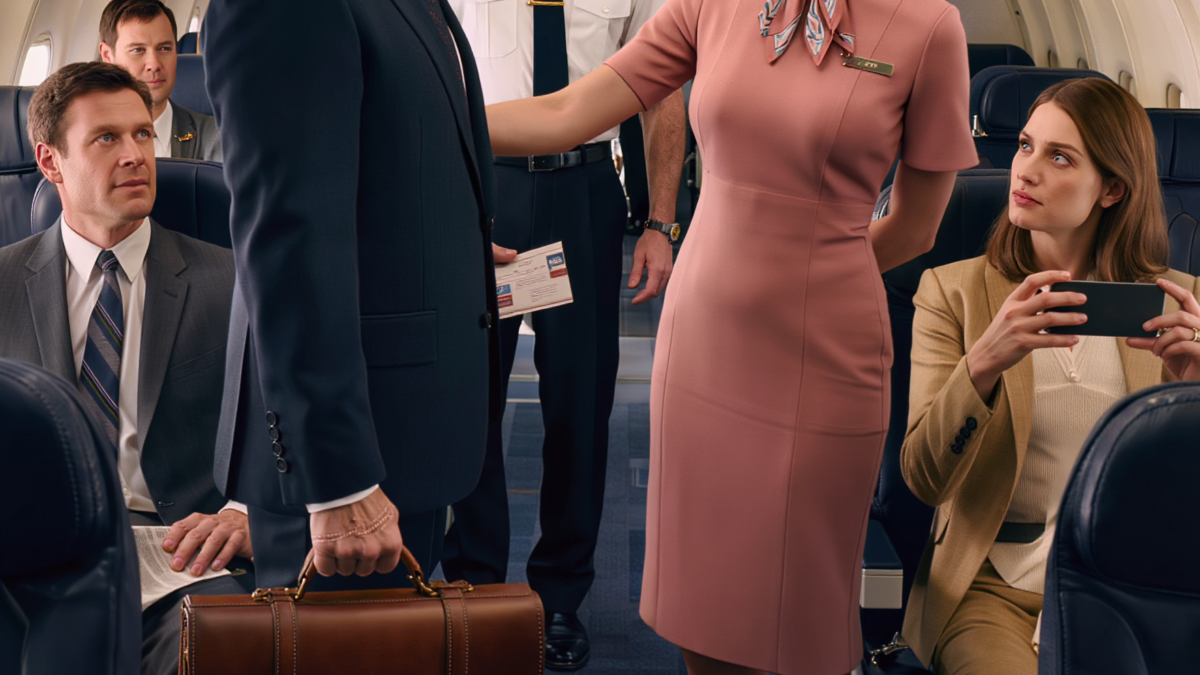
Passengers began turning in their seats when Rebecca Lawson stepped into the aisle and blocked Marcus Ellison from returning to first-class seat 2A.
His boarding pass was still in his hand, folded once along the center. He had already shown it more than once. His identification had been checked. The name matched. The seat matched. Nothing on the paper had changed.
Yet Rebecca stood between him and his seat as if another answer were still required.
“I’m asking you one last time, sir,” she said. “You need to leave the aircraft.”
Marcus did not raise his voice.
He did not argue.
He looked at her for a moment, then asked the only question that seemed relevant.
“May I know what policy I violated?”
Rebecca did not answer.
Instead, she turned toward the front of the aircraft and signaled another crew member.
A moment later, Captain Daniel Harris appeared in the cockpit doorway. Behind him, two airport security officers waited just outside the open aircraft door.
The delay had already spread through the cabin. Passengers who had been checking messages or adjusting laptop screens were now watching the aisle. The woman across from seat 2A quietly lifted her phone.
Marcus noticed her.
He noticed the captain.
He noticed Rebecca’s badge.
He noticed the security officers.
Then he reached beneath his seat, picked up his old leather briefcase, and stepped into the aisle without resistance.
The scene looked simple enough from a distance: a passenger was being removed from an aircraft.
But the details were already becoming more complicated than that.
Earlier that morning, the terminal had been ordinary.
Business travelers crossed the polished concourse with roller bags behind them. Departure announcements echoed from overhead speakers. People waited in coffee lines, answered work emails, checked gate changes, and stared through tall windows at aircraft moving slowly across the ramp.
Marcus Ellison moved through the crowd without attracting much attention.
He was a tall Black man in his early fifties, dressed in a dark navy blazer over a pale blue shirt. He wore no tie. His brown leather shoes showed the dull creases of regular use, and his briefcase had softened around the edges with age.
Nothing about him invited a second look.
He preferred it that way.
When he passed an elderly airport employee arranging wheelchair tags near a service desk, Marcus offered a quiet, “Good morning.”
The man looked up and smiled.
“Morning, sir.”
Marcus continued toward Gate A16.
He was traveling to an aviation infrastructure summit scheduled for later that afternoon. The meeting would bring together transportation officials, planners, engineers, and public-sector representatives to discuss airport modernization and regional transportation projects.
His staff had arranged his travel through the normal state system. He had asked for no special handling.
At the gate, boarding had not yet begun.
Marcus chose a seat near the windows and removed a thin folder from his briefcase. He read several pages of briefing notes, marked two paragraphs in the margin, then closed the folder when the gate agent picked up the microphone.
“Good morning, ladies and gentlemen. We’ll begin boarding Flight 482 with passengers requiring additional time, followed by our first-class customers.”
Marcus stood, adjusted the briefcase strap, and joined the short priority line.
When his turn came, the gate agent greeted him with the same professional smile she had given everyone else.
“Good morning, sir.”
“Good morning.”
He handed her the boarding pass.
The scanner beeped.
A green light appeared.
“You’re all set. Seat 2A. Enjoy your flight.”
“Thank you.”
Marcus walked down the jet bridge.
Inside the aircraft, soft instrumental music played through the cabin speakers. Passengers were settling into dark blue leather seats while flight attendants directed people toward overhead bins.
Rebecca Lawson stood in the front galley.
She was the senior flight attendant on Flight 482 and had been greeting passengers with the smooth rhythm of someone who had repeated the same phrases thousands of times.
“Welcome aboard.”
“Right this way.”
“Your seat is on the left.”
When Marcus reached the aircraft door, Rebecca’s smile changed.
Only slightly.
But enough for him to notice.
Her eyes moved from his face to the boarding pass in his hand.
“May I see that?”
Marcus handed it over.
Rebecca studied the pass.
Seat 2A.
Flight 482.
The same information the gate agent had just scanned.
She looked toward the first-class cabin and then back at Marcus.
“Wait here a moment.”
Passengers behind him slowed.
A man with a laptop bag shifted his weight. A woman farther back looked toward the gate, wondering what was holding up the line.
Rebecca stepped aside and showed Marcus’s boarding pass to a younger flight attendant.
The younger woman read it, glanced toward Marcus, and gave a small shrug.
Rebecca returned.
“This boarding pass is for first class.”
Marcus looked at her.
“That’s correct.”
There was a short pause.
“Do you have another form of identification?”
Marcus blinked once.
“My identification was verified at security.”
“I understand, but I’d still like to see it.”
He reached into his wallet and handed her his driver’s license.
Rebecca compared the name with the boarding pass.
Marcus Ellison.
Same name.
She checked the photograph.
Then the boarding pass again.
Everything matched.
For several seconds, she said nothing.
Finally, she returned both items.
“You may proceed.”
“Thank you.”
Marcus walked into the cabin and sat by the window in 2A.
Across the aisle, a middle-aged woman looked up from a tablet.
She had seen most of the exchange.
Her forehead tightened slightly before she returned to the screen.
Marcus placed his briefcase beneath the seat in front of him and rested the thin folder on his lap.
More first-class passengers boarded.
Rebecca resumed greeting them.
“Good morning.”
“Welcome aboard.”
“Right this way.”
Marcus watched without appearing to watch.
No one else was asked for additional identification.
No one else’s boarding pass was held while another crew member examined it.
He said nothing.
About ten minutes later, Rebecca began the predeparture beverage service.
“Water?”
“Coffee this morning?”
“Orange juice?”
She moved down the cabin row by row.
When she reached Marcus, she stopped.
“I’ll come back.”
Then she continued.
Marcus turned toward the window.
Outside, baggage crews moved containers beneath the aircraft.
Several minutes passed.
The woman across the aisle noticed that every other tray table had a drink.
Marcus’s remained empty.
She caught Rebecca’s attention.
“I think he was skipped.”
Rebecca glanced toward 2A.
“I haven’t forgotten.”
Her tone was professional, but colder than it had been with the others.
Marcus did not call anyone over.
He did not ask for water.
He folded his hands and waited.
The cabin door eventually closed.
Captain Daniel Harris welcomed the passengers over the intercom and announced favorable weather along the route.
Most people returned to their phones.
The woman across from Marcus tried to do the same.
But the earlier exchange stayed with her.
It was not one dramatic event.
It was a series of small ones.
Any single moment could have been dismissed.
Together, they were beginning to look different.
Marcus seemed to recognize that too.
His expression remained neutral, but his attention sharpened.
He noticed crew badges.
He noticed times.
He noticed which questions were asked and which were not.
He did not know yet whether those details would matter.
Still, he remembered them.
A few minutes later, Rebecca returned.
“Sir.”
Marcus looked up.
“Yes?”
“I need to verify your boarding pass again.”
He handed it to her.
She read it.
“Seat 2A. Flight 482.”
“Yes.”
“Who issued this boarding pass?”
“The gate agent.”
“Did anyone change your seat after check-in?”
“No.”
Passengers nearby had started listening.
A businessman lowered his newspaper.
The woman across the aisle removed one earbud.
Rebecca returned the boarding pass.
“For now, remain seated.”
Marcus looked at her.
“I already intended to.”
She walked away.
The businessman stared after her.
“That’s strange,” he murmured.
His wife touched his arm.
“Leave it.”
Marcus heard both of them.
He did not respond.
A late passenger boarded several minutes later, apologizing as he hurried through the door.
Rebecca greeted him warmly.
“Welcome aboard.”
The contrast was obvious enough that the woman across the aisle noticed it immediately.
Marcus did too.
Still, he said nothing.
Then Rebecca returned with the younger flight attendant.
“Sir, another passenger has raised a concern about seating.”
Marcus looked at her.
“What concern?”
“I can’t discuss that.”
“I understand. Is there a problem with my reservation?”
Rebecca avoided answering.
“I need to ask whether you’re certain you’re assigned to this seat.”
Marcus glanced at the small seat number beside him.
“Yes. My boarding pass confirms it.”
Rebecca folded her arms.
“I’ll need another moment.”
She walked away.
The woman across the aisle leaned toward the businessman.
“Did anyone complain?”
He shook his head.
“I didn’t hear anything.”
Neither had she.
Around them, passengers kept quiet.
It was easy to assume the crew knew something they did not.
That assumption held the cabin in place.
Marcus waited.
Five minutes later, beverage service resumed.
Rebecca offered coffee to the businessman, orange juice to the couple behind him, and tea to another passenger.
When she reached Marcus, she stopped.
“We’re temporarily suspending service here.”
Before he could answer, she continued walking.
The businessman looked toward Marcus.
“Did you order something?”
“No.”
“Then why are they skipping you?”
His wife again touched his arm.
“Please.”
Marcus reached into his briefcase and removed a small notebook.
He wrote one line.
Then he put the notebook away.
Rebecca saw him.
She returned immediately.
“What are you writing?”
Marcus looked up.
“Personal notes.”
“About what?”
“The flight. My own observations.”
“Why are you documenting this?”
“I make notes during most trips.”
Rebecca watched him for several seconds.
Then she turned and entered the front galley.
The curtain remained partly open.
Passengers could hear fragments of a conversation.
“…not cooperating…”
“…doesn’t seem right…”
“…captain needs to know…”
Marcus made no effort to listen.
Instead, he picked up the airline safety card and read it.
Across the aisle, the woman studied him.
Most people confronted this way would have demanded a supervisor by now.
Some would have argued.
Marcus did neither.
His calm did not look passive.
It looked deliberate.
A few minutes later, the cockpit door opened.
Captain Daniel Harris stepped into the aisle.
Rebecca spoke with him near the galley and handed him a written note.
Daniel read it.
Then he looked directly toward Marcus.
Marcus met his eyes briefly and returned to the safety card.
Daniel asked Rebecca several questions.
She answered with confidence.
The younger flight attendant stood nearby but said nothing.
After a minute, Daniel returned to the cockpit.
No announcement followed.
The aircraft remained at the gate.
Passengers began checking watches.
Someone farther back asked whether they would miss a connection.
A flight attendant replied, “We’re working through a situation.”
Nothing more.
Then Marcus looked through the window.
The jet bridge was returning.
Several passengers noticed at the same time.
The woman across the aisle lowered her tablet.
“Why is the bridge coming back?”
Nobody answered.
The aircraft door opened.
Two airport security officers stepped inside.
They were calm and professional.
No one rushed.
No one raised a voice.
But the cabin changed the moment they appeared.
Conversations stopped.
The officers exchanged a few words with Rebecca.
Then they approached seat 2A.
The lead officer spoke first.
“Good morning, sir. I’m Officer Ramirez with airport security.”
Marcus looked up.
“Good morning.”
“We’ve been asked to escort you off the aircraft.”
Passengers turned openly now.
The businessman frowned.
The woman across the aisle gripped her phone.
Marcus asked, “May I know the reason?”
Ramirez glanced toward Rebecca.
“We received a report that you refused crew instructions.”
Marcus considered the statement.
“I don’t believe I have.”
“We’re not here to debate the report.”
“I understand.”
Marcus paused.
“Could you tell me which instruction I refused?”
Ramirez hesitated.
“I don’t have those details.”
Marcus nodded.
“I appreciate your honesty.”
The officer shifted.
“If you’ll come with us, we’ll sort everything out inside the terminal.”
Marcus looked around the cabin.
Not for sympathy.
For details.
He saw Rebecca near the galley with her arms folded.
He saw Daniel in the cockpit doorway.
He saw the passengers who had watched the repeated questioning.
Then he closed the folder on his lap.
He reached beneath the seat, picked up his briefcase, and stood.
No protest.
No resistance.
No raised voice.
That calm response seemed to unsettle the cabin more than an argument would have.
As Marcus stepped into the aisle, the businessman across from him spoke.
“Officer.”
Everyone looked toward him.
He hesitated.
“I’ve been sitting here since boarding.”
Ramirez faced him.
“Yes, sir?”
“I never saw him refuse anything.”
The cabin went still.
Rebecca answered quickly.
“Sir, this is an operational matter. Please remain seated.”
“I’m only saying what I observed.”
“Thank you. We’ve addressed the situation.”
The businessman slowly sat back down.
Marcus gave him a brief nod.
Then another passenger unlocked her phone.
The woman across the aisle began recording.
She did not wave the phone or announce what she was doing.
She simply pointed the camera toward the aisle.
The younger flight attendant noticed.
She looked at Rebecca.
Rebecca ignored it.
Marcus reached the aircraft door.
Before stepping onto the jet bridge, he looked at Ramirez.
“May I ask one favor?”
“Of course.”
“My briefcase contains confidential government documents.”
Ramirez nodded immediately.
“You may keep it with you.”
“Thank you.”
Rebecca watched the exchange.
Marcus stepped onto the jet bridge.
The officers walked beside him rather than behind him.
No one touched him.
No one searched the briefcase.
To anyone watching from a distance, they looked like three professionals walking together.
Still, passengers inside the aircraft had seen something else.
A man had been removed from first class.
The door closed.
Quiet conversation began immediately.
“I don’t understand.”
“He never argued.”
“Did we miss something?”
“I don’t think so.”
The woman across the aisle replayed the video she had recorded.
It showed Marcus standing.
Picking up his briefcase.
Walking beside security.
No shouting.
No threats.
No physical confrontation.
Only cooperation.
Near the cockpit, Daniel turned to Rebecca.
“Are you certain about your report?”
“Absolutely.”
“Did anyone else hear him refuse instructions?”
“He questioned them repeatedly.”
Daniel frowned.
“Questioning isn’t necessarily refusing.”
Rebecca crossed her arms.
“He challenged crew authority.”
Daniel did not answer.
His attention moved to the empty seat 2A.
The bottle of water that had never been offered to Marcus sat nearby.
The tray was otherwise untouched.
The safety card rested neatly on the seat.
Daniel picked it up.
A small piece of paper slipped out from beneath it.
He unfolded the note.
There was one line.
Time of repeated seat verification: 8:14 a.m. Witnesses present.
No accusation.
No complaint.
No conclusion.
Just a time and an observation.
Daniel folded the note again.
For the first time that morning, the question in his mind changed.
He was no longer asking whether Marcus had caused a problem.
He was wondering whether the crew had.
Marcus walked through the terminal with Officers Ramirez and Cole.
Travelers passed them without noticing anything unusual.
Ramirez led him into a small interview room used for operational incidents.
There was a table, four chairs, a wall clock, and a security camera mounted in one corner.
“Please have a seat, sir.”
“Thank you.”
Marcus placed his briefcase beside the chair and sat.
Ramirez opened a standard incident form.
“I need to document what happened.”
“Of course.”
He began with routine questions.
“Can you confirm your name?”
“Marcus Ellison.”
“Destination?”
Marcus told him.
“Purpose of travel?”
“Official meetings.”
Ramirez read from the crew report.
Halfway through, he stopped.
“According to this, you repeatedly refused instructions from the flight crew.”
Marcus answered, “I asked for clarification several times.”
“You never refused?”
“No.”
Ramirez wrote something.
“Were you asked to leave your seat before we arrived?”
“No.”
“Were you warned that your behavior could result in removal?”
“No.”
Ramirez stopped writing.
Those details were missing from the report.
He flipped through the pages once more.
Then he glanced at Cole.
Cole had noticed it too.
Neither officer commented.
A knock came at the door.
An airline supervisor entered carrying a folder.
“My name is Linda Brooks. I’m the airport customer service supervisor.”
Marcus stood briefly and greeted her.
“I understand there was an issue on board.”
“There appears to have been.”
Linda sat across from him.
“I’d like to understand what happened from your perspective.”
“I’ll answer whatever you need.”
She asked him to begin at boarding.
Marcus described events in order.
The first boarding-pass check.
The request for additional identification.
The second verification.
The delayed beverage service.
The questions about his seat.
The arrival of security.
He did not speculate about Rebecca’s motives.
Whenever Linda asked why he believed something had happened, Marcus said the same thing.
“I don’t know.”
That answer caught her attention.
People removed from aircraft often arrived angry.
They accused.
They defended themselves.
Marcus described actions.
Nothing more.
When he finished, Linda closed her notebook.
Before she could continue, an employee appeared with Rebecca’s written statement.
Linda read the first page.
Then the second.
She reread one paragraph.
Officer Ramirez noticed.
“Something wrong?”
Linda looked at the report.
“The timelines don’t fully match.”
“In what way?”
“The report says the passenger repeatedly ignored crew instructions before security was requested.”
Ramirez looked toward Marcus.
“Were you given repeated instructions?”
Marcus answered, “I was asked questions.”
Linda said nothing.
She turned another page.
“The report also says the passenger became increasingly confrontational.”
Ramirez looked across the table.
“I didn’t observe that.”
“Neither did I,” Cole added.
Linda closed the folder.
“I need to speak with the crew again.”
She stepped into the hallway and called the aircraft.
Captain Harris answered.
“Captain Harris, this is Linda Brooks at Gate A16.”
“What can I do for you?”
“I’ve completed an initial interview. There are inconsistencies between the written report and the passenger’s account.”
Daniel lowered his voice.
“What kind?”
“The sequence of events isn’t matching.”
Daniel looked toward Rebecca in the galley.
“I’ll review it after landing.”
Linda replied, “I think you should review it before departure.”
He paused.
“Is it that serious?”
“I think it deserves another look.”
After the call, Daniel asked Rebecca to repeat her account.
She did so confidently.
When she finished, he asked one question.
“Did any passenger witness him refusing instructions?”
Rebecca paused.
“I’m not sure.”
“You’re not sure?”
“They were focused on themselves.”
Daniel remembered the businessman.
He had clearly said he witnessed no refusal.
Daniel looked at the empty seat again.
Something no longer fit.
In the interview room, Marcus’s phone vibrated.
The screen showed a first name.
Elaine.
He answered.
“Good morning.”
A woman’s voice came through.
“Governor, we were informed there may be a delay.”
Marcus looked through the window toward the aircraft.
“Yes.”
“Do you need assistance?”
“Not yet.”
He ended the call.
Ramirez had heard enough to become curious.
Whoever had called clearly knew Marcus personally.
And whoever she was had addressed him as governor.
Marcus had introduced himself to everyone simply by name.
Nothing more.
For the first time, Ramirez wondered whether the airport had removed someone it knew very little about.
Flight 482 remained parked.
The delay approached forty minutes.
Passengers received only general requests for patience.
Daniel reviewed Rebecca’s report again.
Passenger repeatedly refused crew instructions and created an escalating disruption requiring removal.
The words sounded decisive.
His own memory did not.
He remembered Marcus sitting quietly.
He remembered no raised voice.
He remembered the businessman’s statement.
A dispatcher called from operations.
“Captain, we’re approaching a significant delay threshold. Is the aircraft ready?”
Daniel looked at the incident report.
“Not until I verify something.”
There was a pause.
“Understood. We’ll hold departure.”
Across the terminal, Linda carried two folders into the airport operations office.
One contained Rebecca’s report.
The other contained her interview notes.
An operations manager joined her.
“What do we have?”
“Two very different versions of the same incident.”
He read Rebecca’s report first.
Then Linda’s notes.
“The passenger never refused to identify himself?”
“No.”
“He left voluntarily?”
“Immediately.”
The manager leaned back.
“So where exactly was the refusal?”
Linda could not answer.
Officer Ramirez’s report was shorter.
Passenger cooperative upon contact.
No resistance observed.
Escorted voluntarily.
No verbal aggression.
Cole read it over his shoulder.
“Simple report.”
Ramirez closed the folder.
“Simple incident.”
Cole glanced toward the crew statement.
“Doesn’t sound like the same incident.”
“No,” Ramirez said. “It doesn’t.”
On the aircraft, the woman who had recorded Marcus showed the video to the businessman.
He watched it carefully.
When it ended, he handed the phone back.
“That’s not what I expected.”
“What did you expect?”
“A disturbance.”
“There wasn’t one.”
“Keep that video.”
“I intend to.”
At airline headquarters, the delay generated an automatic compliance alert.
A security removal before departure required extra documentation before operational records could be closed.
Compliance analyst Sarah Chen opened the electronic file.
She reviewed the crew statement.
Then the captain’s preliminary notes.
Then the airport security summary.
Three documents.
One incident.
Three noticeably different descriptions.
Sarah highlighted several lines.
Then she called her supervisor.
“I found conflicting documentation on Flight 482.”
“How significant?”
“Enough that I’d like a second review.”
“Forward it.”
Sarah sent the file.
She did not yet know who Marcus was.
The name meant nothing to her.
She was following procedure.
Linda returned to the interview room.
“There may be a further delay.”
Marcus nodded.
“I understand.”
She hesitated.
“May I ask something unrelated to the incident?”
“Of course.”
“Were you traveling for business?”
“Yes.”
“Private sector or public?”
“Public.”
Linda stopped there.
Near the gate, passengers who had witnessed the incident began approaching customer service.
One man said, “I’d like to provide a statement.”
Another passenger stepped forward.
“So would I.”
Within minutes, three people had volunteered independent accounts.
Their wording differed.
Their central observation did not.
Marcus had remained calm.
Linda read the statements.
None described shouting.
None mentioned threats.
None said Marcus refused instructions.
The distance between Rebecca’s report and everyone else’s account continued to widen.
Marcus’s phone rang again.
“Marcus speaking.”
“Governor, we’ve confirmed your meeting has been postponed.”
“Thank you.”
“Transportation officials are aware of the delay. Would you like us to contact the airline?”
Marcus looked toward the gate.
“No.”
There was a pause.
“We’ll allow them the opportunity to understand what happened first.”
He ended the call.
Linda had entered the room in time to hear one word.
Governor.
She looked at Marcus.
Then at the reports in her hand.
The incident suddenly carried another layer.
But even before his identity was confirmed, something more important was already clear.
The system’s own records were contradicting the original accusation.
Linda returned to the operations office and opened Marcus’s reservation.
Confirmed first-class ticket.
State government travel account.
Then she noticed a management-only notation attached to the booking.
Official government travel. Coordination contact available upon request.
“That’s interesting,” she said.
The operations manager looked over.
“What?”
“He wasn’t traveling privately.”
“Can we verify the agency?”
Linda reached for the phone.
At headquarters, Sarah Chen had reached the same reservation information.
The government travel designation reminded her of an internal notice distributed earlier in the week.
Several state officials were scheduled to attend the aviation infrastructure summit that afternoon.
She opened the attendee list.
Halfway down the page, she stopped.
Governor Marcus Ellison.
Sarah checked the passenger record.
Same name.
Same destination.
Same departure.
She checked again.
Then she called her supervisor.
“I believe we’ve identified the passenger involved in Flight 482.”
“Who is he?”
Sarah answered carefully.
“The sitting governor scheduled to attend today’s aviation infrastructure summit.”
There was silence.
“Are you certain?”
“I verified it twice.”
“Stay where you are.”
Marcus remained in the interview room reading his briefing folder.
Ramirez returned with two cups of coffee.
“I wasn’t sure how you take it.”
“Black is fine.”
Ramirez handed him a cup.
“I appreciate how cooperative you’ve been.”
Marcus accepted it.
“I know you’re doing your job.”
Ramirez nodded.
“I wish more people understood that.”
They sat quietly for a moment.
Then Ramirez finally asked, “What kind of government work brings you to the capital?”
“A transportation meeting.”
“Important one?”
Marcus looked at him.
“I believe so.”
He did not add anything.
He never introduced himself as governor.
Back on the aircraft, Daniel confronted Rebecca directly.
“I’ve read your report several times.”
Rebecca folded her arms.
“And?”
“I need you to answer one question.”
She waited.
“What specific instruction did the passenger refuse?”
“He questioned my authority.”
“That wasn’t my question.”
“He challenged the seating process.”
“The boarding pass matched.”
“I know.”
“The identification matched.”
“I know.”
“He remained seated.”
“Yes.”
Daniel kept his voice measured.
“So what instruction did he refuse?”
Rebecca said nothing.
Ten seconds passed.
The younger flight attendant standing nearby lowered her eyes.
Linda’s phone rang.
“This is Linda.”
“This is the office of the governor.”
She straightened.
“I’m calling regarding Governor Marcus Ellison.”
Linda looked through the glass toward the interview room.
“Yes.”
“We understand there has been an incident involving his scheduled flight.”
“There has.”
“Is the governor safe?”
“Yes.”
“Has he requested assistance from our office?”
Linda looked at Marcus.
“No.”
A pause.
“That sounds like him.”
Linda asked, “May I confirm that Governor Ellison was traveling on official state business today?”
“Yes. He was scheduled to participate in the aviation infrastructure conference.”
“Thank you.”
Linda ended the call.
Then she went directly to the operations manager.
“It’s confirmed.”
He looked up.
“The passenger is Governor Marcus Ellison.”
The manager removed his glasses.
“When did everyone find out?”
“Just now.”
“And the crew?”
“They still don’t know.”
Corporate compliance escalated the investigation.
A senior director joined the call.
“Before anyone discusses public relations, I want facts.”
Sarah summarized the documentation.
“Witnesses contradict the crew report. Security observed full cooperation. The captain’s notes raise procedural concerns. The passenger has now been positively identified.”
The director interrupted.
“I don’t care that he’s a governor.”
Sarah paused.
“If this happened to him, it could happen to anyone.”
The room became quiet.
That sentence changed the direction of the review.
The issue was not whether the airline had failed to recognize an important person.
The question was whether its procedures had failed an ordinary passenger before anyone knew his title.
Linda returned to Marcus.
She sat across from him.
“Governor Ellison.”
It was the first time anyone at the airport had addressed him by title.
Marcus closed the folder.
“Yes?”
“I owe you an apology.”
He waited.
“We should have understood who you were.”
“With respect,” Marcus said quietly, “my position shouldn’t have mattered.”
Linda lowered her eyes.
He was not correcting her for the sake of pride.
He was identifying the central problem.
The biggest mistake had not been failing to recognize a governor.
It had been allowing treatment that would have been unacceptable no matter who was sitting in 2A.
By early afternoon, corporate compliance had opened a formal review.
The airline’s legal and operations teams were notified.
The instruction from headquarters was simple.
Preserve every record.
No report was to be edited.
No note was to be discarded.
Every communication connected to Flight 482 would be retained.
Two senior airline executives arrived later that day.
Michael Grant, vice president of flight operations, entered the operations office with Karen Whitfield, senior director of corporate compliance.
Linda gave them everything.
Rebecca’s statement.
Daniel’s notes.
Security reports.
Passenger statements.
Boarding records.
Gate logs.
Karen separated the documents into folders.
“No conclusions today,” she said. “Facts first.”
Daniel was interviewed.
Karen asked, “When did you personally become involved?”
“After the senior flight attendant told me a passenger was refusing instructions.”
“What did you observe yourself?”
Daniel paused.
“A calm passenger seated in first class.”
“Did you personally witness him refusing an instruction?”
“No.”
Karen wrote it down.
“You relied on the crew report?”
“Yes.”
“Thank you.”
No lecture.
No accusation.
Only documentation.
Rebecca sat for a separate interview.
A recorder rested on the table.
Karen opened the original report.
“You wrote that the passenger repeatedly refused instructions.”
“Correct.”
“What specific instruction?”
“He questioned my authority.”
Karen looked at her notes.
“I understand.”
Then she asked again.
“What instruction did he refuse?”
Rebecca’s answer came slower.
“He wouldn’t stop asking questions.”
“Asking questions is not, by itself, refusing an instruction.”
Rebecca shifted in the chair.
“He made me uncomfortable.”
Karen wrote the sentence exactly as Rebecca said it.
Then she continued.
“Did you instruct him to leave his seat before security arrived?”
“No.”
“Did he ignore any direct command?”
Rebecca looked toward the table.
“I don’t remember.”
The recorder continued running.
Ramirez was interviewed separately.
His answers matched the written report.
“Was the passenger cooperative?”
“Yes.”
“Did he resist?”
“No.”
“Raise his voice?”
“No.”
“Threaten anyone?”
“No.”
“Did he leave voluntarily?”
“Immediately.”
The differences were becoming increasingly difficult to explain.
Marcus was moved to a quiet conference room while the airline arranged another flight.
Linda brought him a new itinerary.
“We’ve reserved a seat for you this evening.”
Marcus looked at it.
“Thank you.”
“You’ll arrive about three hours later than planned.”
“That will be sufficient.”
“Our executives would like to meet with you.”
Marcus placed the itinerary on the table.
“If they’re gathering facts, I’ll cooperate.”
“They are.”
“If they’re looking for forgiveness, they should finish the investigation first.”
Linda nodded.
“That’s fair.”
In the operations office, Karen built a minute-by-minute timeline.
Passenger boards.
Identification requested.
Boarding pass verified again.
Service delayed.
Captain notified.
Security requested.
Passenger removed.
She looked around the room.
“I want every event supported by evidence.”
The team worked through the sequence.
Most events could be verified.
One category remained largely blank.
Documented refusal of crew instruction.
Karen pointed to it.
“What supports this?”
No one answered.
Daniel finally said, “I don’t have anything.”
Linda shook her head.
“Neither do I.”
Ramirez added, “We never observed it.”
Karen typed into the investigation file.
Claim currently unsupported by available evidence.
Late that afternoon, Michael Grant met Marcus.
“Governor Ellison.”
Marcus stood and shook his hand.
Michael sat across from him.
“I’m not here to defend what happened.”
Marcus listened.
“I’m here to assure you the investigation will follow the evidence wherever it leads.”
“That’s all I expect.”
Michael studied him.
“You’ve shown remarkable patience.”
Marcus looked through the conference-room window.
“Patience is easier when you believe the system is willing to correct itself.”
Michael did not immediately answer.
He understood that the question now extended beyond one employee or one flight.
The investigation continued into the next day.
There were no dramatic public scenes.
No one was marched through the terminal.
No press conference was called.
Instead, investigators, compliance specialists, legal advisers, and operations managers reviewed hundreds of ordinary details.
Gate records.
Passenger video.
Security logs.
Surveillance timestamps.
Crew statements.
Passenger interviews.
Each answered part of the story.
Airport footage showed Marcus entering the gate area, waiting, and boarding with his group.
He had not bypassed the line.
He had not argued with the gate agent.
Jet-bridge footage showed the same thing.
Everything remained routine until Marcus reached the aircraft door.
Karen marked another finding.
No evidence of disruptive behavior before boarding.
The review then focused on cabin procedure.
Crew members were permitted to verify boarding passes when necessary.
But repeated verification required a reason.
Investigators searched the incident documentation.
There was no specific documented reason for repeatedly checking Marcus’s seat.
Only Rebecca’s statement that something had not “seemed right.”
That was not an observable standard.
It was an impression.
The distinction mattered.
Captain Harris completed a supplemental statement based only on what he personally witnessed.
Marcus remained seated.
Marcus answered questions calmly.
Marcus left voluntarily after security arrived.
Daniel signed it.
Then he looked at Michael Grant.
“I should have asked more questions before approving the removal.”
Michael answered, “You relied on information from your crew.”
“I did. But the responsibility still reached my desk.”
Michael nodded.
“That’s correct.”
Rebecca returned for another interview.
Karen placed two documents in front of her.
Rebecca’s original report.
Daniel’s supplemental statement.
“There are significant differences.”
Rebecca looked down.
Karen continued.
“Several passengers, airport security, and the captain describe a cooperative passenger.”
Rebecca remained silent.
“Would you like to amend your report?”
She stared at the papers.
Finally she said, “I believed I was making the right decision.”
Karen nodded.
“I understand.”
Then she added, “This investigation is not evaluating intentions. It’s evaluating actions.”
Rebecca lowered her eyes.
That afternoon, executives met with training staff.
The discussion centered on procedure rather than spectacle.
One instructor said, “When employees rely on assumptions instead of verification, policy begins to fail.”
Another added, “And once one assumption is accepted, every later decision becomes easier to justify.”
No one spoke for several seconds.
Because by then the entire chain was visible.
One unexplained assumption had led to another.
Repeated scrutiny became suspicion.
Suspicion became a report.
The report became a security request.
And the security request removed a passenger whose documented conduct never supported the accusation that started it.
The records did not show a man refusing orders.
They showed a man asking questions.
They showed a system interpreting those questions as something more.
And by the time enough people stopped accepting the original version and began comparing what had actually happened, Flight 482 had become a lesson no one involved could dismiss as a misunderstanding.
This story is a dramatized work of fiction created solely for storytelling and entertainment purposes. It is not presented as a factual report or news account. Any resemblance to actual people, places, organizations, or events is purely coincidental. Names, dialogue, locations, timelines, occupations, and identifying details have been invented, combined, or altered to protect privacy and support the narrative. Some accompanying images or visual elements may be AI-generated or digitally enhanced.