My sister was seconds from selling the 1967 Mustang I had spent three years restoring when my father folded his arms on the porch and told me, “Stop crying over metal. She has bigger plans for the cash.” The buyer already had a $22,000 check ready. I didn’t argue. I opened the folder under my arm and showed him whose name was actually on the title. Then I noticed the document in my sister’s tote bag—and realized my father’s part in this had started long before that morning.
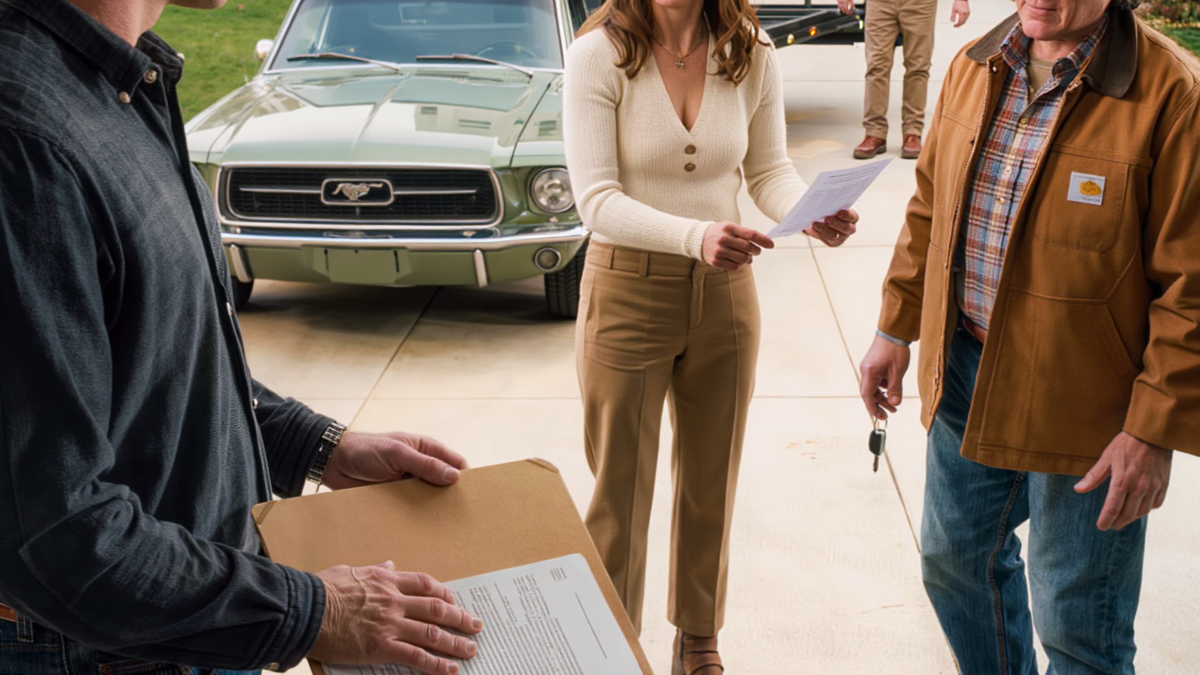
The buyer’s hand was about six inches from the Mustang’s keys when I opened the folder.
He was a heavyset man in his mid-fifties wearing a tan work jacket, faded jeans, and boots that had seen more gravel than carpet. His black Ford F-350 sat in my parents’ driveway with a flatbed trailer behind it, positioned perfectly to take away the car I had spent three years rebuilding.
My sister, Marissa, stood beside him holding a check.
My father stood on the front porch with his arms crossed.
And behind all three of them sat my 1967 Ford Mustang Fastback, Highland Green paint glowing under the late-morning Ohio sun.
Marissa was smiling.
I knew that smile.
I had seen variations of it since we were children. It appeared whenever she believed the difficult part was over and somebody else would be left dealing with the consequences.
The difference that morning was that she hadn’t expected me to walk up the driveway.
I had parked my truck three houses away, around the corner where nobody could see it, then walked back with a manila folder tucked under my arm.
My father noticed me first.
“Evan.”
His voice wasn’t surprised.
If anything, he sounded inconvenienced.
“Dad.”
Marissa turned.
For once, her smile didn’t finish forming.
“What are you doing here?”
I stopped near the edge of the driveway.
“What are you doing with my car?”
The buyer looked at Marissa, then at my father, then at me.
He still had a pen in one hand.
The check was already in Marissa’s.
“Is there a problem?” he asked.
My father stepped forward on the porch.
“No problem.”
I looked at him.
Then at Marissa.
“I got the family text.”
Marissa’s eyes tightened.
That text was the only reason I knew what was happening.
Three years earlier, I had bought the Mustang from a farmer in southern Ohio.
It had been sitting in a barn for years after a storm dropped part of a tree across the passenger side of the roof. The floor pans were heavily rusted. The interior was nearly gone. The original 289 engine had seized long before I arrived.
The farmer wanted $3,000 and one promise.
He didn’t want the car stripped for parts.
He wanted someone to restore it.
I paid him $3,200.
He wrote out a short agreement by hand, and we both signed it.
I kept that sheet of paper.
In fact, I kept everything.
I had been working as an estimator at a collision repair shop for more than a decade. My job depended on documentation. A damaged car came in, and I had to identify what was wrong, estimate what could be repaired, determine what needed replacement, and explain every dollar.
That kind of work changes the way you think.
People remember things differently.
Paper doesn’t.
So on the day I brought the Mustang home, I started a folder.
The farmer’s handwritten sale agreement went inside first.
Then the title paperwork.
Then receipts.
Photographs.
Invoices.
Part numbers.
Engine information.
Insurance documents.
Every major step of the build had a record.
The Mustang itself went into one bay of my father’s three-car garage because I didn’t have enough space at my own place.
I had asked him before I bought it.
“Can I use one bay for a restoration project?”
“Whatever you want, Evan. I’ve got the space.”
That was his exact answer.
I wrote down the date in my project notebook.
At the time, that probably seemed excessive.
Three years later, it didn’t.
The first year was mostly teardown.
I spent forty-three weekends taking the car apart until what remained was bare metal and a chassis that looked more like an industrial sculpture than something that had once traveled highways.
I rented equipment in February and worked in the coldest garage bay in Ohio wearing a jumpsuit, gloves, and a respirator while space heaters fought to keep the temperature high enough for primer.
One Saturday in March, Dad walked into the garage and stopped beside the rotisserie.
He looked at the stripped shell.
“You know you could probably buy one of these already finished for less money than you’re going to spend restoring this one.”
“I’m not restoring it to sell it.”
He shrugged.
“Every car is for sale eventually.”
I wrote that down too.
I couldn’t have explained why.
Something about the sentence stayed with me.
The second year was mechanical.
The original 289 had been frozen for around fifteen years. I sent it to a machinist in Dayton who specialized in vintage Ford small blocks.
The rebuild cost $8,340.
The invoice went into the folder.
So did his business card.
So did the dyno sheet.
Noah Kesler, my closest friend since we were fifteen, helped me source several components through his shop network.
Noah owned a body shop about twenty minutes from my parents’ house. He understood the project better than anybody except me because he had watched it develop from rusted shell to running car.
The third year was paint, interior, and final assembly.
I chose Highland Green because I had been staring at photographs of that exact factory color for years before I could afford a Mustang of my own.
I installed most of the interior myself from a reproduction kit out of Tennessee.
Final assembly took four months.
When a car has been apart for three years, every bolt becomes a choice.
I make choices slowly.
On July 14, I finished.
The next day, the title paperwork was finalized.
The Mustang was registered to Evan Michael Caldwell.
It was insured under the same name.
It was road legal.
It was mine.
For eleven weeks, it remained in Dad’s garage.
Then Marissa started asking questions.
She was twenty-nine, three years younger than me, and had spent most of her adult life cycling through new business ideas.
She wasn’t lazy.
That would have made the situation simpler.
Marissa could work obsessively when she was excited about something.
Her problem was that she became excited about beginnings and impatient with everything that came afterward.
Over four years, she had tried half a dozen ventures.
None lasted long.
The latest was a mobile luxury spray-tan and beauty trailer she called a “rolling glam suite.”
She had been posting concept images online since spring.
The plan required a customized trailer, equipment, branding, lighting, product inventory, and a vehicle capable of moving it.
By her calculations, she needed around $38,000.
She didn’t have it.
The first warning came at Sunday dinner in August.
Mom had asked me to come because I had skipped several family dinners during the final months of the restoration.
She made pot roast.
Dad opened wine.
Marissa spent much of dinner looking at her phone.
Halfway through the meal, she said, “Random question.”
I kept eating.
“What’s a finished 1967 Mustang worth?”
“Depends.”
“Ballpark.”
“Fifty to seventy-five thousand, maybe. Depends on originality, condition, documentation, matching numbers.”
She put down her phone.
“That much?”
“Potentially.”
“Is yours worth that much?”
I looked at her.
“It isn’t for sale.”
She smiled.
“I know. I was just asking.”
Across the table, Dad said, “That’s a lot of cash sitting in a garage.”
Mom changed the subject.
Nobody argued.
I helped clear the dishes and left.
Ten minutes into my drive home, I stopped at a gas station.
I sat in my truck with the engine off and opened my project notebook.
I wrote:
A lot of cash sitting in a garage.
Then I added the date and context.
I wasn’t building a case.
Not consciously.
I simply knew that sentence bothered me.
The second warning came late in September.
I stopped at my parents’ house on a Wednesday afternoon because I had left a torque wrench in the garage.
Dad was working.
Mom had a dentist appointment.
The overhead garage door was open.
I walked inside and stopped.
The Mustang had been moved.
Normally I parked it in the second bay at a slight angle.
Now it was positioned squarely in the first bay beneath the strongest overhead light.
Two small tripods were folded against the rear wall.
A phone charging cable I didn’t recognize had been plugged into an outlet near Dad’s workbench.
Someone had been photographing the car.
I stood there for a few seconds without touching anything.
Then I took out my phone.
I photographed the Mustang’s position.
The tripods.
The charger.
The light.
I collected my torque wrench and went home.
That night, I called Noah.
“Someone’s been photographing the Mustang.”
“Where?”
“Dad’s garage.”
He was quiet.
“Tripods?”
“Two.”
“Car moved?”
“Into better light.”
He exhaled.
“Your sister?”
“That’s my guess.”
“You think she’s shopping it?”
“I think she may already have somebody interested.”
“Why?”
“She asked what it was worth at dinner.”
Noah didn’t answer immediately.
Then he asked, “Where’s your folder?”
“With me.”
“Not in your parents’ house?”
“No.”
“Not in the garage?”
“No. It stays in the truck.”
“Good.”
I leaned back against my kitchen counter.
“There’s something else.”
“What?”
“Dad told me back in March that every car is eventually for sale.”
“That was before the car was finished.”
“Yeah.”
Noah was quiet again.
Then he said, “Evan, if Marissa comes to him with a plan that turns the car into money and gets it out of his garage, he may decide her plan makes sense.”
“I know.”
“And if that happens, he’s not going to think of it as helping somebody take your car.”
“What will he think?”
“That he’s solving a family problem.”
I looked toward the dark kitchen window.
“That sounds like him.”
“Then make sure you’re there if anything happens.”
“I will.”
For almost three weeks, nothing happened.
The tripods disappeared.
The Mustang returned to its normal bay.
I stopped by twice.
Both times, I checked the odometer.
I even checked the position of the tire valve stems, an old shop habit. Wheels move, valve stems rotate. Small things tell stories.
Everything looked normal.
I relaxed slightly.
The mistake I made was assuming that because the car had stopped moving, the plan had stopped too.
On Saturday morning, I was standing in my kitchen wearing sweatpants and a T-shirt, drinking coffee, when my phone buzzed at 9:47.
The preview showed a message from Marissa.
Sold. Thanks, Dad, for making it happen. Heading over at 11 to do the pickup. Derek’s bringing the trailer.
I read it twice.
Then I opened the thread.
It was an old family group chat created for a Smoky Mountains trip two years earlier.
Marissa had sent the message to the wrong group.
I was still in it.
For about ninety seconds, I stood at the kitchen counter without moving.
My coffee cooled beside me.
Then I opened a private message to Noah.
Marissa sold it. Buyer named Derek. Pickup at 11. Parents’ driveway.
His reply came almost immediately.
You have the folder?
Always.
Go. Don’t call first.
I was dressed and in my truck by 10:12.
The trip normally took thirty-five minutes.
That morning it took twenty-eight.
I parked out of sight and walked the final stretch.
The F-350 told me Noah had been right.
So did the trailer.
Dad was on the porch.
Marissa was on the lawn.
Derek stood beside the trailer.
The Mustang had already been pulled out of the garage.
They hadn’t loaded it yet.
That mattered.
When Dad saw me, he said my name like I was somebody arriving early for a meeting he had hoped to finish without me.
Marissa asked what I was doing there.
Then Derek asked if there was a problem.
I told them I had seen the group message.
Dad immediately tried to lower the temperature.
“Don’t make a scene.”
“My car is sitting behind somebody else’s trailer.”
“Your sister is handling something.”
Derek looked between us.
“Wait. Who owns the vehicle?”
“I do,” Marissa said.
Then, realizing how that sounded, she adjusted.
“We do. It’s a family vehicle. My dad and I are handling the sale.”
“The title is in my name,” I said.
Derek turned toward me.
Marissa rushed in.
“We’re working through the transfer.”
“There is no transfer.”
Dad came off the porch.
“Evan.”
I looked at him.
He had the expression he used whenever he believed the next sentence should end a disagreement.
“Stop crying over metal. Your sister has bigger plans for the cash.”
I didn’t answer him.
Instead, I looked at Derek.
“Can I show you something?”
“Please.”
I opened the folder.
The first sheet I gave him was the Ohio title issued in July.
Owner: Evan Michael Caldwell.
The VIN matched.
The address matched.
The history traced back to the farmer who had sold it to me in 2022.
Derek read it.
Then I handed him my current insurance declaration.
Same car.
Same VIN.
Same owner.
He lowered the papers.
Marissa said, “There’s more context.”
I said, “The car has never been for sale.”
Derek looked at the check in her hand.
“How much did you tell him?” I asked.
He answered instead.
“Twenty-two thousand.”
That number told me more than any argument could have.
A properly restored Fastback like mine could be worth three times that amount.
Marissa hadn’t negotiated badly.
She had priced the car to move quickly.
I looked at Derek.
“You know what this car is worth.”
He nodded once.
“I thought there was a reason for the price.”
“There was. She needed the money quickly.”
Marissa stepped closer.
“Evan, stop.”
Derek moved away from the trailer.
“I need my check back.”
“Derek—”
“Ma’am. I need my check.”
She stared at him.
Then at Dad.
Dad looked toward the porch.
Finally Marissa handed Derek the check.
He folded it and slipped it inside his jacket.
The small polite smile he had worn when I arrived was gone.
I said, “The car doesn’t belong to either of them. If you left with it after seeing these documents, you’d be taking property the seller had no authority to transfer.”
He nodded.
“I understand.”
Then I added the sentence that seemed to finally make Dad realize how the morning looked from outside the family.
“You nearly bought stolen property.”
Nobody answered.
Derek looked at Marissa.
Then he asked me for my contact information.
“I was told something different before I drove up here. I’d like a written statement from you, if you’re willing.”
“You’ll have one.”
“I’m leaving.”
He unhitched his trailer setup and prepared to pull away.
Nobody spoke while he worked.
The metallic clicks from the hitch sounded unnaturally loud in the driveway.
When his truck finally left, the Mustang remained exactly where it should have been.
With me.
Marissa turned toward me.
“You didn’t have to do that publicly.”
I almost admired how fast she recovered.
“What exactly should I have done?”
“Pulled me aside.”
“You were taking payment for my car.”
“We could have worked something out.”
“You had already sold it.”
“I was going to pay you back.”
“With what?”
“The sale money.”
I looked at her.
“You were going to pay me for my own car using money you got by selling my own car.”
“I had a plan.”
From the porch, Dad said, “She did have a plan.”
I turned toward him.
“This isn’t your conversation.”
“This is my house.”
“Yes. It is.”
I pointed toward the Mustang.
“That isn’t your car.”
He stopped.
Marissa tried explaining.
First she said the Mustang was effectively family property because it had been stored in Dad’s garage.
Then she explained what the beauty trailer could do for her career.
Then she talked about how Dad had paid attention to my restoration project while ignoring her business plans.
Finally she said I had never made it clear enough that selling the Mustang would be a serious problem.
I let her finish.
Then I asked, “Where’s the bill of sale?”
She blinked.
“What?”
“The bill of sale.”
“There isn’t one.”
“Yes, there is.”
She folded her arms.
I continued.
“Derek didn’t drive ninety minutes with a trailer and hand you a $22,000 check without paperwork.”
Dad spoke from the porch.
“Evan, enough.”
I kept looking at Marissa.
“Where is it?”
She didn’t answer.
“Give it to me, or on Monday I start asking the state title office exactly what was presented to that buyer.”
Marissa stared at me.
Then she walked toward her red Jeep Compass.
She opened the passenger door.
A large tote bag sat on the seat.
She reached inside, removed a folded page, and returned.
When she handed it to me, I recognized the format immediately.
It was a basic downloadable vehicle bill-of-sale template.
Buyer: Derek Hanley.
Seller: Evan Michael Caldwell.
Sale price: $22,000.
Vehicle: 1967 Ford Mustang Fastback.
The VIN matched.
Then I reached the signature line.
Evan M. Caldwell.
The name was mine.
The writing was not.
I held the paper at arm’s length.
For the first time that morning, I stopped calculating.
I simply stared.
“Marissa.”
She said nothing.
“Tell me you didn’t do this.”
“It was going to be handled.”
“You signed my name.”
“I was going to have Dad finish the authorization and then explain everything to you.”
“That isn’t how ownership works.”
“You would have understood once the trailer was operating.”
“How did you copy the signature?”
She looked toward Dad.
I followed her eyes.
Dad had both hands on the porch railing now.
“From my insurance card?”
Marissa didn’t answer.
I turned toward him.
“You gave her a copy.”
“She asked for one.”
“Why?”
“She said she needed information.”
“For what?”
“Taxes.”
“My auto insurance card for her taxes?”
Dad looked away.
The garage photographs returned to me immediately.
The tripods.
The charger.
The Mustang positioned under the light.
“Who gave her the garage key?”
No answer.
“Dad.”
“She already knew where the spare was.”
That was close enough.
“You knew she was photographing the car.”
“I knew she took some pictures.”
“You knew she was talking to buyers.”
“She mentioned somebody was interested.”
“And this morning?”
He didn’t answer.
I stepped closer.
“Did you talk to Derek before he came?”
Dad’s eyes shifted toward Marissa.
That was another answer.
“What did you tell him?”
“I told him the paperwork was being handled.”
Marissa’s head turned toward him.
“You called him?”
Dad ignored her.
I looked at both of them.
The entire timeline changed shape.
Marissa had not simply placed an impulsive listing that morning.
She had asked about the value in August.
She had photographed the Mustang in September.
She had access to the garage.
She had obtained a copy of my insurance documentation.
She had prepared a bill of sale.
She had found Derek.
Dad had spoken to Derek before pickup and assured him the paperwork was being handled.
This had required preparation.
Dad had stood on the porch that morning pretending to be a passive parent caught between two children.
He wasn’t passive.
He had participated.
I folded the bill of sale and put it into my folder.
“This stays with me.”
Marissa stepped forward.
“Evan, don’t turn this into something bigger.”
“I’m not doing anything to it.”
I tapped the folder.
“I’m preserving what happened.”
“That sounds dramatic.”
“No. It sounds like paperwork.”
Dad said, “Can everybody calm down?”
“I am calm.”
I looked toward the Mustang.
“I’m moving the car today.”
Dad frowned.
“You don’t have to do that.”
“Yes, I do.”
I took the keys.
Then I called Noah.
He answered immediately.
“It’s over,” I said.
“What happened?”
“She had a buyer here. Twenty-two thousand.”
Noah exhaled sharply.
“Did he leave?”
“Yes.”
“Car okay?”
“Yes.”
“There’s more?”
“There’s a bill of sale with my signature on it.”
Silence.
“Your actual signature?”
“My name. Not my writing.”
“Evan.”
“And Dad called the buyer before he arrived and told him the paperwork was being handled.”
Noah was quiet for several seconds.
“Bring the Mustang here.”
“That’s why I’m calling.”
“I’ll clear the front bay.”
“You sure?”
“I’ll move the Camaro.”
I looked at the car.
“I can drive it.”
“Then drive carefully.”
I opened the Mustang’s driver’s door.
The hinge made the exact sound I had spent an entire Saturday adjusting in August.
The keys were on the seat where Derek had left them.
I put them in the ignition.
The rebuilt 289 turned twice and settled into the idle I had tuned earlier that summer.
For one second, the driveway disappeared.
All I could hear was the engine.
Three years of weekends lived inside that sound.
I backed out.
I didn’t look at Marissa.
I didn’t look at Dad.
The twenty-minute drive to Noah’s shop was the first time that morning I allowed myself to feel anything other than concentration.
Not anger, exactly.
Something flatter.
The realization that two people who had watched me spend years building something believed my attachment to it mattered less than their preferred use for its value.
Noah had the bay open when I arrived.
He waved me inside.
The Mustang rolled into the front bay.
He closed the door behind it.
Then we went into his office.
I handed him the bill of sale.
He read it slowly.
When he reached the signature, he stopped.
He read it again.
Then he placed it on the desk.
He didn’t say anything for nearly half a minute.
Finally, he walked to the coffee maker.
“You want one?”
“Yeah.”
He poured two cups.
We sat in silence.
About twenty minutes later, Noah leaned back in his chair.
“You need to call Celia.”
Celia Mercer had worked with Ohio vehicle titles for eighteen years.
She was loosely connected to my family through one of Mom’s relatives, but I knew her mainly because of cars.
When I bought the Mustang, Noah had recommended her because vintage vehicle paperwork could become complicated quickly.
She had processed my original transfer.
On Monday morning, I called her.
She remembered the Mustang.
“You finally finish that thing?”
“July.”
“How’d it come out?”
“Good.”
“Then why do I hear something in your voice?”
I explained.
She stopped me twice to confirm details.
My sister advertised the car?
Yes.
Buyer came with payment?
Yes.
Dad confirmed the sale?
Apparently.
Bill of sale had my name?
Yes.
Signature wasn’t mine?
Correct.
“Give me the VIN.”
I read it to her.
I heard keyboard keys on the other end.
Then another pause.
“Okay.”
“What?”
“The title is clean.”
I closed my eyes briefly.
“No transfer request?”
“None.”
“Duplicate title?”
“No.”
“Address change?”
“No.”
“Anything?”
“Nothing. The state record shows exactly what it should show. You are the registered owner.”
I wrote that down.
Celia continued.
“And the paper your sister showed the buyer wouldn’t complete a legal transfer by itself anyway. She would still need the title properly executed.”
“So the car is protected.”
“Right now, yes.”
“Right now?”
“I want you to file a fraud notification.”
I sat straighter.
“Why?”
“Because somebody already tried once.”
That sentence landed differently than anything Dad or Marissa had said.
Not because it was dramatic.
Because it was procedural.
Celia wasn’t emotionally involved.
She didn’t care about our family argument.
She cared that a vehicle titled to one person had nearly been transferred by another.
“If you document it now,” she said, “any future transfer attempt can require additional verification.”
“I’ll come in.”
“Bring everything.”
“The folder’s ready.”
She laughed softly.
“Of course it is.”
On Wednesday, I filed the notification.
The title record received an instruction requiring in-person verification from me for any future ownership change.
Celia gave me a receipt.
I put it in the folder.
By then the folder had become more than a restoration record.
It was a timeline.
On Thursday, Derek emailed me.
His statement arrived on business letterhead from the small trucking company he owned south of us.
It was short and factual.
He wrote that Marissa had contacted him through a private online listing.
The Mustang had been described as a family restoration project being sold because the family’s priorities had changed.
He had negotiated the $22,000 price with her.
Before making the ninety-minute trip, he had called my father, Ronald Caldwell.
That part made me sit back.
Derek wrote that Dad confirmed the family was jointly handling the transaction and that the paperwork was being addressed.
Then Derek documented what happened after I arrived.
I identified myself as the title holder.
I produced the title and insurance records.
The VINs matched.
He retrieved his check.
He left without taking the Mustang.
He signed and dated the statement.
I printed it.
Into the folder it went.
I wrote Derek a short reply thanking him.
He answered less than an hour later.
He said I had probably saved both of us from a much more complicated situation.
Then he added that he had collected vintage cars for three decades and had never come that close to acquiring one from somebody who didn’t have authority to sell it.
His last line surprised me.
If you ever actually decide to sell it, you have my number. If you never do, I understand.
I saved that too.
The next several weeks were quieter.
Not peaceful.
Quiet.
Marissa didn’t call me directly.
Mom became the messenger.
The beauty trailer plan fell apart almost immediately.
Marissa had already placed a $6,000 deposit with a vendor because she expected the Mustang sale to close.
When she couldn’t pay the remaining balance, she lost the deposit.
A branding company had already completed design work for the trailer wrap.
They billed her roughly $4,000.
She couldn’t pay that either.
None of this made me happy.
That was the strange part.
For three years, I had imagined driving the Mustang on cool fall weekends and finally enjoying something I had built without compromise.
Instead, I found myself storing it behind somebody else’s locked door while my sister’s business plan collapsed and my relationship with my father became something I no longer knew how to name.
Mom called in November.
“Could you help Marissa with some of the debt?”
“No.”
“She’s in a difficult position.”
“I know.”
“She lost the trailer deposit.”
“I know.”
“She says the branding company may send the account to collections.”
“I know.”
Mom was silent.
“You really won’t help?”
“No.”
Another silence.
Then she asked, “Will you come for Thanksgiving?”
I looked out my kitchen window.
“I’ll think about it.”
I did.
I didn’t go.
That decision hurt Mom, and I knew it.
But sitting across a table from Dad and Marissa pretending the problem had been a misunderstanding felt impossible.
The attempted sale wasn’t the only issue anymore.
The deeper damage was learning how easily both of them had converted my work into a family resource once Marissa needed money.
Dad had watched me rebuild that Mustang for three years.
He had seen me spend winter mornings in an unheated garage.
He knew what the engine cost.
He knew the title was mine because he had literally stood beside me during part of the registration process.
Yet when Marissa needed $38,000, the question became not whether she could sell my car, but whether my attachment to it was important enough to stop her.
I thought often about Dad’s sentence.
Stop crying over metal.
The insult itself didn’t matter much.
The word choice did.
Metal.
That was how he needed to describe the Mustang in order to justify what they were doing.
Not three years.
Not my savings.
Not weekends.
Not the car I had wanted for five years before I could afford the wrecked shell.
Metal.
Reduce something enough, and taking it becomes easier to explain.
December arrived cold and gray.
One Saturday afternoon, I drove to my parents’ house when I knew they were out.
Mom had asked me not to give back my house key because, despite everything, she hadn’t participated in the sale and didn’t want our relationship to disappear with the others.
I let myself inside.
The house smelled faintly like cinnamon candles.
Christmas decorations were beginning to appear on the mantel.
I walked through the kitchen and opened the garage door.
The second bay was empty.
For three years, that space had been mine.
There had been jack stands there.
Parts bins.
An engine stand.
A rolling tool cart.
Primer dust.
Boxes from Tennessee.
Receipts I carried inside before they could absorb garage humidity.
Now Dad’s riding mower occupied part of the bay.
A dark stain remained on the concrete where my engine stand had once sat.
I stood there for a while.
Then I reached into my jacket pocket.
I had brought the spare house-and-garage key Dad had previously allowed Marissa to use.
I had taken it back after the attempted sale.
For two months, it had been sitting on my kitchen counter.
I placed it on Dad’s workbench.
Beside it, I placed a locksmith receipt.
The week before, I had hired someone to replace the deadbolt on the side entrance at Noah’s shop.
The new lock was keyed to one key.
Mine.
No shared spare.
No family copy.
No assumption that access meant ownership.
The receipt listed Noah’s shop address.
It did not list my parents’ address.
That was the only message I intended to leave.
I walked back through the kitchen and locked the house behind me.
My truck started on the first turn.
Instead of taking the quickest route to Noah’s, I drove the long way.
The roads outside town were mostly empty.
Bare trees lined the fields.
By the time I reached the shop, the winter daylight was already flattening toward evening.
The Mustang waited in the front bay.
Highland Green.
Chrome clean.
Body lines exactly where I had spent hundreds of hours putting them.
My folder sat on the passenger seat of my truck.
The old purchase agreement was inside.
The engine invoice.
The restoration photographs.
The title.
The insurance declaration.
My notebook.
Marissa’s bill of sale.
Celia’s filing receipt.
Derek’s statement.
Three years of building something, followed by one morning of proving that I had built it.
I unlocked Noah’s side door.
The shop was quiet and warm.
The Mustang sat beneath the lights.
I walked inside.
Behind me, I turned the new deadbolt.
The lock clicked once.
That was enough.
The car was mine.
It had always been mine.
The only difference now was that everyone else had finally figured that out.
This story is a dramatized work of fiction created solely for storytelling and entertainment purposes. It is not presented as a factual report or news account. Any resemblance to actual people, places, organizations, or events is purely coincidental. Names, dialogue, locations, timelines, occupations, and identifying details have been invented, combined, or altered to protect privacy and support the narrative. Some accompanying images or visual elements may be AI-generated or digitally enhanced.