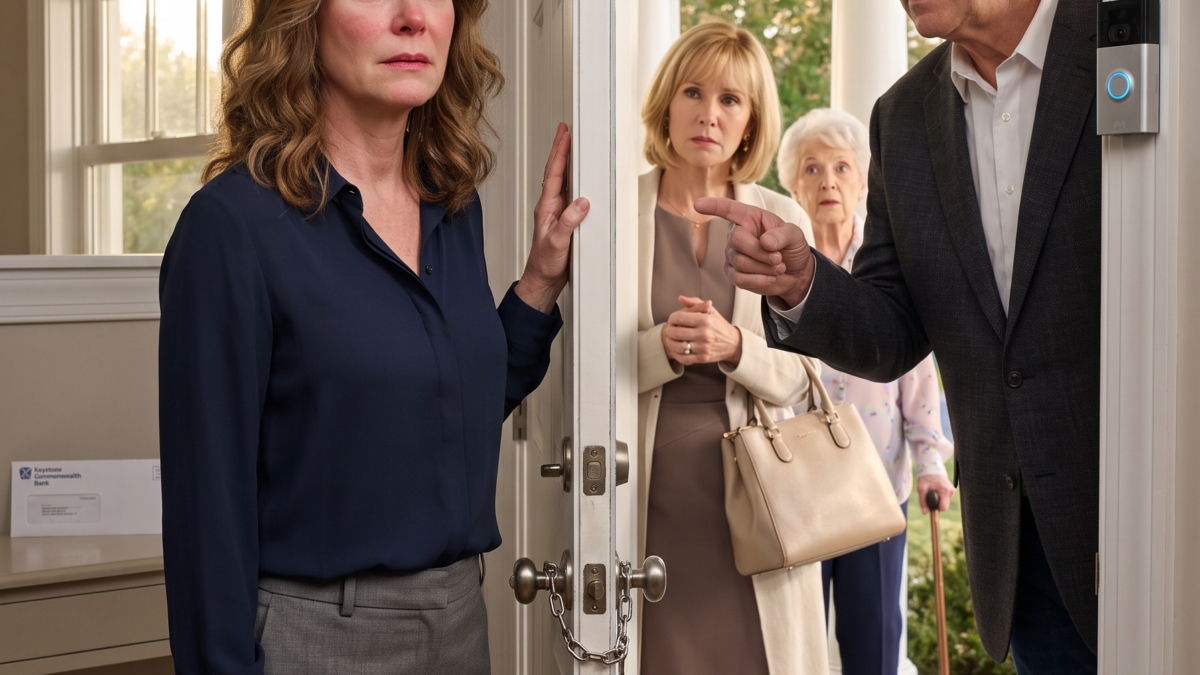
My brother-in-law stood outside my chained front door and told me a forgotten bank account with more than $33 million in my name was not really mine. My sister stayed behind him, gripping her purse and avoiding my eyes. I had already seen the first contradiction: the phone number controlling that account belonged to her. Then Richard warned me exactly what would happen if anyone questioned the money—and forgot the doorbell camera above his head was recording every word.
My name is Margaret Dolan, and for fifteen years after my husband died, I built a life around ordinary things.
I worked behind the circulation desk at the public library in Mechanicsburg, Pennsylvania. I paid my mortgage on the first of every month. I drove an aging sedan that started reliably if I remembered to let it warm for a minute in winter. On Sundays, I ate dinner at my sister Diane’s house in Camp Hill.
My son, Ben, had moved to Denver for a software job, but he called every Thursday evening. At fifty-six, I believed I understood the shape of my life.
Then a plain white envelope arrived at the end of August.
The return address read Keystone Commonwealth Bank.
Inside was a short request asking me to contact the bank regarding my account.
I nearly dropped it into the recycling bin.
I did not have an account at Keystone Commonwealth—or at least I did not think I did. I had used the same credit union for decades.
The letter looked exactly like the sort of thing we warned older library patrons about during fraud-awareness workshops: official-looking paper, urgent language, a request to contact someone about money.
Still, the bank’s name bothered me.
I had heard it somewhere.
At Diane’s house that Sunday, I mentioned the letter while we ate pot roast.
“Can you believe it?” I said. “Some bank I don’t even use says I need to call about an account.”
Diane’s fork stopped halfway to her mouth.
My sister was sixty-one, three years older than I was, and for most of our lives she had been the competent one. She organized church events, managed our mother’s medications, remembered birthdays without writing them down, and kept the calendar for her husband Richard’s medical supply business.
She had also held my life together after Tom died.
In 2011, when my husband collapsed unexpectedly in a hardware-store parking lot, I stopped functioning normally for a while. Diane drove me to appointments. She handled stacks of mail. She made sure Ben, still in high school then, had groceries and lunch money when I could barely remember whether I had eaten.
That history was why I noticed her reaction.
“It’s a scam,” she said.
She said it too quickly.
“Throw it away. Don’t call any number on it.”
Richard kept eating.
He was sixty-four, broad-shouldered, silver-haired, and comfortable in every room he entered. He owned Susquehanna Medical Supply and knew half the businessmen in Cumberland County.
“Diane’s right,” he said. “Those scams are getting sophisticated.”
Then Diane added, “Bring it next Sunday. Richard can look at it.”
Our mother, Joan, was eighty-two and still observant despite moving more slowly. She looked from Diane to Richard and back again.
She said nothing.
Neither did I.
But on the drive home, the bank letter sat in my purse like a stone.
Why did Diane want it?
Why had she reacted before Richard had even finished chewing?
The following Sunday, I told her I had forgotten the envelope.
That was not quite true.
A few days later, on the first Saturday in September, I began cleaning the hall closet I had avoided for years.
Tom’s winter coat still hung in the back.
Beneath it sat a shoe box filled with sympathy cards, funeral paperwork and things I had shoved together during the weeks after his death because I could not bear to decide what mattered.
At the bottom was my old brown leather wallet.
Ben had bought me a new one for Christmas that year, and I had never opened the old one again.
Inside were expired cards, a faded library card and a photograph of Tom proudly holding a fish at Raystown Lake.
Behind the photograph was a debit card.
Keystone Commonwealth Bank.
Margaret A. Dolan.
Expiration date: 04/14.
I sat down on the hallway floor.
Then April 2011 began returning in fragments.
Diane’s yellow kitchen.
A rainy afternoon.
Her driving me to a bank branch on Market Street in Camp Hill.
She had told me Tom’s life-insurance payment should sit somewhere separate while I figured out what to do with it.
I had signed forms.
At the time, I was taking medication and moving through each day in a fog. I remembered a young bank employee wearing a butterfly pin. I remembered Diane answering questions for me.
Later, I moved the insurance money to my regular credit union, paid down the mortgage and created a college fund for Ben.
I assumed the Keystone account had closed.
Apparently it had not.
The number printed on the old debit card was still legible.
Because it was Saturday evening, I called the automated service mostly to satisfy my curiosity.
The recorded voice asked for the card number and identifying information.
I entered it.
Then it read the available balance.
I hung up.
For several seconds I sat perfectly still.
Then I laughed because the number was absurd.
I called again.
The automated voice repeated it.
More than thirty-three million dollars.
I listened a third time.
Same number.
I had never seen that amount of money. My house, car, retirement and savings combined would not have approached even a small fraction of it.
The obvious explanation was a bank error.
A misplaced decimal.
A technical problem.
I barely slept.
Monday morning at nine, I called the Camp Hill branch.
After several minutes on hold, a man answered.
“This is Gary Whitfield, branch manager. How can I help you?”
I explained the old debit card, the letter and the impossible balance.
“I think there’s been some mistake,” I said. “I just want to get it corrected.”
He requested my full name and date of birth.
I heard keyboard keys.
Then silence.
“Mr. Whitfield?”
When he returned, his voice had changed.
“Don’t tell anyone.”
Three words.
Barely above a whisper.
Then his professional tone returned.
“Mrs. Dolan, I’d like you to come into the branch Wednesday at nine. Bring two forms of photo identification and anything you have from when the account was opened.”
I agreed.
After the call, I sat at the kitchen table with the expired card in front of me.
Don’t tell anyone.
A banking mistake did not usually require secrecy.
I called in sick to the library.
Then I did exactly what I taught patrons to do when they suspected identity problems.
I pulled my credit reports.
My mortgage appeared.
My regular credit card appeared.
My old car loan appeared as paid.
Then I saw a Visa account I had never opened.
It had been established in 2021 with a $15,000 limit.
It was used regularly and paid in full every month.
Under my addresses was a P.O. box in Harrisburg.
I had never rented one.
I printed every page.
By then, my hands were shaking badly enough that I had to set the papers down.
Someone had been using my identity.
And that someone appeared to be remarkably careful about keeping my credit healthy.
That frightened me more than a careless thief would have.
A careless person might have wanted a television or a quick loan.
Someone maintaining an identity for years had a different purpose.
I made a list on a yellow legal pad, the way Tom used to whenever we faced a major decision.
First: protect my finances.
Second: document everything.
Third: find independent legal advice.
Fourth: say nothing to Diane or Richard until I understood what was happening.
That last item hurt.
Because I already knew why I had written their names.
Who had driven me to Keystone in 2011?
Diane.
Who had sat beside me while I signed forms?
Diane.
Who had offered to set up online banking because I was overwhelmed?
Diane.
Who had created an email address for me and said she would watch statements until I felt better?
Diane.
At lunchtime, I called Ben.
He answered quickly.
“Mom? Everything okay?”
I told him.
When I finished, he went quiet.
“You need a lawyer,” he said.
“I know.”
“And don’t tell Aunt Diane yet.”
Hearing him say it made the possibility feel real.
At three that afternoon, my phone buzzed.
Diane.
Hey sis, did you ever throw out that bank letter? Richard says those scams can steal your info just from calling. Just making sure you’re safe!!
I stared at the message.
Diane did not use exclamation points.
She thought they were tacky.
I typed slowly.
Yep. Tossed it. Thanks for looking out.
Then I placed the phone facedown.
It was the first meaningful lie I had ever told my sister.
That evening, I reconstructed everything I could remember from 2011.
The bank employee with the butterfly pin.
Diane saying, “Just sign where the flags are.”
Diane offering to monitor the account.
Diane asking for my email password.
The strange thing about memory is that details can remain hidden for years until one fact gives them a new meaning.
On Tuesday I returned to work because sitting at home was worse.
Carla Reyes, who had worked beside me for nine years, took one look at me.
“You look awful.”
“Headache.”
She did not believe me, but she did not press.
That was one of the reasons I trusted her.
Wednesday morning, I arrived at Keystone Commonwealth wearing gray slacks and a navy blouse.
The branch looked almost insultingly normal.
Brick walls.
A fake ficus.
A glass bowl of lollipops beside the teller window.
Gary Whitfield met me at the entrance.
He was about my age, perhaps slightly older, with reading glasses pushed onto his forehead.
He led me into a glass-walled office.
A woman in a dark suit waited beside a laptop.
“Mrs. Dolan, this is Renata Ortiz from compliance.”
Renata checked both forms of identification, examined Tom’s death certificate and compared my signature with records on her screen.
Then she folded her hands.
“You are the named owner of this account. You have the right to review your own account information.”
“I want to see it.”
She turned the laptop.
The original signature card was mine.
My handwriting looked shaky and slanted, exactly as it had during those months.
The next document showed online access being established seven days after the account opened.
The email address was unfamiliar.
The mobile number was not.
It ended in 4471.
Diane’s cell number.
I had called it thousands of times.
“That’s my sister’s phone,” I said.
Gary and Renata exchanged a look.
Renata continued.
For years, the account had shown only small movements—fifty dollars, a hundred dollars, enough activity to keep it alive.
Then in 2019, the mailing address changed to the Harrisburg P.O. box I had found on my credit report.
Beginning in 2023, large incoming transfers appeared.
Hundreds of thousands.
Then millions.
The sending entities had names I did not recognize.
Riverfront DME Partners.
Keystone Mobility Group.
Then one name stopped me.
Susquehanna Medical Supply.
Richard’s company.
His company name had been painted on delivery vans for years.
It had sponsored Ben’s Little League team.
It appeared repeatedly in my forgotten bank account.
Renata explained that someone had recently attempted a very large outgoing transfer. The bank restricted the account and tried to contact the owner.
That was why I received the letter.
Gary cleared his throat.
“There is something else.”
He told me that two days before my call, someone had telephoned the branch asking why transfers had been stopped.
“A woman,” he said.
“What name did she give?”
“Margaret Dolan.”
I pressed both palms against the desk.
Renata slid an affidavit toward me stating that I had not created the online access, had not authorized the address change, had not received the deposits and did not know their source.
“You do not have to sign this today,” she said. “You may want legal counsel first.”
I thought about remaining silent.
Then I thought about thirty-three million dollars moving under my name.
I signed.
Renata recommended that I document the identity theft formally with local authorities and the appropriate federal reporting system.
That afternoon, I made a local report and received a case number.
When I returned to my car, I had three missed calls from Diane.
Then Richard called.
Richard had not called me directly since Tom’s funeral.
I let it ring.
Diane texted seconds later.
Mom says you’re not answering. Where are you? Everything okay?
Our mother did not text like that.
By evening, I understood something important.
They might not know exactly what I had discovered.
But they knew something had changed.
The account had stopped functioning.
A bank letter had escaped their control.
And the sister who usually answered every call had suddenly gone quiet.
Through Carla’s book club, I found an attorney named Ellen Park in Harrisburg who had experience with complex financial cases.
Her office overlooked the Susquehanna River.
She read my notes, credit reports, bank documents and police report without interrupting.
Finally she removed her glasses.
“The strongest thing you did was go to the bank yourself before anyone accused you of anything.”
“What happens now?”
“We document everything and cooperate.”
I left her office feeling, for the first time in weeks, that I was not improvising alone.
Over the next several days, the matter moved beyond the bank.
I gave a formal account of how the Keystone account had been created, what I remembered about 2011 and how Diane had helped me with financial paperwork after Tom’s death.
The questions were precise.
Had I ever received money from Richard?
No.
Had I ever authorized his company to use the account?
No.
Had I known about the Harrisburg P.O. box?
No.
Had I created the online access?
No.
I handed over the expired debit card.
Then I went home.
At 7:40 that evening, my doorbell rang.
Through the peephole I saw Diane.
Richard stood behind her.
I opened the door but left the chain in place.
That small piece of metal suddenly felt very important.
“Maggie,” Diane said. “Can we come in?”
“No. Say what you need to say from there.”
Richard stepped forward.
“Somebody from the bank contacted my office asking about deposits from my company.”
His voice was smooth.
The voice he used with customers.
“Did you go to them?”
“I went to my bank about an account in my name.”
“It’s not your account.”
The friendliness cracked.
“You haven’t touched it in fifteen years.”
“Then why is my name on it?”
Diane placed a hand on his arm.
“Mags, it’s complicated. Richard’s business had some cash-flow problems and your account was sitting there—”
“Diane.”
Richard cut her off sharply.
Then he looked at me.
“Let me explain your situation.”
His tone was quiet.
“That account has your name, your signature and your identification information attached to it. If this becomes a problem, who do you think people believe? A business owner who has employed people in this county for decades, or someone who admits she barely remembers what she signed after her husband died?”
My stomach tightened.
Diane stared at the welcome mat.
Richard continued.
He mentioned my job.
He mentioned Ben.
He referred to private details about how badly I had struggled after Tom’s death.
Only family knew those things.
I looked at Diane.
She still would not meet my eyes.
“Are you finished?” I asked.
He stared at me.
“My attorney is Ellen Park. Anything you want to communicate can go through her.”
Then I pointed above him.
“The doorbell camera is recording.”
Richard looked up.
His hand stopped moving.
For the first time since he arrived, uncertainty crossed his face.
He turned away.
Diane followed him down the steps.
I closed the door, locked it and sat on the floor.
The next morning I called Ellen.
Then I took four personal days and drove east to Cape May, New Jersey.
Tom and I had spent our honeymoon there.
I needed somewhere that existed before Diane managed my accounts, before Richard’s company, before the bank card and the lies.
September had emptied the beach of summer crowds.
I walked every morning.
For three days I barely checked my phone.
On the fourth morning, Diane sent the longest message she had ever written to me.
She apologized for Richard’s behavior.
She said everything was a paperwork misunderstanding.
Then came the important part.
If I told the bank that I had authorized Diane to manage the account back in 2011, she said, everything could be explained as a family arrangement.
Richard would pay off my mortgage.
He would arrange two million dollars for Ben and me.
I read the message twice.
A paid house.
Retirement.
Security for my son.
Then I noticed her wording.
You gave me permission… remember.
She was not offering help.
She was asking me to replace my memory with hers.
I saved screenshots and sent them to Ellen.
I did not respond to Diane.
Ellen called quickly.
“Keep everything. Don’t delete anything.”
My voice broke when I answered.
“She’s my sister.”
“I know.”
That was the worst part.
Diane knew exactly which promise would sound like safety to me because she had spent years learning what frightened me.
When I returned home, the calls stopped.
Sunday invitations stopped.
Then acquaintances began approaching me with vague questions about whether I had been feeling well.
A woman from Diane’s church stopped me outside the library and asked, with exaggerated concern, whether I was “doing okay lately.”
I understood the message.
If I could be described as confused, unstable or forgetful, then my version of events became easier to dismiss.
For the first time in years, I told other people what was happening.
I started with Carla in the library break room.
She listened without touching her soup.
When I finished, she hugged me hard enough to knock my glasses crooked.
I told my supervisor, Janet, before rumors could reach her.
I brought documentation confirming that I was cooperating as an identity-theft victim rather than being treated as the source of the transactions.
Janet read it and handed it back.
“Your job is safe, Maggie.”
Ben flew from Denver the next weekend.
He repaired the sticky back-door lock, helped me improve the cameras and sat at the kitchen table with me until two in the morning looking through old albums.
When we reached a photograph of Diane holding him as a baby, he quietly closed the book.
“You didn’t do anything wrong, Mom.”
I was beginning to believe him.
Two weeks later, Diane returned.
This time she brought our mother.
She carried an apple pie.
For ten minutes she acted like the sister I remembered.
She discussed Mom’s medications, the changing leaves and the church bake sale.
Then she began crying.
Richard’s business had developed financial problems, she said.
They needed somewhere to hold money temporarily.
My forgotten account was available.
She had thought there would be no harm.
Then she removed a folded document from her purse.
It stated that in 2011 I had authorized Diane to manage my finances and use the Keystone account.
There was a line for my signature.
Another for a notary.
“Just sign it,” she said.
I did not touch the paper.
“You want me to say I gave you permission to move thirty-three million dollars through an account I didn’t even know was still open?”
“I want you to protect your family.”
“I am protecting my family. Ben is my family. So am I.”
Her tears stopped.
The shift was immediate.
She reminded me how helpless I had been after Tom died.
How she and Richard had helped me.
How I had forgotten bills.
How much I had needed them.
Mom joined in softly.
“Families take care of each other, Margaret.”
I looked at both of them.
For years, that sentence had meant love.
Now it sounded like a debt collector.
I stood.
“You both need to leave.”
Diane grabbed the pie dish.
At the door she turned.
“When this all comes back on you, don’t call me.”
That night, near midnight, messages began arriving from her phone.
She wrote that Richard had only used the account because I had forgotten it existed.
She wrote that I never would have known if the bank had not contacted me.
She wrote that the money had moved for years without my knowledge.
I read the messages twice.
Then I saw the contradiction.
The document she wanted me to sign claimed I had knowingly authorized the arrangement.
Her own messages said I had never known.
I forwarded every screenshot to Ellen.
The next morning she replied:
Call me. This changes everything.
By December, a formal dispute over the money had begun.
Richard claimed through his company that the funds were legitimate business proceeds held in my account with my knowledge under a longstanding family financial arrangement.
To support that claim, his side needed to establish that I had consented.
That meant my testimony mattered.
The deposition took place on a cold Tuesday in Harrisburg.
Richard sat across from me in a navy suit beside his attorney.
He smiled when I entered.
The questioning began gently.
My job.
My house.
Tom.
Then the attorney asked about the period after my husband’s death and whether medication or grief might have affected my memory.
“Isn’t it possible,” he asked, “that you authorized your sister to manage this account and simply don’t remember?”
I kept my answer short.
“No.”
He asked again in different ways.
I answered truthfully each time.
Eventually, government counsel placed printed copies of Diane’s messages in front of me.
I read one aloud.
Richard only used that account because you forgot it even existed.
Another exhibit showed Diane’s telephone number registered for account alerts.
Another showed electronic access tied to Richard’s business office.
His attorney stopped writing.
Richard leaned forward.
“That’s out of context.”
His lawyer raised a hand.
Richard kept talking.
Then he said the sentence no one in the room needed explained.
“She never knew about it. That was the whole point.”
His attorney told him to stop.
Too late.
The court reporter continued typing.
Every word remained on the record.
In the hallway afterward, Diane grabbed my sleeve.
“Maggie, tell them I didn’t—”
Ellen stepped between us.
I pulled my arm free.
“I told the truth, Diane.”
Three weeks later, Richard’s company withdrew its claim to the thirty-three million dollars.
The funds were ultimately forfeited and directed back toward the program from which investigators concluded the money had originated.
I never received any of it.
I never wanted it.
The larger investigation continued.
Authorities alleged that Richard’s company and related businesses had submitted improper claims for medical equipment associated with people who either had not ordered it or had not received what records claimed.
My forgotten account was one of several accounts used to move money.
The realization changed the entire story.
I had believed someone had selected my dormant account because it was convenient.
The truth was more personal.
Diane had preserved access to it for years.
She had changed the address.
She had controlled the alerts.
And according to later testimony, Richard had eventually asked whether “Maggie’s account” was still available.
One January morning, Ben called from Denver before sunrise.
“Mom, turn on the local news.”
The investigation had become public.
Richard was charged in connection with the financial scheme.
Diane faced separate consequences related to her role in using my identity and trying to influence what I said afterward.
I watched the television for less than a minute before turning it off.
I did not feel triumphant.
Mostly, I felt tired.
Diane eventually agreed to cooperate.
Richard chose to contest the case.
Almost exactly a year after I found the old debit card, I testified in federal court in Harrisburg.
I told the jury about Diane’s yellow kitchen.
The bank employee’s butterfly pin.
The old wallet.
The fork stopping halfway to my sister’s mouth.
Gary Whitfield’s three whispered words.
Richard’s defense again focused on my memory during the months after Tom’s death.
But by then, the case did not depend only on my memory.
There were account-access records.
Telephone records.
Diane’s messages.
Richard’s own words from the deposition.
And Diane’s testimony explaining how access to my account had been maintained.
The jury returned guilty verdicts on the charges against Richard.
He later received a federal prison sentence and a substantial restitution order.
Diane received a separate prison sentence.
Their property and business interests were affected as the financial case was unwound.
The Sunday-dinner house in Camp Hill was no longer theirs.
Susquehanna Medical Supply eventually disappeared.
The community organizations that once displayed Richard’s company name quietly removed it.
A few weeks after Diane’s sentencing, I received a formal letter confirming that I had been treated as a victim of identity theft, that I had not knowingly participated in the transactions and that I had cooperated voluntarily from the beginning.
I framed it.
It hangs in the hallway beside the closet where I found the brown wallet.
My credit records were corrected.
The unfamiliar card disappeared.
So did the Harrisburg P.O. box.
Keystone Commonwealth closed the old account permanently.
Gary Whitfield eventually retired.
One afternoon, he brought the bank’s formal apology letter to my house himself.
We began drinking coffee together.
At first it was once a week.
Then sometimes twice.
He took up fly fishing in retirement and tried teaching me on Yellow Breeches Creek.
I was terrible.
Neither of us cared.
The bank had reprimanded him for whispering those three words to me during that first telephone call.
He never complained about it.
“Bad banking decision,” he told me once.
“Good human decision.”
I still work at the Mechanicsburg library.
A year after everything ended, I began giving a monthly workshop in the community room.
The first one had twelve people.
Then more came.
I teach practical things.
Check your credit reports.
Close accounts you no longer use.
Keep written confirmation.
Protect passwords.
Pay attention to old addresses.
And when grief or illness makes paperwork overwhelming, accept help—but do not disappear from your own financial life completely.
After one workshop, a woman in her seventies approached me.
“My son-in-law has handled everything since my husband died,” she said quietly. “Maybe I should look.”
“Look,” I told her. “And if you need help understanding what you find, come see me.”
Ben became engaged to a pediatric nurse named Priya.
I flew to Denver for their party.
Our mother eventually called me after nearly two years of distance.
She had read the deposition transcript.
Especially the section where Richard said I had never known.
“I didn’t want to believe you,” she said.
It was not the apology I had imagined during the worst months.
But it was enough to begin something.
I visit her every other Sunday now.
We play gin rummy.
We do not talk much about Diane.
Months later, a letter arrived from the facility where Diane was serving her sentence.
She wrote that money was tight.
She asked me to send three hundred dollars each month.
She signed the letter:
Your big sister who always took care of you.
I read it at my kitchen table.
The same table where I had once stared at an expired debit card and wondered how thirty-three million dollars could possibly be connected to me.
Then I carried Diane’s letter into the hallway.
I opened the old shoe box.
Tom’s sympathy cards were still inside.
So was the brown wallet.
I folded Diane’s letter, placed it beside them and closed the lid.
I never answered.
Some doors, once closed for the right reason, do not need to be opened again.
This story is a dramatized work of fiction created solely for storytelling and entertainment purposes. It is not presented as a factual report or news account. Any resemblance to actual people, places, organizations, or events is purely coincidental. Names, dialogue, locations, timelines, occupations, and identifying details have been invented, combined, or altered to protect privacy and support the narrative. Some accompanying images or visual elements may be AI-generated or digitally enhanced.