I walked through my son’s backyard gate carrying a cast-iron skillet of cornbread when I heard my daughter-in-law, Sandra, ask, “Is that old man still not dead?” My son Dennis stood beside her and smiled. I sat through the barbecue without confronting either of them. The next morning, I opened the financial folder Dennis had been “helping” me manage since my wife died—and found two monthly transfers I didn’t remember authorizing. At the bank, the manager found something worse beside his name.
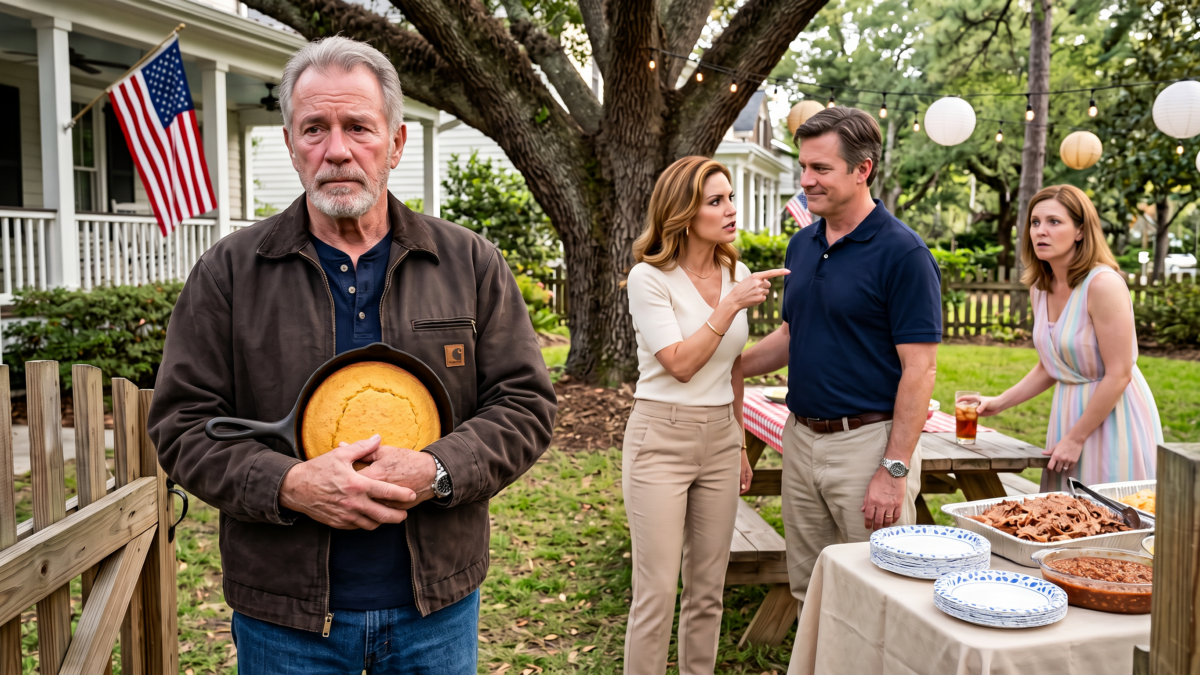
I heard every word through the slats of the garden fence as clearly as if Sandra had been standing beside me.
“Is the old man still not dead? I honestly don’t understand why he keeps showing up here.”
I stopped with one hand still resting against the wooden gate.
In my other hand was a cast-iron skillet full of cornbread I had gotten up at five that morning to make. It was still warm enough that I could feel the heat through the folded kitchen towel beneath it.
Sandra kept talking.
“I’m so sick of him pretending he’s still part of this family. Nobody wants him here. Seventy-six years old, and he still doesn’t know when it’s time to disappear.”
Dennis was standing beside her.
My son.
I couldn’t see every expression through the fence, but I could see enough.
He did not tell his wife to stop.
He did not remind her that I was his father.
He did not say she had crossed a line.
He smiled.
For a few seconds, I stayed where I was.
The backyard smelled like oak smoke, barbecue sauce, cut grass, and the sweet cornmeal crust rising from the skillet in my hands. Somebody had music playing softly on a speaker near the back porch. I could hear glasses knocking together and children running across the grass.
It was the kind of ordinary family noise I had spent most of my adult life working to create.
My name is Arthur. I was seventy-six years old that fall, and for thirty-one years I had worked as a foreman at a shipyard outside Savannah, Georgia.
Shipyard work teaches you certain things.
Steel can look solid and still carry stress you cannot see.
A weld can hold for years before the wrong load exposes the weakness.
And when a structure fails, the cause is rarely the final force placed on it. Usually, the problem began long before anyone heard the first crack.
Standing outside my son’s backyard with a warm skillet in my hands, I finally heard the crack.
What surprised me was that my hands did not shake.
I opened the gate.
Paper lanterns hung between the live oaks. Folding tables had been arranged beneath them, covered with bowls of potato salad, aluminum trays of pulled pork, baked beans, sliced tomatoes, bread, and paper plates.
People turned toward me as I entered.
Some were family. Some were friends of Dennis and Sandra whom I barely knew.
Several people looked at me for half a second and then became suddenly interested in whatever was on their plates.
I carried the cornbread to the far end of the last table.
There was one open chair.
I sat down.
My back had been bothering me during the drive over, but I straightened it anyway. After three decades around shipyard crews, you learn that posture affects more than comfort. Sometimes standing or sitting upright is the only vote you get in a room.
Dennis made a toast later.
He lifted his beer bottle and smiled at everyone gathered around him.
“To family.”
Glasses touched.
People laughed.
Nobody looked toward me.
My grandchildren passed my chair three times during the afternoon.
Not one stopped.
I used to bring them peanut brittle from the candy shop on Abercorn Street whenever I visited. When they were younger, they would meet me at the door asking whether I had brought the little paper bags.
That day, I wondered whether they would have recognized me faster if I had been carrying candy instead of cornbread.
Sandra eventually approached.
She had the same smile she used in photographs—bright around the teeth, careful around the eyes.
“You want a plate?”
“I’m fine.”
She nodded before I had fully finished answering.
Then she walked away.
I could have stood up right then and repeated everything I had heard behind the fence.
I could have demanded that Dennis look me in the eye.
I could have embarrassed Sandra in front of the people she had spent all afternoon arranging into a picture of family happiness.
I did none of those things.
I stayed until the gathering ended.
I stacked folding chairs.
I helped carry trash bags to the bin beside the house.
When nobody offered to take the skillet, I carried it to the outdoor spigot and rinsed it myself.
There were several pieces of cornbread left.
I wrapped them in foil.
Then I tucked the skillet under my arm and walked to my truck.
The drive back to Hartley Lane took about twenty minutes.
Savannah was quiet in the soft evening light, the trees leaning over the streets the way they always had, Spanish moss shifting in the breeze.
By the time I reached my house, the anger I expected still had not arrived.
What I felt was something colder and more useful.
Clarity.
Inside, the house smelled faintly of cedar blocks and sawdust.
I set the skillet on the kitchen counter beneath the brass pendant light Eleanor had chosen when we renovated the kitchen years earlier.
She had loved that light because it reminded her of the lamps in her grandmother’s house in Charleston.
Eleanor had been gone eight years.
Pancreatic cancer.
Seven weeks from diagnosis to the end.
There are losses so fast your mind never catches up with the calendar. For months afterward, I kept waking up with the sense that something had happened but could not remember what it was until I turned toward her side of the bed.
Dennis and Sandra had stepped in during that period.
At first, I was grateful.
Dennis sat at my kitchen table one afternoon with folders, statements, insurance papers, and a laptop spread around him.
“You really don’t need to be worrying about all this right now, Dad.”
He offered to organize the bills, check the accounts, and set up automatic payments.
Sandra said they only wanted to make things easier.
“You’ve got enough to carry,” she told me.
I believed them.
Not because I had suddenly forgotten how to manage money.
I had managed crews, payroll problems, supply schedules, equipment failures, and budgets for most of my working life.
But grief changes the scale of ordinary tasks.
A power bill can look like a decision you do not have energy to make.
A bank statement can remain unopened because the person who used to sit across from you while you paid bills is no longer there.
So when Dennis said he would handle some of it, I said yes.
That was the first turn.
Not a dramatic one.
No deception announced itself.
No one said, “Arthur, we’re going to begin managing parts of your life until you stop noticing where your authority went.”
It happened through conveniences.
An automatic payment.
A password shared.
A signature put in front of me.
A document I trusted my son enough not to read carefully.
That is how some cages are built.
Each bar arrives looking like help.
I sliced two pieces of the remaining cornbread and put them on one of Eleanor’s old brown ceramic plates.
She had bought the set at a pottery fair years earlier. One plate still had the faint imprint of the potter’s thumb in the glaze.
I sat alone at my kitchen table and ate.
The cornbread was exactly right.
Coarse-ground meal.
Real buttermilk.
Cast-iron crust.
I had been making it that way since 1979.
That night, alone in my own kitchen, it tasted better than anything at the party.
Afterward, I moved to the front room and looked through the window at the magnolia tree in the yard.
I had planted it the year Dennis graduated from high school.
As a boy, I loved climbing trees.
Dennis never did.
He would stand at the bottom and tell me the branch looked weak.
The phone buzzed on the table.
A message from him.
Hey, Dad. Sandra says she might have come across wrong tonight. She gets stressed with big gatherings. You know how she is.
I read it twice.
He did not say, I’m sorry.
He did not say, I should not have laughed.
He did not say, My wife had no right to speak about you that way.
He offered an explanation for Sandra.
That was all.
I deleted the message.
For years I had kept excuses the way some people keep receipts—small pieces of evidence I thought might eventually add up to a reason.
Sandra was tired.
Dennis was busy.
The children had activities.
They had forgotten to call.
They assumed I would understand.
They did not mean it that way.
I finally understood that excuses do not become respect simply because you save enough of them.
That night, I slept without taking anything to help me rest.
It was the first time in six months.
I would not call it peace.
It felt more like standing over a blueprint after finally locating the fault line.
The next morning, I made my coffee strong and black.
Then I pulled the firebox from the hall closet.
Inside were the documents I had protected for years.
The deed to the house.
Insurance papers.
Investment statements.
Copies of estate documents.
And a folder I had labeled FINANCES.
I had barely opened it since Dennis started helping.
I carried everything to the kitchen table and spread it out.
The habit returned faster than I expected.
At the shipyard, before we moved heavy equipment or committed weight to a structure, I studied the plans slowly.
You looked for the load points.
The joints.
The places where one failure would travel into another.
That morning, I did the same thing with my own life.
At first, nothing looked alarming.
Dennis was an authorized user on two accounts.
I remembered that.
He had access to my investment brokerage.
I remembered giving it to him during the year after Eleanor died.
There were automatic payments I recognized.
Utilities.
Insurance.
Property taxes.
Then I reached two transfers I did not recognize.
One went to a family grocery account.
The second was labeled miscellaneous household.
Together, they removed $420 from my savings every month.
Not enough to ruin me.
Enough to matter.
I went back through previous statements.
Month after month, the transfers appeared.
I did not remember creating them.
That did not automatically mean Dennis had done anything criminal. I understood that much.
Maybe I had agreed and forgotten.
Maybe I had signed something while still moving through those first months without Eleanor like a man underwater.
That possibility brought its own discomfort.
I had not simply trusted my son.
I had stopped checking.
The distinction mattered.
I wrote the figures on a sheet of paper.
Then I called Wallace Price.
Wallace was not exactly a close friend.
He was something I trusted more in that moment: a careful man.
He had spent roughly thirty years working as a paralegal before retiring. We had served together on a neighborhood improvement committee in 2015.
Wallace read every document before signing.
He asked questions when other people wanted to hurry.
And he had no emotional investment in whether Dennis was a good son.
I told him I had questions about my accounts, estate documents, and property title.
“Come by Thursday morning,” he said. “Bring everything.”
I slept well again that night.
Thursday, I dressed the way I used to dress for a job site.
Nothing formal.
Clean shirt.
Work pants.
Boots.
Deliberate.
Wallace’s study smelled faintly of pipe tobacco and old paper. Books filled two walls. His desk was covered with legal pads stacked into precise piles.
He listened while I explained.
He did not interrupt.
Then he began reading.
Every page.
Every statement.
Every authorization.
When he reached the automatic transfers, he made a small sound in his throat.
“Sloppy,” he said.
“Illegal?”
“Not from what I can see.”
He tapped the paper.
“But sloppy and unwise are enough reasons to fix something.”
He kept reading.
Then he turned his yellow legal pad around.
He had written a numbered list.
“What you need to focus on,” he said, “is not what you may have let drift. Focus on what you still control.”
My name was still on the deed.
I remained primary on the important accounts.
My estate documents could still be changed.
My house still belonged to me.
I was still mentally competent.
Nothing required me to continue arrangements I no longer wanted.
The relief was unexpectedly physical.
My shoulders loosened.
My breathing changed.
It was not triumph.
It felt like oxygen.
I folded Wallace’s list once and put it in my shirt pocket.
The following Monday, I drove to Coastal Heritage Bank on Bull Street.
I asked to speak with the branch manager.
A woman named Patricia came out from the back office.
She had the unhurried manner of someone who had spent years handling conversations involving money and family and understood that the two rarely remained separate for long.
We sat at her desk.
“I want to review every account where I’m the primary holder,” I said. “And I want to know every person who has any kind of access.”
She began pulling up records.
The first account matched my files.
So did the next.
She confirmed the automatic transfers.
Then she confirmed something I had not known.
Dennis had been upgraded from authorized user to co-signer on my savings account.
I stared at the screen.
“Co-signer?”
“Yes, sir.”
“That means he can withdraw?”
“Yes.”
Dennis had legal authority to remove money from savings I had built over more than forty years.
I asked when the status had changed.
Patricia showed me the account history.
It had happened during the period after Eleanor died.
The same stretch of months when Dennis had been bringing papers to the kitchen table and telling me not to worry about details.
I could not honestly say he had forged anything.
I could not claim he had secretly stolen his way onto the account.
The more painful truth was less dramatic.
I had trusted him.
I had signed papers without reading closely.
And somewhere inside that trust, the relationship had quietly moved from my son helping me to my son having authority over money that was not his.
“Remove it,” I said.
Patricia nodded.
“All of it?”
“All of it.”
She removed Dennis’s access.
She canceled the automatic transfers.
She reissued my debit card.
We reset my online credentials to a new email address I had created that morning.
She added alerts for unusual activity.
Then she asked whether I wanted a trusted contact listed in case the bank ever noticed something concerning.
I gave her Wallace’s number.
When I stepped outside, Bull Street looked exactly as it had when I entered.
Traffic.
Sunlight.
People crossing the sidewalk.
Nothing dramatic had changed in the city.
But something had changed in me.
I felt like a man who had discovered loose bolts in a structure and tightened them before the load became dangerous.
That evening, I made Eleanor’s chicken and dumplings.
I had not made them in two years.
Her recipe was still on an index card in her handwriting, stained with grease near one corner.
She taught me to cook the dish the winter Dennis was little and she came down with the flu.
I had spent a week feeding both of us.
Standing over the stove, I remembered Dennis asleep in a chair, his hair sticking up at the back, trusting that his father would put dinner on the table.
I ate alone.
No television.
No phone.
Just the house settling and the occasional hum of the refrigerator.
I thought about Dennis carefully.
Not with hatred.
That would have been easier.
I remembered fishing trips when he would fall asleep in the truck on the way home.
I remembered him at twelve after he broke a neighbor’s window with a badly hit baseball.
He came home sick with guilt.
I sat with him for an hour.
Then we walked together to the neighbor’s house.
Dennis apologized.
We paid for the window.
On the walk back, he stood a little straighter.
I had been proud of him.
The boy in those memories had not vanished in one afternoon.
He had grown into the man who stood beside his wife while she asked why I was not dead yet.
That was harder to accept than simply deciding he had always been bad.
People change by degrees.
Sometimes they do not become monsters.
Sometimes they become smaller.
And you can grieve the smaller version while the person is still alive.
The next morning, I called an estate attorney Wallace had recommended.
His name was Benjamin Oay.
He was in his early sixties and handled wills, trusts, and estate planning.
Wallace had described him with one sentence.
“He listens before he talks.”
That was enough for me.
Benjamin did exactly that.
I told him I wanted to restructure my estate.
Dennis was to be removed as beneficiary wherever possible.
I wanted him removed as executor of my will.
I wanted a living trust with me as trustee.
And I wanted the house dealt with differently.
The house had been mine outright since 2004.
I had made the final mortgage payment when Dennis was still young enough to remember what struggle looked like.
Benjamin’s pen paused.
“Where would you like the property to go?”
I reached into my jacket.
There was a brochure in the inside pocket.
A men’s crisis and recovery center on Oglethorpe Avenue served veterans and displaced older men, especially those caught in that awkward part of life where they were no longer young enough to start over easily but far from incapable.
I had passed the place countless times.
Once, years earlier, I had mailed them a small anonymous donation.
I set the brochure on Benjamin’s desk.
He studied it.
“You’ve thought about this.”
“It’s been thinking itself through for a while.”
We spent almost two hours reviewing options.
Benjamin asked precise questions.
I answered precisely.
When the papers were ready, I signed where I chose to sign and read every page before I did.
Benjamin assembled everything into a clean binder.
“Most people wait until they’ve lost more than they should before they make changes like this.”
I closed the binder.
“I waited long enough.”
Outside, the Savannah afternoon light came low through the live oaks.
I carried the binder to my truck and sat behind the wheel for a minute without starting the engine.
For the first time since Eleanor died, I had made a major decision about my future without asking Dennis whether it was convenient.
About a week later, Sandra came to my house on a Wednesday morning.
I saw her white SUV pull up at the curb.
She did not park in the driveway.
She sat inside for nearly three minutes.
From the front window, I watched her smooth her hair, put on her jacket, check herself in the mirror, and take a long breath.
At the shipyard, I had supervised hundreds of men.
I knew what preparation looked like.
Sandra was rehearsing.
When she knocked, I waited a few seconds before opening the door.
She wore a dark blazer.
Her purse was clasped in both hands.
“Arthur.”
“Sandra.”
I stepped backward.
I did not invite her inside.
She walked in anyway.
That was Sandra.
She moved through other people’s spaces as if permission were a formality everyone had already agreed to waive.
I closed the door.
She entered the living room and stopped.
The room had changed.
I had taken down several family photographs because I had not yet decided which ones I still wanted displayed.
The filing cabinet had been organized.
The binder from Benjamin’s office sat on the coffee table beside one coffee mug.
Sandra noticed all of it.
“This has gone too far,” she said.
I waited.
“Dennis has been trying to reach you. The accounts. The lawyer’s letter. Arthur, we’re your family. We don’t understand what we did.”
I let her finish.
Then I said, “I heard you.”
She blinked.
“At the party. Behind the fence. I heard what you said.”
The careful expression cracked slightly.
“I didn’t know you were—”
“I know.”
She stopped.
“That’s the point,” I said. “You didn’t know I was there.”
Her eyes moved away from mine.
“If you had known, you wouldn’t have said it.”
She opened her mouth.
I continued.
“But because you didn’t know, I heard the truth.”
Her gaze drifted toward the binder.
“Arthur, those finances are our finances too, in a way. We’ve been taking care of things.”
“No.”
She looked back at me.
“You’ve been holding things. That’s different.”
Her jaw tightened.
“I’m not taking that tone.”
“I’m not using a tone. I’m using words.”
She took a breath.
“We’re worried about you. You’re still grieving Eleanor. This kind of extreme reaction—”
“Sandra.”
She stopped.
“This isn’t a reaction to one afternoon.”
I rested one hand against the back of a chair.
“I’ve been sitting with parts of this for thirty years. The party just gave me a reason to finally look at all of it at once.”
For several seconds, she said nothing.
Then she tried another approach.
“Dennis only wants what’s best for you.”
Another pause.
“We’ve given you so much support since Eleanor died.”
When that did not move me, her voice softened.
“You’re going to end up alone. You’re pushing everyone away.”
I looked at her.
I did not see a monster.
That mattered.
Sandra was a woman who had organized her life around control for so long that control probably felt like care to her.
She arranged people.
Schedules.
Money.
Meals.
Family photographs.
Expectations.
Dennis had allowed her to become the center of the family story, perhaps because standing beside a person who managed everything was easier than deciding things for himself.
I could understand that without continuing to accept it.
“You didn’t come because you’re worried about me.”
Her eyes narrowed.
“You came because my name started disappearing from arrangements you were counting on.”
“That’s not—”
“It’s all right.”
“No, it isn’t.”
“I mean I’m not angry.”
That seemed to unsettle her more than anger would have.
“I just needed to see it clearly.”
She looked at the binder again.
“So what? You’re done? You’re cutting Dennis out of everything? Just like that?”
“Not just like that.”
She waited.
“Thirty years of just like that.”
Her mouth opened.
Closed.
Then opened again.
“What am I supposed to tell him?”
“Tell him his father said hello.”
Sandra picked up her purse.
She walked toward the door.
At the threshold, she stopped without turning around.
“You’re making a mistake.”
“Maybe.”
She waited.
“But it’s mine to make.”
The door closed behind her.
I stood alone in the living room.
I did not feel victorious.
I did not feel righteous.
I felt tested.
And still standing.
The old familiar voice moved through my mind.
You’re selfish.
You’re overreacting.
He’s still your son.
Family forgives.
Family understands.
I let the thoughts pass.
For years, I had treated guilt like a guest who deserved a room in my house.
That afternoon, I stopped hosting it.
I drove to a hardware store on Waters Avenue and had new keys made.
One stayed in my jacket.
One went into the firebox.
One went to Gerald, my eighty-one-year-old neighbor, who was still sharper than people half his age.
One went to Wallace with a note.
For the record.
A locksmith named Marcus changed the door locks that afternoon.
He mentioned while working that his grandfather had taught him the trade.
I liked that detail.
Some things get passed down correctly.
Over the next two weeks, the house became quieter.
But it no longer felt abandoned.
There is a difference between loneliness and solitude.
Loneliness asks why nobody came.
Solitude lets you decide who is allowed through the door.
My grandson Eli called one Saturday morning.
He was eighteen, Dennis’s son from his first marriage.
His mother had raised him mostly in Augusta, though he had spent summers and school breaks in Savannah since he was young.
“Grandpa?”
“Still me.”
He gave a small laugh, then went quiet.
“I heard some things about the accounts. And the lawyer.”
I waited.
“I didn’t know if you’d want to talk to me.”
“I always want to talk to you.”
He exhaled.
“Good.”
Then he asked whether he could stop by the following weekend while passing through Savannah.
“Of course.”
“I’m bringing groceries.”
“I have groceries.”
“Don’t argue.”
“I won’t argue.”
He arrived the next Saturday carrying two paper bags from the farmers market.
He moved through my kitchen differently from Sandra.
Eli knew where things were because he remembered where I kept them.
He found the cutting board.
The stockpot.
The old wooden spoon Eleanor had used for years.
He made vegetable soup the way I taught him, starting slowly instead of throwing everything into the pot at once.
While it simmered, we sat at the kitchen table.
“I’m not going to take sides,” he said.
“That’s fair.”
“But I want you to know something.”
I looked at him.
“I see you.”
I did not answer immediately.
He continued.
“Not the version of you that’s convenient. You.”
Eleanor used to say the real test of love was attention.
Not gifts.
Not holidays.
Not speeches.
Attention.
Do you notice the person standing in front of you?
Eli always had.
We ate soup and talked for almost three hours.
He told me about an apprenticeship program he was beginning in architectural drafting.
He wanted to work on structures one day.
Buildings.
Plans.
Things that had to hold.
I told him stories from the shipyard.
The kind I had not told anyone in years.
He listened without checking his phone once.
When it was time to leave, he stood at the door.
“I want to come back.”
“You’re welcome anytime.”
“Not for anything.”
“I know.”
“Just to come back.”
I nodded.
“The door is always open for people who knock with clean hands.”
After he left, I stood in the kitchen beside the warm soup pot.
The house was quiet.
But it was not the same quiet as before.
This one had weight.
Good weight.
The kind that comes after you remove something unstable and discover the structure still stands.
I began paying closer attention to every document carrying my name.
Not because I wanted a war with my family.
Because I finally understood that awareness is not hostility.
Owning a house but refusing to read the deed does not make a person generous.
Having money but refusing to know who controls it does not make a person trusting.
And stepping backward until nobody has to account for your presence is not the same thing as loving them.
The trust closed on a Tuesday.
Benjamin called to confirm that everything was in order.
Within ten days, the house was under contract.
The buyers were a retired couple from Colombia who wanted a Savannah address and a yard large enough for a garden.
When they walked through the property, the woman stood beneath the magnolia tree and looked up through the leaves.
“I can put tomatoes back there,” her husband said.
She laughed.
For some reason, hearing that made the decision easier.
The house had held my life.
It did not need to become a monument to it.
Benjamin handled the legal details.
I read everything before signing.
When the sale closed, I delivered a substantial donation to the men’s crisis and recovery center on Oglethorpe Avenue.
I went in person.
The director, Dr. Carmichael, met me in a small office.
She had the tired, attentive eyes of someone who had watched too many people arrive with nowhere else to go and had chosen not to become numb to it.
I slid the check across the desk.
She looked at the amount.
Then at me.
“What would you like this designated for?”
“For the men who arrive without a plan.”
She nodded slowly.
“That helps.”
I believed her.
I found an apartment on the east side of Savannah in a converted Victorian not far from Forsyth Park.
Second floor.
High ceilings.
Two rooms and a small kitchen.
The sitting-room window faced a line of trees.
I moved in on a Friday with three boxes, Eleanor’s cast-iron cookware, and a framed photograph of the two of us at the shipyard’s centennial celebration.
In the picture, sunlight was in our eyes.
Eleanor had one hand on my arm.
I was trying not to smile too much.
She was laughing because she knew I was trying.
I put the photograph on the windowsill.
The skillet went on the stove.
That first evening, I made cornbread.
The Savannah light turned long and gold near sunset.
I took a chair onto the small balcony.
A mockingbird landed on the railing.
It stared at me as if evaluating whether I mattered.
I stayed still.
After almost a minute, it apparently decided I did not and flew away.
I took that as a good sign.
Three weeks later, a letter arrived from Dennis.
I recognized his handwriting before I opened it.
He had inherited Eleanor’s slight rightward slant.
He probably never knew that.
I sat at the kitchen table with coffee and read.
The letter was short.
He said he did not know how to fix what had happened.
He said he was not sure he deserved to fix it.
Eli had spoken to him.
Not about money or legal details.
Just about the family.
Dennis wrote that something in the conversation had forced him to admit he had been choosing comfort over honesty for a long time.
Near the end was one line I read several times.
I know I laughed. I don’t know how to tell you what I think about that now.
I folded the letter.
I did not throw it away.
I did not put it in the firebox with documents that needed protection.
I placed it in the kitchen drawer where I kept Eleanor’s recipe cards.
That drawer had become a place for things I was not finished with but was not ready to act on.
Some endings do not arrive in one piece.
They come gradually.
Like tides.
The important thing is to stay on solid ground while you decide whether the next wave deserves to reach you.
Eli came back the following month.
And again the month after that.
Sometimes he brought groceries.
Sometimes he brought drafting work.
We spread building plans across my kitchen table.
Cross-sections.
Load calculations.
Joint details.
I asked him questions an old foreman had once asked me.
“Where does the stress concentrate if that connection fails?”
At first, Eli answered like a student.
Eventually, he started answering like someone learning to see the whole structure.
One afternoon, after studying a set of drawings for nearly an hour, he looked up at me.
“That question works for more than buildings, doesn’t it?”
I smiled.
“Yes.”
He looked back down at the plans.
Outside, traffic moved through Savannah, people went home to families and arguments and dinners and old arrangements they rarely examined.
I had spent most of my life believing generosity meant asking for less.
I thought making myself easy to accommodate was a form of strength.
I thought if I gave enough space to the people I loved, they would eventually turn around and notice what that space had cost me.
What I finally learned was simpler.
Love that requires one person to disappear is not made healthier by disappearing more efficiently.
My name had been on deeds, accounts, documents, and plans.
But for several years, I had acted as though presence itself were something I needed permission to claim.
I do not know what will happen with Dennis.
His letter remains in the drawer.
Some mornings, I think I may call him.
Other mornings, I make coffee and let another day pass.
That decision is mine too.
The important thing is that when I look around my apartment now, I recognize the life inside it.
The cast-iron skillet on the stove.
Eleanor’s picture on the windowsill.
Eli’s building plans rolled in a cardboard tube beside the table.
My keys in the bowl near the door.
My name where I choose to keep it.
And when someone knocks, I decide whether to open the door.
This story is a dramatized work of fiction created solely for storytelling and entertainment purposes. It is not presented as a factual report or news account. Any resemblance to actual people, places, organizations, or events is purely coincidental. Names, dialogue, locations, timelines, occupations, and identifying details have been invented, combined, or altered to protect privacy and support the narrative. Some accompanying images or visual elements may be AI-generated or digitally enhanced.