At my sister Emily’s thirty-fifth birthday, she lifted the brass compass our grandmother had carried from Ireland, laughed in front of a room full of guests, and dropped it into the trash. “Cheap, worthless junk.” I said nothing. What Emily didn’t know was that I had spent five years quietly paying for the house around her, the Tesla outside, and the boutique she called her success. Then, while I was waiting to retrieve the compass, I overheard the phone call that changed what her cruelty meant entirely: she was preparing a legal claim accusing me of hiding our grandmother’s money.
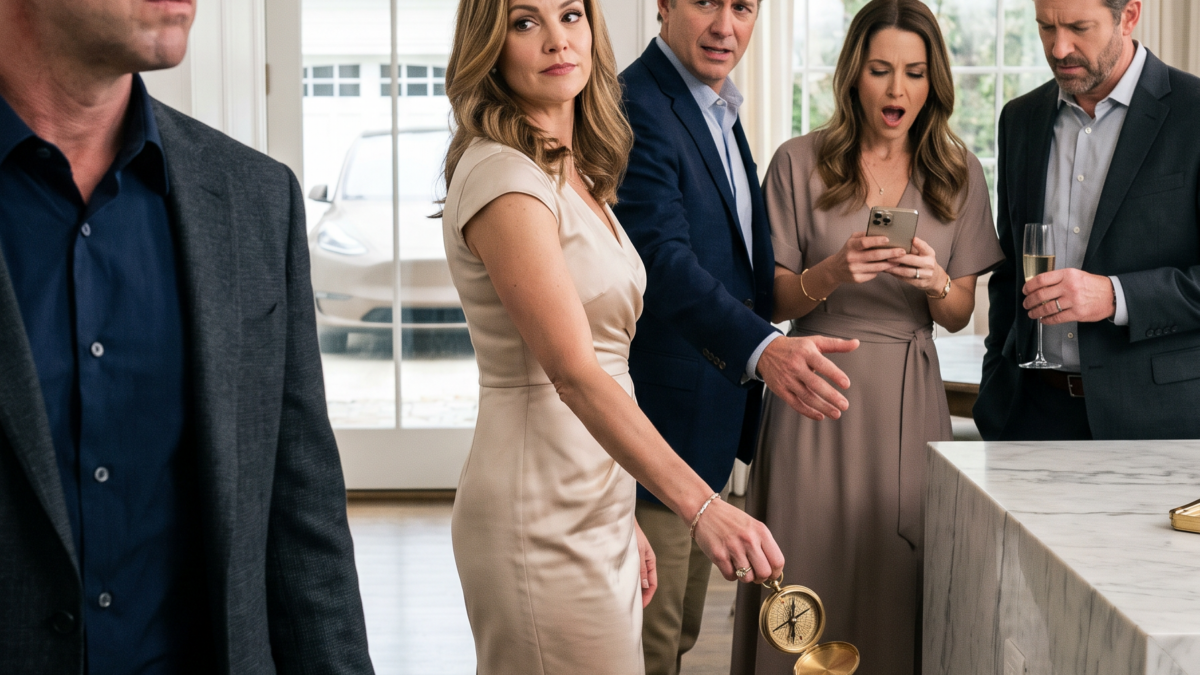
The moment my sister Emily unwrapped my gift at her thirty-fifth birthday party, I knew from her expression that I had made a mistake.
Not because the gift was wrong.
Because I had expected her to recognize what it meant.
She stood beneath the chandelier in the living room of her sprawling suburban home, surrounded by friends holding champagne flutes and wearing clothes chosen to be noticed. The evening had been carefully designed for photographs: cream flowers, gold-rimmed glassware, catered appetizers arranged on white marble, and enough soft lighting to make everyone look ten years younger.
Emily opened the small velvet box I had carried in with both hands.
Inside was our grandmother’s compass.
I had spent three months restoring it.
The brass casing had been dark with age when I found it among the belongings I kept after Grandma passed. I had cleaned it without erasing the tiny scratches she had made over a lifetime. A specialist replaced the cracked crystal, repaired the hinge, and calibrated the needle.
Emily lifted it between two fingers.
For half a second I thought she remembered.
Then her mouth curved.
“Cheap, worthless junk.”
Several guests laughed uncertainly.
Emily laughed louder.
Then she dropped the compass into the trash can beside the gift table.
Wrapping paper shifted around it.
A paper plate tilted.
The brass disappeared halfway beneath a sheet of ivory tissue.
I stood there without saying anything.
That probably made the moment worse for her.
Emily liked resistance because resistance gave her a stage. If I argued, she could become the reasonable sister dealing with her difficult brother. If I walked out dramatically, she could tell everyone I had ruined her birthday.
So I simply looked at the trash can.
The strange part was that almost everything surrounding her had been paid for by me.
The house.
The Tesla in the driveway.
The boutique she described as a thriving independent business.
Even the designer dress she was wearing had ultimately been covered by money from one of the accounts I replenished whenever she pushed her own credit too far.
Emily had no idea.
For five years, I had been the invisible foundation beneath the life she publicly claimed to have built alone.
After our parents died, I inherited Mallister Construction, the company my father had built from a two-man contracting operation into one of the strongest regional construction firms in the state.
Emily had been furious at the will reading.
She heard that I was receiving the company and left before the attorney finished explaining everything.
Later, she began telling people she had rejected family money because she believed in earning her own success.
I never corrected her.
Our parents had left me a private request along with the company.
Take care of your sister.
I interpreted that request far too literally.
Every month, money moved through holding companies and trusts I controlled.
Her boutique routinely lost tens of thousands of dollars. I covered the difference.
Her mortgage, taxes, and insurance were paid through a family trust she believed had been established by a distant relative.
Her Tesla had been purchased through another company. We arranged the paperwork so Emily believed she had won it through a promotional contest.
Even the health insurance for her family was being supplemented by me through an arrangement she thought came from her husband Mark’s teaching benefits.
I told myself I was protecting her.
What I was really protecting her from was reality.
That night, after throwing Grandma’s compass away, Emily drifted back through the party as though nothing meaningful had happened.
She stopped near me twenty minutes later with three friends.
“George, you really should dress better for these events.”
I looked down at my navy jacket.
It was ordinary, clean, and comfortable.
Emily’s dress had cost more than my first used pickup truck.
One of her friends asked what I did for work.
Before I could answer, Emily answered for me.
“He keeps busy. Odd jobs. Construction things.”
“I run a business,” I said.
Emily laughed.
“He’s very proud.”
Her friend Jennifer gave me a sympathetic smile.
Emily touched my arm.
“I’ve offered him work at my boutique. He won’t take it.”
That was almost funny.
Her boutique existed because I had been covering its losses.
“He’s too proud to accept help,” Emily added.
Jennifer turned to Emily.
“That must be difficult.”
Emily sighed as if carrying a burden.
“The hardest part is the embarrassment. People meet us and realize we were raised in the same family, and then I have to explain that we just made very different choices.”
Mark appeared beside her.
He taught history at a public high school and had always been one of the most grounded people in Emily’s life.
Years earlier, when they married, Emily had been ambitious but still recognizably human.
Lately, Mark seemed tired in a way that had nothing to do with his job.
“Emily,” he said quietly. “That’s enough.”
She shrugged.
“I’m just being honest.”
Mark caught my eye.
His lips formed one silent word.
Sorry.
Then he guided Emily toward another arriving couple.
I looked back at the trash can.
I planned to retrieve the compass when nobody was watching, but a guest named Robert had planted himself beside it while telling a story about his new boat.
So I waited.
For the next two hours, I watched my sister perform success.
She talked about opening another boutique.
She mentioned a vacation home in Florida.
She discussed private school for the children.
Each plan required money she did not have.
Each confident statement rested on a system I had quietly built beneath her.
Around ten, guests began leaving.
I walked toward the kitchen, hoping I could finally retrieve the compass without creating another scene.
Emily was inside speaking on the phone.
Her voice was low.
“Yes, Mr. Peterson. I want to move forward.”
I stopped before entering.
I knew the name.
Peterson was an attorney who handled estate disputes.
Emily continued.
“My grandmother had more assets than what was disclosed. I’m sure of it.”
I remained still.
“She always favored George. He visited her constantly near the end. There had to be accounts or property she gave him access to.”
My chest tightened.
There were no hidden accounts.
Grandma’s estate had been fully disclosed and probated.
Emily had signed the final paperwork herself.
Then she said something that made the situation much clearer.
“I think George manipulated her.”
I stepped farther from the doorway.
Emily claimed I had taken advantage of Grandma during her final years, when her memory had begun to fail.
The accusation was not only false.
It was obscene.
I had visited Grandma every Sunday for almost two years.
Sometimes she remembered me immediately.
Sometimes she called me by my father’s name.
Sometimes she did not know who I was at all.
I still sat with her.
I read aloud.
I played her favorite music.
I brought coffee she was no longer allowed to drink and let her complain about it.
Emily visited three times.
Now she was suggesting those visits had been part of a plan.
“I want what’s mine,” she said into the phone. “And I want him caught off guard.”
There was a pause.
Then she laughed softly.
“He won’t see it coming.”
I moved away before she could discover me.
I took out my phone.
I sent a message to Sarah, my chief financial officer.
Monday. Nine a.m. Bring every record connected to Emily.
I did not confront my sister.
I walked through the living room.
The compass was still in the trash.
For reasons I could not explain at the time, I left it there.
Then I drove home in my ten-year-old Honda Civic, the same car Emily regularly mocked.
At a red light, I thought about the irony.
She believed the man in the old Honda needed her pity.
She had no idea the Tesla in her driveway belonged to one of my companies.
Monday morning was cold and clear.
I arrived at Mallister Construction shortly after seven.
Our headquarters occupied the top floors of a glass office tower downtown.
Emily drove past that building regularly.
She had never once asked what was inside.
At nine, Sarah entered my office carrying coffee and a thick accordion file.
She had worked with me for three years.
She was precise, blunt, and nearly impossible to surprise.
“Ready?” she asked.
“I should have done this years ago.”
Sarah set the folder on the conference table.
“You were honoring your parents.”
“I was enabling my sister.”
She did not disagree.
We started with the boutique.
Emily described the business publicly as a success.
The numbers told a different story.
It had not produced a profitable year.
Inventory decisions were based on Emily’s personal taste rather than sales data. Employee turnover was constant. Promotions were expensive and ineffective.
The monthly deficit averaged around thirty thousand dollars.
I stared at the figures.
“I knew it was losing money. I didn’t realize it was this bad.”
“It would have closed years ago without you.”
Sarah pulled out another file.
“The Tesla is worse.”
She showed me three separate loan records.
Emily had pledged the vehicle as collateral.
“She can’t do that.”
“No.”
“She doesn’t own it.”
“Exactly.”
The Tesla belonged to Infinity Holdings, one of our companies.
Emily had been borrowing against an asset she merely believed was hers.
“What about the house?”
Sarah gave me a look.
“The George Mallister Family Trust owns it.”
I knew that.
What I had not appreciated was how completely Emily misunderstood the arrangement.
She believed she and Mark had built equity.
In reality, the trust paid the mortgage, property taxes, insurance, and major repairs.
They were essentially living rent-free.
Sarah turned to another section.
“Now the community donations.”
I leaned forward.
For several years, I had made donations to local organizations and allowed Emily to appear at ceremonies because she enjoyed the visibility.
I did not care whose name appeared on a plaque.
Sarah cared because she had found something else.
“She’s been contacting several organizations after the donations.”
“For what?”
“She claims she incurred administrative expenses arranging the gifts and asks for reimbursements.”
I stared at her.
“For donations she didn’t make?”
“Yes.”
“How much?”
“Usually about twenty percent.”
“Did anyone pay?”
“Two organizations did.”
The room felt different after that.
Until then, I could still tell myself Emily was irresponsible and vain.
The reimbursement requests suggested deliberation.
The conference room door opened.
Richard Blackstone and Amanda Torres, attorneys who had represented my company for years, entered carrying documents.
Richard shook my hand.
“We received something this morning.”
He placed Emily’s preliminary estate filing on the table.
I read the first page.
She alleged that I had influenced Grandma and concealed assets.
Amanda placed another document beside it.
It was the probate closing statement from three years earlier.
Emily’s signature appeared at the bottom.
“She acknowledged the estate was fully disclosed and settled,” Amanda said. “Her current position directly conflicts with the paperwork she signed.”
“So the claim goes nowhere?”
“We expect it to fail.”
Richard sat down.
“But there is another problem for Emily.”
He explained that she had spent years publicly claiming she refused family money.
Several people remembered hearing the story.
Sarah gave a humorless laugh.
“Of course she told them that.”
I looked at her.
Something in her tone was personal.
“You know something.”
Sarah hesitated.
Then she closed the file.
“I knew Emily in college.”
I stared at her.
“How well?”
“We were roommates.”
I sat back.
Sarah had never mentioned it.
She continued.
“The boutique concept Emily built her store around was originally mine.”
“What?”
“I developed the business plan for a class project. She copied most of it and later presented the concept to people as her own.”
That explained something I had never understood.
Emily loved the identity of being a boutique owner.
She had never demonstrated much understanding of retail.
Sarah did.
Sarah continued.
“I also watched her create emergencies whenever your parents visited because she knew they would give her money.”
“Why didn’t you tell me?”
“You never asked.”
“That’s not much of an answer.”
“No. But when you hired me and I realized how much money you were quietly putting into Emily’s life, I started documenting everything very carefully.”
Sarah picked up her phone.
“There’s more.”
She opened a video.
The recording showed Emily’s birthday party.
Emily lifted Grandma’s compass.
The audio captured her calling it cheap and worthless.
Then she dropped it into the trash.
The footage continued.
Several minutes later, Emily was telling guests I was unsuccessful and embarrassing.
“Where did this come from?”
“One of the catering staff.”
The catering company used wearable cameras for liability documentation during larger events.
The owner knew Sarah professionally.
I watched the clip twice.
Not because I needed proof that Emily had humiliated me.
I had been there.
But something about seeing it from the outside changed the experience.
I looked small in the corner of the frame.
Emily looked delighted.
Richard folded his hands.
“How do you want to proceed?”
“What are my options?”
“We can unwind the support gradually.”
“And the other option?”
“Immediately.”
I thought of Grandma’s compass in the trash.
“Immediately.”
The documents came out.
I signed the termination of boutique funding.
I signed instructions returning the vehicle to company control.
I authorized formal notice regarding the house.
I ended recurring payments tied to Emily’s personal credit.
I instructed our team to preserve every relevant record.
It did not feel victorious.
It felt overdue.
Sarah’s phone buzzed.
Then mine.
“You have messages from Mark,” she said.
I had seven.
The first read:
George, I’m sorry about Saturday. Emily was completely out of line.
The second:
The kids saw it. They keep asking why she threw away Uncle George’s gift.
Then:
I found the compass in the trash. I cleaned it. I have it.
I read the next message.
There are things you don’t know.
Then:
The kids have been asking about you for months. Emily tells them you’re too busy for them.
I stopped.
That did not make sense.
I had sent cards.
Birthday checks.
Christmas gifts.
Invitations.
Many had been returned.
Some had simply disappeared.
The final message read:
I think my marriage is falling apart. Please meet me. Alone.
I replied.
One o’clock. Murphy’s Deli.
Mark responded within seconds.
I’ll be there.
Murphy’s was a family-owned deli in an old brick building downtown.
Emily disliked places where the menu was printed on paper and nobody cared about reservations.
That made it ideal.
Mark arrived ten minutes early.
He looked exhausted.
He sat across from me and placed a small paper bag on the table.
From it, he removed Grandma’s compass.
He had cleaned it.
The brass caught the light.
“I couldn’t leave it there,” he said.
I picked it up.
“Thank you.”
We ordered coffee.
Mark waited until the waitress left.
“George, I need you to let me finish before you react.”
I nodded.
“I’ve known for two years that you’ve been supporting us.”
I froze.
Mark explained that the insurance arrangement had first made him suspicious.
A colleague at his school mentioned that the program Emily claimed covered their premiums did not exist.
Mark began researching.
Eventually, he traced the pattern back to me.
“You knew?”
“Yes.”
“Why didn’t you say anything?”
“Because once I understood what you were doing, I started noticing what Emily was doing.”
He took out his phone.
“I’ve been documenting things.”
He opened a recording.
Emily’s voice filled the booth.
She had been drinking when it was made, but she was easy to understand.
She joked about taking money from our parents years earlier.
She talked about knowing combinations and creating excuses for cash.
My stomach turned.
“When was that recorded?”
“Three months ago.”
Mark opened another recording.
This one was worse.
Emily was speaking to someone on the phone.
She said the children did not need a relationship with me.
She described me as unstable and unsuccessful.
Then she said something that made me grip the edge of the table.
She had been taking the gifts I sent and putting her own name on some of them.
The college-fund checks were gone.
I had sent twenty thousand dollars for each child over several years.
Emily had redirected the money into her boutique and personal spending.
I stared at Mark.
“She took money meant for James and Lisa?”
He nodded.
“All of it.”
The sandwiches arrived.
Neither of us touched them.
Mark continued.
“There’s another issue.”
He told me Emily had been involved with a man she presented publicly as a business contact.
Mark had photographs and financial records.
I apologized.
He shook his head.
“I stopped pretending we had a normal marriage a long time ago. I stayed because of the kids.”
Then he looked at the compass.
“When I saw her throw that away, something changed.”
Mark knew Grandma’s story.
He knew the compass had crossed the Atlantic with her family.
He knew it represented home.
“I realized I was teaching the kids that what Emily was doing was normal.”
“What are you going to do?”
“I’m leaving.”
He had already spoken to an attorney.
The children would stay with him while the family situation was reviewed.
Then Mark told me Emily was meeting investors that evening.
She planned to pitch a major expansion of the boutique.
“She says she has stable backing from a private benefactor.”
I almost smiled.
“Me.”
“She doesn’t know that.”
I called Sarah.
“Change of plans.”
That night, Sarah and I arrived at a French restaurant shortly before eight.
Richard and Amanda were nearby.
Emily entered wearing a designer dress and carrying a tablet.
Three men followed her.
The Brennan brothers.
I knew them well.
Mallister Construction had built their corporate headquarters.
We had worked together for years.
Emily did not know.
She sat in a corner booth and began her presentation.
Her voice carried.
“Our growth has been exponential.”
It had not.
“We’re positioned to scale.”
She was not.
“With your investment and my existing backing, we could open ten locations within eighteen months.”
I waited.
Then I stood.
“Good evening, gentlemen.”
Tom Brennan looked up and immediately smiled.
“George.”
Emily stopped speaking.
James Brennan stood to shake my hand.
“Good to see you.”
Emily looked from them to me.
“You know each other?”
Tom laughed.
“Know each other? George’s company built our headquarters.”
Emily gripped the edge of the table.
She tried to recover.
“This is my brother. He does construction work.”
Michael Brennan looked confused.
“Emily, your brother owns Mallister Construction.”
The restaurant noise seemed to recede.
Emily stared at me.
“That’s impossible.”
“No,” I said. “It isn’t.”
She looked at the Brennan brothers.
“Our parents didn’t leave him anything.”
I met her eyes.
“They left me the company.”
Emily started to speak.
I continued.
“You would know that if you had stayed through the will reading.”
Sarah approached with a folder.
Emily looked at her.
Recognition flickered.
“Sarah?”
Sarah placed the records on the table.
“The financial backing you’ve been describing to investors came from George.”
Emily laughed.
It sounded forced.
“I built my business myself.”
Sarah opened the folder.
“No. Your boutique has operated at a loss for years.”
She turned several pages.
“These are the transfers that covered those losses.”
Tom Brennan read the figures.
His expression changed.
Emily pushed the papers away.
“You don’t understand.”
Richard joined us.
He introduced himself as my attorney.
“As of noon today, the financial support has ended.”
Emily stared at him.
“The property used by the boutique is also under Mallister control. Formal notices have been issued.”
“This is ridiculous.”
Amanda explained the vehicle issue.
The Tesla Emily had driven to the restaurant was not hers.
Through the windows, we could see a recovery vehicle entering the parking area.
Emily stood.
“You can’t do this here.”
I reached into my jacket and removed Grandma’s compass.
“The way you threw this away in front of everyone?”
She looked at it.
For the first time since the birthday, she had no quick response.
Tom Brennan stood.
“You told us you were self-funded.”
“I am.”
The records remained open on the table.
Tom looked at them.
Then at Emily.
“No. You aren’t.”
The Brennan brothers gathered their things.
“We’ll be in touch, George.”
They left.
Emily turned toward me.
“You ruined me.”
I shook my head.
“No. I stopped financing the version of your life you were pretending was real.”
A restaurant manager approached carefully.
There was a problem with the card attached to the reservation.
Emily opened her wallet.
One card failed.
Then another.
Then a third.
I quietly paid for what had already been ordered.
Emily stared at me.
I lowered my voice.
“There’s also a notice at the house.”
Her eyes widened.
“Mark has taken the kids somewhere safe while you both work through what happens next.”
She sat down.
“George, please.”
I had waited years to hear humility in her voice.
It did not feel satisfying.
It felt sad.
Two days later, Emily arrived at my office.
Security called first.
Sarah came into my office.
“She’s downstairs.”
“How is she?”
“Like she hasn’t slept.”
I told security to let her up.
When Emily entered, she stopped just inside the door.
She looked around at the executive suite, the floor-to-ceiling windows, the photographs of completed projects, the awards, the framed plans from major buildings.
“This is yours?”
“For eight years.”
She sat.
Her designer dress from the restaurant was wrinkled.
Her hair was pulled back.
“I went home,” she said. “There were notices everywhere.”
I said nothing.
“Mark took the kids.”
“He’s protecting them.”
“From me?”
“From chaos.”
She looked at the floor.
Then I told her what Mark had shown me.
The recordings.
The missing college money.
The cards she had intercepted.
The gifts she had returned.
The stories she had told James and Lisa about me.
“How do you know?”
“Mark.”
The remaining confidence left her posture.
“He knows?”
“He’s known more than you thought for a long time.”
Emily stared at the carpet.
“The man I was seeing won’t answer me.”
I did not respond.
Sarah entered carrying a box from the boutique.
Employees had packed Emily’s personal belongings.
The shop was effectively closed.
Sarah set the box down.
Several former employees had begun comparing experiences.
There were stories of people being humiliated for minor mistakes, denied reasonable flexibility, and treated as disposable.
Emily shut her eyes.
“Stop.”
I looked at her.
“You never stopped.”
She opened her eyes.
For the first time in years, she looked frightened rather than offended.
“I don’t have anything.”
I opened a desk drawer.
From it I removed a folder.
Inside were copies of birthday cards, Christmas cards, returned envelopes, receipts, and checks.
“I tried to be in your children’s lives.”
Emily stared at the paperwork.
I showed her a birthday check.
Then another.
I showed her the receipt for a bicycle I had bought James.
It had been returned.
I showed her the art supplies I sent Lisa.
Those had disappeared too.
Then I opened a photo album Mark had helped me assemble.
School performances.
Soccer games.
Science fairs.
Recitals.
Years I had missed.
I pointed to James standing beside a science project about structural engineering.
“He wanted me there.”
Emily looked away.
“You told him I didn’t care.”
“I thought I was protecting them.”
“From what?”
She had no answer.
After a long silence, Emily asked for money.
Not much, she said.
Just enough to get started again.
I refused.
She threatened legal action.
Sarah reminded her that we had extensive documentation.
The anger returned briefly.
Then faded.
I placed Grandma’s compass on my desk.
Emily reached toward it.
I moved it away.
“No.”
Her hand stopped.
“You don’t get to decide it matters now because everything else disappeared.”
She began to cry.
Not elegantly.
Not theatrically.
Just quietly.
“What am I supposed to do?”
“Find work.”
“Nobody will hire me.”
“Then start somewhere nobody cares about your image.”
She looked around my office.
“Mom and Dad would be ashamed of you.”
I held her gaze.
“They were worried about you long before they died.”
She stood.
“I hate you.”
“I know.”
She left.
For three weeks, I heard almost nothing from her.
Mark kept me updated about James and Lisa.
They were doing better than I expected.
Children sometimes adjust faster once the adults stop pretending everything is normal.
Then, on a Sunday morning, an unfamiliar number appeared on my phone.
“George?”
Emily.
Her voice sounded different.
“I’m at Mom and Dad’s graves. Can you come?”
I almost said no.
Instead, I drove there.
Emily sat on the grass between our parents’ headstones.
She wore jeans and a plain sweater.
No designer bag.
No carefully styled hair.
She looked younger.
Not happier.
Just less artificial.
“Mark bought me these clothes at Target,” she said.
I sat across from her.
Fresh carnations rested beside our mother’s stone.
Mom had loved carnations.
Emily used to bring expensive roses because they photographed better.
“I’ve been coming here every day,” she said.
“Why?”
“To understand how I became this person.”
I waited.
Emily looked toward Grandma’s grave several yards away.
“I was jealous of you.”
I started to speak.
“Please let me finish.”
So I did.
She told me that growing up, she believed affection came easily to me and had to be earned by her.
She became obsessed with appearing prettier, more successful, more impressive.
When our parents left me the company, she interpreted it as confirmation that she was less loved.
“So I decided if I couldn’t be loved, I would be envied.”
She laughed once, without humor.
“And you made that possible.”
She removed a folded paper from her pocket.
It was a list of people she had hurt.
My name appeared repeatedly.
So did Mark’s.
The children’s names appeared even more.
“I stole their uncle from them.”
Her voice broke.
“I took money meant for their future. I made them doubt people who loved them.”
She looked at me.
“How do I come back from that?”
“I don’t know.”
It was the most honest answer I had.
Emily told me Mark was moving forward with a divorce.
She did not blame him.
Then she told me she had visited the nursing home where Grandma spent her final years.
The staff remembered her.
They also remembered me.
“They said I visited three times.”
She looked embarrassed.
“They said you were there every Sunday.”
I looked toward Grandma’s grave.
“She had good days.”
“The director gave me something.”
Emily removed an envelope.
Grandma had left her a letter.
Emily read it aloud.
Grandma wrote that she understood Emily’s pain.
She wrote that I had a natural ability to give affection freely, while Emily’s path would be harder.
Then she explained why she had left Emily no money.
Money had become a cage for her.
The letter said:
“You are loved. You have always been loved. But you must learn who you are without the decorations.”
Near the end was a reference to the compass.
It would find Emily when she was ready to find her way home.
Emily cried.
“She knew.”
“Yes.”
“She knew what I was becoming.”
“Yes.”
“And she loved me anyway.”
“We all did.”
Emily looked down.
“That makes it worse.”
“No. It makes it real.”
She told me she had begun therapy through a community program.
Her therapist had identified longstanding narcissistic patterns and deep insecurity.
Emily was quick to add that she understood an explanation did not erase responsibility.
She had also found a job.
Minimum wage.
A downtown coffee shop.
The owner knew nothing about her old social circle.
“I make my own money now.”
She seemed almost surprised by the sentence.
Then she pulled a cheap compass from her pocket.
It looked like something from a camping store.
“I bought this with my last twenty dollars.”
“Why?”
“Because I need to practice choosing a direction without shortcuts.”
It would have sounded ridiculous coming from the Emily I knew six months earlier.
From the woman sitting in front of me, it sounded sincere.
She asked whether, someday, if Mark believed she was ready to see the children again, I would help.
I did not promise forgiveness.
I promised presence.
“If you do the work.”
“I will.”
Six months became a series of small tests.
Emily kept her job.
Then she applied for an entry-level accounts receivable position at one of the Brennan companies.
Tom Brennan called me before making a decision.
“Her application is unusually honest.”
“How honest?”
“She describes the entire collapse.”
I closed my eyes.
“Give her the same consideration you would give anyone else.”
“No special treatment?”
“None.”
They hired her.
She took the bus.
She packed lunch.
She did not use my name.
She did not ask for favors.
Meanwhile, I began seeing James and Lisa regularly.
The first time Mark brought them to my office, James stood at the windows staring at the city.
“Mom said you owned a company.”
He looked at me.
“I thought she might be lying again.”
I chose my words carefully.
“Your mother is trying hard not to lie anymore.”
Lisa found an old family photograph on my desk.
“Is that Mom?”
“Yes.”
“She looks happy.”
“She was.”
Lisa studied it.
“Not pretend-happy.”
I did not know what to say to that.
They started visiting.
Museums.
Parks.
My office after school.
Normal things.
Things I should have been doing for years.
Emily knew.
She never inserted herself.
At the six-month mark, a family evaluator reviewed her progress.
Therapy attendance was consistent.
Employment was stable.
Boundaries had been respected.
The children wanted to see her.
They were also afraid.
James had asked one question that stayed with everyone.
“How do we know Mom won’t throw us away like she threw Uncle George’s gift away?”
Emily heard the question.
She did not defend herself.
The first visits were supervised.
The first Sunday, she arrived early at a community center with a small robotics kit for James and watercolors for Lisa.
When the children entered, she did not rush toward them.
She sat on the floor and began fumbling with the robotics pieces.
James watched for several minutes.
Finally he stepped closer.
“You’re holding that upside down.”
Emily looked at him.
“Can you show me?”
He did.
Lisa took longer.
Emily let her.
Eventually, Lisa sat down beside the watercolors.
Two hours passed.
No photos.
No social media.
No performance.
When it was time to leave, James gave Emily a quick hug.
Lisa waved.
Emily did not ask for more.
Afterward, she exhaled so hard her shoulders dropped.
“I was terrified.”
“You handled it.”
“I was afraid they would reject me.”
“They might sometimes.”
She nodded.
“I know.”
The visits continued.
During the fourth, Lisa painted a family picture.
Everyone stood together except Emily.
Emily was drawn several steps away.
She asked gently, “Why am I over there?”
Lisa answered without hesitation.
“Because you’re finding your way back.”
Emily’s eyes filled.
Lisa continued.
“You’re not home yet. But you’re walking toward us.”
Emily nodded.
“That’s fair.”
A few weeks later, she showed me a savings account.
Two thousand dollars.
“I’m paying back the college funds.”
“You don’t need to pay me.”
“I’m not doing it for you.”
She looked at me.
“I’m doing it because every deposit is proof that I’m choosing something different.”
She lived in a small studio apartment.
She rode the bus.
She bought secondhand clothes.
She cooked on Sundays for the week.
She seemed more peaceful than she had been in the expensive house.
One year after the birthday party, Thanksgiving arrived.
I hosted.
Sarah was in my kitchen helping with dinner.
Over the previous year, our working relationship had become a friendship, and recently something closer.
“You’re checking your phone again,” she said.
“I’m nervous.”
“You don’t have to host this.”
“I know.”
The doorbell rang.
Mark arrived with James and Lisa.
Lisa hugged me immediately.
James pretended he was too old for hugs, then hugged me anyway.
Emily arrived several minutes later carrying an apple pie.
Her hair was its natural brown.
She wore a simple dress.
“I made it,” she said.
“You?”
“Apparently financial collapse teaches baking.”
I laughed.
So did she.
It was the first easy laugh we had shared in years.
She also carried a gift.
Inside was a framed watercolor based on an old family photograph.
Lisa had helped her paint it.
We sat around the same dining table where our parents once hosted holidays.
Before dinner, Emily stood.
“I need to say something.”
Nobody interrupted.
She spoke first to Mark.
Then the children.
Then Sarah.
She apologized for taking Sarah’s business idea years earlier.
Sarah nodded.
“I appreciate you saying it.”
Finally, Emily turned to me.
“One year ago, I thought losing everything meant my life was over.”
She placed an envelope beside my plate.
Inside was a check for two thousand dollars.
“The first repayment toward what I took from the kids.”
I started to object.
She raised a hand.
“Please.”
I stopped.
“I know it will take years.”
She looked around the table.
“I need it to take years.”
Then she removed Grandma’s compass from her pocket.
Months earlier, after Emily earned her first promotion and had remained consistent with the children, I had returned it to her.
She placed it in the middle of the table.
“I had it checked.”
James leaned forward.
“And?”
“It’s inaccurate.”
Everyone laughed.
“About fifteen degrees.”
I shook my head.
“Grandma carried a broken compass her entire life?”
Emily smiled.
“I think that was the point.”
She touched the brass.
“She never cared about perfect magnetic north. She cared about knowing what direction mattered.”
Dinner felt different from the holidays I remembered.
No phones on the table.
No photographs staged for strangers.
No performances.
James talked about robotics.
Lisa showed Sarah her art portfolio.
Mark told stories from his classroom.
Emily told a story about burning a pie at work and having to buy another one.
Normal.
Later, while the others cleaned up, Emily and I stood on the back deck.
“I might start helping at the community center,” she said.
“As what?”
“Peer support. Nothing clinical. Just someone who has been very wrong about her own life and knows what rebuilding looks like.”
“You nervous?”
“Terrified.”
“That might be useful.”
She smiled.
“That’s what my therapist said.”
She also told me she was writing something for the children.
Not for publication.
A record of what happened.
“What are you calling it?”
“Compass Points.”
I looked at her.
“That’s terrible.”
She laughed.
“I know.”
Then her expression softened.
“But maybe honest.”
Before leaving, Emily handed everyone a small wooden compass pendant she had made in a therapy craft group.
“They don’t work,” she warned.
James put his on anyway.
Sarah did too.
Emily drove away in a used Honda Civic she had purchased with her own money.
I watched until the taillights disappeared.
Later, Sarah and I cleaned the kitchen.
She said, “You know what changed most?”
“Emily?”
“All of you.”
I looked at her.
“Mark stopped avoiding conflict. The kids learned adults can be wrong without the world ending. Emily learned consequences. You learned that supporting someone and rescuing them are not the same thing.”
That night, I sat alone in my study.
Grandma’s compass was no longer on my desk.
Emily had it.
For years I had believed taking care of my sister meant preventing her from falling.
I had been wrong.
Sometimes preventing the fall also prevents the lesson.
My phone buzzed.
Emily.
Thank you for not giving up on me when you stopped enabling me. Love you, brother.
I replied.
Love you too. Coffee Sunday.
That became our routine.
Every Sunday.
The same coffee shop where she had once worked minimum wage shifts.
No agenda.
No dramatic reconciliation speeches.
Just two siblings learning how to speak honestly.
Months later, Tom Brennan contacted me.
Emily had proposed an internal financial-literacy initiative for employees recovering from major financial setbacks.
He said the proposal was thoughtful and practical.
“She isn’t asking you to support it.”
“Good.”
“She specifically wrote that she wants no consideration based on family connections.”
I smiled.
“That sounds like her.”
A few days later, Emily showed me a letter from one of the boutique employees she had mistreated.
The woman wrote that she forgave Emily but did not want to rebuild a relationship.
Emily folded the letter carefully.
“That’s fair.”
I looked at her.
The old Emily would have called forgiveness without reconciliation unfair.
The new Emily understood that forgiveness did not create obligations.
As we left the coffee shop that Sunday, she stopped near the door.
“I kept one thing from that birthday.”
“What?”
She opened her phone.
It was a photograph taken before the gifts were opened.
Emily had just seen me arrive.
For one unguarded second, her face showed genuine happiness.
“I keep this because it reminds me I wasn’t completely gone,” she said.
I studied the picture.
“No.”
She slipped the phone back into her pocket.
“I buried a lot of good things under garbage.”
I thought of Grandma’s compass in the trash.
“You found some of them.”
Emily shook her head.
“We found them.”
Then she pushed open the coffee shop door.
Outside, the afternoon was ordinary.
Cars moved through the intersection.
Someone walked a dog.
A city bus pulled toward the curb.
Emily paused beside me.
“Coffee next Sunday?”
“Same time.”
She smiled.
Not the smile she once used for photographs.
The one I remembered from childhood.
“See you then, George.”
And this time, when my sister walked away, I did not feel responsible for where she was going.
I simply trusted that she finally knew how to choose her own direction.
This story is a dramatized work of fiction created solely for storytelling and entertainment purposes. It is not presented as a factual report or news account. Any resemblance to actual people, places, organizations, or events is purely coincidental. Names, dialogue, locations, timelines, occupations, and identifying details have been invented, combined, or altered to protect privacy and support the narrative. Some accompanying images or visual elements may be AI-generated or digitally enhanced.