At my mother’s 70th-birthday cookout, a neighbor marched onto my lawn, pointed at me in front of half the street, and shouted at two responding officers, “Arrest him now.” I was still wearing my barbecue apron, my brother still had the tongs, and my mother was sitting beneath an oak tree in a paper “Birthday Queen” crown. I didn’t argue. I simply kept one worn leather case hidden behind my back—until one veteran officer caught a glimpse of the gold inside and stopped midstride. The neighbor thought she had finally proven we were the problem. She had no idea her husband’s phone had been documenting something much larger all afternoon.
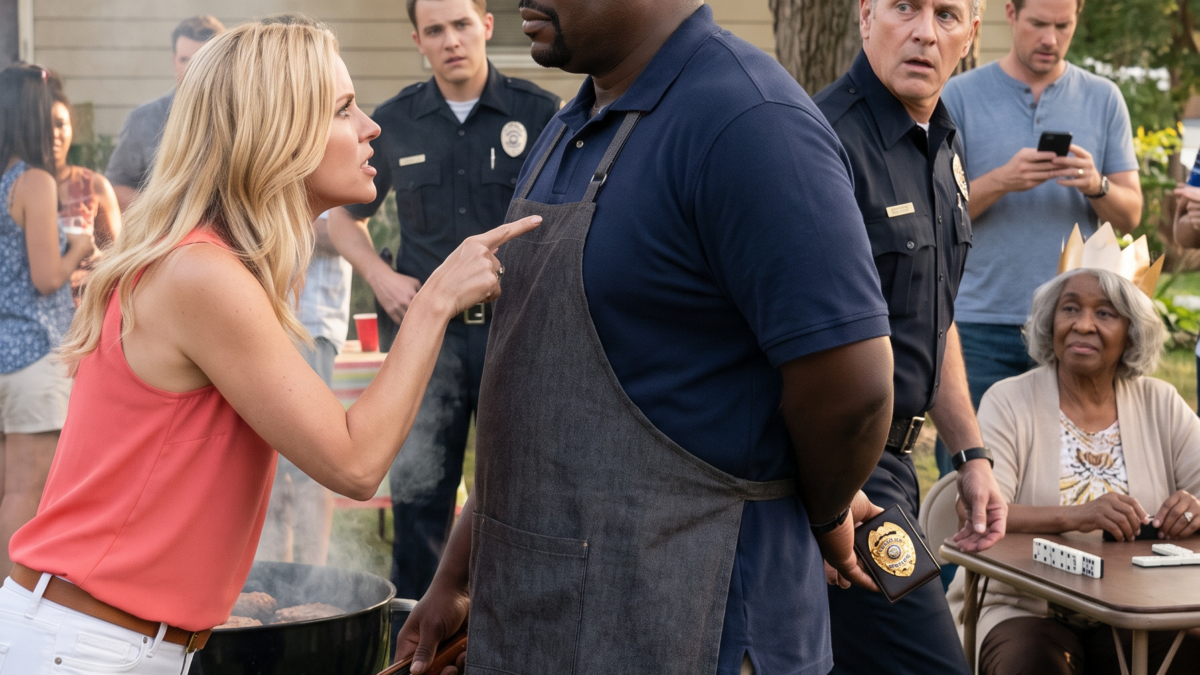
Anthony Freeman was standing in his driveway at seven on a Saturday morning, wearing an old navy polo and arguing with his older brother about charcoal.
Levi held up the bag like evidence in a trial.
“You bought the wrong kind.”
Anthony glanced at it. “It’s the kind Dad used.”
“Dad had flavor despite this charcoal, not because of it.”
From the open kitchen window, Regina laughed.
Anthony shook his head and dragged the second cooler toward the backyard. The June morning was already warm, the kind of North Carolina heat that softened the edges of everything before breakfast. Dogwood Lane was quiet except for sprinklers ticking across lawns and Levi muttering insults at a bag of briquettes.
By noon, the street smelled like smoked ribs, onions, cornbread, and charcoal.
Two folding tables stood beneath the oak tree in Anthony’s front yard, covered with red-and-white checkered cloths. A glass dispenser of sweet tea held lemon slices like little yellow windows. Cousins moved trays between the kitchen and lawn. Church friends arrived carrying foil-covered pans. Regina’s friends clustered near the porch. Someone set up dominoes under the oak.
At the center of it all sat Anthony’s mother.
Ernestine Freeman had turned seventy.
She wore a wide straw hat, a bright floral dress, and a paper crown Zuri had decorated that morning with glitter and crooked gold stars. The front said Birthday Queen.
Zuri, six years old and missing one front tooth, had spent most of the morning explaining ladybugs to anyone who stayed still long enough.
Anthony had planned the cookout for a month.
His mother had spent thirty years cleaning office buildings at night so Anthony and Levi could live lives that happened mostly in daylight. She had packed lunches before school, slept in fragments, and somehow made Sunday dinner appear every week as though exhaustion were a private matter no one else needed to see.
A seventy-year birthday deserved more than restaurant reservations.
It deserved smoke.
Music.
Family.
A table long enough that nobody had to ask whether there was room.
By early afternoon, Dogwood Lane was full without feeling crowded. Cars lined one side of the street legally. Children chased one another around the oak. The playlist moved from gospel to old-school soul. Levi guarded his smoker with the seriousness of a federal facility.
Three houses away, behind the spotless windows of a white colonial, Lindsay Whitley watched the cars arrive.
She was thirty-eight, polished, successful, and locally recognizable. Her photograph appeared on real-estate signs and bus-bench ads around the county. For three years she had been one of the top-selling agents at her brokerage.
She also served as social chair of the neighborhood association, a title she treated with considerably more authority than the bylaws provided.
Her husband, Todd, worked in mortgage lending.
They had lived on Dogwood Lane longer than the Freemans.
Anthony’s family had moved in during January, when the trees were bare and neighbors stayed indoors. The moving truck had come on a gray Tuesday. Anthony had gone back to work before half the boxes were unpacked. Regina’s hospital schedule had kept her equally busy.
Most people on the street knew them only as the new family in the corner house.
That suited Anthony.
Three months earlier, after a national search and a unanimous city council vote, he had been sworn in as police chief.
He had spent twenty-one years getting there.
Foot patrol.
Detective bureau.
Supervisory assignments.
A stint as deputy chief in another city where he had focused on response times, internal discipline, and rebuilding relationships between officers and neighborhoods that had learned not to trust one another automatically.
His appointment had made the local newspaper twice.
Most people glanced at the photograph and moved on.
Anthony still drove a sixteen-year-old pickup. He mowed his own grass. He wore old sneakers to the grocery store and had spent so much of his first three months buried in departmental budgets and staffing plans that he had missed every neighborhood social event.
That was why Lindsay Whitley did not recognize him.
At one o’clock, she crossed the street.
Todd followed a few steps behind with his phone already out.
Anthony saw them approaching while he was brushing sauce across a rack of ribs.
Lindsay stopped at the edge of the lawn where the sidewalk met the grass.
“Hi,” she called. “Sorry to interrupt. Who’s in charge of all this?”
Anthony set the brush down.
“That would be me.”
He walked over, wiping his hands on his apron.
“I’m Anthony. We’re the corner house.”
“I know.”
“Can I help you?”
“Lindsay Whitley. Three doors down. White colonial.”
She did not offer her hand.
Instead, her eyes moved across the yard.
Tables.
Coolers.
Guests.
Domino players.
Children.
Smoker.
Cars.
The inspection took long enough for Anthony to notice it.
“So,” she said finally, “this is a lot.”
Anthony glanced behind him.
“It’s my mother’s seventieth birthday.”
He pointed toward Ernestine.
“That’s her in the hat. Birthday queen.”
Mama Ernestine lifted two fingers without looking away from her dominoes.
Anthony smiled.
“Levi’s ribs are almost criminal. We can fix you both a plate.”
For a moment, the smell from the smoker drifted across the lawn.
Todd looked toward it.
Lindsay did not.
“We don’t eat this,” she said.
The gesture she made seemed to include more than the ribs.
Anthony’s smile faded by a degree.
“What exactly is the problem?”
“The neighborhood association has standards about gatherings. Noise. Cars. Smoke. Number of guests. This is already affecting the street.”
Anthony looked down Dogwood Lane.
No driveways were blocked.
No one was parked on a lawn.
The music was low enough that he could hear Levi arguing with a cousin near the smoker.
“It’s one o’clock on a Saturday.”
“That doesn’t mean people can do whatever they want.”
Regina had come up beside Anthony by then.
She wore a simple cream sleeveless blouse and linen pants, her hair pulled back from her face.
“The music is at normal volume,” she said. “The cars are legal. The grill is on our property.”
Lindsay turned to her.
“And you are?”
“Regina. His wife.”
For several seconds, neither woman moved.
Regina’s expression remained neutral.
Then she said, “You’re welcome to stay, and you’re welcome to go home. Those are the two options.”
Todd lowered his phone slightly.
Lindsay blinked.
Then she smiled without warmth.
“Cute.”
From the domino table, Ernestine called, “Tell her to bring a chair if she stays.”
Several relatives laughed.
Anthony wished they had not.
Not because his mother had said anything wrong.
Because he saw Lindsay’s face change.
She turned toward the sidewalk.
“You should know,” she said, “I have the mayor’s cell number.”
Mama Ernestine placed a domino.
“Tell him to bring a chair too.”
That got a louder laugh.
Lindsay walked home.
For roughly ten minutes, Anthony assumed the problem was over.
Then he noticed her standing on her porch with her phone raised.
She moved to the side yard.
Then to the fence.
Then back to the porch.
Todd appeared carrying a yellow legal pad.
Levi noticed next.
“Is she filming us?”
Anthony flipped a burger.
“Looks like it.”
“Why?”
“No idea.”
Fifteen minutes later, Lindsay was walking along the fence with what appeared to be a decibel-meter app open on her phone.
She called numbers to Todd.
He wrote them down.
Then she photographed the cars.
Every plate she could see.
A church van.
Regina’s SUV.
Levi’s truck.
A cousin’s minivan with two car seats visible through the rear glass.
Levi watched from the smoker.
“She’s taking pictures of license plates.”
“I see her.”
“You want me to go ask what she’s doing?”
“No.”
Levi looked at his brother.
“No?”
Anthony turned the ribs.
“No.”
At the next table, Zuri was bargaining with another child over a blue popsicle.
Anthony deliberately kept his voice low.
“It’s Mama’s birthday. We’re not turning this into something else.”
Levi exhaled through his nose.
Then Lindsay returned carrying an actual tape measure.
Todd followed, recording.
She extended the tape between her fence and the nearest point of Levi’s smoker while Todd called out the distance.
Levi stared.
“Anthony.”
“I see her.”
“Are we in a comedy?”
“Apparently.”
Lindsay dictated something to the camera.
Todd nodded.
Then he kissed the side of her head as though she had completed an impressive home inspection.
On the neighborhood group text, Lindsay posted a complaint about smoke, traffic, music, and property values.
Most people did not respond.
The neighborhood association president did.
Her name was Carol Jenkins, a retired elementary-school teacher who had lived on Dogwood Lane for nearly thirty years.
Her reply was short.
A birthday party is not a violation.
Lindsay took a screenshot.
Todd watched over her shoulder.
“She dismissed you.”
“She’s protecting them.”
“What are you going to do?”
Lindsay created a folder on her phone titled Neighborhood Standards and saved the screenshot.
At 1:40, she called the city’s non-emergency line.
She complained about cars, smoke, music, and the number of guests.
A clerk listened.
Then he explained that a private Saturday-afternoon barbecue, with legal parking and ordinary noise levels, was not itself a code violation.
Lindsay interrupted him twice.
Finally, she ended the call.
“The system is useless,” she told Todd.
He nodded because agreement had become his default posture.
Twenty minutes later, she crossed the street again.
This time, she did not smile.
Anthony was carrying a tray toward the grill when she stopped at the sidewalk.
“I asked you nicely.”
Anthony set the tray down.
“What do you need, Lindsay?”
“Music off. Grills out. Guests gone by three.”
Several nearby conversations stopped.
“Or what?” Levi asked.
Lindsay looked at him.
“Or I make a call.”
Levi set down his tongs.
He was larger than Anthony and less interested in diplomacy.
“Whose lawn do you think you’re standing in front of?”
Anthony lifted one hand.
“Levi.”
His brother looked at him.
The gesture meant enough.
Back off.
Not today.
Todd raised his phone higher.
“Careful,” he said. “Wouldn’t want an incident on camera.”
Levi stared at the phone.
Anthony stepped slightly between them.
“This is my mother’s birthday,” he said. “No one is blocking the street. No one is threatening you. The music is reasonable. If you have a legitimate complaint, make it.”
Lindsay folded her arms.
“This is not that kind of neighborhood.”
Anthony’s expression changed.
Only slightly.
“What kind?”
She looked across the yard.
“You know exactly what I mean.”
Regina came to Anthony’s side.
Lindsay raised her voice.
“You people can take this cookout back to whatever part of town does this.”
A chair scraped near the domino table.
Someone inhaled sharply.
Anthony did not move.
He had spent enough years in interviews, hearings, crime scenes, and meetings where one careless sentence could make a bad situation worse.
So he did what experience had taught him to do.
He let silence make the other person decide whether to stop.
Lindsay did not stop.
“Final warning.”
Then she turned and walked away.
Todd followed, still filming.
Levi waited until they reached the other side.
“You still want me to do nothing?”
Anthony picked up the tongs.
“Yes.”
“Why?”
“Because Mama is seventy once.”
Levi studied him.
Then picked up his own tongs.
“All right.”
Anthony returned to the grill.
But something had changed.
Regina saw it.
She waited until they were alone near the smoker.
“You’re filing this away.”
Anthony looked toward Lindsay’s house.
“I’m paying attention.”
At 2:40, Lindsay called 911.
Todd filmed from several feet away.
“What is your emergency?” the dispatcher asked.
“Yes, hi. I need officers on Dogwood Lane immediately.”
Her voice sounded different.
Softer.
Fragile.
“There’s a large aggressive gathering. Dozens of people. Men drinking in the open.”
Todd kept the camera trained on her.
“I went over politely to ask about the noise, and one of the men threatened me.”
“Threatened you how?”
“The big one came toward me aggressively. I’m shaking. I can barely hold the phone.”
The phone remained steady in Lindsay’s hand.
Todd gave her a quiet thumbs-up.
“There are so many of them,” she continued. “Fifty. Maybe sixty. More cars keep coming.”
The dispatcher asked several questions.
Then: “Are any of them armed?”
Lindsay paused.
“They’re barbecuing.”
Another pause.
“Probably.”
The dispatcher recorded the address and told her units were on the way.
Across the street, Regina watched Lindsay pace with the phone.
“She called.”
Anthony turned a rack of ribs.
“I know.”
“You could end this right now.”
He knew exactly what she meant.
One sentence.
I am the chief of police.
The entire afternoon would change.
Anthony closed the grill lid.
“No.”
Regina looked at him.
“Not first.”
“Anthony.”
He lowered his voice.
“If my name is the only thing standing between this family and handcuffs, then this street isn’t safe.”
Regina said nothing.
“I’d rather find that out here,” he continued, “in daylight, with witnesses, than find out some night when it’s somebody else’s family.”
She watched him for a long moment.
Then she touched his cheek.
“All right.”
She returned to Ernestine’s table and refilled her tea.
Eight minutes passed.
No patrol car.
Lindsay called 911 again.
“This is me again,” she said. “Dogwood Lane. Nobody has come. It’s getting worse.”
The dispatcher explained that units were close.
Lindsay’s voice rose.
“The bass is unbelievable. Do you want something terrible to happen before anyone takes this seriously? Because I vote in this city. I know people. I’m documenting everything.”
“Units are approximately two minutes out.”
Lindsay ended the call.
“Camera ready,” she told Todd.
“Battery’s full.”
A patrol SUV turned onto Dogwood Lane.
Lindsay crossed the street before it had fully stopped.
Officer Frank Grady was driving.
He had nineteen years of patrol experience and the habit of comparing dispatch notes to what his eyes actually saw before deciding anything.
Beside him sat Officer Evan Boyle, twenty-three years old and ten weeks out of field training.
The dispatch screen said:
Large aggressive gathering.
Possible threats.
Caller feels unsafe.
Grady slowed as the Freeman house came into view.
He saw folding tables.
Children.
A grandmother in a paper crown.
Sweet tea.
Dominoes.
Smoke from a barbecue.
People sitting in lawn chairs.
He parked.
Boyle looked through the windshield.
“This is it?”
“This is the address.”
Lindsay was already moving toward them.
Grady unbuckled.
“Rule one,” he told Boyle quietly, “when the scene doesn’t match the call, pay attention to the scene.”
Boyle nodded.
“Rule two?”
Grady opened the door.
“Everybody gets to finish a sentence.”
They stepped onto the street.
“Officers, thank God,” Lindsay called. “This man threatened me. This whole thing is out of control.”
Anthony stood beside the grill.
His apron was stained with sauce.
His hands were loose.
For reasons he could not have explained later, he reached into the front pocket and touched the worn leather case resting beside a meat thermometer and a pack of gum.
He removed it.
Then he held it behind his back.
Grady stopped several feet away.
“Afternoon, sir. We got a call about this address. Can I get your name?”
“Anthony Freeman.”
“This is your residence?”
“Yes.”
Anthony gestured toward Ernestine.
“That’s my mother. Today’s her seventieth birthday.”
He nodded toward Levi.
“That’s my brother. He’s responsible for the smoker and most of the arguments about charcoal.”
Grady’s mustache shifted.
The smell from the smoker had reached him.
Before he could answer, Lindsay stepped between them.
“He’s lying.”
Grady looked at her.
“About what?”
“About what happened. I came over politely. He became aggressive. His brother threatened me too. There are open containers. The music has been illegal all day.”
Todd raised his phone.
“I have everything.”
Lindsay placed a hand against her chest.
“I feared for my life.”
Grady’s voice stayed even.
“Did Mr. Freeman touch you?”
“He didn’t have to touch me.”
“Did his brother touch you?”
“No, but that’s not the point.”
“What exactly did either man say?”
“It was the energy. The way they came toward me.”
Grady glanced toward Anthony.
Anthony had not moved.
Regina stood near his shoulder.
Levi was beside the smoker with the tongs lowered at his side.
Ernestine remained seated.
Lindsay leaned closer to Grady.
“I know how this works. I’m a homeowner. I sell half the houses in this ZIP code. You take him in, sort it out downtown, and everybody’s afternoon gets simpler.”
Grady looked at her.
“That’s not exactly how it works.”
“It’s how it worked on the last street I lived on.”
Grady said nothing.
Lindsay snapped her fingers.
“Todd. The file.”
Todd stepped forward with the yellow legal pad.
Lindsay opened it.
“Noise readings. Every fifteen minutes.”
She pointed.
“Vehicle photographs. License plates. Time stamps. Distance from that smoker to my fence measured twice.”
She turned the pad toward Grady.
“I do my homework.”
Grady looked down at the measurements.
Then at the smoker.
Then at the birthday table.
“You measured their smoker?”
“Twice,” Todd said.
A few people at the party exchanged looks.
But no one laughed.
Not anymore.
Porches along Dogwood Lane were beginning to fill.
Carol Jenkins, the retired teacher and neighborhood association president, stepped outside with her arms crossed.
A man from the gray house shut off his sprinkler.
Another neighbor stood behind a screen door.
People sensed when something had stopped being a neighborhood disagreement and become a record.
Boyle opened his notepad.
He had been trying to capture names and statements, but he kept glancing at Anthony.
Something bothered him.
The man in the apron did not behave like someone waiting for the police to decide what happened.
He also did not behave like someone trying to impress them.
He simply stood.
Calm.
Watching.
“Sir,” Boyle said, “do you have identification?”
Anthony nodded.
“I do.”
His right hand remained behind his back.
“In fact, Officer, I’ve got it in my hand.”
Grady had moved a step to the side.
From that angle, he saw the leather case.
It had fallen partly open.
A gold shield caught the sunlight.
Grady stopped.
His brain took several seconds to connect what he was seeing to a memory.
A city hall ceremony.
A stage.
Dress uniforms.
A photograph in the precinct lobby.
A new chief he had seen mostly from a distance.
Anthony Freeman.
Grady looked from the badge to Anthony’s face.
The face resolved.
He knew exactly who he was looking at.
Boyle did not yet.
Lindsay did not notice Grady stop.
She had reached the point in the afternoon where she interpreted any pause as resistance to her authority.
“What are you waiting for?” she demanded.
Grady looked toward her.
She pointed directly at Anthony.
“Grab him right now.”
Several phones captured the moment.
The music happened to change tracks at almost the same second.
For a beat, the lawn went strangely quiet.
Anthony spoke without raising his voice.
“Careful what you wish for, ma’am.”
Lindsay turned on Grady.
“Did you hear me? I am the caller. I am the victim. Do your job.”
“Ma’am, lower your voice.”
“Excuse me?”
“I said lower your voice and step back.”
She pointed toward Anthony again.
“Do you know who I am?”
Grady glanced at the badge still mostly concealed behind Anthony’s back.
“Yes, ma’am. I know your name.”
“I know the union president. I have the mayor’s cell number. If that man is not in handcuffs in thirty seconds, I will have both your jobs.”
Boyle looked at Grady.
Then followed Grady’s line of sight.
He saw the gold shield.
His pencil stopped.
The photograph in the precinct lobby flashed into his mind.
He looked at Anthony.
Then back at the shield.
His mouth opened slightly.
Nothing came out.
Lindsay folded her arms.
“Monday morning,” she said, “I start making calls.”
Grady watched her for a long second.
Then looked at Anthony.
“Sir?”
Anthony nodded.
His hand came out from behind his back.
The leather case opened fully.
Gold caught the late-afternoon sun.
The shield was engraved.
Chief of Police.
Anthony held it at shoulder height.
“My name is Anthony Freeman,” he said. “I’m the chief of police of this city.”
Lindsay stared at him.
“These two officers work in my department,” Anthony continued. “The dispatcher you spoke to this afternoon works in my department.”
Officer Grady straightened.
“Chief.”
Boyle’s response came a fraction later.
“Chief.”
The word moved across the lawn.
Carol Jenkins uncrossed her arms.
Someone on a porch whispered something Anthony could not hear.
Mama Ernestine closed her eyes briefly.
Not with surprise.
With something closer to relief.
Lindsay laughed.
It sounded brittle.
“Okay.”
Nobody answered.
“You can buy those online.”
Todd’s phone started to lower.
Lindsay turned toward him.
“Tell them.”
Todd said nothing.
Grady spoke instead.
“Ma’am, I stood honor guard at Chief Freeman’s swearing-in ceremony.”
Lindsay looked at him.
“That is the chief of police.”
Todd lowered the phone to chest level.
For the first time all afternoon, he was no longer filming Lindsay like a supportive documentarian.
He was watching her.
Lindsay recovered quickly.
“Well, I don’t care what he’s chief of. He still threatened me.”
Anthony said nothing.
“I still felt unsafe.”
Grady kept his expression neutral.
“That will be documented.”
“I have evidence.”
Todd swallowed.
Lindsay looked at him.
“You got every second, right?”
Todd’s voice was quieter than before.
“Most of it.”
“Every second.”
He nodded slowly.
“Every second.”
Anthony closed the badge case.
Then he looked at Grady.
“Officer Grady.”
“Yes, Chief.”
“You’ll take Mrs. Whitley’s statement exactly as she wants it given.”
Grady nodded.
“Word for word.”
“Yes, sir.”
“Then take mine. My wife’s. My brother’s.”
Anthony turned toward Boyle.
“Officer Boyle, collect available video. Mr. Whitley’s footage, if he consents. Any porch cameras whose owners consent. Request the dispatch audio from both calls.”
Boyle nodded.
“Yes, sir.”
“Preserve chain of custody.”
“Yes, sir.”
Anthony looked toward Lindsay.
She stared back.
“You wanted procedure on this lawn,” he said. “You’re going to get procedure.”
“I don’t have to stand here for this.”
Grady’s tone softened.
“Actually, ma’am, we do need to finish your report.”
“I’m going home.”
“You reported a serious threat twice.”
He paused.
“If your report is accurate, we investigate it.”
Lindsay started to speak.
Grady continued.
“If it isn’t accurate, we investigate that too.”
The distinction landed more heavily than shouting would have.
Lindsay looked around.
Porches were full now.
Carol Jenkins stood near the curb.
Todd had taken one small step away from his wife.
At the picnic table, members of the Freeman family watched in silence.
The atmosphere had shifted.
Thirty minutes earlier, Lindsay had treated the lawn as evidence.
Now every object on it appeared to be evidence against her version.
The birthday crown.
The sweet tea.
The children.
The smoker.
The legal parking.
The people who had watched her cross the street more than once.
The phone in Todd’s hand.
Boyle approached Todd.
“Sir, you said you recorded the afternoon?”
Todd looked at Lindsay.
Then at Anthony.
Then at his phone.
“Yes.”
“You’re willing to provide the footage?”
Todd hesitated.
Lindsay answered for him.
“Of course. It proves everything.”
Todd looked at her.
Then back at Boyle.
“Yes.”
Boyle held out his hand.
Todd did not immediately move.
He stared at the phone as if seeing it for the first time.
Four hours.
Lindsay measuring.
Lindsay narrating.
Lindsay photographing.
Lindsay making calls.
Lindsay instructing him what to film.
Finally he handed it over.
Anthony slid the badge case back into his apron pocket.
Then he picked up his tongs.
Grady glanced toward him.
“Chief?”
Anthony lifted the grill lid.
“My ribs are burning.”
For the first time since officers arrived, several people laughed.
Not loudly.
Enough to release some of the tension.
Grady took Lindsay’s statement on the sidewalk because she insisted on giving it immediately.
She became more precise as she spoke.
She said Anthony had moved toward her aggressively.
She said Levi had held tongs in what she considered a threatening manner.
She repeated that she had feared for her safety.
Grady asked follow-up questions.
He wrote her answers exactly.
Lindsay initialed each page.
“Smart,” she said when she handed back the pen. “Getting everything in writing.”
Grady looked at the signed statement.
“I agree.”
In the patrol SUV, Boyle accessed the dispatch recordings.
The two officers listened with the windows closed.
They heard Lindsay describe an aggressive gathering.
They heard her claim she could barely hold the phone.
Then came the question about weapons.
Are any of them armed?
They’re barbecuing.
Probably.
Grady rubbed a hand across his mustache.
Boyle looked at him.
“That’s bad.”
“We’re not done.”
Todd’s video was worse.
Or clearer, depending on perspective.
It showed Lindsay photographing plates.
Measuring the smoker.
Dictating observations to Todd.
It showed her first conversation with Anthony.
His offer of food.
Regina’s response.
Levi stopping when Anthony raised his hand.
It showed Lindsay’s second approach.
Her demands.
Her statements about the neighborhood.
Then, shortly before the first 911 call, the recording captured Lindsay on her own patio.
She turned toward Todd.
“Watch this.”
She adjusted her posture.
Then asked, “Do I look shaken?”
Seconds later, she dialed.
Her voice changed.
Boyle replayed that section.
Then once more.
Grady leaned back in the driver’s seat.
The legal pad that Lindsay had believed strengthened her case had unintentionally created a synchronized timeline.
The videos had time stamps.
The calls had time stamps.
Her measurements had time stamps.
Everything aligned.
Anthony did not watch the footage.
When Grady approached the grill to ask for direction, Anthony gave him only one.
“I’m a witness on this one, not the chief.”
Grady waited.
“Route everything outside the department. County attorney. Treat me like any other homeowner who made a statement.”
“Yes, sir.”
Anthony turned a rib.
Then added, “Thank you for stopping when you saw the badge.”
Grady frowned slightly.
Anthony looked at him.
“Some people don’t stop for the face.”
Grady understood.
Twenty minutes later, he walked back toward Lindsay.
She was standing near her driveway with Todd several feet away.
“Mrs. Whitley.”
She crossed her arms.
“What now?”
“We’ve completed the initial review.”
“And?”
“You’re being cited in connection with false reporting. Two counts. The file will be referred to the county attorney.”
For several seconds, Lindsay said nothing.
Then she laughed once.
“You cannot be serious.”
“You’ll have the opportunity to address the allegations through the normal process.”
“I’m the victim.”
“That will be part of the record.”
She looked toward Anthony.
He was serving food.
“You’re doing this because of him.”
Grady kept his voice calm.
“No, ma’am.”
He held out the citation.
“We’re doing this because of what was reported and what the available recordings show.”
Lindsay did not take the paper.
Todd finally spoke.
“Lindsay.”
She looked at him.
“Take it.”
Something changed between them in that moment.
It was not dramatic.
Todd simply moved another step away.
But several neighbors noticed.
So did Lindsay.
She took the citation.
At roughly six o’clock, the birthday party started growing.
Carol Jenkins crossed the street first.
She carried a lemon pound cake.
“I should have introduced myself in January,” she told Anthony.
He accepted the cake.
“You’re introducing yourself now.”
The couple from the gray house came next with folding chairs.
Another neighbor brought ice.
Someone apologized to Ernestine for the interruption even though they had not caused it.
Mama Ernestine waved them toward the food.
By sunset, the gathering had nearly doubled.
Grady and Boyle had officially cleared the call, but before leaving, Ernestine wrapped two plates in foil.
Grady tried to refuse.
She looked at him.
“Officers eat too, baby.”
He accepted the plate.
Boyle did the same.
The birthday cake came out at dusk.
Seventy candles were too many for any one person to protect from the evening breeze, so several cousins formed a wall around them.
Zuri climbed into Ernestine’s lap.
Everyone sang.
Ernestine closed her eyes and made a wish.
When the candles went out, Anthony leaned toward her.
“What’d you wish for, Mama?”
She looked down the long table.
At Levi.
Regina.
Zuri.
Neighbors who had not known one another that morning.
Then she looked at her son.
“More Saturdays.”
Across the street, Lindsay’s house was dark.
The blinds were closed.
Her neighborhood group text had gone silent.
Later that night, one final message arrived from Carol Jenkins.
A birthday party is not a violation.
What happened today is.
By Sunday evening, video from Dogwood Lane was circulating online.
One porch camera had captured the widest angle.
Lindsay in coral.
Her finger extended.
Anthony in an apron.
Two uniformed officers.
Then the slow movement of Anthony’s hand from behind his back and the flash of the gold shield.
Another clip came from Todd’s footage.
Another from a neighbor.
The confrontation spread quickly because it needed almost no explanation.
A woman demanded the arrest of a man on his own lawn.
The man turned out to be the police chief.
But the part investigators cared about was not the reveal.
It was everything that happened before it.
The dispatch audio was preserved.
So were Todd’s recordings.
So was the legal pad.
So were the signed statements.
Within days, investigators began looking beyond that Saturday.
They found previous calls connected to Lindsay.
Nine across three years and two neighborhoods.
A jogger reported because she said he looked unfamiliar.
A mail carrier reported for lingering.
Teenagers selling candy for a sports fundraiser described as suspicious.
A father waiting at a bus stop with his sleeping child reported because Lindsay said the situation looked wrong.
None of those incidents had resulted in criminal findings.
Each one had been treated as an isolated complaint.
Taken together, they created a pattern.
The file widened.
The state real-estate board opened its own review because Lindsay’s professional license carried conduct requirements.
Her brokerage suspended her, then ended its relationship with her after reviewing the available material.
Within a week, her advertisements began disappearing from bus benches.
The criminal case moved more slowly.
Five weeks later, Lindsay appeared in court with counsel.
The prosecutor’s strongest tool was the one Lindsay had created herself.
Her legal pad.
Because she had recorded times so carefully, investigators were able to align her notes with Todd’s video and both 911 calls.
The timeline showed what she was doing immediately before, during, and after the statements she made to dispatch.
The video of her asking Todd, “Do I look shaken?” seconds before the emergency call became especially difficult to explain.
The case did not go to a full trial.
Lindsay pleaded guilty to two counts related to false reporting.
The court imposed a fine, community service, and an educational program.
She was also ordered to provide a formal written apology to the Freeman family.
Mama Ernestine read it once.
Then she folded it back along the creases.
Levi found it near the grill several weeks later and asked what she intended to do with it.
Ernestine waved it at the coals.
“Makes a decent fan.”
Anthony laughed despite himself.
The judge’s remarks received almost as much local attention as the original video.
The judge told Lindsay she had not treated the police as a public service for everyone.
She had treated them as if they were a private tool for removing people who made her uncomfortable.
The community-service requirement eventually placed her in programs connected to neighborhood outreach.
Todd cooperated with investigators.
During later proceedings, his statement remained consistent.
“I filmed what she asked me to film.”
That became part of his own problem.
Because the recordings showed he had not simply been a passive bystander.
He had encouraged Lindsay.
Praised the documentation.
Helped measure the smoker.
Held the phone while she rehearsed.
Their marriage did not survive the aftermath.
Todd filed for divorce later that year.
Anthony never celebrated that.
When Regina mentioned the possibility of a civil lawsuit, he sat across from her at their kitchen table and listened.
She had reasons.
Their daughter had been home.
His mother’s birthday had been disrupted.
Their family had been publicly accused.
But Anthony shook his head.
“The law is doing the law’s part.”
Regina folded her arms.
“And us?”
“We go be the neighbors we said we were.”
She looked at him for several seconds.
Then nodded.
The incident did, however, change how Anthony ran his department.
He took the dispatch recordings, officers’ reports, available video, and de-identified examples from earlier complaint patterns and built them into a training package.
Patrol officers eventually nicknamed it the Freeman Tape.
The lesson was not that callers should be distrusted.
It was that facts had to be separated from narration.
Officers were trained to compare what dispatch said with what they actually observed.
Dispatchers received new guidance for repeated complaints.
Supervisors were given a process for identifying when one caller repeatedly reported similar categories of people or behavior despite previous complaints producing no violations.
The goal was not to punish callers automatically.
It was to recognize patterns before the ninth call was treated as though it had no relationship to the first eight.
Neighboring departments asked to review the program.
Several adopted versions of it.
At the press conference announcing the changes, Anthony was asked about Lindsay directly.
He declined to discuss her personal situation.
Instead, he said, “In this city, the police protect everyone. We are not anyone’s personal removal service.”
Officer Grady received a commendation.
He tried to refuse it.
“I stopped walking,” he told Anthony. “That’s the whole story.”
Anthony overruled him.
“In my experience,” he wrote in the commendation memo, “knowing when to stop is one of the rarest professional skills.”
Boyle kept a copy of his original field notes.
His mother framed the commendation photograph from the small ceremony.
The body-camera audio also preserved something his family never allowed him to forget.
When Anthony brought the badge around from behind his back, Boyle had whispered, very quietly:
“Oh no.”
The white colonial went up for sale the next spring.
A competing real-estate agent got the listing.
It sold quickly to a young family with a golden retriever, a swing set, and two children under eight.
On moving day, Carol Jenkins left a foil-covered pound cake on their porch.
The note said:
Welcome to Dogwood Lane.
You’re going to love Saturdays here.
One year after Ernestine’s seventieth birthday, the neighborhood blocked off part of the street with borrowed sawhorses.
The permit was legitimate.
Anthony checked.
Twice.
They called the event Open Flame, Open Table.
It had started as Mama Ernestine’s next birthday cookout and expanded until nearly every household contributed something.
One family brought folding chairs.
Another brought a karaoke machine.
Carol managed desserts.
The new family from the white colonial brought deviled eggs.
Their golden retriever, Biscuit, spent most of the afternoon stealing attention from the children.
Nobody reported him.
Levi set up his smoker in almost the same location as before.
Someone had printed a small sign for the ribs:
ALMOST CRIMINAL.
The phrase came from Anthony’s old joke to Officer Grady on the afternoon everything started.
The church eventually used it for a fundraiser sauce.
Levi refused to explain the name to anyone who had not been there.
Grady and Boyle sometimes came after shift.
Grady brought grandchildren.
Boyle brought his mother, who had heard the story enough times to quote parts of it.
Even the dispatcher who took Lindsay’s calls attended once.
Ernestine insisted she receive the first plate.
“Professionalism under foolishness deserves feeding,” she said.
Nobody argued.
Zuri turned seven.
She lost another tooth and started charging younger children one juice box each for “official” ladybug tours of the flower beds.
Late one Saturday afternoon, she climbed onto Anthony’s back while he worked the grill.
He bent slightly so she would not fall.
“Daddy?”
“Yes?”
“Are you the boss of all the police?”
Anthony glanced toward Grady, who heard the question and immediately pretended not to.
“Monday through Friday.”
Zuri tightened her arms around his shoulders.
“Who’s the boss on Saturday?”
Anthony pointed his tongs toward the long table.
Ernestine, seventy-one now, wore another paper crown and was defeating three grown men at dominoes.
“Same boss it’s always been.”
Zuri considered that.
“Grandma?”
“Grandma.”
By then, the training program built from the Dogwood case had spread to several nearby cities.
The state academy had requested materials.
Anthony was proud of that.
But it was not what he thought about when he stood in his yard.
What he noticed instead was the sound of people using one another’s names.
He noticed Carol arguing about pound cake recipes.
He noticed the new family from the white colonial laughing with neighbors they had met only months before.
He noticed Grady letting Zuri explain ladybugs for eleven uninterrupted minutes.
He noticed Regina crossing the lawn with a tray and still looking at him the way she had on their wedding day.
And sometimes, while working the grill, Anthony’s eyes drifted toward the patch of grass where Lindsay had stood pointing at him.
Nothing marked it.
The grass had grown.
That was the ordinary miracle of it.
The place where one person had once demanded that he be removed from his own lawn had become the path children used to run between the domino table and the flower beds.
No plaque.
No fence.
No permanent scar in the ground.
Just grass.
Smoke.
Laughter.
A long table.
A family that had refused to surrender the day.
And an old apron hanging from Anthony Freeman’s shoulders while the badge stayed exactly where he preferred it on Saturdays—out of sight.
This story is a dramatized work of fiction created solely for storytelling and entertainment purposes. It is not presented as a factual report or news account. Any resemblance to actual people, places, organizations, or events is purely coincidental. Names, dialogue, locations, timelines, occupations, and identifying details have been invented, combined, or altered to protect privacy and support the narrative. Some accompanying images or visual elements may be AI-generated or digitally enhanced.