At Easter dinner, Lady Charlotte publicly questioned why a servant was wearing what looked like a Blackwood family medal. Emma Carter quietly covered the worn bronze disk, but the Dowager Duchess suddenly ordered her closer. Thirty guests watched Margaret Blackwood study the engraving, ask who had given it to Emma’s father eight years earlier—and then bow her silver head before the young woman serving her table. The medal explained part of her reaction. The unsigned letter Margaret remembered next explained something much deeper.
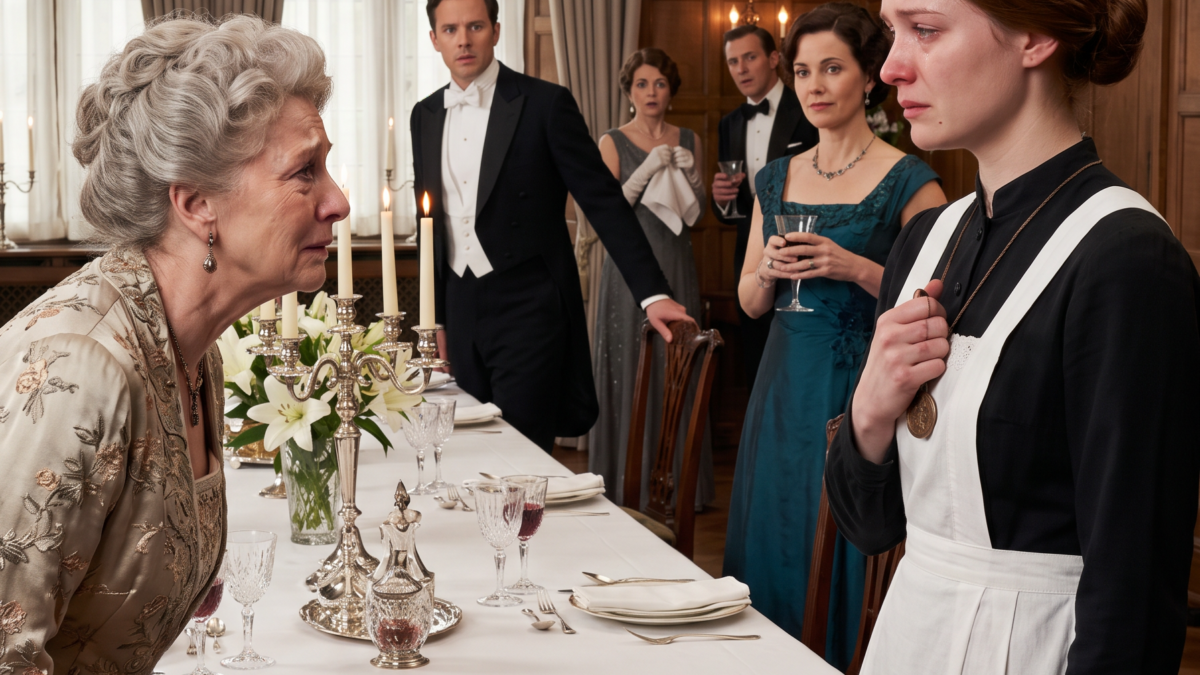
“Your Grace, why are you bowing to me?”
Emma Carter’s voice barely rose above the soft clink of silverware, yet every guest at the Easter table heard it.
Nearly thirty men and women sat beneath the chandeliers of Blackwood Manor, surrounded by white lilies, polished crystal, candlelight, and the deep glow of dark oak walls. A moment earlier the room had been full of conversation. Now no one moved.
Before Emma stood Margaret Blackwood, Dowager Duchess of Westmore, a woman who had spent more than sixty years watching other people lower their heads to her.
Now Margaret’s silver head was bowed before a young servant in a plain black dress.
At the far end of the table, Alexander Blackwood, Duke of Westmore, had risen so quickly that his chair still stood several inches behind him. His gray eyes moved from his mother to Emma and finally to the worn bronze medal resting against the black fabric near Emma’s collar.
He had seen Margaret face grief, scandal, illness, and decades of society’s cold scrutiny without allowing so much as a tremor to show in her hands.
Tonight, those hands were shaking.
“Mother,” Alexander said.
Margaret did not turn.
Emma’s fingers closed around the medal as though she might somehow hide it again.
It was far too late for that.
Only minutes earlier, Lady Charlotte Bennett had been smiling over the rim of her wineglass.
“How unusual,” Charlotte had said in the pleasant voice she reserved for remarks meant to wound without sounding cruel. “I had not realized the Blackwood household permitted servants to wear family decorations.”
Several guests had turned toward Emma.
She had felt their attention gather around her while she stood beside the table holding the wine bottle.
“It is not a family decoration, my lady.”
Charlotte’s smile had sharpened by a degree.
“Then perhaps you would explain how someone in your position came to possess it.”
Alexander had placed his fork beside his plate.
The faint sound against porcelain had carried farther than it should have.
“That is enough, Charlotte.”
Emma had expected the matter to end there.
Instead, Margaret had gone pale.
“Come closer,” the dowager duchess had said.
Emma had obeyed.
One step.
Then another.
Her shoes made almost no sound against the polished floor, but every movement seemed enormous beneath the silence of so many watching people.
Margaret had stared only at the bronze disk.
“Where did you get this?”
“It was entrusted to my father eight years ago, Your Grace.”
Margaret’s breath had caught.
“By whom?”
Emma had hesitated.
That hesitation told Alexander that Charlotte’s little attempt at public humiliation had uncovered something much larger than she understood.
“By someone your family loved,” Emma had said quietly.
Margaret rose.
Alexander took one step toward her, but his mother lifted a hand to stop him.
Then, before every titled guest at her Easter table, she walked the remaining distance to Emma and bowed.
A fork slipped from someone’s fingers and touched a plate.
No one reached for it.
Emma showed no satisfaction.
Only alarm.
“Your Grace, please do not bow to me.”
Margaret raised her head.
Grief softened the severe lines around her mouth.
“I should have done this years ago.”
Alexander stared at both women.
“What happened years ago?”
Neither answered.
Outside the manor, Easter bells carried through the evening air.
Inside, every fork remained lowered.
Seven weeks earlier, Emma Carter had stood outside the iron gates of Blackwood Manor with one small trunk at her feet and the name she had spent eight years trying not to remember carved into the stone pillars before her.
Blackwood.
A late-winter wind swept across the grounds, cold enough to redden her cheeks. Beyond the gates, the manor rose at the end of a long gravel drive, all gray stone, tall windows, dark roofs, and the kind of restrained grandeur that did not need decoration to announce wealth.
Emma had known the name before she accepted the position.
That was why she had nearly refused it.
When the employment agent pushed the contract across the desk, Emma stared at the address long enough for the woman to ask whether something was wrong.
“No,” Emma had said.
It had been easier than explaining that a single family name could open an entire room in memory she had kept locked for years.
She considered walking away.
Then she pictured her mother asleep beneath two blankets in their rented cottage because they could not afford enough coal for the stove. She pictured the physician’s bill folded beside the bread tin and the collection notice Emma had turned facedown so her mother would not see it.
Pride could protect a secret.
It could not heat a house.
So Emma signed.
A footman met her at the side entrance and led her into the servants’ part of the manor, where the grandeur narrowed into stone corridors, polished floors, copper pans, back stairs, and the warm noise of a kitchen preparing dinner.
Mrs. Finch, the housekeeper, waited beneath a narrow staircase with a ring of keys at her waist.
Her gray eyes examined Emma and then the modest trunk.
“Emma Carter?”
“Yes, ma’am.”
“You have worked in service before?”
“For two years.”
“Good. His Grace expects order. The Dowager Duchess expects discretion. Neither has patience for excuses.”
Emma inclined her head.
“Neither do I.”
Mrs. Finch looked at her more carefully.
It was not quite approval, but it was close.
“You may do well here.”
Emma’s room was on the third floor beneath the eastern roof. It was small, clean, and warmer than the cottage she had left behind. There was a narrow bed, a washstand, a wooden chair, and one window overlooking the gardens.
When she was finally alone, she opened her trunk.
Two black dresses.
A wool shawl.
Three books.
Her father’s medical notebook, wrapped in cloth.
At the bottom rested a small wooden box.
Emma sat on the edge of the bed for several seconds before lifting the lid.
Three letters lay inside, tied with a faded blue ribbon.
Beside them rested a bronze medal, its edges worn smooth from years of handling.
She touched the metal with one finger.
Eight years earlier, her father had placed it in her palm and told her that it belonged to a family named Blackwood.
He had meant to return it himself.
His declining health had taken that chance from him.
Before he died, he had made Emma promise that the object would eventually reach the family whose name was engraved on its back.
But the promise had included something else.
Something more difficult.
Emma closed the box.
She had not come to Blackwood Manor for gratitude.
She had not come to reveal who had given her father the medal.
She had certainly not come to use the final days of a dead son as a way into a wealthy family’s favor.
She had come to work.
Nothing more.
The following morning, Emma tied a white apron over her black dress and carried a breakfast tray through the West Gallery.
Portraits lined the walls between long windows filled with cold sunlight.
She kept her gaze forward until she reached the third painting.
Then she stopped.
The young officer in the portrait wore a dark uniform and a half smile Emma remembered far too well.
Henry Blackwood.
For one suspended heartbeat, the gallery disappeared.
Emma heard a tired laugh from another winter.
A man humming badly beneath his breath.
A quiet promise made in a room with frost against the windows.
The tray trembled.
“You know that face.”
The voice came from behind her.
Emma turned slowly.
Alexander Blackwood stood less than ten feet away.
He wore a dark morning coat, and the severity of it made his gray eyes seem even more familiar.
Too familiar.
He looked from Emma to Henry’s portrait.
“You know that face,” he repeated.
Emma steadied the tray.
“I thought I recognized him, Your Grace.”
“From where?”
The question was quiet.
That made it more difficult to evade.
“I may have been mistaken.”
Alexander’s expression barely moved.
“Most people do not nearly drop a tray when they mistake one stranger for another.”
Emma lowered her gaze.
“I apologize.”
“I did not ask for an apology.”
For one dangerous instant, memory rose too quickly.
Henry in a narrow room eight years earlier.
Henry laughing weakly as he described an older brother who, according to him, believed himself incapable of losing an argument.
Emma pushed the image down.
“The breakfast room is waiting, Your Grace.”
Alexander watched her.
He was accustomed to people filling silence whenever he allowed it to linger.
Emma did not.
At last, he stepped aside.
“Then you should not keep it waiting.”
She passed him without looking at the portrait again.
She could feel his attention following her until she reached the end of the gallery.
During the following days, Alexander began noticing Emma where he had previously noticed only the work around him.
She moved quietly through the manor and never remained after a task was finished, but details kept drawing his attention.
In the library, he heard her correctly pronounce a Latin phrase beneath an old engraving.
Another morning, an elderly footman named Mr. Ellis became dizzy near the back stairs.
Emma was beside him before anyone else had decided what to do.
She helped him sit, loosened his collar, checked his pulse, and asked another servant to bring water.
Alexander came upon them halfway through.
“Who taught you that?”
Emma looked up from Mr. Ellis’s wrist.
“My father.”
“Was he a physician?”
A pause.
“Yes.”
“Where did he practice?”
“Wherever he was needed.”
Alexander frowned.
Again, an answer that revealed almost nothing.
He began noticing that Emma rarely lied outright.
She simply opened the smallest possible door and closed it before he could see the room beyond it.
Several days later, Margaret Blackwood felt faint while reviewing Easter invitations in the blue sitting room.
Emma entered carrying fresh flowers just as Margaret’s teacup struck its saucer.
The nearest maid froze.
Emma did not.
She set down the flowers and moved to Margaret’s side.
“Please remain seated, Your Grace.”
Margaret frowned.
“I am perfectly capable of standing.”
“Then you may prove it after the dizziness passes.”
Margaret stared at her.
The surprise in the older woman’s expression almost made Emma step back.
Instead, Margaret stayed seated.
Emma opened the window a few inches, checked her pulse, and asked for water.
When Alexander entered, his mother was already recovering.
He looked at Emma.
“Your father taught you this as well.”
“Yes, Your Grace.”
Something in her voice brought Henry’s portrait immediately back to him.
Later that afternoon, Alexander crossed the corridor beside the chapel and stopped.
Someone inside was humming.
The melody was simple and old.
He knew it immediately.
Henry had sung it constantly when they were young, an old marching song learned from a retired officer who once worked on their father’s estate.
Alexander stepped inside.
Emma stood beneath the stained-glass windows arranging white lilies.
She had not heard him.
“Where did you learn that song?”
Emma froze.
Slowly, she turned.
Alexander saw recognition in her eyes before caution covered it.
He did not come closer.
“You recognized my brother. Your father was a physician. And now you know a song Henry carried with him.”
His voice softened, but the question became more dangerous because of it.
“Who are you, Miss Carter?”
Emma looked down at the lilies.
“I am Emma Carter, Your Grace.”
“That tells me your name.”
“It is the only answer I am prepared to give.”
Alexander’s eyes narrowed.
“You speak as though you have something to protect.”
Emma lowered another lily into the vase.
“Perhaps I do.”
Before he could answer, carriage wheels sounded in the courtyard.
A woman’s voice drifted from the corridor.
“Alexander, I hope your servants have not hidden you from me already.”
Lady Charlotte Bennett appeared beneath the chapel arch.
She wore a dark green traveling dress and gloves the exact shade of cream that seemed designed never to touch anything dirty.
Charlotte was beautiful in the polished manner society rewarded. Every movement seemed practiced without appearing rehearsed. Every smile arrived at precisely the right moment.
Her gaze rested on Alexander.
Then it moved to Emma.
It remained there slightly too long.
“I did not realize I was interrupting.”
“You are not,” Alexander said. “Miss Carter was arranging flowers.”
Charlotte looked at the lilies.
Then at Emma.
“Of course.”
The words sounded harmless.
Emma knew better.
By evening, Charlotte had settled into Blackwood Manor with the confidence of someone who expected eventually to belong there permanently.
Her preferences were known by breakfast.
Tea of a particular blend.
Fresh roses rather than lilies.
The curtains opened at a specific hour.
Breakfast precisely at eight.
None of those requests was unreasonable alone.
Together, they became a quiet declaration that the household should rearrange itself around her.
On the second morning, Charlotte requested Emma personally.
“The tea is too cool,” she said after one sip.
Emma replaced it.
The second cup was too strong.
The third was accepted.
Charlotte gave her a faint smile.
“You learn quickly.”
“Thank you, my lady.”
“How long have you been here?”
“Not long.”
“And His Grace already knows your name.”
Emma kept her expression neutral.
“Mrs. Finch requires that the household staff be properly introduced.”
“How efficient.”
Charlotte lifted the cup.
“A servant should always value efficiency. It prevents imagination from becoming troublesome.”
Emma understood the warning.
She gave Charlotte nothing in return.
“Is there anything else, my lady?”
“No. That will be all.”
Over the next several days, Charlotte never offered Emma anything obvious enough to challenge.
A napkin was returned without explanation.
A vase was moved after Emma placed it.
A shawl was examined for several seconds and then exchanged for another.
Emma corrected each thing quietly.
Charlotte thanked her every time.
Alexander noticed.
He noticed more when Charlotte allowed a lace handkerchief to fall beside her chair during afternoon tea.
Emma bent and retrieved it.
“Thank you,” Charlotte said. “One should always know what belongs within reach.”
Emma straightened and placed the handkerchief beside Charlotte’s cup.
“I have never reached for anything that was not mine, my lady.”
Charlotte’s smile remained elegant.
“Then we understand each other.”
Across the room, Alexander slowly lowered the newspaper in his hands.
Later he found Emma in the library returning books to their shelves.
“Has Charlotte been troubling you?”
Emma slid a volume into place.
“Lady Charlotte has been reminding me of my position.”
“That is not what I asked.”
Emma turned.
Firelight moved across Alexander’s face.
“My position is the reason she believes she may.”
Alexander frowned.
“Your position does not give anyone permission to humiliate you.”
“No, Your Grace. But people with power often confuse permission with opportunity.”
He said nothing.
Emma returned to the shelves.
She assumed the conversation was finished.
Then Alexander spoke again.
“And what do you believe about power?”
Emma paused.
“That it reveals character more often than it creates it.”
Alexander watched her.
The answer stayed with him long after he left the library.
Over the next several days, he began observing the people around him differently.
Charlotte spoke gently to titled guests and more sharply to servants when she believed no one important was listening.
Margaret remained formal but fair.
Emma, meanwhile, seemed determined to disappear into her duties.
The harder she tried to become invisible, the more contradictions Alexander noticed.
She read labels on imported medicines without difficulty.
She recognized an old military phrase carved beneath a portrait.
She once stopped a junior maid from confusing two herbs used for very different purposes, then changed the subject immediately when asked how she knew.
None of it fit neatly with the life Emma presented.
One rainy afternoon, Alexander found her replacing wilted flowers in the morning room.
On a side table lay one of Henry’s old books, a collection of essays on military strategy.
Emma glanced at it for less than a second.
Alexander saw.
“Did my brother lend you books?”
Her hand stopped above the vase.
“No, Your Grace.”
“Then why did you recognize that one?”
“I recognize the author.”
“You keep answering the smallest part of every question.”
Emma looked at him.
“Because sometimes the larger part is not mine to give.”
Rain whispered against the windows.
Alexander stepped closer to the table while keeping several feet between them.
“Was your father treating soldiers when you knew Henry?”
Emma’s expression shifted.
There it was again.
Truth before caution.
“Yes.”
“And you were with him sometimes.”
“Yes.”
“How old were you?”
“Seventeen.”
Alexander became very still.
“You knew my brother at the end of his life.”
Emma lowered her eyes.
“Yes.”
The word changed the atmosphere of the room.
For eight years, Alexander had carried an image of Henry’s final days assembled from official messages, formal reports, and what no one had been willing to describe.
Now a witness stood in front of him arranging lilies.
“Was he alone?”
“No.”
The answer came immediately.
Alexander drew a slow breath.
“Who was with him?”
“My father for part of the time. I was there afterward.”
He looked toward the rain-darkened garden.
“My mother never knew.”
“I know.”
Alexander turned.
“How?”
Emma’s hesitation answered part of the question before her words did.
“Because I wrote to her.”
Alexander stared.
“You wrote to my mother?”
“Once.”
“When?”
“After Henry died.”
“What did you say?”
Emma’s voice softened.
“That her son was not alone. That he spoke of home. That he was treated with kindness.”
Alexander closed his eyes briefly.
When he opened them, the duke’s composure remained, but the older brother had moved much closer to the surface.
“Why did you not sign the letter?”
“Because the letter was about Henry. Not me.”
Alexander watched her.
“And there was more.”
Emma said nothing.
He stepped forward.
“There was more, was there not?”
“Yes.”
“Then tell me.”
She shook her head.
“I cannot.”
His jaw tightened.
“Cannot or will not?”
“Both.”
Neither moved.
Then Alexander asked the one question Emma had always feared someone in that family might ask.
“Did Henry make you promise something?”
Emma’s fingers tightened around the stem of a lily.
She did not answer.
She did not need to.
Alexander understood.
For the first time, the mystery was no longer who Emma Carter was.
It was what Henry Blackwood had trusted her to protect.
Alexander did not question her again that afternoon.
Something in his manner changed after that.
He appeared to understand that silence could be an act of loyalty rather than defiance.
Still, the question remained between them.
Three days later, he found her in the small conservatory carrying folded linens toward the servants’ corridor.
Rain tapped lightly against the glass roof.
The air smelled of damp earth and rosemary.
“Miss Carter.”
Emma stopped.
“Your Grace.”
Alexander held her gaze.
“My brother made you promise something.”
It was not a question.
Emma looked toward the rain-streaked panes.
“Yes.”
“And you still believe that promise binds you.”
“A promise does not become less binding because the person who trusted you is no longer here.”
The words struck him harder than Emma intended.
Alexander looked away.
Then he asked quietly, “Was he afraid?”
Emma tightened her hands around the basket.
There it was.
The question beneath every other question.
She could hear Henry’s voice as clearly as if eight years had disappeared.
Do not let her remember only the fear.
Emma chose her words carefully.
“He was human.”
Alexander’s jaw tightened.
“That is not an answer.”
“It is the truest one I can give without betraying him.”
Silence settled beneath the glass ceiling.
Then Emma continued.
“He did not want to be remembered as fearless. He wanted to be remembered as brave enough to remain himself even when he was frightened.”
Alexander looked at her.
“He spoke of my mother?”
“Often.”
“And me?”
A faint warmth entered Emma’s face.
“More than you would probably like.”
Alexander almost smiled.
“That sounds like Henry.”
“He told me about the apple tree near the west wall.”
Alexander’s expression changed.
“What about it?”
“He said you climbed it first, tore your coat, and blamed him because he was younger.”
For one brief moment, the Duke of Westmore disappeared.
Only Henry’s brother remained.
“He climbed first.”
Emma’s mouth softened.
“He said you would say that.”
A quiet laugh escaped Alexander before grief caught it.
He lowered his head.
“Thank you.”
It was the first time Emma had heard gratitude from him without the distance of rank behind it.
He looked at her again.
“Emma.”
She raised her eyes immediately.
He had never used her first name before.
They both noticed.
Neither mentioned it.
“There is one more thing,” Alexander said.
His attention had fallen to the movement of Emma’s hand near her collar.
She realized too late that her fingers had touched the chain hidden beneath her dress.
Alexander saw it.
“What are you hiding there?”
Emma hesitated.
Then she reached beneath the collar and drew out the bronze medal.
The worn metal caught the pale conservatory light.
Alexander stopped moving.
“Where did you get that?”
“Henry gave it to my father.”
Alexander stepped closer without touching it.
“My mother gave him that before he left.”
“I know.”
“Then why do you have it?”
“My father kept it for Henry. Before my father died two years ago, he gave it to me.”
Alexander lowered his voice.
“Why?”
“Because Henry asked that one day it be returned to your mother.”
“Then why did you wait?”
Emma closed her fingers around the bronze disk.
“Because he did not ask me to return only the medal.”
Alexander stared at her.
“What else?”
“He asked me to wait until I could return it without turning his memory into an advantage.”
Alexander looked again at the medal.
Eight years.
Emma could have appeared at Blackwood Manor at any point during those years.
She could have attached her name to Henry’s final days.
She could have told Margaret what she knew.
She could have asked for money, help, employment, introductions, security.
Instead, she had entered through a servants’ door and said nothing.
By Easter morning, Blackwood Manor had become a house of white lilies, polished silver, carefully arranged flowers, and carefully concealed tension.
Nearly thirty guests arrived beneath a pale spring sky.
Carriages circled the gravel drive while servants crossed the halls with trays, linens, and last-minute instructions.
Emma knew the day would be difficult.
She had not expected it to feel dangerous.
Alexander had spoken to her only twice since the afternoon in the conservatory.
Something between them had changed.
His attention no longer carried suspicion.
That alone was enough for Charlotte to notice.
During dinner, Emma moved along the long table with the other servants, pouring wine and replacing plates beneath the chandeliers.
Margaret sat near the center in silver-gray silk.
Alexander sat several places away, answering an elderly guest while watching far more than he appeared to.
Charlotte sat close to him.
Her smile had never looked more gracious.
Emma reached her place with the wine.
“Thank you,” Charlotte said.
Then her elbow shifted.
The movement was tiny.
The edge of her glass tipped.
Red wine spread across the white tablecloth and touched the sleeve of Charlotte’s gown.
Several guests turned.
Emma immediately set down the bottle and reached for a clean napkin.
“I’m sorry, my lady.”
Charlotte looked at the stain.
Then at Emma.
“How unfortunate.”
Her voice was soft enough to sound generous.
“You have seemed distracted lately.”
Emma began blotting the tablecloth.
“I assure you, my lady, I was attentive.”
“Of course.”
Charlotte smiled toward the nearest guests.
“Perhaps attention becomes difficult when one’s ambitions are elsewhere.”
The words sounded light.
Their meaning was not.
Emma could feel the room listening.
Alexander placed his fork down.
“Charlotte.”
She turned toward him with practiced innocence.
“I meant nothing unkind.”
Emma straightened.
“There is no harm done, Your Grace.”
“I did not say there was.”
Alexander’s voice was quiet.
Charlotte looked back at Emma.
“No, perhaps not. A household can be very forgiving when a servant becomes interesting.”
This time, conversation stopped along the table.
Emma’s face remained composed even as heat moved beneath her skin.
She reached for the folded cloth beside the wine stain.
When she bent slightly, the chain beneath her collar slipped forward.
The bronze medal appeared against her black dress.
Charlotte saw it first.
“What is that?”
Emma’s hand moved to cover it.
Too late.
“A personal keepsake, my lady.”
Charlotte leaned back.
“It looks military.”
Alexander stood.
His chair scraped across the floor.
“Enough.”
But another voice came before he could continue.
“Come here.”
Margaret Blackwood had gone pale.
Every eye turned toward her.
She was staring at the bronze disk as if the past had entered her dining room without invitation.
Emma did not move immediately.
Margaret’s voice softened.
“Please.”
Emma stepped forward.
One step.
Then another.
Margaret reached out but stopped before touching the medal.
“Where did you get this?”
Emma swallowed.
“It was given to my father eight years ago, Your Grace.”
Margaret’s fingers tightened against the table.
“By whom?”
Emma glanced once at Alexander.
His face was perfectly still.
“By your son.”
Margaret’s breath caught.
“Henry?”
Emma nodded.
The room seemed to lose its air.
Margaret stared at her.
Then something changed in her expression.
Not recognition of Emma’s face.
Recognition of a memory.
“You were there.”
“Yes, Your Grace.”
Margaret’s lips parted.
“And the letter.”
Emma felt the bronze medal warm beneath her hand.
“What letter?”
“The one that came after Henry died. No signature. Only a few lines.”
Margaret’s voice became unsteady.
“You told me he spoke of home. You told me he had been treated with kindness. You told me he had not been alone.”
Emma heard the ticking clock near the fireplace.
Nothing else.
Margaret leaned forward.
“Did you write it?”
Emma looked at the woman who had lived eight years with those words.
“Yes,” she said. “I wrote it.”
Somewhere along the table, a fork touched porcelain.
No one reached for it.
Margaret remained motionless.
Her fingers rested against the table’s polished edge as if the wood were the only thing holding the past at a manageable distance.
“You wrote it,” she repeated.
This time it was not a question.
Emma nodded.
“Yes, Your Grace.”
Candlelight moved across silver and crystal between them.
Even Charlotte had lost the careful smile she had worn minutes earlier.
Margaret looked at the medal.
“Why did you never give your name?”
“Because the letter was not about me.”
“It told me my son was not alone.”
“He was not.”
Margaret drew a careful breath.
Alexander stood several feet away, listening with the stillness of someone afraid that one careless movement might interrupt something he had waited years to hear.
“Tell me,” Margaret said.
Emma lowered her gaze.
“My father was called away for a short time. Henry asked me to stay.”
“And you did?”
“Yes.”
“What did he speak about?”
Emma glanced toward Alexander.
“Home.”
She continued after a moment.
“The west orchard. The stone wall. His mother.”
Margaret’s expression softened painfully.
“Me?”
“Often.”
Emma hesitated, then allowed herself one small memory.
“He remembered how you corrected his manners before dinners and then slipped him extra cake afterward when no one was watching.”
Margaret covered her mouth.
Alexander closed his eyes.
It was such a small memory.
That was why it carried so much weight.
It belonged to the living Henry.
Not the formal portrait upstairs.
Not the official notices.
Not the grief that had reduced him to a name and a date.
“Was he frightened?” Margaret asked.
Emma’s fingers closed around the medal.
The promise returned to her with perfect clarity.
Henry had never asked her to pretend he felt no fear.
He had asked only that fear not become the final shape of his life.
“Yes,” Emma said gently.
Margaret looked down.
“But he did not want you to remember only that.”
Margaret slowly raised her eyes.
Emma continued.
“He said courage did not mean never being afraid. He said it meant loving something enough that fear did not become the most important thing in the room.”
Margaret’s eyes filled.
She did not look away.
“And you carried that for eight years.”
“It was his to entrust.”
“You could have come to us.”
“For what?”
“Money. Security. A position better than this.”
Emma shook her head.
“Then his memory would have become something I traded.”
No one at the table seemed willing to disturb the silence.
Margaret looked from the medal to Emma’s plain black dress.
Then toward the place where the servants had been standing all evening.
Slowly, she rose.
Charlotte shifted in her chair.
“Your Grace,” she said carefully, “surely no one doubts the girl’s kindness, but there are distinctions that exist for a reason.”
Margaret turned.
“Yes,” she said. “There are.”
Then she stepped away from the table.
Emma’s expression changed.
“Your Grace, please.”
Margaret continued until she stood directly before her.
“For eight years, you carried my son’s final dignity while this family did not even know your name.”
Emma shook her head.
“I did what I promised and asked nothing for it.”
Margaret’s voice trembled once.
Then steadied.
“That is why this is not charity.”
She lowered her head.
The Dowager Duchess of Westmore bowed before the servant who had spent the evening pouring her guests’ wine.
A fork slipped from someone’s hand.
Around the table, other hands slowly lowered with it.
For several seconds, no one seemed to remember how to move.
Margaret remained before Emma, her silver hair catching the candlelight while white lilies stood between the crystal glasses.
Emma closed her hand around Henry’s medal.
“Your Grace, please rise.”
Margaret did.
Her eyes were wet.
Her voice remained steady.
“I should have done that years ago.”
Charlotte drew a quiet breath.
“Gratitude is admirable,” she said. “But surely gratitude does not erase rank.”
Margaret turned toward her.
“No,” she said. “Character does.”
Charlotte stayed composed, but the color in her cheeks deepened.
Margaret looked toward the empty chair beside her.
“Emma, sit here.”
Emma stared at it.
“Your Grace, I cannot.”
“Why?”
“Because I am serving.”
Margaret’s expression softened.
“Not tonight.”
Emma instinctively looked toward Mrs. Finch, who stood near the doorway.
The housekeeper gave the smallest nod.
Then Alexander stepped forward.
Without ceremony, he pulled back the chair beside his mother.
He did not order Emma to sit.
He simply waited.
That difference mattered.
Emma crossed the few feet between them and sat.
For the first time since arriving at Blackwood Manor, she occupied the same table she had been assigned to serve.
Conversation returned slowly.
It did not return unchanged.
Men who had barely looked at Emma earlier now addressed her with careful attention.
Women who had measured her by an apron found reasons to look toward their plates.
Charlotte remained through dessert.
She was elegant.
Quiet.
When she finally rose to leave, she stopped beside Emma.
“Miss Carter.”
Emma met her eyes.
“Lady Charlotte.”
There was no triumph in Emma’s voice.
That seemed to unsettle Charlotte more than anger might have.
She inclined her head and walked away.
Later, after the final carriage disappeared beyond the gates and Blackwood Manor settled into quiet, Emma stepped beneath the covered stone walkway beside the chapel.
Spring rain whispered over the roof.
The air smelled of wet earth and lilies.
She heard footsteps behind her.
Alexander stopped several feet away.
“You could have told me everything the first day.”
Emma looked into the dark garden.
“Then you would have known Henry’s story and not mine.”
She turned toward him.
Alexander held her gaze.
“For weeks, I wanted to know your secret.”
Emma waited.
“And now?”
Alexander looked beyond the stone arches toward the rain.
“Now I find I would rather know what makes you laugh.”
Emma had not expected that.
“That seems a very small ambition for a duke.”
“Then perhaps I have been ambitious about the wrong things.”
A smile almost reached her lips.
Alexander noticed.
“There,” he said softly. “I should like to know what causes that.”
This time Emma did smile.
“You may have to be patient.”
“I am beginning to suspect you intend to teach me.”
The chapel bells began ringing across the estate, deep and slow in the wet evening.
Alexander offered his hand.
Nothing more.
No promise dramatic enough to frighten the moment away.
Emma looked at it.
Then she placed her fingers lightly in his.
He did not close his hand around hers until she allowed it.
Together, they stood beneath the stone arch while rain moved through the darkness beyond them.
Rank could tell the world where a person stood.
It could never tell the world what they were worth.
This story is a dramatized work of fiction created solely for storytelling and entertainment purposes. It is not presented as a factual report or news account. Any resemblance to actual people, places, organizations, or events is purely coincidental. Names, dialogue, locations, timelines, occupations, and identifying details have been invented, combined, or altered to protect privacy and support the narrative. Some accompanying images or visual elements may be AI-generated or digitally enhanced.