At Christmas dinner, my brother called across the table, “Still single at 37? No wonder you came alone.” Eleven relatives laughed, and Mom turned to the businessman he had spent all evening flattering and added, “Who would ever marry her?” I lowered my glass. “Someone already did. You all know him.” The businessman stood and offered me his hand—while, six feet away, a copied mortgage bearing Mom’s strangely written signature waited beneath the fruit bowl.
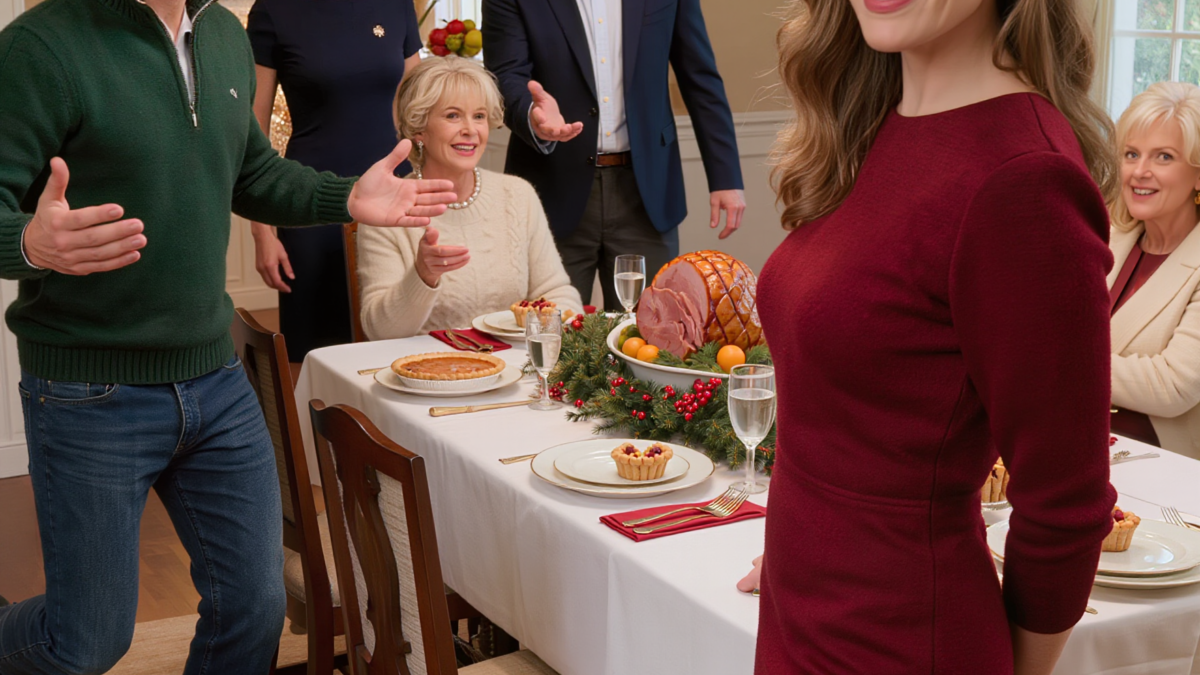
“Still single at thirty-seven?”
My brother called the question across my mother’s Christmas table as if he had been saving it all evening.
“No wonder you came alone.”
The laughter started before Cody finished speaking.
Aunt Patty slapped one palm against the tablecloth. Dale coughed into his coffee. Two cousins laughed because Patty was laughing, and their spouses joined in half a second later. Even Cody’s two-year-old laughed from the high chair because everyone around him was making noise.
Amber, my brother’s wife, did not.
Neither did the man sitting in my father’s old chair at the head of the table.
My mother laughed last.
She touched the sleeve of the man Cody had spent four hours calling sir and said, as if I were not sitting eight feet away, “Who would ever marry her?”
My name is Laurel Hartman.
I was thirty-seven years old, and for most of that Christmas Day I had been waiting for one decent moment to tell my family the truth.
I had planned to do it over pie.
Instead, I wrapped my fingers around my water glass, lifted it half an inch, and set it all the way down until the base touched the wooden table.
It was a habit I had inherited from my father. Roy Hartman never said anything important while holding something in his hand.
“Someone already did,” I said.
The laughter stopped.
“You all know him.”
For a moment, the only sound came from the kitchen radio playing a Christmas carol from a station in Omaha.
Then Graham Pierce folded his napkin, placed it beside his pie plate, and stood from my father’s chair.
He held one hand toward me.
“Ready, darling?”
Cody stood so fast that his chair tipped backward and struck the floor.
“Sir—let me explain.”
That was the part I remembered most clearly later.
Not Laurel.
Not I’m sorry.
Sir.
My brother had just made an entire table laugh at his sister, but his first fear was losing the approval of the man he believed was about to buy our family business and leave him in charge.
What Cody did not know was that Graham had already made one important decision about him.
What none of them knew was that another problem was waiting in the kitchen beneath my mother’s fruit bowl.
To understand how we reached that Christmas table, you have to understand the green sign on Norfolk Avenue.
HARTMAN IMPLEMENT had been painted across it since 1986.
My father had mixed the green himself.
He repainted it whenever the Nebraska wind and summer sun faded the letters, always using the same shade. After he died, nobody touched it because nobody knew the mixture.
Farmers from around Madison County knew the dealership. They knew Roy Hartman. They knew my younger brother Cody had stayed home and eventually taken over day-to-day operations.
They also knew which Hartman child had left.
That was me.
I drove south when I was twenty-two.
Veterinary school was part of the reason. The larger reason was simpler: I wanted to go.
In my family, saying that out loud had been the mistake.
By thirty-seven I ran a two-person large-animal veterinary practice outside Lincoln. My workdays started before sunrise. During calving season, I spent more time in barns and pickups than in my own kitchen.
My hands always smelled faintly of chlorhexidine no matter what soap I used.
My truck carried a winch, emergency gear, a calf puller, three pairs of gloves, and a battered coffee cup that had occupied the same holder since 2019.
At two in the morning, a rancher could call because a mare was down or a cow was struggling, and I would go.
I liked the honesty of the work.
An animal did not care whether I had disappointed my mother by leaving Norfolk.
A rancher did not call me to discuss family loyalty.
They paid me to tell them what I saw.
Sometimes the truth was good.
Sometimes it was not.
Either way, I gave it to them.
That was how I met Graham Pierce.
It happened two Octobers before the Christmas dinner.
I received a call about a mare outside Columbus, Nebraska, a place I had never visited before. When I arrived, a tall man in his forties was standing inside the barn with a flashlight in one hand and his phone in the other.
He wore an old canvas coat that had probably been expensive when it was new.
He showed me a medication recommendation on his screen.
“The veterinarian before you used this,” he said. “Worked in an hour.”
“It’ll look like it worked in an hour,” I told him. “That’s the problem.”
He waited.
“If she’s dealing with what I think she is, that medication could hide what we need to see. I’m not using it.”
He looked at me for several seconds.
Most wealthy owners reacted to the word no by asking how much money it would take to turn it into yes.
Graham simply lowered his phone.
“All right,” he said. “What do you need?”
I told him.
He brought it.
We spent nearly two hours walking the mare through the dark, his flashlight angled toward her feet while frost formed along the fence rails.
By dawn, she was standing square and reaching for hay.
I wrote the bill on the tailgate of my truck.
Graham did not even look at the amount.
“You’re paying me to tell you when you’re wrong,” I said.
He took the pen.
“Then I’m paying you to tell me I’m wrong.”
He signed the check in full.
The following week, his office asked me to take over veterinary care for the rest of his animals.
A client later mentioned Pierce Equipment.
That was how I discovered the quiet man in the canvas coat owned a regional farm-equipment company with eleven stores stretching across Nebraska and beyond.
He had never mentioned it.
We started seeing each other gradually.
Coffee after early calls became dinner. Dinner became weekends when neither of us was working. He learned when not to talk while I completed paperwork. I learned that he folded every piece of ham into neat squares before eating it, a habit I found strange until it became familiar.
We married quietly at the courthouse in Lincoln the following April.
Two witnesses.
A clerk magistrate with a cold.
A water glass on the table because I had asked for one.
When the magistrate reached my part, I lifted the glass and set it down against the wood before saying yes.
Graham noticed.
He did not ask why.
That was one of the reasons I married him.
In September, he came into my kitchen wearing his coat and said, “I’m talking to your brother about buying the dealership.”
I stopped cutting vegetables.
I had always known that possibility existed. Pierce Equipment was expanding. Hartman Implement was the sort of independent store they sometimes acquired.
Still, hearing Graham say it made the room feel smaller.
“Buy it or don’t,” I said. “That’s your business.”
He waited.
“My name stays out of your numbers.”
“All right.”
“I don’t want to become a line in anybody’s deal.”
He considered that carefully.
“Then mine doesn’t come home either.”
We agreed.
It was not secrecy so much as separation.
My marriage was mine.
The proposed acquisition was his.
I should explain why the dealership mattered so much.
Dad had spent most of his adult life building it.
When he died in October 2022, he left his half of the company to Cody.
The will described him as the child who stayed.
Those exact words.
Mom already owned the other half.
Cody became general manager.
I received nothing from the dealership and had not expected to.
Dad died in the parts bay between shelving stacked with filters and hydraulic hose.
Bev Sorenson, the bookkeeper, found him.
After the funeral, we ate lunch in the church basement. Egg salad sandwiches, coffee, sheet cake, the kind of meal that appears at Midwestern funerals because everyone knows exactly how to make it without being asked.
Mom stood beside me near the coffee urn.
Her hands were shaking.
Without looking at me, she said, “If she’d stayed, he would’ve had help.”
She directed the sentence toward Aunt Patty, but she made sure I heard it.
I refilled Mom’s coffee.
My hands did not shake.
For a long time, that felt like one of the strongest things I had ever done.
Cody put his arm around her afterward.
“Mom doesn’t mean it, Lore. It’s the day.”
Maybe she did.
Maybe grief had only loosened the door on something already there.
After that, the comments became ordinary.
At Thanksgiving the following year, Cody leaned back after dinner and said, “Laurel’s biological clock is louder than the oven timer. Somebody check whether she’s done.”
Patty shrieked with laughter.
Mom covered her mouth and said, “Oh, he’s teasing.”
I laughed too.
That was the part I disliked remembering.
I laughed because laughter bought you your chair at that table.
If you laughed, you were easygoing.
If you objected, you were difficult.
If you were difficult, then everyone could say you were the reason the room had become uncomfortable.
Across the table, Amber rose quietly, took my empty water glass, filled it at the sink, and returned it.
She did not laugh.
She did not defend me either.
She simply looked at the tablecloth.
I remembered that later.
In early November, about six weeks before the Christmas dinner, Graham called me while I was between farm visits.
“Your brother invited me to Christmas,” he said.
I stared through my windshield.
“He wants me to meet the family who built the store.”
“Let him.”
“Laurel.”
“We tell them at dessert.”
He was quiet.
“One time,” I continued. “Everybody together. I am not announcing our marriage in a parking lot after church where Aunt Patty can hear it from her Buick.”
“I won’t lie if someone asks me directly.”
“I know.”
“And if nobody asks?”
“We tell them over pie.”
That was the plan.
Nine days later, Bev Sorenson changed the shape of everything.
The envelope was on the counter when I returned to the clinic from a farm call.
Norfolk postmark.
My name written in Bev’s rounded, careful handwriting.
Bev had kept the dealership books since 1995. She still sent me a Christmas card every year with five dollars tucked inside, as if I remained nine years old.
But it was November.
Inside the envelope was a photocopy and a yellow note.
Your dad would want one of you to know.
Cody handles your mother’s mail.
—B
The photocopy was a mortgage.
Not Dad’s old business loan.
A second loan.
It had been recorded in June against the dealership building and lot.
The lender was based in Sioux City.
The amount was large.
There were two owner signatures.
Cody Hartman.
Donna Hartman.
A notary stamp appeared beneath them.
Travis Keel.
I had known Travis since childhood. He and Cody still met for drinks some Thursday evenings.
At first, I thought the problem was simply debt.
Maybe Cody had borrowed against the building without telling anyone.
That alone was serious.
Then I looked at Mom’s signature.
I went to my desk and opened the birthday card she had mailed me in August.
Happy birthday, Laurel.
Hope the cows are treating you well.
Love, Mom.
I laid it beneath the exam light next to the mortgage.
Mom’s handwriting was upright and slightly cramped.
Her capital D never fully closed at the top.
It had been like that on every card I could remember.
The D on the mortgage was sealed shut.
The pressure was wrong too.
Mom wrote lightly.
The mortgage signature had been pressed into the page.
I stared at the two versions until the examination light warmed the back of my neck.
Then I called Bev.
She answered on the second ring.
“Honey?”
“The second signature.”
Her breath changed.
“He brought it in already signed.”
“Cody?”
“Yes.”
“Did you see Mom sign it?”
“No.”
“Did Travis?”
“He notarized it.”
I closed my eyes.
“Has Mom been coming into the store?”
“Your mother hasn’t set foot in here since your father died. Cody brings her the mail. Cody brings checks home for her to sign.”
“And this loan?”
“It never came through my books.”
That was worse.
“Do you know what the money paid for?”
“No.”
“Does the buyer know?”
I deliberately did not say Graham’s name.
Bev hesitated.
“I asked Cody for the paperwork. He said the buyer has everything he needs.”
I sat in my truck afterward with the photocopy in my lap.
I had four choices.
Tell Graham and violate the one boundary we had established.
Warn Cody.
Tell Mom.
Or say nothing and let Graham’s due-diligence process discover whatever it was going to discover.
I picked up my phone twice to call Mom.
Twice I put it down.
Over the phone, that page would become Laurel’s theory.
Laurel’s suspicion.
Laurel being jealous of her brother again.
She needed to see the mortgage beside her own handwriting.
December was busy at the clinic, and the first day I could reasonably get another veterinarian to cover my calls was Christmas.
So I made my decision.
I would bring the page to Mom Christmas morning.
Before the meal.
Before Graham arrived.
Before we told anyone we were married.
Whatever Mom had done with my name over the years, the name on that mortgage was hers.
On Christmas Eve, Graham stood in our kitchen folding the good coat he wore to funerals and bank meetings.
Without looking at me, he asked, “Does your mother read what she signs?”
I became still.
“What?”
“The store. Family businesses get informal. I wondered.”
“She reads birthday cards.”
He gave me a brief look but did not push.
I could have told him everything right then.
The photocopy was locked in my truck less than a hundred feet away.
Instead, I held our boundary.
“My family stays out of your numbers.”
“And my numbers stay out of the house,” he said.
Christmas morning, I drove through Norfolk before sunrise.
Hartman Implement was closed.
The parking lot was empty.
Dad’s green sign looked gray in the winter light.
I could still see the places where his brush strokes had started thicker at the tops of letters.
Then I drove to Mom’s farmhouse.
She was in the kitchen slicing onions when I arrived.
“You came alone,” she said.
Her eyes went past my shoulder toward the driveway before she hugged me.
“It’s eight in the morning, Mom.”
“I thought maybe with the roads…”
She stopped.
“Come help with the ham.”
The kitchen was warm enough to fog the lower edge of the windows.
Her handwritten recipe cards were scattered near the stove.
I took the photocopy from my coat and placed it on the table beside the glaze recipe.
“Mom.”
She turned.
“This has your name on it.”
She looked briefly.
“Did you sign it?”
She turned back toward the onions.
“Your brother handles the store.”
“It’s a loan against the building.”
No answer.
“From June.”
She opened the oven.
I moved the recipe card closer to the photocopy.
“Look at the D.”
The knife stopped.
“Mom, look at your D and then look at the one on that mortgage.”
For several seconds, she remained facing the sink.
Then she said, “You’ve always been jealous of your brother.”
Before I could answer, the back door opened.
Amber came in carrying a diaper bag and their toddler.
“Merry Christmas. Sorry we’re—”
She stopped.
Her eyes went to the table.
Mortgage.
Recipe card.
Mom.
Me.
Amber crossed the kitchen and slid the photocopy beneath the fruit bowl.
“Before Cody sees it and makes it a thing,” she said softly.
Then she handed me a dish towel.
My hands were empty.
She had noticed.
“I didn’t laugh last year either,” she said.
“For what it’s worth.”
It was worth more than she probably knew.
Cody arrived minutes later.
He came through the mudroom wearing the boots Mom hated on her clean floor.
He lifted her in a hug.
“Big night, Ma. Don’t embarrass me in front of Pierce.”
Mom laughed.
“I never embarrass anybody.”
At five o’clock, Graham’s diesel pickup turned into the yard.
Cody’s head lifted instantly.
“That’s him.”
He was outside before Graham had removed the keys from the ignition.
Through the window, I watched my brother shake my husband’s hand with both of his.
There were fourteen places at the table.
Cody had arranged them himself.
Graham sat in Dad’s chair at the head.
Cody sat at his right hand.
Mom sat at his left.
I was placed near the far end between Amber and the high chair.
“Mr. Pierce, sir, you comfortable there?”
“Yes.”
“Beer? Wine?”
“Water is fine.”
“Water for Mr. Pierce.”
By the third sir, I started counting.
It gave me something to do.
During appetizers, Aunt Patty asked Graham if he had a family.
“I do,” he said.
He lifted his glass.
“I’m married.”
“Oh, how nice. Where’s—”
Cody interrupted.
“Tell them about the Kearney store, sir.”
And just like that, Graham’s sentence disappeared under the next conversation.
I watched my family hear my husband say he was married and never wonder who his wife might be.
Then Cody pointed his fork toward me.
“This is Laurel. She’s the one who left.”
“No offense, Lore.”
“None taken.”
He smiled at Graham.
“She’s very independent.”
Mom nodded.
“Very independent.”
She said it like a diagnosis.
Through dinner, Cody explained the dealership.
He talked about inventory, land, customers and his plans for the future.
Then he lowered his voice slightly.
“You’ll see when your people go through everything. Clean as a whistle. One loan. Dad’s old one. That’s the whole sheet.”
I stopped with a bite of ham in my mouth.
One loan.
Under the fruit bowl in the kitchen sat paperwork for another.
Then Cody said, almost casually, “I picked up a parcel out by the highway in June. Got plans for it after the deal. A man’s got to build something with his own name on it.”
June.
My fork touched the plate.
June.
The month of the second loan.
I looked at Graham.
He was cutting his ham into squares.
“Good to hear,” he said.
He never looked at me.
For the first time, I wondered whether he already knew.
The meal continued.
Cody told stories about me.
The old boyfriend from Wayne.
The time I left for school.
How I chose animals over people.
How Mom and Dad always wondered whether I would ever “settle down.”
I passed the potatoes.
I asked Patty about her knee.
I cut the toddler’s food when Amber needed both hands.
Under the tablecloth, Amber’s hand found my wrist.
She held it there for several seconds.
Then she let go.
Cody stood before dessert and tapped his bottle with a knife.
“I want to say something.”
He looked at Graham.
“This family has been through a lot. Dad built that store from nothing. I’ve been keeping it going since we lost him. So I want to raise a glass to Mr. Pierce, the man who’s going to keep Dad’s name on that sign.”
Everyone lifted a drink.
Graham raised his water about an inch.
“To Roy,” he said.
Two words.
The whole night, everyone else had called him Dad.
Graham was the first person to say my father’s name.
When Mom went for pie, Cody followed her into the kitchen.
The door swung twice.
I heard Mom say one word.
“Paper.”
When Cody returned, he did not sit completely back in his chair.
He watched me.
The pie arrived.
This was supposed to be our moment.
Graham looked down the table toward me.
His expression was calm.
Your call.
Aunt Patty started cutting her crust.
“So, Laurel. Is there someone? At your age, honey, you can’t be too picky.”
“Patty,” Mom said, but without conviction.
I placed my hand around my glass.
I began lowering it.
Cody saw.
Maybe he remembered Dad’s habit too.
Maybe he simply saw that his quiet sister was about to speak in front of the buyer he wanted to impress.
Whatever he saw, he rushed to get there first.
“Still single at thirty-seven?”
He grinned across the table.
“No wonder you came alone.”
The table erupted.
Then Mom laughed.
“Who would ever marry her?”
I set the glass down.
“Someone already did.”
Silence.
“You all know him.”
Graham folded his napkin.
He stood.
“Ready, darling?”
Cody’s chair hit the floor.
“Sir—let me explain.”
He came around the chair with both palms open.
“It’s just a family joke. Laurel knows that. Lore, tell him.”
I did not.
Graham did not respond either.
Cody’s words accelerated.
“She’s been at Mom all day too. Some paper she brought. She says I signed something. I don’t even know what she’s talking about. She’s always been strange about the store since Dad died.”
Graham finally turned.
Not toward Cody.
Toward Mom.
“Mrs. Hartman, did you sign a mortgage against Hartman Implement in June?”
Mom’s hand stopped.
Aunt Patty looked from him to Cody.
“What mortgage?”
“June?” Mom whispered.
“Not mine,” I said.
Graham nodded once.
“The title review found a second loan against the property. Before any acquisition can close, Mrs. Hartman needs to confirm whether she signed it.”
Mom looked at Cody.
Cody’s voice rose.
“Mom, tell him.”
She said nothing.
“Did you sign it?” Graham asked.
Mom still said nothing.
For once, nobody rescued the silence for her.
Graham picked up his coat.
“Until that is answered, there is nothing more to discuss about the sale.”
Amber caught my hand as I walked past.
She squeezed once.
Then Graham and I stepped outside.
The two pickups sat cold in the yard.
Through the dining-room window, Cody’s chair remained on its back.
I climbed into Graham’s truck.
The heater blew air colder than the December night.
“You knew,” I said.
He rested both hands on the steering wheel.
“The first week of December. The title search found the June mortgage.”
“Bev sent me a copy in November.”
He turned.
“The signature isn’t Mom’s.”
“I know.”
“The D is wrong.”
“I know that too.”
I stared at him.
“How?”
“Your mother sent me a Christmas card.”
Despite everything, I almost laughed.
He looked through the windshield.
“There’s another document.”
My stomach tightened.
“Cody’s seller disclosure. October. He was required to list everything owed against the business.”
“How many loans did he list?”
“One.”
“And he signed it?”
“Yes.”
Graham paused.
“That’s when I decided he wouldn’t stay after the acquisition.”
I leaned forward and rested my forehead against the dashboard for several seconds.
“So tonight changed nothing?”
“About that? No.”
“Then why did you come?”
“You planned to tell them over pie.”
He said it as if the answer were obvious.
“I came for that.”
We sat in silence.
Then Graham said, “He’ll come to you.”
“Who?”
“Cody.”
“Why me?”
“Because he thinks you can change my mind.”
He was right.
Three days later, I pulled into the clinic parking lot and found Cody leaning against his truck.
Frost covered the hood but not the windshield.
He had been there a while.
I switched off my engine and stepped out.
“Merry Christmas, I guess,” he said.
His usual salesman’s smile appeared halfway and disappeared.
“Kids are fine. Amber’s at her mother’s. She’ll come around.”
I said nothing.
“Pierce’s guy called me.”
He pushed his hands into his coat pockets, removed them, then put them back.
“Look, about Christmas. Patty gets going. Mom gets going. I said something. It got out of hand. You know how that table is.”
I waited.
He circled the subject like he did when negotiating equipment prices.
Finally, the real reason for the visit arrived.
“Tell him to change it.”
I looked at him.
“You’re his wife, Laurel. One word from you and this goes away.”
“No.”
“Just tell him Mom signed the paper.”
I stared at him.
He continued.
“She’ll back you.”
There it was.
“Tell Mom you looked again and were wrong. She’ll sign whatever she needs to sign if it comes from you.”
My hands were cold.
They were also completely steady.
Cody finally explained the land.
He had used the June loan to purchase a parcel near the highway.
He planned to sell it before the dealership transaction closed, pay the loan off, and replace the money without anyone finding out.
The buyer he expected had backed away.
Everything had collapsed from there.
“It was supposed to be fine,” he said.
Then, because Cody could never let an explanation remain an explanation, he turned it toward me.
“You’ve always needed to be right. You leave town, come back twice a year and look at everybody like you’d have done everything better.”
“Cody.”
“Lore, please.”
The word cracked in the cold air.
Please.
“The kids. The store. Dad’s name.”
He wiped one eye with the back of his hand.
That was when I understood what had bothered me beneath everything else.
Cody thought my marriage was leverage.
A husband was something I could pull.
He had spent Christmas flattering Graham because he believed Graham controlled the future of the dealership.
Then he mocked me in front of the same man because he believed I had no importance at all.
Now that he knew I was Graham’s wife, he assumed my value was access.
“The day Graham told me he was talking to you about the store,” I said, “I told him to keep my name out of his numbers.”
Cody stared at me.
“I meant it.”
“Lore—”
“I’m not putting my marriage into yours now.”
He stepped forward.
“And I am not telling Mom to lie for you.”
He looked away.
“Whatever she says has to be hers.”
I pointed toward his truck.
“You take it to her yourself.”
Then I unlocked the clinic, walked inside, and closed the door behind me.
My hands started shaking only after the lock turned.
My veterinary technician appeared from the office carrying two cups of coffee.
She gave me one without asking what had happened.
I held it until the shaking stopped.
Cody did take the problem to Mom.
But events had already moved beyond family conversations.
In early January, an attorney working on the property review requested financial records relating to the June mortgage.
The request went to Bev.
Bev sent exactly what they asked for.
Then she included one additional page.
A bank statement.
The loan money had arrived from the Sioux City lender on a Tuesday.
Three days later, most of it had left again.
Not to a dealership supplier.
Not toward Dad’s old loan.
Not into dealership operations.
It had gone to a land closing.
The parcel was on Keel Road near the highway.
The buyer listed on the deed was Cody Hartman personally.
Bev called me afterward.
“I sent what they asked for,” she said.
“And?”
“And one page they didn’t.”
I closed my eyes.
“They’ll know it was you.”
“Everybody in Norfolk will know it was me.”
She almost laughed.
“That’s why it had to be me.”
The next major decision belonged to Mom.
She met with an attorney in Norfolk.
Amber drove her because snow covered the roads.
Cody was asked to wait outside.
According to Amber, the attorney placed one page in front of Mom and explained the options plainly.
If the signature was Mom’s, then the debt was partly hers. The loan had helped purchase land owned by Cody personally, and her share of the dealership sale could be used to satisfy the debt.
If she refused to answer, the transaction could not move forward cleanly while the mortgage remained against the building.
If the signature was not hers, she needed to say so formally.
Mom stared at the paper.
Then she asked one question.
“And my daughter? Does she get anything from this?”
“No, ma’am,” the attorney said. “Laurel isn’t part of the transaction.”
A few days later, Mom signed a formal statement in front of a different notary.
Amber watched.
The D in Donna was open at the top.
Exactly as it had been on every birthday card.
Her real hand.
Her real name.
Her statement said the mortgage signature was not hers.
In the car afterward, Amber told me Mom placed her purse on her lap and looked through the windshield.
“I’m not paying for his land,” she said.
Nothing else.
I did not know whether she thought about me.
Eventually, I stopped needing to know.
Once she disputed the signature, the rest became paperwork rather than family debate.
The lender called the loan.
The Keel Road parcel went up for sale.
It sold in March for less than Cody had paid.
The remaining amount was taken from Cody’s side of the dealership proceeds when the eventual sale was completed.
Pierce Equipment bought Hartman Implement.
Graham offered the same terms he would have offered an unrelated seller.
He also kept the decision he had made before Christmas.
Cody did not remain with the company.
“Nobody who signed that disclosure keeps a key,” Graham said.
That was his entire explanation.
Travis Keel also faced consequences involving his notary commission after questions arose about a signature he had certified without watching the supposed signer execute it.
Bev called what followed “coffee talk on Norfolk Avenue.”
Everyone in town seemed to know some version of the story.
Amber moved to Wayne with the children.
She did not call me to announce that she was leaving Cody.
Instead, she sent me a photograph of the kids playing in the snow outside the two-bedroom apartment she had rented above a dentist’s office.
I mailed the children sheets of cartoon cow stickers from the clinic.
“They put them on the dentist’s window,” Amber texted.
Life kept moving.
That was the strange part.
Big family crises make you expect the world to change color.
It doesn’t.
Cows still calve.
Clients still call at two in the morning.
Coffee still burns if you forget it in the microwave.
My mother began calling.
The first voicemail was simple.
“It’s your mother. We should talk.”
I listened.
I did not return it.
Ten days later, another.
“Your brother isn’t doing well. I thought you’d want to know.”
Then one voicemail contained only four seconds of breathing before the call ended.
I did not block her number.
I did not call back either.
Both choices mattered to me.
She was allowed to reach me.
I was allowed not to answer.
In March, Pierce Equipment scheduled the replacement of Dad’s old sign.
Nobody told Mom the date.
She came anyway.
Bev saw her parked across Norfolk Avenue with the engine running.
Two workers raised a lift and unbolted the sign my father had painted in 1986.
The green letters descended slowly between them.
It took eleven minutes.
Bev timed it.
Of course she did.
“Your mother never got out of the car,” she told me later.
“Was she alone?”
“Yes.”
The sign went into the bed of a Pierce Equipment truck.
For decades, everyone in my family had spoken about Dad’s name as if paint could hold a family together.
Watching that sign come down probably felt like losing him again.
I was not there.
I was at the clinic working.
A few weeks later, Bev drove two hours to see me.
She arrived while I was fitting a splint onto a calf’s foreleg.
She sat on a stool in her winter coat and placed an old cardboard box beside her.
“Found something.”
Inside was a cloth-covered ledger.
1986 was written on the spine.
Dad’s first year under the sign.
“He wrote in pencil that year,” Bev said. “Used to say ink was for when things were real.”
I smiled around the strap I was holding between my teeth.
Outside the clinic window, Graham stood beside the bed of his truck.
There was something long and flat beneath a tarp, secured with straps.
He had not mentioned it.
Which meant I already knew.
My phone began vibrating on the chair near the door.
Mom.
I looked at the screen.
Then I turned it face down.
I did not silence it.
The calf shifted.
I pulled my glove higher over my wrist and returned my attention to the leg.
Bev opened the ledger.
Most of the pages contained numbers.
Parts.
Payroll.
Invoices.
On one page from March 1986, Dad had written something different.
A paint mixture.
One can chrome green.
Two spoons yellow.
One drop black.
Less than you think.
For years, everyone had said nobody knew how to recreate the color on the Hartman Implement sign.
Nobody had thought to look in the book.
Outside, Graham waited beside the tarped sign in the bed of his truck.
Inside, Dad’s recipe lay open under the clinic lights.
My phone remained face down, still able to ring.
And for the first time in years, I understood that leaving one family table had never meant abandoning where I came from.
It had only meant I was finally allowed to decide what I carried with me.
This story is a dramatized work of fiction created solely for storytelling and entertainment purposes. It is not presented as a factual report or news account. Any resemblance to actual people, places, organizations, or events is purely coincidental. Names, dialogue, locations, timelines, occupations, and identifying details have been invented, combined, or altered to protect privacy and support the narrative. Some accompanying images or visual elements may be AI-generated or digitally enhanced.