A senior officer blocked me from the command hallway, called me a trespasser, and picked up the phone to have me removed while several staff members watched. I said nothing. I had identification and orders in my bag, but I let him spell my name into the receiver. Then the voice on the other end interrupted him. He slowly lowered the phone—and before anyone could explain why, the installation’s senior enlisted leader reached the top of the stairs, saw my face, and snapped to attention.
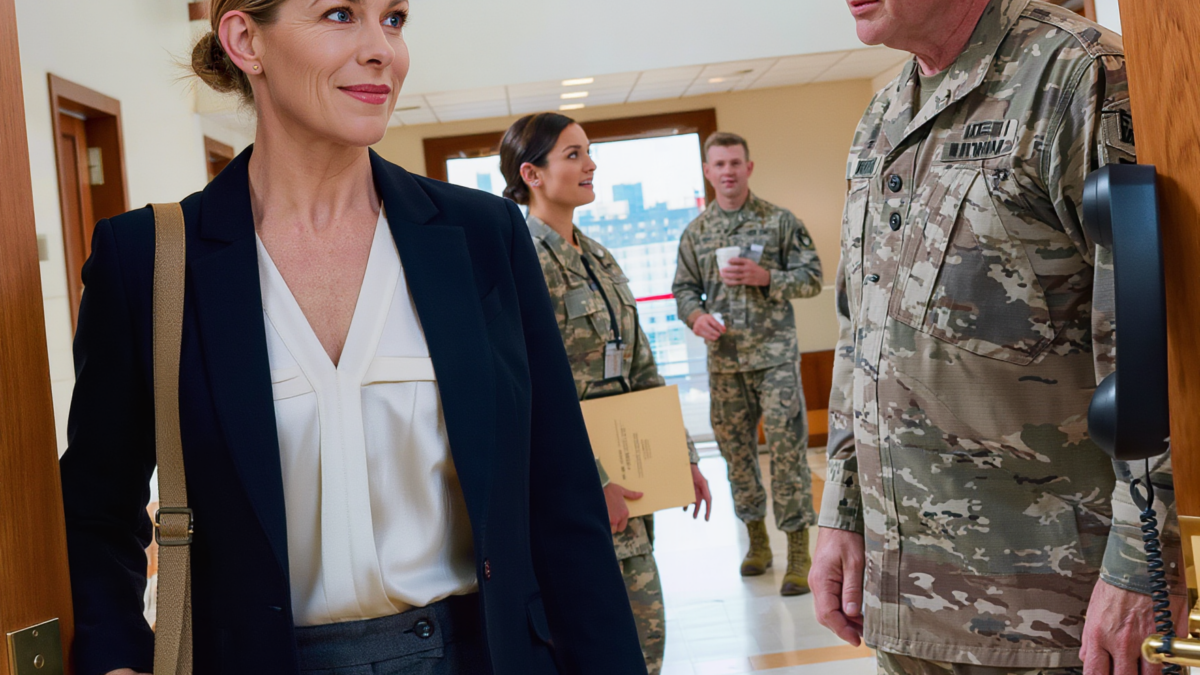
The man blocking the second-floor hallway had decided who I was before I finished climbing the stairs.
I had a canvas bag over one shoulder, a rental-car key in my pocket, and civilian clothes that gave him nothing useful to read. No visible rank. No aide. No driver. No entourage waiting below.
To Lieutenant Colonel Marcus Cronin, I was simply a woman standing where he believed she did not belong.
“Ma’am, this floor is restricted.”
He delivered the sentence with the practiced certainty of someone accustomed to having people obey before he needed to explain himself.
Behind him, a young captain stood holding a manila folder against her chest. Her eyes flicked toward me, then back to him.
I stopped a few feet from the command suite.
“I’m here to see the command office.”
“There’s nobody in the command office.”
Cronin tilted his head toward the staircase.
“There won’t be until the change of command. You need to turn around.”
I remained where I was.
His expression changed only slightly. Not anger. Something closer to impatience that had become personal because I had not moved when instructed.
“My name is Diana Merrick,” I said. “I’d still like to see the office.”
“I don’t care what your name is.”
He said it almost casually.
That was the part I remembered later.
If he had raised his voice immediately, the moment might have felt like temper. Instead, he spoke the way a man speaks when he believes the matter beneath him.
“This is a restricted headquarters floor. You are not authorized to be here. You can leave on your own, or I can have security escort you out.”
The captain shifted her weight.
Two staff officers had appeared in the doorway of the operations bay. Neither came closer. Both watched.
I had everything required to end the misunderstanding.
My military identification was in my wallet. A folded copy of my orders rested in an outside pocket of the canvas bag. Either one would have established within seconds that I was not lost, confused, or wandering through someone else’s workspace.
I did not reach for either.
Part of the reason was professional.
The truth does not always need to be pushed forward immediately. Sometimes the way people behave before they know the truth tells you more than the truth itself ever could.
Another part was personal.
I wanted to know how far he would take his certainty.
He showed me.
Cronin crossed to the administrative desk outside the command suite and picked up the phone.
He did not lower his voice.
“This is Lieutenant Colonel Cronin, acting garrison commander. I have a security problem on the command floor.”
The captain looked down at the folder.
Cronin looked directly at me.
“A woman is refusing to leave. No appointment. No visible identification.”
Technically correct.
Then he asked my name again.
“Diana Merrick.”
He repeated it into the receiver.
Then he spelled it.
Slowly.
M-E-R-R-I-C-K.
Something about hearing my own name turned into administrative evidence made the entire scene strangely distant.
I had spent twenty-three years learning how quickly institutions reduce people to lines on paper. Names. Dates. Ranks. Positions. Categories.
Useful most of the time.
Dangerous when someone thinks the category is the person.
Cronin continued speaking.
“Yes. Refusing to leave the command floor. I would like her removed.”
Then he went quiet.
He listened.
I watched his face because it was suddenly the most informative object in the hallway.
His mouth changed first.
The faintly satisfied set of it disappeared.
His eyes shifted back toward me.
Not over me.
At me.
“What?”
The captain lifted her gaze.
Cronin listened again.
“Say that again.”
Another pause.
He lowered the receiver slowly.
For the first time that morning, he seemed uncertain about what would happen next.
None of us knew yet that the phone call was only half of what was coming.
Two hours earlier, before Cronin had seen me, I had driven through the installation’s main gate under a gray morning sky.
I was not officially due for three days.
On the scheduled day, there would be a stage, folding chairs, printed programs, formal uniforms, families squinting into sunlight, and the ceremonial transfer of authority.
I had spent enough of my life around ceremonies to know both their value and their limitations.
A ceremony tells people what an institution believes about itself.
An ordinary morning tells you what the institution actually is.
I wanted the ordinary morning.
So I had flown in the previous evening using my own name, rented an unremarkable sedan at the airport, slept badly in a chain hotel beside the highway, and entered the installation at dawn without an aide or driver.
The guard at the gate checked my identification and temporary access documentation, handed everything back, and waved me through.
That was how I wanted it.
No one preparing.
No one cleaning up behavior because the incoming commander was watching.
I drove the loop road while most of the post was still waking.
Motor pools sat in shadow.
A formation moved along one shoulder, boots striking pavement in a steady rhythm.
The commissary parking lot was mostly empty. The chapel lights were off. Fast-food signs at the edge of the installation glowed against the dim morning.
Then I passed the airfield.
I slowed automatically.
Flight lines had always done that to me.
For years, aircraft had been less like machines and more like rooms in which the best and worst parts of my life had happened.
A flight line before sunrise still loosened something in my chest.
I parked where I was allowed, walked toward the edge of the area, and watched a medical evacuation crew perform a preflight.
Three figures moved around the aircraft with patient concentration.
One worked along the tail assembly with a flashlight.
Another checked equipment.
None rushed.
People who understand aviation know that speed in the air is purchased through care on the ground.
They did not know who I was.
That made what I was seeing useful.
Nobody becomes meticulous because a colonel is standing nearby if they do not know the colonel is there.
I watched until the sky lightened.
Then I returned to the sedan.
There was one place I needed to see before headquarters.
The memorial grove stood a short walk away, a curve of young oaks around a granite marker.
Every military community finds its own way to create such places.
Stone.
Bronze.
Trees.
Names.
Objects designed to stay still because memory does not.
Six weeks earlier, while reading the briefing packet for my upcoming command, I had seen a roster of people commemorated there.
One name had stopped me.
Chief Warrant Officer Elliot Sarno.
I read it four times.
Then I closed the file and opened it again later to make sure I had not imagined the connection.
I had known Elliot when we were both much younger.
I was thirty in the fall of 2011, a captain and medical evacuation pilot.
Elliot was twenty-eight and the best pilot I had ever shared a cockpit with.
He had an oversized laugh, photographs of his infant daughter tucked where regulations probably preferred they not be, and a talent for making dangerous moments psychologically smaller.
When everything around us became loud, Elliot became quieter.
He understood instinctively that panic often comes from letting the mind grow an event beyond the size of the next action.
Check the instrument.
Hold the heading.
Listen to the call.
Make the next correction.
One task at a time.
He used to make dry remarks over the intercom when a mission became tense.
Something about bad coffee.
Something about one of my landings.
Something intentionally ordinary.
The ordinary thing would pull my attention back toward the actual work.
I had used his method for fifteen years after his death.
I was using it in Cronin’s hallway without realizing it.
But before the hallway, there was the grove.
The grass was wet that morning.
Small flags left by visitors moved slightly in the breeze.
Someone had placed a note inside a clear plastic sleeve near the stone.
I did not read it.
Some words belong only to the person who left them and the person whose name they face.
I followed the names until I found his.
Chief Warrant Officer Elliot Sarno.
The letters were ordinary.
That was almost offensive.
Fifteen years of memory reduced to a name cut cleanly into granite.
I stood there longer than intended.
The last time I had been beside Elliot, we were flying a medical evacuation mission during a difficult deployment.
A unit on the ground had taken heavy losses.
Requests for evacuation came quickly.
Our job was simple in description and complicated in every practical sense.
If someone needed medical evacuation, we went.
Weather, terrain, darkness, pressure—the details changed.
The promise did not.
If you need us, we come.
That night, Elliot and I flew into a difficult landing zone.
The aircraft came under hostile fire during the approach and again while patients were being loaded.
I do not revisit the visual details.
Memory has preserved enough without assistance.
What I remember most clearly is the ground medic.
I never saw his face well.
He moved people toward our aircraft with controlled urgency, returning again and again until everyone who could be moved had been loaded.
He worked as though fear were a private matter he intended to address later.
Elliot and I held the aircraft where it needed to be.
Then, during departure, the cockpit was hit.
Elliot was critically struck.
He did not survive.
I flew the aircraft home.
Most of the people we carried survived.
That mattered.
For years I forced myself to make it matter.
The Army later awarded me a Silver Star for my actions that night.
I accepted it because refusing would have turned a collective event into a personal gesture, and I did not want that.
But I never became comfortable with the medal.
It was connected to the worst night of my career.
Every time someone treated it as proof of courage, some part of me remembered the empty seat beside me.
I never learned the ground medic’s name.
Wars scatter people.
Units rotate.
Paperwork moves through systems nobody has time to reconcile completely.
The medic became a figure in memory.
Elliot became a folded flag, a notification, a set of photographs, occasional contact with people who had known him, and eventually a name on a memorial I did not discover until fifteen years later.
Standing in that grove before sunrise, I had thought I was finally giving grief an address.
Then I left the stone and walked toward headquarters.
I expected an empty office.
Instead, I met Marcus Cronin.
To be fair, stopping an unknown person on a restricted command floor was part of his responsibility.
I have always believed that distinction mattered.
The problem was not that he stopped me.
The problem was that he never actually investigated.
He categorized.
Then he enjoyed enforcing the category.
There is a difference between a leader doing his duty and a leader enjoying his authority.
For a few seconds, they can look identical.
After that, the difference becomes visible in the questions they ask.
Cronin asked almost none.
By the time he called security, he knew my name and little else.
That was why I let him continue.
A rude encounter was small compared with things I had survived.
Elliot had taught me how to reduce loud moments to manageable scale.
So while Cronin spelled my name into a phone as if creating a case file, some quiet part of my mind kept saying: small problem, steady hands.
Then the person on the other end recognized the name.
Cronin lowered the phone.
Footsteps sounded on the stairs.
They were unhurried.
A command sergeant major emerged onto the landing, speaking over his shoulder to someone below.
He was broad through the shoulders, close to fifty, with gray at his temples and the posture of someone who had worn authority long enough not to display it unnecessarily.
Command Sergeant Major Acriman.
The installation’s senior enlisted leader.
He turned.
Saw me.
Stopped.
I had witnessed recognition before, but rarely like that.
His eyes fixed on my face and remained there as though the hallway had disappeared.
Then his body moved before the rest of him seemed ready.
He came to attention.
Full attention.
Heels aligned.
Hands placed correctly.
Chin level.
Not a casual straightening.
Not courtesy.
Something deeper.
Every person in the hallway noticed.
Cronin stared at him.
“Sergeant Major?”
Acriman did not move.
Captain Elise Tran—though I did not yet know her name—lowered her folder slightly.
One of the staff officers stepped farther from the operations doorway.
Cronin tried again.
“What are you doing standing at attention?”
Acriman answered without looking away from me.
“For the colonel, sir.”
The word entered the hallway like new gravity.
Colonel.
I watched understanding reach different people at different speeds.
Captain Tran recalculated first.
Her eyes moved from me to Cronin, then to the telephone.
She took one small step sideways and back, increasing the space between herself and him.
It was not dramatic.
That made it revealing.
The two staff officers became very still.
Cronin’s confidence did not disappear completely.
People at the center of collapsing assumptions are often the last to release them.
“There’s been a misunderstanding.”
“Yes, sir,” Acriman said.
“There has.”
I crossed to the desk.
“May I?”
Cronin stepped away from the phone.
I picked up the receiver.
“This is Colonel Merrick.”
“Diana.”
Lieutenant General Warren Thorp’s voice was controlled and quiet.
He was the senior commander responsible for the installation and the officer who had personally selected me for command.
Months earlier, I had sat across from him during the selection process.
He asked difficult questions without turning the interview into theater.
At the end, he explained why he wanted me for the assignment.
Not because of medals.
Not because of flying.
Because he believed I understood that leadership was most truthful when no one thought the leader was watching.
He had his own habit of appearing unexpectedly in operations centers.
His staff disliked the unpredictability.
His subordinate commanders valued the fact that he saw their organizations outside formal briefings.
That morning, by coincidence or luck, Thorp had been standing in his operations center with coffee when Cronin’s report moved up the chain.
A woman named Diana Merrick was refusing to leave the command floor of the installation she had already been selected to command.
“Tell me where you are,” Thorp said, “and who is standing with you.”
I told him.
There was a pause.
“The acting commander with you is Lieutenant Colonel Cronin.”
“Yes, sir.”
“The same Lieutenant Colonel Cronin who just called my operations center asking to have my incoming installation commander removed as a trespasser.”
“Yes, sir.”
Another pause.
“I can have him relieved today.”
Cronin could not hear every word, but he could read enough from my side of the conversation.
His shoulders tightened.
Thorp continued.
“And before you answer, understand what bothers me most. He was not discourteous because he knew you were a colonel. He was discourteous because he believed you were not important.”
I looked at Cronin.
Thorp was right.
That was the actual problem.
A person who suddenly becomes respectful when rank appears has not discovered respect.
They have discovered consequences.
“I’d like to handle it myself,” I said.
Silence.
Then Thorp’s voice softened almost imperceptibly.
“You would?”
“Yes, sir.”
“All right.”
Another pause.
“It’s your installation in three days anyway. Apparently, today is beginning early.”
I almost smiled.
Almost.
Then his voice changed.
“Acriman is there, isn’t he?”
I turned toward the command sergeant major.
He was still at attention.
“Yes, sir.”
“I thought he might be.”
There was something beneath Thorp’s words.
Knowledge.
“Ask him about the fall of 2011 when you get a minute.”
My chest tightened.
Acriman’s eyes changed.
“What does he know?” I asked.
“I’m going to let him tell you.”
Then Thorp returned immediately to business.
“Put me on speaker.”
I pressed the speaker button.
The small click sounded unnaturally loud.
“This is Lieutenant General Warren Thorp.”
Cronin straightened automatically.
The staff officers did too.
Thorp’s voice filled the hallway.
“The woman standing there is Colonel Diana Merrick. In three days, she assumes command of this installation.”
No one moved.
“I selected her personally. She arrived early and alone because she wanted to observe the installation before anyone knew she was observing it.”
Cronin stared straight ahead.
“She was stopped on a restricted floor. That part is not the issue. The issue is what happened next.”
Thorp allowed the silence to work.
“An officer decided, with very little information, that another person was not worth basic courtesy. He reached for removal before reaching for a question.”
Captain Tran looked at Cronin.
Thorp continued.
“I want everyone within hearing distance to remember this: a leader’s character is often easiest to see in how that leader treats someone believed to have no power.”
Cronin closed his eyes briefly, then opened them.
“Colonel Merrick has asked to handle the matter herself. She will.”
The line went quiet.
The hallway remained still for several seconds.
Then Acriman spoke.
“In the fall of 2011, ma’am, I was a medic.”
I turned.
He was no longer speaking like the installation’s senior enlisted leader.
He was speaking like someone who had spent years holding a memory alone.
“There was a night when several people needed evacuation. Conditions were bad.”
I knew before he finished.
The position of his shoulders.
The restraint in his voice.
The year.
Everything aligned.
“A medical aircraft came in,” he said. “I loaded the patients.”
My fingers went cold.
Acriman looked directly at me.
“The crew held long enough for us to get everyone aboard.”
He paused.
“I recognized your face when I came up those stairs. I didn’t know your rank. I didn’t know you were coming here. I knew your face.”
For fifteen years I had remembered him as a moving silhouette.
Now the silhouette had a name.
A career.
Gray hair.
A life that had continued on the other side of the mission.
“It was you,” he said.
I had handled Cronin’s confrontation without any difficulty.
That sentence nearly undid me.
Acriman had been the medic on the ground.
The man I had never identified.
He had been carrying the same night.
The room had changed again.
The first change had been about rank.
This one had nothing to do with rank.
Cronin looked between us and seemed to understand that the mistake he made that morning had accidentally opened a door into history none of us expected to walk through.
He spoke carefully.
“Colonel.”
I looked at him.
“There is no excuse for how I handled this.”
That was the first thing he said all morning that earned my respect.
Not because it repaired anything.
Because he did not decorate the mistake.
No explanation about procedures.
No claim that he had only been doing his job.
No attempt to convert arrogance into caution.
“No,” I said. “There isn’t.”
The staff waited.
Everyone expected the same next step.
Immediate removal.
Public humiliation.
A satisfying reversal.
I could feel their anticipation.
The emotional logic of the moment invited punishment.
Cronin had decided I was small.
Now everyone knew I was not.
The simple story would have been to make him small in return.
But I had learned enough over the years to distrust simple stories.
“Let’s be precise,” I said.
Cronin remained standing.
“You did not fail because you couldn’t recognize rank hidden under civilian clothing. Nobody is required to recognize what is not visible.”
I glanced toward the phone.
“You failed because you decided the person standing in front of you was beneath your courtesy.”
He said nothing.
“You reached for removal before you reached for information.”
Captain Tran looked down.
I continued.
“That is the behavior I am holding you accountable for.”
“You’re right.”
“I know.”
The answer surprised him.
Possibly everyone.
“The question I cannot answer from one morning is what kind of officer you are the other three hundred sixty-four days of the year.”
Cronin lifted his eyes.
“General Thorp offered to relieve you.”
His jaw tightened.
“I told him no.”
For the first time, Cronin looked genuinely confused.
“May I ask why?”
“Because removing you would be easy.”
The hallway remained silent.
“It would allow me to feel decisive. It would give the staff a dramatic story. And it would allow you to spend the rest of your career telling yourself you were destroyed because of bad luck—because the woman you challenged happened to outrank you.”
I shook my head.
“That would let you avoid the actual lesson.”
His eyes stayed on mine.
“I need to know whether this is a habit you can correct.”
The formal consequences came later that afternoon.
Once the office officially opened to me and I had the authority to use it, I called Cronin in privately.
I documented the incident in writing.
The counseling was direct.
It described the behavior accurately and without emotional embellishment.
The concern was not failure to identify an incoming commander.
It was his treatment of someone he presumed had little standing.
I placed the paper in front of him.
“Read it.”
He read every line.
When he finished, he signed.
I did not soften the meeting by offering reassurance.
Accountability loses meaning when the person delivering it immediately starts rescuing the recipient from discomfort.
Only after the document was complete did I tell him the second part.
“I read your record before coming here.”
He looked up.
“That is what incoming commanders do.”
His professional record was strong.
The installation had gone through a leadership gap, and Cronin had kept it functioning.
Readiness had remained steady.
Maintenance problems existed but were documented.
Administrative systems worked.
His reputation suggested he drove people hard.
That aligned with what I had seen.
But competence was real.
I was not willing to pretend otherwise because I disliked him.
“You have a correctable problem,” I told him. “You decide too quickly who deserves your full attention.”
He listened.
“I am going to watch that problem specifically.”
I tapped the counseling statement.
“If you correct it, you have a future here. If you do not, this document becomes the first page of a longer record.”
He sat quietly.
Then he asked, “Why bother?”
“What?”
“You have every reason not to.”
I leaned back.
“Because I cannot demand disciplined judgment from this organization and then abandon disciplined judgment the first time I’m personally offended.”
He absorbed that.
“If I remove every capable officer the first time I see an ugly habit, I will spend my command removing people instead of leading them.”
I paused.
“Do not mistake that for forgiveness.”
“I won’t.”
“It is an opportunity. Opportunities have limits.”
“Yes, ma’am.”
He stood.
Then he came to attention.
This time, the gesture meant something different.
In the hallway, every movement he made had been built around authority.
Now the posture looked chosen rather than automatic.
“Thank you, Colonel.”
“You do not owe me thanks.”
He hesitated.
“Understood.”
After he left, I sat alone in the office I had wanted to see before anyone knew it belonged to me.
For several minutes I did nothing.
Then I opened the readiness reports.
Command is mostly unglamorous.
Budgets.
Maintenance.
Personnel.
Housing.
Training schedules.
Investigations.
Meetings about problems that never become stories.
By late afternoon I had read enough to confirm my earlier conclusion.
Cronin was a capable administrator with a damaging interpersonal habit.
If he had been cruel and incompetent, I would have removed him.
Keeping him would then have required others to pay for my experiment in patience.
That would not have been leadership.
But a capable person with a specific correctable failure can be worth the trouble of correction.
The arithmetic is not romantic.
Most real leadership is not.
Just before five, Captain Elise Tran knocked on the open door.
She had spent most of the day moving in and out with schedules, reports, and access lists.
Now she lingered.
“For what it’s worth, ma’am…”
I waited.
“I’ve wanted someone to challenge Colonel Cronin’s behavior for a while.”
She looked briefly toward the hallway.
“I just didn’t expect the part where you kept him.”
“The challenging is easy.”
She looked back.
“Anyone angry enough can confront somebody.”
I closed the folder in front of me.
“The harder job is deciding what to do with them afterward.”
Tran considered that.
Then she nodded.
Not the polite nod subordinate officers give senior ones.
The slower kind that means an idea has entered and will remain.
“Good night, Colonel.”
“Good night, Captain.”
The cost of the day reached me later.
Not in the hallway.
Not during the phone call.
Not while correcting Cronin.
It came at the memorial grove.
The light was fading when I returned.
Acriman was already there.
He wore a plain jacket instead of his uniform and stood in front of Elliot’s name with his hands loosely folded.
He did not turn when I approached.
I stopped beside him.
For a while we said nothing.
Finally he nodded toward the stone.
“His last unit was connected to this post. That’s why his name is here.”
I looked at the letters again.
“His widow lives nearby,” Acriman continued. “She comes on his birthday.”
A small smile appeared and disappeared.
“I come more often.”
“I saw his name in my briefing packet.”
“I figured.”
“I read the roster four times.”
Acriman looked toward me.
“That’s why you came early.”
“Partly.”
“For the post?”
“For him.”
The wind moved through the young oaks.
“I’ve carried him for fifteen years,” I said. “I never had anywhere to put the memory.”
Acriman faced the stone again.
Then he began telling me things I had never known.
The patients from that mission were not anonymous to him.
He knew names.
He knew who recovered.
He knew who went home.
One had become a high school teacher and coached track.
Another had built a family with three daughters.
One sent Acriman a card every Thanksgiving, the same family photographed year after year on a porch as the children grew taller.
Acriman gave me the mission from the ground.
I had spent fifteen years remembering the cost.
He gave me the receipt.
People had lived.
Lives had continued.
Children had been born.
Careers had changed.
Families had grown.
The mission had not merely taken Elliot from us.
It had also returned other people to the lives waiting for them.
For years I had understood that intellectually.
Standing beside Acriman made me understand it physically.
“I never knew,” I said.
“I figured you didn’t.”
“The promise cost him everything.”
Acriman nodded.
“It did.”
I stared at the stone.
For most of my adult life, the central promise of medical evacuation had lived inside me.
If someone needed us, we came.
That night, keeping the promise had cost Elliot his life.
I had never resolved the arithmetic.
Acriman had apparently spent years doing the same calculation.
“It was worth it,” he said.
He spoke quietly.
Not dramatically.
Like someone who had argued the case privately many times.
“I’ve had fifteen years to be angry about it too.”
He looked at me.
“Some of those people are grandparents now.”
My throat tightened.
“You kept the promise,” he said. “He kept it. It cost what it cost, and it saved what it saved. We don’t get to keep one side of the equation and erase the other.”
I almost lost my composure.
Not in the hallway when Cronin called security.
Not when Thorp offered to remove him.
Not when an entire staff discovered who I was.
Here.
Beside a name.
Because this was the thing large enough to matter.
Acriman saw the change in me and turned his attention back to the granite.
He gave me privacy without leaving.
It may have been the kindest thing anyone did for me that week.
Three days later, I took command on schedule.
The stage was exactly the kind of stage I had imagined.
Folding chairs.
A band.
Families.
Formal uniforms.
Sunlight strong enough to make people narrow their eyes.
Cronin stood with the staff.
When the colors passed and the ceremony moved through its familiar rhythm, his salute was correct.
Something in his expression had changed.
I chose to believe that change provisionally.
Leadership becomes hypocritical very quickly if you announce that people can change and then spend every day assuming they will not.
Over the next several weeks, I watched him.
Transformation was not dramatic.
It rarely is.
Mostly, it looked like interruption.
Cronin interrupting a young specialist during a maintenance briefing, then catching himself.
“Finish your point.”
The specialist did.
Cronin listened.
Another meeting, he began dismissing a civilian employee’s concern as something that could be handled later.
Then he stopped.
“What am I missing?”
She explained.
He adjusted the decision.
Clumsy.
Visible.
Real.
Habits do not disappear because one hallway becomes memorable.
They disappear through repeated moments when a person recognizes the old impulse before it controls the next action.
Cronin did that often enough for me to notice.
Months later, I told him once.
Briefly.
No ceremony.
“You’re doing better.”
He looked uncomfortable.
“Thank you.”
“Don’t make it a moment.”
“Yes, ma’am.”
We moved on.
Acriman became what good command sergeants major often become to commanders: the person one step away who can see parts of an organization the commander cannot see from the chair.
He never allowed our connection to the old mission to interfere with professional disagreement.
Sometimes he told me I was wrong.
Occasionally he was right.
More often than I enjoyed.
That is useful.
On the morning of the change-of-command ceremony, he had stood one pace behind and slightly to my side.
The traditional position.
The practical meaning was simple.
I am with this commander.
When I addressed the formation, I kept the speech short.
Most people forget long speeches almost immediately.
I told them I had arrived three days early.
Most already knew what had happened.
Stories move quickly through closed communities.
I did not tell them to remember the humiliation of an officer who misjudged his incoming commander.
I asked them to remember a question.
“How do you treat the person you are certain can do nothing for you?”
That was all.
Not the person who can promote you.
Not the person whose rank you recognize.
Not the person whose favor you need.
The person you believe has no leverage over your life.
I told them I would watch how they answered that question.
And that they should watch how I answered it too.
Then I told them I was proud to be their commander.
I was.
The post became mine officially that morning.
But in my mind, the transfer had already happened in a second-floor hallway.
Not because Cronin had been embarrassed.
Because I had been given my first opportunity to establish what kind of authority I intended to practice.
He had handed me the test accidentally.
I had almost certainly needed it.
Grief changed too.
That was the unexpected part.
For fifteen years, Elliot had existed everywhere and nowhere.
A cockpit.
A photograph.
A name on paper.
A memory that arrived unexpectedly when a pilot made a dry joke or a crew worked through a preflight exactly right.
Now he had a place.
A grove of young oaks a short walk from headquarters.
Acriman went there.
Elliot’s widow went there on his birthday.
I began going there too.
A person does not put down someone like Elliot.
That language is too clean.
But memory becomes easier to carry when it has somewhere to stand.
I sometimes thought about the absurd chain of events that brought me to the grove early.
If Cronin had been polite, perhaps I would have visited briefly that morning and moved on.
Perhaps the day would have become ordinary.
Perhaps Acriman and I would have met during the formal command process and never recognized the connection in quite the same way.
Instead, Cronin’s certainty created a phone call.
The phone call froze a hallway.
The frozen hallway made Acriman’s recognition impossible to miss.
And the recognition opened a door I had failed to open for fifteen years.
I never thanked Cronin for that.
Some debts would become insulting if spoken aloud.
I suspect he understood anyway.
Years of service had taught me that people are constantly being misjudged in hallways of one kind or another.
Offices.
Hospitals.
Family kitchens.
Hotel lobbies.
Bank counters.
Classrooms.
Places where one person decides another person’s size before asking enough questions to know it.
The temptation when the truth finally arrives is powerful.
You can erase the offense so everyone becomes comfortable again.
Or you can enjoy watching the person who diminished you become small.
Both options are emotionally easy.
The harder option is precision.
Name the wrong accurately.
Hold the person accountable for exactly that wrong.
Then decide what they are worth going forward based on evidence rather than adrenaline.
That is what I tried to do with Marcus Cronin.
Not mercy disguised as virtue.
Not retaliation disguised as justice.
Assessment.
Boundary.
Consequence.
Opportunity.
Then observation.
He changed enough to justify the decision.
Had he not, I would have made another one.
The canvas bag I carried that first morning stayed in my office closet for the rest of my command.
My original orders remained folded in one pocket longer than they needed to.
Once, months later, Captain Tran saw the bag while helping move equipment before a renovation.
“Is that the bag?”
I looked up.
“What bag?”
She smiled.
“The bag.”
I understood.
“Yes.”
“The orders were actually inside it?”
“They were.”
“And you really could have shown Colonel Cronin?”
“At any point.”
She shook her head.
“I don’t know how you stood there.”
I thought about Elliot.
About the intercom.
About bad coffee and steady hands.
“Yes,” I said. “You do.”
She frowned.
I nodded toward the hallway.
“You just haven’t met the moment that teaches you yet.”
Years before, Elliot Sarno taught me how to keep a problem the size of the next control input.
Years later, Marcus Cronin gave me a hallway in which to practice it.
And Command Sergeant Major Acriman gave me the answer to a question much larger than either of them.
The mission had cost what it cost.
It had also saved what it saved.
For fifteen years, I had remembered only one side of that equation.
Now, when I walked through the memorial grove and stopped beneath the oaks, I could remember the rest.
Elliot’s name was still carved into stone.
Nothing changed that.
Nothing should.
But around the name were lives that continued because he and I had kept a promise together.
That knowledge did not remove grief.
It gave grief context.
Sometimes that is the most healing truth available.
And sometimes the person standing in front of you, the one you have already decided is too small to matter, carries an entire history you cannot see.
Cronin learned that in a hallway.
I learned something there too.
Being unseen hurts.
But being finally seen is not always the greatest reversal.
Sometimes the greater gift is discovering that someone you thought had disappeared into the worst night of your life has been carrying the same night beside you all along.
This story is a dramatized work of fiction created solely for storytelling and entertainment purposes. It is not presented as a factual report or news account. Any resemblance to actual people, places, organizations, or events is purely coincidental. Names, dialogue, locations, timelines, occupations, and identifying details have been invented, combined, or altered to protect privacy and support the narrative. Some accompanying images or visual elements may be AI-generated or digitally enhanced.